Home Blog Page 4995

RCBC to expand products, services for SMEs as it banks on sector for growth

PHILSTAR FILE PHOTO

RIZAL COMMERCIAL Banking Corp. (RCBC) is looking to tap small- and medium-sized enterprises (SMEs) for growth and plans to use technology to expand its products and services for the sector.

“We really like the way SMEs are moving. We think SMEs are coming out of the pandemic very strongly, and therefore, we do want to throw a lot of resources and energy behind growing our business with the SME sector,” RCBC Executive Vice- President and Global Transaction Banking Group Head Emmanuel T. Narciso said in an interview with BusinessWorld.

Mr. Narciso said RCBC is investing in technology to boost its services for the SME segment.

“We’re really looking at how we can leverage digital, which was, in the past, more in the realm of the large corporate and the retail side. We’re looking at how we can leverage that on the SME side to deliver better products and to be more efficient in terms of how we deliver those products for them,” he said.

“On the SME side… that’s where we want to throw the digital energy, so to speak,” Mr. Narciso said, adding they plan to launch products and services for the sector within the year.

The official said the bank’s ongoing initiatives are seen to help continue its growth momentum.

“We have a lot of capital coming in from SMBC (Sumitomo Mitsui Banking Corp.), the Japanese bank, which is the 12th largest bank in the world. So, you put all that together, we’re very well positioned to be able to use that capital to boost the income of the bank even more,” Mr. Narciso said.

“We’re all hoping that the economy picks up… As you know the biggest income of a bank comes from net interest income. So, we have deposits, we’ve been growing deposits very well. But if we don’t lend that out, the net interest income doesn’t grow as fast. So, we’re really hoping that the economy puts us in a position where all the capital and all the deposits which we’re growing, we’re able to deploy that into earning assets,” he added.

SMBC in November hiked its stake in RCBC to 20% from 5%, infusing P27.1 billion in fresh capital into the local bank.

RCBC’s attributable net income increased by 71% to P12.1 billion in 2022 from P7.1 billion in the year prior on the back of improved performance across its core businesses.

This translated to a return on equity of 11.2% and a return on assets of 1.2%.

The bank had a consolidated network of 462 branches, 1,352 automated teller machines (ATM), and 1,559 ATM Go terminals nationwide at end-2022.

RCBC’s shares closed at P23.95 each on April 5, up by P1.08 or by 4.72% from the previous day. — A.M.C. Sy

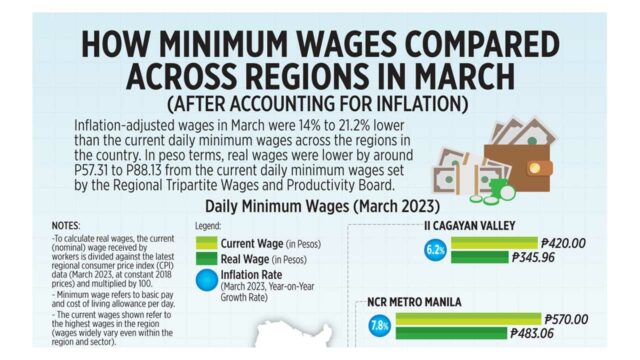
How minimum wages compared across regions in March

Inflation-adjusted wages in March were 14% to 21.2% lower than the current daily minimum wages across the regions in the country. In peso terms, real wages were lower by around P57.31 to P88.13 from the current daily minimum wages set by the Regional Tripartite Wages and Productivity Board.

How minimum wages compared across regions in March

Shares to move sideways as market waits for leads

BW FILE PHOTO

PHILIPPINE SHARES are expected to move sideways this week as trading resumes after an extended break ahead of key economic data.

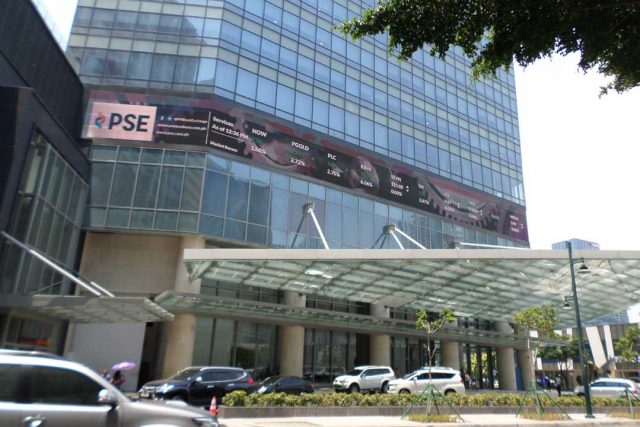
The bellwether Philippine Stock Exchange index (PSEi) rose by 16.47 points or 0.25% to close at 6,488.51 on Wednesday, while the broader all shares index went up by 4.78 points or 0.13% to end at 3,486.74.

Week on week, however, the PSEi decreased by 11.17 points or 0.17% from its close of 6,499.68 on March 31.

Philippine financial markets were closed from April 6-10 due to nonworking days in observance of Holy Week and to commemorate the Day of Valor.

The PSEi declined last week as investors opted to pocket their gains and reset and recalibrate strategies for this quarter “amid [macroeconomic] uncertainties,” online brokerage 2TradeAsia.com said in a report.

For this week, investors may continue to stay on the sidelines ahead of key data releases and with the market’s focus shifting to the next meetings of the Bangko Sentral ng Pilipinas (BSP) and US Federal Reserve, 2TradeAsia.com said.

At home, the Philippine Statistics Authority is set to release February trade, manufacturing and labor data this week.

In the United States, the March consumer price index report will be released on April 12, while March producer price index data will come out on April 13.

“First quarter GDP (gross domestic product) data will not be available until May 11 — this will be about a week after the next Fed meeting (May 2-3) and just after the BSP’s board meeting (May 18). Earnings results for the first quarter of 2023 will be around this time as well,” it said.

“The relative monotone in April and crucial macro movements in May will likely pressure prudent funds to withhold deployments… until the broader picture becomes more conductive for bolder plays. Speculations and corporate-specific stories might take the spotlight until then,” the online brokerage added.

The Fed last month raised interest rates by 25 basis points (bps) to the 4.75%-5% range.

It has hiked rates by 475 bps since March 2022.

Meanwhile, the BSP last month increased borrowing costs by 25 bps as inflation remains elevated, bringing its key rate to 6.25%.

Since May 2022, the central bank has raised rates by 425 bps.

Trading volume could improve this week “as investors may be more comfortable entering into new positions after the long weekend,” China Bank Securities Corp. Research Director Rastine Mackie D. Mercado said in an e-mail.

Value turnover was at P11.46 billion with 5.24 billion shares changing hands on Wednesday, lower than the previous week’s value turnover of P32.18 billion with 4.80 billion issues traded.

Mr. Mercado placed the PSEi’s support at 6,400 to 6,420 and resistance at 6,600-6,640, while 2TradeAsia.com puts immediate support at 6,400 and resistance at 6,650-6,750. — A.H. Halili

Tourism industry aims to fill vacancies through job fairs, workshops

Commuters wait for public transportation along Ortigas Extension in Cainta, Rizal, Sept. 14, 2022. — PHILIPPINE STAR/ WALTER BOLLOZOS

THE HOSPITALITY industry will hold job fairs and workshops nationwide throughout the year to address labor shortages that have affected the tourism industry since the pandemic’s onset, the Tourism department said. 

The Department of Tourism (DoT) said that its national tourism job fair “Trabaho, Turismo, Asenso” will continue on its third leg on May 11, in partnership with the Department of Labor and Employment (DoLE).

“For the tourism industry to become an engine of employment generation, the DoT will continue to empower our tourism workforce by giving them access to jobs that will match their skills,” said Tourism Secretary Christina G. Frasco in a statement on Wednesday.

“Its multiplier effect across various sectors can support job creation, which is exactly what we wish to achieve as we eye to exceed our targets for this year,” she said.

The job fairs held in its second phase in Central Luzon, Western Visayas, and Northern Mindanao offered over 8,185 jobs, the DoT said. They took place in Robinsons Starmalls in San Fernando, Pampanga, Robinsons Jaro in Iloilo City, and Limketkai Mall in Cagayan de Oro respectively.

The series of DoT-DoLE job fairs launched since August have offered 16,485 employment opportunities to job seekers in total.

Tourism stakeholders have previously said that the hotels, resorts, travel agencies, and tour operators sectors have struggled with such vacancies for a while now.

“Much of the workforce in our sector has gone elsewhere, to other industries, so looking for the right people with the right talent has been a problem,” said Margie F. Munsayac, Hotel Sales and Marketing Association (HSMA) chair and Bluewater Resorts’ vice president for sales and marketing, in an interview with BusinessWorld in March.

Since the pandemic, vacancies have risen after professionals realized they could get financial stability from work-from-home jobs.

Ms. Munsayac said that one way the HSMA is trying to bridge the resulting skills gap is by supporting the tourism workshops of the DoT and stepping up to train and educate young practitioners in the field.

Previously, the DoT said that over a million workers in the industry were affected by the coronavirus pandemic. It recently celebrated the Philippines reaching 2.65 million arrivals last year, which exceeded the benchmark target by one million.

“The more visitors we have, the more jobs we will create for our fellow Filipinos,” said Ms. Frasco.

She expressed hope that both the public and private sectors’ programs will meet the demands of employers following the influx of travelers brought by the ongoing “revenge travel” phenomenon. — Brontë H. Lacsamana

MWSS sees sufficient supply of water despite low Angat levels

PHILSTAR FILE PHOTO

DECLINING water levels at Angat Dam remain sufficient to supply Metro Manila and nearby provinces as the dry season kicks in, the Metropolitan Waterworks and Sewerage System (MWSS) said.

“We are confident that the water in Angat and all other sources like Laguna Lake and Wawa will be sufficient,” Leonor C. Cleofas, administrator of MWSS, said in a Viber message to BusinessWorld on Monday.

The Philippine Atmospheric, Geophysical and Astronomical Services Administration (PAGASA) reported that the water level in Angat Dam declined to 199.37 meters on April 10 from 199.76 meters on April 9.

The dam has a minimum operating level of 180 meters operating level and a normal high-water level of 212 meters. The latter is considered the ideal level with adequate safety margins during the dry months.

“Angat level is way above the 180-meter level (which is the trigger for) priority allocation to domestic water” instead of irrigation, Ms. Cleofas said.

Angat Dam is the main source of water for Metro Manila, accounting for about 90% of the capital’s potable water.

PAGASA also said that El Niño is set to develop in the second half of the year and run until 2024.

“The PAGASA forecast is that if ever there is an El Niño the impact is early next year. Anyway, we have to use our water wisely,” Ms. Cleofas said.

Asked to comment, representatives of Maynilad Water Services, Inc. and Manila Water Co., Inc. said their water augmentation measures are in place.

“It is expected for the water level in Angat Dam to go down as the summer season progresses. The Angat Dam technical working group is monitoring the water elevation trend regularly to ensure that it stays at healthy levels,” Jennifer C. Rufo, head of Maynilad’s corporate communications, said in a Viber message on Monday.

Ms. Rufo said water service interruptions in areas served by Maynilad will continue.

“As long as our raw water allocation is unchanged, then the current service levels in our concession area will stay the same,” she said.

Earlier, Maynilad said customers will continue to experience service interruptions as supply remains inadequate.

Maynilad supplies water to the west zone of Metro Manila while Manila Water provides water for the east zone.

Manila Water has said it will maximize the production of its treatment plants and water sources to ensure uninterrupted water services as demand increases.

“Same contingency measures. We continue to supply 24/7 to our customers except during times of preventive and regular maintenance and emergency repair activities,” Nestor Jeric T. Sevilla, Jr., Manila Water’s corporate strategic affairs group head said in a Viber message. — Ashley Erika O. Jose

LRTA awaiting gov’t funding commitment for LRT-2 West extension

PHILSTAR FILE PHOTO

THE Light Rail Transit Authority (LRTA) said it has requested that the government expedite the issuance of a budget document known as the multi-year obligational authority (MYOA) to signify a commitment to fund the LRT-2 West Extension project.

“’Yan ang nire-request namin, the soonest sana. Kasi ’yan ang hinihintay namin para maka-start kami ng bidding, with that document pwede ka na mag-start ng bidding (It is what we are requesting, the soonest if possible. That’s the document we are waiting for to start the bidding for the project),” LRTA Administrator Hernando T. Cabrera told reporters.

Mr. Cabrera said that the MYOA should have been issued last year.

The MYOA is issued by the Department of Budget and Management to government agencies undertaking multi-year projects.

Nakaabang na ang consulting services natin, kumpleto na ang lahat ng bidding documents, kumpleto na ang lahat ng mga design. Naka-suspend lang ’yung consultant kasi wala silang ginagawa e, so they have to scale down, naka-skeleton force lang sila (Our consulting services providers are ready, the bidding documents are complete, the design is complete. The consultant is currently not doing anything and has had to scale down to a skeleton force),” Mr. Cabrera said. 

He added that the delay could be the domestic sourcing of the funds.

“Compared to other projects that are funded by JICA (Japan International Cooperation Agency) or ADB (Asian Development Bank), this one is a locally-funded project,” he said.

Mr. Cabrera said all the issues concerning alignment and right of way (RoW) for the West Extension project have been resolved.

Initially, Mr. Cabrera said that there were issues involving the Philippine Ports Authority (PPA), informal settlers and RoW sharing with other government projects.

“The last remaining hurdle namin diyan actually is ’yung doon sa area na pag-aari ng PPA. Meron kasing tatamaan na area doon na pagmamay-ari ng PPA, ’yun na lang ang last hurdle namin. Pero continuous ’yung aming coordination meeting with them para matapos na ’tong issue (Our last remaining hurdle was in the area owned by the PPA because the project will cross an area controlled by PPA. But we are holding continuous coordination meetings with them to resolve the issue),” he said.

Meanwhile, Mr. Cabrera said that due to the changes made to Department of Public Works and Highways (DPWH) projects in the same area, there is a chance that the existing RoW will be able to accommodate the West Extension project.

Sa nabasa kong report is that itong isang DPWH na project ito iuusog nila ng konti so it will accommodate us now to go back doon sa road RoW so wala na kaming problema sa informal settlers (A report I’ve read showed that one DPWH project will be slightly moved, so the RoW can now accommodate us. We don’t have any problem with informal settlers anymore),” he said.

“But basically, the main problem is the funding. Tuloy-tuloy ang request namin to speed up the budget (We are continuously requesting to speed up the allocation of the budget),” he added.

The West Extension project will connect the current line that ends in Recto to Port Area, Manila. The 3-kilometer project will have three stations: Tutuban, Divisoria and Pier 4.

A letter of transmittal indicates that the total cost of the West Extension is P10.12 billion. — Justine D. Tabile

Border inspection facilities may be most important step in curbing ASF

FREEPIK

THE farming industry said the government needs to expedite the construction of first border inspection facilities to finally contain the African Swine Fever (ASF) outbreak.

In a statement, Samahang Industriya ng Agrikultura Executive Director Jayson H. Cainglet said the Philippines remains the only country without first border inspection facilities.

“It will not matter if you impose movement protocols and bio-security measures on farms and the transport of live hogs if we continue to have unlimited entry of untested imported pork at the port of first entry,” he said.

Mr. Cainglet noted that the funds for the construction were earmarked in 2019, adding, “there is obviously a resistance within the Department of Agriculture (DA) to construct such facilities.”

Former President Rodrigo R. Duterte approved the establishment of designated cold examination areas in major ports like Manila, Batangas, Subic, Cebu, and Davao to contain the spread of ASF.

“Producers are bearing the cost of increased biosecurity at the farm level, continued regular testing of pigs for ASF and related diseases, stricter ordinances on pig movement; yet there is no real quarantine inspection of imported pork,” he said.

Mr. Cainglet added that the lack of indemnification is discouraging hog raisers from reporting outbreaks in their farms.

As of March 5, the Bureau of Animal Industry reported that 325 cities and municipalities have reported ASF outbreaks. — Sheldeen Joy Talavera

Low metal prices loom as some mining firms face cost pressures

BW FILE PHOTO

THE mining industry faces a period of declining prices for industrial metals a year after some companies had to deal with increased costs, analysts said.

“Prices of industrial metals have settled lower, and we can theorize that several mining companies will be affected by that,” Luis A. Limlingan, head of sales at Regina Capital Development Corp., said in a Viber message.

The filing of full-year earnings to the stock exchange indicated that some mining companies suffered losses last year due to cost pressures and poor weather, which dampened output.

“Two factors that would significantly affect their revenue would be the reopening of the global economy and, more important, where the price of industrial metals will go towards in the remaining months of 2023,” said Mr. Limlingan.

Philex Mining Corp. reported an earnings drop of nearly 27% to P1.8 billion on a 5.5% decline in revenue to P9.26 billion.

Global Ferronickel Holdings, Inc. reported a decline in attributable income of 0.65% to P1.96 billion. Revenue slipped 13% to P6.73 billion.

Atlas Consolidated Mining and Development Corp. reported a 16.6% decline in net profit to P3.22 billion on higher operating costs. Revenue fell 4.4% to P17.68 billion.

Benguet Corp.’s net profit fell 6.3% to P1.33 billion in 2022, off a 5% rise in revenue to P4.03 billion.

This year, Mr. Limlingan said most miners are forecasting favorable weather, allowing them more days of operation.

PROFIT GAINS
The mining companies that reported higher profit in 2022 were buoyed by higher ore prices, as well as the impact of foreign exchange movements.

The Mines and Geosciences Bureau (MGB) said nickel ore prices remained elevated at between $3.70 and $11.86 per pound in 2022, with gold at $1,802.82 per troy ounce.

On the other hand, the price of copper fell to $4 while silver fell to $21.76 per troy ounce.

The value of metallic mineral output grew 31.73% to P238.05 billion, the MGB said.

Apex Mining Co., Inc. posted the highest growth in attributable income last year of 316.1% to P3.34 billion. Consolidated revenue rose 39% to P10.31 billion. Gold and silver revenue both rose to P6.97 billion and P455.81 million, respectively.

Nickel Asia Corp., the country’s largest producer of lateritic nickel ore, posted a 1.5% increase in attributable net income to P7.93 billion. It reported a 2.2% increase in revenue to P2 billion.

In a Viber message, Rizal Commercial Banking Corp. Chief Economist Michael L. Ricafort said that geopolitical risks caused metal prices to rise last year.

Both Mr. Ricafort and Mr. Limlingan cited the reopening of China, the country’s biggest market on nickel supply, as a possible prop for demand.

“There are also proposals to tax mineral ore exports, similar to Indonesia, to encourage more smelting/mineral processing investments and facilities to be established in the country as well as raise additional tax revenues,” Mr. Ricafort said.

Chamber of Mines of the Philippines Chairman Michael T. Toledo said another driver for the industry is the Philippines’ intention to reduce carbon emissions.

He said that this will trigger the demand for raw materials for the production of electric vehicles (EVs) and renewable energy facilities. 

In January, the Palace approved a zero-tariff scheme for EV imports for five years to jump-start EV production amid hopes many components will eventually be produced here.

He said the industry is still waiting on “the enactment of a responsive mining fiscal regime that would allow mining to provide a consistent revenue stream” for the country and host communities. — Sheldeen Joy Talavera

PHL notifies WTO of safeguard measures probe into LPG steel cylinder imports 

REUTERS

THE Philippines has officially notified the World Trade Organization (WTO) of its plan to conduct a safeguard measures investigation into imported liquefied petroleum gas (LPG) steel cylinders.

“On April 4, 2023, the Philippines notified the WTO’s Committee on Safeguards that it initiated on April 4, 2023, a preliminary safeguard investigation on LPG cylinders,” the WTO said in its website.

The notification is required by Article 12.1 (a) of the WTO Agreement on Safeguards, the Philippines said in its notice.

A WTO member is required to notify the Committee on Safeguards upon initiating an investigatory process relating to serious injury or threat thereof and the reasons for it; making a finding of serious injury or threat thereof caused by increased imports; and taking a decision to apply or extend safeguard measures.

The Department of Trade and Industry (DTI) announced on March 29 that it initiated the investigation following a petition filed by Ferrotech Steel Corp., claiming that the surge in imported LPG steel cylinders has caused serious injury to domestic industry.

Ferrotech has proposed 10 years of safeguard measures for steel cylinder imports.

“The DTI, acting under Section 6 of Republic Act 8800 or the Safeguard Measures Act, has made an evaluation of the application and found the existence of a prima facie case that will justify the initiation of a preliminary safeguard measures investigation on imports of LPG steel cylinders falling under ASEAN Harmonized Tariff Nomenclature Code 73.11 from various countries,” Trade Secretary Alfredo E. Pascual said in the notice.

According to the DTI, the investigation will cover the 2017 to 2021 period, during which China was the source of 98.9% of imported LPG steel cylinders.

The Bureau of Customs estimates that LPG steel cylinder imports increased 24% to 15,942 metric tons (MT) in 2019 and 45% to 23,058 MT in 2020. Import volume fell 13% to 19,990 MT in 2021.

The DTI added that the Philippines imported 10,827 MT as of the end of July 2022, equivalent to 54% of 2021 levels.

The Philippines charges a 10% most-favored-nation tariff rate on LPG cylinder imports. — Revin Mikhael D. Ochave

Ease of paying taxes measure poised to eliminate outdated tax code provisions

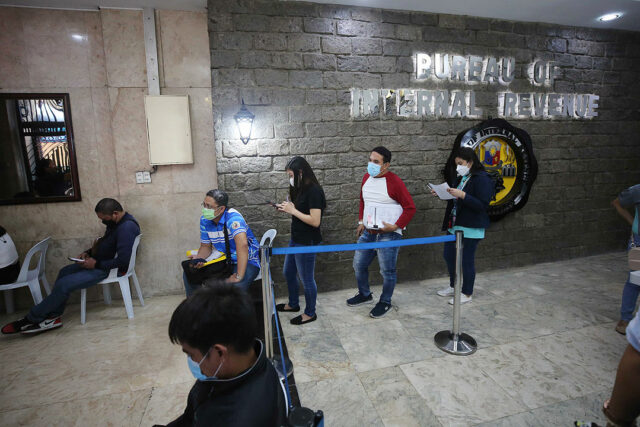
People line up to file their income tax returns at the Bureau of Internal Revenue office in Intramuros, Manila, April 18, 2022. — PHILIPPINE STAR/ RUSSELL A. PALMA

THE proposed Ease of Paying Taxes Act is expected to boost taxpayer compliance and increase government revenue, though the bill’s contradictory and outdated provisions need to be sorted out, analysts said.

“Simplifying tax procedures will help lower taxpayers’ costs in time, money, and mental distress. This will promote compliance that will eventually be helpful in raising money to fund strategic projects,” InvestEd Philippines Finance Executive Daniel C. Penkian said in a text message.

“Simpler taxation can improve compliance by reducing inadvertent non-payment of taxes. To some extent, taxpayers are unable to comply with the regulations because of complexities, which could have been remedied if our tax laws are as simpler,” he added.

House Bill No. 4125, or the proposed Ease of Paying Taxes Act, amends sections of Republic Act No. 8424, otherwise known as the National Internal Revenue Code of 1997, as amended.

The bill, a priority measure of the administration, was passed by the House of Representatives in September and is currently pending at a Senate committee.

It aims to modernize tax administration and improve collection efficiency by encouraging proper and easy compliance at the least cost.

It also seeks to adopt best practices and replace antiquated rules such as restrictions on venue for filing and payment, while customizing policies for various types of taxpayer.

The Secretary of Finance, upon the recommendation of the Bureau of Internal Revenue (BIR) Commissioner, will also be granted the authority to overhaul or create new taxpayer classifications.

Current tax law only recognizes a single category grouping the largest taxpayers.

Large taxpayers are defined as establishments with VAT paid or payable of at least P100,000 for any quarter of the preceding taxable year; with excise tax paid or payable of at least P1 million for the preceding taxable year; with annual income tax paid or payable of at least P1 million for the preceding taxable year; or with withholding tax payment or remittance of at least P1 million for the preceding taxable year.

Froilyn P. Doyaoen-Pagayatan, tax counsel of Gorriceta Africa Cauton & Saavedra law offices, said that the proposed legislation of the basis for classification of taxpayers would make tax administration “contemporaneous with economic conditions and more uniform.”

“The proposal that taxpayers not classified as large or medium taxpayers are not required to withhold taxes would reduce the burden of tax compliance on these taxpayers, who will be allowed to focus on their operations.  It would also allow the BIR to focus on large and medium taxpayers in the enforcement of withholding tax obligations,” she added.

“Classifying taxpayers into large, medium, and small based on the taxpayer’s capacity to comply with tax rules, the amount and types of taxes being paid, gross revenue, volume of transactions, wage and employment levels, and other economic and financial considerations is another form of efficiency,” Mr. Penkian added.

Mr. Penkian said that the bill’s plan to introduce a small and medium taxpayer classification and a corresponding BIR special unit will “improve service and tax administration for both.”

“Institutionalizing simplified tax returns and processes will significantly help smaller taxpayers as most of them don’t usually have the same level of resources (tax accountants, lawyers, pool of compliance staff) as compared with large taxpayers,” he added.

However, Ms. Doyaoen-Pagayatan noted that the criteria for large taxpayers was established over two decades ago and that “the foregoing threshold amounts would be low under present economic circumstances.”

“Hence, such criteria could lead to classification of taxpayers as large even if, considering their present economic capabilities, they would not be able or would find it difficult to fulfill the additional compliance requirements which are the consequences of being classified as large taxpayers, such as the obligation to withhold,” she added.

She also cited Revenue Memorandum Order (RMO) No. 17-2017, which classifies as medium-sized taxpayers the top 500 non-individual taxpayers of the 12 top revenue regions in terms of collection that satisfy the criteria for large taxpayers but have not been designated as such by the BIR Commissioner.

“It is clear that under RMO No. 17-2017, the classification of a taxpayer as medium depends largely on the collection performance of the revenue region where a taxpayer is registered. This leads to lack of uniformity and equity in the enforcement of tax rules as it is possible that a taxpayer, otherwise classified as medium taxpayer, would escape being classified as such simply because of its place of registration,” she said.

The proposed bill also introduces a Taxpayer’s Bill of Rights.

“This proposes the enumeration of additional fundamental rights to further promote fair treatment of taxpayers and put guardrails in place to protect them against wrongful assessments,” Mr. Penkian said.

Ms. Doyaoen-Pagayatan said the inclusion of the bill of rights is “laudable” but most items are “mostly abstractly stated that prosecution and conviction of Bill of Rights violators may be challenging.”

“The Bill of Rights seems to be more of policy statements than specific criminal acts,” she added.

The Ease of Paying Taxes Act also creates a Taxpayer’s Advocate Office.

“It is worthwhile to highlight that the Taxpayer’s Advocate Office is intended to be independent from the BIR though the plan was to have the office directly report to the BIR Commissioner. There may be an issue of independence if that is the case,” Mr. Penkian noted.

“With respect to the Tax Advocacy Office, its proposed function is to protect and promote the rights of taxpayers and to identify systemic problems in the BIR and propose solutions to address such problems.  However, (the bill) proposes that the Tax Advocacy Office shall report directly to the BIR Commissioner. The power and control of the BIR Commissioner over the Tax Advocacy Office may affect the independence and objectivity of the latter in the performance of its functions,” Ms. Doyaoen-Pagayatan added.

The bill also allows taxpayers to file returns or pay taxes anywhere, particularly with any authorized agent bank, Revenue District Office (RDOs), or collection agent, except in cases specified by the commissioner.

“The bill will further reduce the burden of paying taxes and will provide protection to the taxpayers.  Reducing the burden means the taxpayers can pay taxes in RDOs and banks outside the principal place of business, removing the restrictions on payment venue, which will be easier for the taxpayers to comply with,” Res Werkes Phils., Inc. Chief Financial Officer Jonathan Q. Sibug said in an e-mail.

Mr. Penkian said that this will also “greatly help taxpayers save time in declaring and paying their dues resulting in flexibility and efficiency.”

“It’s about time that we remove the requirement that taxes must be paid in the BIR offices or banks within the jurisdiction of the taxpayer’s legal residence, principal place of business or principal office. Companies are highly concerned about the customer experience; so the government should be concerned about the taxpayer-experience,” he added.

Ms. Doyaoen-Pagayatan added that if the bill were passed and tax payments are allowed anywhere, this would “significantly lighten the burden of tax compliance especially for taxpayers that are not large or medium taxpayers.” — Luisa Maria Jacinta C. Jocson

E-governance legislation expected to address corrupt practices not curbed by digitalization

ILOILO CITY GOVERNMENT 

A PROPOSED e-governance bill is expected to address the blind spots of the government’s current digitalization effort in curbing corruption, analysts said.

“E-governance can only be successful if government makes a commitment to use e-governance tools to ensure efficient, transparent and accountable public services,” Terry L. Ridon, a public investment analyst and convenor of think tank InfraWatch PH, said via e-mail.

Mr. Ridon said that the current state of digitized government has not yet clamped down on corrupt practices and inefficient services.

“We are mindful of the failure of (the current set-up of) e-governance in several agencies in preventing corrupt practices, such as in the Bureau of Customs in which organized smuggling continues to persist despite the institution of mandated digitization mechanisms,” Mr. Ridon said.

He also said that expanding e-governance “should help stop current concerns relating to the offloading of Filipino travelers due to unreasonable delays in the passport control process,” referring to an incident at the Ninoy Aquino International Airport in which a passenger missed a flight due to an immigration officer’s excessive questions.

Digitizing government documents should “limit the intervention of fixers and middlemen,” Sherwin E. Ona, a political science and development studies professor at De La Salle University, said in a Viber chat.

“Well-designed online services can result in faster turnaround time for transactions, and fewer opportunities for corruption due to the transparent nature of information and communications technology services,” he said.

The bill cleared third reading at the House on March 6. Its counterpart measure in the Senate is currently at the committee level.

 House Bill No. 7327 tasks the Department of Information and Communications Technology (DICT) with creating an E-Government Master Plan.

The measure also proposes to create the Philippine Infostructure Management Corp., a government-owned and -controlled corporation under the DICT to implement infrastructure programs like the National Broadband Plan, the Free Wi-Fi for All, and the expansion of the National Government Data Centers and Government Cloud.

 If passed into law, the digitization of a paper-based documents and information is expected to “encourage government cooperation with the private sector in providing resources, assets, and services,” Information and Communications Technology committee chairman and Navotas City Rep. Tobias M. Tiangco said during plenary deliberations on the bill.

According to Mr. Ridon, E-governance serves as an “institutional check” in the procurement process (at) all levels of government, ensuring that public officials cannot interfere during the course of public bidding as soon as terms of reference and bidding documents are issued.

He added that government itself is the “ultimate roadblock” in ensuring efficiency and transparency through e-governance “if it fails to rein in malevolent actors in public service who might reject implementing e-governance tools for illicit ends.”

Deputy Minority Leader and ACT Teachers’ Party-list Rep. France L. Castro, one of the legislators who voted against the bill, said e-governance may increase state surveillance of the public and place citizens who lack digital access at a disadvantage.

“It will widen and worsen the digital divide among Filipinos,” Ms. Castro said during a March briefing.

To address this, Mr. Ona said that the measure must guarantee the protection of personal data through serious implementation of the data privacy law and cybersecurity protocols.

“The usual approach is infrastructure driven. This should not be the case for e-governance (as) it must be sensitive to the critical needs of its citizens,” he said. — Beatriz Marie D. Cruz

Significance of prescriptive period of assessment

Most taxpayers have six days left before the deadline for filing the Annual Income Tax Return (AITR) for the calendar year 2022, the last day for which is April 17. With the filing of the AITR, the power of the Bureau of Internal Revenue (BIR) to assess and examine whether correct taxes were paid begins. However, the power of the BIR to assess deficiency taxes is not limitless.

Taxes are the lifeblood of the government and must be collected without hindrance. Taxes are the government’s primary means of generating the funds needed to support its operations and see to the general well-being of the people.

Nevertheless, the Supreme Court (SC) held that, in the case of Kepco Philippines Corp. v. Commissioner of Internal Revenue (CIR), G.R. Nos. 225750-51, the power of taxation should be exercised with caution to minimize the proprietary rights of a taxpayer. It must be exercised fairly, equally, and uniformly, lest the tax collector kill the goose that lays the golden egg. To maintain the general public’s trust and confidence in the government, this power must be used justly and not treacherously.

The National Internal Revenue Code (NIRC), as amended, provides protection to taxpayers against tax audits by the BIR. Among the rules that protect taxpayers are the Statute of Limitations, which refers to the period during which the BIR can assess and collect taxes. The prescriptive period in making an assessment depends upon (a) whether a tax return was filed, (b) whether the tax return filed was either false or fraudulent, or (c) whether a waiver of the statute of limitations was executed.

GENERAL RULE ON PRESCRIPTIVE PERIOD OF ASSESSMENT
Section 203 of the NIRC provides that an assessment of internal revenue tax under ordinary circumstances must be made within three years counted from the period fixed by law for the filing of the tax return or the actual date of filing, whichever is later.

Thus, the three-year period starts to run differently for the various tax types. For example, an annual income tax return for a taxpayer observing the calendar year filed on April 15 will start the clock on the prescriptive period on this day. However, for a quarterly VAT return filed on April 25, the period is counted from that date.

Similarly, the Court of Tax Appeals (CTA), En Banc, held in the case of CIR v. Carmona, C.T.A. EB Case No. 1324, that the Final Assessment Notice issued on July 25, 2011 and received by the taxpayer on Aug. 11, 2011, for all the pertinent quarters for the year 2007 was invalid. The CTA counted the three years from the various dates that the quarterly VAT Returns and the Income Tax Returns were filed. The BIR had only until Jan. 31, 2011 and April 15, 2011, at the latest, within which to issue the FAN against the taxpayer for deficiency VAT and Income Tax, respectively. As such, BIR’s right to assess the taxpayer within the three-year prescriptive period had prescribed.

Consequently, taxpayers should check the prescriptive period for each tax type as some may prescribe earlier than others.

EXCEPTIONS
The exceptions to the three-year prescriptive period of assessment are (1) in case of extraordinary circumstance and (2) the execution of a waiver of the statute of limitations.

I. Extraordinary circumstance

The first exception is found in Section 222 (a) of the NIRC which explains that BIR may assess the tax within a period of 10 years from the discovery of a false or fraudulent return with the intent to evade tax or failure to file a return. This basically makes these circumstances imprescriptible, as the 10-year period starts from discovery. Hence, there may be assessments that can be made decades after the taxable years because of fraud or a failure to file a return.

However, it is important to note that the BIR cannot simply avail of this period without including the basis for its allegations of falsity, fraud, and omissions committed by the taxpayer in the assessment notice.

The SC held in the case of CIR v. Fitness by Design, Inc., G.R. No. 215957, that to avail of the extraordinary period of assessment in Section 222 (a) of the NIRC, the Commissioner of Internal Revenue has the burden of proving that the facts exist to evidence fraud. In this case the assessment for taxable year 1995 was issued only in 2004. However, the Supreme Court did not apply the 10-year period for the failure of the Commissioner to prove that the taxpayer deliberately failed to reflect its true income in 1995.

Nonetheless, the SC ruled in the case of CIR v. Estate of Toda, Jr., G.R. No. 147188, that “fraud” in its general sense, is deemed to comprise anything calculated to deceive, including all acts, omissions, and concealment involving a breach of legal or equitable duty, trust, or confidence justly reposed, resulting in the damage of another, or by which an undue and unconscionable advantage is taken of another. In this case, the SC applied the 10-year prescriptive period. The BIR was able to prove that the sale of the property first to Altonaga then to Royal Match, Inc., was merely a tax ploy, a sham, and without business purpose and economic substance. Doubtless, the two sales were executed to mislead the BIR with the end in view of reducing the consequent income tax liability and without any business purpose. In effect, the transactions resulted more in the mitigation of tax liabilities than for legitimate business purposes which constitutes tax evasion.

II. Waiver of statute of limitations

The second exception is provided under Section 222 (b) of the NIRC which allows the execution of the waiver of the defense of prescription. The waiver is a bilateral agreement between a taxpayer and the BIR to extend the period of assessment to a certain date beyond the three-year period. There is no limitation as to the length of the extension as long as it is agreed upon by the taxpayer and the BIR. In addition, the extended period may be further extended by the execution of another before the expiration of the original or the first extension. Hence, it is not uncommon to expect the BIR to request a new waiver before the current waiver expires.

In case the BIR requests a waiver, the taxpayer should always assess whether a waiver is advantageous to him or if it will just unnecessarily lengthen the assessment process. Factors to consider may be the time needed to produce the additional documents requested by the BIR, if any, or additional time needed to discuss and controvert the remaining findings of the BIR.

Nevertheless, the waiver of the statute of limitations is not a waiver of the right to invoke the defense of prescription. In the case of Universal Weavers Corp. v. Commissioner of Internal Revenue, G.R. No. 233990, the SC ruled that a waiver of the statute of limitations under the NIRC, to a certain extent, is a derogation of the taxpayers’ right to security against prolonged and unscrupulous investigations conducted by revenue officers. Make no mistake, it is not a renunciation of the right to invoke the defense of prescription. The SC further ruled that it is, therefore, imperative that the waiver is carefully and strictly construed and duly compliant with the present guidelines and procedural requirements prescribed by the BIR to serve its purpose of affording protection to the taxpayer.

In summary, the purpose of the statute of limitations on the assessment is to safeguard the interest of the taxpayer from unreasonable examination, investigation, or assessment. Accordingly, the government must assess internal revenue taxes on time to prevent extending indefinitely the period of assessment. Taxpayers must be given the assurance that they will no longer be subjected to further investigation for taxes after the expiration of the reasonable periods set by law. Thus, when the assessment is issued beyond the prescriptive period, the government’s right to collect deficiency taxes also prescribes. Simply put, the failure of the BIR to comply with the aforesaid prescriptive periods ends its power to assess and starts the taxpayers’ right to invoke prescription.

Let’s Talk Tax is a weekly newspaper column of P&A Grant Thornton that aims to keep the public informed of various developments in taxation. This article is not intended to be a substitute for competent professional advice.


Penelope Germaine D. Sernande is an associate from the Tax Advisory & Compliance division of P&A Grant Thornton, the Philippine member firm of Grant Thornton International Ltd.

pagrantthornton@ph.gt.com