Home Blog Page 4964

Upson posts 33% higher income

LISTED information technology retailer Upson International Corp. booked a net income of P537.86 million in 2022, higher by 33.3% than the P403.64 million reported in the previous year, the company said on Monday.

“Our financial performance is a testament to our commitment to be the shopping gateway to technology. This commitment shall be our legacy contribution to support the digital transformation of our country,” Upson President and Chief Executive Officer Arlene Louisa T. Sy said in a disclosure.

“This is why we are continuously expanding our retail footprint nationwide, along with warehouses and logistics operations, to reach underserved markets,” Ms. Sy added.

The newly listed company reported that its revenues grew by 10.4% to P9.46 billion from P8.57 a year prior.

It said a significant driver of its financial growth in 2022 was the expansion of its retail branch network, which added 24 to the existing 183 branches in 2021.

The company operates 207 branches nationwide with a total of six warehouses located in Manila, Cebu, Cagayan de Oro, and Davao City as of December 2022.

Proceeds from the company’s recent initial public offering will be used to expand its store locations, aiming at 250 stores from 2023 to 2027 or an additional retail space of 25,000 square meters.

This year, it plans to open 50 stores within the National Capital Region and other key cities in the country.

Upson shares declined by 1.65% or four centavos to finish at P2.39 each on Monday. — Adrian H. Halili

PBB posts higher net profit in 2022

PHILIPPINE Business Bank, Inc. (PBB) saw its net income rise by 12.3% last year on the back of an improved loan portfolio amid the economy’s reopening.

PBB’s net profit stood at P1.311 billion last year, rising from the P1.168 billion seen in 2021, the lender said in a disclosure to the local bourse on Monday.

This translated to a return on average equity of 9% and a return on average assets of 0.97%.

The bank’s financial statement was unavailable as of press time.

“Fourth-quarter net income was P384.9 million by 25.7% against its third-quarter net income of P306.3 million,” PBB Chief Operating Officer Cynthia A. Almirez said.

The bank’s net interest income stood at P5.547 billion last year.

Net interest margin was at 4.33%.

Meanwhile, net loans and receivables rose by 12.9% to P103.5 billion from P91.7 billion in 2021.

“On the balance sheet side, PBB’s loan portfolio grew 12.9% year on year as credit activity began to gain momentum with the continued economic recovery and the resulting uptick in market demand for financing,” Ms. Almirez said.

On the funding side, deposit liabilities were at P114.5 billion in 2022. Low-cost current and savings account deposits stood at P62 billion, while time deposits reached P52.5 billion.

Shareholders’ equity was at P14.6 billion.

PBB’s capital adequacy ratio stood at 13.85% last year, while its minimum liquidity ratio was at 21.75%.

Ms. Almirez said the P1.75 billion in proceeds from PBB’s stock rights offering in the first quarter increased the bank’s capital and enhanced its ability to expand its loan and investment securities portfolio.

“This will further improve profitability in 2023,” she added.

The bank’s total assets stood at P134.6 billion at end-2022.

PBB has 157 branches nationwide.

Its shares closed unchanged at P8.12 apiece on Monday. — AMCS

Inside the music industry’s battle with the UK government over AI song generators

KELLY SIKKEMA/UNSPLASH

UNIVERSAL Music Group has been asking music streaming services like Spotify to stop developers from scraping its material to train artificial intelligence (AI) bots to make new songs. The label, which controls about a third of the recorded music industry, has also been issuing substantial numbers of takedown requests in relation to AI uploads appearing online.

It is the latest move in the music industry’s growing battle to prevent AIs from using its songs without licensing them. Behind these efforts to enforce copyright, the big worry is about how governments will balance the rights of AIs against human creativity.

In particular, the UK government is threatening to water down copyright laws to benefit tech companies at the expense of not only the music industry but also creative businesses like literature, films, and photography. So, what’s going on?

On a “royalty free music generator” like Mubert, it’s already possible to type in a prompt and the program will use AI to search a catalogue of music for patterns. Tell it to play a “fast voodoo rhythm in the style of a nursery rhyme with some pretty electronics,” and it will copy parts of songs that correspond and generate music to match. You can also generate music that sounds like a particular artist, and whatever tracks you create are downloadable.

Mubert claims to be “on a global mission to empower creators.” It is unclear how that squares with not paying human creators royalties for the use of their music. Mubert even emphasizes that its audio material is made “from real musicians and producers,” recognizing that the value in the music is coming from human creators.

Music is protected by copyright law, which means that anyone wanting to use a song has to pay for a license. This ensures that rightsholders and creators are paid properly for their creativity. For example, Spotify pays a license to record labels and artists to put music on its platform. The same is true of everyone from bars, cafes, and pubs playing records for their customers, to artists sampling someone else’s song in their new track.

If AI programs are using labels’ music catalogues without permission, they could be seen to have infringed music rights in at least two ways: by using the music to train the AIs, and in copying parts of the music that the AI produces from the training data.

If the streaming platforms were seen to have facilitated such illegal activity, they could be found guilty of secondary copyright infringement, comparable to an illegal downloading platform like The Pirate Bay.

Unfortunately for the music industry, the UK government has been muddying the waters with proposals to change the copyright rules to benefit tech companies. A few months ago, it floated the idea of making an exception for the first type of infringement: using music catalogues as training data. This would also apply to other artistic works like videos and photographs.

There are already copyright exceptions in the UK where permission for reuse is unnecessary, such as “criticism, review or quotation,” though there are limitations to make sure this is done fairly.

When governments want to create a new exception, they must follow three requirements set out in the Berne convention. It must be for very specific special circumstances, must not interfere with the normal exploitation of the work, and must not unreasonably prejudice the rightsholder. In my view, the UK proposal doesn’t meet any of these steps and would be contrary to international law.

The proposed exception met with widespread objections, with only 13 out of 88 responses to the consultation in favor. The House of Lords Communications and Digital Committee said the proposal is “misguided” and should be scrapped. The government did then appear to backtrack in February, with science minister George Freeman saying it would not take the exception forward.

In March, however, it published a white paper, A Pro-Innovation Approach to AI Regulation, which raised the prospect that it might be reviving its previous approach. The white paper wants to prioritize making the UK a tech-friendly environment, emphasizing “the role of regulation in creating the environment for AI to flourish.” It mentions risks to things like mental health, privacy rights and human rights, but not any threats to intellectual property (IP).

This comes at a time when governments around the world and international organizations such as the World Intellectual Property Organization are considering how laws need to adapt to AI. Japan and Singapore are already introducing copyright exceptions along similar lines to those being discussed in the UK. This is also a major concern for the creative industries, but not to the same extent as the UK, which tends to be particularly influential in IP law around the world.

There are no proposals for copyright exceptions in the US or the European Union (EU). Indeed, the US IP laws are currently being tested by photographic giant Getty Images against an AI operator called Stability Diffusion, which has been scraping its images to generate new ones. US copyright has a “fair use” exception which could potentially be a defense for these operators, so Getty wants confirmation that is not the case. It has also filed a case along the same lines in the UK, which is at an earlier stage.

This all boils down to whether we still believe human creativity deserves greater protection than machine creativity. Appealing to tech might seem like a good strategy for the UK, but the creative industries contribute hugely to the economy — £109 billion in 2021, or nearly 6% of total gross domestic product (GDP).

The value of music also goes beyond raw economics, offering emotional comfort, health benefits, and even inspiring social, political, and economic change. The creators should arguably be rewarded for this too, whether they are responsible for composing music directly or providing the material that AI repurposes.

Copyright law is supposed to ensure that creators are fairly remunerated for their work. When it brings such value to the world, it seems like a strong argument for protecting it. — The Conversation via Reuters Connect

Hayleigh Bosher is a Senior Lecturer in Intellectual Property Law, Brunel University London.

Wes Anderson, Ken Loach among big names competing at Cannes Film Festival

A SCENE from The Old Oak

WES Anderson, Ken Loach, Todd Haynes, and Wim Wenders are among the directors vying for the top prize at next month’s Cannes Film Festival, where Hollywood stars will also walk the red carpet on the Croisette waterfront for the premieres of their latest works.

At a press conference on Thursday, festival Director Thierry Fremaux and President Iris Knobloch announced the lineup for the 76th edition of the major cinema showcase from May 16-27.

Nineteen films will vie for the festival’s coveted Palme d’Or prize, of which six are directed by women, a record for the event. Only two women directors have previously won the prize.

“It’s a competition that will mix young filmmakers competing for the first time with veterans whose names and works we know,” Mr. Fremaux said.

Mr. Loach returns to the festival with The Old Oak, about Syrian refugees arriving in a former mining village in Britain, while Mr. Anderson brings his star-studded Asteroid City, in which major events disrupt a junior stargazer convention.

Other directors in competition include American filmmaker Mr. Haynes with May December starring Oscar winners Natalie Portman and Julianne Moore, Italian Nanni Moretti with Il Sol Dell’Avvenire, German filmmaker Wim Wenders with Perfect Days, and Japan’s Hirokazu Kore-eda with Monster.

Women directors in competition include France’s Catherine Breillat with L’Ete Dernier, Austrian Jessica Hausner with Club Zero, and Tunisian Kaouther Ben Hania with Les Filles D’Olfa.  Reuters

Organizers have already announced the festival’s opener — biographical drama Jeanne du Barry featuring Johnny Depp, the Hollywood star’s first live-action film since his defamation trial against ex-wife Amber Heard last year.

Also out of competition is veteran Martin Scorsese’s Killers of the Flower Moon, about the murders of Osage Native Americans. Set in 1920s Oklahoma, the movie features past Scorsese collaborators Leonardo DiCaprio, Robert De Niro, and Jesse Plemons.

Adventurer Indiana Jones will return to the festival 15 years after his last appearance in Cannes. Harrison Ford reprises the title role in Indiana Jones and the Dial of Destiny, which will have its world premiere in France.

The festival will have a special tribute to Mr. Ford’s career, Mr. Fremaux said.

Spanish filmmaker Pedro Almodovar will bring his Western short Strange Way of Life while 12 Years a Slave director Steve McQueen will premiere documentary Occupied City, about Amsterdam under Nazi occupation during World War II.

“Films are back in cinemas and especially, audiences are back in cinemas,” Ms. Knobloch said.

“Filmmakers, artists, professionals are all in agreement. Nothing can replace the cultural event represented by the release of a film in the cinema.”

Swedish director Ruben Ostlund, whose film Triangle of Sadness won last year’s Palme d’Or, will preside over the jury at this year’s competition. — Reuters

Overseas Filipinos’ cash remittances (February 2023)

MONEY SENT by overseas Filipino workers (OFWs) grew at the slowest pace in seven months in February, data from the Bangko Sentral ng Pilipinas (BSP) showed. Read the full story.

Overseas Filipinos’ cash remittances (February 2023)

How PSEi member stocks performed — April 17, 2023

Here’s a quick glance at how PSEi stocks fared on Monday, April 17, 2023.


Manila told to boost defense to preserve maritime biodiversity

Chinese dredging vessels are purportedly seen in the waters around Mischief Reef in the disputed Spratly Islands in the South China Sea in this still image from video taken by a P-8A Poseidon surveillance aircraft provided by the United States Navy May 21, 2015. — U.S. NAVY/HANDOUT VIA REUTERS/FILE PHOTO

A SECURITY think tank on Monday called for a stronger maritime defense system to protect the biodiversity in areas claimed by the Philippines in the South China Sea.

“Various security issues on the West Philippine Sea are affecting its biodiversity and marine resources, and have limited tourism opportunities in the area,” Victor Andres C. Manhit, president of Stratbase ADR, said in a statement, referring to areas of the sea within the country’s exclusive economic zone.

The government, in cooperation with scientists and environmentalists, should craft strategies that will “sustain biodiversity and develop Philippine marine resources,” he said.

Mr. Manhit said unlawful land reclamation activities, construction of artificial islands and other intrusions within the Philippines’ exclusive economic zone “cannot continue.”

“We believe that the security in the West Philippine Sea in the traditional, nontraditional and emerging domains must be acted upon through a strategic and responsive inter-agency approach.”

Mr. Manhit cited a 2016 arbitral ruling that voided China’s sweeping claims over the South China Sea. The United Nations-backed court found that land reclamation and construction of artificial islands had caused “irreparable harm to the coral reef ecosystem.”

Despite the ruling, such unlawful practices are still being carried out, causing “severe damage to marine life and ecosystems” of the West Philippine Sea, he said.

He said tourism initiatives would make the area more accessible to Filipinos. “In all these endeavors, the efforts of the national and international community to secure biodiversity and promote tourism must complement and respect the Philippines’ 2016 arbitral victory,” he said.

The Philippines will benefit from Australia’s P3.6-billion investment in maritime and environmental protection, Stratbase said in the statement.

“The marine environment is under threat from pollution, climate change and over-exploitation. And it is more important than ever that we work together to protect it,” Australian Embassy Deputy Head of Mission Moya Collett said in the statement.

“We are proud to support the Philippines in its efforts to preserve the marine environment and become more climate change- and disaster-resilient,” she added.

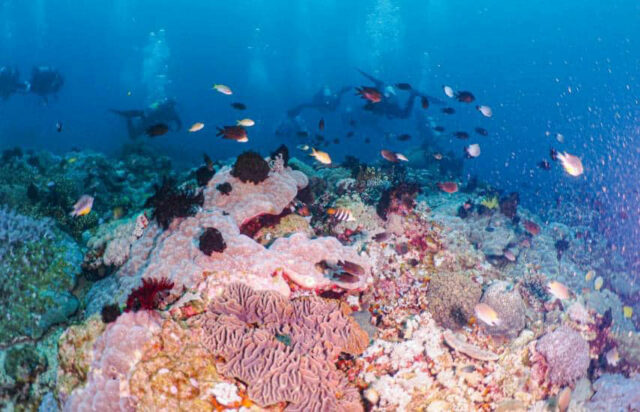
The Australian government has funded a number of coral restoration projects throughout the Philippines including in Pangasinan, Verde Island Group, Palawan and Zambales.

“Australia highly values its maritime partnership with the Philippines, and we will continue to work together to protect maritime biodiversity, which is so important to the health and prosperity of our two nations,” Ms. Collett said.

Tensions between the Philippines and China have risen in the past months, with the Philippine Coast Guard boosting efforts to expose its neighbor’s expansive activities.

President Ferdinand R. Marcos, Jr.’s decision to widen US access to military bases in the Philippines under their 2014 Enhanced Defense Cooperation Agreement (EDCA) had also angered Beijing, which is also under fire for claiming self-ruled Taiwan.

The US and the Philippines are set to end their biggest joint military exercises on April 18, which were participated in by 17,600 members of the Armed Forces of the Philippines and US military.

The “shoulder-to-shoulder” exercises included live-fire exercises near disputed waters of the South China Sea.

Batangas Rep. Ralph G. Recto said the US and China should work together to help the Philippines contain an oil spill that has affected Oriental Mindoro and nearby areas.

“It is not yet late for the government to turn the Mindoro oil spill as the site of an ‘environmental Balikatan’ where even nations at loggerheads with each other, like the US and China, can work together in fighting a real ecological disaster instead of an imaginary enemy,” he said in a statement.

The Philippines can bank on the “global humanitarian tradition” of helping a nation whose “resources are overwhelmed by the challenges at hand,” the lawmaker said.

The oil spill from MT Princess Empress, which was carrying 800,000 liters of industrial fuel when it sank off the waters of Oriental Mindoro on Feb. 28, had seeped out and destroyed marine life in three regions.

“If this month’s Balikatan in five provinces can mobilize 17,000 troops from three countries for a “mock war,” then even a fraction of the personnel and logistics involved will be a great help in battling a real, not simulated, ecological threat,” Mr. Recto said.

“If Beijing and Washington are competing for our affection, then they should see the Mindoro oil spill as an opportunity for them to show their solidarity with us.” — Kyle Aristophere T. Atienza

Marcos, Czech leader talk about China sea dispute

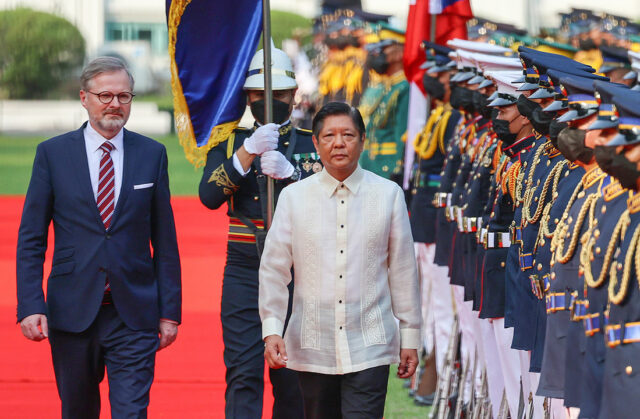
President Ferdinand Marcos, Jr. with Czech Republic Prime Minister Petr Fiala during the welcome ceremony at the Kalayaan grounds in Malacañan Palace in Manila on Monday, April 17, 2023. — PHILIPPINE STAR/ KRIZ JOHN ROSALES

PHILIPPINE President Ferdinand R. Marcos, Jr. and Czech Republic Prime Minister Petr Fiala met at the presidential palace in Manila on Monday, discussing mutual interests including defense cooperation, trade, labor deals and cultural ties.

At a briefing after their 4 p.m. meeting, Mr. Marcos said Mr. Fiala and he had discussed regional issues including the Philippines’ sea dispute with China and the China-Taiwan conflict.

“We had a very interesting exchange of views regarding regional and international issues, including the West Philippine Sea and cross-strait relations, and the war in Ukraine, amongst others,” the Philippine leader said.

He said they had both emphasized the two countries’ “shared commitment to democracy, to human rights and the rule of law.”

The two countries signed a defense cooperation agreement in 2017 and set up a defense committee, which met for the first time in 2019.

The two leaders last year met on the sidelines of the commemorative summit between the Association of Southeast Asian Nations and European Union in Brussels, where they talked about the Armed Forces of the Philippines’ modernization program.

Mr. Marcos said he had also told Mr. Fiala during their meeting the Philippines is a “strategic location” in Southeast Asia and that it has the potential to be a gateway to the Asia-Pacific region.

“We recognize the importance of building on the existing areas of cooperation and exploring new opportunities for collaboration,” he said.

“We shared positive developments in the Philippine economy, including our high gross domestic product growth rate and strong economic outlook in the context of a difficult and volatile world economic situation,” he added.

Mr. Fiala is also set to visit six other countries during his 10-day visit to Asia.

Earlier, the Czech official said the goal of his Asian trip is “to improve and develop relations with countries in this region and support Czech companies in local markets.”

“The Philippines is a fast-growing economy and I am glad that Czech companies are and will be operating here in many areas, for example defense, aviation or transport,” he said.

Business relations between the Philippines and Czech date back to the 1930s. — Kyle Aristophere T. Atienza

DoH: Philippines’ daily COVID infections rose by 23% in past week

THIS SCANNING electron microscope image shows SARS-CoV-2 (round gold objects) emerging from the surface of cells cultured in the lab. SARS-CoV-2, also known as 2019-nCoV, is the virus that causes COVID-19. — NIAID-RML

THE PHILIPPINES posted 2,386 coronavirus infections in the past week, the Department of Health (DoH) said on Monday.

The daily average rose by 23% to 341 cases on April 10 to 16 from a week earlier, the agency said in a bulletin.

Of the new cases, 17 were severe or critical. As of April 16, 91% of total COVID-19 admissions or 356 patients were in severe and critical condition, DoH said.

It added that 12.3% or 234 of intensive care unit beds for coronavirus patients were occupied, while 17.4% or non-ICU beds had been used.

Health authorities verified 20 more coronavirus deaths in the past week that occurred as late as January 2021.

There were 8,611 active coronavirus infections in the Philippines as of March 26. The country has posted more than 4 million cases since the pandemic started in 2020. The death toll stood at 66,439.

As of March 16, more than 78.4 million Filipinos had been fully vaccinated against COVID-19, 23.8 million of whom had received their first booster dose, while almost 4.4 million got their second booster shots.

SC asked to stop, void SIM card registration 

PHILIPPINE STAR/MIGUEL DE GUZMAN

CIVIC groups on Monday asked the Supreme Court (SC) to stop the government from requiring Filipinos to register their subscriber identity modules (SIM) cards, saying it violates freedom of speech and privacy. 

In a 59-page petition, the group asked the tribunal to nullify the SIM Registration Act, noting that state punishment of SIM card deactivation creates a “chilling effect” on the public. 

“The line, if crossed, will warp the nation from one that exercises police power for the common good of its citizens into a police state,” the plaintiffs led by National Union of Journalists in the Philippines Secretary-General Ronalyn V. Olea said. 

She was joined by Bagong Alyansang Makabayan Secretary-General Renato M. Reyes, Jr., former Bayan Muna Rep. Eufemia C. Cullamat, an information technology expert, a mother of victims of the government’s drug war, fisherfolk and farmers’ group leaders, and a lawyer. 

“The SIM Registration law is an overbroad law that reaches into protected freedoms and restrains free flow of ideas and information,” they said. 

The law, signed on Oct. 10, requires mobile phone users to register their SIMs under their names or risk deactivation. The deadline for registration is on April 26. 

The law seeks to deter text scams and other criminal activities done through mobile phones. 

The groups said deactivating SIM cards would suppress civic space and effectively silence Filipino mobile phone users. 

Citing a provision of the law, they raised concerns about law enforcers being given access to the database of registered SIMs through subpoenas, which they said violates their right to privacy. 

About 71.95 million SIMs have been registered, or 42.82% of 168.98 million subscribers nationwide, based on data from the Department of Information and Communications Technology (DICT). 

Of the registered SIMs, 35.66 million were from Smart Communications Inc., 31.03 million from Globe Telecom, Inc. and 4.95 million from DITO Telecommunity Corp. 

In separate statements last week, Smart and DITO sought a 120-day extension of the registration period due to low compliance or less than 50%. 

Under the law, the DICT can extend the registration process for four months. 

“Every Filipino has an objective expectation of privacy over their SIM cards and the data it contains and transmits,” the plaintiffs said. 

“Regardless of reason, nondisclosure results in enforced silence and the law presumes that every Filipino is a suspected criminal.” — John Victor D. Ordoñez 

Bangsamoro peace process involves international community, OPAPRU tells Chinese envoy 

BANGSAMORO officials with representatives of international donor agencies during a February 2020 forum in Cotabato City for a discussion on continuing support to the region’s peace initiatives and transition process. — OPAPRU

THE PEACE process in the Bangsamoro, a Muslim-majority region in southern Philippines where rebel groups fought for autonomy for decades, was facilitated and continues to be assisted by the international community, the Presidential peace advisers office said on Monday in response to a statement by the Chinese ambassador relating to Taiwan independence.   

We took note about the statement of Chinese Ambassador to the Philippines Huang Xilian comparing the internal tension in China with Taiwan to the Mindanao peace process,the Office of the Presidential Adviser on Peace, Reconciliation and Unity (OPAPRU) said in a statement.   

Mr. Huang, in a speech at a forum in Manila on Friday, said, The Taiwan question is entirely Chinas internal affair, as is the Mindanao issue to the Philippines. You will never allow any third party to meddle with resolving rebel issues in Mindanao.”  

OPAPRU took exception to this, saying, The success of the Mindanao peace process has a vibrant support from the stakeholders as well as the international community.”   

Peace negotiations and the resulting development of the new Bangsamoro Autonomous Region in Muslim Mindanao involves member countries of the Organization of Islamic Cooperation, the European Union and its member nations as separate entities, Australia, Japan, the United States, United Nations agencies, and various international non-government groups, among others.    

The Bangsamoro peace process ever since has been facilitated by a third-party country to ensure fairness and maintain the integrity of the peace negotiations,OPAPRU said.   

Now in its implementation phase, the role of the international community in the southern peace process is very crucial to help deliver the peace dividends.”  

OPAPRU said countries with similar situations such as ourscan use the Bangsamoro model in resolving conflicts peacefully and not resort to unnecessary threat of force, intimidation, and/or violence.”  

The new Bangsamoro region, set up in 2019 and under a governance transition phase until 2025, has political and fiscal autonomy from the National Government based on Republic Act No. 11054 or the Bangsamoro Basic Law. Marifi S. Jara

Mindoro oil spill stirs up local friction, confusion in Puerto Galera 

TOURISM officials led by Secretary Christina Garcia Frasco during a dive in Puerto Galera on April 12, which was joined by Mayor Rocky D. Ilagan. — DEPT. OF TOURISM

By Kyle Aristophere T. Atienza, Reporter 

A GOVERNANCE expert on Monday urged National Government agencies to play a more active role in the oil spill management in Oriental Mindoro as the crisis has caused issues among local officials and confusion over the real impact of the man-made disaster.  

At the weekend, the local governments of Oriental Mindoro province and Puerto Galera town released conflicting statements on the quality of sea water in the popular beach destination.  

On Saturday night, Oriental Mindoro Governor Humerlito BonzA. Dolor issued a report from the Department of Environment and Natural Resources (DENR)-Environmental Management Bureau indicating that at least seven areas in Puerto Galera including Sabang, one of the towns economic hubs, showed poor water quality in terms of oil and grease in four consecutive tests.  

Local government units are encouraged to conduct proper steps based on science and the official agency of the government,the provincial chief said.  

The report also stated that samples from the towns of Roxas, Pola, Pinamalayan, Naujan, Gloria, Bongabong, and Calapan City also showed poor results.   

It said sampling frequency in Baco and San Teodoro, Puerto Galeras neighboring towns, was not met,which means the results of water quality tests from the two areas may not yet be conclusive.”  

A few hours after Mr. Dolors announcement, Puerto Galera Mayor Rocky D. Ilagan issued a statement saying the town is not included in the areas affected by the oil spillbased on an April 15 report from the Office of the Civil Defense (OCD).  

Mr. Ilagan stressed that the OCD is the “lead agency” in the inter-agency task force managing the oil spill crisis.  

He also cited a statement from Health officer-in-charge Maria Rosario S. Vergeire saying that the Department of Health (DoH) is not keen on imposing a swimming ban on Puerto Galera and the tests conducted are not yet conclusive.”  

A hastily and premature reaction from the LGU (local government unit), without considering the advice of the members of the task force may have an adverse effect on the general welfare of our people,Mr. Ilagan said.   

LEAD AGENCIES
Marial Ela A. Atienza, a political science professor at the University of the Philippines, called on concerned national agencies to intervene.  

In the case of the oil spill affecting Oriental Mindoro, if inter-local chief executives’ conflict is preventing timely response at the cost of more threats to the people and the environment, it is important for national agencies to respond quickly and appropriately, using empirical or scientific evidence from experts,she said in a Viber message.  

In this situation, both the DoH and the DENR, plus the National Disaster Risk Reduction and Management Council, should be the lead agencies,she added.  

Ms. Atienza said that based on the Philippine Disaster Risk Reduction and Management (PDRRM) law and the Local Government Code, LGUs are the first responders when it comes to disasters.   

The PDRRM Law also requires all LGUs to have local DRRM ordinances and functional local DRRM offices so that they know how to prepare and respond to disasters.”   

However, the laws also state that should disasters go beyond single localities or affect a large area composed of different LGUs, not only inter-LGU cooperation is needed,Ms. Atienza explained. Regional and national government agencies should be involved, especially if the threats are urgent and the LGUs are incapable or even unwilling to deal with the disasters directly.”  

Mr. Dolors announcement came just days after Tourism Secretary Christina G. Frasco went scuba diving in Puerto Galera “in a show of supportto the town, which she said continues to be unaffected by the oil spill.”  

The town last month lobbied for its exclusion from the state of calamity declaration in the province.  

Jayson C. Abarquez, coordinator of Puerto Galera-based Stairway Foundations environmental program, said the results of water tests should also be compared with previous samplings to the same areas prior to the oil spill if there are any to help ascertain the source of the grease and oil and guide us in our action plans.”   

Although the DoH did not categorically prohibit swimming and other water activities based on the report, Mr. Abarquez said his organization took the governor’s advisory with caution by canceling some of their water activities, which include educational activities at sea.  

Puerto Galeras Mr. Ilagan had earlier admonished the University of the Philippines-Marine Science Institute, which has been closely monitoring the incident, for issuing a warning in early March that the oil spill might reach the town.  

In the April 15 statement, the local chief said, At present, the [LGU of] Puerto Galera deems it prudent to maintain the status quo and to await for the official position of the Department of Health, the DENR, and the inter-agency task force in order to verify the current data regarding the oil spill and to coordinate the proper measures to be taken regarding the incident.”  

The tanker MT Princess Empress, which was carrying 800,000 liters of fuel, sank off the waters of Naujan town in late February, affecting the livelihood of fisherfolk and tourism businesses as well as threatening marine resources.   

A coalition of various sectoral groups that advocate for the protection of the Verde Island Passage (VIP) called on the National Government to speed up efforts to contain the oil spill and hold accountable those responsible for it.”  

Puerto Galera and other areas in the VIP affected by the oil spill are set to lose millions in expected income from tourism,Protect VIP said in a statement on Monday.  

The continued spread of the oil slick will cause more damage unless it is completely contained by the government,it added. Damage already done must be compensated for by those responsible, which the government must also identify.