Home Blog Page 491

Ex-Speaker appears before ICI, denies kickback claims
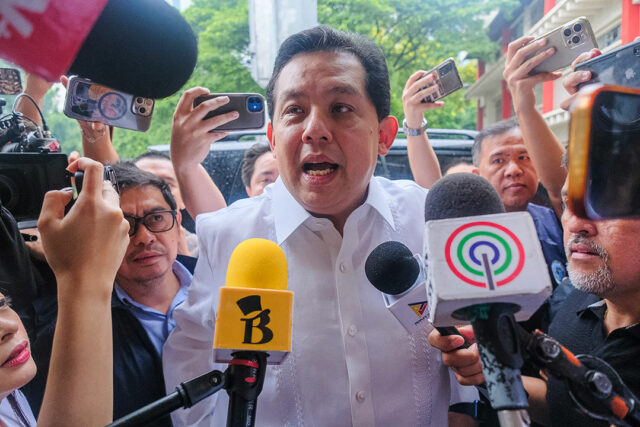
LEYTE REP. and former Speaker Ferdinand R. Martin G. Romualdez faces the media after arriving at the Taguig office of the Independent Commission for Infrastructure, which is investigating irregularities in flood-control projects. — PHILIPPINE STAR/RYAN BALDEMOR

By Erika Mae P. Sinaking

LEYTE REP. Ferdinand Martin G. Romualdez on Tuesday appeared before the Independent Commission for Infrastructure (ICI), submitting an affidavit that detailed his role in the budget process as the body pressed ahead with its probe into alleged kickbacks from flood control projects.

The former Speaker denied receiving any illegal payments for approving or facilitating government contracts, saying he was “not part of the bicameral conference committee” that finalized the national budget.

He said his decision to appear before the ICI was meant to “clarify issues and help the commission in its work.”

“My appearance demonstrates my resolve to tell the truth and keep politics from distorting it,” he said in a separate statement. He added that he wants the truth to come out — “not speculation or political theatrics.”

His testimony came a week after the ICI summoned him following allegations made by Orly Regala Guteza, a former security aide to Party-list Rep. Elizaldy S. Co. Mr. Guteza told a Senate Blue Ribbon Committee hearing that he had delivered luggage filled with cash — each allegedly worth about P48 million — to several locations, including a Taguig residence supposedly linked to the former Speaker.

Mr. Romualdez dismissed the testimony as “fabricated” and politically motivated, saying the Taguig property mentioned had been under renovation since early 2024.

“The witnesses that were presented have already been discredited for having presented falsified documents, and their testimonies have already been denied,” he told reporters after the ICI’s closed-door session.

ICI spokesman Brian Keith F. Hosaka said Mr. Romualdez’s affidavit helped clarify his role in the budget process and that of other lawmakers tied to the anomalies. He will return for a follow-up hearing as the commission continues to study the documents he submitted, he added.

Mr. Romualdez said he was ready to appear “any time” he is invited again and would submit his statement of assets, liabilities and net worth (SALN) at the commission’s request.

Budget Secretary Amenah F. Pangandaman also appeared before the ICI in a separate session, explaining how projects move from the National Expenditure Program (NEP) to the General Appropriations Act, and how the Budget department releases funds.

“We don’t really know where those insertions come from,” she told reporters. “They usually come from the departments proposing projects to the Department of Budget and Management.”

She added that the Commission on Audit should examine whether government agencies are implementing their projects properly, especially those of the Department of Public Works and Highways.

OCTA POLL
Meanwhile, a large majority of Filipinos support President Ferdinand R. Marcos, Jr.’s move to expose corruption in flood-control projects, according to an OCTA Research survey that also revealed widespread anger over misuse of public funds.

The poll, conducted from Sept. 25 to 30, found that 83% of respondents backed Mr. Marcos’ decision to reveal irregularities in the multibillion-peso flood-control program, even if it could have political consequences. Only 3% disagreed, while 13% were undecided.

Support was highest in Metro Manila (91%) and the rest of Luzon (90%), and lowest in the Visayas (64%) and Mindanao (78%).

About 60% of respondents said they felt anger or outrage over corruption in infrastructure projects, while 30% reported fear or anxiety and 9% said they felt sadness or disappointment. OCTA said anger was most pronounced among younger Filipinos and residents of Luzon and the Visayas.

OCTA said 46% trusted the newly formed Independent Commission for Infrastructure (ICI) to lead the investigation of the scandal. The Senate ranked second with 23%, followed by the House of Representatives with 13%, indicating a preference for a nonpolitical probe.

When asked about their expectations, 68% said they want corrupt officials and contractors held accountable, while 58% sought imprisonment of those found guilty and recovery of stolen or misused funds.

OCTA interviewed 1,200 adults for the poll, which had a ±3% error margin.

At a palace briefing on Tuesday, Presidential Communications Office Undersecretary Claire A. Castro said the President is determined to pursue the probe “until accountability is achieved,” but urged the public to allow investigators to complete their work.

OCTA said the results show Filipinos strongly back the anti-corruption campaign but expect visible follow-through and structural reforms to ensure transparent and efficient implementation of infrastructure projects.
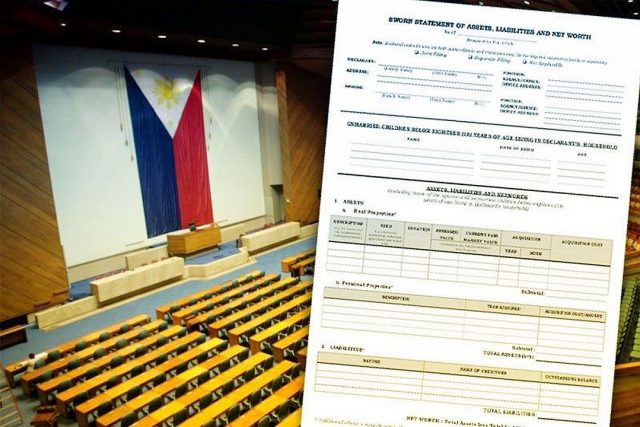

Ombudsman reopens public access to officials’ SALN

PHILSTAR FILE PHOTO

By Erika Mae P. Sinaking

THE Office of the Ombudsman has restored public access to the statements of assets, liabilities, and net worth (SALN) of government officials, reversing a restrictive policy imposed during the Duterte administration that had limited transparency for more than four years.

Under Memorandum Circular No. 3 issued on Tuesday by Ombudsman Jesus Crispin C. Remulla, the public can again request copies of SALNs, subject to safeguards that balance transparency and data privacy.

The move effectively revokes former Ombudsman Samuel R. Martires’ 2020 memo that required notarized consent from the official concerned before any SALN could be released.

The circular reinforces our constitutional duty to uphold public accountability while respecting the privacy of individuals, Assistant Ombudsman and spokesperson Jose Dominic F. Clavano IV told a news briefing.

He outlined the procedures for requesting access, including redactions of sensitive information such as home addresses, minors’ details and government-issued identification numbers.

Requesters must file a prescribed request form with valid identification. Access may be denied if the information will be used for commercial purposes, poses security threats or is linked to harassment or fictitious requests.

Each released document will carry a watermark, control number and disclaimer, and requesters must shoulder reproduction and certification costs.

Media, research institutions and other entities that publish materials derived from SALNs must provide the Ombudsman with copies or accessible links to their publications within five days of release.

Transparency advocates hailed the decision as a significant reversal of what critics called a “dark period” for public accountability. The 2020 restrictions had made it nearly impossible for journalists and watchdogs to investigate discrepancies in officials’ wealth declarations, shielding potential conflicts of interest and corruption from public scrutiny.

Mr. Remulla earlier vowed to “restore transparency” and design clear guidelines to prevent both abuse and obstruction of the public’s right to information.

Legal experts said the reform is a critical step toward rebuilding institutional trust.

“The worms of corruption thrive in the dark,” lawyer and political analyst Jesus Nicardo M. Falcis III told BusinessWorld in a Facebook Messenger chat. “Releasing the SALN will shine a light that prevents those worms from thriving and multiplying.”

Dennis V. Blanco, a political science professor at the University of the Philippines Diliman, said public access ensures accountability and allows citizens to track the financial conduct of their leaders.

“It restores the constitutional right to scrutinize how officials acquire and spend wealth,” he said in an e-mailed reply to questions. The directive must, however, be applied consistently and without political favor, he added.

Ester B. Onag, an Adamson University professor and governance analyst, said the reform reaffirms the constitutional tenet that “public office is a public trust.”

“The success of this reform will depend on how ‘reasonable access’ is defined and applied consistently across cases,” she said via Messenger chat. “At the end of the day, it is the people who will judge the actions of these officials.”

Tighter rules for unprogrammed funds sought

PHILIPPINE STAR/ MICHAEL VARCAS

By Adrian H. Halili and Chloe Mari A. Hufana, Reporters

THE PHILIPPINES’ Finance chief said the proposed 5% cap on unprogrammed funds is excessive, as the Marcos administration faced renewed scrutiny over their use amid a multibillion-peso infrastructure scandal.

“A 5% limit is too big for the National Government,” Finance Secretary Ralph G. Recto told reporters on the sidelines of a Senate budget hearing on Tuesday. “We can probably implement a benchmark — it’s something we can look into.”

Asked if a 2% threshold would be sufficient, he said: “Maybe.”

Budget Secretary Amenah F. Pangandaman earlier said she wanted to limit unprogrammed appropriations to 5% of the national budget. These standby funds can only be used if revenue collections exceed targets or if more grants or foreign funds become available.

Mr. Recto said the funds should be reserved for “unforeseen situations” such as disasters or foreign-assisted projects excluded during the budget preparation.

“The government should respond quickly [to calamities] — you cannot really program for that,” he said, adding that the President should have flexibility to release funds for emergencies.

Under the proposed 2026 national budget, unprogrammed appropriations amount to P250 billion, largely earmarked for pre-planned initiatives instead of emergency contingencies.

Major allocations include P80.9 billion for infrastructure and social programs, P97.3 billion for foreign-assisted projects, P50 billion for the Armed Forces modernization and P6.7 billion for health emergency allowances.

Meanwhile, Malacañang defended the inclusion of unprogrammed funds, saying they serve as a fiscal buffer rather than a political tool.

“The budget will be handled carefully and will not be released immediately — contrary to fears that it will become a pork barrel fund,” Palace Press Officer Clarissa A. Castro told a news briefing in Filipino.

She said the Department of Budget and Management (DBM) considers unprogrammed funds a “safety net” to supplement the National Disaster Risk Reduction and Management Council (NDRRMC) fund when disaster costs rise.

“When contingent funds are depleted, that’s when we draw from unprogrammed appropriations,” Ms. Castro said.

The House of Representatives on Monday approved on third reading the proposed P6.7-trillion General Appropriations Bill for 2026 amid criticism from the opposition. The Makabayan bloc said the measure perpetuates the “pork barrel” system that enabled misuse of public work funds.

Lawmakers removed P35 billion in unprogrammed appropriations for infrastructure, leaving P45 billion for the Strengthening Assistance for Government Infrastructure (SAGIP) and Social Programs.

House appropriations committee Chairperson Mikaela Angela B. Suansing said the adjustment aims to prevent fund diversion while maintaining support for foreign-assisted projects that require counterpart funding.

Ms. Castro dismissed opposition claims that unprogrammed funds could again be abused, noting that President Ferdinand R. Marcos, Jr. has ordered a probe into anomalies in flood-control and other infrastructure projects.

“With the President leading the probe into irregularities, we can expect even greater vigilance in managing the budget,” she said. “The administration will ensure that these funds are used properly and not wasted.”

Mr. Marcos created the Independent Commission for Infrastructure (ICI) to investigate the multibillion-peso fraud, which he flagged in his state of the nation address in July. The commission has since been holding hearings to trace irregularities in project funding.

47 protests filed vs China in 2025

Chinese dredging vessels are purportedly seen in the waters around Mischief Reef in the disputed Spratly Islands in the South China Sea in this still image from video taken by a P-8A Poseidon surveillance aircraft provided by the United States Navy May 21, 2015. — U.S. NAVY/HANDOUT VIA REUTERS/FILE PHOTO

THE PHILIPPINES has filed 47 diplomatic protests against China this year, the Department of Foreign Affairs (DFA) said amid rising tensions in the South China Sea.

During the DFA’s budget hearing on Tuesday, Foreign Affairs Secretary Ma. Theresa P. Lazaro said that the Philippines has filed 47 diplomatic protests so far in 2025, and a total of 245 since 2022.

“The latest diplomatic protest is what just happened recently in Bajo de Masinloc (Scarborough Shoal),” Ms. Lazaro told senators.

On Sunday, the Philippine Coast Guard reported that a Chinese vessel collided with a Philippine ship near Thitu Island.

Thitu, which the Philippines calls Pag-asa, is part of the resource-rich Spratly Islands. It is about 12 nautical miles (22 kilometers) from China’s air and naval base at Subi Reef. The island is the largest of the Philippine-occupied islands in the Spratlys and is the only one with a permanent civilian settlement.

Separately, the US State Department condemned China’s recent ramming of a Philippine vessel near the sea feature.

“We stand with our Philippine allies as they confront China’s dangerous actions which undermine regional stability,” US Department of State Principal Deputy Spokesperson Thomas Pigott said in a statement

Mr. Pigott added that Beijing continues to undermine regional stability and disregard prior commitments to resolve disputes peacefully.

“The United States reaffirms Article IV of the 1951 United States-Philippines Mutual Defense Treaty extends to armed attacks on Philippine armed forces, public vessels, or aircraft – including those of its Coast Guard – anywhere in the South China Sea,” he said.

Manila and Washington are treaty allies, which obligates both nations to come to each other’s aid in the event of an armed attack in the Pacific, including the South China Sea. — Adrian H. Halili

Gov’t finalizing farm road plan

PRESIDENT Ferdinand R. Marcos, Jr. inspected the nearly completed Camalaniugan Bridge in Cagayan, which cuts travel time between Aparri and Ballesteros from one hour to just 20 minutes, Oct. 14. — PCO

PHILIPPINE President Ferdinand R. Marcos, Jr. on Tuesday directed government agencies to implement a nationwide master plan for farm-to-market roads, saying the system must be reformed to ensure that infrastructure truly supports farmers and boosts agricultural output.

Speaking in Claveria, Cagayan during his Ugnayan with Farmers dialogue, he said the government has finalized a plan, mapping priority areas for road construction and rehabilitation.

“We’ve already drawn up a plan for the entire Philippines,” he said in Filipino, according to a livestreamed video on the Radio, Television, Malacañang Facebook page.

“We will also meet with our mayors and governors to ask if our plan is good, if the proposed routes for the farm-to-market roads are correct, and to hear their suggestions — which we will follow in implementing the plan.”

In a separate press briefing, Palace Press Officer Clarissa A. Castro said the plan will be rolled out immediately but did not elaborate on the details.

“He wants this done quickly. Before his term ends, he wants the project to already be completed. In fact, he hopes it will be finished before Christmas,” she said in Filipino.

The President emphasized the new plan would not cater to favoritism.

“Not like before, when it was all about favoritism. People would make requests like, ‘Put a farm-to-market road here,’ and if they were friends or party mates, it would get approved. There was no real plan. Sometimes, farm-to-market roads were built in random places that didn’t even help our farmers.”

The initiative, led by the Department of Agriculture (DA), the Department of Public Works and Highways (DPWH), and the National Irrigation Administration (NIA), aims to improve logistics efficiency and strengthen rural value chains.

Farm-to-market road initiatives have drawn corruption criticisms following the emergence of ‘ghost’ projects, widening the Philippines’ ongoing probe on public work scams.

Mr. Marcos on Monday also ordered an investigation into reports of seven ghost farm-to-market road projects in Davao Occidental worth P105 million.

The DA has submitted its findings to the President, leading to coordination between Agriculture Secretary Francisco P. Tiu Laurel, Jr. and Public Works Secretary Vivencio B. Dizon to probe the issue.

WATER IMPOUNDING DAM
Also on Tuesday, Mr. Marcos led the inauguration of the P500-million Union Water Impounding Dam in Claveria, Cagayan, a flagship infrastructure project aimed at improving irrigation, flood control and climate resilience in northern Luzon.

The project, built across the Cabicungan River in the villages of Union and Cadcadir, is expected to irrigate more than 1,050 hectares of farmland and benefit over 1,000 farmers, according to Mr. Marcos’ office.

It features slope protection and drainage systems designed to reduce river siltation and erosion while preventing flooding in agricultural zones.

The Union Dam forms part of the DPWH’s Katubigan program, implemented in partnership with NIA.

It is one of several water impounding projects in Cagayan, including those in the villages of Tabbugan and Bacsay, which together are projected to serve more than 3,000 farmers across the province, NIA Region 2 spokesperson Paula M. Pereña said, according to a statement from Mr. Marcos’ office.

CAMALANIUGAN BRIDGE
Mr. Marcos also inspected the nearly completed Camalaniugan Bridge in Cagayan, describing it as one of the country’s most visually striking and well-built bridges.

Once operational, the cable-stayed bridge—the longest of its kind in Cagayan Valley—will link the municipalities of Aparri and Camalaniugan, cutting travel time between Aparri and Ballesteros from one hour to just 20 minutes.

The bridge is expected to serve about 6,000 travelers daily.

The Camalaniugan Bridge, which began construction in May 2020, is 99% complete as of September 30, according to Mr. Marcos’ office.

The new structure will serve as an alternate route to the Magapit Suspension Bridge—currently the only crossing over the Cagayan River in the area—and is expected to ease traffic, boost trade, and lower transport costs for goods and commuters.

Mr. Marcos noted that the bridge’s completion would complement the nearby Aparri Port, facilitating faster cargo movement across northern Cagayan. — Chloe Mari A. Hufana

Customs reforms underway

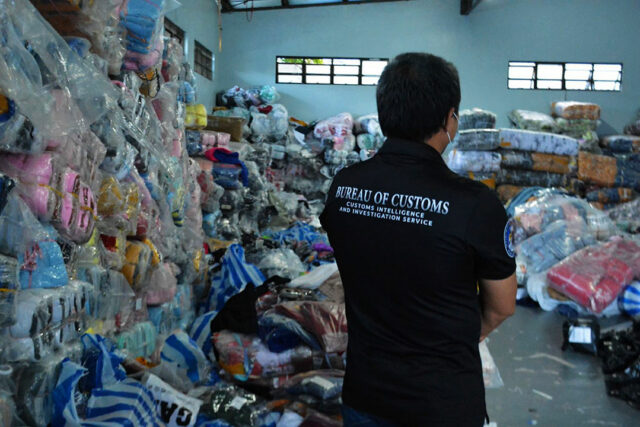
MEMBERS of the Bureau of Customs-Customs Intelligence Investigation Service inspect various counterfeit shirts, perfumes and other luxury goods at a warehouse in Las Piñas City. — PHILIPPINE STAR/MIGUEL DE GUZMAN

PRESIDENT Ferdinand R. Marcos, Jr. is banking on sweeping reforms at the Bureau of Customs (BoC) to bolster US confidence in his administration’s anti-corruption campaign, the Palace said on Tuesday.

Palace Press Officer Clarissa A. Castro said the reforms are a direct response to the President’s directive to eliminate corruption and restore the integrity of government institutions.

“President Marcos has made it clear that fighting corruption is a top priority,” she told a Palace briefing in Filipino.

This comes after the US State Department named the BoC as one of the most corrupt agencies in the Philippines, hindering the entry of more American investments.

Ms. Castro touted that the BoC, under newly appointed Commissioner Ariel F. Nepomuceno, has achieved a 96.99% digitalization rate and rolled out systems to track overstaying cargo and streamline travel documentation.

The BoC has also tightened conflict-of-interest rules, prohibiting officials and their relatives up to the fourth degree from engaging in customs brokerage or related businesses.

Ms. Castro said the bureau has been coordinating with the American Chamber of Commerce and the US Embassy, through the Department of Foreign Affairs, to highlight these reforms and demonstrate that the Philippines is serious about ensuring transparency, accountability, and professionalism in its trade processes.

“With the progress we’ve seen and the reforms now in place, we can expect a positive response from the US State Department,” she added.

The Marcos administration’s Customs overhaul comes amid broader efforts to attract foreign investment and strengthen ties with key trading partners by addressing long-standing issues of inefficiency and corruption in government agencies.

Meanwhile the BoC on Tuesday said that it is looking to strengthen anti-smuggling measures, citing the low conviction rate for the smuggling of illicit products in the country.

“We have agreed to have a joint effort, starting with case investigation to case buildup, because we recognized that a lot of cases filed I court have been dismissed due to documentation issues,” Mr. Nepomuceno said in a budget hearing.

He added that the BoC is also looking to enter into a public and private partnership to fully digitalize its operations. — Chloe Mari A. Hufana and Adrian H. Halilli

DBM OKs P5-B cash aid release

PHILIPPINE STAR/ MICHAEL VARCAS

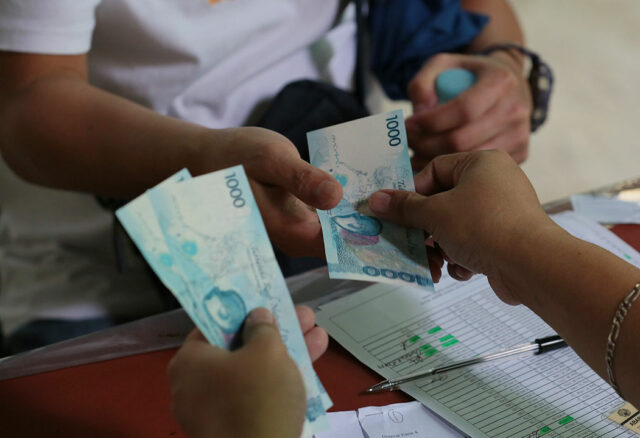
THE Department of Budget and Management (DBM) has approved the P5-billion release to the Assistance to Individuals in Crisis Situations (AICS) program.

In a statement on Tuesday, the DBM said the AICS fund release is set to help more than 411,000 beneficiaries from October up to the rest of the year.

The AICS program provides medical assistance, burial, transportation, education, food assistance, and cash relief assistance to a person or family in need.

Budget Secretary Amenah F. Pangandaman said the allocation aims to address the budget deficiency under the Protective Services for Individuals and Families in Difficult Circumstances component of the Department of Social Welfare and Development.

“This latest fund release underscores the importance of unprogrammed appropriations as fiscal buffers that enable the government to respond swiftly to social and humanitarian emergencies,” she said.

This came as the House of Representatives lawmakers refused to sign the P6.793-trillion national budget for 2026 amid calls to scrap the P35 billion allotted for unprogrammed appropriations.

Ms. Pangandaman explained that unprogrammed appropriations are not “discretionary or secret funds,” but standby allocations duly authorized and approved by Congress.

“These funds can only be accessed when there are excess or windfall revenues, new revenue measures, or valid loan agreements for foreign-assisted projects,” she said. — Aubrey Rose A. Inosante

Expanded education voucher program hurdles House

PHILSTAR FILE PHOTO

THE House of Representatives on Monday passed on final reading a bill expanding the government’s private education voucher program, aiming to boost access to quality education across the country.

With 287 votes in favor, three against and two abstentions, the chamber passed House Bill No. 4744, which seeks to expand the state’s education voucher program to include kindergarten and elementary students.

The bill also proposes the creation of a private education bureau that would oversee and regulate the expanded voucher program.

“Public and private schools are not competitors but partners in nation-building,” Pasig Rep. Roman T. Romulo, who heads the House Education Committee, said in a statement on Tuesday. “Together, they ensure that all Filipinos have access to quality education.”

The proposal is a priority measure by the Marcos administration. Its passage revived a similar bill previously approved in the 19th Congress but left unenacted due to time constraints. — Kenneth Christiane L. Basilio

Senator wants probe of schools’ quake preparedness

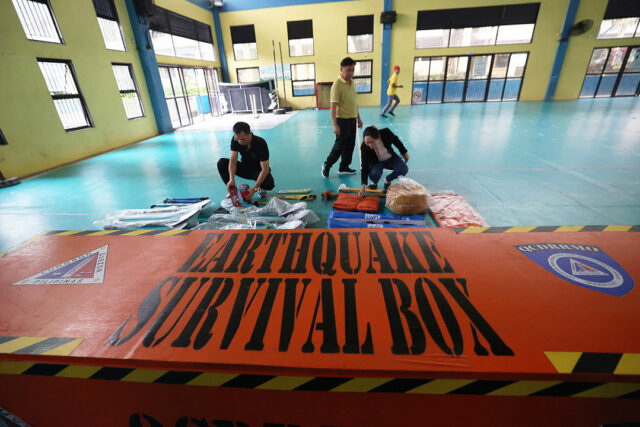
QUEZON CITY High School (QCHS) Disaster Risk Reduction and Management Council and faculty members checked the various equipment in the Earthquake Survival Box provided by the local government inside the QCHS gym as part of their disaster preparedness, Oct. 14. — PHILIPPINE STAR/MIGUEL DE GUZMAN

A SENATOR on Tuesday called for a Senate inquiry into the structural integrity of local schools in the event of strong earthquakes, after consecutive tremors rocked the country.

“It is important to know how prepared and resilient our schools are to strong earthquakes for the safety of students, teachers, parents, and others who work in schools,” Senator Paolo Benigno “Bam” Aquino IV said in a statement.

He added that the potential probe will determine the extent of the damage caused by recent earthquakes and the measures being implemented by concerned agencies to ensure that affected schools can safely resume classes.

Mr. Aquino said that he is planning to file a resolution in the upper chamber to formalize the Senate probe.

“We also need to know the actions taken by government agencies to repair school buildings and classrooms so that our students can use them as soon as possible and so that their studies are not interrupted,” he added.

The senator said that he also seeks to tackle potential measures to strengthen disaster preparedness and resilience in schools.

It includes regular safety inspections, the regular conduct of earthquake drills and evacuation protocols, and the placement of earthquake emergency kits.

Mr. Aquino added that he will also push for an additional budget for the Education department for the inspection and assessment of public-school buildings to ensure their structural integrity.

“Let’s not gamble with the lives of our countrymen. It is better to ensure the preparedness and safety of our school buildings against earthquakes,” he said.

Successive earthquakes rocked various parts of the country recently, causing death and extensive property damage. — Adrian H. Halili

Lawmaker backs suspension of fines on temporary plates

Vehicles are stuck in traffic along EDSA-Taft in Pasay City, May 20, 2025. PHILIPPINE STAR/RYAN BALDEMOR

A CONGRESSMAN on Tuesday urged the government to keep the suspension of penalties on drivers using temporary plates, citing the unresolved backlog in official license plate issuance.

“Before we talk about imposing fines, let’s first make sure the system is in order,” Deputy Majority Leader and Party-list Rep. Ramon Rodrigo “Rodge” L. Gutierrez said in a statement.

Land Transportation Office chief Markus V. Lacanilao on Monday ordered the suspension of an order implementing a fine on those using temporary plates.

“This decision reflects a commitment to fairness and responsiveness to the needs of our constituents,” said Mr. Gutierrez, adding that the suspension could pave the way for the agency to come up with solutions to ensure the timely delivery of plate releases.

The government had resolved the backlog in vehicle license plates that had accumulated since the past decade, then-Transportation Secretary Vivencio B. Dizon said in July. — Kenneth Christiane L. Basilio

PDEA shuts down two drug dens in central Mindanao

COTABATO CITY — Anti-narcotics agents arrested six drug peddlers and shut down two clandestine drug dens in separate operations in two central Mindanao provinces in two days.

Three drug den operators were arrested by agents of the Philippine Drug Enforcement Agency-Bangsamoro Autonomous Region in Muslim Mindanao (PDEA-BARMM) during an entrapment operation on Monday, in Barangay Salimbao in Sultan Kudarat, Maguindanao del Norte.

Gil Cesario P. Castro, director of PDEA-BARMM, told reporters on Tuesday, that the three suspects were immediately detained by their agents after they sold P34,000 worth of crystal meth (shabu) right in the premises of their drug den in Barangay Salimbao.

Mr. Castro said the operation was laid with the help of Maguindanao del Norte Gov. Tucao O. Mastura and Vice Gov. Marshall I. Sinsuat, who had separately warned last week to flex their connections and powers as elected officials in addressing shabu and marijuana trafficking in the 12 towns under their jurisdiction.

Mr. Castro said Brig. Gen. Jaysen C. De Guzman, director of the Police Regional Office-Bangsamoro Autonomous Region, also assisted the entrapment operation in Barangay Salimbao that led to the arrest of the three suspects and the immediate shutdown of their drug den in the area.

Benjamin C. Recites III, director of PDEA-12, also announced on Tuesday that their agents and operatives under the Police Regional Office-12 (PRO-12) had clamped down three den operators in an entrapment operation in Barangay Malandag in Malungon, Sarangani last Saturday.

Mr. Recites said all three suspects yielded peacefully when they sensed that they had sold P54,400 worth of shabu to non-uniformed PDEA-12 agents and policemen under PRO-12’s director, Brig. Gen. Arnold P. Ardiente, inside their drug den in Purok Adelfa in Barangay Malandag.

Mr. Recites said the drug den is now guarded by barangay officials and volunteer community watchmen. — John Felix M. Unson

P6.3-M cannabis shrubs torched in Benguet

BAKUN, BENGUET — Philippine Drug Enforcement Agency (PDEA) and policemen torched at least P6.36 million worth of fully grown marijuana plants in a joint eradication operation in Barangay Kayapa, Bakun, Benguet on Monday.

The operation, carried out from early morning until evening, marks a significant blow against illegal drug cultivation in the area.

Starting at 7 a.m. Monday, operatives led by PDEA-La Union and joined by Bakun, Benguet policemen, PDEA Pangasinan, PDEA Baguio and Benguet and the Provincial Drug Enforcement Unit of the Benguet police, trekked rugged terrain and cleared two separate marijuana plantation sites until 9 p.m.

At least 3,506 square meters with a total of 31,800 fully grown marijuana plants were uprooted, then torched.

PDEA Regional Director Atty. Benjamin G. Gaspi believed “(their) operation dealt a heavy financial loss to those behind the illegal plantations and demonstrated the authorities’ capability to strike even in remote areas.”

He added: “This successful operation is part of PDEA’s intensified campaign against illegal drug sources. Our continued collaboration with local police units ensures that no area will serve as a safe haven for illegal drug activities.” — Artemio A. Dumlao