Home Blog Page 4730

National Government fiscal performance

THE NATIONAL Government’s (NG) budget surplus ballooned to P66.8 billion in April from P4.9 billion a year ago, as revenue growth outpaced expenditures, data from the Bureau of the Treasury (BTr) showed. Read the full story.

National Government fiscal performance

How PSEi member stocks performed — May 29, 2023

Here’s a quick glance at how PSEi stocks fared on Monday, May 29, 2023.


Narrower current account deficit seen this year

STOCK PHOTO | Image by Marcos Marcos Mark from Pixabay

The country’s current account deficit could narrow this year amid lower commodity prices, but weaker exports due to a slower global economy may keep the balance in deficit, analysts said.

Makoto Tsuchiya, assistant economist from Oxford Economics Japan, said the firm expects the current account deficit as a percentage of gross domestic product (GDP) to settle at 2.7% this year and 3.3% in 2024.

Both forecasts are more optimistic than the projections of the Bangko Sentral ng Pilipinas (BSP), which sees a $17.1-billion deficit (4% of GDP) for this year and $16.8 billion (3.4% of GDP) for 2024.

“The forecast represents an improvement from last year given lower commodity prices, but the balance will remain in deficit given slowing goods exports on the back of weaker global economic outlook and the lower demand for electronics, particularly semiconductors, amid an IT cycle downturn,” he said.

The BSP reported a current account deficit of $17.8 billion in 2022, higher than the $5.9-billion deficit  year earlier, as the trade in goods deficit widened.

China Banking Corp. Chief Economist Domini S. Velasquez said the current account deficit may narrow over the coming months due to a lower trade deficit.

“Merchandise exports likely bottomed out in the first quarter and will improve moving forward. Recent trade data showed Chinese export demand picking up which will likely continue through the rest of the year,” she said in a Viber message.

The trade-in-goods deficit in March widened to its highest level in two months as exports and imports continued to fall.

The Philippine Statistics Agency (PSA) reported that the trade-in-goods balance was in deficit by $4.93 billion in March, expanding from the $3.91-billion deficit in the preceding month and the $4.59-billion deficit a year earlier.

Goods exports declined 9.1% year-on-year to $6.53 billion in March, reversing the 6% growth posted a year earlier, while imports dropped 2.7% year-on-year to $11.46 billion, a turnaround from the 23.4% growth posted in March 2022.

For the first quarter, exports declined 13.2% to $16.86 billion, while imports slipped 3.3% to $31.44 billion. This brought the trade deficit to $14.58 billion in the quarter, wider than the $13.08-billion deficit posted a year earlier.

“In lieu of the weak merchandise exports this year, we expect the trade deficit to receive support from improving services exports led by BPOs (business process outsourcing companies) and tourism. Also, imports will be softer this year, as oil prices settle lower,” Ms. Velasquez said.

She added that dollar reserves are above $100 billion. This would allow the Philippines to meet its external debt obligations and provide the BSP with the tools to mitigate excess volatility in the peso.

The BSP reported dollar reserves edging higher to $101.8 billion at the end of April, from $101.5 billion at the end of March.

Rizal Commercial Banking Corp. Chief Economist Michael L. Ricafort said the recent decline in prices of key global commodities which the Philippines imports could lead to a narrower current account deficit this year.

These commodities include crude oil, other energy items, and industrial metals.

“At the same time, the continued growth in the structural dollar inflows…would also help narrow the current account deficit going forward,” he said.

Mr. Tsuchiya said a weaker-than-expected global economy, weak Philippine exports, risks to the tourism sector and slower growth in cash remittances may negatively affect the current account balance.

“If the global economy slows further than we expect, and consequently Philippine goods exports are weaker than expected, then this will bring the current account balance deeper into deficit,” Mr. Tsuchiya said.

He said a deterioration in the current account deficit will have various effects on monetary policy.

“Deeper deficit will put downward pressure on the peso, which in turn might constrain the BSP’s move to cut rates, as it will lead to further deprecation of the currency if it results in narrower interest rate differential with the Fed,” he said.

The Monetary Board kept its benchmark interest rate unchanged at 6.25% on May 18. This is the first time it has left rates untouched after nine meetings.

Since it began its monetary tightening cycle in May 2022, the BSP has raised borrowing costs by a total of 425 basis points (bps). The BSP will next discuss policy settings on June 22.

On the other hand, the Federal Reserve raised borrowing costs by 500 bps since March 2022, bringing the Fed funds rate to 5-5.25%. The Fed is set to meet on June 13-14.

“Fiscal implications are also important, as the Philippines already suffers from its status as a twin deficit economy. Although Fitch Ratings recently upgraded the outlook for the Philippines to stable from negative, a wider current account deficit will increase pressure on the government to compress its fiscal debt,” Mr. Tsuchiya added.

The Bureau of the Treasury reported that the fiscal deficit narrowed 14.51% year-on-year to P270.9 billion in the three months to March.

The government had projected the deficit for the period at P298.705 billion.

This year, the government set the budget deficit ceiling at P1.499 trillion, equivalent to 6.1% of GDP.

Meanwhile, in its rating action commentary last week, Fitch Ratings said it sees the current account deficit narrowing to 2.3% of GDP in 2024.

“We expect the current account (CA) deficit to narrow to 2.3% of GDP (about $11 billion) by 2024, from an estimated 4.4% of GDP (nearly $18 billion) in 2022, reflecting mainly a falling hydrocarbon import bill, which accounted for the spike in the CA deficit in 2022,” it said.

However, the current account deficit will persist amid robust domestic demand and the government’s infrastructure push.

A significant deterioration in gross international reserves and net external creditor position due to a more persistent current account deficit may lead to a rating downgrade, Fitch Ratings said.

Last week, the credit rater kept the Philippines’ long-term foreign currency issuer default rating at “BBB” and upgraded its outlook to stable from negative. — Keisha B. Ta-asan 

BoC gearing up for increased EU trade

THE Bureau of Customs (BoC) said it is getting ready for strengthening trade and investment between the Philippines and Europe by making transactions more seamless.

In a statement on Monday, the BoC said it has entered into a partnership with the European Union (EU)-ASEAN Business Council and the European Chamber of Commerce of the Philippines.

“This collaboration represents a significant milestone in our efforts to strengthen economic ties with European businesses. By enhancing our modernization program and streamlining our processes, we aim to create a seamless and efficient trade environment that benefits both parties,” Commissioner Bienvenido Y. Rubio said.

The BoC is working on “fostering a conducive business environment, facilitating trade, and promoting mutual prosperity between the Philippines and its European partners.”

“With this collaboration, it aims to position the Philippines as a premier destination for European businesses, creating opportunities for both regions,” it added.

The BoC is also working on transitioning to paperless transactions and streamlining clearance processes for donations during calamities.

On Thursday, President Ferdinand R. Marcos, Jr. called for the resumption of free trade talks with the EU. The negotiations officially started in 2016 but were suspended a year later. — Luisa Maria Jacinta C. Jocson

British Chamber sees electronics, fruits gaining from trade scheme

REUTERS

THE British Chamber of Commerce Philippines (BCCP) said the UK’s new trade scheme will benefit Philippine products like electronics and processed fruit with the launch of a new trading scheme on June 7.

BCCP Executive Director Chris Nelson said that the Philippines could climb the ranks of UK trading partners with the launch of the Developing Countries Trading Scheme (DCTS).

“There is significant trade in electronics, coconut oil, processed fruit, and spectacle lenses. Currently, the Philippines is ranked 64th in terms of the trade with the UK. I can see that going up significantly,” Mr. Nelson said.

UK government data puts Philippine exports to the UK at 2.4 billion pounds in 2022, up 26%.

The DCTS will replace the UK’s Generalized System of Preferences trading scheme. The new trading scheme will benefit 65 developing countries.  

“The DCTS will be removing 150 of the tariff lines. It will cover an area of over 3.3 billion people. Particularly for the Philippines, it will continue to grow trade that’s already doing extremely well,” Mr. Nelson said.

“The Philippine economy will continue to grow and do well, and that’s also supported by the various economic reforms that have occurred, and we see further liberalization occurring,” Mr. Nelson added. — Revin Mikhael D. Ochave

Budget dep’t threatens to deny funding in 2024 to underspending agencies

BUDGET SECRETARY AMENAH F. PANGANDAMAN — COURTESY OF DEPARTMENT OF BUDGET AND MANAGEMENT FACEBOOK PAGE

THE Department of Budget and Management (DBM) said government agencies need to ramp up their spending after noting the slower pace of budget utilization.

“We want to remind our agencies to avoid underspending, given our very limited fiscal space. Again, we need to instill discipline in our National Government agencies or we shall put the money into agencies which can really implement them,” Budget Secretary Amenah F. Pangandaman said in a statement.

“As early as the start of the year, we emphasized that only implementation-ready proposals will be included in the 2024 budget,” she added.

At the end of April, the budget utilization rate was at 90%, equivalent to P1.18 trillion worth of notices of cash allocation (NCAs) issued during the period. This was behind the 92% pace set a year earlier.

Unused allocations totaled P128.07 billion at the end of April.

NCAs are a quarterly disbursement authority that the DBM issues to agencies, which allows them to withdraw funds from the Treasury to support their spending needs.

The DBM had released 85.8% or P4.52 trillion of the 2023 national budget at the end of April, leaving P749.85 billion for the remainder of the year.

This was slightly ahead of the year-earlier pace of 85.6%.

Releases to government agencies and departments totaled P2.98 trillion, or 94.8%.

“We all know that our national budget is the lifeblood of all government programs and projects. The faster we disburse and utilize our funds, the faster we can procure and implement our projects,” Ms. Pangandaman added. — Luisa Maria Jacinta C. Jocson

New weighbridges open on NLEX

NLEX

NLEX Corp. said it opened new weighbridges in Porac, Pampanga and Concepcion, Tarlac to help truckers avoid overweight fines along the company’s toll roads.

A privately-operated weighbridge has also opened along the Subic-Clark-Tarlac Expressway (SCTEX) in Dinalupihan, Bataan, it said.

The private weighbridge, operated by ACB Truck Scale Services, is open between 8 a.m. and 5 p.m., charging fees of P400-P600 fee depending on truck type.

“Having these weighbridge sites in place will help reduce overloading incidents which threaten the safety of motorists as extra load may affect the driver’s control of the vehicle,” the company said in a statement.

“This will also protect roads from further damage and improve the efficient movement of cargoes,” it added.

“Additional weighing stations are planned for SCTEX Floridablanca and Dinalupihan, and NLEX Marilao, Mindanao, and Karuhatan,” the company said, referring to the North Luzon Expressway toll road.

The expressway has 12 stations along with four satellite locations in partnership with private firms.

The private stations are TAG Metal Weighbridge at Ninoy Aquino Highway in Mabalacat, Pampanga; the Clark Development Corp. Weighbridge at Clark Freeport in Mabalacat, Pampanga; the Subic Bay International Corp. Weighbridge at San Bernardino Road in the Subic Bay Freeport Zone, and the Mega Subic Terminal Services, Inc. Weighbridge at the NSD Compound at the freeport.

Republic Act No. 8794 or An Act Imposing a Motor Vehicle User’s Charge on Owners of all Types of Motor Vehicles and for Other Purposes, regulates vehicle weights on the roads.

A 33-ton weight limit is also in force on the southbound lanes of the Candaba Viaduct, a key bottleneck on the highway system where the road narrows to traverse the Candaba swamp, NLEX said.

NLEX Corp. is a subsidiary of Metro Pacific Tollways Corp., the toll road arm of the Metro Pacific Investments Corp., one of three key Philippine units of Hong Kong-based First Pacific Co. Ltd., the others being Philex Mining Corp. and PLDT, Inc.

Hastings Holdings, Inc., a unit of PLDT Beneficial Trust Fund subsidiary MediaQuest Holdings, Inc., has a majority stake in BusinessWorld through the Philippine Star Group, which it controls. — Justine Irish D. Tabile

House approves salt industry rehab bill on 3rd reading 

PHILIPPINE STAR/EDD GUMBAN

THE House of Representatives said it approved on third reading a bill seeking to revive the Philippine salt industry.

At Monday’s plenary session, the vote was unanimous with 287 legislators supporting House Bill No. 8278.

The proposed measure calls for the creation of a Philippine Salt Industry Development Roadmap (PSIDR), which will propose programs, projects, interventions, and incentives to increase salt production.

The PSIDR also aims to promote public and private investment in salt industry development.

The bill also seeks to create the Philippine Salt Industry Development Council with the Agriculture Secretary as chairman and the Trade Secretary as co-chair.

The bill classifies salt as an agricultural product, giving the Department of Agriculture (DA) jurisdiction over the industry. It is currently overseen by the Department of Environment and Natural Resources.

All salt produced or manufactured in the Philippines both for the domestic market and for export will be labeled “Made in the Philippines” in a “prominent and conspicuous” manner in compliance with Republic Act No. 7394 or the Consumer Act of the Philippines.

Priority areas for salt production will be provinces with type 1 climates like, namely Ilocos Norte, Ilocos Sur, La Union, Pangasinan, Zambales, Bataan, Occidental Mindoro, Palawan, Antique, and Marinduque.

It also defines small-scale salt farms as being not more than three hectares, medium-scale farms as up to 50 hectares, and large-scale farms as up to 500 hectares. It caps at 1,000 hectares a salt farm owned or leased by an association, cooperative or corporation.

The DA’s Bureau of Fisheries and Aquatic Resources will be placed in charge of applications for salt farm leases under the bill.

The proposed law also gives salt farmers and processors priority access to credit and guarantee schemes from government financial institutions. — Beatriz Marie D. Cruz

BIR’s transfer pricing audit history

In our previous article “BIR transfer pricing audits — the next wave?,” we looked into Revenue Audit Memorandum Order (RAMO) No. 1-19 which is the current regulation in force when it comes to Transfer Pricing (TP) audits. The RAMO explained in detail how the Bureau of Internal Revenue intends to conduct its audit of related-party transactions.

In my experience so far, only a few BIR officers have tried to include TP findings in their tax investigations, or at least discussed how related party transaction (RPT) prices are derived. Because the RAMO was introduced in 2019, no TP controversies have reached the courts as yet.

Confucius once said that anyone who wants to define the future must study the past, because without history, there is no future. As such, any glimpse into the future of TP audits should begin with a study of what came before. What can taxpayers glean from past TP cases in preparing for TP audits in the future?

BURDEN OF PROOF LIES WITH THE TAXPAYER
In a 2005 Court of Tax Appeals (CTA) case, the BIR used the taxpayer’s documents to scrutinize the prices of products sold to both related and unrelated parties. Based on the documents, the BIR concluded that the taxpayer did not declare all its export sales, based on the price comparison it conducted.

The requirement of scrutinizing taxpayer documents has been reiterated in the RAMO guidelines. Among the initial audit steps is for the BIR to schedule a meeting with the taxpayer to gain an understanding of the taxpayer’ data with respect to its transactions with related parties and transfer pricing policy. Examination of contracts, audited financial statements, income tax returns, and BIR Form No. 1709 (Information Return on Transactions with Related Party), among others, must be conducted to collect additional information.

More importantly, the BIR may request and analyze the taxpayer’s TP documentation (TPD) especially if the taxpayer is required to maintain such files based on the criteria set by the BIR. Compliant TPD must be contemporaneous. This means that it is brought into existence at the time the related parties develop or implement any arrangement that might raise transfer pricing issues, or review these arrangements when preparing tax returns, or not later than the deadline to file the annual income tax return.

Since the taxpayer has the burden to prove that the related-party transactions comply with the TP rules, it is best for the taxpayer to maintain TPD and other relevant records and have these ready for a possible TP audit.

COMPARABILITY AND FAR ANALYSIS
In a 2005 CTA case, the BIR asked a taxpayer why prices offered to foreign affiliates were lower than domestic prices. The taxpayer explained that the domestic selling price is not a benchmark price for export sales because export and domestic markets are different. For one, the export market is competitive while the domestic market is a captured market. Another reason is that to beat quotes of other sellers with lower production costs than those of the Philippines, the taxpayer offers lower mark-ups on export products in order to get the business and in the process maximize the utilization of its production facilities. Finally, the taxpayer said export sales maximize productivity, which in turn results in a lower unit cost of production as fixed overhead is spread over larger volumes.

The above reasons were found by the Court to justify setting a lower price for exports. Thus, the Court ruled in favor of the taxpayer.

The RAMO guidelines provide that the BIR officer conducting the audit should be able to draw conclusions about the characteristics of the taxpayer’s business and the functions performed by related parties, and to examine the appropriateness of the remuneration received by the taxpayer and related parties relative to the functions performed, assets used, and risks borne by each party through review and analysis of accounting data, interviews, plant tours and site visits.

The BIR may also perform a comparability analysis. That is the audit in transfer pricing that compares the condition of related-party transactions and that of independent transactions. Accordingly, the taxpayer should include in its documents reasons that make commercial sense if there are differences in the pricing policies. 

In summary, taxpayers should be thoroughly familiar with the characteristics of their products or services and their comparability with other products or services offered to independent parties or offered in an independent transaction. Understanding the functions, assets, and risks is crucial because this would lead to the correct characterization of the taxpayer’s business operations and expected level of return.

BE FAMILIAR WITH THE TP RULES
In a 1995 CTA case, the BIR alleged that the taxpayer overstated its cost of goods due to the transfer pricing of products to its mother corporation. Specifically, the BIR alleged that a fourth-generation antibiotic should not be allowed to incur costs of improvement eight times higher than its supposed precursor, doxycycline, a third-generation antibiotic.

The taxpayer was able to demonstrate the physical characteristics and circumstances involved in the production of minocycline, a completely different kind of antibiotic from doxycycline, with each one having a separate and unique chemical structure and production process. Also, the development costs of both antibiotics are different. The taxpayer contended that there is no sufficient basis to compare the two as they are not in the same generation of antibiotics. The taxpayer explained that the cost of improvement for minocycline should be gauged against another fourth-generation tetracycline developed likewise from Declomycin in order to produce comparable and reliable data.

In this case, the taxpayer challenged the transfer pricing method used by the BIR in deriving its TP findings. Needless to say, taxpayers should be familiar with the tax rules so they can intelligently defend their related party transactions, TP policy and TPD.

Under the RAMO guidelines, specific rules need to be followed by the taxpayer and BIR examiners. These include the selection of TP methods. In the antibiotic case, the BIR was imposing the comparable uncontrolled price (CUP) method in determining the arm’s-length price. However, the same seems not applicable because of the differences in the characteristics and circumstances surrounding the taxpayer’s products, which could have a material impact on the price of goods.

KNOW MORE ABOUT TP AUDIT PREPARATION
P&A Grant Thornton will be offering a free webinar on June 20, 2023, “Am I TP audit ready?” We hope we can help taxpayers in preparing their companies for possible TP audits in the future. Join us in our discussion.

Let’s Talk TP is an offshoot of Let’s Talk Tax, a weekly newspaper column of P&A Grant Thornton that aims to keep the public informed of various developments in taxation. This article is not intended to be a substitute for competent professional advice.


Marie Fe F. Dangiwan is a director from the Tax Advisory & Compliance division of P&A Grant Thornton, the Philippine member firm of Grant Thornton International Ltd.

pagrantthornton@ph.gt.com

Philippines to hold first three-way sea exercises with US and Japan

PHOTO FROM PHILIPPINE COAST GUARD

By Kyle Aristophere T. Atienza, Reporter

THE PHILIPPINES will hold its first-ever three-way maritime exercises with the United States and Japan off the waters of Mariveles, Bataan this week.

During the drills on June 1 to 7, the Philippine Coast Guard will deploy BRP Melchora Aquino, BRP Gabriela Silang, BRP Boracay and a 44-meter multi-role response vessel, it said in a statement.

The US Coast Guard will deploy a  418-foot Legend-class cutter, while Japan’s Coast Guard will send an Akitsushima-class patrol vessel, it added.

The Philippine Coast Guard (PCG) said the trilateral maritime exercise seeks to strengthen interoperability through communication exercises, maneuvering drills, photo exercises, maritime law enforcement training, search-and-rescue and passing exercises.

Participating coast guard personnel will demonstrate a scenario involving a suspected vessel involved in piracy, it said.

The joint law enforcement team from the three coast guards will carry out a boarding inspection followed by a search-and-rescue operation.

“The US Coast Guard and Japan Coast Guard have been assisting us in our human resource development program, particularly in law enforcement training,” Philippine Coast Guard Vice Admiral Rolando Punzalan Jr. said in the statement. “This is a good opportunity to thank and show them what our personnel learned from their programs.”

He said the weeklong exercise would also involve a sporting event to strengthen the three coast guards’ camaraderie, a special interest exchange for women in maritime law enforcement and an expert exchange for the Philippine Coast Guard personnel’s professional development.

PCG spokesman Armand Balilo said the trilateral exercises have nothing to do with China’s aggression in Philippine-claimed territories in the South China Sea.

“This is search and rescue and law enforcement. It has nothing to do with the West Philippine Sea,” he told reporters, referring to areas of the sea within the Philippines’ exclusive economic zone.

Japanese news outlet Japan Times reported earlier this year a tripartite security agreement between the Philippines, US and Japan had been agreed in principle during President Ferdinand R. Marcos, Jr.’s visit to Tokyo in February.

The Philippine leader said it is “part of an ongoing process that we are undertaking to make more solid partnerships and alliances that we are beginning to put together in our area.”

The US and Japan have backed the Philippines in its sea dispute with China, whose increased assertiveness in the South China Sea has worsened tensions.

The US and Philippines were also looking forward to a three-way security partnership with Australia.

A four-way security dialogue among the US, Japan, Australia and India and the so-called Group of Seven (G7) supported Mr. Marcos “on his position to adhere to the international rules-based order and maintain peace and stability in the region,” the Presidential Communications Office said in a statement on May 26, citing a May 20 letter of Japanese Ambassador to the Philippines Kazuhiko Koshikawa.

The leaders underscored their commitment to strengthen coordination with regional partners, including the Association of Southeast Asian Nations (ASEAN), to maintain a free and open Indo-Pacific region, the palace said.

G7 countries include Canada, France, Germany, Italy, Japan, the United Kingdom and US.

Mr. Koshikawa said the G7 leaders have stressed that China’s expansive claims in the South China Sea have no legal basis, opposing its “militarization in the region.”

“Significantly, the leaders reiterated the legally binding arbitral tribunal award rendered on July 12, 2016 as a significant milestone as a basis for peaceful [resolution] of disputes between the parties,” according to his letter.

“Furthermore, they affirmed the importance of peace and stability across the Taiwan Strait, and agreed to foster resilience to economic coercion.”

During the four-way meeting, Japan’s Foreign Ministry said Prime Minister Fumio Kishida had expressed serious concerns about attempts to change the status quo by force or coercion in the Indo-Pacific, including the East and South China Seas, the presidential palace said.

Police arrest 24,000 illegal drug suspects in more than 18,000 raids

PHILIPPINE STAR/MIGUEL DE GUZMAN

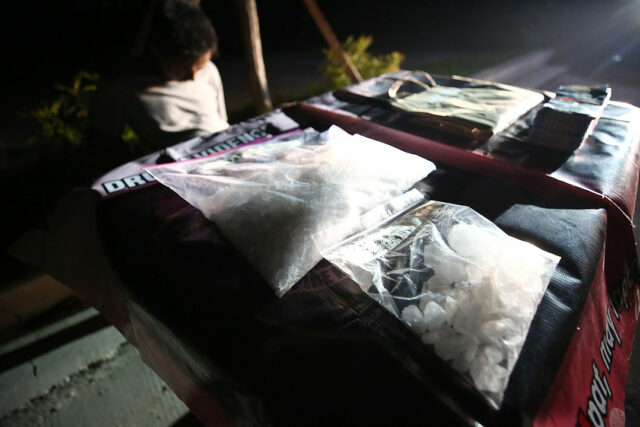
PHILIPPINE police have arrested 24,197 suspects in more than 18,000 anti-illegal drug raids this year, according to authorities.

Police had seized P6.05 billion ($110 million) worth of illegal drugs as of May 27, national police chief General Benjamin C. Acorda, Jr. told a livestreamed news briefing on Monday. He did not say how many died.

He added that the agency would continue investigating cops to ensure they remain clean. “We will continue vetting and investigating the backgrounds of our drug enforcement officers to make sure that none of them turn to the wrong path,” he said in mixed English and Filipino.

Earlier this month, Interior Secretary Benjamin C. Abalos, Jr. said a five-man advisory panel had recommended the filing of criminal and administrative charges against four senior police officers over their alleged ties to the illegal drug trade.

He earlier called on all colonels and generals to resign after a probe found many top police officers were involved in illegal drugs. Almost a thousand senior police officers had submitted their courtesy resignations, Mr. Abalos told a news briefing on May 8.

The five-man advisory panel is composed of former national police chief Rodolfo S. Azurin, Jr., former police officer now Baguio City Mayor Benjamin B. Magalong, ex-Defense Secretary Gilberto C. Teodoro, retired police Major General  R. Nerez and retired Court of Appeals Associate Justice Melchor Quirino C. Sadang.

At least 25 police officers have been charged with murder in connection with ex-President Rodrigo R. Duterte’s anti-illegal drug campaign, Justice Secretary Jesus Crispin C. Remulla told the United Nations (UN) Human Rights Council in November. An inter-agency task force on extralegal killings investigated at least 17,000 cops.

The Philippines has accepted more than 200 recommendations from the United Nations Human Rights Council, including investigating extralegal killings and protecting journalists.

Police seized P30.9 billion worth of illegal drugs in 37,000 raids last year, the presidential palace said in February, citing a Philippine Drug Enforcement Agency report. More than 53,000 drug suspects were arrested during the raids.

The Interior and Local Government department on May 7 declared at least 17 municipalities in the Zamboanga Peninsula in southern Philippines drug-free.

Earlier this month, the agency partnered with the United States Agency for International Development (USAID), along with the Department of Health to reduce illegal-drug use and demand at the local level.

The International Criminal Court (ICC) in January reopened its probe of Mr. Duterte’s campaign against illegal drugs, saying it was not satisfied with the government’s efforts to probe human rights abuses.

ICC Prosecutor Karim Ahmad A. Khan said last month that the crimes committed during the drug war were condoned by the Duterte government.

“Nothing about these crimes, committed in large part by law enforcement personnel entrusted with protecting citizens from violence, suggests that the potential cases before the court are of marginal gravity,” he said in response to the Philippines’ appeal to suspend the probe.

The government estimates that at least 6,117 suspected drug dealers were killed in police operations. Human rights groups say as many as 30,000 suspects died. — John Victor D. Ordoñez

Philippines had 11,667 COVID cases in past week

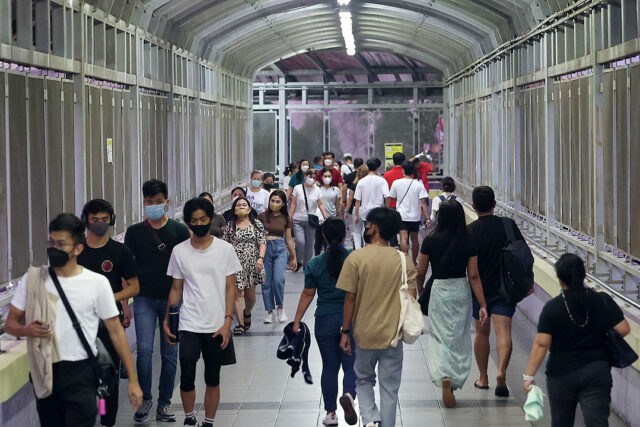
Commuters pass through an overpass connecting the LRT Lines 1 and 2 in Manila. — PHILIPPINE STAR/MIGUEL DE GUZMAN

THE PHILIPPINES posted 11,667 coronavirus infections in the past week, with a daily average of 105, according to health authorities.

The daily average on May 22 to 28 rose by 6% from a week earlier, the Department of Health (DoH) said in a bulletin.

There were 105 severe and critical cases, accounting for 0.9% of the cases. There were no reported deaths on May 15 to 28.

DoH said 453 of 2,077 intensive care unit (ICU) beds had been used as of May 28, while 4,208 out of 18,121 non-ICU beds were occupied.

There were 554 severe and critical admissions, it added.

About 78.44 million Filipinos had been fully vaccinated against the coronavirus as of March 19, DoH said, with 23.81 million people having received booster shots. — Kyle Aristophere T. Atienza