Home Blog Page 4570

Financial system’s resources rise as of May

BW FILE PHOTO

THE TOTAL resources of the country’s financial system continued to rise at end-May, preliminary data from the Bangko Sentral ng Pilipinas (BSP) showed.

Resources of banks and nonbank financial institutions increased by 7.8% to P28.528 trillion in the first five months of the year from P26.463 trillion in the same period in 2022.

According to data from the central bank, banking resources rose by 9.1% to P23.495 trillion at end-May from P21.527 trillion a year prior. Banks include universal and commercial banks, thrift banks, as well as rural and cooperative banks.

Broken down, universal and commercial banks held P22.078 trillion of total banking resources, 9.2% higher than the P20.214 trillion logged in the comparable year-ago period.

Resources of thrift banks hit P1.008 trillion, inching up by 5% from P954 billion a year ago.

Meanwhile, total resources of rural and cooperative banks climbed by 13.6% to P408 billion from just P359 billion in 2022.

On the other hand, nonbanks’ resources grew by 1.9% to P5.034 trillion from P4.936 trillion as of end-May 2022.

Nonbank financial institutions include investment houses, finance companies, security dealers, pawnshops and lending companies. 

Institutions such as nonstock savings and loan associations, credit card companies, private insurance firms, the Social Security System and the Government Service Insurance System are also considered nonbanks. — K.B. Ta-asan

Shell Lube Recycle promotes plastic waste management

Posing with the Shell Lube Recycle bins are (from left) Shell Lubricants Philippines Business Development Manager Jensen Garcia, Shell Lubricants Asia-Pacific Vice-President Mansi Tripathy, Shell Lubricants Philippines Vice-President Jackie Famorca, and Green Antz Builders Founder and CEO Engr. Rommel Benig. — PHOTO FROM SHELL LUBRICANTS

IN AN EFFORT to reduce plastic waste and promote “circular solutions,” Shell Lubricants launched what it calls Shell Lube Recycle — a collaborative sustainability project to bring together customers and partners in responsible plastic waste management and recycling. The project will initially roll out with Green Antz “as one of the many partners in the pipeline” as it is piloted in Metro Manila.

Customers are encouraged to drop off their used lubricant bottles and pails as well as other plastics into designated bins located in strategic collection sites with partner auto workshops and car dealers such as Autocasa and Car Doctor in Quezon City; Foton Motor Philippines in Pampanga (Clark), Valenzuela City, Laguna (Sta. Rosa), Pasig City, and Cavite (Bacoor); and Chery Auto Philippines in Pasig City and Cavite (Bacoor). Shell Lubricants Philippines said it is actively seeking more partnerships as the project expands.

The plastic waste collected will be recycled into other useful materials, such as eco-bricks which are sturdy and durable. These can be used for both residential and commercial construction, like the commercial building of the Shell Mobility station in Plaridel, Bulacan launched last 2021.

During the MoA signing ceremony held recently in Taguig City, Shell Lubricants Philippines Vice-President Jackie Famorca highlighted the initiative’s alignment with Shell’s commitment to promote waste management.

“We recognize the need for a fundamental shift in our approach to waste production and management, which inspired our Shell Lube Recycle program that we are launching with Green Antz as the first of the many partnerships in store for this initiative. Let’s help create a more sustainable future for the next generations to come by converting plastic waste into something more meaningful and useful,” said Ms. Famorca.

Moreover, this initiative is in support of government policies that promote the increase of recycling rates, including measures focused on the collection and sortation of waste as well as the Extended Producer Responsibility (EPR) Law.

Shell Lubricants Asia-Pacific Vice-President Mansi Tripathy shared Shell Lubricants’ aspiration to deliver high-performance products, with lower carbon footprint through waste reduction and more circular solutions. In addition to carbon intensity reduction, Shell Lubricants is committed to increasing the amount of recycled content in its products’ packaging to 30% and ensuring that all packaging is reusable or recyclable by design by 2030.

Shell Lubricants Philippines entered a partnership with Green Antz, a social enterprise dedicated to reducing plastic waste and promoting sustainability in the Philippines. Since its inception in 2013, the company has actively engaged in plastic waste collection, upcycling, and the advocacy of sustainable practices within local communities. Green Antz will be responsible for the recovery and recycling of plastic waste collected from designated bins in partner location sites.

“Green Antz has maintained a longstanding partnership with Shell Pilipinas Corp. (SPC), sharing a common vision for sustainability. We are more excited than ever to embark on this significant undertaking, strengthening our ties with SPC through its Shell Lubricants Business. We look forward to taking another step toward furthering our shared goals in the sustainability realm in the country,” said Green Antz Builders Founder and CEO Engr. Rommel Benig.

The goal to reduce carbon emissions is aligned with Shell’s overarching commitment to become a net-zero emission business by 2050. Furthermore, SPC recently signed an agreement with the Department of Environment and Natural Resources for the identification and development of Nature-Based Solutions (NBS) opportunities in the Philippines. This collaboration with stakeholders and partners reinforces Shell’s carbon reduction efforts as well as strengthens initiatives that protect the environment.

Japanese animé master Miyazaki’s likely final film opens

WITHOUT trailers, ads or any promotion at all, the likely final film by Oscar-winning Japanese animation master Hayao Miyazaki opened in Japan on Friday, with early viewers saying the lack of information made the experience more exciting.

Mr. Miyazaki, now 82 and known for a long roster of films including Academy Award winner Spirited Away, called a press conference a decade ago to say he was too tired to make another full-length feature film and was retiring.

But he soon retracted that, as he had prior retirement announcements, and after some short projects began work on How Do You Live? (Kimitachi wa Do Ikiru Ka?), the story of a 15-year-old boy coping with the death of his mother.

“I was really excited to see a Miyazaki movie,” said Michiru Miyasato, an 18-year-old student who came to the first showing at a central Tokyo cinema.

“Because I didn’t know anything about it ahead of time, my excitement increased even more, which I think was really cool.”

Like other Miyazaki films from Studio Ghibli, the company he co-founded, the release was timed for the start of school summer holidays in Japan and features the laborious hand-drawn artwork and vivid colors Mr. Miyazaki has long been known for.

But the opening lacked the usual fanfare of events, saturation advertising, trailers and merchandising tie-ins. The only information released was a poster drawn by Mr. Miyazaki — and even that was only sent to a limited number of cinemas.

“Since there was absolutely no promotion, it felt as if I could experience it all directly with my body,” said Yumiko Kokubo, a social worker in her 50s.

Toshio Suzuki, Studio Ghibli producer, said the strategy came from a desire to do something fresh.

“A poster and a title — that’s all we got when we were children,” he told NHK public television.

“I enjoyed trying to imagine what a movie was about, and I wanted to bring that feeling back.”

In a first for Mr. Miyazaki’s films, which include Princess Mononoke and My Neighbour Totoro, this one also has an IMAX release.

Though Mr. Miyazaki has retired and returned several times in the past, his age has many believing this time may be for real.

“I thought his previous film was the last, then this was announced — and they say it’s the last,” said Rens Takahashi, 24, who works in computer graphics.

“So I was really, really looking forward to it.”

No overseas release date has yet been announced. — Reuters

Public-private sector collaboration to enhance breast cancer care

ANGIOLA HARRY-UNSPLASH

Breast cancer is the most common type of cancer in women in the Philippines, with the highest incidence rate of 17.6%, according to the World Health Organization (WHO).

It accounts for 15% of all new cancer cases and 8% of all cancer deaths in the country, the Philippine Society of Medical Oncology (PSMO) reported. The PSMO also revealed that three out of 100 Filipino women are estimated to develop breast cancer before the age of 75.

More than half (53%) of breast cancer cases in the country are diagnosed in Stages III and IV, while only 2% to 3% of cases are diagnosed in Stage I.

The US Centers for Disease Control and Prevention (CDC) defined breast cancer as a disease in which cells in the breast grow out of control. There are different kinds of breast cancer, which depends on which cells develop into cancer.

The CDC noted that while some people do not have any signs or symptoms, some warning signs of breast cancer include new lumps in the breast or underarm; thickening or swelling of part of the breast, and irritation or dimpling of breast skin. Some may also experience redness or flaky skin in the nipple area or the breast; pulling in of the nipple or pain in the nipple area; nipple discharge other than breast milk including blood; any change in the size or the shape of the breast; and pain in any area of the breast.

In providing a platform for discussion on breast cancer, the Swiss Chamber of Commerce of the Philippines (SwissCham Philippines) organized the “Inspiring Conversations on Breast Cancer in the Philippines” roundtable series. This was an initiative of the Philippine Cancer Society (PCS) and ICanServe Foundation, with the support of Novartis Healthcare Philippines. The ensuing roundtables are scheduled on July 26, Aug. 9, Aug. 22, and Aug. 31, which will also be attended by members of the Philippine Press Institute (PPI) to help in their breast cancer reporting fellowship this year.

The PPI reporting fellowship seeks to deepen understanding about terminologies and policies related to breast cancer; gain knowledge in healthcare innovations available to patients and their families; and link journalists with government and medical experts for story development.

“Health literacy is very important to encourage healthy behavior, such as breast self-examination to detect potential early signs of breast cancer. For its part, the government should ensure that patients have access to quality health services and accurate health information,” said Department of Health (DoH) Undersecretary Rosario Vergeire, who delivered the keynote speech on behalf of Health Secretary Teodoro Herbosa.

Ms. Vergeire also highlighted how the National Integrated Cancer Control Act (NICCA) is helping address gaps in the national cancer control program by operationalizing the Cancer Assistance Fund (CAF), Cancer and Supportive-Palliative Medicines Access Program (CSPMAP), and Medical Assistance to Indigent Patients Program (MAIP).

The DoH is working to strengthen the country’s primary healthcare system to achieve Universal Health Care (UHC) through the DoH Konsultayo program, she said.

This program provides the primary care benefit package of PhilHealth such as medical consultation, X-ray, sputum exam, among others, and supplements this with additional tests and medicines for basic and chronic conditions. An organized breast cancer screening in Konsultayo will be a welcome addition.

Meanwhile, PCS president Dr. Corazon Ngelangel shared how the organization guides patients in navigating the whole breast cancer care continuum from patient education, early cancer detection and treatment to hospice-palliative care.

Joel Chong, president of Novartis Healthcare Philippines, said that integrating the patient perspective across cancer care is not just a noble aspiration, it is a responsibility.

“By empowering patients, listening to their needs, and involving them as active partners in their care, we can develop personalized therapies, improve treatment outcomes, and enhance the overall patient experience,” he said.

The roundtable discussion highlighted need for collaboration to address breast cancer among Filipinos.

“This is something we need to do, and we need to do it together. The government alone cannot address the gaps in our country’s healthcare system. We need the support of civil society and the private sector. During the pandemic, we saw the Filipino spirit of cooperation where all sectors pitched in — nagtulong-tulong tayo. I hope that all of our voices are heard as one, and we unify all of our efforts so that we can give more hope to our breast cancer patients,” Ms. Vergeire said.


Teodoro B. Padilla is the executive director of Pharmaceutical and Healthcare Association of the Philippines (PHAP). PHAP represents the biopharmaceutical medicines and vaccines industry in the country. Its members are in the forefront of research and development efforts for COVID-19 and other diseases that affect Filipinos.

Jollibee shares rise as easing US inflation boosts sentiment

INVESTORS snapped up Jollibee Foods Corp. shares last week amid positive market sentiments on easing inflation in the United States.

The Caktiong-led company was the third most traded stock with P1.37 billion worth of 5.51 million shares exchanging hands on the trading floor from July 10 to 14 based on data from the Philippine Stock Exchange (PSE).

The share price of the homegrown fast-food giant closed at P254.20 apiece on Friday, up by 5.8% from a week ago. Year to date, the stock gained 10.5%.

“[Jollibee’s] price movement came in due to the overall market sentiment about the CPI (consumer price index) report from the US,” Mercantile Securities Corp. Head Trader Jeff Radley C. See said in a Viber interview.

The US Labor epartment said the country’s CPI gained 3% in June, the smallest year-on-year increase since March 2021 and after a 4% rise in May. The CPI was lifted by rises in gasoline prices and rents, Reuters reported.

“The reports have helped to support the view the Federal Reserve will stop hiking rates after an expected 25 basis points rate increase later this month,” Reuters said.

“I think it is due to foreign inflows coming into Jollibee after a strong start for the year and its plan to expand more globally. Jollibee plans to open 550-600 new stores in 2023. For the first quarter of 2023, Jollibee has already opened 111 new stores,” Joylin F. Telagen, research head at IB Gimenez Securities, Inc., said in an e-mail.

Data from the PSE showed net foreign buying for Jollibee stood at P584.93 million last week. It rose to P448.15 million on Thursday from the P65.97 million recorded on Wednesday.

In the first quarter, Jollibee reported a 3.2% drop in its attributable net income to P2.19 billion from P2.26 billion in the same quarter last year. Revenues went up by 28.5% to P55.09 billion during the period from P42.86 billion a year ago.

System-wide sales, which measure all sales to consumers from company-owned and franchised stores, rose by 31.1% to P78.64 billion from P59.98 billion.

Overseas system-wide sales jumped by 23.3%, while same-store sales rose by 8.8%. For the Philippines, system-wide sales increased by 36.7% while same-store sales went up by 31.6%.

The company plans to open 550 to 600 stores this year and is on track to hit the target after opening 111 outlets in the first quarter.

Ms. Telagen forecast Jollibee’s revenues at P59.85 billion in the second quarter and P245.8 billion for the entire year.

As of end-March, the company had been operating 6,542 stores worldwide with 3,281 in the Philippines and 3,261 in its international business.

Ms. Telagen noted that the news of illegal dismissal in Jollibee North America is just temporary, though there was a sell-off at the beginning of the week.

In a separate report, Jollibee North America addressed claims of illegal dismissal of nine employees of its branch in New Jersey, saying the store in Journal Square terminated the workers due to its financial issues.

“Its strong fundamentals still moved the stock to close at a higher level,” said Ms. Telagen.

She expects the company’s stock to trade sideways this week and placed its support level at P234.00 and its resistance at P260.00.

Ms. Telagen said her bias is still a “continuation of the long-term uptrend,” adding that if the P260.00 is broken, Jollibee might see a retest of its P328.40 all-time high in the next few months.

“Set your alert and trade cautiously,” she added.

Mr. See pegged the stock’s support and resistance levels at P250.00 and P260.00, respectively. — Lourdes O. Pilar with Reuters

EU removes post-Fukushima curbs on Japan food imports

REUTERS

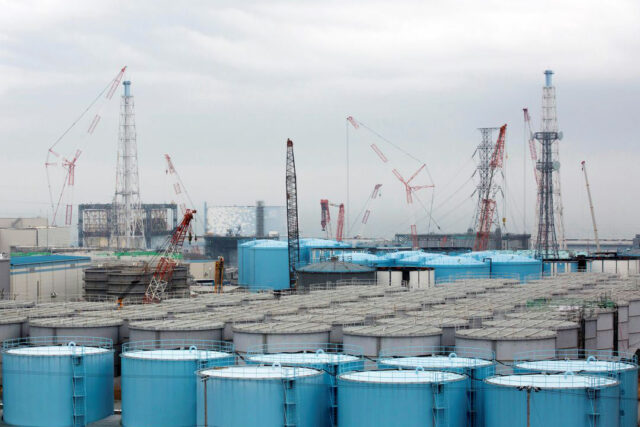
BRUSSELS — The European Union (EU) agreed to remove restrictions on Japanese food imports, imposed after the 2011 Fukushima nuclear accident, with the hope that Japan will ease its controls on EU farm produce.

The EU has required pre-export testing of food products for radioactivity since an earthquake and tsunami wrecked the Fukushima Dai-ichi nuclear plant on Japan’s east coast.

Since 2021, it has required certificates showing levels of radioactive isotopes in wild mushrooms, some fish species and edible wild plants, such as bamboo shoots, from Fukushima and nine other prefectures.

The European Commission said these restrictions had been fully lifted, while noting Japan continued to monitor for radioactivity and stressing Japan should publish its findings.

“This move will help drive forward the reconstruction of the devastated areas and is one we appreciate and welcome,” Japanese Prime Minister Fumio Kishida told a press conference after an EU-Japan summit.

European Commission President Ursula von der Leyen said both sides had also agreed to work on removing Japanese trade barriers to EU beef, fruit and vegetables, whose access to Japan is limited by food safety rules.

Mr. Kishida said Japan would make a judgment based on science, as the EU had done in lifting its restrictions.

At the summit, the EU and Japan also committed to deeper cooperation in green and digital transitions, research and other fields. “We both need to de-risk our supply chains so one of our objectives is to reduce over reliance on a handful of suppliers, many of them based in China,” Ms. Von der Leyen said, adding cooperation would include critical raw materials.

The European Union and Japan already have a free trade agreement and are united in opposition to Russia’s invasion of Ukraine. — Reuters

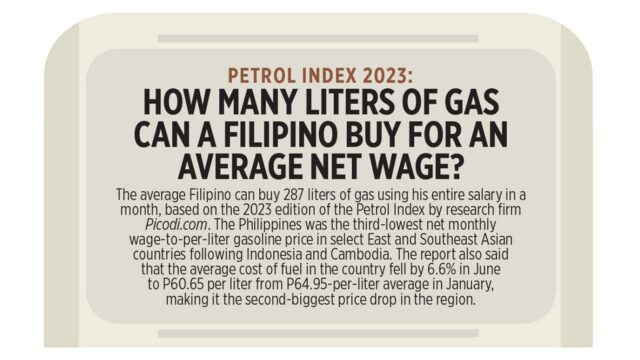
Petrol Index 2023: How many liters of gas can a Filipino buy for an average net wage?

The average Filipino can buy 287 liters of gas using his entire salary in a month, based on the 2023 edition of the Petrol Index by research firm Picodi.com. The Philippines was the third-lowest net monthly wage-to-per-liter gasoline price in select East and Southeast Asian countries following Indonesia and Cambodia. The report also said that the average cost of fuel in the country fell by 6.6% in June to P60.65 per liter from P64.95-per-liter average in January, making it the second-biggest price drop in the region.

Petrol Index 2023: How many liters of gas can a Filipino buy for an average net wage?

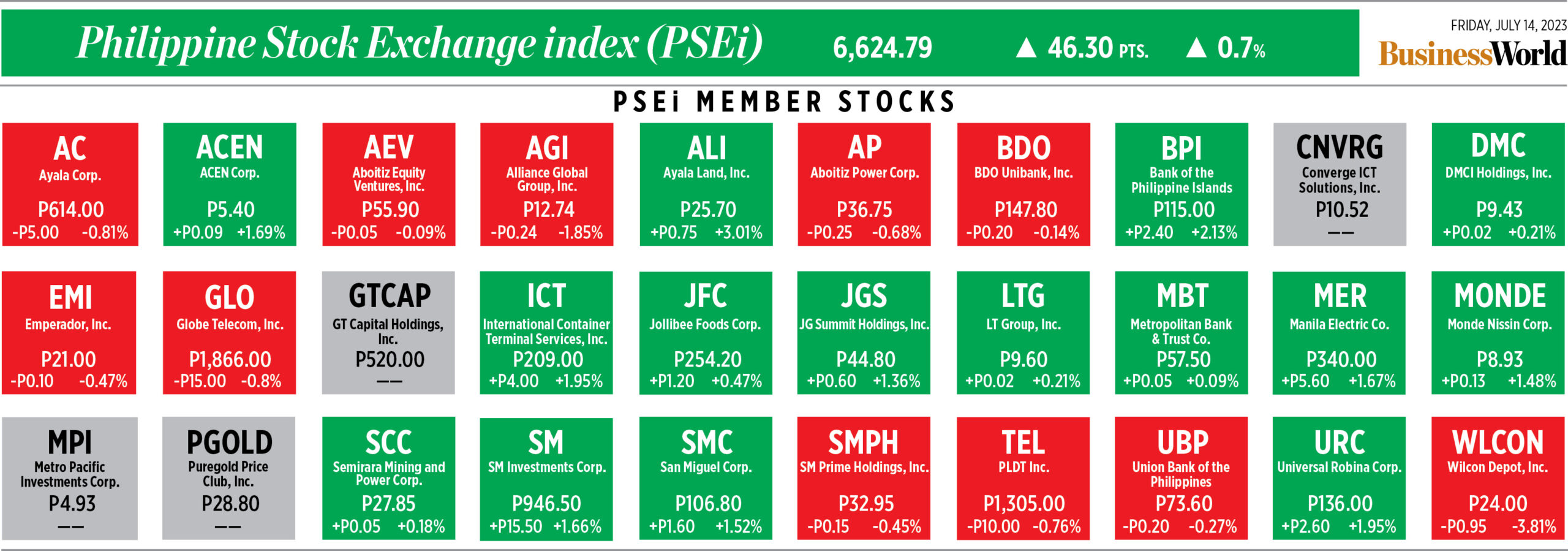
How PSEi member stocks performed — July 14, 2023

Here’s a quick glance at how PSEi stocks fared on Friday, July 14, 2023.


PSEi may drop on profit taking after 5-day climb

BW FILE PHOTO

STOCKS may decline this week due to profit taking following their five-day rally and as investors wait for more leads ahead of the US Federal Reserve’s policy review this month.

The bellwether Philippine Stock Exchange index (PSEi) rose by 46.30 points or 0.7% to 6,624.79 on Friday, while the broader all shares index went down by 18.75 points or 0.53% to close at 3,515.81.

Week on week, the PSEi gained 245.76 points or 3.85% from its close of 6,379.03 on July 7.

“While persistent selling pressure tempered gains made at the start of the week, market sentiment took a sharp upturn starting mid-week as the faster-than-expected easing in US consumer and producer price indices raised hopes that the [US Federal Reserve] will deliver its final rate hike this month,” China Bank Securities Corp. Research Associate Lance U. Soledad said in an e-mail.

US consumer prices rose in June as headline and core inflation continue to subside, but probably not fast enough to dissuade the Federal Reserve from resuming raising interest rates this month, Reuters reported.

In the 12 months through June, the consumer price index advanced 3%, making the smallest year-on-year increase since March 2021 and followed a 4% rise in May.

Meanwhile, the US producer price index (PPI) for final demand edged up by 0.1% in May. This was revised to show the PPI falling 0.4% instead of the previously reported 0.3%.

In the 12 months through June, the PPI gained 0.1%. This was the smallest year-on-year rise since August 2020 and followed a 0.9% rise in May.

The Fed will hold its next policy meeting on July 25-26.

It hiked its target interest rate by 500 basis points to a range between 5% and 5.25% before pausing its tightening cycle in June.

For this week, analysts expect the PSEi to drop as investors pocket their gains from the market’s recent rally.

“Considering the steep gains made over the past three sessions, we think profit taking may initially ensue [this] week. Offshore market movements may continue to influence local price action, especially price action relating to the Fed’s future policy rate trajectory,” Mr. Soledad said. 

“The market may test the validity of its breach of the 6,600 level. Given the market’s rally [last] week, we may see episodes of decline [this] week driven by profit taking,” Philstocks Financial, Inc. Senior Research Analyst Japhet Louis O. Tantiangco added in a Viber message.

Mr. Tantiangco said other trading drivers for the week include the expected release of remittances and balance of payments data.

For this week, he placed the PSEi’s support at 6,600 and resistance at 6,800, while online brokerage firm 2TradeAsia.com put support and resistance at 6,500 and 6,800, respectively. — A.H. Halili with Reuters

Peso may strengthen on dovish central bank bets

BW FILE PHOTO

THE PESO may continue to rise against the dollar this week on expectations that the US Federal Reserve may cut rates early next year amid slowing inflation.

The local currency closed at a fresh three-month high of P54.40 versus the dollar on Friday, strengthening by 11 centavos from Thursday’s P54.51 finish, data from the Bankers Association of the Philippines’ website showed.

This was the peso’s strongest close since its P54.40-a-dollar finish on April 5.

Week on week, the peso jumped by P1.22 from its P55.62 close on July 7.

The local unit opened Friday’s session at P54.45 per dollar. Its weakest showing was at P54.55, while its intraday best was at P54.31 against the greenback.

Dollars traded went down to $1.15 billion on Friday from the $1.41 billion recorded on Thursday.

The peso appreciated on Friday on expectations that the Fed may begin cutting rates in early 2024 after softer-than-expected producer price index (PPI) in June, Rizal Commercial Banking Corp. Chief Economist Michael L. Ricafort said in a Viber message.

The producer price index for final demand nudged up 0.1% last month, the Labor department said on Thursday, Reuters reported.

Data for May was revised to show the PPI falling 0.4% instead of the previously reported 0.3%. In the 12 months through June, the PPI gained 0.1%. That was the smallest year-on-year rise since August 2020 and followed a 0.9% rise in May.

Economists polled by Reuters had forecast the PPI would rebound 0.2% on the month and rise 0.4% on a year-on-year basis.

The US central bank paused its tightening cycle in June after hiking the fed funds rate by 500 basis points (bps) to 5%-5.25%.

The Fed will hold its next policy meeting on July 25-26.

Mr. Ricafort added that the peso was supported by a weaker US dollar recently.

The US dollar bounced on Friday after falling sharply the last few days, as investors consolidated losses ahead of the weekend, but its trajectory remained tilted to the downside with the Federal Reserve thought near the end of its rate hike cycle amid softening inflation.

The dollar index edged up 0.2% to 99.923, after touching a 15-month low of 99.574 earlier. The index was down 2.3% for the week.

The weekly decline was exacerbated by June US producer and consumer inflation data that showed easing price pressures.

Investors have been betting on a turn lower in the dollar for months, with short positions more than doubling over the month to July 7, according to data from Commodity Futures Trading Commission, although they remain far off the levels in 2021.

For the week, Mr. Ricafort said that the peso could continue to strengthen amid expectations of a dovish Fed, a stance that could be mirrored by the Bangko Sentral ng Pilipinas (BSP).

The BSP has kept borrowing costs steady for two straight meetings after hiking by a cumulative 425 bps to bring its key rate to a near 16-year high of 6.25%.

Its next policy meeting is on Aug. 17.

For this week, Mr. Ricafort expects the peso to trade between P54.20 and P54.70 per dollar. — AMCS with Reuters

Maynilad expects pause in service interruptions as Ipo water levels rise

PHILIPPINE STAR/KRIZ JOHN ROSALES

MAYNILAD Water Services, Inc. said it could further suspend its plan to interrupt water services with levels rising at the dams supplying the capital.

“We were able to suspend service interruptions over the past four days because rains over the Ipo watershed have been keeping water level in Ipo Dam high,” Jennifer C. Rufo, head of Maynilad corporate communications, said in a Viber message on Sunday.

She added that increased water levels at Bulacan’s Ipo Dam, which is downriver from Angat Dam, the main source of water for Metro Manila, allowed the company to still access 2,400 million liters per day (MLD), despite reduced water releases from Angat. 

“Given this, we expect to be able to indefinitely suspend the daily interruptions, but they will immediately be reinstated once the rains over the watersheds stop and inflows to Ipo Dam start dwindling,” she said.

On Saturday, Maynilad announced the suspension of planned service interruptions in parts of Caloocan, Malabon, Manila, Valenzuela, Navotas and Quezon City for July 15-16, saying that improved supply from Ipo Dam mitigated the impact of reduced releases from Angat Dam.

Last week, the west zone water concessionaire announced a program of nine-hour daily water interruptions starting July 12, affecting about 591,000 accounts.

The National Water Resources Board had reduced the water allocation for Metropolitan Waterworks and Sewerage System (MWSS), after water levels at Angat fell below the dam’s minimum operating level.

“The water interruptions have been suspended from Friday until (Monday) morning. We will assess (on Monday) night if the interruption will resume or not,” Patrick James B. Dizon, head of the MWSS Angat/Ipo operations management division, said in a Viber message. 

As of 6 a.m. on Sunday, the water level in Angat Dam increased to 179.06 meters from 178.48 meters a day earlier, though still lower than its 180-meter minimum operating level, while Ipo Dam levels dipped to 100.02 meters from 100.03 meters the day before. 

Ms. Rufo said that because the habagat (southwest monsoon) is ongoing, Maynilad hopes that rain will continue to fall over watersheds to further increase the water level at Angat Dam. 

Separately, Maynilad said that it plans to spend P1 billion to reactivate over 60 deep wells this year.

It has been tapping deep wells, both old and new, which could provide around 32 MLD of additional supply in preparation for El Niño, Maynilad said.

The company said these deep wells are located in Caloocan, Quezon City, Las Piñas, Muntinlupa, Parañaque, Bacoor, Cavite City, Kawit, and Imus.

By the end of this month, the company said it expects to produce about 12.38 MLD from its deep wells in 19 locations.

Deep wells are reactivated only as a contingency measure due to the expected water shortages brought on by El Niño. Groundwater is not deemed a sustainable source of water, considering the proximity of Metro Manila to Manila Bay, from where salt water could seep into groundwater reserves, rendering them unusable.

“We have found some viable deep wells, and their yield will add to our water supply should El Niño further affect the availability of water from traditional sources,” Maynilad President and Chief Executive Officer Ramoncito S. Fernandez, said in a statement over the weekend.

Maynilad serves the cities of Manila, except San Andres and Sta. Ana. It also operates in Quezon City, Makati, Caloocan, Pasay, Parañaque, Las Piñas, Muntinlupa, Valenzuela, Navotas, and Malabon. It also supplies the cities of Cavite, Bacoor, and Imus, and the towns of Kawit, Noveleta, and Rosario, all in Cavite province.

Metro Pacific Investments Corp., which has a majority stake in Maynilad, is one of three Philippine units of Hong Kong-based First Pacific Co. Ltd., the others being Philex Mining Corp. and PLDT, Inc.

Hastings Holdings, Inc., a unit of PLDT Beneficial Trust Fund subsidiary MediaQuest Holdings, Inc., has an interest in BusinessWorld through the Philippine Star Group, which it controls. — Ashley Erika O. Jose