Home Blog Page 4443

IESF World Esports Championship 2023 MLBB kicks off in Romania

SINGAPORE — The long awaited IESF World Esports Championship 2023 Mobile Legends: Bang Bang (MLBB) tournament finally kicks off. Catch 16 international teams vying for the lion’s share of the $100,000 prize pool, and the opportunity to bear the crown of the first-ever IESF MLBB championship!

Taking place in Iasi, Romania — the Group Stage features a single round robin format that will be held today till August 30. The participating teams will be split in groups of four, where they’ll have to battle it out in a best-of-three (BO3) series. The top two teams from each group will then proceed onto the Playoffs held from Aug. 31 to Sept. 3, in double elimination bracket. The final two teams will face off in a best-of-five series at Main Stage B.

“We’re proud to be part of the global esports family brought together by the IESF committee, and to celebrate competitive gaming,” stated Ray Ng, Head of Esports Ecosystem, MOONTON Games, “This event wouldn’t have been made possible without the tireless efforts of our partners and  athletes, and we look forward to the many surprises that the championship has in store.”

The participating countries for this year’s MLBB tournament are:

Romania, Indonesia, United States and Brazil. Colombia, Egypt, Senegal and Namibia.

Ukraine, Turkey, Georgia and the Philippines. Mongolia, UAE, Kazakhstan and Saudi Arabia.

Mancini aims to win Asian Cup with Saudi Arabia men’s team

NEW Saudi Arabia coach Roberto Mancini said his main goal is for the men’s national team to win the Asian Cup after 27 years, at the Saudi Arabian Football Federation (SAFF) presentation event in Riyadh on Monday.

The former Italian coach outlined his aspirations to raise the team’s level in Asia, and detailed his long and short-term plans, adding he will evaluate the players to complete the objective to win the continental tournament.

“Our target is to win the Asian Cup after 27 years. Our target before that is that we have four friendlies, we have two World Cup qualifiers and after that we have a 20-day training camp to prepare for the Asian Cup,” Mr. Mancini said in a statement.

“I am not a magician, we have exceptional talents and we can achieve our goals through continuous work. We have good players, the previous coach did a great job, and in the coming period we have to translate our words into realities on the field.” — Reuters

WNBA crown

Aces head coach Becky Hammon was in a quandary. Her charges had played nine games in 19 days, and she figured they deserved a rest. The constant traveling, which included a stop in the White House honoring their championship last year, was bad enough. That she had needed to ride her starters given her roster’s lack to depth and the absence of vital cogs Candace Parker and Riquna Williams made the situation even worse. At the same time, however, she knew she had to defend their spot atop Women’s National Basketball Association (WNBA) standings with the regular season drawing to a close — which meant keeping an all-hands-on-deck approach to their remaining matches.

In the end, the decision was out of Hammon’s hands. The players voted to keep playing, in large measure because the next two contests were against top-flight competition. In other words, bragging rights were at stake, and far be it from the defending titleholders to back off from a challenge. And so they competed. First up were the Mystics, finally at full strength with the return of former Most Valuable Player awardee Elena Delle Donne. Then came a trip to the East Coast, where the rival Liberty awaited. In each case, they looked ready at the start, only to falter as the encounters progressed.

In the aftermath of the defeats, Hammon indicated some regret, and with reason. After all, the Aces got nothing from their exertions; they still absorbed losses even though their First Five did not play sparingly. Unfortunately, what’s done is done. And, now, with the Liberty just one and a half games behind their pace-setting slate, they need to leave nothing in the tank in order to stay ahead. The good news is that they will be hosting three of their final four regular season set-tos at home, with the lowly Storm and Mercury on tap. Simply put, their fate remains in their hands.

First things first, though, and the Aces will be angling to prevent a three-outing slide by prepping well for the Mystics. The Michelob ULTRA Arena will, no doubt, be rocking; not for nothing are they tops in attendance figures. And, to their credit, they’ve been able to turn the intense fan support into 16 victories through 17 contests. Should they manage to take care of business, it won’t matter if the Liberty get to run the table; homecourt advantage in every round of the playoffs will be theirs. Meanwhile, outside of hoping for the return of Parker and Williams to active duty, they would do well to brace themselves for tough times as they move to retain their crown.


Anthony L. Cuaycong has been writing Courtside since BusinessWorld introduced a Sports section in 1994. He is a consultant on strategic planning, operations and human resources management, corporate communications, and business development.

IMF managing director to meet leaders in China, go to Indonesia, India

REUTERS

 – International Monetary Fund Managing Director Kristalina Georgieva will visit China from Wednesday to meet with top leaders, before travelling to Indonesia and India for ASEAN and Group of 20 summits, an IMF spokesperson said on Tuesday.

“During Aug. 30 to Sept. 3 the Managing Director will be visiting China to engage in bilateral discussions with China‘s senior leadership team,” they said.

Ms. Georgieva will then travel to Jakarta to participate in a summit of leaders of the Association of Southeast Asian Nations (ASEAN) before attending the G20 meeting for heads of state and government in New Delhi.

Last month, the IMF raised its 2023 global growth estimates slightly given resilient economic activity in the first quarter, but warned that persistent challenges were curtailing the medium-term outlook.

The lender projects global real gross domestic product growth of 3% in 2023, up 0.2 percentage point from its April forecast, but left its outlook for 2024 unchanged, also at 3%.

The Fund left its forecast for China unchanged, predicting the world’s second-largest economy will grow by 5.2% this year, up from a COVID-subdued 3% in 2022, before falling to 4.5% in 2024, warning that China‘s recovery was underperforming and that a deeper contraction in the real estate sector remained a risk.

Ms. Georgieva will be in Jakarta from Sept. 4 to Sept. 7 and New Delhi from Sept. 8 to Sept. 10, the spokesperson added. – Reuters

US holds drills with allies off Korean peninsula, Pyongyang vows to bolster navy

– The United States, South Korea and Japan staged joint naval missile defense drills off the Korean peninsula on Tuesday, as North Korea accused Washington and its allies of creating “the most unstable waters with the danger of a nuclear war.”

The three nations staged exercises in international waters off South Korea’s southern Jeju island to improve their ability to detect and track targets, and share information in the event of provocation by Pyongyang, South Korea’s military said.

The drills come as North Korean leader Kim Jong Un has called for “radically” modernizing the weapons and equipment of its naval forces, criticizing an increased presence of U.S. strategic assets in the region.

In a speech to mark Navy Day, Kim said the “gang bosses” of the United States, Japan and South Korea announced regular joint military exercises, news agency KCNA reported, apparently referring to their Aug. 18 summit at Camp David, Maryland.

“Owing to the reckless confrontational moves of the U.S. and other hostile forces, the waters off the Korean Peninsula have been reduced into the world’s biggest war hardware concentration spot, the most unstable waters with the danger of a nuclear war,” Kim was quoted by KCNA as saying.

In the first standalone meeting between the leaders of the U.S., South Korea and Japan, the three agreed to deepen military and economic cooperation as they seek to project unity in the face of China’s growing power and the North’s nuclear threats.

South Korea and the United States last week began the Ulchi Freedom Shield summer exercises, designed to enhance their joint responses to North Korea’s nuclear and missile threats. Pyongyang has long denounced the drills as a rehearsal for war.

As part of the exercises, the allies‘ special operations troops practiced infiltrating an enemy’s coastline from the sea, riding rubber boats and emerging from the waves with diving gear and guns.

“The prevailing situation requires our navy to put all its efforts into rounding off the war readiness to maintain the constant combat alertness,” Mr. Kim said, adding the naval forces would become part of the “state nuclear deterrence carrying out the strategic duty”. – Reuters

Chinese county offers ‘cash reward’ for couples if bride is aged 25 or younger

STOCK PHOTO | Image by StockSnap from Pixabay

 – A county in eastern China is offering couples a “reward” of 1,000 yuan ($137) if the bride is aged 25 or younger, the latest measure to incentivize young people to get married amid rising concern over a declining birth rate.

The notice, which was published on Changshan county‘s official Wechat account last week, said the reward was to promote “age-appropriate marriage and childbearing” for first marriages. It also included a series of childcare, fertility and education subsidies for couples who have children.

Concerned about China’s first population drop in six decades and its rapid aging population, authorities are urgently trying an array of measures to lift the birth rate including financial incentives and improved childcare facilities.

China’s legal age limit for marriage is 22 for males and 20 for females, but the number of couples getting married has been falling. That has driven down birth rates due to official policies which make it harder for single women to have children.

Marriage rates hit a record low in 2022 at 6.8 million, the lowest since 1986, according to government data released in June. There were 800,000 fewer marriages last year than in 2021.

China’s fertility rate, already one of the world’s lowest, is estimated to have dropped to a record low of 1.09 in 2022, state media reported.

High childcare costs and having to stop their careers have put many women off having more children or any at all. Gender discrimination and traditional stereotypes of women caring for their children are still widespread throughout the country.

Low consumer confidence and growing concerns over the health of China’s economy are also key factors cited by young Chinese for not wanting to get married and have children. – Reuters

To stop hoaxes on WhatsApp, Line and Telegram, fact-checking must go beyond social media

STOCK PHOTO | Image by Pexels from Pixabay

Disclaimer: This asset – including all text, audio and imagery – is provided by The Conversation. Reuters Connect has not verified or endorsed the material, which is being made available to professional media customers to facilitate the free flow of global news and information.

This article is part of our #FightHoax2024 series.

Ahead of Indonesia’s 2024 general election, fact checks in Indonesia are expected to save the public from misinformation.

Media organizations and activists in Indonesia still heavily focus on social media for factchecking activities to eradicate misinformation.

This is understandable, given social media is still the platform used the most by the public to access fact-check contents and to clarify any news they see. Not to mention that most mobile phone users (68%) in Indonesia turn to social media to access information.

Yet we seem to almost forget that our personal conversations can also contribute to the spread of false information.

A report by the Indonesian Anti-Slander Society (MAFINDO) on the spread of misinformation in Indonesia has placed WhatsApp – currently the most popular communication app in the country – as a platform for spreading misinformation.

My latest research, which I conducted with my research team from the Digital Journalism Department at the Multimedia Nusantara University (UMN) in Indonesia, shows people rarely refer to messaging apps as their main source for finding facts.

Maybe it is the time for Indonesian press and fact-check communities to intensify their factchecking dissemination strategy by targeting instant messaging apps, like Whatsapp, Line and Telegram.

The Reuters Institute for the Study of Journalism’s Digital News Report 2021 shows that the people of Global South, including Indonesia, considers WhatsApp a medium for spreading misinformation.

This means our instant messaging activities are not really safe from hoaxes.

However, from total of 1,596 respondents from our research, only 379 of them use messaging apps – WhatsApp, Telegram, Line – to seek fact-check contents.

The majority of respondents (1,335) still prefer to access fact-check content via social media. Other platforms they prefer to use are news websites (769), search engines (731) and television (388).

We argue that personalized factchecking –- through WhatsApp or other messaging apps –- is important to complement existing factchecking strategies targeting social media.

To begin with, journalists can integrate the fact-check contents they publish on social media or news websites with messaging services, especially WhatsApp.

Integration with messaging apps will increase engagement with audiences and, at the same time, expand the distribution of fact checks to combat misinformation.

Press institutions and fact-checkers can also use chat features to engage audiences. MAFINDO and Indonesia media organization Tempo have done this. Both organizations collaborate with Whatsapp to integrate fact-checks using a chatbot technology.

The chatbots will work or respond only after receiving messages from the users. Through this feature, all users can choose to read fact-check articles or report suspicious information.

Tempo and MAFINDO’s chatbots are a good first step.

However, both are a passive technology, because they only receive factchecking messages from readers and then respond accordingly by sending the same fact-check articles for all users. In addition, only users who have the numbers of the two chatbots can access this technology.

Based on the evidence I’ve seen , I believe we need to strengthen this approach with two strategies: push notifications and personalization.

Push notifications use technology to automatically deliver notifications and digital content to audiences. Personalization is an effort to map audience preferences or characteristics that can then be used as a basis to send relevant content or notifications.

News media companies and fact-check communities could start by mapping their audience database, based on gender, occupation or location, as well as people’s reading time online.

Fact-check consumption patterns are closely related to audience characteristics. So, media companies could create databases to map different audiences’ interests in factchecking different topics.

After mapping their audience, the press company could send notifications on fact-check content using the personalization and push notification strategies.

It means newsrooms would send notifications via WhatsApp to the relevant audiences. “Relevant” means that the notification contains a number of factchecking content on topics liked by that audience.

However, we should note that push notification strategy could make errors at times. For instance, media organizations could distribute content that is irrelevant to that audience’s interests, and at the wrong time. These unguided push notifications could be very annoying to some audiences.

Therefore, personalization and push notifications need to be present simultaneously. I call it “personalization-based push notifications”. This would ensure users only receive content relevant to their interests.

But before starting any audience mapping work, media organizations should first secure consent from their users by asking them to opt in or out of having their data included.

Media companies must also guarantee that any personalized factchecking databases or notifications would protect their audience’s personal data.

To avoid privacy breaches, news organizations and fact checkers need to invest in creating subscription systems using reliable technology.

This strategy would require investments in human resources and technology. If we could successfully implement it, our digital fortress against misinformation and misinformation will be strengthened.

It would be better if users could easily interact via chat with different newsrooms to ask for fact-checks about any issues they are interested in.

With this, more Indonesians could go from potentially spreading false information to their family and friends through personal chats, to helping share more factual, better quality information ahead of future elections. – Reuters

[B-SIDE Podcast] What PHL education should look like in the AI era

Follow us on Spotify BusinessWorld B-Side

A significant portion of what has traditionally been taught in tertiary education has lost its relevance in the present, according to Hyper Island Institute of Higher Education, a digital creative business school.

In this episode of B-Side, Peachy Pacquing, managing director at Hyper Island Singapore, speaks with BusinessWorld reporter Ashley Erika O. Jose about the need for transformative education, characterized by meta-learning, or learning how to learn.

This approach arises as a response to the changing times, in which technologies like artificial intelligence (AI) are now able to perform tasks that were previously taught in traditional educational settings, she said.

“As an example, if we spend so much money educating our children in multimedia, teaching them how to create websites and code, I am not against these hard skills, but how does that play out in a world where AI can create all of these things? Have we prepared them sufficiently for a time when the tools and frameworks that we taught them in the past no longer hold the value they used to deliver?”

“That’s why meta-learning is incredibly important to us because meta-learning is transcendent, meaning it’s not just relevant today, but it will equip you with the skills and mindset that will help you see the world as it evolves and enable you to contribute value regardless of how it evolves,” she added.

Established in Sweden two decades ago, Hyper Island has continued to expand its presence across the globe with operations in London, Manchester, Singapore, New York, São Paulo, Stockholm, and Karlskrona.

“It was born because the Swedish government realized that the way they were doing education was no longer sufficient, or relevant and therefore there was a challenge to reimagine education more than 20 years back,” Ms. Pacquing said.

Follow us on Spotify BusinessWorld B-Side

China has 243 GW of new coal power approved or under construction – research

STOCK PHOTO | Image by PublicDomainPictures from Pixabay

 – China currently has 243 gigawatts (GW) of coal-fired power either approved or under construction, enough to power the whole of Germany, with local governments still worried about power supply security, new research showed on Tuesday.

China began building coal-fired plants with a total capacity of 37 GW in the first half of this year, and approved 52 GW of new projects, said a report by the Centre for Research on Energy and Clean Air (CREA) and Global Energy Monitor (GEM).

As well as the 243 GW now officially in the pipeline, another 149 GW has been announced but not formally permitted. Total coal power capacity could increase by between 23% and 33% above 2022 levels if all the projects go ahead.

China has promised to cut coal consumption starting from 2026 as part of its efforts to bring greenhouse gas emissions to a peak before 2030, but mounting energy security concerns are driving the new approvals.

“The coal power spree is a last-minute push by China’s coal industry to lock in capacity and emissions before China’s CO2 emissions are due to peak late this decade,” said Lauri Myllyvirta, lead analyst at CREA.

China’s new coal-fired plants are supposed to provide back-up for the vast amount of new renewable energy sources being connected to the grid, but CREA-GEM said most of them are in places that “already have more than enough coal power” to support renewable projects.

China has bristled at suggestions it is backsliding on clean energy commitments, with officials arguing it has been managing the green transition far more effectively than any other country at a similar stage of development.

In an article that was later deleted, chief energy official Zhang Jianhua this month accused “foreign hostile forces” of using the challenges of decarbonization to “distort and slander” China’s energy policies.

“Energy policy has been one of the areas where public discussion and debate has still been possible, helping inform policymaking,” said Myllyvirta. “The NEA’s desire to tighten the control of the media and the narrative is of course concerning.” – Reuters

3M Philippines joins public schools for Brigada Eskwela S.Y. 2023 – 2024

Teachers, students, and parents alike were invited to join in the Brigada Eskwela festivities.

Renowned consumer product and diversified science company 3M Philippines recently partnered with public schools to prepare for the opening of School Year 2023 – 2024. With a new period of on-site classes on the horizon, there was no better time for 3M Philippines to launch their back-to-school campaign Malinis, Maaliwalas, at Masiglang Pagbabalik Eskwela, which was conducted as part of the Department of Education’s annual Brigada Eskwela program.

For this school year, 3M Philippines aspired to create a welcoming environment for incoming students of Cubao Elementary School in Quezon City and Cayetano Arellano High School in the City of Manila.

Vivian Faustino, Country Sales Leader for 3M Philippines Consumer Business Group, shared some spirited words with those in attendance.

Vivian Faustino, Country Sales Leader for 3M Philippines Consumer Business Group, spoke about the company’s goals for this latest initiative. According to Faustino, “3M supports Brigada Eskwela and the bayanihan spirit of all the education stakeholders in preparing and providing a clean learning environment for students and teachers in public schools.”

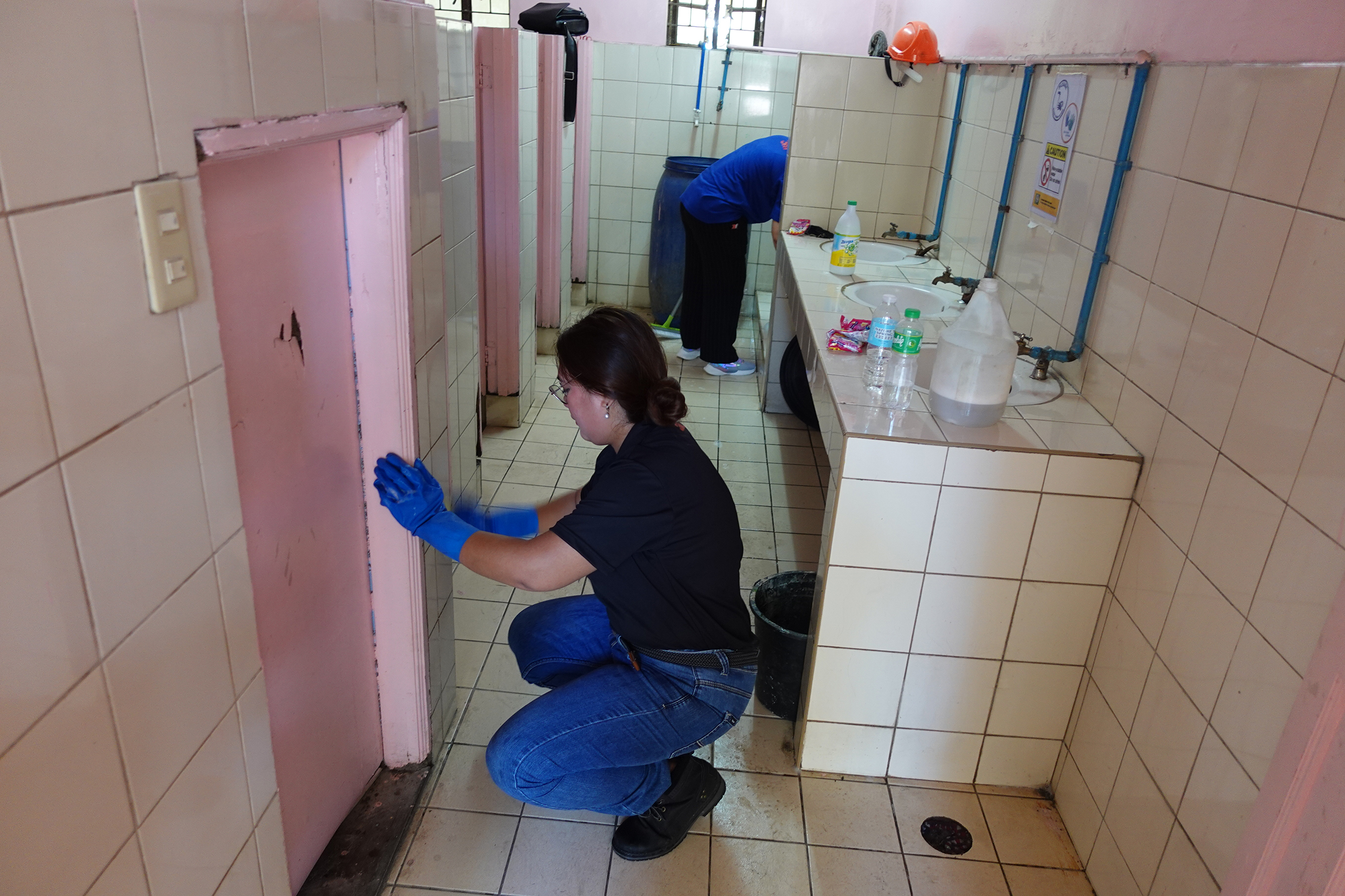
Indeed, the uniquely Filipino bayanihan spirit prevailed as volunteers from 3M Philippines and Global Service Center spent their time cleaning and decorating the schools together with teachers, students, and their parents. Some of the household brands of 3M that sponsored the event are Scotch-Brite™, Post-it®, and Scotch™. With the help of Scotch-Brite™ Scouring, Bathroom, and Floor Care products, the school facilities were made neat and tidy for both teachers and students alike. To beautify the classrooms, 3M Philippines also provided stationery and school supplies from its brands Scotch™ and Post-it®.

John Butch P. Locara, Principal of Cayetano Arellano High School, expressed his appreciation for the superior quality of 3M’s products. “Dito sa aming paaralan, subok na namin ang mahusay na kalidad ng Scotch tapes. Ginagamit ko ‘yan sa aking trabaho sa opisina,” he said. “Kami ay naniniwala na sa pagbabayanihan ng bawat isa ay maihahanda natin ang paaralan na malinis at maayos para sa ating mga mag-aaral.”

Eloisa C. Tamon, Principal of Cubao Elementary School, was likewise grateful for 3M’s partnership. “Salamat 3M Philippines sa pagpili sa amin bilang benepisyaryo para sa Brigada Eskwela,” she said. “Nakasisiguro kami na gamit ang mga produkto ng 3M ay malilinis natin ng mahusay at mapapaganda ang bawat classroom at paligid ng paaralan.”

3M volunteers came to two public schools to help clean and decorate the premises for students and teachers alike.

3M Philippines and Global Service Center employees also had fun decorating the classrooms using Scotch™ Scissors as well as an array of adhesive products like Tapes and Glue Sticks. In addition, colorful Post-it® Notes were used to label and design teaching materials and parts of the classroom. These handy and beautiful decorations helped create an environment that is more conducive to learning.

3M Philippines envisions their products as essential parts of the learning process once the school year begins. Aside from Brigada Eskwela, 3M Philippines’ product engineer Ms. Mary Ann Demition gave tips and advice on how to use trusted brand Scotch-Brite™ in household cleaning. She also shared how Scotch™ and Post-it® products benefit from 3M technology, stimulating the curiosity and creativity of all those in attendance.

Faustino emphasized 3M’s important role in educating the youth. “3M has always been a part of students’ formative years as we provide relevant 3M product tools in every stage of their learning and development,” she said. “Scotch™ and Post-it Notes® products help students fulfill their desire for self-expression and individuality.”

After the challenges of the last few years, the return to on-site learning is an exciting time for all. And 3M Philippines is—and will always be—around to ensure a safe, clean, and healthy environment for children to learn and develop.

For more information about the campaign and the company, please visit: https://www.3mphilippines.com.ph/.


Spotlight is BusinessWorld’s sponsored section that allows advertisers to amplify their brand and connect with BusinessWorld’s audience by enabling them to publish their stories directly on the BusinessWorld website. For more information, send an email to online@bworldonline.com.

Join us on Viber at https://bit.ly/3hv6bLA to get more updates and subscribe to BusinessWorld’s titles and get exclusive content through www.bworld-x.com.

Debt payments surge to P908 billion

BW FILE PHOTO

THE NATIONAL Government’s (NG) debt payments nearly doubled to P907.93 billion during the first half of the year, mainly due to the increase in principal amortization.

Preliminary data from the Bureau of the Treasury (BTr) showed the government’s debt payments surged by 98% in the January-June period from P458.355 billion in the same period last year.

In the first six months, more than two-thirds or 68.89% of the debt service bill went to amortization.

Principal payments as of end-June more than tripled to P625.47 billion from P201.14 billion last year.

Broken down, amortization on domestic debt soared to P561.42 billion as of end-June from P153.38 billion a year ago.

Principal payments on foreign debt jumped by 34.1% to P64.05 billion in the first half from P47.76 billion in the same period a year ago.

Meanwhile, interest payments rose by 9.81% to P282.458 billion in the six-month period from P257.215 billion a year ago.

Interest on local debt slipped by 6.2% to P192.884 billion as of end-June from P205.687 billion last year.

Broken down, interest payments on domestic debt consisted of P108.366 billion for fixed-rate Treasury bonds, P74.731 billion for retail Treasury bonds, and P6.709 billion for Treasury bills.

Meanwhile, interest paid on foreign debt jumped by 73.8% to P89.574 billion in the first semester from P51.528 billion a year ago.

JUNE DEBT SERVICE BILL
In June alone, the debt service bill doubled to P88.4 billion from P44.29 billion in the same month in 2022.

Month on month, debt payments surged by 80.2% from P49.05 billion in May.

More than half (59.8%) of the total debt servicing during the month went to interest payments.

Interest payments in June rose by 43.9% to P52.88 billion from P36.75 billion in the same month in 2022.

Interest paid to domestic creditors rose by 20.9% to P40.28 billion. This consisted of P25.62 billion in retail Treasury bonds, P11.412 billion in fixed-rate Treasury bonds, and P1.55 billion in Treasury bills.

Interest paid to external creditors surged by an annual 268.2% to P12.604 billion in June.

Meanwhile, amortization payments skyrocketed (371.4%) to P35.517 billion in June from P7.534 billion in the same month in 2022.

Domestic debt payments ballooned to P27.981 billion in June, while amortization on foreign obligations inched up by 5% to P7.536 billion.

Rizal Commercial Banking Corp. Chief Economist Michael L. Ricafort in a Viber message said that the higher debt service bill was partly due to elevated inflation, which drove up government expenditures.

Headline inflation eased to 5.4% in June from 6.1% in May, still well above the central bank’s 2-4% target range.

For the first half, inflation averaged 7.2%.

The Bangko Sentral ng Pilipinas (BSP) expects inflation to average 5.6% this year.

Mr. Ricafort also noted there was an increase in borrowing costs due to rising interest rates.

The BSP has raised interest rates by 425 basis points (bps) from May 2022 to March 2023, bringing the key rate to 6.25%, a near 16-year high.

“Higher debt servicing is also a function of more maturities of government securities earlier this year,” Mr. Ricafort added.

“The government’s debt service program this year is set at P1.552 trillion. This is composed of P941.353 billion in amortization payments and P610.665 billion in interest payments.”

Next year, the government set its debt servicing program at P1.91 trillion. Broken down, this consists of P670.471 billion for interest payments and P1.24 trillion for principal amortization. — Luisa Maria Jacinta C. Jocson

Use of cryptocurrency in money laundering a rising concern

The use of cryptocurrency in money laundering is “worrying,” according to an expert. — REUTERS

THE PHILIPPINE central bank remains vigilant against money laundering and terrorism financing risks posed by the rise in transactions using virtual assets such as cryptocurrency.

“As virtual assets continue to surge both in users and transactions, the BSP anticipates that different types of risks, including anti-money laundering and countering the financing of terrorism (AML/CFT), may contribute to higher risk exposure,” Bangko Sentral ng Pilipinas (BSP) Deputy Governor Chuchi G. Fonacier told BusinessWorld via Viber message.

She noted the BSP “remains supportive and proactive amidst these developments, while at the same time recognizes that commensurate regulatory mechanisms must be put in place,”

The Philippine central bank regulates virtual asset service providers (VASPs).

While the initial framework only covered providers facilitating the exchange of fiat and virtual assets, the BSP introduced amendments in January 2021 to cover more types of VASPs and to address its risks amid increased use of virtual assets.

Ms. Fonacier said the amendments combined global risk management standards such as the guidance established by the Financial Action Task Force (FATF) on money laundering. This was to align BSP regulation with its international peers.

“This will also help ensure that VASP activities are executed within an unbroken chain of regulated entities. In addition, additional risk management guidelines and reportorial requirements to enhance AML/CFT regulations, risk management, and consumer protection measures aim to ensure the safety and soundness of the financial industry,” she said.

The Philippines is already under increased monitoring by the FATF over deficiencies in its fight against money laundering. The Philippines has been included in the FATF’s “gray list” since 2021.

With the recent collapse of cryptocurrency exchange FTX, Ms. Fonacier said the BSP is also focused on key risk areas such as corporate governance, accounting process, and consumer protection.

“The BSP tightened its licensing mechanism and imposed a three-year moratorium on new VASP license applications starting Sept. 1, 2022. Correspondingly, the BSP likewise strengthened its supervisory activities on existing BSP-registered VASPs to consider their overall performance, risk management systems, and their impact to financial services and the financial system as a whole,” she said.

VASPs refer to entities that offer services or engage in activities that provide facility for the transfer or exchange of virtual assets — any type of digital unit that can be digitally traded or transferred and can be used for payment or investment purposes.

The BSP classifies cryptocurrencies as a type of virtual asset.

CRYPTO ADOPTION
Swarup Gupta, industry manager of the Economist Intelligence Unit, said the adoption of cryptocurrency has been led by emerging markets with usage picking up in the Philippines, Vietnam, India, Pakistan, Brazil and Thailand.

“Unfortunately, the use of cryptocurrency for illegal activities has also increased over the last two years,” he said in an e-mail.

“Total cryptocurrency received by illicit addresses (in value terms) was estimated at around $20 billion in 2022. The majority of this, around 40%, was used to circumvent (primarily US) sanctions with stolen funds and scams also accounting for a substantial amount of illegal activity.”

Mr. Gupta said this has prompted some countries to tighten AML/CFT regulations, particularly New Zealand and Singapore.

In the US Congress, a bill was recently refiled to strengthen AML/CFT regulations for the digital asset industry, which includes the implementation of customer verification.

Mr. Gupta said governments should ensure that regulations applicable to conventional financial entities are also applicable to issuers of digital assets such as cryptocurrencies.

“This can only be ensured by a clear and unambiguous set of guidelines for crypto assets, which have been held back by the authorities as of now,” he said.

Mr. Gupta said the increased use of cryptocurrency for illegal activities is “worrying” in the absence of globally applicable regulations and sanctions.

The Anti-Money Laundering Council (AMLC) said they periodically review and revisit the implementing rules of the Anti-Money Laundering Act (AMLA) to ensure adherence to international standards.

“The acceleration of digital transformation as well as the COVID-19 (coronavirus disease 2019) pandemic led to the increase in digital vulnerabilities and physical movement restrictions that translated to the proliferation of cybercrimes globally, which does not exempt the Philippines,” the AMLC said.

“Authorities need to be vigilant given the lack of effective market surveillance in the absence of a clear governance framework,” he said. — K.B.Ta-asan

ADVERTISEMENT
ADVERTISEMENT