Home Blog Page 437

Marcos, Cabinet officials ready to publish net worth
PHILSTAR FILE PHOTO

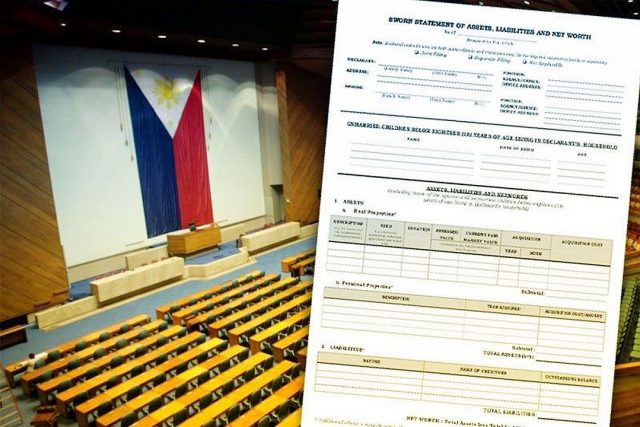
THE presidential palace on Monday said members of the Executive branch including President Ferdinand R. Marcos, Jr., are open to publicizing their statements of assets, liabilities and net worth (SALN), following the new Ombudsman’s plan to lift restrictions as calls for government transparency intensify.

“Whatever is proper, in accordance with the law and beneficial in the fight against corruption — everyone in the Executive branch will comply,” Palace Press Officer Clarissa A. Castro told a news briefing in Filipino. “Everyone in the Executive branch is ready.”

The Philippines is probing a multibillion-peso public works scam after Mr. Marcos’ pronouncements during his fourth state of the nation address, where he accused lawmakers of receiving kickbacks in various infrastructure projects.

This opened a can of worms as various government branches launched their own inquiries, further uncovering irregularities in infrastructure spending and prompting renewed scrutiny of accountability and transparency in public service.

The President also appointed former Justice Secretary Jesus Crispin C. Remulla as ombudsman and established an independent body to probe public work scams.

Mr. Remulla last week said he would lift restrictions on the SALNs of government officials to further boost transparency in the government, a call Filipinos have amplified in nationwide protests.

He said he would issue a memorandum this week reversing retired ombudsman Samuel R. Martires’ policy, which critics had condemned for limiting transparency and accountability.

While the anti-graft chief wants the documents publicized, he noted there may be redacted information, which he called “privacy matters.”

“The purpose of the SALN is to promote transparency in civil service and establish a deterrent against government officials bent on enriching themselves through unlawful means,” according to the Civil Service Commission.

During the tenure of former Ombudsman Conchita Carpio-Morales, the public could request access to SALNs, subject to guidelines similar to those cited by Mr. Remulla. However, access was curtailed in September 2020 after Mr. Martires issued Memorandum Circular No. 1.

The memo limited the release of SALNs to three instances: when requested by the official concerned or their authorized representative, when ordered by a court in connection with a case or when sought by the Office of the Ombudsman’s Field Investigation Office for a fact-finding inquiry.

FARM-TO-MARKET ROAD SCAM
Meanwhile, Mr. Marcos has ordered agencies concerned to investigate reports of seven nonexistent farm-to-market road projects in Davao Occidental worth P105 million.

Ms. Castro said the Department of Agriculture (DA) has submitted its report to the President, prompting coordination between Agriculture Secretary Francisco P. Tiu Laurel, Jr. and Public Works Secretary Vivencio B. Dizon.

“Yes, they’ve already discussed the matter,” she said in Filipino. “The secretaries will be working together to investigate the issue.”

When asked about specific presidential instructions, Ms. Castro said Mr. Marcos has long emphasized accountability in public works.

“The President has repeatedly said that those who are responsible must be held accountable,” she said. “From the start — even in his state of the nation address — he has directed that all cases be investigated thoroughly, supported by strong evidence, so that any legal action will not be wasted.”

The ghost projects add to mounting concerns about transparency and efficiency in agricultural infrastructure spending, as the administration pushes to modernize farm logistics and curb corruption in public works. — Chloe Mari A. Hufana

Audit commission seeks more funds, staff to probe flood control scandal

PHILIPPINE STAR/MIGUEL DE GUZMAN

THE Commission on Audit (CoA) is seeking additional funding to hire more auditors as it investigates corruption in multibillion-peso flood control projects involving public officials and contractors.

“We noticed a lack of manpower, and we need your help on this,” CoA Chairman Gamaliel A. Cordoba told senators at a budget hearing on Monday. “The number of our positions decreased due to the lower budget given by the Department of Budget and Management.”

CoA’s proposed 2026 allocation was cut to P15.07 billion, about P1.92 billion less than what the agency had requested. The reduced funding forced the agency to scrap 963 positions.

Mr. Cordoba said he has ordered a full audit of all Department of Public Works and Highways (DPWH) flood control projects in Bulacan from July 2022 to May 2025. He added that CoA has submitted eight fraud audit reports to the Office of the Ombudsman and 12 to the Independent Commission for Infrastructure (ICI) for potential administrative and criminal action.

“The first eight that we submitted became the basis of the administrative suspension of the employees and personnel from the DPWH First District of Bulacan,” he said.

The CoA chief also announced a measure requiring auditors to file declarations of conflict of interest to improve transparency. “All our employees will be asked to declare if they have any economic interests that may conflict with their work as auditors.”

The Marcos administration faces increasing scrutiny over flood-control projects, where billions of pesos in public funds were diverted through padded contracts and shell companies.

The Senate, along with the ICI, are conducting parallel investigations into the scandal, which has become a major test of the government’s anti-corruption drive and its management of infrastructure spending.

Meanwhile, the ICI has mapped out 421 suspected ghost flood control projects funded by the government from 2016 to 2025, based on its initial validation report released on Monday.

Of the questionable projects, 261 were found in Luzon, 109 in the Visayas and 51 in Mindanao. These projects were part of a broader infrastructure list of 238,200 projects nationwide during the same period.

Flood control accounted for 12.5% of the total, or 29,800 projects, the commission said. Roads made up the biggest share at 37.8% or 90,000, followed by multipurpose buildings at 26.7% or 63,500, school buildings at 11.7% or 27,900, bridges at 5.9% or 14,000, hospitals at 0.7% or 1,700 and other infrastructure at 4.7% or 11,300.

ICI Executive Director Brian Keith F. Hosaka said the commission would focus its inquiry on the suspected ghost projects, describing them as “low-hanging fruit” in the probe of almost 30,000 flood-control projects nationwide.

“We are more organized now,” he told a livestreamed news briefing. “We know what we look for initially, and these are the 421 ghost projects.”

The findings were based on field validations conducted with the Department of National Defense–Armed Forces of the Philippines, the Department of the Interior and Local Government–Philippine National Police, Department of Economy, Planning and Development Public Works department.

Validation work includes on-site inspections, technical audits and case documentation in preparation for submission to the Office of the Ombudsman. The ICI said it plans to refer at least 15 cases to the Ombudsman within the next three weeks.

Former national police chief Rodolfo S. Azurin, Jr. was sworn in as the commission’s special adviser and investigator before Court of Appeals Associate Justice Pedro B. Corales. Mr. Azurin said his role would focus on strengthening project verification to prevent similar anomalies.

“Our goal is to ensure that every public infrastructure project funded by taxpayers truly exists and serves its purpose,” he said.

Meanwhile, ICI warned that former Party-list Rep. Elizaldy S. Co could face contempt proceedings if he fails to attend the commission’s Oct. 14 hearing on his alleged role in the flood-control scam. Mr. Co has been summoned but has yet to return to the Philippines. — Adrian H. Halili and Erika Mae P. Sinaking

50% of Filipinos want Duterte to be liable

PCOO.GOV.PH

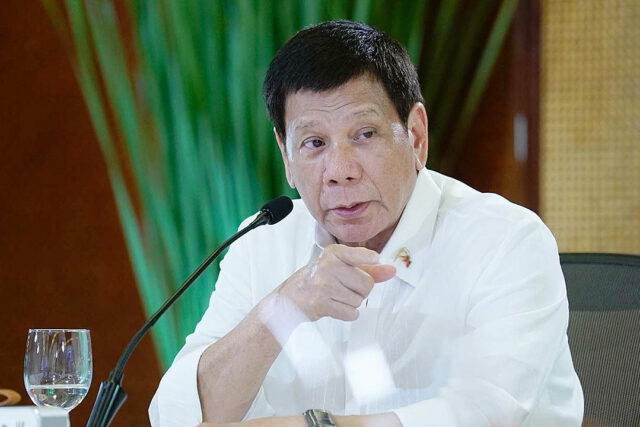
HALF of Filipinos think former President Rodrigo R. Duterte should pay for the killings tied to his administration’s war on drugs, according to a Social Weather Stations (SWS) poll.

The nationwide poll, conducted from Sept. 24 to 30 among 1,500 adults and commissioned by the Stratbase Group, found that 50% of respondents agreed the tough-talking Philippine leader should face responsibility for drug war deaths.

SWS said 32% disagreed, 15% were undecided and 4% said they did not know enough to answer. The survey had a ±3% error margin.

Support for accountability was strongest in the Visayas (54%), Metro Manila (53%) and Balance Luzon (52%). Mindanao, Mr. Duterte’s political base, posted the lowest rate at 39%.

Older Filipinos showed greater support for holding the ex-President liable, with 62% among those aged 55 and above agreeing, compared with 52% of those aged 45 to 54, 45% of respondents aged 35 to 44 and 43% among Gen Z or those aged 18 to 24.

Stratbase Group President Victor Andres “Dindo” C. Manhit said the findings highlight a “growing public recognition that accountability must prevail regardless of political power.”

“The data clearly show that Filipinos believe justice and rule of law are essential foundations of our democracy,” he said in a statement. “People understand that no one, not even a former president, should be above the law.”

Mr. Duterte is in custody of the International Criminal Court (ICC), which earlier rejected his bid for temporary release.

In a 23-page ruling issued on Friday, the tribunal said his detention was necessary to ensure his appearance at trial, prevent obstruction of the investigation and avert possible commission of further crimes.

The ICC wants to try Mr. Duterte for alleged crimes against humanity committed during the anti-drug campaign that left thousands dead. Duterte has denied wrongdoing and maintains that the campaign was a legitimate effort to combat illegal drugs.

More than 6,000 drug suspects died, according to government data, but human rights activists say as many as 30,000 people, mostly from poor families, were murdered. — EMPS

Reforms pushed amid flood scam

PHILIPPINE STAR /KJ ROSALES

HOUSE Speaker Faustino “Bojie” Dy III said on Monday the chamber would prioritize reforms to rebuild public trust, amid a widening flood control scandal that has shaken confidence in the government.

“Our conscience has been stirred to fulfill genuine reforms that will restore public trust in our institution,” he told the House floor in Filipino before lawmakers take a month-long congressional break. “It is our duty to correct what must be corrected and improve our service to the nation.”

He said that lawmakers will focus on passing priority measures, including amendments to the bank secrecy law, national land use and blue economy bills, which he described as important in strengthening the economy.

“The true test is not measured solely in the plenary, but in how we carry out our duties with honesty, accountability, and integrity,” the House Speaker said.

Also on Monday, the House floor approved a motion allowing the lower chamber to continue holding congressional hearings despite a month-long break, which would end on Nov. 10. — Kenneth Christiane L. Basilio

Bill criminalizes license renting

Ongoing flood control works continue in Binondo, Manila. — PHILIPPINE STAR/RYAN BALDEMOR

A PHILIPPINE Senator on Monday said he has filed a bill looking to criminalize “license for rent” schemes, where contractors rent out their licenses to dummy companies and public works officials to siphon funds from flood control projects.

Senate bill No. 1453, the License Integrity Bill, filed by Senator Erwin T. Tulfo, seeks to impose jailtime between three years and 12 years on those found lending, borrowing, and fraudulently using their licenses.

It also seeks to impose fines of not less than P300,000 but not more than P3 million on those found renting their contractor licenses.

“These privileges have often been misused and abused,” he said in the explanatory note.

“A disturbing practice has emerged where grantees lend, lease, sell, or otherwise allow third parties to unlawfully use their licenses, while others fraudulently obtain or misrepresent such privileges to cloak illegitimate transactions under the guise of legality,” he added.

Separate congressional probes found that contractors have been colluding with public works officials to siphon off billions in funding for flood mitigation projects.

The proposed measure not only covers the contractors’ license in the Department of Public Works and Highways but also the customs brokers in Bureau of Customs, and environmental licenses in Department of Environment and Natural Resources. 

The Senator said that public officials who will issue licenses to unqualified or conflicted applicants will also be penalized administratively and criminally.

“This affirms the nature of licenses and permits as personal, non-transferable privileges subject to the continuing oversight of the State,” he added.

Mr. Tulfo said that the proposed measure also seeks to restore the integrity of government-issued licenses and permits, strengthen accountability, prevent abuses that undermine governance, and ensure that the license privileges serve only their lawful and intended purposes. — Adrian H. Halili

Davao Region gets P298-M aid

PRESIDENT Ferdinand R. Marcos, Jr. and Social Welfare Secretary Rexlon T. Gatchalian among other government officials visited towns in Davao Oriental on Oct. 13, after it was hit by twin earthquakes last week. — DSWD

PHILIPPINE President Ferdinand R. Marcos, Jr. has ordered the release of P298 million in financial assistance to local government units in the Davao Region, severely affected by the twin earthquakes that struck on Oct. 9 and Oct. 10.

During his visit to the hard-hit municipalities of Manay and Tarragona in Davao Oriental on Monday, he said the Office of the President will distribute aid ranging from P15 million to P50 million to nine provinces, and P3 million to P15 million to 12 affected cities and municipalities.

The Office of the President allocated P50 million to Davao Oriental; P5 million each to the municipalities of Manay, Banaybanay and Lupon; P10 million each to Mati City and the municipalities of Tarragona, Baganga, Boston, and Cateel; P5 million each to the municipalities of Caraga and San Isidro; and P3 million to the municipality of Governor Generoso.

Some P20 million will be allotted to Agusan del Sur, and P15 million each to the provinces of Davao de Oro, Davao del Norte, Davao Occidental, Agusan del Norte, Surigao del Norte, Surigao del Sur, Dinagat Islands, and Davao City.

Mr. Marcos also visited Davao Oriental to personally oversee relief operations for areas hit by the twin earthquakes that struck the province.

He inspected damaged infrastructure, including the Davao Oriental Provincial Hospital in Manay District, which was completely destroyed, and the Manay National High School, where several classrooms and the faculty room had collapsed.

He also visited evacuation centers in Tarragona, where 255 displaced families are currently staying in makeshift tents.

The Department of Social Welfare and Development (DSWD) distributed food packs, hot meals, and P10,000 in cash aid to families whose homes were destroyed.

Meanwhile, the Department of Budget and Management (DBM) said Mr. Marcos has directed agencies to ensure “round-the-clock” support for affected communities.

The DBM Chief said the government will provide up to P150,000 in financial aid to families who lost relatives in the recent earthquake.

The DBM released more than P2.34 billion earlier this month to replenish the Quick Response Funds (QRF) of the DSWD.

The DBM said the replenishment aims to speed up aid and recovery efforts for the victims of recent calamities that hit the country.

Out of this, P1 billion has been released to the Department of Public Works and Highways to cover the third replenishment of its built-in QRF.

A total of P1.341 billion was also released to the DSWD to cover the additional replenishment of its 2025 QRF.

The QRF is a stand-by emergency fund to support aid, relief, reconstruction, and rehabilitation in calamity-affected areas. — Chloe Mari A. Hufana and Aubrey Rose A. Inosante

DoTr revokes protocol license plates

PHILIPPINE STAR/ MICHAEL VARCAS

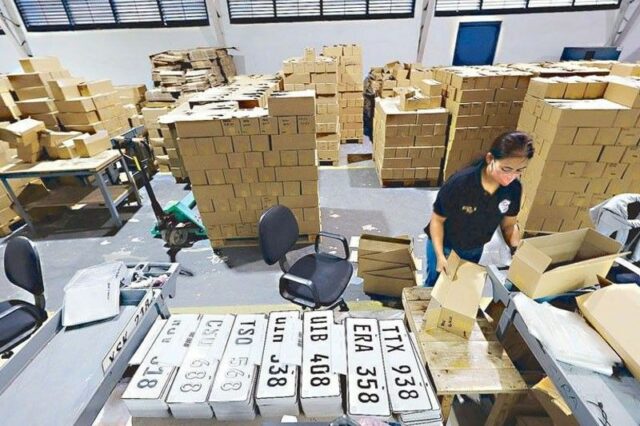
THE Department of Transportation (DoTr) has ordered the revocation of protocol license plates issued to officials of the agency and its attached agencies.

“All concerned officials shall surrender the protocol license plates issued to them and the LTO (Land Transportation Office) shall undertake the necessary coordination to implement this directive,” Transportation Acting Secretary Giovanni Z. Lopez said.

In a memorandum order dated Oct. 13, Mr. Lopez revoked the privilege of agency officials to prevent misuse and abuse in using special government license plates.

“Revoking all previously issued authorization to use protocol license plates given to officials of the DoTr Central Office, including its Sectoral and Attached Agencies and Corporations,” the agency said.

The directive was issued following a viral road rage incident involving Transportation Undersecretary for Internal Audit and Special Concerns Ricardo E. Alfonso, Jr. who was seen using blinkers and protocol plate number.

The DoTr has also directed all concerned officials to surrender protocol license plates, noting that the LTO is currently undertaking all necessary coordination and measures to implement the order.

Further, the agency has also ordered the prohibition of sirens, blinkers, and similar flashing devices by DoTr officials and its affiliated agencies. — Ashley Erika O. Jose

OIC Vida vows DoJ continuity

BW FILE PHOTO

JUSTICE Undersecretary Fredderick A. Vida on Monday committed to sustaining the Department of Justice’s (DoJ) investigation into alleged irregularities in flood control and infrastructure projects as he takes over as officer-in-charge (OIC).

“This should be a team effort—Team DoJ continuing the mandate to serve the Filipino people,” Mr. Vida said in his first media briefing as acting Justice secretary. “The public’s expectations of us, especially in government, are high. In situations like this, we must always stand on what is right—on the rule of law.”

Mr. Vida, who now leads the DoJ following the appointment of former Justice Secretary Jesus Crispin Remulla as Ombudsman, said the department will sustain its coordination with the Office of the Ombudsman and the Independent Commission on Infrastructure (ICI) in gathering evidence on alleged anomalous projects.

He said the DoJ and the Office of the Ombudsman recently signed a memorandum of agreement (MoA) to facilitate the collection of testimonies and evidence from witnesses under the Witness Protection Program (WPP).

“The public should continue to trust that the DoJ remains their ally in pursuing justice,” Mr. Vida said, citing ongoing cases such as those related to the missing sabungeros and flood control irregularities. “We assure the public that we will only file strong cases.”

Mr. Vida confirmed that the DoJ is still evaluating affidavits and testimonies submitted by parties involved, including those allegedly identifying high-profile individuals.

“As of now, there is no tell-all affidavit submitted,” he clarified. “We must verify every testimony with factual and objective evidence. We cannot rely solely on statements without proof.”

Assistant State Prosecutor Richard Anthony D. Fadullon added that the National Bureau of Investigation (NBI) has recommended the filing of cases, but the determination of state witness eligibility remains within the discretion of the DoJ’s investigating officers.

“The timeline is already set,” Mr. Vida said. “The people are impatient, but we will file cases in the coming weeks—based on evidence, with or without state witnesses.”

Addressing calls from some groups for protests and demands to remove certain officials, Mr. Vida urged the public to allow and trust the legal process to proceed.

“In the coming weeks, in coordination with the Ombudsman and the ICI, we will be filing the appropriate cases. We must let each institution function. When we shortcut the process, that’s when problems arise.” — Erika Mae P. Sinaking

OPAPRU, Basilan LGUs to implement 2 peacebuilding projects

COTABATO CITY — The Office of the Presidential Adviser on Peace, Reconciliation and Unity (OPAPRU) and the provincial government of Basilan forged an agreement to jointly implement two more peacebuilding programs in the island province.

The now markedly peaceful Basilan is one of the five provinces in the Bangsamoro Autonomous Region in Muslim Mindanao (BARMM) and is touted as one of BARMM’s new investment hubs.

BARMM regional officials told reporters on Monday that Basilan Governor Mujiv S. Hataman and Secretary Carlito G. Galvez, Jr. of OPAPRU signed the agreements for the two peace and socio-economic programs during a multi-sector peace forum at the provincial capitol in Barangay Santa Clara in Lamitan City on Thursday last week.

The first of the two agreements binds OPAPRU and the provincial government and all other local government units (LGUS) in Basilan to cooperate in implementing the Localizing Normalization Implementation (LNI) Program, aiming to sustain the peace now spreading around the province.

The second agreement obliges the OPAPRU and the Hataman administration to implement together the Preventing and Transforming Violent Extremism, which complements the LNI Program.

Bangsamoro Chief Minister Abdulrauf A. Macacua, chairperson of the multi-sector and inter-agency BARMM Regional Peace and Order Council, said on Monday that all provincial offices in Basilan of the agencies under his office will support both peacebuilding programs.

The two programs are focused on improving the lives, via humanitarian interventions, of decommissioned combatants of the Moro Islamic Liberation Front (MILF) and former violent religious extremists who have returned to the fold of law through the joint intercession of local executives in Basilan, the police and the military.

Provincial and municipal officials in Basilan separately told reporters that the national government has earmarked P14 million for both programs that the military’s Western Mindanao Command and the Police Regional Office-Bangsamoro Autonomous Region shall both support too.

Mr. Hataman said he is certain that the MILF, the Moro National Liberation Front and former members of the Abu Sayyaf terror group who have pledged allegiance to the government will help push the two peacebuilding programs forward. — John Felix M. Unson

PSEi ends higher as investors pick up bargains

REUTERS

THE MAIN INDEX rebounded slightly on Monday on bargain hunting following the market’s recent decline.

The Philippine Stock Exchange index (PSEi) rose by 0.24% or 14.54 points to close at 6,052.33. Meanwhile, the broader all shares index dropped by 0.07% or 2.85 points to end at 3,655.59.

“Local equities cautiously edged higher after marking an intraday low near the psychological support at 6,000, with bargain hunters stepping in to pick up battered blue chips,” AP Securities, Inc. said in a market note.

The PSEi opened Monday’s session at 6,026.11, slightly lower than Friday’s close of 6,037.79. It sank to an intraday low of 6,002.98, while its best showing was at 6,078.37.

“The PSEi opened the week in positive territory despite persistent trade uncertainties between the US and China that weighed on global markets. The index’s resilience was likely driven by bargain hunting, while investor sentiment was further lifted by the appreciation of the Philippine peso against the US dollar,” Regina Capital Development Corp. Head of Sales Luis A. Limlingan said in a Viber message.

The peso was broadly steady against the dollar on Monday, closing at P58.245, just a tad lower than Friday’s finish of P58.24, Bankers Association of the Philippines data showed.

Meanwhile, world markets found steadier ground on Monday after being whipsawed by broadsides in the US-China trade war, while gold hit new record highs in a sign that uncertainty remained high, Reuters reported.

While US President Donald J. Trump had threatened 100% tariffs on China from Nov. 1 and Beijing threatened countermeasures, he sounded more conciliatory on Sunday, posting that everything would be fine and the US did not want to “hurt” China.

Beijing defended on Sunday its curbs on exports of rare earth elements and equipment as a response to US aggression, but stopped short of imposing new levies on US products.

US stock futures pointed to a rebound when Wall Street reopens on Tuesday, with S&P 500 and Nasdaq stock futures up more than 1% each.

Back home, most sectoral indices closed in the red on Monday. Industrials dropped by 1.22% or 110.26 points to 8,926.26; property sank by 0.42% or 9.67 points to 2,262.74; holding firms decreased by 0.19% or 9.57 points to 4,841.38; and financials dropped by 0.1% or 2.16 points to 2,019.59.

Meanwhile, mining and oil rose by 2.29% or 327.72 points to 14,640.08, and services jumped by 2% or 45.87 points to 2,330.18.

Value turnover declined to P4.92 billion on Monday with 1.96 billion shares traded from Friday’s P6.37 billion with 1.52 billion shares changing hands.

Decliners outnumbered advancers, 121 to 76, while 52 names closed unchanged.

Net foreign buying was at P109.29 million on Monday, a reversal of the P1.01 billion in net selling recorded on Friday. — Alexandria Grace C. Magno with Reuters

GOCC pay scheme under GCG review 

THE Governance Commission for Government-Owned or -Controlled Corporations (GCG) said the new compensation framework guidelines for workers in state-run firms is currently undergoing final review.

In a statement dated Oct. 9, the regulator said the guidelines for the new Compensation and Position Classification System II (CPCS II) — which raises salaries and adds tiered medical allowances — are now being looked at by the GCG, sitting en banc.

“Once approved, the Implementing Guidelines will immediately be readied for the signature of the members of the GCG en banc and for publication in a newspaper of general circulation,” the GCG said, adding that the pay scale will also be posted on GCG’s website.

The regulator said state-run firms that have submitted complete documentation will have their Authority to Implement requests processed and released on a “first-in, first-out” basis once the guidelines take effect.

“The GCG reaffirms its continued partnership with the GOCC sector and its commitment to the timely and transparent implementation of the CPCS II,” it said. — Aubrey Rose A. Inosante

PHL close to concluding trade deals with EU, UAE

REUTERS

THE Department of Trade and Industry said on Monday that it is looking to finalize negotiations for free trade deals with the European Union (EU) and the United Arab Emirates (UAE), next year and next month, respectively.

At a Senate budget hearing on Monday, Trade Secretary Cristina A. Roque said the Philippines is not yet at the stage of discussing market access issues with the EU.

“We are still in the text-based negotiations. These are the rules and disciplines,” Trade Undersecretary Allan B. Gepty also told the Senators.

The Philippines-EU FTA is expected to be the country’s most comprehensive trade agreement, being the first such deal to tackle government procurement, digital trade, energy and raw materials, and trade and sustainable development.

Trade between the Philippines and the EU was $15.5 billion in 2024, making the bloc the Philippines’ fifth-largest trading partner, accounting for 7.7% of total trade.

Philippine exports to the EU hit $8.1 billion, while imports from the EU amounted to $7.5 billion.

Ms. Roque said that the DTI is looking to sign a free trade deal with the UAE by late November.

“The Comprehensive Economic Partnership Agreement (CEPA) will be signed by end of November, around Nov. 24,” Ms. Roque told the panel.

Among the top Philippine exports to the UAE are electrical equipment, food products, iron and steel, mineral fuels and machinery.

Mr. Gepty said products covered under the free trade deal include agricultural products, industrial products, machinery, and electronics.

The Philippines and the UAE began negotiating their CEPA in February 2022. Once signed it would be Manila’s first free trade agreement (FTA) with a Middle Eastern country.

The CEPA is expected to provide opportunities for Dubai companies to invest in the Philippines.

The UAE is the Philippines’ 18th biggest trading partner and top export market in the Gulf Cooperation Council. — Adrian H. Halili