Home Blog Page 434

100% foreign ownership rules seen easing Abu Dhabi oil company’s PHL expansion

THE PHILIPPINES is “ready and open” for major foreign oil companies, including Abu Dhabi National Oil Co. (ADNOC), seeking to expand their presence in the country, Trade Secretary Ma. Cristina A. Roque said, citing deregulation rules that allow full foreign ownership in parts of the energy business.

In a statement on Wednesday, Ms. Roque noted that Republic Act 8479 or the Downstream Oil Industry Deregulation Act, allows 100% foreign ownership in refining and distribution.

ADNOC is a state-owned oil company of Abu Dhabi and one of the largest oil companies by production in the world.

“ADNOC shared plans to update a proposed PHL–UAE supply agreement and the establishment of a strategic petroleum depot in Subic or La Union, aimed at enhancing the Philippines’ energy security and supply resilience,” the DTI said in a separate social media post on Wednesday.

The Philippines signed a Comprehensive Economic Partnership Agreement with the UAE, which is expected to raise Philippine exports to the Gulf state by 9.13% and expand access for professionals and businesses.

Ms. Roque and Finance Secretary Frederick D. Go met UAE Minister of Industry and Advanced Technology Sultan Ahmed Al Jaber, who also chairs ADNOC.

“Our engagement with ADNOC is part of the Philippines’ continuous efforts to secure a reliable, affordable, and competitive energy supply,” Mr. Go said.

“Through the Philippines–UAE CEPA, we seek to build long-term partnerships with UAE companies that will strengthen energy security and expand opportunities for Filipino workers and businesses,” he added.

ADNOC operates a Philippine logistics arm supporting the country’s first LNG import terminal in Batangas.

ADNOC has participated in spot tenders with Philippine energy groups like First Gen and San Miguel, which the Philippine government is pushing to expand to longer‑term and aggregated supply deals.

“In April 2022, ADNOC Logistics & Services and AG&P signed a long-term charter agreement for the Floating Storage Unit ISH, which supports the country’s first LNG import terminal in Batangas Bay,” it added. — Aubrey Rose A. Inosante

PEZA obtains manufacturing, aerospace investment pledges during US mission

THE Philippine Economic Zone Authority (PEZA) said it obtained investment commitments from manufacturing, aerospace, pharmaceutical, and information technology and business process management (IT-BPM) companies during a five-day mission to the US.

“This mission sends a clear message that the Philippines — through PEZA — is open, ready, and competitive for high-value investments,” PEZA Director General Tereso O. Panga said in a statement on Wednesday.

“From advanced manufacturing and aerospace to medical technology and IT-BPM, global companies continue to recognize the strength of our talent, the reliability of our economic zones, and the impact of the government’s reforms,” he added.

The mission was held on the sidelines of the Consumer Electronics Show 2026 from Jan. 5 to 6, where four Filipino exhibitors showcased their products and services.

Among the investments is a $200-million pledge from a vertical manufacturer of high-quality industrial and medical exam nitrile gloves and glove-making machines.

Targeted for operations this year, the manufacturing project is being positioned to serve Western and ASEAN markets.

It is expected to generate 2,000 jobs at two sites in South Luzon and Cebu.

PEZA also met with a manufacturer of portable brain imaging systems, which is also interested in setting up operations in the Philippines.

“The pharmaceutical and medical device sector is one of the promising new sources of ecozone foreign direct investment following PEZA’s launching last year of the country’s first pharma park and the guidelines for registration of pharm-related projects,” it added.

The investment promotion agency also met with an aerospace company planning a major expansion in the Philippines. It has been operating in Baguio City since 1984.

“The company is considering New Clark City as the site of its next expansion phase, which is projected to bring in over $15 million in new investment and generate 1,000 additional jobs, adding to its current workforce of more than 2,000 employees,” it said.

PEZA also met with representatives of a US mental health services provider that is considering setting up a center in the Philippines.

“The company currently operates in the US and India and is considering launching IT-BPM operations, with the potential to employ more than 1,500 within its first year of operations,” it said.

As of November 2025, PEZA zones host over 250 companies with US equity, accounting for P410 billion in investments and 380,000 jobs. — Justine Irish D. Tabile

Visayas power issues stem from dependence on other grids — DoE

STOCK PHOTO | Image by Natsuki from Unsplash

THE Department of Energy (DoE) said it is expecting power issues in the Visayas due to its dependence on other grids for supply.

In the course of preparing its three-year power outlook, the DoE flagged the Visayas as a problem area also due to the termination of some renewable energy (RE) contracts.

“For Luzon, there should enough power. It’s more in the  Visayas area. Because of the problem in Visayas, then Mindanao will be affected because they export power to Visayas,” Energy Secretary Sharon S. Garin told reporters on Tuesday.

Regarding the terminated RE contracts, Ms. Garin said the service contracts were canceled due to the developers’ failure to deliver on their commitments.

Some of these projects were awarded through application and the previous green energy auction (GEA) rounds.

“Maybe had the projects come in for GEA-1 and GEA-2, then this would not even be an issue. So, projections for 2026, 2027, and 2028, basically show that we have to catch up because of the failure of the GEA winners to deliver,” Ms. Garin said.

The final energy outlook is awaiting adjustment and recalculation of forecasts and assumptions “but we’ll be ready within a month,” she said.

Among the aspects being reviewed are the scheduling of planned outages in order that they do not take place during the high-demand dry season.

“We’re rescheduling everything, coordinating also with the ERC (Energy Regulatory Commission) on that,” she said.

Ms. Garin said programs are in place to minimize the possibility of power rationing in the Visayas that will require blackouts.

“We have the LP (Interruptible Load Program), energy conservation efforts, rooftop solar programs. We’re adding also to our bunker reserves,” she said. “It’s just extra work but the DoE is working on it and assessing what we will be doing come summer 2026,” Ms. Garin said.

Last year, the DoE forecast a peak demand of 14,769 megawatts (MW) for Luzon, 3,111 MW for the Visayas, and 2,789 MW for Mindanao.

The National Grid Corp. of the Philippines (NGCP) said that the projected peaks are expected to continue increasing.

“It will always increase. And the drivers are the same. Population, economic activity, and development, etc.,” NGCP Spokesperson Cynthia P. Alabanza said in a briefing on Wednesday.

Ms. Alabanza said the Grid Operating and Maintenance Program, which includes the proposed three-year maintenance outages of grid and system operations, has been approved by the DoE. — Sheldeen Joy Talavera

Polish pork from zones not affected by ASF to be allowed for import

REUTERS

THE PHILIPPINES entered into a bilateral regionalization agreement with Poland that will allow the resumption of pork imports from parts of that country not affected by African Swine Fever (ASF).

According to Department of Agriculture (DA) Memorandum Order (MO) No. 1, signed on Jan. 14, the Philippines adopted an ASF regionalization scheme for Poland in lieu of a blanket ban on products from the entire country regardless of the outbreak’s location. The regionalization measure is authorized by DA Administrative Circular No. 12, series of 2025.

According to the MO, the Bureau of Animal Industry reviewed documentary submissions from Polish veterinary authorities and concluded that “Poland maintains sufficient veterinary oversight and has established necessary control and mitigating measures against ASF, ensuring that there is low risk of importing swine products, and by-products, including meat from identified proposed zones for recognition.”

ASF is a highly contagious viral disease lethal to swine and wild boars. — Vonn Andrei E. Villamiel

Jan. transmission rates down as power reserve costs decline

BW FILE PHOTO

TRANSMISSION RATES in the January electricity bill are set to fall due to the lower cost of power reserves used to maintain reliable operations, the National Grid Corp. of the Philippines (NGCP) said.

In a briefing on Tuesday, Julius Ryan D. Datingaling, NGCP head of business and regulatory development, said overall transmission rates declined 0.68% month on month to P1.3455 per kilowatt-hour (kWh).

“The downward movement is generally due to the decrease in AS (ancillary services) costs,” he said.

AS costs, or power reserves tapped by grid operators to maintain reliable operations, declined to P0.5971 per kWh from P0.6217 per kWh a month earlier.

Citing the Independent Electricity Market Operator of the Philippines, Mr. Datingaling said increased supply on the reserve market prompted the decline in AS prices.

Transmission wheeling rates, on the other hand, decreased to P0.6058 per kWh from P0.5894 per kWh previously. This reflects the cost of delivering electricity from power generators to the distribution system.

Other charges, which include universal charge, feed-in tariff allowance, and value-added tax on transmission and AS charges, fell to P0.1426 per kWh from P0.1436 previously.

Rates declined by 1.67% in Luzon, 0.99% in the Visayas, and 2% in Mindanao.

The transmission rate is billed to end-users through distribution utilities and electric cooperatives.

“For the January 2026 electric bill of end consumers, NGCP charges only 60 centavos per kWh for the delivery of its services,” the NGCP said, adding that its revenue is capped and regulated by the Energy Regulatory Commission. — Sheldeen Joy Talavera

NEA loans to electric co-ops hit P2.8B in 2025

BW FILE PHOTO

THE National Electrification Administration (NEA) said it disbursed loans totaling P2.8 billion to 45 electric cooperatives (ECs) in 2025, against P1.6 billion a year earlier.

In a statement on Wednesday, NEA said it has allocated P1.7 billion to fund the capital expenditure projects of 34 ECs, of which 15 were in Luzon, eight in the Visayas, and 11 in Mindanao.

The Accounts Management and Guarantee Department released P956 million for working capital loans of 11 ECs serving electricity consumers in Albay, Cagayan de Sulu, Camarines Sur, Cotabato, Negros Oriental, Northern Negros, Pampanga, Pangasinan, Sultan Kudarat and Tarlac.

Some ECs also received P142.2 million in calamity loans to rehabilitate vital energy infrastructure damaged by Super Typhoon Odette in 2021.

The NEA has been offering financial assistance to ECs through its Enhanced Lending Program. The mechanism aims to ensure their operations will continue for the benefit of their member-consumer-owners.

The program consists of regular, calamity, and concessional loans, standby and short-term credit, single-digit system loss loans, renewable energy loans, and modular generator set financing.

Republic Act No. 9136, or the Electric Power Industry Reform Act of 2001, tasks the NEA with overseeing missionary electrification and providing financial, institutional, and technical assistance to electric cooperatives.

NEA has a target of increasing the rural electrification rate to 94% by the end of 2026. — Sheldeen Joy Talavera

Sugar millers oppose scheme linking import eligibility to exports under US quota scheme

WIKIMEDIA.ORG/PATRICKROQUE01

THE Philippine Sugar Millers Association (PSMA) reaffirmed its opposition to any Sugar Order that would tie eligibility to import sugar with exports of raw sugar to the US.

In a statement on Wednesday, the PSMA said such a scheme could exacerbate the current glut, which has depressed millgate prices in recent years.

“Currently, our country has unprecedented sugar inventory levels brought about by excessive imports over the past three years,” the association said.

The PSMA said current inventory levels should be brought back to levels it considers healthy — equivalent to about two months of national demand.

The PSMA also urged the Sugar Regulatory Administration (SRA) to exercise its powers rather than create new mechanisms that guarantee future imports to compensate exporters.

“Linking exports to guaranteed import replenishment can have serious long-term negative impact on the viability of the sugar industry… any import volume must be (calibrated to match) an actual shortfall. Doing otherwise puts the viability of this industry in jeopardy,” the association added.

The group recommended that for US shipments, the SRA issue “A” quedans, official certificates that confirm sugar allocations for export, without creating expectations of additional imports. — Vonn Andrei E. Villamiel

Bicol cold-storage complex due to open by early March

DA.GOV.PH

THE Department of Agriculture (DA) said a new P500‑million cold storage facility in Pili, Camarines Sur is expected to open in late February or early March.

The facility is nearing completion after weather‑related delays, the DA said in a statement.

According to the DA, the facility will feature six refrigerated warehouses with a combined capacity of 2,688 pallet positions, enough to store about 4,600 metric tons of boxed meat or 3,000 metric tons of vegetables.

The facility also includes a blast freezer, processing and packing areas, and a solar power system to enhance energy efficiency, the DA said.

Agriculture Secretary Francisco P. Tiu Laurel, Jr. said the facility will strengthen food security, support employment, and raise farmer incomes in the region.

“This investment strengthens food security, creates jobs, attracts agri-investments, and — most importantly — raises incomes of farmers, fishers, and everyone in the agriculture value chain across Bicol and neighboring regions,” he was quoted as saying in a statement.

Camarines Sur Governor Luis Raymund F. Villafuerte, Jr. was quoted in the statement as saying that the facility’s reach could extend beyond the province.

He said huge volumes of produce from the Visayas and Mindanao pass through Camarines Sur en route to Metro Manila and other major Luzon markets, making the province an important transit point.

Meanwhile, Mr. Laurel said the DA has also earmarked another P500 million for a complementary food hub, with implementation expected to begin in June and take about 12 months.

The planned food hub will provide trading and distribution facilities to complete the province’s emerging food system. — Vonn Andrei E. Villamiel

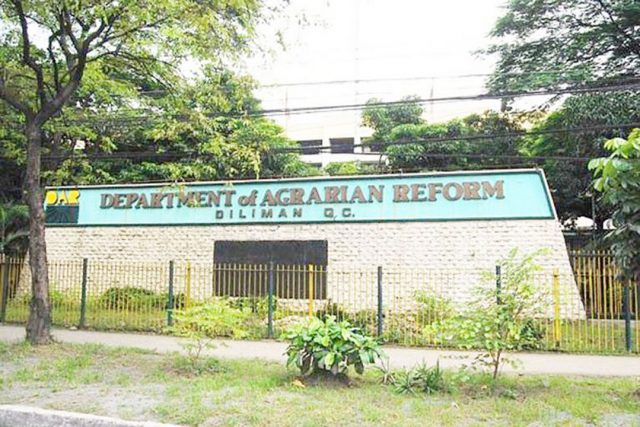
DAR 2026 land distribution target 400,000 hectares

FACEBOOK.COM/DARGOVPH

THE Department of Agrarian Reform (DAR) said it hopes to distribute 400,000 hectares of farmland to agrarian reform beneficiaries (ARBs) this year.

Agrarian Reform Secretary Conrado M. Estrella III told BusinessWorld that only about 700,000 hectares of agricultural land are left to be awarded to farmers, downgrading an earlier estimate of 2 million.

Mr. Estrella said most of the land to be distributed this year is located in Mindanao and the Visayas.

“This year, we will go for 400,000 hectares and finish the balance by 2027,” he said on Wednesday via Viber.

Mr. Estrella said DAR has yet to determine the number of land titles to be issued this year, pending the outcome of ongoing land surveys.

He said DAR also aims to complete the distribution of Certificates of Condonation and Release of Mortgage before June.

Under Republic Act No. 11953, or the New Agrarian Emancipation Act, DAR is tasked with condoning certain mortgage obligations, including unpaid amortization, interest, and surcharges incurred by ARBs under the Comprehensive Agrarian Reform Program.

Mr. Estrella said DAR will also focus on irrigation projects this year to allow farmers to plant crops year-round.

He added that DAR will also encourage beneficiaries to adopt modern and scientific farming and livestock production methods.

“We hope to encourage agrarian reform organizations to adopt a more business-like culture where they are trained to manage financial matters, adopt the latest agricultural technologies, and develop innovative marketing skills,” Mr. Estrella said. — Vonn Andrei E. Villamiel

My AI-powered bar review journey

On Jan. 7, the Office of the 2025 Bar Chairperson announced the results of the 2025 Bar Exams. Of the 11,420 examinees, 5,594 successfully hurdled the Bar Exam for a passing rate of 48.98%. In recent years, the passing rate has swung wildly: 72.28% in 2020-21, 43.47% in 2022, 36.77% in 2023, and 37.84% in 2024.

These numbers underscore a reality every bar taker understands: the Philippine Bar is among the toughest exams in the world. Aside from being the only professional licensure examination administered by the Supreme Court, it is purely essay based, spans an entire week with three full testing days in September, and demands mastery of political law, civil law, criminal law, labor law, commercial and taxation law, remedial law, and legal and judicial ethics.

BUILDING A TECH-ASSISTED STUDY ROUTINE
As an examinee preparing for the 2025 bar exam, I crafted a study plan that treated the Bar syllabus as my bible, following it methodically until I was confident that no principle, concept, or doctrine had been left untouched. What kept me up at night, however, was not whether I would put in the hours, but whether I would be able to retain and retrieve what I was studying when it mattered.

That was where artificial intelligence (AI) stepped in. Alongside the mental and emotional discipline that bar review demands, I decided to adopt a study plan built around a digital and tech-driven framework. AI became my constant, quiet study partner and personal coach that helped turn the overwhelming volume of readings into manageable, organized, and test-ready knowledge.

FROM SELF-MADE NOTES TO AI-GENERATED BAR DRILLS
I entered the review period with one major asset: my own personal notes from law school. These were my own distilled summaries of readings, lectures, and cases culled from my classes, organized in a way that matched the Bar syllabus, and reflected how I understood the law. Instead of experimenting with new reviewers, I turned my notes into the backbone of an AI-enhanced study system.

My process was simple but powerful. I fed portions of my notes into AI and ask it to transform them into bar-type review materials. A typical prompt looked like this:

Here are my notes for the topic “Refund of Erroneously or Excessively Paid Taxes under Section 229 of the Tax Code.” Please create bar exam style questions to test all relevant principles, rules, doctrines, as well as the amendments introduced by the Ease of Paying Taxes (EoPT) law in relation to this topic, which I will answer, and you will grade my answer afterwards as if you were a bar examiner. Give feedback on where I can improve.

The AI responded by generating essay questions, drills, question and answer sets, mnemonics, and memory techniques tailored specifically to my own summaries. It then evaluated my answers and pointed out gaps, weak reasoning, or missing legal bases. Instead of passive reading, my notes were transformed into an active testing engine with immediate, targeted feedback on how to improve.

Whenever a doctrine or provision felt unclear, I asked the AI to restate the rule in simpler terms and provide practical examples. Once the concept clicked, I then used AI to transform those same principles drawn from codal provisions and jurisprudential perspectives, into potential bar exam problems. Over time, topics that once felt intimidating became more familiar, understandable, and relatable.

All that work paid off when I finally took the exam in September. By then, I had answered so many AI-generated questions that very few issues felt completely new. The difficult questions I encountered in the exam all echoed patterns I had already seen in the AI-generated drills. The real advantage was not that the questions were identical, but that my mind had been trained to recognize the legal issues quickly and respond with clear, structured, and confident answers because of the timely feedback the AI provided after every practice response to the questions it generated. Because AI had forced me to apply the law repeatedly, I could respond calmly and methodically when faced with similar issues during the actual exam. 

THE RESULT AND THE ROAD AHEAD
On the day that results were released, I deliberately stepped away from my devices and spent the day trying not to think about whether my name would appear on the list of successful examinees. My parents and siblings were the ones who called with the good news. What I felt most was contentment and relief that the months of intense preparation had done their work and that I would not have to repeat the bar review cycle.

One piece of advice I can give to the 2026 Bar candidates is to make use of technology in preparing for the bar. While AI is not a magic solution and cannot replace the discipline of reading codals or understanding doctrine, it is a powerful amplifier. It can convert personal notes into dynamic, adaptive reviewers; simulate the bar examination environment; and sharpen both retention and analysis. For me, repeatedly encountering codal principles and doctrines in question and answer format trained my mind to think and answer like a lawyer, to anticipate how examiners might frame issues, to structure answers properly, and to give responsive, legally grounded conclusions. Embracing both tradition and innovation allowed me to walk into the exam room not only well-read, but also well-trained to think, write, and respond like a lawyer.

Congratulations to all successful examinees of the 2025 Bar. I look forward to signing the Roll of Attorneys and reciting the Lawyer’s Oath with you, as we soon — and officially — become panyeros and panyeras in the profession we have all diligently prepared to join.

The views or opinions expressed in this article are solely those of the author and do not necessarily represent those of Isla Lipana & Co. The content is for general information purposes only, and should not be used as a substitute for specific advice.


Jose Luis M. Yupangco is a manager in the Tax Services department of Isla Lipana & Co., the Philippine member firm of the PwC network.


Eala scores a repeat win over Vekic ahead of Aussie Open main draw

ALEX EALA — REUTERS/ZUMA PRESS WIRE/CHRIS PUTNAM

ALEXANDRA “ALEX” EALA reasserted mastery of seasoned Croatian ace Donna Vekic, 6-3, 6-4, in the Kooyong Classic in Melbourne on Wednesday at the Kooyong Lawn Tennis Club ahead of her main draw debut in the Australian Open (AO) this weekend.

The 20-year-old Ms. Eala scored the repeat win in just over an hour for her final game before duking it out against the world titans in this year’s first Grand Slam at the same city slated until Feb. 1.

Ms. Eala previously beat the 29-year-old Croatian, who won a silver medal in the 2024 Paris Olympics singles, at the ASB Classic in Auckland, New Zealand last week with a 4-6, 6-4, 6-4 comeback win.

That win snowballed to a final four finish after a 7-5, 5-7, 4-6 loss to China’s Wang Xinyu, her third in the WTA Tour, that should serve handy in her preparations for the big stage.

Mses. Eala and Vekic along with Ms. Xinyu are also listed in the main draw of the Philippine Women’s Open on Jan. 26 to 31 in Manila albeit the stint of the Filipina ace still hangs in the air depending on her campaign in the AO.

Her rematch with Ms. Vekic, WTA No. 70, was her lone duel in Kooyong, which only served as an exhibition tourney for invited rising and seasoned players as their final buildup for the AO, which she considers a home tourney given a rich history.

Ms. Eala, formerly world No. 2 in the girls division, netted her first Grand Slam girls doubles crown in the 2020 Australian Open before jumping to the women’s division with multiple qualifying round stints in the past as a wildcard.

The Filipina sensation this time around will play in her first AO main draw, earning a direct entry as a Top 50 player.

Ms. Eala, a proud graduate of the Rafael Nadal Academy in Spain, this week rose to No. 49 from No. 53, resetting her previous career-best at No. 50 last month in time for the AO main draw firing off on Jan. 18 after the ongoing qualifiers.

The AO this week also released a promotional video featuring Ms. Eala and her mentor Rafael Nadal, sharing what it means to play in the Australian major as one of the world’s only four Slams and the first for the season.

“For me to be able to win the junior girls doubles with a good friend of mine was such a treasured memory,” Ms. Eala beamed, recalling the historic 2020 campaign with Indonesian pal Priska Madelyn Nugroho. “It’s sort of my home slam and I have a lot of good memories there.”

Ms. Eala went to win another Slam girls doubles crown in 2021 French Open with Russian teammate Oksana Selekhmeteva but is yet to get past the second round of the women’s singles since turning pro.

She became the first Filipina winner in any Slam main draw last year in the US Open, slaying then 6-3, 2-6, 7-6 (13-11) win over world No. 15 Clara Tauson of Denmark in the first round.

In AO which remains as the Slam main draw she has not played in after stints in Wimbledon and French Open, Ms. Eala definitely wants more. — John Bryan Ulanday

Shai Gilgeous-Alexander’s 3rd quarter outburst lifts OKC Thunder over Spurs

Shai Gilgeous-Alexander (L) — REUTERS/IMAGN IMAGES/ALONZO ADAMS

SHAI GILGEOUS-ALEXANDER scored 15 of his 34 points in the third quarter to help the Oklahoma City (OKC) Thunder to a 118-98 home win over the San Antonio Spurs on Tuesday.

The Spurs were held below 100 points for the first time this season.

The Thunder have won four consecutive games and eight of 10 since a Christmas Day loss to San Antonio.

The Spurs have lost back-to-back games and six of their last 10 since beating Oklahoma City for the third time in a 13-day span.

After a back-and-forth first half, the Thunder seized control in the third, first with an 11-0 run early on with five points and two assists from Gilgeous-Alexander.

Just after the run ended on Stephon Castle’s corner 3-pointer, Gilgeous-Alexander and Spurs star Victor Wembanyama matched up in the lane.

Gilgeous-Alexander was called for an offensive foul as he passed it out to Cason Wallace, but Wembanyama fell to the ground, clutching his right knee.

Though he briefly left the game, Wembanyama soon returned.

After San Antonio quickly cut the deficit to four, Oklahoma City ripped off another big run to stretch the lead out — this time for good.

Gilgeous-Alexander fueled that run as well, closing the 12-0 spurt with a block on Dylan Harper, a rebound and a drive the other way before being fouled at the rim.

Gilgeous-Alexander then closed the quarter with a block on Wembanyama’s alley-oop attempt.

Gilgeous-Alexander finished 11 of 23 from the field with five rebounds, five assists and a career-high-tying four blocks.

Chet Holmgren added 10 rebounds and three blocks, as Oklahoma City finished with a season-high-tying 11 blocks.

Jalen Williams scored 20 for the Thunder on 9-of-15 shooting, while Alex Caruso scored 13 off the bench.

Wembanyama went down grasping his ankle after landing on Kenrich Williams’ foot early in the fourth quarter but remained in the game.

Castle, who had been struggling from beyond the arc, led the Spurs with 20 points on 3-of-5 shooting on 3-pointers.

Wembanyama added 17 points, and De’Aaron Fox recorded 14. — Reuters

ADVERTISEMENT
ADVERTISEMENT