Home Blog Page 4286

Union bats for reforms to wage-setting system

PHILIPPINE STAR/ANDY G. ZAPATA JR.

By John Victor D. Ordoñez, Reporter

LEGISLATORS must reform the regional wage-setting system to ensure that pay keeps up with the rising cost of living, a labor group said.

“Though not among the priority measures of this administration, the Federation of Free Workers (FFW) would like to express its commitment to addressing the pressing low wage issue that continues to burden the Filipino workers,” Jose G. Matula, president of the FFW, said in a Viber message.

The Legislative-Executive Development Advisory Council (LEDAC) on Wednesday said it has identified 10 priority bills which it is backing for passage by the end of the year.

Mr. Matula said the government should not overlook proposals to improve the situation of the workforce and renewing organized labor’s support for a P150 legislated wage hike.

“We propose the immediate review and adjustment of the minimum wage to ensure that it adequately covers the basic needs of workers, taking into account the rising cost of living and inflation,” he said.

In March, Senate President Juan Miguel F. Zubiri filed a bill seeking to increase the minimum wage for such workers by P150.

Mr. Zubiri said last month that he would appeal to the President to consider the legislated wage hike, even if it is not listed as a LEDAC priority.

“We need it. Our countrymen are really struggling,” the Senate president said.

At the House of Representatives, the Makabayan coalition proposed a wage hike of P750 for all private sector workers, including those working in special economic zones, freeports, and in agriculture.

Finance Secretary Benjamin E. Diokno and National Economic and Development Authority Secretary Arsenio M. Balisacan have warned that proposals to legislate a P150 wage hike would stoke inflation.

The Employers Confederation of the Philippines has said that a legislated wage hike should also consider workers in less formal employment, noting that private-sector workers only make up 16% of the workforce.

Labor groups have cited the need to review the wage-setting process since many workers still live in poverty even after the recent P40 wage hike in Metro Manila.

On June 29, the Metro Manila regional wage board approved a P40 increase to the minimum wage, bringing daily pay to P610 a day.

The increase is much lower than the amount sought by the Unity for Wage Increase Now, which is a P570 increase that would lift the daily minimum wage in Metro Manila to P1,100.

Labor Secretary Bienvenido E. Laguesma has said his department will defer to Congress should it decide to intervene with a wage hike law.

Legislators should work on coming up with ways to strengthen safety nets, insurance coverage, and job security for job-order workers, Mr. Matula added.

Unemployment rose to 4.8% in July from 4.5% a month earlier. Job quality deteriorated as the underemployment rate, which measures employed workers looking for more work or longer hours, rose to a 20-month high of 15.9% from 12% in June.

“The FFW recognizes the importance of economic growth and the development of our nation,” Mr. Matula said. “However, it is equally crucial to ensure that the benefits of this progress are justly distributed among all sectors of society, particularly our hard-working classes.”

The economic story China doesn’t own

FREEPIK

China’s economic slowdown has rippled through Asia. Tourists aren’t flocking to Thai beaches or Singaporean malls in the numbers anticipated. Factories are struggling, and there are questions about whether Beijing can bankroll public works in the manner to which the neighborhood has become accustomed.

One glaring omission from the list of spillovers: interest-rate cuts.

Despite the country’s heft, China’s travails aren’t translating into easing in its backyard. The People’s Bank of China (PBOC) has been pushing down domestic rates and trimming bank reserve requirements in an effort to free cash for lenders to support the recovery. But in shaping financial conditions, the Federal Reserve still rules. Chair Jerome Powell’s press conference Wednesday will get more eyeballs than any speech by PBOC boss Pan Gongsheng. 

Rate reductions, once penciled in by economists for late this year and early 2024, now look more distant in South Korea and Indonesia. In the Philippines, officials insist they are ready to hike again, if needed. In a recent speech, Michele Bullock, the new governor of the Reserve Bank of Australia, pledged to keep up the inflation fight that dominated the final year of Philip Lowe’s term. Bank of Japan Governor Kazuo Ueda seems intent on distancing himself from his predecessor’s ultra-easy stance, even if his goal is to make money a bit less cheap rather than expensive. Sure, they worry about China — just not so much that they are ready to move too far from the Fed.

By and large, monetary authorities have adopted a version of the higher-for-longer mantra espoused by US policymakers. That means most, if not all, of the tightening is done. But don’t even think about a pivot to something looser. Inflation has retreated, but is still too far from targets. That’s a message Powell is likely to reinforce after this week’s meeting of the Federal Open Market Committee.

Asian central bankers make it their business to be on top not just of Fed speak, but the nuances around the central arguments. They hate to be seen as mimicking, and always insist that they don’t adjust their dials just because their US counterpart shifts. In reality, the trends reflect what’s going on in the FOMC. Bank of Korea (BOK) Governor Rhee Chang-yong provided this pithy remark at a conference last year: “The Bank of Korea is now independent from our government, but not from the Fed.”

How come DC still packs this punch? Wasn’t China on its way to regional supremacy, striving to increase invoicing in yuan, and funding vast infrastructure projects like bridges in the Philippines and railways in Malaysia? The International Monetary Fund projected in April that China will be the top contributor to global growth over the next five years, with its share set to be double that of the US.

A big part of the answer is that China’s currency is still a minnow relative to the dollar and even the euro. Its capital markets are smaller than those of America and considerably more opaque. The greenback’s role in international payments has never been stronger, according to data compiled by financial messaging service Swift. Trades related to the US currency climbed to a record 46% in July, compared with slightly more than one-third a decade ago. The euro was second as measured by transaction count, with the yuan also trailing the pound and yen. Most cross-border loans are in dollars. The lion’s share of the $7.5-trillion-a-day foreign-exchange market features USD trading.    

South Korea, a key exporter and vital link in the global technology chain, offers useful insight into where things stand. The country is a key US ally with loads of business interests in China. The BOK was one of the first to begin increasing rates in August 2021. That early start enabled it to tighten consistently but conservatively; quarter-point increments have been favored, with the odd half-point step to underscore the central bank’s seriousness. So where is Rhee currently positioned? You guessed it: higher for longer.

The BOK has even deployed phrases from the Greenspan and Bernanke eras era like “considerable period” and “considerable time.” At his Aug. 24 press conference,  Rhee said he would pay close attention to Powell’s speech at the Fed’s Jackson Hole retreat the following evening. “It’s quite a dilemma for us if the Federal Reserve maintains a tight policy for a considerable period of time and it starts to affect our monetary policy,” Rhee said.

Not that China doesn’t count. Beijing’s challenges figured in the European Central Bank’s downgrade of its growth estimates last week, though the outlook wasn’t so dim that it prevented another hike from Frankfurt. And it’s a reasonable guess that China will earn a mention during Powell’s post-FOMC briefing. But far from roiling finance, China’s lackluster performance is a secondary consideration. Pan is not yet a maestro. 

BLOOMBERG OPINION

Zobel elected to rejoin BPI’s board of directors

FERNANDO ZOBEL DE AYALA

FERNANDO ZOBEL de Ayala was elected as a director of Bank of the Philippine Islands’ (BPI) board on Sept. 20, the lender said on Thursday.

Mr. Zobel will replace Romeo L. Bernardo, who resigned effective Sept. 12 after being appointed as a member of the Bangko Sentral ng Pilipinas’ (BSP) policy-setting Monetary Board (MB), BPI said in a statement.

His election to the board is still subject to confirmation by the MB. He will no longer be a member of the bank’s Advisory Council.

Mr. Zobel was likewise appointed as a member of the Executive Committee and Personnel and Compensation Committee, also replacing Mr. Bernardo.

“I am glad to welcome Fernando back to the board of BPI. Fernando has played a crucial role in the bank’s history and transformation throughout his almost three-decade tenure as non-executive director of BPI’s Board,” BPI Chairman Jaime Augusto Zobel de Ayala said.

Fernando Zobel de Ayala previously served as BPI’s vice chairman from April 2013 to September 2022, and was first elected to BPI’s board in October 1994.

Last year, he resigned from his post and went on medical leave to focus on his health and recovery. He also stepped down from his positions in Ayala Corp.; Ayala Land, Inc. (ALI); ACEN Corp.; Globe Telecom, Inc.; Integrated Micro-Electronics, Inc.; and Manila Water Co. Inc.

In February, he rejoined ALI as advisor to the board.

BPI saw its net income rise by 4.5% year on year to P13 billion in the second quarter.

This brought its first half attributable net profit to P25.15 billion, higher by 23.02% year on year.

BPI’s shares closed unchanged at P107 apiece on Thursday. — AMCS

Netflix can be sued by ex-Central Park Five prosecutor for defamation

VENTI VIEWS—UNSPLASH

NEW YORK — Netflix was ordered by a federal judge to face a defamation lawsuit by best-selling author and former Manhattan prosecutor Linda Fairstein over her portrayal in a 2019 crime drama about the Central Park Five case.

US District Judge Kevin Castel on Tuesday said Fairstein plausibly alleged that Netflix, director Ava DuVernay and writer-producer Attica Locke acted with actual malice as to five scenes in When They See Us.

The series dramatized the story of five Black and Hispanic teenagers who spent five to 13 years in prison after being wrongfully convicted in the April 1989 rape of a white jogger in Central Park. Another man confessed in 2002.

Mr. Castel in a 67-page decision found evidence that in depicting Ms. Fairstein as a villain emblematic of broader problems in criminal justice, the defendants “reverse-engineered plot points to attribute actions, responsibilities and viewpoints to Ms. Fairstein that were not hers and are unsupported in defendants’ substantial body of research materials.”

The Manhattan judge said jurors should decide whether there was “clear and convincing evidence that defendants were recklessly indifferent to the truth.”

Netflix, based in Los Gatos, California, and the defendants’ lawyers did not immediately respond to requests for comment. A lawyer for Ms. Fairstein had no immediate comment.

Ms. Fairstein, 76, had been running the sex crimes unit of the Manhattan District Attorney’s office when the 28-year-old jogger, later identified as Trisha Meili, was attacked.

The five alleged defamatory scenes include suggestions that Ms. Fairstein withheld evidence, coerced confessions, and ordered a mass police roundup of young Black men in Harlem.

Backlash from the series caused Ms. Fairstein to lose her publisher, resign under pressure from several boards and be attacked on social media including under the hashtag #CancelLindaFairstein.

The defendants said Ms. Fairstein offered no evidence that their portrayal of her “reflected the essence of truth” and was protected by the First Amendment.

They also said that the lawsuit threatened filmmakers’ ability to dramatize controversial, real-life events when told from “different and often marginalized perspectives.”

New York City reached a $41-million settlement with the five original defendants, without admitting wrongdoing, in 2014. — Reuters

ICTSI set to complete Australian port expansion

INTERNATIONAL Container Terminal Services, Inc. (ICTSI) expects to complete the expansion of its port in Melbourne, Australia within this year after the arrival of its two new quay cranes from China, the listed port operator said.

On Thursday, Victoria International Container Terminal (VICT) said the cranes are part of its 235-million Australian dollar expansion investment that will boost its capacity by up to 1.25 million twenty-foot equivalent units (TEUs).

ICTSI, the parent firm of VICT, said that to date, it had invested about one billion Australian dollars in its Melbourne operations.

Meanwhile, VICT said its M/V CMA CGM Pelleas, which it described as a supersized ship at 350 meters in length and 43 meters wide has docked at its port in Melbourne.

“There is a global trend by shipping lines toward the use of larger ships, which are more efficient due to their carrying capacity,” Bruno Porchietto, chief executive officer of VICT, said in a statement.

The container vessel has a carrying capacity of almost 10,000 TEUs, VICT said.

“It’s a strong signal of where the future lies for the Port of Melbourne and VICT — by the end of the year, our facility will be capable of docking two of these vessels or even larger simultaneously,” Mr. Porchietto said, adding that large vessels are likely to be common at its terminal.

Further, the VICT facility also has strategic advantages as it is located at Webb Dock, Mr.  Porchietto said.

“Because our operations sit at the entrance to the Port our facility can easily accommodate these larger vessels that are unable to sail further down into Melbourne’s Yarra River due to length and height restrictions,» he said.

At the local bourse on Thursday, shares in ICTSI fell by P1.20 or 0.59% to end at P202.80 apiece. — Ashley Erika O. Jose

Strategic planning for HR department

We’re nearing the last quarter of the year. In preparation for the new year, how do we assess the capability and competency of our human resources (HR) department to prepare it to respond to the challenges? — Mill Stone.

The key word is “manage,” and not “respond.” The idea is not to be reactive. Mindset is everything. Your outlook should be positive and proactive ahead of any strategic planning exercise for your department, and ultimately for the whole organization.

I don’t know what you’re thinking but the last quarter of the year is not enough time to come up with an intelligent plan. You should have started strategic planning by gathering all the key information by July or August. As of today, there are little over three months remaining in the calendar.

In reality, you only have two months to do strategic planning. In this country, December is typically a write-off, because of every conceivable extracurricular activity that crops up near the end of the year, including, for HR, giving out annual employee awards.

Two months may not be enough to assess the capabilities of your HR department. First of all, you need input from an annual employee opinion survey. If you don’t have one, what’s the next best option? Gather the input of all department heads. This is easy to do, but not necessarily objective compared to what an opinion survey might give you.

To fast-track the gathering of information from all department heads, limit them as to the number of projected number of employees, broken down in terms of employment status like regular and contractual. The numbers must be identified on a per-position level.

Next is the kind of training required for them to acquire the needed knowledge, attitude, skills, and habits (KASH). This is followed by the type of compensation required to support and maintain employees with the right KASH.

Last, identify the kind of management intervention aside from training needed to raise productivity.

PROCESS
The sooner you can get these inputs, the more solid your footing is in starting the HR strategic planning process. But remember that there’s no single approach to any planning activity. It varies from organization to organization, the industry, market positioning, customer demands, the competitive environment, the state of the company’s technological evolution, and other factors.

Here are a basic framework and step-by-step process you could follow:

Step One. Analyze the environment. HR must understand the external business environment and the prevailing trends. This is not a monopoly of the operations, sales, marketing and technical departments. HR must know the answers to the following questions: How much is the projected wage increase judging by the prevailing rate of inflation? How will increased labor costs affect pay policy? How many employees are needed? How are they going to be distributed to the various departments? What are the required skills?

Step Two. Forecast the staffing level needed. Forecasting is not an exact science. It is subject to uncertainty and error. Be scientific about it by making use of statistics based on historical data.

For the number of employees, you must guard against “empire buildings” by department heads who seek to gain influence by overstaffing their units.

Step Three. Determine the future demands on HR. Aside from staffing needs, there are many specific requirements that HR must deliver. Using the framework of David Ulrich, HR must work relentlessly by wearing various hats: that of an employee champion, a change agent, a business partner, and an administrative expert.

As an employee champion, HR must take the lead in protecting labor rights. As a change agent, HR must practice continuous improvement to become a profit center rather than a cost center. As a business partner, HR should provide expertise on the industry’s personnel landscape. And as an administrative expert, HR must be focused on improving its systems to help the workers do a good job.

Step Four. Implement and adjust the HR plan. The last step in HR strategic planning is the implementation and evaluation of results. Success comes when HR departments skillfully weather labor shortages or surpluses, reduce attrition to the single digits, manage conflicts between bosses and subordinates, and so on.

The important thing is to determine which of the planning part contributed to success or failure. Evaluation serves to diagnose where the process failed and seeks to prevent such failures from recurring.


Bring Rey Elbo’s effective leadership program called “Superior Subordinate Supervision” to your management team. Or chat with him on Facebook, LinkedIn, X (Twitter) or e-mail elbonomics@gmail.com or via https://reyelbo.com.

Climate change, climate fraud

CHRIS LEBOUTILLIER-UNSPLASH

There was a time when the world was told that the global population was headed for starvation. Thus, in The Population Bomb, author Paul Ehrlich claimed that overpopulation and famines would lead to worldwide deaths due to lack of food by the 1970s. Then in 1988, NASA scientist James Hansen testified before the US Congress that the “greenhouse effect” was very prevalent and could lead to dangerous levels in global temperature.

Needless to say, like COVID narcissists that warned of complete human decimation if everyone did not get vaccinated, none of those environmental warnings came true.

And yet the Marcos Administration has chosen to put climate change at the forefront of its foreign policy agenda: committing to expand renewable energy and move away from coal, natural gas expansion, and reliance on fossil fuels.

The Philippines also committed to cut greenhouse gas emissions by 75% in 2030, doubling down on a previous 70% target under the Paris Agreement on Climate Change, which the Philippines ratified in 2017. The Agreement, incidentally, also allowed the Philippines to have access to the Green Climate Fund, which runs into the billions of dollars, allocated for developing countries as encouragement to adopt climate change policies.

The biggest casualty if such policies push through is our transportation sector, which has been dubbed as “the largest source of air pollution and energy-related Greenhouse gases (GHG) (34% of total GHG emissions) in the Philippines, whereby road transport is the largest contributor (with over 80%). In October 2015, the Philippines submitted their official conditional GHG mitigation target to the United Nations Framework Convention on Climate Change (UNFCCC) as Intended Nationally Determined Contribution (INDC), in which the Government stated an emission reduction target of 70% until 2030 with international support” (see transferproject.org).

The most unfortunate reality about all this climate alarmism is that — even though we are putting a huge portion of our transport sector at risk — as well as possibly undermining our businesses with incredible amounts of additional costs to address so-called climate change, the Philippines simply is not a factor due to its relative size. It currently contributes merely 0.35% share in fossil CO2 emissions (as of 2016) and even if it does meet all its climate change targets, its responsibility is nowhere near that of China (with 127,05 million tons Carbon dioxide equivalent* or CO2e), the USA (6,001 million tons CO2e), India (3,394 million tons CO2e), the EU (27 countries, with 3,383 million tons CO2e), Russia (2,476 million tons CO2e), Japan (1,166 million tons CO2e), Brazil (1,057 million tons CO2e), Indonesia (1,002), Iran (893 million tons CO2e), and Canada (736 million tons CO2e). Compare that with the Philippines’ mere 133 million tons CO2e (in 2020; see wiki and macrotrends.net).

But ultimately, the climate change hysteria is just that. According to David Siegel in an entry in his blog Shortfall (“Important Peer-Reviewed Papers on Climate Change,” November 2021): “Simple statistical analysis shows that the majority of peer-reviewed findings are false or meaningless, and the press will take any paper and blow it up into a headline. But people often ask me for peer-reviewed papers refuting the standard dogma of climate alarm, and there are many. Keep in mind that all atmospheric data before 1980 is suspect, and all ocean measurements before 2005 are worthless. Everyone knows Antarctica is not warming, so I’ll focus on trying to figure out man’s role in the climate. When I ask people who are sure that humans are having an alarming impact on the earth’s climate, I ask them to name one single paper that convinced them. So far, I have never gotten a paper.” (For more information on the accuracy of environmentalist papers or studies, see Climatecurious.com).

And yet the ridiculousness of the Philippine stance on climate change is all the more highlighted when one realizes that even if the Paris Agreement targets are met, it still wouldn’t mean much in terms of climate effects but humongously so in terms of economics. There is really no point in bankrupting Philippine business when doing so won’t even save the planet.

This is because even “if the US delivers for the whole century on the President’s very ambitious rhetoric, it would postpone global warming by about eight months at the end of the century. Now let’s add in the rest of the world’s Paris promises. If we generously assume that the promised carbon cuts for 2030 are not only met (which itself would be a UN first), but sustained, throughout the rest of the century, temperatures in 2100 would drop by 0.3 degrees — the equivalent of postponing warming by less than four years. Again, that’s using the UN’s own climate prediction model,” writes Bjorn Lomborg (“The Paris Climate Agreement Won’t Change the Climate,” www.lomborg.com, January 2017)

“But here’s the biggest problem: These miniscule benefits do not come free; quite the contrary. The cost of the Paris climate pact is likely to run to 1 to 2 trillion dollars every year, based on estimates produced by the Stanford Energy Modeling Forum and the Asia Modeling Exercise. In other words, we will spend at least one hundred trillion dollars in order to reduce the temperature, by the end of the century, by a grand total of three tenths of one degree,” he writes.

And yet, while carbon emission alarmism has gone unabated, another — a more obvious problem — remain under the media’s radar. “The Philippines is considered the third-largest contributor to plastic waste worldwide, contributing to an estimated 0.75 million metric tons of ocean plastic every year. Dubbed as the ‘sachet economy,’ the Philippines is notorious for irresponsible trash haulers and open dump sites that cause the plastic to spill into the seas. Contrary to popular belief, however, this waste is not solely generated by the country alone. The Philippines is only one among the many Southeast Asian countries that receive illegal imports of plastic waste from developed countries. Indeed, the Global North is just as accountable for what is considered a domestic problem” (“The Face of Plastic,” Stanley Guevarra, www.ateneo.edu/news/2022/07/18/face-plastic, July 2022).

Which hasn’t stopped policymakers and even media from continuing to advocate the wearing (and eventual throwing away) of thousands of masks: Thus, in Baguio City alone, “an estimated 417,834 facemasks are disposed daily, generating 3,585 kg/day of additional waste” (“Face mask and medical waste generation in the City of Baguio, Philippines: its current management and GHG footprint,” Lunag, etc., Journal of Material Cycles and Waste Management volume 25, January 2023).

Doubling down on the Paris Agreement is the wrong solution to a problem that needs to be identified with better clarity. In the meantime, simply enforcing current Philippine laws — such as RA 8479 (Clean Air Act) and RA 9275 (Clean Water Act) — would certainly go a longer and more effective way.

Finally, perhaps now is also not the time to demonize fossil fuel use in the country.

* According to the United States Environmental Protection Agency, Carbon dioxide equivalent or CO2e means the number of metric tons of CO2 emissions with the same global warming potential as one metric ton of another greenhouse gas.


Jemy Gatdula is a senior fellow of the Philippine Council for Foreign Relations and a Philippine Judicial Academy law lecturer for constitutional philosophy and jurisprudence

https://www.facebook.com/jigatdula/

Twitter  @jemygatdula

Fed keeps rates steady, toughens policy stance

REUTERS

WASHINGTON — The US Federal Reserve held interest rates steady on Wednesday but stiffened a hawkish monetary policy stance that its officials increasingly believe can succeed in lowering inflation without wrecking the economy or leading to large job losses.

The Fed’s benchmark overnight interest rate may still be lifted one more time this year to a peak 5.5%-5.75% range, according to updated quarterly projections released by the US central bank, and rates kept significantly tighter through 2024 than previously expected.

“People hate inflation. Hate it,” Fed Chair Jerome H. Powell said in a press conference after the end of a two-day policy meeting at which central bank officials held the benchmark overnight interest rate in the current 5.25%-5.5% range, but sketched a stricter policy path moving forward in an inflation fight they now see lasting into 2026.

But a “solid” economy with still “strong” job growth, Mr. Powell said, will allow the central bank to keep that additional pressure on financial conditions through 2025 with much less of a cost to the economy and labor market than in previous US inflation battles.

Indeed, monetary policy is expected to remain slightly restrictive into 2026 while the economy continues to largely grow at its estimated trend level of around 1.8%.

Even as inflation declines for the rest of 2023 and in coming years, the Fed anticipates only modest initial reductions to its policy rate. That means the expected half percentage point of rate cuts in 2024 would have the net effect of raising the inflation-adjusted “real” rate.

As of June, Fed officials had expected to cut rates by a full percentage point next year.

While Mr. Powell said the Fed was “in a position to proceed carefully” with future policy moves, he also made clear the jury was, to some degree, still out on the central bank’s fight to contain the worst outbreak of inflation in 40 years.

“We want to see convincing evidence really, that we have reached the appropriate level” of interest rates to return inflation to the Fed’s 2% target, a judgment its policy makers have not yet made, Mr. Powell told reporters.

Inflation by some measures remains more than double the Fed’s desired level, though Powell said the pace appeared to be in decline across several key parts of the economy.

Bond yields jumped after the release of the latest Fed projections and policy statement, with the 2-year Treasury note a roughly 17-year high near 5.2%. Major US stock indices fell.

A WIDER RUNWAY?
While Mr. Powell’s inflation language remained strict, the tone did shift to accommodate what appears to be a growing sense among US central bankers that the sought-after “soft landing” may be developing.

Mr. Powell would not call it the Fed’s “baseline” — yet.

But the path had likely “widened… I do think it’s possible,” he said, a comment underlined by projections showing Fed policy makers at the median see inflation continuing to fall even with gross domestic product continuing to grow and the unemployment rate never rising above 4.1%, an outcome that would fly in the face of US history and the predictions of several top economists.

Even Fed staff had until recently penciled in an expected recession this year, the usual outcome of successful inflation battles that drive out spending and investment and push up joblessness. The median GDP forecast among policy makers for 2023 is now 2.1% — five times where it began the year.

With the federal funds rate falling to 5.1% by the end of 2024 and 3.9% by the end of 2025, the central bank’s main measure of inflation is projected to drop to 3.3% by the end of this year, to 2.5% next year and to 2.2% by the end of 2025. The Fed expects to get inflation back to its 2% target in 2026, which is later than some officials had thought possible.

Ahead of this week’s Fed meeting, investors had been banking on significant rate cuts next year, an expectation clouded by the projections that show 10 of 19 officials see the policy rate remaining above 5% through next year.

That means companies and households will face even tighter credit conditions and higher borrowing costs than they have already absorbed during the Fed’s aggressive two-year battle to contain inflation. Rising government bond yields, for example, will pass through into how banks set interest rates on credit cards, auto loans, and home mortgages. 

If it was a hawkish outcome, however, it was because the economy had outperformed, with inflation falling so far at little cost to jobs or economic output.

“The message conveyed in their upward revision to growth and their downward revision to the unemployment rate in 2024 clearly indicates a Fed that has dialed up their expectation for a soft landing, despite higher-for-longer rates,” said Olu Sonola, head of US regional economics at Fitch Ratings.

The Fed’s statement was approved unanimously after a meeting that marked new Fed Governor Adriana Kugler’s debut on the central bank policy-making stage. — Reuters

PDEx lists AEV’s P17-B retail bonds

PHILIPPINE Dealing and Exchange Corp. (PDEx) listed the P17.45-billion fixed-rate retail bonds of listed Aboitiz Equity Ventures, Inc. (AEV) on Thursday.

In a stock exchange disclosure, AEV said its bond issuance consists of a base offer amounting to P11 billion and an oversubscription option of up to P6.45 billion.

“The bonds form part of the second and final tranche of retail bonds from AEV’s Securities and Exchange Commission (SEC)-registered P30 billion peso-denominated fixed-rate retail bonds shelf registration program in 2022,” AEV said.

“The PDEx listing paves the way for the secondary market trading of the Series ‘C’ Bonds, with a fixed interest rate of 6.3402% per annum maturing in 2025, Series ‘D’ bonds with a fixed interest rate of 6.4762% per annum maturing in 2028, and Series ‘E’ bonds with a fixed interest rate of 6.8032% per annum maturing in 2033,” the company added.

In July, AEV announced that it sought the SEC’s approval for the P17.45-billion retail bond offer.

The company also previously projected that the bonds could be offered to the public by the third quarter.

Last year, the company issued the first tranche of its fixed-rate retail bonds along with the final tranche of its 2019 bonds amounting to about P20 billion.

AEV’s core businesses are grouped into five main categories: power generation, distribution, and retail electricity supply, financial services, food manufacturing, real estate, and infrastructure.

In the first half of the year, AEV’s net income fell 11% to P10.5 billion from P11.8 billion a year ago.

On Thursday, AEV shares at the local bourse dropped 20 centavos or 0.43% to close at P45.80 each. — Revin Mikhael D. Ochave 

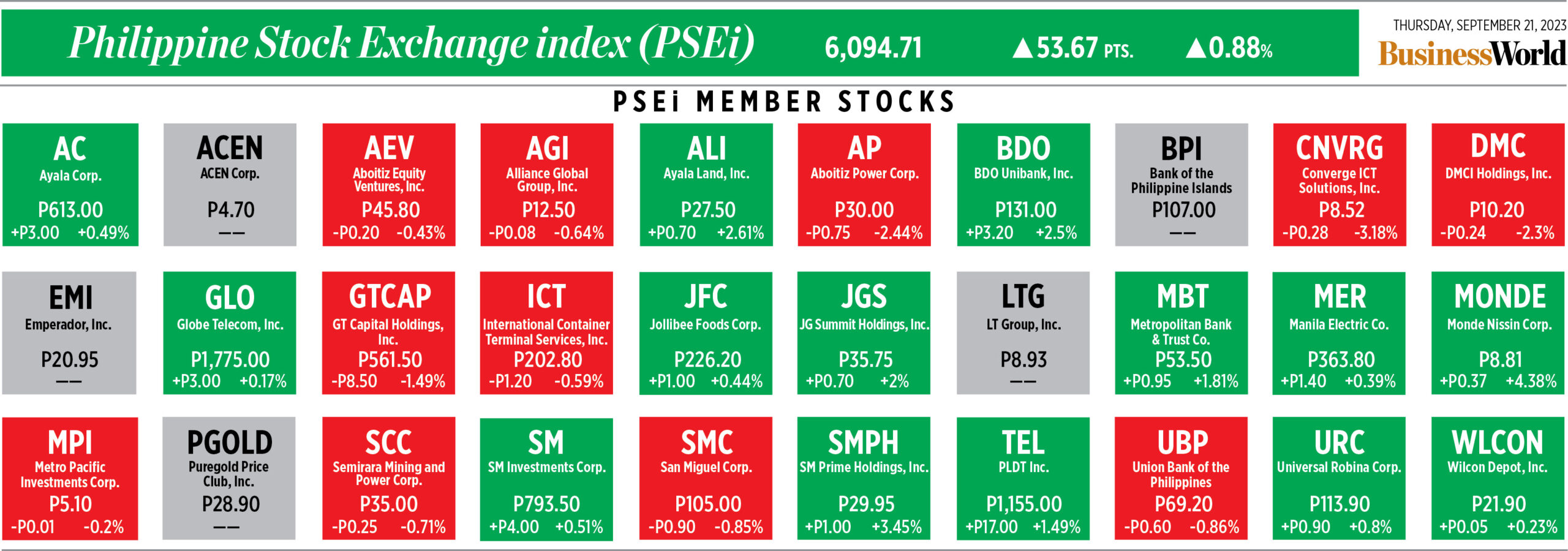
How PSEi member stocks performed — September 21, 2023

Here’s a quick glance at how PSEi stocks fared on Thursday, September 21, 2023.


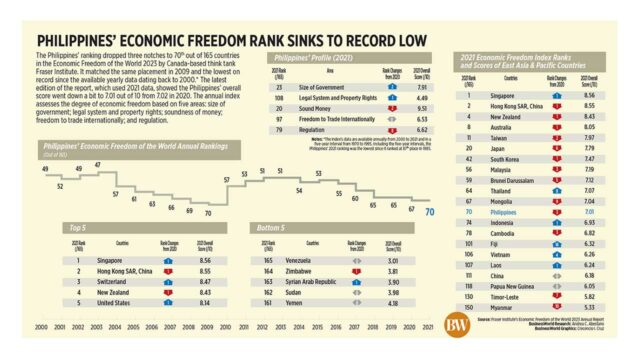
Philippines’ economic freedom rank sinks to record low

THE PHILIPPINES’ global economic freedom ranking fell three spots due to lower scores in trade freedom, sound money, and regulation according to a global report measuring 2021 data. Read the full story.

Philippines' economic freedom rank sinks to record low

Peso declines on hawkish BSP signals

BW FILE PHOTO

THE PESO depreciated against the dollar on Thursday after hawkish signals from the Bangko Sentral ng Pilipinas (BSP).

The local currency closed at P56.855 versus the dollar on Thursday, weakening by 4.50 centavos from Wednesday’s P56.81 finish, data from the Bankers Association of the Philippines’ website showed.

The local unit opened Thursday’s session weaker at P56.90 per dollar. Its intraday best was at P56.82, while its worst showing was at P56.95 against the greenback.

Dollars traded went down to $815.28 million on Thursday from the $835.5 million on Wednesday.

The peso inched down on Thursday after the BSP hinted at a potential rate hike at its November meeting and raised its inflation forecasts for this year and the next, Rizal Commercial Banking Corp. Chief Economist Michael L. Ricafort said in a Viber message.

BSP Governor Eli M. Remolona, Jr. said after their policy meeting on Thursday that a rate increase will be “on the table” in the Monetary Board’s Nov. 16 review, with the magnitude of the hike to be based on data.

The Monetary Board on Thursday kept its policy rate at 6.25% for a fourth straight meeting, as expected by 14 economists in a BusinessWorld poll last week.

Interest rates on the overnight deposit and lending facilities were also left unchanged at 5.75% and 6.75%, respectively.

The BSP has raised borrowing costs by 425 basis points from May 2022 to March 2023 to tame inflation.

On Thursday, the central bank raised its average inflation forecast for 2023 to 5.8% from 5.6% previously, and to 3.5% from 3.3% for 2024.

Meanwhile, the BSP kept its 2025 inflation forecast unchanged at 3.4%.

Headline inflation rose for the first time in seven months to 5.3% in August from 4.7% in July. Year to date, inflation averaged 6.6%, well above the BSP’s 2-4% target.

The peso was also dragged down by the US dollar reaching a six-month high, Mr. Ricafort added.

The dollar hit a 6-1/2-month high on Thursday after the US Federal Reserve signaled policy would remain restrictive for longer, even after holding rates steady, Reuters reported.

The dollar index, which measures the currency against a basket of rivals, rose as high as 105.68, its strongest since early March, before settling slightly lower at 105.45.

The Fed met market expectations at its monetary policy meeting on Wednesday, holding interest rates steady at the 5.25%-5.5% range.

The US central bank, however, stiffened a hawkish monetary policy stance that its officials increasingly believe can succeed in lowering inflation without wrecking the economy or leading to large job losses.

For Friday, Mr. Ricafort sees the peso ranging from P56.75 to P56.95 per dollar. — AMCS with Reuters