Home Blog Page 424

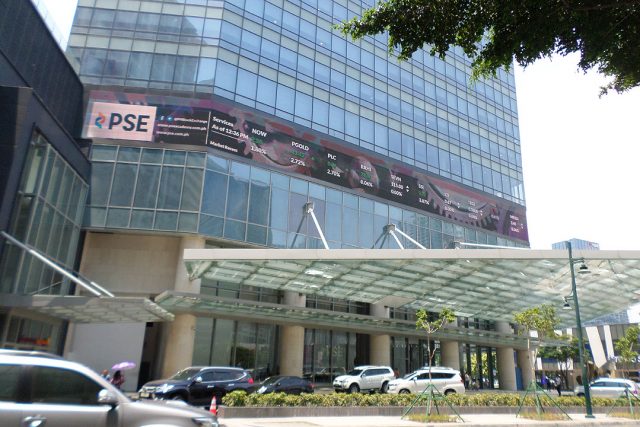
PSEi slides to 6,300 level on weak peso, IMF view

BW FILE PHOTO

PHILIPPINE SHARES sank further on Tuesday, with the main index dropping to the 6,300 level anew, due to strong selling pressure amid the peso’s slide against the dollar and weakening economic prospects.

The Philippine Stock Exchange index (PSEi) slumped by 1.31% or 84.92 points to close at 6,352.86, while the all shares index declined by 1.02% or 37.39 points to finish at 3,606.81.

“The Philippine equity space pulled back amid mounting pressures from the free-fall of the Philippine peso and the anticipated mid-January to February seasonal turning point,” AP Securities, Inc. said in a market note.

“Sectoral performance dipped heavily into the red as an intense meltdown was seen mostly in property and financials, while services and mining and oil survived the onslaught of selling today.”

On Tuesday, the peso weakened by 1.5 centavos to finish at P59.455 against the dollar, data from the Bankers Association of the Philippines showed. This is just a shade stronger than its all-time low close of P59.46 recorded on Jan. 15.

“The PSEi ended lower as strong selling pressure was seen across the board. The index showed continued momentum slowdown, breaching back below the 6,300 level,” Regina Capital Development Corp. Head of Sales Luis A. Limlingan said in a Viber message.

“Market sentiment was weighed down by both global and local uncertainties, compounded by the IMF’s (International Monetary Fund) outlook for slower economic growth in the country.”

IMF said on Monday that the Philippine economy may expand slower until next year as global uncertainties and a corruption controversy continue to drag growth.

In its latest World Economic Outlook (WEO) released on Monday, the IMF said it expects Philippine gross domestic product (GDP) to grow by 5.6% this year, within the government’s 5%-6% goal. This is the same projection given following its Article IV Consultation with the country last December, but slightly lower than its 5.7% estimate in the previous WEO.

The IMF also cut its Philippine growth forecast for 2027 to 5.8% from its 6% projection in October. This also falls within the government’s 5.5%-6.5% target.

Most sectoral indices closed in the red. Property plunged by 2.67% or 63.13 points to 2,296.42; holding firms decreased by 1.88% or 96.50 points to 5,028.68; financials went down by 1.72% or 37.34 points to 2,126.53; and industrials retreated by 1.18% or 108.49 points to 9,051.83.

Meanwhile, services rose by 0.72% or 18.60 points to 2,568.69, and mining and oil went up by 0.33% or 57.56 points to 17,254.94.

Decliners outnumbered advancers, 133 to 68, while 66 names closed unchanged.

Value turnover rose to P7.13 billion on Tuesday with 1.22 billion shares traded from the P5.19 billion with 2.25 billion issues that changed hands on Monday.

Net foreign buying was at P303.41 million versus the P30.34 million in net selling recorded on Monday. — Alexandria Grace C. Magno


Rice output ‘disappointing’ even after surpassing DA’s downgraded 2025 target

Farmers are seen in a rice field in Bustos, Bulacan, Oct. 17, 2023. — PHILIPPINE STAR/KJ ROSALES

PHILIPPINE production of palay (unmilled rice) rose 3.01% to 19.68 million metric tons (MMT) in 2025, recovering from the previous year’s decline but below an original official projection of over 20 MMT, analysts said.

Danilo V. Fausto, president of the Philippine Chamber of Agriculture and Food, Inc., told BusinessWorld that despite more favorable weather, last year’s rice output was still “below expectations.”

“Rice output of 19.68 MMT is a disappointment since the Department of Agriculture’s (DA) (earlier) projected output for 2025 of around 20.3 MMT to 20.4 MMT,” he said via Viber.

The DA has since downgraded its 2025 goal to 19.61-19.89 MMT.

The Philippine Statistics Authority (PSA) reported that palay output last year exceeded the 2024 total of 19.09 MMT, which had declined 4.85% from 2023.

The PSA also recorded a 2.22% increase in the harvest area to 4.75 million hectares in 2025.

Mr. Fausto said that while the harvested area expanded and support to the rice industry increased, output did not meet the early projection, warranting a review of the DA’s programs and performance.

Raul Q. Montemayor, national manager of the Federation of Free Farmers, said last year’s rice output was still below production levels seen in recent years.

“The 2025 result is actually lower than in 2021 to 2023 in terms of production, harvest area, and yield. So we are not really progressing, and in the meantime, population and rice requirements are increasing,” he told BusinessWorld via Viber.

The PSA reported palay output of 19.96 MMT in 2021, 19.76 MMT in 2022, and 20.06 MMT in 2023.

Mr. Montemayor also questioned the inability of production to keep up with demand despite the billions of pesos poured into the rice industry.

“Why is output not catching up with demand, why is the harvested area going down despite investments in irrigation, and why are yields not improving significantly despite seed, fertilizer, mechanization, and other subsidies?” he said.

Jayson H. Cainglet, executive director of the Samahang Industriya ng Agrikultura, said the increase in production and harvested areas last year was a direct result of good farmgate prices in 2024.

“2024 was a good year for rice farmers, farmgate prices ranged from P18 to P27 per kilo, thus encouraging more farmers to plant palay,” he told BusinessWorld via Viber.

However, Mr. Cainglet said that output this year will be weighed down by the sharp decline in farmgate prices over the past two cropping seasons, which may discourage farmers from increasing production.

“The same goes for other crops and the livestock sector. Positive farmgate prices will encourage more small planters to plant, and more backyard growers to raise hogs and poultry,” he added.

Former Agriculture Undersecretary Fermin D. Adriano told BusinessWorld that with palay output of close to 20 MMT, the Philippines would still need to import around 4 MMT of rice this year.

“The 20 MMT of palay will convert to around 13 MMT of rice. Our rice consumption is above 16 MMT annually. In other words, we need to import around 4 million MT (including shipments to strengthen our rice inventory) this year to ensure price stability,” he said in a Viber message.

The DA said that with the palay production target set at 20.3 MMT this year, rice imports are projected between 3.6 MMT and 3.8 MMT, levels it considers sufficient to meet demand without depressing farmgate prices. — Vonn Andrei E. Villamiel

More drilling results pending from Malampaya

PRIME ENERGY, operator of Service Contract No. 38, said it has successfully drilled the Malampaya East-1 reservoir. — COURTESY OF PRIME ENERGY

INITIAL RESULTS from two Malampaya gas drilling programs are expected within the quarter, the Department of Energy (DoE) said in a statement on Tuesday.

It said the results are expected from two active drilling sites, the Camago-3 and Bagong Pagasa-1 wells.

A major natural gas discovery was announced this week for Malampaya East-1. The discovery lies about five kilometers east of the existing Malampaya gas resource off Palawan province.

The new discovery is equivalent to roughly 14 billion kilowatt-hours of electricity a year, enough to power about 5.7 million households, 9,500 buildings or about 200,000 schools per year.

Malampaya East-1 is the first completed well of the Malampaya Phase 4 Drilling Campaign, which also includes Camago-2 and Bagong Pag-asa 1.

“Driven by the President’s marching orders for energy security, this discovery was delivered in record time. This will be marked in history as the first 100% Filipino-led indigenous gas venture,” Energy Secretary Sharon S. Garin said.

In 2023, the Malampaya consortium — composed of Prime Energy Resources Development B.V., UC38 LLC, Prime Oil & Gas, Inc., and state-owned PNOC Exploration Corp. — secured a 15-year renewal of Service Contract No. 38, paving the way for the exploration and development of additional gas reserves until 2039.

Drilling the new wells at the Malampaya field started last year in hopes of producing new gas by 2026.

To ensure continuity of the country’s indigenous energy supply, the government awarded nine major service contracts to explore high-potential sites in the West Philippine Sea and the Sulu Sea, as well as to continue production at the Galoc field.

The government is also banking on hydrogen exploration with two service contracts awarded.

The DoE said it obtained funding for the Philippine Gradiometry and Seismic Survey Project, a nationwide geological initiative that will generate critical data for future bidding rounds. — Sheldeen Joy Talavera

PEZA says prospective investors shrugging off corruption concerns

THE Philippine Economic Zone Authority (PEZA) said potential investors have not yet let the infrastructure corruption scandal affect their plans, adding that it still expects the economic zones it administers to generate 100,000 new jobs this year.

“We do not see any signs of slowing down as long as the government can immediately resolve all its issues so that finally we can tell the global community that we are open for business and that we are ready to welcome their investments into the Philippines,” PEZA Director General Tereso O. Panga told Money Talks with Cathy Yang on One News on Tuesday.

“Right now, we are at 1.8 million in direct jobs. We are projecting 100,000 new jobs this year. The big bulk of that will be coming from information technology and business process management (IT-BPM).”

For this year, PEZA is hoping to approve P300 billion worth of investment pledges, up from P262 billion it approved in 2025.

The top three industries operating in PEZA-administered zones are manufacturing, economic zone (ecozone) development, and IT-BPM.

“These investments that we attract, once realized, will then translate into the generation of the much-needed jobs, not just in terms of numbers, but quality jobs,” he said.

“The two main drivers of growth are our electronics and IT-BPM sectors. And so the strategy of PEZA is if we can create more ecozones in rural and new growth areas, then we can provide more livelihoods, support communities, and generate more jobs,” he added.

Nevertheless, Mr. Panga said that PEZA harbors some concerns about how the corruption scandal has been impacting the country’s viability as an investment destination.

“It is a cause for concern. I think all these political risks and all this noise about corruption in government are definitely impacting our viability as an investment destination,” he said.

“We can see from the pronouncements of the President and the cabinet that they are well-meaning (and want) to finally achieve closure on this; only when we can hold those really responsible for this mess accountable for their actions can we show the  global community that we are (serious),” he added.

He said the ecozone advantage is being somewhat insulated from the impact of the corruption scandal.

“What we usually tell them is that in PEZA, at least in the ecozones, they can be in a safer haven for their investments,” he added.

After the government announced a reform package to boost investor confidence, Mr. Panga cited the need to be “consistent and harmonized with how we implement the law… that is the only way we can really grant the fiscal incentives as promised in the law and in our registration agreements,” he added. — Justine Irish D. Tabile

BoI approves Isabela, Pangasinan solar projects

THE Board of Investments (BoI) said it approved the registration of two renewable energy (RE) projects worth a combined P2 billion in Isabela and Pangasinan.

“RE remains a top priority sector for investment promotion,” Trade Undersecretary and BoI Managing Head Ceferino S. Rodolfo said in a statement on Tuesday.

“These approvals signal a strong start for 2026 in terms of investment generation, particularly in the RE sector, and reinforce investor confidence in the Philippines’ clean energy transition,” he added.

The BoI greenlit the P1.99-billion Gamu Solar Power Project of Intramuros Solar Energy Corp. in the municipalities of Gamu and Naguilian, Isabela.

With an expected capacity of 70.786 megawatts (MW) peak, the project is set to begin commercial operations in March.

The other project was the P17.42-million Richbake, Inc. Solar Power Project in Pangasinan.

To be developed by PI Energy, Inc., the solar project will have a 0.494-MW peak capacity and begin operations by March.

“These projects support the Philippine Energy Plan 2023-2050, which aims to increase the share of renewable energy in the power generation mix to at least 35% by 2030, 50% by 2040, and more than 50% by 2050,” the BoI said.

“Once operational, the two solar facilities will contribute to meeting the additional capacity requirement of 984 MW needed to achieve the targeted 694 MW of installed solar capacity under the Clean Energy Scenario by 2050,” it added.

Meanwhile, the BoI is expecting the registration of more RE projects after it endorsed 81 projects worth P1.96 trillion for green lane treatment.

Of the 81, 74.5% were in the RE sector, which is expected to generate over 163,000 jobs.

Since February 2023, 232 projects have been endorsed for green-lane treatment, which makes them eligible for expedited processing. These are projected to generate P6.11 trillion in investments and 398,567 jobs. — Justine Irish D. Tabile

GOCCs ordered to prepare 2027 budget proposals 

BW FILE PHOTO

THE Department of Budget and Management (DBM) ordered state-run firms to start preparing their budget proposals for 2027.

Acting Budget Secretary Roland U. Toledo issued Corporate Budget Memorandum No. 48 for heads of government-owned or -controlled corporations (GOCCs), kicking off another one of the preparatory stages for drafting the National Expenditure Program for next year.

He said the budget seeks to “intensify optimization of budgetary support to GOCCs in response to the call to reform the public corporate sector in light of the tight fiscal resources of the government.”

The DBM said the government disbursed P122.83 billion to GOCCs as of the end of November, equivalent to 96.4% of the allocations budgeted for 2025.

Mr. Toledo said proposals from state-run firms will be assessed based on value for money, performance indicators, and consistency with the government’s fiscal consolidation agenda.

“It is emphasized that the agency’s performance, specifically the progress of implementation of funded programs/projects and its corresponding budget utilization, will be a key review factor,” he said.

Mr. Toledo added that the 2027 budget should focus on the efficient use of government resources for nation-building and closing market gaps.

“It aims to maintain the principle of non-preferential treatment, which requires that government resources shall not be used to finance advantages or benefits that directly or indirectly enable GOCCs/GFIs to compete with the private sector,” he said.

Earlier this month he had notified the heads of departments and agencies to start preparing their budget proposals.

For the 2026 budget, the DBM said government agencies’ budget proposals surged to P11 trillion from P9.2 trillion in funding requests for the 2025 spending plan. — Aubrey Rose A. Inosante

First yellow alert of 2026 raised over Visayas grid

BW FILE PHOTO

THE Visayas grid was placed on yellow alert on Tuesday, the first such alert this year, following forced outages at several power plants, according to the National Grid Corp. of the Philippines (NGCP).

In an advisory, NGCP said that the Visayas grid was placed on yellow alert between 5 p.m. and 7 p.m.

Peak demand hit 2,284 megawatts (MW) against the available capacity of 2,403 MW.

A total of 681.1 MW was unavailable to the grid after 20 power plants went on forced outage and 21 were running on derated capacities.

A yellow alert is issued when the operating margin falls below the transmission grid’s contingency requirement, narrowing the supply-demand buffer.

“The Luzon and Mindanao grids are (operating normally),” the NGCP said.

Eight yellow alerts were raised in 2025 over the Visayas  grid, while the Mindanao grid experienced one yellow alert.

The Department of Energy expects power supply in the Visayas to be vulnerable this year because of its dependence on the other two island grids.

Energy Secretary Sharon S. Garin has said that the final power outlook for this year is expected to be ready within the month. — Sheldeen Joy Talavera

Two proposals accepted for Cebu BRT consultancy

PHILSTAR FILE PHOTO

THE Department of Transportation (DoTr) said it received two valid proposals for the technical consultancy contract for the Cebu Bus Rapid Transit (BRT) project. 

The DoTr said the accepted proposals were filed by Dohwa Engineering Co., Ltd., and Botek Bosphorus Technical Consulting Corp. A third submission by Trans-consult Ltd. was rejected due to incomplete documents.

The remaining two will undergo the next stage, which is the evaluation of their financial proposals.

The remaining phases of the Cebu BRT, designated 2A and 3A, cover 13 stations and 62 stops. These are due for completion by the end of 2028.

The government broke ground on the first package of the project in 2023. It was initially scheduled for full operations in 2025 but was pushed back to 2028.

Once completed, the Cebu BRT system is expected to serve up to 169,000 passengers per day.

According to the World Bank’s implementation status and research report, the pace of Cebu BRT construction has slowed down, and major civil works packages are yet to be launched. — Ashley Erika O. Jose

Trade dep’t encouraging retailers to list on PSE

BW FILE PHOTO

THE Department of Trade and Industry (DTI) said it is encouraging retailers to list on the Philippine Stock Exchange (PSE) to raise funds for expansion.

“If they want to go to the stock exchange, we can assist them with that. Some are prepared for that, and some are interested in that,” Trade Secretary Ma. Cristina A. Roque told reporters on Monday.

“I am also setting a meeting with the president of the PSE to discuss how brands that are already large enterprises can enter the stock exchange,” she added.

She said such listings broaden the options for retailers to fund their expansions.

“That is how you can grow: either you sell some shares, you list, you get private equity, or you borrow from the bank. It is good to know all the possible options,” she added.

She said PSE listing was discussed when the DTI met with the Philippine Retailers Association.

“Discussions focused on strengthening cooperation through a proposed memorandum of understanding, aimed at supporting shared goals in promoting sustainability, reducing environmental impact, and encouraging positive consumer behavior across the retail sector,” the DTI said in a social media post.

“Both parties expressed support for continuing to work together and expanding these efforts nationwide,” it added.

Ms. Roque said she also urged retailers to look at how they can benefit from the Corporate Recovery and Tax Incentives for Enterprises to Maximize Opportunities for Reinvigorating the Economy (CREATE MORE) Act.

“A lot of them are manufacturers also… They have thousands of stores, and some already have a presence globally,” she said.

“We informed them of that because usually they think (CREATE MORE) is just for foreign investors. They do not know that it is also for local investors,” she added.

She also urged retailers to tap the DTI’s Foreign Trade Service Corp. for any export plans. — Justine Irish D. Tabile

Special safeguard measures sought on onion, deboned chicken, meat imports

PHILSTAR/MIGUEL DE GUZMAN

THE Department of Agriculture (DA) said it will seek special safeguard (SSG) measures on several imported agricultural products like onion, deboned chicken, and meat products.

Department Order No. 5, Series of 2026, signed by Agriculture Secretary Francisco P. Tiu Laurel, Jr. on Jan. 19, requested that the Bureau of Customs apply additional duties on such products.

A price-based special safeguard  measure allows the government to temporarily raise duties on specific imported products when their prices fall below set thresholds, in order to protect domestic industries from cheap imports.

Under Republic Act No. 8800 or the Safeguard Measures Act, the DA may impose SSG duties on agricultural products without a formal investigation once the trigger price is breached on a cost, insurance, and freight (CIF) basis.

The DA said monitoring by its Trade Remedies Office under the Policy Research Service showed that CIF prices of several products breached their respective trigger levels, prompting the request for safeguard duties.

The additional products covered include fresh or chilled onions, with a trigger price of P74.21 per kilo, and frozen mechanically deboned chicken (out of quota) with a trigger price of P93.96 per kilo.

Meat and edible meat offal salted in brine, dried, or smoked, excluding freeze-dried chicken and dried pork skin, were set a trigger price of P70.50 per kilo.

Prepared or preserved meat, meat offal, or blood of turkeys, except mechanically deboned or separated meat, were assigned a trigger price of P259.22 per kilo.

Meanwhile, other preserved meat, meat offal, or blood products, excluding those of turkey and chicken, were set a trigger price of P298.55 per kilo.

The SSG duties will be imposed on a per-shipment basis and will be determined by the difference between the actual CIF price at the time of import lodgment and the applicable trigger price. — Vonn Andrei E. Villamiel

Palace says impeachment bid versus Marcos could hurt Philippine economy

PRESIDENT FERDINAND R. MARCOS, JR. — PPA POOL

THE impeachment complaint filed on Monday against Philippine President Ferdinand R. Marcos, Jr. could hurt the economy and the country’s foreign relations, Malacañang said on Tuesday.

“Regardless of who filed it, it is not good for the President’s image to be hit with an impeachment complaint,” Palace Press Officer Clarissa A. Castro told a news briefing in Filipino.

“It is also not viewed positively by economists… as it creates the perception that some sectors are dissatisfied or negative about the President’s performance,” she added.

Ms. Castro separately told GMA News the impeachment move could also affect how the Philippines is viewed overseas.

The remarks come as the government recently lowered its economic growth targets for 2026 and 2027, citing lingering headwinds from a high-profile corruption scandal and broader global and domestic uncertainties.

Economic Secretary Arsenio M. Balisacan this month said the Development Budget Coordination Committee set a 5%-6% gross domestic product (GDP) growth target for 2026 and 5.5%-6.5% for 2027, down from 6%-7% for both years. The 6%-7% target for 2028 was kept.

Mr. Balisacan said the adjustment reflected weaker momentum last year, with growth slowing to about 4.8%-5% as infrastructure spending and business confidence were affected. The revised outlook also aligns with projections from multilateral institutions. Full-year 2025 GDP data will be released on Jan. 29.

Mr. Marcos is facing an impeachment complaint linked to a widening flood control corruption scandal involving lawmakers, contractors and senior government officials.

The complaint was filed on Jan. 19 by lawyer Andre R. de Jesus and endorsed by House Deputy Minority Leader and Party-list Rep. Jernie Jett V. Nisay.

The 12-page complaint cited multiple grounds for impeachment, including personal benefit from anomalous infrastructure contracts and failure to veto unprogrammed budget funds.

It described a network “ghost” flood control projects, which it said pointed to systematic plunder of public funds.

Ms. Castro also dismissed claims of a link between Mr. De Jesus and First Lady Marie Louise A. Marcos, following allegations by Davao City Rep. Paolo Z. Duterte that the complainant had served as the First Lady’s legal counsel in a disbarment case against a former lawmaker. Ms. Castro said no such case was filed by the First Lady.

Mr. Duterte earlier described the impeachment bid as “drama” and questioned its motives. Allies of the President in the House, including Speaker Faustino G. Dy III, have dismissed the complaint as lacking merit.

The filing places House Majority Leader Ferdinand Alexander “Sandro” A. Marcos III, the President’s son, in a potentially sensitive position should the case advance in the chamber.

Ms. Castro said she was unaware of any discussion between father and son on the matter.

“The President’s instruction to his son has always been to simply do his job,” she said. “There is no special treatment for relatives or allies.”

‘VAGUE ASSERTIONS’
Meanwhile, Lanao del Sur Rep. Zia Alonto Adiong, who heads the House Committee on Suffrage and Electoral Reforms, said the impeachment complaint is unlikely to move forward in the absence of credible evidence.

“This particular complaint appears crafted more for media consumption than for serious constitutional scrutiny,” he said in a statement.

“The House will not treat impeachment as a mere press statement or partisan maneuver. We will demand substance, and in this instance, substance is conspicuously absent,” he added.

Mr. Adiong stressed that impeachment complaints should not be based on recycled accusations, hearsay, or political grievances.

“Vague assertions and political dissatisfaction do not meet that standard,” he said. “The House leadership and the majority recognize this reality. This effort is unlikely to even reach the plenary for a vote on endorsement.”

The complaint, filed on Monday, also accuses Mr. Marcos of bypassing domestic legal processes by sending his predecessor Rodrigo R. Duterte to The Hague to face charges of crimes against humanity tied to his deadly war on drugs.

Mr. Adiong noted that the allegations largely rely on long-standing claims from vocal critics that have already been aired publicly without producing verifiable evidence.

“Any impeachment article must allege and substantiate at least one of the specific impeachable offenses enumerated in the 1987 Constitution,” he said.

Under the Constitution, impeachment may be initiated on grounds such as culpable violation of the Charter, bribery, graft and corruption, or betrayal of public trust.

Mr. Adiong said lawmakers would continue to uphold the standard of requiring evidence and verifiable allegations before considering any complaint.

Under the Constitution, any Filipino may file an impeachment complaint, but at least one-third of all House members must endorse it before it can be transmitted to the Senate, which sits as an impeachment court. — Chloe Mari A. Hufana and Adrian H. Halili

China lodges protest over PCG official’s remarks

A Philippine Coast Guard footage showing the China Coast Guard pursuing and blasting a Bureau of Fisheries and Aquatic Resources vessel with water cannons near Pag-asa Island on Oct. 12, 2025.

BEIJING has lodged a formal diplomatic protest with Manila after remarks by a Philippine Coast Guard (PCG) official that China called “malicious” and misleading, the Chinese Embassy in Manila said on Tuesday.

“China strongly condemns this and has lodged strong protests with the Philippine side,” Chinese Foreign Ministry spokesman Guo Jiakun said in a statement. He added that recent statements by Philippine uniformed personnel had spread disinformation and “wantonly smeared China’s image.”

“Certain Philippine uniformed service members, driven by personal political motives, have repeatedly made outrageous and absurd statements, in a habit of inciting confrontation,” Mr. Guo said. “Such behavior is despicable.”

The protest comes after PCG spokesman Jay Tristan Tarriela posted videos on social media showing him in front of a flat screen displaying artificial intelligence-generated images of Chinese President Xi Jinping.

Mr. Tarriela has also criticized Beijing’s aid to Filipino fishermen in the contested waters, calling it political propaganda.

The PCG official said his statements were factual, supported by video evidence, photographs, official PCG reports, satellite imagery and independent observations.

Mr. Guo called on the Philippine official to “refrain from making provocations against China and stop confusing right and wrong,” warning that there would be consequences if the behavior continued.

Philippine Senator Ana Theresia N. Hontiveros-Baraquel condemned the Chinese Embassy’s public attacks on the PCG official and urged the Department of Foreign Affairs (DFA) to respond.

“We must not allow the Chinese Embassy — or any embassy, for that matter — to disrespect public servants who are simply defending what is rightfully ours,” she said in a statement. “I expect the DFA to take this matter seriously.”

In a letter to Foreign Affairs Secretary Ma. Theresa P. Lazaro, Ms. Hontiveros asked what actions the agency had taken to ensure foreign diplomatic missions respect the limits of diplomatic conduct and refrain from targeting Filipino officials.

She also requested details on any steps taken regarding the Chinese Embassy’s recent posts.

Allowing China’s actions to pass without response risks normalizing foreign interference and undermining the dignity of Philippine institutions, as well as the safety of those tasked with defending the country’s national interests, she said.

Ms. Hontiveros said disputes between nations should be handled through diplomatic channels rather than public campaigns targeting individual officials.

“The Chinese Embassy is acting like a victim,” she said. “It is their country that fires water cannons at our personnel, threatens our fisherfolk, and destroys our marine environment.”

Relations between Manila and Beijing have worsened in recent years over overlapping claims in the South China Sea, a vital corridor for trillions of dollars in global maritime trade.

China has continued to assert and expand its presence in the disputed waters despite a 2016 United Nations-backed arbitral tribunal ruling that voided its expansive claims.

The Department of Foreign Affairs did not immediately respond to requests for comment. — Adrian H. Halili