Home Blog Page 4232

Alternergy shareholders approve preferred shares to raise capital

ALTERNERGY HOLDINGS Corp. has obtained shareholder approval for the reclassification of its preferred shares in a move aimed at raising capital for various projects.

In a stock market disclosure on Wednesday, the listed energy company said the reclassification of about 1.48 billion preferred shares with a par value of P0.10 had been approved during a special stockholders’ meeting on Tuesday.

The shares will be subdivided into two classifications, namely: “Perpetual Preferred Shares 1” amounting to about 1.18 billion; and nonvoting “Perpetual Preferred Shares 2” for the remaining 300 million.

The 300 million shares are broken down into Series A, B, and C of 100 million perpetual preferred shares per series.

“The reclassification of [Alternergy’s] perpetual preferred shares is in anticipation of our next capital raising exercise to fund our renewable projects,” Alternergy President Gerry P. Magbanua said.

“Our Green Perpetual Preferred Shares Program will allow Alternergy to access a wider base of institutional investors to broaden our sources of capital,” he added.

At the same meeting, an increase in the number of board seats — to nine directors from seven previously — was also approved

“The increase in the number of independent directors will broaden the diversity and breadth of expertise of our Board,” Alternergy Chairman Vicente S. Pérez, Jr. said.

“Alternergy espouses a culture of diversity in terms of experience, expertise, culture, age, gender and orientation. We believe diversity creates greater value to our company’s growth,” he added.

Last week, the company announced that it had tapped three investment banks to lead in raising the P12-billion project financing for its two wind power projects.

The two projects for debt financing are Alternergy’s 55-megawatt (MW) Alabat Island wind power project in Quezon province and its 86-MW Tanay wind power project in Rizal province, which are expected to be completed by 2025.

At the local bourse on Monday, shares of the company went up by one centavo or 1.2% to P0.84 apiece. — Sheldeen Joy Talavera

Artificial intelligence, data analytics to boost financial firms’ cybersecurity

STOCK PHOTO | Image by Gerd Altmann from Pixabay

INTEGRATING artificial intelligence (AI) and data analytics in banks’ cybersecurity measures could help them better detect and combat potential threats.

“These technologies power vital cybersecurity capabilities, such as attack surface risk management (ASRM) and extended detection and response (XDR),” Trend Micro Philippines Country Manager Ian Felipe said in an e-mail to BusinessWorld.

“Real-time threat intelligence would make fraudulent and suspicious activities easier to detect while allowing organizations to respond to threats immediately, all from one consolidated platform. This would empower BFSI organizations to proactively combat cybercrime and contribute towards enhancing the overall safety of the sector,” Mr. Felipe said.

ASRM provides continuous attack surface discovery and real-time risk assessment, while XDR enables endpoint controls and organization-wide data collection and correlation across the whole information technology infrastructure, he added.   

“By combining ASRM and XDR in a unified cybersecurity platform like Trend Vision One, BFSI (banking, financial services and insurance) organizations can gain increased visibility and detailed insights into potential threats,” Mr. Felipe said.

Trend Vision One is Trend Micro Philippines’ real-time threat intelligence platform that BFSI organizations can use to mitigate risks, protect assets, and enhance security to help address some of the top risks these firms face.

These risks include negligent insiders, shortage of qualified personnel and organizational misalignment and complexity according to Trend Micro’s Cyber Risk Index study for the second half of 2022.

The study showed that 80% of respondents said they are “somewhat to very likely”to experience a breach in customer data (82%), intellectual property (82%), or a successful cyberattack (87%) in the next 12 months.

Among the cyber threats expected by the respondents are ransomware, business e-mail compromise, botnets, watering hole attacks, and denial of service.

Addressing the Philippines’ ongoing cybersecurity talent shortage could also help improve cybersecurity in the country, he added.

“Currently, the Philippines only has around 200 cybersecurity experts in the country and this number is insufficient to address even just the needs of the BFSI sector alone. Therefore, more needs to be done to upskill talent — both fresh graduates and mid-career professionals. Encourage them to take on the mantle of cybersecurity personnel,” Mr. Felipe said. — A.M.C. Sy

Yields on central bank’s term deposits inch lower

BW FILE PHOTO

YIELDS on the Bangko Sentral ng Pilipinas’ (BSP) term deposits dropped on Wednesday following less hawkish signals from central banks.

Demand for the BSP’s term deposit facility (TDF) amounted to P375.538 billion on Wednesday, below the P400-billion offer as well as the P443.4 billion in tenders seen a week earlier for a P380-billion offering.

Broken down, the seven-day term deposits fetched bids amounting to P218.879 billion, short of the P220 billion auctioned off by the BSP. It was also lower than the P241.415 billion in tenders logged the previous week for a P210-billion offer.

Accepted rates for the tenor ranged from 6.4% to 6.465%, a tad narrower than the 6.4% to 6.469% band logged a week ago. This caused the average rate of the one-week deposits to slip by 0.7 basis point (bp) to 6.4312% from 6.4382% previously.

Meanwhile, demand for the two-week deposits amounted to P156.659 billion, below the P180-billion offer and the P201.985 billion seen in the previous auction.

Banks asked for yields from 6.4% to 6.478%, a tad higher than the 6.4% to 6.475% range seen last week. This caused the average rate of the paper to dip by 0.85 bp to 6.4458% from the 6.4543% quoted on Oct. 4.

The BSP has not auctioned off 28-day term deposits for three years to give way to its weekly offerings of securities with the same tenor.

The term deposits and the 28-day bills are used by the central bank to mop up excess liquidity in the financial system and to better guide market rates.

“The TDF auction yields were marginally lower week on week, partly due to reduced hawkish signals from the BSP and monetary officials recently,” Rizal Commercial Banking Corp. Chief Economist Michael L. Ricafort said in a Viber message.

Mr. Ricafort said some officials from the US Federal Reserve have signaled a possible pause in monetary tightening, while the BSP chief said the Monetary Board may fire off a 25-bp rate hike in their November meeting, a tad less hawkish than his earlier hints about an off-cycle increase being on the table.

BSP Governor Eli M. Remolona, Jr. on Wednesday said the Monetary Board is open to hike borrowing costs by 25 bps on their Nov. 16 review following the release of data showing faster-than-expected September inflation.

Headline inflation accelerated for a second straight month to 6.1% in September from 5.3% in August. This brought the nine-month inflation average to 6.6%, still higher than the BSP’s 5.8% forecast and 2-4% target.

The Monetary Board has kept the benchmark interest rate at 6.25% for four straight meetings after it hiked borrowing costs by 425 bps from May 2022 to March 2023 to help tame inflation.

“The Israel-Hamas war led to some fund shifts to the safest assets such as US or local government bonds, as is the tendency whenever there are geopolitical uncertainties or risks,” Mr. Ricafort said. — K.B. Ta-asan

More bloodshed will never resolve the Israel-Palestine conflict

THERE is no justification for violence against civilians — not by militants and not by governments. The surprise attack by Hamas, as its fighters surged across the border with Gaza and into Israelis’ homes and neighborhoods, taking hostages and leaving more than 1,000 dead, has shaken the nation to its core, and shocked the world.

On the other side of that border fence? That’s where families are trapped in a tiny coastal enclave by a land, sea, and air blockade enforced by Israel and Egypt since 2007. They are now experiencing the terrifying but familiar thunder of thousands of airstrikes from the powerful Israeli military. At least 750 Palestinians have also died since Tel Aviv began its retaliation. So why is the world not as shocked by their plight?

There are at least two million people in Gaza — most of them civilians — yet the West risks seeing only Hamas. Israel must of course defend its citizens and borders. But as depraved and savage as Hamas’ attacks have been, the response must not be to further devastate innocent Palestinians. One set of war crimes does not justify committing another against an already long-suffering people.

In Gaza’s thin strip of land you will find doctors and nurses, physiotherapists and cancer specialists. Academics and their students. Artists, archaeologists, poets and journalists, with no end of material to fuel them, and schoolteachers whose classrooms have been struck multiple times with missiles launched from Israeli warplanes and drones, their young pupils living with unimaginable intergenerational trauma. Those born since 2008 are now living through their fourth all-out war.

Israeli Defense Minister Yoav Gallant ordered a “complete siege” on Gaza, saying authorities would cut electricity and prevent the entry of food and fuel. “We are fighting human animals and we are acting accordingly,” Gallant said. When you block these essentials, hospitals cannot operate, an already poorly nourished population is weakened, and many people die. What Gallant is ordering amounts to the war crime of collective punishment.

For their part, Hamas militants have followed suit — threatening to kill non-combatant hostages if Israel keeps bombing civilian areas in Gaza without warning. Prime Minister Benjamin Netanyahu’s response: “What we will do to our enemies in the coming days will reverberate with them for generations.” I have covered two wars in Gaza — 2012 and 2014 — and Netanyahu’s words can mean only one thing: The use of extreme military force in densely populated areas to target militants, as if the inevitable deaths of thousands of civilians is acceptable collateral damage. It is not. There is no safe place to evacuate to, despite what the Israeli military tells Gazans. The bombs are falling everywhere.

Even before this latest outbreak of violence more than 200 Palestinians and nearly 30 Israelis have been killed so far this year. As the UN Middle East envoy Tor Wennesland told the Security Council on Aug. 21, that makes 2023 the deadliest year since 2005. “The lack of progress towards a political horizon that addresses the core issues driving the conflict has left a dangerous and volatile vacuum, filled by extremists on both sides.” Given what unfolded over the last few days, Israel and its allies would have done well to heed his warning.

It is not just Gaza. Israel has maintained a military occupation of the West Bank, where some three million Palestinians live, since 1967 — an act that is viewed as illegal under international law. In July alone, the Israeli Defense Forces launched a sustained attack on the Jenin refugee camp, killing at least 12 Palestinians and wounding 100 more. That assault may constitute a war crime, according to UN experts, including Francesca Albanese, special rapporteur on human rights in the Palestinian Territory.

So often, these outbreaks of violence between Israel and militants in the West Bank and Gaza are written about as if they came out of nowhere. All evidence points to the contrary. Since 2021, three respected human rights groups — Human Rights Watch, the Israeli-run B’Tselem, and Amnesty International — have described Israel’s actions as meeting the legal test of apartheid: the widely recognized system of institutionalized racial segregation enforced in South Africa from 1948 to the early 1990s. Each of their reports lays out in deeply researched detail Israel’s system of oppression and domination over Palestinians, including territorial fragmentation, segregation and control, dispossession of land and property and denial of economic and social rights.

Israel has rejected all these claims. Its foreign ministry released a response on Jan. 31 last year to the Amnesty report, calling it antisemitic and saying it “denies the state of Israel’s right to exist.”

Yet anyone who has traveled on “sterile roads” in the West Bank, walked down Al-Shudada Street in Hebron where Israeli settlers can drive without restrictions and Palestinian residents can only enter on foot to access their homes, or watched Palestinians forced to line up for hours in narrow walkways to pass through Israel’s military checkpoints, knows what racial segregation looks like.

As do the Palestinians of Gaza, hemmed into what has been called the world’s largest open-air prison — 41 kilometers long and between six to 12 kilometers wide — and able to access medical care or travel for work or academic opportunities only through a cruel and arbitrary permit system.

There is only one way to end this violence, and it is not with more bloodshed. Indeed, the more severe Israel’s military response, the more it will stoke the fires of vengeance, retard hopes of a rapprochement between Israel and its neighbors, and turn global public opinion against it — all goals that Hamas would applaud. Instead, Israel’s allies and enablers — starting with the US — need to convince Netanyahu to end the military occupation and enter negotiations for a lasting peace that gives Palestinians a real homeland and Israel a secure future. Anything else is just history repeating. And failing.


BLOOMBERG OPINION

The best places to drink if you can’t get into the World’s 50 Best Bars

LUWADLIN BOSMAN—UNSPLASH

LET’S SAY you can’t get to Licorería Limantour in Mexico City or Double Chicken Please in New York — two of the top 50 bars in the world.

Don’t worry. The World’s 50 Best Bars has made a second, less vaunted list with other bars in those cities. Despite its name, the organization also ranks the top 51-100 drinking holes in the world, based on votes from 680 experts in the field.

New entries on the 2023 list of 51-100 best bars list include Martiny’s in New York City, which ranked No. 68, and Rayo (No. 72) and Kaito del Valle in Mexico City, as well as 11 other additions this year.

A bar from Albania made the list for the first time: Nouvelle Vague in the capital city of Tirana.

The list, owned by UK publisher William Reed Business Media, is closely watched in the industry. On one hand, it’s an honor — and a marketing bump — just to be listed. But if an establishment appears on this half of the list, it also means it’s not in the top half.

Such a fate befell Manhattan, a Singapore bar that has been slowly slipping down the list. It was No. 11 in 2019, No. 33 in 2021, and this year slipped to No. 63. It probably suffered particularly this year because the hotel that houses it was closed for a time for refurbishing. Attaboy in New York and Kumiko in Chicago also slipped off the top 50 list to take spots on the 51-100 ranking.

Critics say that such lists can be influenced by establishments that spend time and money getting voters in the door. (Even though the voter rolls are supposed to be anonymous, bar owners and chefs say they think they can figure out which influencers, journalists, or bartenders might be voting.)

Others say that these lists encourage innovation and ensure that bars don’t rest on their laurels. — Bloomberg

Here’s the full 51-100 list for 2023:
51. Danico, Paris
52. Lady Bee, Lima
53. The Bellwood, Tokyo
54. Lyaness, London
55. Vesper, Bangkok
56. Tan Tan, São Paulo
57. Attaboy, New York
58. SubAstor, São Paulo
59. 28 HongKong Street, Singapore
60. Arca, Tulum, Mexico
61. Byrdi, Melbourne
62. Hero Bar, Nairobi
63. Manhattan, Singapore
64. Nutmeg & Clove, Singapore
65. El Gallo Altanero, Guadalajara, Mexico
66. Tropic City, Bangkok
67. Sidecar, New Delhi
68. Martiny’s, New York
69. Ergo, Dubai
70. Barro Negro, Athens
71. Penicillin, Hong Kong
72. Rayo, Mexico City
73. Civil Liberties, Toronto
74. Hope & Sesame, Guangzhou, China
75. Bar Cham, Seoul
76. Swift, London
77. Velvet, Berlin
78. Analogue Initiative, Singapore
79. High Five, Tokyo
80. La Sala de Laura, Bogotá
81. Kaito del Valle, Mexico City
82. Kumiko, Chicago
83. Native, Singapore
84. Svanen, Oslo
85. Camparino in Galleria, Milan
86. Nouvelle Vague, Tirana, Albania
87. Ruby, Copenhagen
88. Red Frog, Lisbon
89. Thunderbolt, Los Angeles
90. Mirror Bar, Bratislava, Slovakia
91. Maison Premiere, New York
92. Donovan Bar, London
93. Tjoget, Stockholm
94. Sin + Tax, Johannesburg
95. Schofield’s, Manchester, UK
96. Lost & Found, Nicosia, Cyprus
97. Darkside, Hong Kong
98. The Bar in Front of the Bar, Athens
99. Employees Only, New York
100. Artesian, London

BSP gets P98.8M in coins through deposit machines

Bangko Sentral ng Plipinas Governor Felipe M. Medalla (left) and Robinsons Retail Holdings, Inc. President and Chief Executive Officer Robina Gokongwei-Pe (right) inspect the coin deposit machine located in Robinsons Place Ermita in Manila. — KEISHA B. TA-ASAN

CONSUMERS have deposited P98.8 million worth of currency into the Bangko Sentral ng Pilipinas’ (BSP) coin deposit machines (CoDMs) as of end-September or just three months after their rollout in June.

This is equivalent to 37.2 million pieces of coins from over 37,000 transactions, the BSP said in a statement. The highest single transaction recorded on the machines so far was worth P100,260.

“With more CoDMs installed in various retail establishments, the BSP expects wider public use that will lead to more efficient coin recirculation in the country,” the central bank said.

The BSP has completed its goal of deploying 25 coin deposit machine units across Metro Manila and other nearby provinces. The central bank began deploying CoDM units in June in partnership with Filinvest Lifemalls Corp., Robinsons Supermarket Corp., and SM Retail, Inc.

BSP Deputy Governor Bernadette Romulo-Puyat told reporters on Wednesday that the central bank is looking to roll out more machines across the country, adding that the BSP has been asked to set up some in Cebu, Davao, Pampanga, and Baguio.   

“Right now, we are just assessing [the existing machines]. We’re talking to the provider how to make the machines better because the machines are usually jammed,” she said in mixed English and Filipino.

The machines can get stuck if the coins deposited are taped or bundled or if a consumer deposits foreign objects such as nails, tokens, and screws, she said.

“The ideal is when we deploy coin deposit machines, it would be stand-alone,” Ms. Romulo-Puyat said. “Now, the machines need technical assistance all the time.”

The demand for coin deposit machines has been higher than expected, with people lining up to deposit coins, she added.

“People have warmed up to it. The mere fact that people are asking when the BSP will deploy units in their area means people are looking for it,” she added.

The BSP has installed coin deposit machines in SM Megamall in Mandaluyong City, SM City Grand Central in Caloocan, SM City Marilao in Bulacan, SM City Taytay Rizal, SM Hypermarket FTI in Taguig City, SM Southmall in Las Piñas City, SM City Sucat in Parañaque, SM City Calamba, SM City Marikina, SM City San Mateo Rizal, SM City Valenzuela, Robinsons Place Metro East in Pasig City, Robinsons Place Antipolo City, Rizal, Robinsons Place Novaliches and Robinsons Place Magnolia, Quezon City.

The value of coins deposited in CoDMs may be credited to the depositor’s e-wallet account or converted into a shopping voucher for over-the-counter transactions. Customers depositing coins can credit the equivalent amount to their GCash or Maya e-wallets.

All denominations of the BSP Coin Series and New Generation Currency Coins Series are accepted by the CoDM. Unfit and demonetized coins, foreign currency, and foreign objects are rejected by the machine and returned to the depositor. — Keisha B. Ta-asan

Southeast Asia eyes hands-off AI rules, defying EU ambitions

TRUSTPAIR.COM

SINGAPORE/STOCKHOLM — Southeast Asian countries are taking a business-friendly approach to artificial intelligence (AI) regulation in a setback to the European Union’s (EU) push for globally harmonized rules that align with its own stringent framework.

Reuters reviewed a confidential draft of the 10-member Association of Southeast Asian Nations’ (ASEAN) “guide to AI ethics and governance,” whose content has not previously been reported.

Three sources told Reuters the draft is being circulated to technology companies for feedback and is expected to be finalized at the end of January 2024 during the ASEAN Digital Ministers Meeting. Companies that have received it include Meta, IBM, and Google.

EU officials earlier this year toured Asian countries in a bid to convince governments in the region to follow its lead in adopting new AI rules for tech firms that include disclosure of copyrighted and AI-generated content.

In contrast to the EU’s AI Act, the ASEAN “AI guide” asks companies to take countries’ cultural differences into consideration and doesn’t prescribe unacceptable risk categories, according to the current version reviewed. Like all ASEAN policies, it is voluntary and is meant to guide domestic regulations.

With almost 700 million people and over a thousand ethnic groups and cultures, Southeast Asian countries have widely divergent rules governing censorship, misinformation, public content, and hate speech that would likely affect AI regulation. Thailand, for example, has laws against criticizing its monarchy.

Technology executives say ASEAN’s relatively hands-off approach is more business friendly as it limits the compliance burden in a region where existing local laws are already complex and allows for more innovation.

“We are also pleased to see this guide aligns closely with other leading AI frameworks, such as the United States’ NIST AI Risk Management Framework,” IBM Asia’s vice-president of government affairs Stephen Braim said, referring to voluntary guidelines developed by the US Department of Commerce’s National Institute of Standards and Technology.

Meta and Google did not respond to request for comment.

BENEFITS VS HARM
The guide, which is meant to be periodically reviewed, urges governments to aid companies through research and development funding and sets up an ASEAN digital ministers working group on AI implementation.

Senior officials in three ASEAN countries said they are bullish on the potential of AI for Southeast Asia and believe the EU has been too quick to push for regulation before the harms and benefits of the technology are fully understood.

The ASEAN guide advises companies to put in place an AI risk assessment structure and AI governance training, but leaves specifics to companies and local regulators.

“We see it as putting ‘guardrails’ for safer AI,” one official told Reuters. “We still want innovation.”

The guide warns of the risks of AI being used for misinformation, “deepfakes,” and impersonation, but leaves it to individual countries to work out the best way to respond.

Other Asian nations such as Japan and South Korea have flagged similarly relaxed approaches to AI regulation, casting doubts over the EU’s ambition to establish a global standard for AI governance based on the rules that would apply to its 27 member states.

Driving the EU push are concerns in Brussels about the rapid pace of AI development and its effect on civil rights and security, which have put risk controls and enforcement at the center of the proposed legislation.

While ASEAN does not have any powers to make laws, its preference for member states to make their own policy determinations puts those countries on a distinctly different track to the EU.

The EU’s struggles to create global consensus on AI regulation contrast with its mostly successful campaign last decade to establish data protection laws that have become a template for other major economies around the world. 

“What we think is important is to have similar principles,” a European Commission spokesperson told Reuters. “We are not seeking full harmonization, as we are mindful of cultural differences, however, we regard the underlying principles as important.”

EU officials and lawmakers told Reuters that the bloc would continue to hold talks with Southeast Asian states to align over broader principles.

“If we want AI to be used for good, we need to come together on the basic principles of human rights,” Dutch minister for digitalization Alexandra van Huffelen told Reuters. “I don’t think we are very far off from that we couldn’t bridge the differences.” Reuters

Declining unemployment and the Tholos forum

There were a number of positive economic stories in the Philippines recently as reported in BusinessWorld: “AMRO sees PHL as fastest-growing economy in the region” (Oct. 5), “Marcos removes cap on rice prices” (Oct. 5), “Philippine manufacturing output peaks in August” (Oct. 6), “Jobless rate dips to 3-month low in August” (Oct. 6), “NAIA 9-month passenger traffic surpasses 2022 full-year tally” (Oct. 8), “‘Much better’ growth seen in 2nd half” (Oct. 9), “IMF still sees PHL as one of region’s strongest economies this year” (Oct. 11), “FDI net inflows jump to 3-month high in July” (Oct. 11).

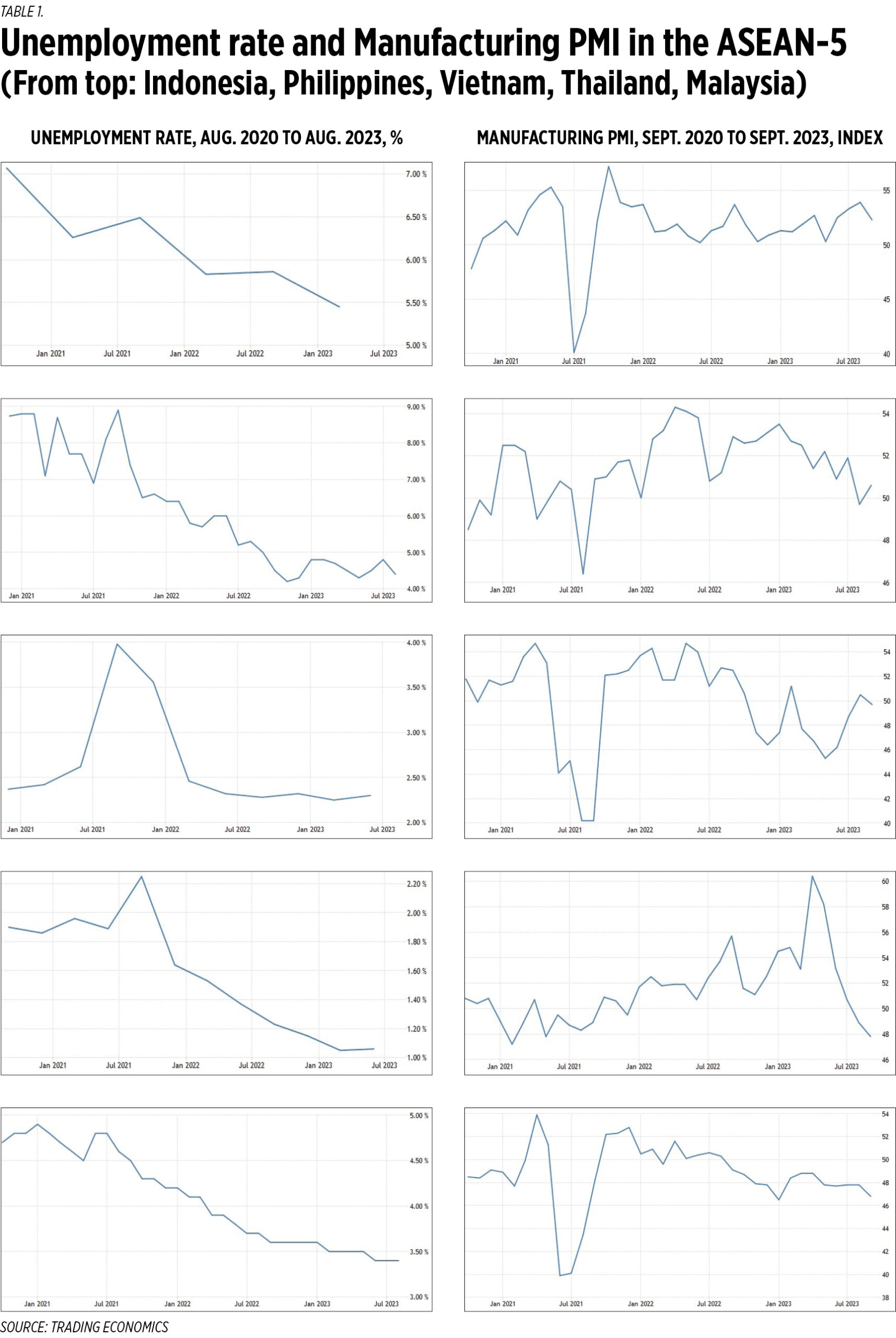
So, despite the Philippines’ slowing GDP growth and high inflation rates in the second and third quarters of 2023, the unemployment rate went down to 4.4% in August. Then the manufacturing purchasing managers’ index (PMI) stayed above 50. The PMI is an indicator of whether market conditions are expanding, staying the same, or contracting as viewed by purchasing managers.

I checked the data for the ASEAN-5 on unemployment rates and manufacturing PMI over the last three years. All five countries — Indonesia, Malaysia, the Philippines, Thailand, and Vietnam — showed declining unemployment, which is good. But when looking at the manufacturing PMI, only Indonesia and the Philippines had an index above 50 as of September. The other three countries have seen declining PMI, below 50, especially Thailand and Malaysia (see Table 1).

Congrats to the economic team, particularly Secretaries Benjamin Diokno of the Finance department, Amenah Pangandaman of the Budget and Management department, and Arsenio Balisacan of the National Economic and Development Authority, for leading the positive business outlook of the country.

THOLOS FORUM 2023
Meanwhile, the Tholos Foundation in the US will hold the Tholos Forum 2023 with the theme, “Coalitions, Freedom, Innovation” on Oct. 16 to 18 in Nice, France. Among the topics to be discussed in the conference are digital taxes, harm reduction, the international property rights index (IPRI), climate and energy, US and Germany politics, and country updates from international participants. This writer is one of Tholos International Fellows.

Results of IPRI 2023, which was launched by the Property Rights Alliance (PRA, Washington DC) in late September, will be presented again by Lorenzo Montanari, Executive Director of PRA.

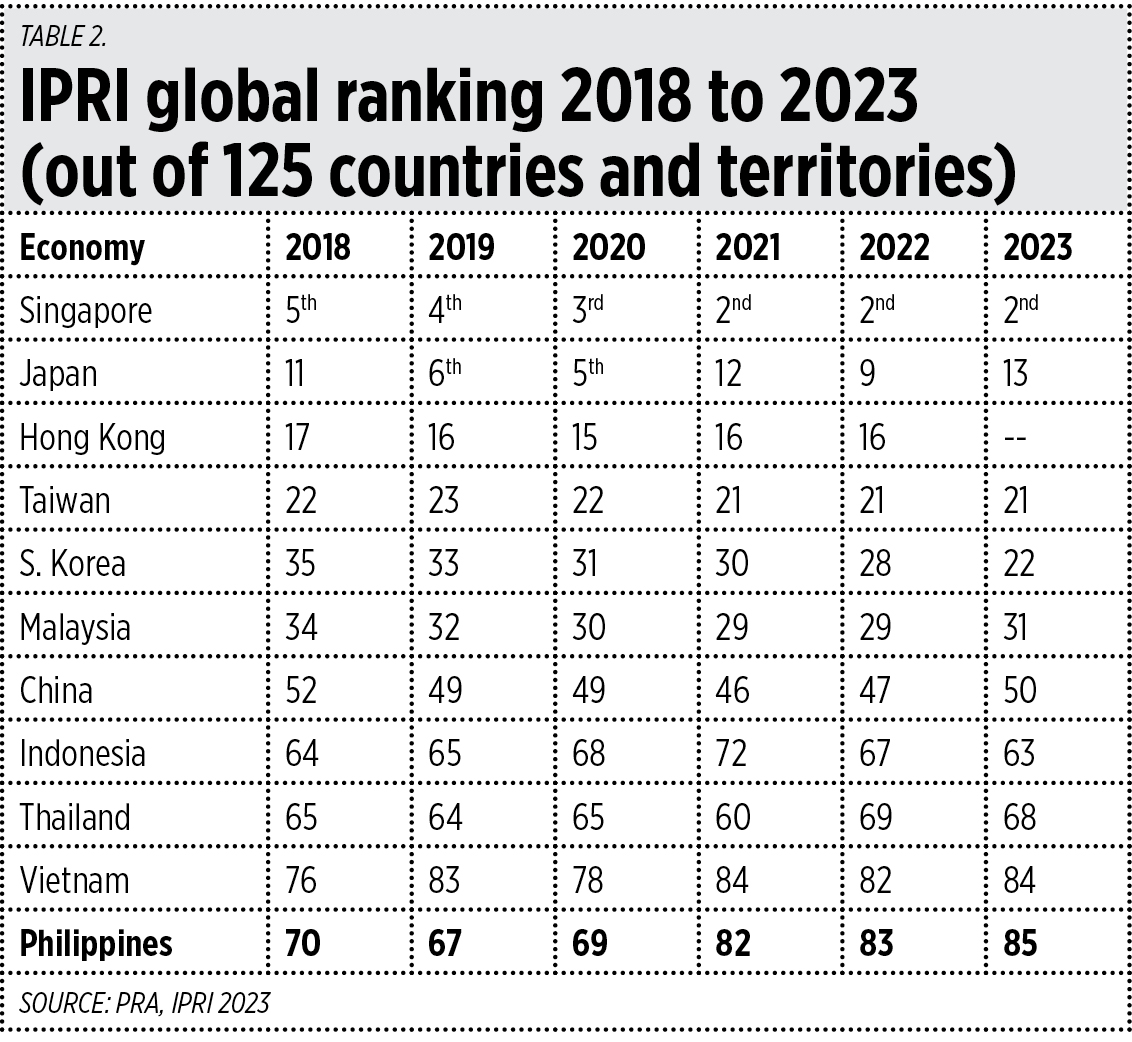
The IPRI is a composite of three sub-indices: legal and political (LP) environment, physical property, and intellectual property protection. Basic data for LP to derive the index come from the World Justice Project and the World Bank’s World Governance Indicators. The Philippines showed a deterioration in its global ranking, from 70th in 2018 to 85th in 2023, pulled down by a low score in LP due to a poor performance in the rule of law and political stability — and/or other countries simply improved (see Table 2).

My suspicion on why the Philippines and other ASEAN countries have low overall scores is that the World Bank’s data on world governance is itself tainted. Nonetheless, various economic and business indicators, like those in Table 1, point to the Philippines having an improving overall business environment.

I will write more about the Tholos Forum next week.


Bienvenido S. Oplas, Jr. is the president of Bienvenido S. Oplas, Jr. Research Consultancy Services, and Minimal Government Thinkers

minimalgovernment@gmail.com

SM Prime to open mall in San Pedro City with 90% space leased out

SY-led SM Prime Holdings, Inc. is set to open a new mall in San Pedro City, Laguna on Oct. 13, marking its 84th mall in the country.

In a regulatory filing on Wednesday, the listed property developer said that SM Center San Pedro is its fourth mall in Laguna province, joining SM City Sta. Rosa, SM City San Pablo, and SM City Calamba.

SM Prime President Jeffrey C. Lim said the new mall “is set to provide further opportunity for the company to expand its brand of service and convenience to more Filipinos in the south, specifically in Laguna and nearby towns of Cavite.”

He added that the mall, “with its ideal location, aims to converge business, leisure and entertainment that will enhance economic and civic activities in the area.” 

SM Center San Pedro is situated along U.B. Main Road, Brgy. United Bayanihan.

According to SM Prime, the mall will open with almost 90% of space lease-awarded, sharing three levels of shopping, dining, and entertainment hubs, including the company’s SM Hypermarket, SM Appliance, Ace Hardware, Miniso, Watsons, Simply Shoes, Pet Express, and BDO.

It will also feature an SM Foodcourt, Cyberzone, indoor plaza, and parking areas.

In the first half, SM Prime recorded a 38% increase in consolidated net income to P19.4 billion from P14.1 billion a year ago due to higher revenues.

Shares of SM Prime on Wednesday rose 10 centavos or 0.32% to P31.10 apiece. — Revin Mikhael D. Ochave

LVMH sales growth loses fizz as post-pandemic splurge wanes

ALEXANDER NAGLESTAD-UNSPLASH

The wines and spirits division posted a 14% revenue decline over the quarter

PARIS — Luxury goods bellwether LVMH reported a 9% rise in third quarter revenue on Tuesday, marking slower growth as a strong wave of post-pandemic spending eases due to rising inflation and economic turbulence.

“After three roaring years, and outstanding years, growth is converging toward numbers that are more in line with historical average,” LVMH chief financial officer Jean-Jacques Guiony told analysts.

LVMH, which owns labels including Louis Vuitton, Dior, Tiffany, and Bulgari, said revenue came to 19.96 billion euros ($21.16 billion), up 9% year on year, stripping out the effect of currency fluctuations and acquisitions. Total revenue rose 1% year on year.

The fashion and leather goods division, home to Louis Vuitton and Dior, recorded sales growth of 9%, compared to analysts’ expectations for 10% growth.

LVMH is facing slowing demand for high end goods in the United States and Europe, where rising prices have prompted shoppers — especially younger generations — to pull back from a post-pandemic spending euphoria, while the recovery in China has been uneven.

Mr. Guiony noted that while business slowed in Europe over the quarter, there was not a marked change in demand for fashion and leather goods from China compared to two years ago, except that more purchases are being made outside of the mainland as travel resumes.

In the United States, there was little change in trends, according to Mr. Guiony.

The wines and spirits division posted a 14% revenue decline over the quarter, with the company flagging less demand for Champagne over the period, while the weak economic environment in the US, and a slower-than-expected bounce back in China affected demand for Hennessy cognac.

LVMH is the first major global luxury firm to report earnings this quarter and gives investors an insight into what to expect from rivals Hermes and Kering report on Oct. 24.

“This seems good enough to support the share price, as buyside expectations were possibly more muted, as the significant market derating suggests,” said Luca Solca, analyst with Bernstein, noting the company faced a tougher comparison period following strong performances in China, the United States and Europe a year ago.

Investors have recently lowered their expectations for the luxury sector and around 96 billion euros has been knocked off the value of LVMH since April.

The French luxury group was last month unseated as Europe’s most valuable listed company after a 2-1/2 year long reign by Danish drugmaker Novo Nordisk, which was boosted by the growth of anti-obesity drug Wegovy.

A stronger euro against the US dollar than a year earlier also impacted the company as US sales were worth less when converted back into its home currency. The negative currency impact was worse than anticipated, said Mr. Guiony, noting he expected it to negatively affect margins in the second half, although some of that would be offset by hedging strategies.

The currency impact is expected to affect European companies with large US operations this earnings season.

Sony LinkBuds S x Olivia Rodrigo headphones to be available in PHL

SONY Philippines last week announced that its limited-edition collaboration with singer Olivia Rodrigo will be available for pre-order in the country by the end of the month.

The LinkBuds S x Olivia Rodrigo limited edition headphones are priced at P10,999 and will be available for pre-order from Oct. 28 to Nov. 16 at select Sony dealers and the brands official Lazada and Shopee stores. Those who will purchase will get a free Olivia Rodrigo GUTS tote bag.

“Based off Sony’s LinkBuds S noise canceling truly wireless headphones, the new limited edition LinkBuds S x Olivia Rodrigo feature Custom EQs (special equalizers) tuned by Olivia and her producer Daniel Nigro for optimal listening of her albums GUTS and SOUR on any music streaming service and come in a unique violet marble pattern styled by Olivia and made with environmentally conscious materials,” Sony said in a statement.

“I’m so excited that I got to design a limited edition LinkBuds S in the color violet. The sound is incredible, and I can’t wait for my fans to experience GUTS in this way,” Ms. Rodrigo was quoted as saying.

The headphones have two special equalizers customized for Ms. Rodrigo’s music that can be accessed via the Sony | Headphones Connect app, the brand said.

“When designing the LinkBuds S x Olivia Rodrigo, Olivia chose an environmentally conscious design using factory recovered plastic, reclaimed water bottles, and recycled plastic materials from automobile parts to create parts of the case and body of the headphones. Due to the variation in material, the headphones host a violet marble pattern that causes no two pairs of LinkBuds S x Olivia Rodrigo to be the same,” Sony said.

The LinkBuds S x Olivia Rodrigo have noise canceling and high-resolution audio wireless features.

“Smart features such as Adaptive Sound Control and Auto Play learn from the user’s behavior and automatically adjust sound settings to provide the right sound for the moment,” Sony said.

Furnished copies

FREEPIK

THE MEMOS of old had a list of recipients at the end of the typed message just under the sender’s signature. They were categorized under “cc,” which stood for “carbon copies” — if one still remembers those thin sheets of onion-skin paper that record imprints from the typewriter in ever lighter shades as copies were added.

A list of those furnished copies of the now more common e-mail determines the importance of the message and the audience being addressed, aside from the direct recipient. This may even include others outside the organization.

So, after finding out what the e-mail is about (Pending reorganization?), the list of those copied shows how far the ripple effect will go. The longer the list with copies, the more significant the news is likely to be for the main addressee. (It could even be good news, like winning a loyalty award.) Sometimes, the copy involves a whole department (no names needed) in case the subject is about a new head of the department.

The designation of the digital audience revolves around the following possibilities: 1.) The inclusion is simply “For Your Information” (FYI) ensuring that the persons in the list have been looped in and cannot claim later on that they didn’t know what was coming, then hide behind feigned ignorance; 2.) Credit for some success is being shared by the sender; and, 3.) The copied persons are asked to give their opinions, formally being solicited. The list of furnished copies does not include leaks.

There is a difference between the memo addressee at the top and the copied list right under “subject.” The top name, sometimes more than one, is the purported target of the correspondence. Those copied are people who can add to the applause or come to the sender’s aid, if required. This is an important audience for any further exchange of e-mails that may result from the original one.

Most insidious is the box for “bcc” which is a blind list known only to the sender. The blind copies involve people who may have no business being in the loop, maybe even some who are not authorized to know the contents of the message. None of the formally copied know the invisible list added to the correspondence.

The blind copies may also include a person several rungs higher than the sender whose boss (and the blind copy’s subordinate) is the formal addressee or among the copy list. The blind copy seems to say — hey, you shouldn’t get this but it’s good for you to know who your friends are.

What does the copied person do with mail that does not affect how well he sleeps at night or how hefty his bank balances can become? Does he even read what to him may simply be e-junk? And should he react and press “reply to all” to get the whole audience panting for more? “Noted” may be a good enough response. It’s the same as saying — I need to take a nap.

Because of the ease and speed of e-mail, it is important for a sender to be careful with his words. A mis-sent message, or inclusion of someone already forced into early retirement in the copy box, can result in career changes of the worst kind. After pressing “send,” there is no way to retract this digital missile.

It’s safe to follow a simple rule. Just ignore e-mail where you are only copied. Fine, you can still read what the message is about (or simply skip it altogether) but there is no need to react, not right away.

Now Viber groups are formed around some project (Operation Shoelace) to keep each of the designated participants in the loop for the latest updates, sometimes hourly on a hot issue. Here, it is important to routinely check who are the designated participants. An opinion that is carelessly expressed (he is useless and a power tripper besides) may refer to a recently added personality. Can retribution be far behind?

Copied lists are worth studying. They denote the personalities whose opinions are being sought. (Should I go ahead with this?) It is up to the respondent to “reply to all” or just limit his recommendations to the main sender who has the option to share it with the original copy list. By this time anyway, the grapevine has taken over… or lost interest.


Tony Samson is chairman and CEO of TOUCH xda

ar.samson@yahoo.com