
How PSEi member stocks performed — October 17, 2023
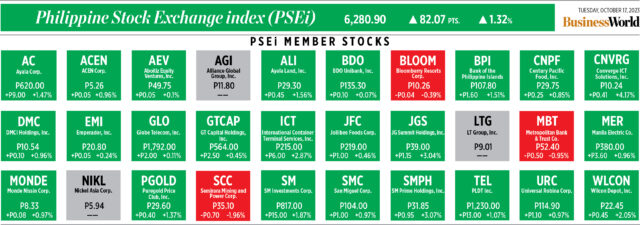
Here’s a quick glance at how PSEi stocks fared on Tuesday, October 17, 2023.
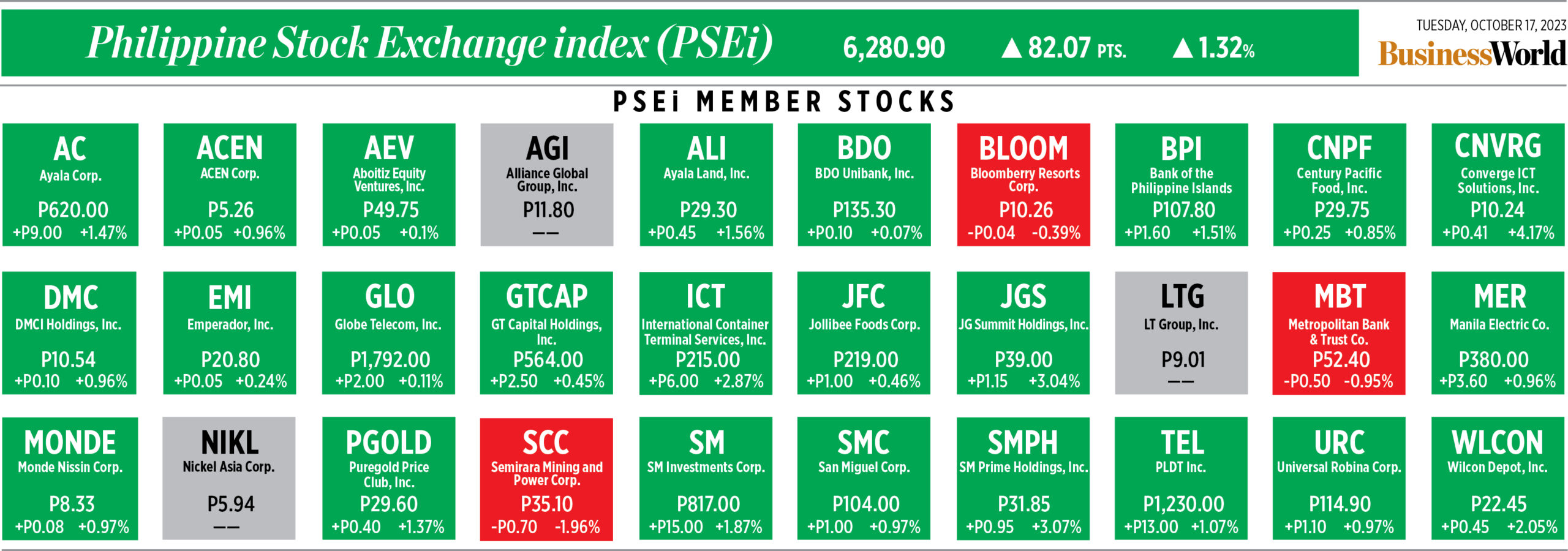

Here’s a quick glance at how PSEi stocks fared on Tuesday, October 17, 2023.

PHILIPPINE SHARES rebounded on Tuesday as investors bought bargains and on optimism ahead of the corporate results season in the United States and positive remittances data at home.
The Philippine Stock Exchange index (PSEi) went up by 82.07 points or 1.32% to close at 6,280.90 on Tuesday, while the broader all shares index added 31.48 points or 0.93% to end at 3,391.38.
“The index rose on the back of bargain hunting and better risk sentiment. The index tracked most Asian markets higher as the US earnings season started on a positive note and China injected fresh liquidity into the financial system,” China Bank Capital Corp. Managing Director Juan Paolo E. Colet said in a Viber message.
“The market was able to fully recoup [Monday’s] losses as it saw a broad-based rally, which we attribute to optimism ahead of the third quarter earnings season and positive spillovers from the overnight rally in Wall Street. Moreover, foreigners turned net buyers today, which provided added boost to the rally,” China Bank Securities Corp. Research Associate Lance U. Soledad said in an e-mail on Tuesday.
Net foreign buying stood at P276.42 million on Tuesday versus the P369.15 million in net selling recorded on Monday.
Futures for Wall Street’s main indexes edged higher on Monday ahead of this week’s corporate earnings and economic data that could offer clues on the state of the US economy, while tensions over Israel-Hamas conflict kept gains in check, Reuters reported.
Results from large banks Goldman Sachs, Bank of America, Morgan Stanley, pharmaceutical giant Johnson & Johnson, electric automaker Tesla, and video-streaming pioneer Netflix are due this week.
Mr. Colet added that market sentiment improved following the release of improved remittances data on Monday.
Cash remittances coursed through banks rose by 2.7% to $2.79 billion in August from $2.72 billion in the same month in 2022, central bank data showed.
The August growth was the fastest in three months or since the 2.8% in May, but slower than 4.3% in August last year.
For the first eight months of 2023, cash remittances increased by 2.8% to $21.58 billion from $20.99 billion in the previous year.
The central bank expects remittances to rise by 3% this year.
Almost all sectoral indices rose on Tuesday. Property climbed by 47.94 points or 1.82% to 2,673.19; services went up by 24.54 points or 1.61% to 1,548.56; holding firms rose by 85.06 points or 1.45% to 5,939.32; industrials increased by 60.72 points or 0.69% to 8,826.52; and financials inched up by 8.44 points or 0.47% to 1,797.52.
Meanwhile, mining and oil fell by 107.02 points or 0.97% to 10,930.38.
Value turnover went up to P5.69 billion on Tuesday with 1.25 billion shares changing hands from the P3.76 billion with 815.38 million issues seen on Monday.
Advancers outnumbered decliners, 110 versus 78, while 45 shares closed unchanged. — SJT with Reuters

THE PESO inched up against the dollar on Tuesday amid easing concerns over the war in the Middle East.
The local currency closed at P56.746 versus the dollar on Tuesday, strengthening by 3.4 centavos from Monday’s P56.78 finish, data from the Bankers Association of the Philippines’ website showed.
The local unit opened Tuesday’s session stronger at P56.70 per dollar. Its intraday best was at P56.67, while its weakest showing was at P56.78 against the greenback.
Dollars traded jumped to $1.109 billion on Tuesday from the $859.9 million on Monday.
“The peso strengthened amid easing market concerns over further escalation of the ongoing Israel-Hamas conflict,” a trader said in an e-mail.
Market sentiment improved after US President Joseph R. Biden, Jr. said he would go to Israel to help prevent the Israel-Hamas war from escalating, Rizal Commercial Banking Corp. Chief Economist Michael L. Ricafort said in a Viber message.
Mr. Biden will make a high stakes visit to Israel on Wednesday to show support for its war on Hamas, after Washington said Prime Minister Benjamin Netanyahu had agreed to let humanitarian aid reach besieged Gazans, Reuters reported.
Israel has vowed to annihilate the Hamas movement that controls Gaza after Hamas gunmen killed 1,300 people, mainly civilians, during a rampage through southern Israeli towns on Oct. 7, the deadliest single day in Israel’s 75-year history.
Israel has bombarded the Gaza Strip with airstrikes that have killed more than 2,800 Palestinians, a quarter of them children, and driven around half of the 2.3 million Gazans from their homes. It has imposed a total blockade on the enclave, blocking food, fuel and medical supplies, which are rapidly running out.
The peso strengthened due to dovish signals from a US Federal Reserve official, Mr. Ricafort added.
Federal Reserve Bank of Philadelphia President Patrick Harker said on Monday the central bank should not create new pressure on the economy by increasing the cost of borrowing, Reuters reported.
The Fed kept its key rate unchanged at the 5.25% to 5.5% range at its meeting last month.
It has hiked rates by a cumulative 525 basis points since it began its tightening cycle in March last year.
The US central bank will meet from Oct. 31 to Nov. 1 to revisit its policy stance.
For Wednesday, the trader said the peso could strengthen further amid a likely softer US retail sales report.
The trader expects the peso to move between P56.60 and P56.85 per dollar on Wednesday, while Mr. Ricafort sees it ranging from P56.65 to P56.85. — A.M.C. Sy with Reuters

By Adrian H. Halili, Reporter
AN EXTENSION of lowered tariffs on pork, rice, and corn may not stabilize surging domestic prices for the commodities, analysts said.
Leonardo Q. Montemayor, chairman of the Federation of Free Farmers said the initial tariff reductions had no lasting impact on domestic prices.
“(It) has not resulted in lower prices of rice, pork and corn. The main beneficiaries have been importers and traders, while government revenue and prices obtained by domestic producers have suffered,” Mr. Montemayor said in a Viber message.
Mr. Montemayor added that rice, pork, and corn are expected be in ample supply until the first quarter of 2024, citing the Department of Agriculture (DA).
The DA, however, said there will be a shortage equivalent to 10 days’ demand for pork at the end of the fourth quarter, due to holiday demand.
“Encouraging more imports will only discourage farmers from increasing production,” he said.
Philippine Institute for Development Studies Senior Research Fellow Roehlano M. Briones said allowing lower tariffs to run for longer will “not be enough to stabilize prices” for the three agricultural commodities.
He added that further tariff reductions are an appropriate measure to stabilize market prices of the goods, though protections for domestic producers will erode.
On Oct. 23, the Tariff Commission will hear arguments on the possible extension of the reduced most favored nation tariff rates for rice, pork, and corn.
Executive Order No. 10, signed by President Ferdinand R. Marcos, Jr., extended the lower tariffs on the three commodities until Dec. 31, 2023.
National Economic and Development Authority (NEDA) Secretary Arsenio M. Balisacan said that an inter-agency committee has recommended the extension of the low-tariff regime.
Rice tariffs are currently set at 35% for all imports, regardless of whether they fall within the minimum access volume (MAV) quota. Originally the 35% rate had applied only to grain from Southeast Asia.
Tariffs on pork were set at 15% for shipments falling within the MAV quota and 25% for those exceeding MAV.
Corn tariffs are currently at 5% and 15% for those within the quota and those exceeding it, respectively.
The public hearing is set to be conducted via videoconference on Monday afternoon.
Last month, Mr. Marcos rejected a proposal to further reduce tariffs on rice, citing stabilizing global prices. NEDA had proposed to cut tariffs to as little as 0%.
To curb rice prices, he imposed a national price ceiling for well-milled rice and regular milled rice at P45 and P41 per kilo, respectively, price ceilings which have since been removed.

PRESIDENT Ferdinand R. Marcos, Jr. must return from Saudi Arabia with investments in transportation, power and connectivity reached on the sidelines of the inaugural summit between Southeast Asian and Gulf leaders, analysts said on Tuesday.
“Potential investment from the Middle East would be in the form of infrastructure projects particularly in the key focus areas of the Philippines such as renewable energy, power, transportation, connectivity, and utilities,” John Paolo R. Rivera, president and chief economist at Oikonomia Advisory & Research, Inc., said in a Viber message.
The other must-haves from the visit include enhanced trade and protections for overseas Filipino workers.
Mr. Marcos flies to Riyadh on Oct. 19, and is scheduled to meet bilaterally with the Saudi government and businesses, Foreign Affairs Assistant Secretary Daniel R. Espiritu said at a Palace briefing on Monday.
Foundation for Economic Freedom President Calixto V. Chikiamco said Mr. Marcos should also secure investments for the Bangsamoro Autonomous Region in Muslim Mindanao “in areas of power generation, toll roads, halal foods, regional telecommunications, shipping, airlines, etc.”
“The Public Service Act Amendment and the Bangsamoro Autonomous Law have created conditions favorable for foreign investment in Muslim Mindanao, especially from Gulf countries,” Mr. Chikiamco said in a Viber message.
Mr. Espiritu said the President is expected to promote the newly established sovereign wealth fund and discuss OFW welfare during his meetings with Saudi officials and business leaders.
The investment fund has been provided with initial capital by state-owned banks and the central bank.
Mr. Espiritu added that Mr. Marcos is expected to hold a bilateral meeting with Bahrain to discuss the 40th year of the two nations’ diplomatic relationship.
The Association of Southeast Asian Nations and the Gulf Cooperation Council (GCC) will hold their first-ever summit on Oct. 20, over a decade after the first ministerial meetings between the two organizations in Bahrain in 2009.
The GCC is composed of energy-rich countries with strong petrochemicals and logistics industries, Mr. Espiritu said. — Beatriz Marie D. Cruz

SUGAR millers said retail prices are not reflecting the decline of mill gate prices for raw sugar, and questioned why no corresponding “adjustments” have emerged for sugar sold to the public.
While acknowledging the typical lag time for retail prices to adjust to movements in the mill gate price, Philippine Sugar Millers Association (PSMA) Executive Director Jesus L. Barrera said in a statement on Tuesday that “there should be market adjustments in the retail prices.” “Otherwise, the drop in farm gate prices is not trickling down and benefiting consumers.”
PSMA said that the average trading prices for milled sugar declined to slightly above P2,500 per 50-kilogram bag (LKg) on Oct. 12, with one mill selling at P2,700/LKg.
“Overall, our mill gate prices in the first six weeks of the new season are way below (those of) last season,” it added.
Citing the Sugar Regulatory Administration (SRA), PSMA said mill gate prices last year averaged P3,021.04/LKg and peaked at P3,798.24/LKg. The price was P3,000/Lkg at the end of last year.
“It is our sugar producers, particularly our small farmers, that are feeling the squeeze from inflation and lower prices especially now that they are just starting to harvest their crop,” Mr. Barrera said.
Headline inflation accelerated for a second straight month to 6.1% in September from 5.3% in August amid a surge in food and transport costs, according to the Philippine Statistics Authority.
The SRA has said that raw sugar was trading below its P3,000 per bag target, with prices between P2,500 and P2,700 per bag.
SRA Administrator Pablo Luis S. Azcona called trading abnormal, with prices fluctuating by P100 or more on a weekly basis.
He added that the oversupply of sugar was a main factor in the decline of trading prices.
The SRA also delayed the release of about 150,000 metric tons of imported sugar to ensure fairer prices for farmers. — Adrian H. Halili

ADVOCACY GROUP Philippine Business for Education (PBEd) said the Education department needs to enhance teacher training and develop quality instructional materials to help educators achieve mastery in their chosen subjects.
“Empowering teachers to master their subject matter not only demands an upskilling in pedagogical approaches but they must also be provided with the right resource materials,” PBEd Deputy Executive Director for Programs Hanibal Camua said in a statement on Tuesday.
He added that the government must invest in professional development and access to quality teaching resources to adapt to changes in education.
In September, PBEd signed a partnership with the Department of Education (DepEd) Region VI or Western Visayas for a civic education project known as Sibika.ph, an online resource portal for teachers and high school students.
Under the tie-up, PBEd will conduct capacity-building workshops for 100 teachers and train them on civic engagement, which will “help students grasp the significance of civic education to personal and societal development.”
“This will also ensure that the next generation are well-prepared to embrace democratic values and are actively engaged in nation-building,” Mr. Camua said.
The project has developed 17 DepEd-certified learning modules for senior high school complemented by videos and assessment tools.
“Under the partnership, these materials will be distributed in various school division offices within the Western Visayas region, upon completion of the learning experience design training with teachers,” PBEd said.
It added that Sibika.ph encourages student-led exercises that are integrated in the learning modules, with the goal of increasing active engagement.
“With the learning crisis and threats posed by false narratives, it is imperative that we provide our youth with skilled teachers and well-developed educational materials to help them make informed decisions and foster critical thinking,” Mr. Camua said. — Justine Irish D. Tabile

THE Bangko Sentral ng Pilipinas (BSP) said on Tuesday that it signed a memorandum of agreement with the Department of Trade and Industry to host the Cashless Expo 2023.
The expo aims to push digitalization and financial inclusion for micro, small, and medium enterprises (MSMEs), allowing them to grow their businesses through digital payments, BSP Deputy Governor and Payments and Currency Management Sector Head Mamerto E. Tangonan said in a speech on Tuesday.
“This cashless expo is really in support of the Digital Payments Transformation Roadmap… This is the first time that we will conduct a consumer fair (allowing only) digital payments. This is one way by which we will encourage MSMEs to adopt digital payments,” Trade Assistant Secretary Mary Jean T. Pacheco said.
The expo supports the BSP’s Digital Payments Transformation Roadmap, which aims to digitize 50% of retail transactions by volume and value and to bring the banked population to 70% of all adults by the end of this year.
Mr. Tangonan noted that merchant payments accounted for 58% of all retail payments by transaction volume, of which 54% consisted of digital payments.
The Cashless Expo 2023 will run between Nov. 17 and 19 at the World Trade Center. — Aaron Michael C. Sy
THE Government Service Insurance System (GSIS) said it is offering loan condonation and restructuring to its delinquent borrowers.
The program, known as Restructuring Program for Service Loans (RPSL), “hopes to address the clamor of our members and pensioners who would like to settle their obligations in full or in part through flexible means,” GSIS President and General Manager Jose Arnulfo A. Veloso said in a statement on Tuesday.
According to Mr. Veloso, RPSL offers interest rates of 3-6% for those settling their arrears, subject to an initial payment of at least 10% of the outstanding balance and five years to pay down the rest.
The GSIS had earlier offered a condonation program known as Program for Restructuring and Repayment of Debts (PRRD). In May 2022, the program waived penalties and surcharges worth around P1.5 billion pesos on 14,722 loan accounts.
“By strengthening our loan collection efficiency, we are also protecting the financial health of the pension fund so that members may avail of benefit and services when they fall due,” Mr. Veloso said.
Loans eligible for the RPSL include Salary Loans; Enhanced Salary Loans; Restructured Salary Loans; Emergency Loan Assistance; Summer One-Month Salary Loans; Member’s Cash Advances; eCard Plus Cash Advances; Consolidated Loans; Enhanced Conso-Loans; Emergency Loans; Home Emergency Loans; Study Now, Pay Later loans; Fly PAL, Pay Later loans; Educational Assistance Loans; Stock Purchase Loans; Policy Loans; Optional Policy Loans; GSIS Financial Assistance Loans; PRRD; Multi-Purpose Loans; Computer Loans; and other future loans. — Myara Janae B. Poliarco

THE National Dairy Authority (NDA) said it entered into a partnership with Malaysia’s Farm Fresh Bhd. to set up a dairy cattle breeding farm.
In a statement, the NDA said that Farm Fresh is looking for a 200-400 hectare site for the farm.
“Farm Fresh is actively collaborating with the Philippine government to materialize a significant $20-million investment, primarily focused on cattle breeding for milk production,” NDA said.
The proposed farm will hold 3,000 head of cattle, to be managed by the company’s Philippine subsidiary, Farm Fresh, Inc.
The farm investment will be paired with a 6,000 square-meter dairy processing facility, which will also take in the output of dairy farms, raising the possibility of raising farm incomes, NDA Administrator Gabriel L. Lagamayo said.
Farm Fresh has said that it is considering locations in Batangas and Laguna for the breeding farm, with operations to start by 2028.
The company also owns a 6,000-sq.m. site in San Simon, Pampanga, on which the $5-million processing facility will rise.
“The Philippines and Malaysia exhibit remarkable similarities in terms of topography and climate. We see tremendous potential in the Philippines,” Farm Fresh, Founder Tuan Ee Loi said.
Farm Fresh operates five dairy farms in Malaysia and one in Australia. The company also has two processing facilities in Malaysia and one in Australia. — Adrian H. Halili

THE PHILIPPINES is still negotiating with China on the loan that will finance the South Long-Haul project, the Philippine National Railways (PNR) said on Tuesday.
“The DoTr (Department of Transportation) and DoF (Department of Finance) are studying and evaluating other options for other financial assistance, as well as a hybrid approach, with government money and partially funded by the private sector,” Jeremy S. Regino, PNR general manager, told reporters on Tuesday on the sidelines of 43rd ASEAN Railway CEO conference.
Mr. Regino said the maritime dispute in the West Philippine Sea (WPS) is not expected to have an impact on negotiations.
“Negotiations are ongoing, and I don’t think (the WPS issue) was a factor. It is more on how interested the Chinese government is in the project. It is a matter of how badly or enthusiastically they would want to pursue the project,” he said.
Earlier this year, the DoTr said the Chinese government withdrew its funding for three railway projects being pursued under the previous government’s Build, Build, Build flagship program.
“The reason why the negotiations stalled in the previous administration was (differences) on the rate of interest,” he said, adding that had there been an agreement on rates, the project “would have been done.”
The initial phase of the project involves a 380-kilometer railway connecting Banlic, Calamba, Laguna and Daraga, Albay.
Mr. Regino said the PNR has decided to delay a shutdown in Metro Manila operations to January in order to avoid inconveniencing the public. The PNR estimates ridership at about 35,000 a day during the holiday season.
“We will be stopping the full line in Metro Manila by the middle of January. The January closure will not affect the completion of the project because preparatory works are being done so there will be no idle time,” Mr. Regino said.
PNR is expected to close its Tutuban to Alabang route in October to allow the completion of the North-South Commuter Railway project. — Ashley Erika O. Jose
THE Energy Regulatory Commission (ERC) said it rejected a petition by the National Grid Corp. of the Philippines (NGCP) to revise the 2022 Amended Rules for Setting Transmission Wheeling Rates (RTWR).
The NGCP had sought to include “grass fires” as events qualifying for force majeure treatment.
The ERC said in a statement it issued an order dated Sept. 5 outlining its ruling on the NGCP petition which the company filed on Dec. 22.
In its petition, NGCP proposed to consider grassfires as a force majeure event (FME), saying such fires had taken place “on multiple instances in several provinces,” which caused power interruptions and significant damage to transmission facilities.
The ERC said any grass fire incident — to be considered “unforeseen” and “extenuating” — must satisfy the conditions of an FME under the 2022 amended RTWR.
The 2022 Amended RTWR includes “all events occurring in the Philippines which result in an increase in the costs incurred by the Regulated Entity in the transmission of electricity.”
“More importantly, such incident must not have been caused by or attributed to NGCP, willfully or through its neglect,” the ERC said in the statement.
The ERC also denied an NGCP appeal to limit the coverage of the fourth regulatory period (RP) to the years 2016 to 2020, instead of 2016 to 2022.
The NGCP said that it remains faithful to the original five-year period based on the Transmission Wheeling Rates Guidelines issued in 2003 and 2009.
It also said the only exception to the five-year RP “or any subsequent RP should have been upon the request of NGCP in compliance with the requirements of the 2009 RTWR which was the applicable Rules when the 4th RP commenced in 2016,” the company said.
“Absent any request from NGCP for the extension of the 4th RP from five years to seven years, the 4th RP remains at five years or from 2016 to 2020,” the NGCP said.
“Considering that five years has long been determined to be the appropriate coverage for each RP, the Honorable Commission should be consistent in applying the same to the 4th RP,” it added.
In its refusal, the ERC said it has exercised its “rule-making authority to promote the interests of the public” to cover the entire lapsed period under the 4th RP, according to the authority it holds under the Electric Power Industry Reform Act and the amended Public Service Act.
“The Commission was deliberate in its decision to cover the years 2016 to 2022 under the 4th RP as this period had already lapsed by the time the 2022 RTWR was adopted by the Commission,” the ERC said.
The ERC also rejected the NGCP’s proposal to remove a provision allowing the National Transmission Commission (TransCo) to participate in rate-setting applications.
The Commission said that TransCo’s participation is “necessary for complete relief for any rate-setting application,” considering that it is still the owner of transmission assets and holds interests in the outcome of such rate-setting applications.
“As for NGCP’s proposal to include explicit provisions on reopening of events, the Order reiterated that the 2022 Amended RTWR already includes sufficient mechanisms and safeguards governing rate adjustments for the regulated entity,” the ERC said.
The proposed amendment to use a lock-in weighted average cost of capital (WACC), instead of the classic WACC, was also rejected by the ERC, which ruled that this contradicts the “spirit of performance-based regulation and the consumers’ interests.”
“The ERC reminded NGCP that the 2022 Amended RTWR, which already details the procedure for the setting of the WACC, among others, was subjected to public consultation in which NGCP itself participated,” the Commission said.
BusinessWorld asked NGCP Spokesperson Cynthia P. Alabanza to comment but she had not replied at the deadline. — Sheldeen Joy Talavera
