Home Blog Page 413

PHL still most disaster-prone nation

A car was submerged in flood water near the corner of Mother Ignacia and Sgt. Esguerra street in Barangay South Triangle, Quezon City after a heavy downpour, Aug. 30. — PHILIPPINE STAR/MIGUEL DE GUZMAN

By Aubrey Rose A. Inosante, Reporter

THE PHILIPPINES kept its title as the world’s most disaster-prone nation for a 21st straight year, with typhoons and floods battering communities while billions of pesos meant to protect them vanish in graft scandals.

The Southeast Asian country posted a risk score of 46.56 in the 2025 WorldRiskIndex, unchanged from last year but still ahead of 192 other nations. India ranked second, followed by Indonesia, Colombia and Mexico, according to the study released on Wednesday by Germany’s Bündnis Entwicklung Hilft and Ruhr University Bochum.

World Risk Index 2025: Philippines Remains World’s Most At-Risk Country for DisastersThe index weighs exposure to disasters such as cyclones, floods and earthquakes alongside vulnerability indicators like poverty, inequality and health systems. A score of 100 signals extreme risk.

The Philippines faces a broad spectrum of hazards, but river and coastal flooding remain the most significant threats, according to the report.

The ranking highlights how climate change continues to hit the archipelago, which is lashed by about 20 tropical storms each year. The latest assessment comes as the country braces for Tropical Storm Opong, days after Super Typhoon Nando — internationally named Ragasa — plowed through Luzon.

At the same time, government flood control programs are collapsing under the weight of corruption scandals. A sweeping investigation this year exposed widespread misuse of funds, forcing the removal of P255 billion ($4.4 billion) worth of projects from the proposed 2026 national budget. Flood control allocations were cut to zero.

“One problem that has become obvious is that the needed infrastructures like flood control projects are not being built because of corruption,” Maria Ela L. Atienza, a political science professor at the University of the Philippines, said in a Viber message. There seems to be more focus on relief rather than disaster prevention, she added.

China, Mexico and Japan led in disaster exposure, but the Philippines still placed fourth globally with a score of 39.99. The country also ranked “very high” in vulnerability (54.2) and coping capacity (58.54), underscoring weak infrastructure and strained social systems.

Provinces most at risk of flooding included Cagayan, Agusan del Norte, Pangasinan, Pampanga, Maguindanao and Metro Manila, each scoring above 82% in exposure. By contrast, Marinduque, Laguna, Batanes, Sarangani and Dinagat Islands had low flood exposure.

Metro Manila’s flood risk has been worsened by “soil sealing,” where rapid urbanization covers natural surfaces with concrete, preventing water absorption.

The capital sits on a low-lying river plain intersected by the Pasig River and a dense canal network. Laguna, meanwhile, benefits from hilly terrain and the buffering capacity of Laguna de Bay, which absorbs excess water.

GOVERNMENT FAILURES
The Philippines’ top ranking reflects governance failures more than geography, analysts said.

“Risks have skyrocketed because of the fact that public spending on risk management through flood controls and climate change was substandard to nonexistent,” John Paolo R. Rivera, a senior research fellow at the Philippine Institute for Development Studies, said in a Viber message. “Politicians and their cahoots decided to be greedy.”

Despite disaster-related laws and international financing for resilience, spending has skewed toward emergency relief. Manila regularly deploys military and civilian assets for typhoon response but falls short in long-term prevention such as drainage systems, retention basins and reforestation.

Ms. Atienza said development plans at the local and national levels should be balanced with effective disaster-risk management.

“Big infrastructures like airports and highways as well as commercial establishments and housing projects should not destroy the environment and cause dangers to people or make areas more disaster-prone,” she added. 

Disaster risk is increasingly shaped by social inequality and weak institutions, even in developed economies, according to the report. In Africa, almost 80% of the continent is classified as high- or very high-risk, while Asia and the Americas remain hotspots.

China, with a risk score of 30.62, ranked eighth overall, while the US did not make the top 10. Globally, the gap between disaster exposure and coping capacities has widened as governments struggle to finance prevention.

The Philippines’ risk score, while slightly lower than last year, remains stubbornly high despite decades of donor-backed disaster management programs. Manila has passed multiple disaster laws, created a national council and tapped international climate finance, but implementation has lagged.

The costs are rising. Super Typhoon Nando caused billions of pesos in damage to agriculture and infrastructure this month, compounding fiscal stress as the government pushes higher social spending and grapples with debt exceeding 60% of GDP.

With flood control funds scrapped in the 2026 budget, analysts said the Philippines risks more economic and human losses.

“The current challenges in flood risk management require a fundamental rethinking of disaster preparation,” according to the 2025 report, noting that extreme weather events are not only increasing in frequency, but are also increasingly exceeding the capacities of existing protection systems.

“At the same time, practical examples from various regions of the world show that successful coping strategies are based on the interplay of several factors: technological innovation, local capacity for action, and ecological resilience,” it added.


Trump’s visa crackdown may spur US offshoring

DCSTUDIO-FREEPIK

By Justine Irish D. Tabile, Reporter

US COMPANIES may offshore more technology roles to the Philippines and other low-cost markets as President Donald J. Trump’s revamped visa rules raise costs for bringing in foreign talent, analysts said.

The White House last week imposed a $100,000 annual fee on new H-1B visas, the program that allows companies to hire skilled foreign workers in areas such as information technology, engineering and finance. The levy, paid by employers, adds to restrictions already making it harder to secure visas for staff.

“It is going to cause more offshoring,” Jimit Arora, chief executive officer (CEO) at Everest Group Ltd., told BusinessWorld on the sidelines of the International IT-BPM Summit in Manila on Tuesday.

“Because people will not want to bring the people onshore, you drive more offshoring. And as you are driving more offshoring, you look at not just India; you also look at other geographies,” he added.

Companies already face concentration risks from their dependence on India, the world’s biggest hub for outsourced IT and business-process services, he said. The visa rules could accelerate investments from Mexico and Canada to the Philippines and India, where global capability centers (GCC) are expanding.

“You have a lot of Canadian financial institutions that use the Philippines, and the Canadian labor market is going to get tighter,” Mr. Arora said. “So those people will start putting more in their global capability centers either in India or in the Philippines.

The policy could also speed adoption of artificial intelligence as companies try to cut labor costs, he added.

Jonathan R. Madrid, president and CEO at the IT & Business Process Association of the Philippines (IBPAP), said the direct impact on the country would be modest.

“For the majority of the business process outsourcing industry or even the GCC industry, it should have a very minimal impact, if any,” he told BusinessWorld at the same event. “I took a look at the total number of H-1B visas, and less than 1% are with Filipinos.”

The US program has long been dominated by Indian workers, who account for about 70% of approvals. Mr. Madrid said that means India is likely to see a bigger boost from firms shifting offshore roles, though the Philippines could capture spillover demand for certain tech positions.

“This will have a bigger impact if we have more technology talent,” he said. “Because to have an H-1B visa implies that you have a certain level of technical skills. It is not like you are just entering the country for a general reason.”

The Philippine Chamber of Commerce and Industry (PCCI) echoed concerns about the costs, warning that these could discourage firms from hiring Filipino workers in the US.

“The additional cost of the H-1B visa will increase the cost of hiring people from the Philippines to the US, which will lessen the job opportunities there,” PCCI Chairman George T. Barcelon said in a Viber message. “This will induce more US companies to offer offshoring jobs.”

The Philippines is one of the world’s biggest outsourcing destinations, with more than 1.7 million employed in the IT and business-process management sector. Industry revenue is expected to exceed $40 billion this year, making it the country’s second-biggest source of foreign exchange after remittances.

Data from the Philippine Statistics Authority showed that 9.8% of the 2.16 million overseas Filipino workers in 2023 were deployed to North and South America. Most, however, were in lower-skilled service roles rather than the technical jobs typically covered by H-1B visas.

FNG bets on Japanese-inspired smart living trend in Philippines

FNG President and Federal Land, Inc. Vice-Chairman William Thomas F. Mirasol

By Beatriz Marie D. Cruz, Reporter  

FEDERAL Land NRE Global, Inc. (FNG) is banking on the growing demand for smart living with its Japanese-inspired developments in the Philippines, according to a top executive.

The Philippines’ sustained interest in Japanese technology and culture serves as a main selling point for the developer, said FNG President and Federal Land, Inc. Vice-Chairman William Thomas F. Mirasol.

FNG is the joint venture of real estate giants Federal Land, Inc. and Japan’s Nomura Real Estate Development Co. Ltd.

“The Philippines has long had an affinity for things Japanese, both in technology and popular culture. I think in terms of even electronics or cars, the Philippine market appreciates the thinking and the quality that you find in most Japanese products,” he told BusinessWorld Editor-in-Chief Cathy Rose A. Garcia as part of BusinessWorld One-on-One online interview series.

“If you have that extra layer of assurance that it was planned right and it was executed right, it can make all the difference.”

Japanese design principles are redefining modern living, blending smart technologies with natural elements to prioritize functionality and comfort.

Smart living, which integrates technology to enhance efficiency, is seen to grow in demand as these technologies become more widely available in the Philippines, Mr. Mirasol said.

Some Japanese technologies that Mr. Mirasol hopes to see in FNG’s future projects include a mechanical parking system, two-way lockers for deliveries, and underfloor storage.

However, he noted that proximity to office, retail and leisure establishments remain a key influence on Filipinos’ homebuying preferences.

“Those basic things are there, and those will always be dominant. Having access to smart technology or smart features just makes it a little bit better,” Mr. Mirasol noted.

Ty-led Federal Land first partnered with Nomura Real Estate and Isetan Mitsukoshi Holdings Ltd. to develop  the premier four-tower building called The Seasons Residences in Bonifacio Global City.

The success of The Seasons Residences, which combined Japanese innovation with Filipino sensibility, led to the creation of FNG — the joint venture between Federal Land and Nomura Real Estate.

FNG’s ongoing developments include Yume at Riverpark, a Japanese-inspired neighborhood, and the Riverpark North Commercial District. Both are located within the 600-ha Riverpark township in General Trias, Cavite.

The construction of The Observatory, a multi-tower condominium in Mandaluyong City, is expected to be completed by 2030.

MARKET TRENDS
According to Mr. Mirasol, changing market preferences across real estate segments are pushing developers to improve their offerings.

In the residential sector, living spaces are shrinking amid affordability issues and smaller family sizes, he said.

To spur demand, developers have begun “hyper-amenitizing” their properties to include coworking spaces and multi-use courts.

For office, continuing adoption of work-from-home schemes has prompted developers to redesign their spaces, Mr. Mirasol said.

“As an office, you now have to earn the commute of your employees,” he said.

Nowadays, companies allocate spaces in traditional offices for wellness activities, dining, coffee shops, and even on-site counseling, Mr. Mirasol noted.

The FNG executive said increasing hyper-connectivity also means local firms are competing for talent with companies based abroad.

“Designing office space that makes it worthwhile for the employee to come in, that’s a big challenge right now,” Mr. Mirasol said.

These evolving market trends continue to influence how FNG brings the Japanese-inspired living to Filipinos.

“The thing that FNG offers, which I think is unique, is that our Japanese partners bring in all of their many, many years of experience in designing efficient, well-working homes,” Mr. Mirasol said.

“And that starts from the very design, structurally, mechanically, everything that we can do to make the living experience better,” he said.

Owning a property also pushes an individual to be engaged in their community, Mr. Mirasol also said.

“So, if you’re a property owner, number one, I think you become a better citizen. You’ll take care of the community, you’ll be more engaged because you have something at stake,” he said. “Because you have an investment that depends on things working the way they should.”

Over the next year, the Philippine property sector is expected to experience “growth across the board,” driven by the country’s young working population and economic growth, Mr. Mirasol said.

According to Mr. Mirasol, the country’s real estate market remains stable due to Filipinos’ “buy-and-hold” strategy.

“The Philippine cultural sense is when you buy property, you are going to hang on to that. You’re going to pass that down to the next generation, and that makes for a very, very stable market,” he said.

Catch BusinessWorld One-on-One online interview series “Reconfiguring Business Amid Megatrends” on BusinessWorld’s Facebook page and YouTube channel. The interview with Federal Land NRE Global, Inc. President and Federal Land, Inc. Vice-Chairman William Thomas F. Mirasol will be streamed at 11 a.m., Sept. 25 (Thursday).

Philippines’ August budget deficit widens as revenues slip

Workers of the Department of Public Works and Highways put temporary asphalt on the potholes along Roxas Blvd. in Manila. — PHILIPPINE STAR/EDD GUMBAN

THE PHILIPPINES’ budget deficit widened in August as revenues fell faster than spending, adding pressure on the government to borrow more and keep within its deficit ceiling.

The gap ballooned 56% to P84.8 billion ($1.5 billion) from a year earlier, according to data released by the Bureau of the Treasury on Wednesday. Compared with July, the shortfall surged more than fourfold from P18.9 billion.

National Government Fiscal PerformanceCollections fell 8.8% to P352.5 billion, dragged by a steep decline in nontax revenues, which slid nearly 68% to P21.3 billion. Treasury income dropped 53%, while remittances from other offices tumbled 73%.

Tax revenues, however, inched up 3.4% to P331.2 billion. Bureau of Internal Revenue collections rose 5% to P250.1 billion, offsetting weaker Bureau of Customs receipts, which slipped 1.4% to P77.4 billion.

Government expenditures fell 0.7% to P437.3 billion in August from a year ago, weighed by lower primary spending, which excludes interest payments. Primary outlays dropped 3.5% to P374.2 billion.

Interest payments, by contrast, jumped almost 20% to P63.1 billion. The primary deficit — net of interest costs — widened to P21.7 billion from just P1.4 billion a year earlier.

For January to August, the fiscal gap rose 25% to P869.2 billion from a year earlier. The deficit represents 56% of the P1.56-trillion full-year ceiling, leaving room for additional borrowing in the final four months.

Spending climbed 7.2% to P3.95 trillion, already 65% of the government’s P6.08-trillion expenditure program. Primary spending increased 6% to P3.37 trillion, while interest payments grew almost 15% to P584.1 billion, making up 15% of total disbursements.

Revenue collections rose 3.1% to P3.09 trillion, equivalent to 68% of the P4.52-trillion full-year goal. Tax revenues made up 90% of the haul, rising 8.9% to P2.79 trillion.

The BIR collected P2.14 trillion, up 11%, boosted by higher corporate and personal income taxes, value-added tax, tobacco excise, percentage tax on financial institutions and documentary stamp duties. The robust performance of the BIR allows the deficit to remain manageable, the Treasury said.

Customs collections edged up 1.1% to P621.4 billion, supported by efforts against smuggling and illicit trade.

Nontax revenues, by contrast, fell 31% to P298.3 billion, though this still accounted for 97% of the P306.5-billion annual target.

Treasury income slipped 5.5% to P189.3 billion, surpassing the revised P179.2-billion goal. The bureau cited higher interest earnings on deposits, dividends from state companies and remittances from the Philippine Amusement and Gaming Corp. and Manila International Airport Authority.

The primary deficit surged 52% to P285 billion in the eight-month period, accounting for 85% of the total fiscal gap. The Treasury attributed the increase to the government’s push for priority programs and growth-supportive spending.

The government aims to cap the deficit at P1.56 trillion this year, equivalent to 5.5% of gross domestic product (GDP). Officials plan to gradually narrow the shortfall to P1.55 trillion or 4.3% of GDP by 2028. — Aubrey Rose A. Inosante

DigiPlus’ overseas expansion continues with South Africa license applications

STOCK PHOTO | Image by Tim Johnson from Unsplash

DIGIPLUS Interactive Corp. (PLUS), the listed gaming and leisure company behind BingoPlus, has applied for three gaming licenses in South Africa, which analysts said is part of its strategy to expand overseas and reduce exposure to stricter gambling rules in the Philippines.

In a disclosure on Wednesday, the company said it submitted applications to South Africa’s Western Cape Gambling and Racing Board (WCGRB), the provincial regulator of betting and gaming activities, for a national manufacturer license, a bookmaker license, and a bookmaker premises license.

The company said WCGRB is considered a preferred jurisdiction for international operators because of its “transparent regulatory processes and digital readiness.”

“The filing of our online gaming license in South Africa marks another milestone in DigiPlus’ global growth journey, as we bring our proven track record of innovation, responsible gaming, and player protection, together with our strength in localizing games for diverse markets, to one of Africa’s most dynamic economies,” DigiPlus Chairman Eusebio H. Tanco said.

On Sept. 22, DigiPlus launched its GamePlus platform in Brazil, giving users access to more than 150 free-to-play and real-money games.

AP Securities, Inc. Research Head Alfred Benjamin R. Garcia said the South Africa applications appear to be the “natural next step” after the company’s Brazil expansion.

“There’s an urgency for PLUS to diversify its revenue stream as the Philippines tightens its rule on online gambling, and we feel this is the right time for PLUS to explore other markets,” he said in a Viber message.

China Bank Capital Corp. Managing Director Juan Paolo E. Colet said the move highlights the importance of risk diversification.

“There’s the evident growth angle since the entry into new markets is expected to boost overall revenues,” he said.

“It makes sense to spread their chips across different jurisdictions so that they’re not overexposed to country-specific regulatory risk,” he added.

He also said the company’s overseas expansion story continues to attract investors.

“From what I’ve seen so far, DigiPlus is carefully executing its expansion strategy. They’re selecting promising gaming markets, [so] this should reassure investors that the company will be disciplined in deploying capital and maintaining profitability,” Mr. Colet said.

Shares of DigiPlus fell by 2.03% or 50 centavos to close at P24.10 each on Wednesday. — Alexandria Grace C. Magno

Makro returning to PHL via Ayala, CP AXTRA venture

CPAXTRA.COM

LISTED conglomerate Ayala Corp. is bringing back grocery chain Makro to the Philippines after signing a partnership with Thai retail giant CP Axtra Public Company Ltd. (CP AXTRA).

In a statement on Wednesday, Ayala Corp. said its wholly owned subsidiary ACX Holdings Corp. had executed definitive agreements with CP AXTRA to relaunch Makro stores in the country.

The partnership between ACX Holdings and CP AXTRA subsidiary Makro ROH Co., Ltd. also formed a joint venture, M&Co. Corp., which will operate the Makro stores.

M&Co. seeks to offer “a modern shopping experience with a wide range of food and nonfood products at accessible prices for both consumers and small business operators,” Ayala Corp. said.

“We are excited to partner with CP AXTRA to bring Makro back to the Philippines. Together, we seek to build on CP AXTRA’s proven success in delivering quality products at more affordable prices through the Makro format,” said Mark Robert H. Uy, head of corporate strategy and business development at Ayala Corp.

Makro, a Dutch international brand, first entered the Philippine market in 1996 through a joint venture among SHV Holdings N.V., Ayala Corp., and Sy-led SM Investments Corp.

Ayala later sold its 28% stake to the SM Group, which in 2009 rebranded Makro outlets into its own hypermarket and supermarket formats.

SHV later divested its Asian Makro operations, which are now operated by Thailand’s Charoen Pokphand Group through CP AXTRA.

Tanit Chearavanont, group chief wholesale business officer at CP AXTRA, said the partnership is aligned with the company’s strategy to expand its regional footprint.

“The Philippines represents one of the most dynamic and fast-growing markets in Southeast Asia,” he said.

“Through this partnership, CP AXTRA’s expertise in wholesale and retail management is combined with Ayala Corp., a trusted local partner with strong market presence, established customer base, and extensive land and mall development expertise,” Mr. Chearavanont said.

Shares of Ayala Corp. rose 0.4% or P2 on Wednesday to close at P502 each. — Beatriz Marie D. Cruz

Eat like a celebrity

Chef Marc Nacua, with his wife chef Princess Anne Uy

ON SEPT. 18, a chef who has cooked for celebrities was treated like one, with San Juan rolling out the red carpet at Guevarra’s for Princess Anne Uy.

Ms. Uy laughed in an interview with BusinessWorld when she remembered being asked by Australians if she was a real princess back home: she would reply that she didn’t wear a cape, but an apron. But the chef, who caters at Melbourne’s Marvel Stadium (after stints at Nobu and Crown Casino) has had her own brushes with celebrity.

Ms. Uy and her husband, Marc Nacua, were at Guevarra’s by Chef Laudico in San Juan last week for the 5th edition of Taste of the Philippines: A Global Culinary Journey, a collaboration series by chefs Rolando “Lau” Laudico and his wife Jacqueline, the owners of Guevarra’s, among other restaurants. Mr. Laudico is also known for his TV stints on the local franchise for MasterChef. The collaboration, which continues “until supplies last” is a partnership with Nutribullet.

SINGERS AND BANDS
Due to Ms. Uy’s position at one of Australia’s largest performing venues, she’s given a taste of her cooking to some of the world’s most famous. She recalled serving the British band Coldplay: “They’re very good with sustainability, so they like seafood and vegetables. In the whole stadium, we cannot use any plastic.”

During her stint at Nobu, she recalled feeding star Nicki Minaj: “She loves sushi (and) anything with tempura,” she said. As for popstar Adele, she said, “Adele (was) very conscious with food at the time. She only loved sushi and sashimi. They ordered tempura, steaks.”

She and her husband have some degree of celebrity though: Ms. Uy won the Silver Knife Bocuse d’Or Australia – National (2025) and second place in Seafood at the World Food Championship (2023, Dallas). Her husband, meanwhile, was the Dessert Champion at the 2024 World Food Championship – Australia and was Top 7 at the World Food Championship in Indianapolis, USA.

ON THE MENU
This time around, she’s not serving the dishes with which she won (she recalls serving a Duck and Lamb Embotido — a local steamed meatloaf — in Australia).

For her stint at Guevarra’s, she made Umami Lechon Belly Roll, Prawn Toast with Kare-Kare Bonito, Chicken Moringa Chawanmushi, and Seafood Udon. Of these, the lechon (roast pig) is a standout for obvious reasons (we’re Filipino and we like pork), but kidding aside, we’d go back again and again for the Seafood Udon. It’s her own take on the local palabok (noodles with an enriched seafood sauce), but without all the actual (taking after the Filipino idiom for “complications”) “palabok.” It’s clean and seafood-forward without all the fat, resulting in a more intense and seemingly distilled flavor, but still unmistakably Filipino. This she achieved by using Japanese techniques and ingredients like bonito and mirin. “At first, I though they’d never marry each other,” she said about melding Japanese and Filipino in her food. “But then I tried to think of how they’re going to connect.”

As for her husband, he made Dried Mango Rum Baba, Piñacolada Pavlova, and his competition-winning piece, Winter Morning. This contained parmesan frangipani crumbs, Maja Blanca de Cacao, coconut-rum granita and lychee pieces.

Speaking of marriage, she and Mr. Nacua had been childhood sweethearts before marrying and migrating (he went to Australia first). She spoke about the highly unique experience of having two decorated chefs at home: “When someone’s on their day off, someone will cook for you,” she said. “Normally we eat together at home. We cook for each other.”

Mr. Laudico recalled that they all met at a Filipino Independence Day dinner in Australia that he worked on with them, convincing them to collaborate with him if ever they came to the Philippines — most of the chefs in the Taste of the Philippines series became part of it in this way.

“Aside from the advocacy of Guevarra’s to promote Filipino cuisine, we also want to promote Filipino chefs. Especially the ones who really work so hard abroad, really trying to promote Filipino flavors,” he told BusinessWorld. “One way of promoting Filipino cuisine is also promoting Filipino chefs.”

THE TASTE OF HOME
Ms. Uy talked about the difficulties of getting the real taste of home abroad, and why skill matters in recreating what home cooking should taste like. “We don’t have anything like our local produce. We have it frozen, or otherwise in the can. If we cannot replicate it, we just need to use another ingredient,” she said. “Missing the home taste, we still need to have the knowledge that we can get from the Philippines.

Kung hindi mo rin kayang magluto dito, hindi mo rin siya madadala sa Australia (if you can’t cook at home, you can’t bring that to Australia).”

Guevarra’s by Chef Laudico is in 387 P. Guevarra St., San Juan City. — Joseph L. Garcia

Term deposit yields dip on BSP, Fed easing bets

BW FILE PHOTO

THE BANGKO SENTRAL ng Pilipinas’ (BSP) term deposits continued to fetch lower yields on Wednesday on bets of further monetary easing here and in the United States.

Bids for the central bank’s term deposit facility (TDF) amounted to P108.193 billion, above the P90 billion placed on the auction block and the P105.104 billion in bids for a P100-billion offer volume a week ago. The BSP made a full award of its offer.

Broken down, the seven-day deposits attracted P53.515 billion in bids, higher than the P40-billion offer but below the P58.145 billion seen for the same offer volume last week.

Accepted rates for the one-week securities were from 5.05% to 5.09%, narrower than the 5.03% to 5.11% margin a week earlier. With this, the weighted average accepted yield for the seven-day tenor declined by 0.81 basis point (bp) to 5.0747% from 5.0828% last week.

Meanwhile, tenders for the 14-day papers reached P54.678 billion, more than the P50-billion placed on the auction block and the P46.959 billion in bids recorded for the P60-billion offer last week.

The BSP accepted bids carrying yields ranging from 5% to 5.14%, wider and lower than the 5.05% to 5.15% band last week. As a result, the average rate of the two-week tenor slipped by 0.4 bp to 5.1074% from 5.1114% previously.

The BSP has not auctioned off 28-day term deposits for nearly five years to give way to its weekly offerings of securities with the same tenor.

Both the TDF and BSP bills are used by the central bank to mop up excess liquidity in the financial system and to better guide market rates towards the policy rate.

Term deposit yields continued to go down, tracking the decline in comparable secondary market rates, on bets of further rate cuts from the BSP and the US Federal Reserve, Rizal Commercial Banking Corp. Chief Economist Michael L. Ricafort said in a Viber message.

“The series of BSP rate cuts in recent months and possible BSP and Fed rate cuts in the coming months led more investors to lock in yields before they go down further,” he said.

Last month, the BSP lowered benchmark interest rates by 25 bps for a third straight meeting to bring the policy rate to 5%.

It has now slashed borrowing costs by a total of 150 bps since kicking off its rate-cut cycle in August 2024.

BSP Governor Eli M. Remolona, Jr. has said they could deliver one more cut this year — which would likely be its last reduction for this easing cycle — to support the economy and if inflation remains manageable.

Analysts expect another 25-bp cut from the BSP at either its October or December meeting as the weak outlook for the global economy is expected to affect domestic growth prospects.

Meanwhile, the Fed last week lowered its target rate by 25 bps to the 4%-4.25% range, which was its first cut since December. This brought its total reductions since September 2024 to 125 bps.

Its “dot plot” showed projections of two more rate cuts this year.

US Federal Reserve Chair Jerome H. Powell said on Tuesday the central bank needed to continue balancing the competing risks of high inflation and a weakening job market in coming interest rate decisions, even as his colleagues staked out arguments on both sides of the policy divide, Reuters reported.

“Near-term risks to inflation are tilted to the upside and risks to employment to the downside — a challenging situation,” Mr. Powell said in remarks that stuck close to language used last week when the central bank cut its benchmark rate a quarter of a percentage point.

The current rate is still considered high enough to lean against price pressures in the economy, but “leaves us well positioned to respond to potential economic developments. Our policy is not on a preset course,” Mr. Powell said.

While that phrase is something of a mantra for central bankers, it has taken on particular resonance now, with strong opinions emerging on both sides of the policy divide.

In remarks before Mr. Powell spoke on Tuesday, Fed Vice Chair for Supervision Michelle Bowman said the Fed could downplay concerns about persistent inflation and needed to make a commitment to cut rates in support of a job market she worries may be about to rupture.

By contrast, regional Fed Reserve Bank presidents who spoke this week recommended caution about further rate cuts while inflation remained nearly a percentage point above the central bank’s target and the impact of the administration’s tariffs and other policies is still being assessed.

The Fed next meets on Oct. 28-29, with investors assigning a high probability that officials will cut interest rates again, consistent with projections issued after last week’s meeting showing quarter-point cuts anticipated in October and December.

While job market concerns are now competing more with high inflation in the minds of Fed officials, Mr. Powell said there was no “risk-free path” for the Fed to follow at the moment.

Traders have ramped up bets on further US rate cuts, with Fed funds futures implying a 91.9% chance of a rate cut at the central bank’s October meeting, up from an 89.8% probability on Tuesday, according to the CME Group’s FedWatch tool. — Katherine K. Chan with Reuters

QC like you’ve never seen it before

BIRD SELLER BOULEVARD — JOSEPH L. GARCIA

DESPITE the presence of two of the best-known universities and (for a long while) two of the largest media and entertainment networks in the country, there’s something simply suburban about Quezon City, fondly nicknamed QC.

Another QC (Quezon Club that is), is rising in QC, giving back a little oomph to what was once the country’s capital (it’s a long story; look it up).

Solaire Resort North, the entertainment complex’s branch up here, invited BusinessWorld for a glamorous night in Quezon Club, set to open on Sept. 26. We don’t use the word “glamor” lightly: think tropical chic interiors with cane chairs, brocade, tigers, lions (no bears) woven into the plush cushions; and the same motif repeated in the borders of the china. Cap that with an evening of international dancers performing to hits by Madonna and Mariah (with appealing visuals on a clearer-than-crystal mirror LED screen), and we’d say we had a pretty good night.

The menu is impressive with a decidedly international flair: think foie gras, and oysters topped with caviar. For the mains, we ordered the Lamb Rack with sweet snap pea puree and port wine jus (P2,200; glamor does not come cheap), and Sous Vide Duck Breast with sweet potato, orange jus, and cowboy beans (P2,800). The lamb had a very mild taste, and the accoutrements refreshing and lively. The duck had an excellently aggressive savory flavor and hints of smoke in a mildly sweet sauce that accented the duck’s vigor. “It’s London luxury brasseries,” Sandro Alessandrini, Director of Food and Beverage for Solaire Resort North, said about the menu’s inspiration.

A DELICIOUS VARIETY OF COCKTAILS
We went through the club’s signature cocktails list, having six of the eight offerings (between P550 to P650). What the food offerings have in international flair, the cocktails fight back with local indulgence.

For example, some of the drinks are inspired by Filipino art: there’s the Amorsolo Rice Highball (Plantation Original Dark Rum, Horchata Fizz, pandan syrup, and marshmallow) — ambitious, but we were wont to avoid it because it tasted far too much like kakanin (Filipino rice cakes — if that’s your thing, you might get some pleasure having that as a smooth and light drink). Sabel’s Appletini, named after National Artist Benedicto “BenCab” Cabrera’s hapless muse, Sabel, might drive you nuts: it’s made of Drouhin Selection calvados (a French apple brandy traditionally from Normandy), homemade pear vermouth, apple syrup, and apple peel bitters. There’s an indicator of symbols up to three indicating a cocktail’s strength, and Sabel wasn’t kidding with its three-numbered rating. It was strong, and despite the chill, it went down your throat quite warmly, and had a slightly woody aftertaste (we mean all of that as a compliment).

The Spillarium (Buttered Volcan Blanco Tequila and Corn Cordial) had just one symbol after it, designating it as a weaker cocktail: reader, it was not. The corn cordial gave it a flavor akin to straight bourbon, and did taste light, but razor-sharp. A tiny blotter with a small artwork dissolves in the drink to give it a tint like watercolors.

The Sonata Lady (Dewar’s 15 Years, Lemon Saccharum, Mathilde Peach, honey ginger syrup, lemon, and egg white), made my companion say, “Now that’s a cocktail.” Served in a stemmed teacup, it was light, bright, and sparkling. The Breakfast Arabesque (Boodles Gin, banana syrup, cereal milk, and lemon juice) had the same quality.

Our favorite was the Bird Seller Boulevard, inspired by the classic Boulevardier (whiskey, sweet vermouth, and Campari), their version used Monkey Shoulder Whisky, Tomato Vermouth, and Salted Egg House Amaro. Served in a giant ceramic egg within a birdcage, not only is it a show, but it was a delightful play as a savory drink with a juicy quality that made one’s mouth water (the sides are also rimmed with salted egg, so we spent a few minutes licking that too). While our favorite, it was simply too rich to drink multiples of it.

What we did order repeatedly (while watching very enthusiastic dancers giving their all to Donna Summer playing in the background) was the Smoked Genesis (Los Sietes Doba Yej Mezcal, Volcan Blanco Tequila, Pineapple Arugula Saccharum, strega, and balsamic vinegar). It’s quite spicy, deliciously warm down the throat, and given a savory edge by the mezcal.

“We are quite unique as a venue in Quezon City,” said Mr. Alessandrini. “I don’t think there’s anything as high-end as we are: obviously in a luxury five-star resort.”

Quezon Club at Solaire Norte opens to the public on Sept. 26. — Joseph L. Garcia

Largest Tongits prize pool competition in the country: Third GTCC first prize of P5 million was won by a tailor from Rizal

A tailor from Rizal wins and raises the GTCC: September Arena championship trophy.

Jomar Sapo-an, a humble tailor, emerges victorious in the GameZone Tablegame Champions Cup (GTCC): September Arena: Maraming, maraming salamat sa lahat ng bumubuo ng GameZone, kung di po dahil sa kanila, wala po ako rito.”

This GTCC is the third Tongits competition held by GameZone. It is currently the most influential national-level competition in the Philippines and the Tongits competition with the largest prize pool in the entire Philippines.

GameZone presented the “GameZone Tablegame Champions Cup (GTCC): September Arena,” a two-day offline tournament, which ran from Sept. 20 to 21 at the Filinvest Tent in Muntinlupa, Metro Manila, bringing in the top 36 seasoned players from all over the Philippines to compete for the prestigious golden trophy and a prize pool of P10,000,000, the largest prize pool for a Tongits competition in the entire Philippines.

GameZone will provide a P10-million prize pool for each competition, with the goal of showcasing the skill, perseverance, and shining qualities of the Filipino people through professional competitive play. All participants will be selected through online games, giving everyone an equal chance to transform their lives and showcase their talents.

In addition, each competition will allocate P1 million for public welfare projects and community development initiatives. This effort reflects GameZone’s commitment to continue bringing entertainment while also promoting responsible gaming and meaningful contributions to society.

Gamemaster Integrated, Inc. President Rafael Jasper Vicencio presents the grand prize and trophy to the winner of the GTCC: September Arena.

As GameZone culminates the final day of the tournament, the top 2 players Jomar and Erlinda are both reserve players who only went to the event for their love of the game, not knowing that they will both be facing each other in the finals. They brought out their competitive nature as Erlinda won the first round of the finals leading the game by 10,600 points, but then things took a quick turn with Jomar’s exceptional performance and mastery of the game. He was able to take the lead by 500 points to win a championship, enduring to the end and going all out in the final game to become the GTCC September Arena’s grand champion. 

Jomar, the ultimate winner, received the grand prize of P5 million and the golden trophy, with Rafael Jasper Vicencio, President of Gamemaster Integrated, Inc., presenting the prize and trophy to the grand champion of the GTCC: September Arena tournament.

In an exclusive interview with the grand champion, Jomar, still in shock after winning the tournament, raises his hands up to the skies and said, ”nagpapasalamat po ako kay God at sa pamilya ko.

Sapo-an raises his hand up to the skies as he becomes the champion of the tournament.

Jomar and his family reside in Rizal, but are originally from Bohol. He says that it was his wife, his number one fan who pushed him to join but was nervous as it was his first time ever attending a Tongits tournament. With him now being the grand champion, he feels every bit of happiness.

“Inaalay ko po ang panalong ito sa pamilya ko po, lalong lalo na sa asawa ko, na number one fan ko, supportive sa akin ‘yun, sya ang nag-push sakin na pumunta rito, nag-pray lang din po ako kay God, na kung para sa akin, para sa akin.”

When asked what he will be doing with his winnings: ”Unang-una po sa lupa’t bahay, para po sa pamilya, bibili po kami ng lupa at bahay, sa ngayon po di pa po namin napapag-usapan kung sa Maynila o sa Bohol.

With the trustworthy prizes and fair competition system, it brought out the players’ competitive spirit and, after winning the prize, Jomar showed his sportsmanship spirit by also giving credits to his fellow players stating that all of them are masters of the game and it was not easy, but left it all to luck on the cards. He stated that his playing experience comes from playing card games and playing through the GameZone application on his phone. This gave him an unforgettable experience throughout his whole journey during the tournament, as he emerged as the champion in the GTCC: September Arena. After the tournament, he plans to go home to hug his wife and two kids.

Passion meets purpose: GameZone donates P1 million to the Kalusugan Plus initiative, chosen by the community received by the BingoPlus Foundation.

What sets GameZone apart is its commitment to creating memorable experiences in and out of the competition. Players were not only celebrated for their talent but also treated with hospitality deeply rooted in Filipino values. Each participant was allowed to bring up to 1 companion who enjoyed an all-expense-paid, five-day hotel stay complete with food and accommodations — a gesture that reflects GameZone’s dedication to making the journey unforgettable for both players and their families.

At the heart of GameZone as a brand is the desire to promote qualities that not only speak to the competitive nature of gaming but also to the virtues that can inspire and uplift society, with the event being labeled as the biggest Tongits table game tournament in the Philippines. The tournament opened with an air of excitement with participants and players from different backgrounds making their way to the event, with 36 players given an opportunity to create history and were grouped randomly as they went head-to-head with each other in one of the most challenging long hours and rounds of their playing career, making their way through the elimination round and finals giving each player a platform to shine.

All of the participants were recognized during the two-day tournament creating another milestone event with the brand raising a platform where everyone can join, win and be part of GameZone. Another highlight of the event was the donation given by GameZone to the initiative that was voted by the public community. GameZone was able to donate an amount of  P1-million donation to the Kalusugan Plus initiative, with BingoPlus Foundation’s Executive Director Angela Camins-Wineke there to accept donation, which will go to the chosen initiative by the  community for support and development.

Overall, the GameZone was able to set a milestone moment as it set records and opened new doors of opportunities, promising an exciting and entertaining platform for future players of the game. The tournament was not only a game of cards for the players, because it also fostered champions for change, with proof that the love for Filipino entertainment is as strong as ever. This commitment to excellence, combined with a strong focus on public welfare, positions the GameZone brand as a leader in the gaming industry, paving the way for even greater achievements in the future.

Above all, GameZone promotes responsible gaming. Play Responsibly. Play for fun only. Gambling is not an acceptable way of livelihood, and it does not solve any financial problems. To find out more about the tournament, just visit the official website of GameZone — gzone.ph.



Spotlight is BusinessWorld’s sponsored section that allows advertisers to amplify their brand and connect with BusinessWorld’s audience by publishing their stories on the BusinessWorld Web site. For more information, send an email to online@bworldonline.com.

Join us on Viber at https://bit.ly/3hv6bLA to get more updates and subscribe to BusinessWorld’s titles and get exclusive content through www.bworld-x.com.

Peso sinks to three-week low as Powell signals caution on cuts

BW FILE PHOTO

THE PESO sank to a three-week low against the dollar on Wednesday after US Federal Reserve officials gave a cautious view on future cuts due to sticky inflation and a weak labor market.

The local unit closed at P57.461 versus the greenback, dropping by 16.6 centavos from its  P57.295 finish on Tuesday, Bankers Association of the Philippines data showed.

This was its worst showing in over three weeks or since it closed at P57.51 on Sept. 2.

The peso opened Wednesday’s session weaker at P57.33 versus the dollar. Its intraday high was at just P57.31, while its worst showing was at P57.49 against the greenback.

Dollars exchanged went down to $1.73 billion on Wednesday from $1.86 billion on Tuesday.

“The dollar-peso closed higher but traded at a narrow range on cautious trading due to lack of market catalysts, but mostly tracking dollar strength due to the hawkish turn in Fed statements,” a trader said by telephone.

The dollar was also supported by increased geopolitical risks as US President Donald J. Trump ramped up his rhetoric against Russia, Rizal Commercial Banking Corp. Chief Economist Michael L. Ricafort said in a Viber message.

For Thursday, the trader said the peso could move between P57.30 and P57.60 per dollar, while Mr. Ricafort expects it to range from P57.30 to P57.50.

The US dollar edged higher on Wednesday, rebounding from its lowest level in nearly a week, after Federal Reserve Chair Jerome H. Powell struck a cautious tone on further easing overnight, though markets still priced in two more rate cuts this year, Reuters reported.

Key for markets now is the expectation of quarter-point rate cuts at the remaining two Fed meetings this year and another in the first quarter of 2026, in line with the central bank’s guidance after last week’s meeting.

The US dollar index, which measures the currency against six major rivals, added 0.35% on Wednesday to trade at 97.575, attempting to claw back ground after two straight losing sessions in which it touched its lowest since Thursday at 97.198 overnight. — AMCS with Reuters

Landlords urged to improve offices, offer concessions in tenant-leaning market

STOCK PHOTO | Image by Pooja Singh from Unsplash

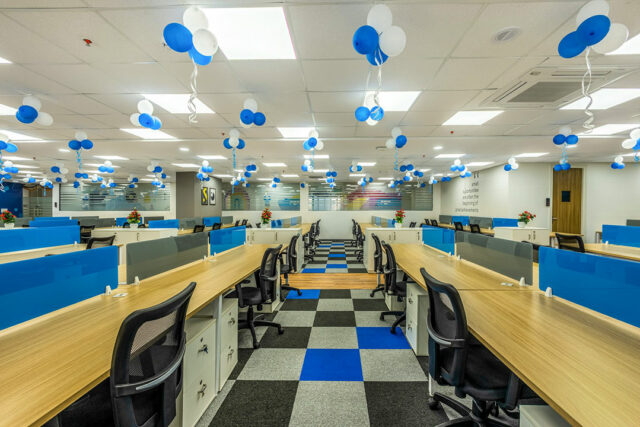
PHILIPPINE office developers need to upgrade their workspaces and offer lease incentives as more companies return to traditional office setups, according to property consultancy Colliers Philippines.

In its Survey Flash Report released on Wednesday, Colliers said six out of 10 respondents are now working in a traditional office setup, slightly higher than the 54% recorded in the fourth quarter of 2024.

Meanwhile, 40% of respondents follow hybrid work arrangements, while 4% are fully working from home.

“This shows that now is an opportune time for office landlords to aggressively promote their office development pipeline especially in Metro Manila submarkets likely to achieve landlord’s market status in the next 12 to 24 months,” Colliers said in its report.

The consultancy also noted office space consolidation by major occupiers, which creates opportunities for developers with sizable, vacated office space in the Makati central business district (CBD) and Fort Bonifacio to target outsourcing firms and large-scale traditional occupiers.

The Makati CBD (33%) is the top choice among respondents looking to expand in the next 12 to 24 months, followed by Fort Bonifacio in Taguig City (23%).

Other preferred locations include the Bay Area (12%), Quezon City (12%), Alabang (11%), and the Ortigas CBD (10%).

The survey also found that 56% of respondents ranked lower base rents as their most preferred concession when looking for office space to lease, followed by rent-free fit-out periods (17%), fit-out allowance (15%), and no or delayed rent escalation (12%).

In the first half of the year, more than half of Metro Manila-based office transactions were expansions, Colliers said in its Second Quarter Property Market Report.

Outsourcing firms, flexible workspace operators, logistics companies, banks, financial services, and information technology firms took up space in Fort Bonifacio and the Makati and Ortigas CBDs.

The consultancy “encourages occupiers to capitalize on the current market conditions to secure favorable lease terms.”

“Meanwhile, landlords should enhance the look of their spaces and continue offering concessions to stay competitive in a tenant-leaning market.”

Colliers surveyed about 200 respondents from real estate developers, property equity analysts, brokers, and investors from July 30 to 31. — Beatriz Marie D. Cruz