Home Blog Page 3925

Century Properties ‘cautiously optimistic’ for next year

LISTED property developer Century Properties Group, Inc. (CPG) expects to perform better in 2024, said its top official who remains cautious despite his optimism for the year ahead.

“Our outlook [for next year] is actually cautiously optimistic. There are many reasons why we believe it’s going to be a good year. Our affordable housing business is growing very rapidly. As you are probably aware, we’ve launched many projects,” CPG President and Chief Executive Officer Marco R. Antonio said in a media briefing last week.

“I think overall, 2024 should be a banner year for the company,” he said, describing the coming year as “better than this year.” 

From January to September, CPG logged a 13% increase in its net income to P1.3 billion while its revenues climbed by 10% to P9.7 billion.

“2023 is proving to be a very strong year for the company… We’re already reaching our pre-pandemic levels,” Mr. Antonio said. 

According to Mr. Antonio, the company’s commercial leasing business has been performing “above market” in terms of occupancy rates. 

“For commercial leasing, it is kind of a mixed bag,” he said, citing the challenges faced by the office sector such as the pandemic, the contraction of the Philippine offshore gaming operators or POGO market, and work-from-home arrangements. 

“With that said, I think our properties are performing above market in terms of both occupancies,” Mr. Antonio said.

“We don’t plan any new speculative office developments in the near future. We’re focusing our efforts into really filling up all of our current office and retail spaces,” he added.

On CPG’s retail business, Mr. Antonio said the company is looking at driving occupancy in retail spaces.

“I think there’s a lot to be excited about in retail. But specifically for Century City Mall, we’ve seen already the positive inflection point where we’ve been able to drive up the occupancy for the mall significantly this year, which we plan to continue next year,” Mr. Antonio said.

Based on its website, CPG’s office and retail spaces include Century City Mall, Century Diamond Tower, Century Spire Offices, and Asian Century Center BGC.

The company is also engaged in residential projects, hospitality projects, mid-income and affordable housing, and property management.

Shares of CPG at the local bourse were last traded on Nov. 24 at 30 centavos apiece. — Revin Mikhael D. Ochave

Federal Land bullish on year-end showing

PROPERTY developer Federal Land, Inc. is bullish about its year-end performance led by its residential portfolio, its top official said.

“We’re doing great. 2019 was our best year ever. And as of end-October, we’ve already exceeded 2019 numbers. We’re very optimistic about the year-end numbers,” Federal Land, Inc. President William Thomas F. Mirasol said on the sidelines of BusinessWorld’s economic forum in Taguig City last week.

“Our growth drivers continue to be what it was always been — it’s residential, particularly in the mid- and high-end [segments],” he added.

For next year, Mr. Mirasol disclosed that Federal Land is eyeing to launch developments in areas such as Mandaluyong City, Bonifacio Global City (BGC), Cebu, Pasay City, and Cavite.

“These [projects] are mixed-use. There is always a residential component and there will always be a bit of retail and commercial components,” Mr. Mirasol said. 

According to Mr. Mirasol, Federal Land launched 10 projects this year. Some of these projects are the second tower of The Grand Midori Ortigas residential project in Pasig City launched in July, the Federal Land Communities that offer multi-use developments, and the first Mitsukoshi mall in BGC.

Federal Land is the wholly owned property unit of Ty-led conglomerate GT Capital Holdings, Inc.

For the nine months through September, it logged a 176% increase in core net income to P1.9 billion while its total revenues rose 6% to P13.2 billion.

Shares of GT Capital were last traded on Nov. 24 at P560 per share. — Revin Mikhael D. Ochave

He will always kick a**

By Brontë H. Lacsamana Reporter

Movie Review
Enter the Dragon
Directed by Robert Clouse
QCinema International Film Festival —Restored Classics

BOTH martial artists and lovers of kickass combat in movies were hooked on Bruce Lee in the 1970s (and even beyond) for his legendary skill and charisma as a fighter and as an actor. This writer, having been raised by a father who practices martial arts and adores movies himself, was well aware of Mr. Lee’s enormous presence on screen and in the lives of many.

When the QCinema International Film Festival announced that Robert Clouse’s Enter the Dragon would be part of its Restored Classics section, getting tickets for it was a no-brainer.

An unprecedented collaboration between Hollywood and Hong Kong, the 1973 film places Mr. Lee in a fighting tournament organized by the crime lord Han (played by an entertainingly stereotypically villainous Shih Kien). With the help of fellow competitors Roper (John Saxon) and Williams (Jim Kelly), he sets out to bust Han’s operation.

For sure, much has already been said about one of the most influential action films of all time. It set the standard for many kung fu films, spy movies, and revenge tales to come.

A few things struck this writer while watching the restored version on the big screen. One was that the remarkable bodily presence of Bruce Lee just doesn’t get old, whether he is acting or fighting (damn, those well-defined muscles and those intense eyes!). It is clear that his movies are a product of an ardent love for martial arts, reaching fans even today every time his character engages in a fight sequence or firmly reiterates his philosophies.

Another striking thing is the image of Hong Kong that this film captures. The floating slums and boats on Aberdeen Harbour, for example, paint a vivid picture of a place that no longer looks like that. On the big screen it conveys the awesome sense of the characters coming together to face the unknown.

However, there’s no doubt that younger people reliving this classic will mainly be viewing it given its revered placement in cinema history. It exists now as the bedrock for many more forms of media that followed, ones that today’s audiences grew up on, from Kill Bill to John Wick (and yes, now you understand why every fighting game MUST have a Bruce Lee type character).

Not all of its elements stand the test of time either — the martial artists having their pick from a lineup of women? The cross-dissolve to transition between scenes recalling the past? That slick, funky score by Lalo Schifrin? It’s stuff you definitely don’t get from movies today.

In a recent trip to Hong Kong, this writer made a few stops to prepare for the big-screen rewatch of the classic. These include Bruce Lee’s statue in the Avenue of Stars, which many tourists visit to this day, and a pop-up exhibit on the legendary martial artist at the Hong Kong Heritage Museum in Sha Tin.

While Enter the Dragon exists now as some cultural artefact to draw inspiration and quote from, its allure as a kickass piece of entertainment still rings true. It is a timeless showcase of jaw-dropping fight choreography, silly plot points, and inspired set pieces like the mirror room towards the end.

This writer imagines her father in 1973, then in his late teens sitting on the stairs of a packed movie theater staring up at the screen in awe. She thinks back to the many teenagers at the Bruce Lee exhibit making TikToks of each other imitating his fighting poses next to vintage posters and action figures.

Mr. Lee’s most iconic movie, sometimes looking like a parody of itself, still succeeds at freezing him in time at his pinnacle, never to grow old or forgotten.

13th month pay: A comprehensive guide for SMEs

TOWFIQU BARBHUIYA-UNSPLASH

For business owners, understanding the intricacies of employee compensation and taxation is crucial to maintain a well-functioning and compliant workforce. It ensures that their employees are fairly compensated, while also meeting their legal obligations.

One key aspect of employee compensation in the Philippines is the 13th month pay. In this article, we’ll discuss how to compute it, when it must be given and other important things that small and medium enterprises (SME) need to know.

WHAT IS 13TH MONTH PAY?
The 13th month pay is an employee monetary benefit mandated by the Philippine government under Presidential Decree 851. All private employers must provide this benefit to rank-and-file employees at the end of each year, and no later than Dec. 24.

The 13th month pay should not be less than one-twelfth (1/12) of the total basic salary earned by an employee within the calendar year.

Every rank-and-file employee in the private sector has a right to receive a 13th month pay as long as they have worked in the company for at least one month within the calendar year. This benefit applies, regardless of position, designation, and employment status, and irrespective of the method by which their salary is paid. Rank-and-file employees paid on a piece-rate basis, fixed or guaranteed wage plus commission, those with multiple employers, resigned employees, terminated employees, and employees on maternity leave also receive a 13th month pay.

Meanwhile, state employees, employees in private subsidiaries of the government and those working in government-owned and -controlled corporations are excluded from this benefit. This is due to different compensation structures and bonus schemes that apply to the public sector.

Other exclusions for 13th month pay are commission-based employees, boundary- or task-based employees, freelancers, contractual workers, household helpers and persons in personal service, and other employees who are paid a fixed amount for a specific work.

DOLE ENFORCEMENT
The Labor department regional/field/provincial office with jurisdiction over the workplace monitors all employers’ compliance with the 13th month pay. More importantly, SMEs must file a compliance report with the portal at https://reports.dole.gov.ph/. The report must be made no later than Jan. 15.

The report must also contain the name of establishment, address, principal product or business, total employment, total number of workers benefited, amount granted per employee, total amount of benefits granted, and the name, position and telephone number of the person making the report.

Employers that fail to pay their employees face administrative action from the Labor department. Thus, the agency urges employers with difficulties in complying to seek assistance from it or explore other financing options.

For businesses with unpredictable cash flow, or business owners who simply want to be prepared for unexpected cash flow gaps, a revolving credit line can serve as a standby financing option. Alternatively, employers can also get a business loan from the Trade department, which offers reasonable interest rates and simpler application requirements to better help SMEs.

COMPUTING 13TH MONTH PAY
To get the amount of 13th month pay, just follow this basic formula: total basic salary earned during the year divided by 12 months.

If an employee receives the same amount of monthly basic salary (excluding allowances, overtime pay and other benefits), you can compute their total basic salary for the year with this formula: monthly basic salary time months worked.

PREPARING FOR 13TH MONTH PAY
Preparing for the 13th month pay can be a significant financial undertaking. But with proper planning and strategic financial management, this can become a manageable and predictable part of operations. Here are some steps employers can take to ensure they are well-prepared.

BUDGETING THROUGHOUT THE YEAR. Anticipate and budget throughout the year by setting aside a fixed amount each month equivalent to one-twelfth of the expected 13th month payout. By doing this, businesses can avoid the financial strain of a lump sum expense at the end of the year.

MONITORING PAYROLL EXPENSES. Keeping a close eye on payroll expenses throughout the year is crucial. This includes being mindful of increases in staff numbers or salary adjustments, because these changes will affect the total 13th month pay liability.

USING FINANCIAL TOOLS AND SERVICES. Consider leveraging financial tools to ensure liquidity and readiness for this payout. A revolving credit line can provide flexible access to funds, allowing businesses to draw on credit as needed to cover short-term expenses like the 13th month pay.

EMPLOYEE COMMUNICATION. Transparent communication with employees about their 13th month pay is important. This involves informing new hires regarding the calculation of their pro-rated 13th month pay and ensuring all employees understand the payment schedule.

REGULAR FINANCIAL REVIEWS. Conducting regular financial reviews can help businesses stay on top of their financial health. These include assessing cash flow, reviewing budget allocations for employee compensation and making adjustments as needed to ensure availability of funds for the 13th month pay.

LEGAL COMPLIANCE AND UPDATES. Staying updated with any changes in legislation or guidelines regarding the 13th month pay is vital for compliance. Employers should regularly consult legal resources or financial advisors to keep abreast of any developments in labor laws and tax regulations.

EXEMPTIONS
According to Section 3 of rules that enforce PD 851, paying 13th month applies to all employers except:

Distressed employers, such as those incurring substantial losses, or nonprofit institutions and organizations whose income has consistently declined by more than 40% of their normal income for the last two years;

The government, its political subdivisions and government-owned and -controlled corporations, except for private subsidiaries;

Employers of household helpers and persons in personal service;

Employers of people paid on commission, boundary or task basis and people paid a fixed amount for performing a specific work;

Employees of people who are not eligible to receive the benefit.

Understanding and correctly computing the 13th month pay is essential for SMEs in the Philippines. By adhering to the guidelines and being aware of taxation implications, employers can ensure compliance and foster a positive work environment. Moreover, by exploring various financial resources like a revolving credit line, businesses can maintain the financial health necessary to meet these obligations, contributing to a thriving and equitable economic environment.

This article reflects the opinion of the author and does not reflect the official stand of the Management Association of the Philippines.


Benedict S. Carandang is NextGen vice chairman of the MAP ICT Committee and vice-president for external relations of First Circle. This article was co-written with Jess Jacutan, First Circle’s content marketing lead.

map@map.org.ph

benedict@firstcircle.ph

Rates of T-bills, bonds may end lower

BW FILE PHOTO

RATES of Treasury bills and bonds on offer this week could decline to track secondary market movements, driven by the peso’s appreciation against the dollar and easing global oil prices.

The government will auction off P10 billion in Treasury bills (T-bills) on Tuesday or P3 billion each in 91- and 182-day papers and P4 billion in 364-day papers.

On Wednesday, it will offer P20 billion in reissued seven-year Treasury bonds (T-bonds) with a remaining life of five years and 10 months.

T-bill and bond yields may track the rally seen at the secondary market last week amid a stronger peso, which could reduce importation prices and overall inflation, Rizal Commercial Banking Corp. Chief Economist Michael L. Ricafort said in a Viber message.

Global crude oil prices reached four-month lows last week, which could help alleviate inflationary pressures, causing yields to decline, Mr. Ricafort said.

“The trading week will feature a bond auction with indications of 6.15-6.25%. We think this will be well received as we suspect bond supply in December to be meager,” a trader added in an e-mail.

On Friday, the peso closed at P55.38 against the greenback, appreciating by one centavo from the P55.39 finish on Thursday.

This was the local currency’s strongest close versus the dollar in over three months or since it ended at P55.19 on Aug. 2.

Meanwhile, Brent crude futures settled down 84 cents or 1% at $80.58 a barrel on Friday, while US West Texas Intermediate crude fell $1.56 or 2% from Wednesday’s close to $75.54, Reuters reported.

At the secondary market on Friday, rates of the 91-, 182-, and 364-day T-bills went down by 40.24 basis points (bps), 36.34 bps, and 22.22 bps week on week to end at 5.7399%, 5.9376%, and 6.2694%, respectively, based on PHP Bloomberg Valuation Service (BVAL) Reference Rates data published on the Philippine Dealing System’s website.

Yields on the seven-year and five-year bonds also declined by 15.11 bps and 12.72 bps week on week to end at 6.2715% and 6.242%, respectively.

“The PHP BVAL yields mostly continued to ease despite some hawkish signals from local monetary authorities to ensure inflation is anchored towards the Bangko Sentral ng Pilipinas’ (BSP) targets,” Mr. Ricafort added.

BSP Governor Eli M. Remolona, Jr. on Friday said monetary policy will remain “hawkish for a while,” reiterating that the Monetary Board could still resume tightening if inflation picks up anew.

At its Nov. 16 policy meeting, the BSP kept its target reverse repurchase rate at a 16-year high of 6.5% amid easing inflationary pressures following an off-cycle hike of 25 bps last month.

The Monetary Board has now raised borrowing costs by a total of 450 bps since it started its tightening cycle in May 2022.

It will hold its final policy meeting for this year on Dec. 14.

Headline inflation eased to 4.9% in October from 6.1% in September. This brought the 10-month average to 6.4%, still above the BSP’s 2-4% target and 6% forecast for the year.

The Bureau of the Treasury (BTr) did not auction off T-bills last week to make way for its maiden offering of one-year tokenized bonds, from which it raised P15 billion at a coupon rate of 6.5%.

At its last offering of T-bills on Nov. 13, the government raised P15 billion as planned via the short-term papers as total bids reached P46.441 billion or more than thrice the amount on offer.

Broken down, the Treasury made a full P5-billion award of the 91-day T-bills, with tenders for the tenor reaching P20.133 billion. The average rate of the three-month paper fell by 22.9 bps to 6.123%. Accepted rates ranged from 6.024% to 6.197%.

The government likewise borrowed the programmed P5 billion from the 182-day securities, as bids for the paper reached P10.732 billion. The average rate for the six-month T-bill stood at 6.513%, down by 2.3 bps, with accepted yields ranging from 6.45% to 6.549%.

The government also raised P5 billion as planned via the 364-day debt papers, with bids reaching P15.576 billion. The average rate of the one-year T-bill went down by 3.1 bps to 6.56%. Accepted yields were from 6.54% to 6.585%.

On the other hand, the seven-year bonds to be offered on Wednesday were last auctioned off on Aug. 8, where the government raised P23.629 billion, below P30 billion on the auction block, at an average rate of 6.468%. Accepted yields ranged from 6.378% to 6.5%.

The BTr wants to raise P150 billion from the domestic market this month, or P60 billion via T-bills and P90 billion via T-bonds.

The government borrows from local and foreign sources to help fund its budget deficit, which is capped at 6.1% of gross domestic product this year. — Luisa Maria Jacinta C. Jocson with Reuters

Rio police investigate Taylor Swift concert organizers after fan’s death

TAYLOR SWIFT at an event for Taylor Swift: The Eras Tour. —IMDB.COM

RIO DE JANEIRO’s police said on Friday they have opened an investigation into the organizers of the Brazilian leg of Taylor Swift’s The Eras Tour for the death of a 23-year-old fan who fell ill at the show last week.

The police will investigate whether entertainment firm Time for Fun (T4F) committed the crime of endangering human life or health.

Fans and concert-goers said they had been banned from entering the venue with bottles of water despite the extreme heat in the city which hit 59.3 degrees Celsius (138.7 degrees Fahrenheit) on the day of the event.

Ana Clara Benevides fell ill last Friday, on the first night of Swift’s Rio tour in Rio, and later died in hospital. The extreme weather led the US pop star to postpone her concert the following day, just two hours before she was to go on stage.

“The organizers of the event will be called to give evidence and further investigations are underway to ascertain the facts,” Rio’s civil police said in a statement.

Police have also launched a separate investigation into the cause of Ms. Benevides’ death, which has not yet been concluded.

T4F said the company and its representatives were cooperating with the authorities and available for any clarifications.

The firm’s chief executive officer Serafim Abreu acknowledged on Thursday that the concert organizers could have taken “alternative actions” to help fans cope with the extreme heat. Ms. Swift will conclude the Brazilian leg of her tour with three sold-out shows in Sao Paulo from Nov. 24 to 26, which are also organized by T4F.

Weather forecasters say those days are set to be cloudy, rainy and have milder temperatures. — Reuters

It’s past time scientists admitted their COVID mistakes

L-N-S7-UNSPLASH

DURING the pandemic years, Americans’ trust in scientists fell, according to a Pew poll released this month. In 2019, only 13% of Americans were distrustful enough to say they weren’t confident in scientists to act in the public’s best interest. Now that figure is 27% — despite recent triumphs in astronomy, cancer research, genetics and other fields.

It’s reasonable to assume the problem stems from Covid-era public health missteps. Some public health agencies took years to admit what had quickly become obvious: that the virus was airborne. Others suggested precautions, closing playgrounds and beaches, where any benefit would have been minimal. Some promoted policies, like sustained social isolation, that were hard to implement and endure — even for the prominent epidemiologists promoting them.

Public health researchers and officials seem to think that rebuilding trust is just a matter of clearer, more persuasive communication. That would help, but it’s not enough — they should admit to their mistakes.

There’s been reluctance to do so. Last week, I attended an international meeting at Boston University on pandemic preparedness, and a panel on communication never got into the mistakes of the pandemic. When I asked experts afterwards about various policies and declarations that look wrong in retrospect, I got a chorus of “We didn’t know” — an unsatisfying answer. Even at the time, scientists should have been clearer when they were basing policies on educated guesses.

Sandro Galea, dean of public health at Boston University, delves deep into what public health got wrong in his new book, Within Reason: A Liberal Public Health for an Illiberal Time, to be published on Dec. 1.

He tackles the silencing of dissenting opinions that led to groupthink, and the encroachment of political and personal opinions into the arena of science. That led to policies that were not always within reason — restrictions on outdoor behavior, closed playgrounds and prolonged school closings.

In an interview, Galea told me that the reluctance to talk about such mistakes comes from a place of insecurity — a fear of giving in to the other side, equated here with former President Donald Trump. Public health officials were rightfully dismayed by Trump’s unreliable bombast. But the answer isn’t to pretend to be infallible.

Even as early as January and February of 2020, the US public health community was making unforced errors. Evidence mounted week after week that this disease was wreaking havoc in China and spreading around the world. Health authorities should have been scrambling to prepare hospitals and nursing homes, to create tests that worked, and to develop a strategy for contact tracing and virus monitoring. They should have warned people of possible business and school closures ahead.

Instead, we got reassurance from public health officials, including editorials claiming that seasonal flu was a worse threat.

New York’s major outbreak in March 2020 created the conditions for a U-turn. As people died despite the lockdowns, we got moralizing about the dangers of going outside, despite reasonable evidence that was not the problem.

Perhaps it’s misguided to expect people to trust scientists when trust in so many institutions has fallen. (Scientists are still more trusted than journalists.) And yet science works because the methods of science were developed to smooth out the work of fallible humans into a body of reliable, useful knowledge.

The double-blind clinical trial is an ingenious antidote to bias and our human tendency to see what we want rather than what’s really there. That’s why I got the Covid vaccine — not because I uncritically trust Anthony Fauci.

The same level of evidence didn’t support the implementation of vaccine mandates, and some institutions went beyond reasonable evidence in forcing workers and students at very low risk of severe disease to get second and third booster shots.

This public health excess fed into existing pockets of irrational paranoia, giving new power to gurus on YouTube, who proclaim that they government is covering up deadly vaccine side effects — as well as the “real” cure for Covid, UFO aliens and plots to take away everyone’s property.

Some of those spouting conspiracy theories are scientists — or at least people with the right degrees — which points to a flaw in the idea that people should trust the whole profession. Historian Edward Tenner calls them alt-thorities, and they show up not just on YouTube but Fox News and the popular Joe Rogan show.

So maybe the best we can hope for is more trust in scientists who appeal to that great body of established knowledge, and who present new knowledge when bolstered with multiple lines of evidence. And we should trust them not necessarily to act in the public interest, but to act in the pursuit of truth.

BLOOMBERG OPINION

Amplifying office recovery (part 1)

STOCK PHOTO | Image by Adolfo Félix from Unsplash

METRO MANILA recorded a marginal rise in office vacancy due to the completion of new office buildings and spike in vacated spaces in the third quarter of 2023.

Colliers continues to record deals from traditional and outsourcing firms implementing a mix of flight to quality and flight to cost measures.

For the first nine months of the year, office transactions outside Metro Manila recorded flattish growth, with Cebu, Pampanga, and Laguna cornering bulk of closed transactions.

Moving forward, we see greater opportunities for expansion in key areas outside Metro Manila as occupants maximize the second and their tier cities’ skilled talent pool and improving infrastructure network.

Colliers encourages occupiers to continue complementing their workplace strategies with flexible workspace options. Landlords should remain flexible in offering commercial terms to capture demand from occupiers considering flight-to-value measures. Landlords should also align with occupiers’ environmental, social, and governance (ESG) and diversity, equity, and inclusion (DE&I) goals and continue implementing innovative programs to further support their tenants’ return-to-office (RTO) initiatives.

ALIGN WITH ESG AND DE&I GOALS
With the heightened importance on sustainability and inclusivity in the workplace, landlords must align with tenants on their ESG and DE&I goals.

Colliers encourages landlords to be more proactive in implementing and promoting ESG and DE&I elements within building amenities and common areas. This can be in the form of green features and certifications, landscaping, renovation of shared facilities and landlord-initiated events that support the wellness and productivity of employees.

TENANT ENGAGEMENT ACTIVITIES
As companies are now encouraging their employees to return-to-office, landlords have a role to play in rekindling the attractiveness of return-to-office, which can be done through tenant engagement events that promote the well-being of employees.

Landlords may take advantage of creating events around the coming holidays.

AMPLIFY FLIGHT-TO-VALUE STRATEGY
Based on Colliers’ third quarter 2023 data, several companies implemented flight to quality/cost strategies.

Among these are traditional and outsourcing firms that took up spaces in Fort Bonifacio, Makati central business district (CBD), and Ortigas CBD. These firms took advantage of a market that remains tenant-leaning and maximized the opportunity to lease new, high quality office spaces in major business districts at lower rents.

Colliers believes that given the prevailing market conditions, opportunities remain for tenants to implement flight-to-quality strategies at a lower cost due to decreased rents brought about by the pandemic.

In our view, now is an opportune time to secure space in locations with substantial supply of new and quality office spaces. Given the current stock of vacant spaces and new office towers to be completed in the next 12 months, we encourage tenants to consider office spaces in Fort Bonifacio and Ortigas CBD.

Occupiers may also consider flexible workspaces in either their flight-to-value strategy or rationalization of their current office real estate. Colliers encourages occupiers to review their real estate strategies ahead of lease expiry to take advantage of high vacancy in the market, especially with our still elevated forecast for 2023 and 2024.

(To be concluded next week)


Kevin Jara is associate director for office services – tenant representation at Colliers Philippines.

NPLs may rise amid high rates, inflation — IMF

MARI GIMENEZ-UNSPLASH

NONPERFORMING LOANS (NPLs) could rise in the near to medium term as interest rates are expected to remain high amid lingering upside risks to inflation, the International Monetary Fund (IMF) said.

“Because we’re in a high interest rate environment, especially if loans need to be reset, there is a risk that people will need to switch to loans with higher interest rates and that could lead to some repayment difficulties,” IMF Representative to the Philippines Ragnar Gudmundsson said in an interview on the sidelines of the BusinessWorld Forecast 2024 economic forum on Nov. 22.

The banking industry’s NPL ratio eased for the fourth straight month in September, although soured loans inched up amid high borrowing costs, preliminary data from the Bangko Sentral ng Pilipinas (BSP) showed.

Banks’ NPL ratio stood at 3.4%, easing from the 3.42% seen in August 2023 and September 2022. This was the lowest NPL ratio in six months or since 3.33% in March.

However, the amount of bad loans rose by 0.3% to P444.313 billion in September from P442.902 billion in August and by 7.2% from P414.606 billion in September last year.

The real estate sector will be heavily affected by the high interest rate environment and could drive the overall rise in NPLs, Mr. Gudmundsson said.

“As interest rates on loans taken out during COVID-19 reset, NPLs could increase further, especially in the commercial real estate segment, where vacancy rates remain elevated,” he said in a speech at the same forum. “Despite the regulatory limits for real estate loans at 25% of total loans, a prolonged real estate slowdown could affect banks’ profitability.”

“In the commercial real estate sector, some of these real estate developers may need to refinance. That’s a normal thing: for real estate developers to refinance their activities. But now, they will have to refinance in a higher interest rate environment, which of course means that it could affect their profitability. That’s why we’re saying that it is an area of potential vulnerability that needs to be monitored,” Mr. Gudmundsson said.

For the residential segment, homeowners may likewise need to refinance their mortgages with higher rates compared to when they first took out their loans, he added.

Banks’ NPLs may decline once inflation slows further, as this could prompt monetary easing, Mr. Gudmundsson said.

BSP Governor Eli M. Remolona, Jr. on Friday said its policy stance will remain “hawkish for a while” as upside risks to prices remain.

At its Nov. 16 policy meeting, the BSP kept its policy rate at a 16-year high of 6.5% amid easing inflation following an off-cycle hike of 25 basis points (bps) last month.

The Monetary Board has now raised borrowing costs by a total of 450 bps since it kicked off its tightening cycle in May 2022.

It will hold its last policy review for this year on Dec. 14.

Headline inflation slowed to 4.9% in October from 6.1% in September. This brought the 10-month average to 6.4%, still above the BSP’s 2-4% target and 6% forecast for the year.

The BSP’s “higher-for-longer” stance and readiness to resume hiking if more upside risks to prices emerge should keep inflation on track to return within target, which will improve the outlook for NPLs moving forward, Mr. Gudmundsson said.

Still, regulators should consider “introducing a sectoral systemic risk to real estate exposures or increase relevant risk weights” to maintain financial stability, he said.

“The BSP, the Securities Exchange Commission, and other regulatory agencies should collaborate closely to address remaining data gaps on large conglomerates and expand their stress testing capabilities,” Mr. Gudmundsson added. — A.M.C. Sy

MPT South finalizing details of expressway deal with SMC

MPTC.COM.PH

MPT South Corp. is finalizing details of its partnership with San Miguel Corp. (SMC) to develop P72-billion expressway projects, the top executive of the Metro Pacific Tollways Corp. (MPTC) unit said.

“It’s something that I have to get direction from senior management. What the intention is to really have something by next year, so that is something that we have to finalize with our principal together with San Miguel,” Raul L. Ignacio, president and general manager of MPT South, told reporters last week.

In August, MPTC signed a memorandum of agreement with SMC to build and operate the Cavite-Batangas Expressway (CBEX) and Nasugbu-Bauan Expressway (NBEX) projects with a combined value of P72 billion.

Under the partnership, the two parties will be developing an almost 80-kilometer toll road that will connect MPTC’s Cavite-Laguna Expressway (CALAX) to Bauan, Batangas.

In 2018, MPTC was granted the original proponent status for the 50.4-kilometer Cavite-Tagaytay-Batangas Expressway (CTBEX) project by the Department of Public Works and Highways (DPWH), some segments of which overlapped with SMC’s unsolicited proposal for CBEX and NBEX, which were approved by the Cavite and Batangas governments.

The two companies are anticipated to break ground on the project in 2024, with CBEX and NBEX expected to be finished and operational by 2027.

Mr. Ignacio said the company’s CTBEX proposal is still live as it has not given up its original proponent status, but due to the signing with SMC, “the project’s way forward is still being discussed.”

“We just have to finalize the plans on CBEX in order to determine and to make a final decision on CTBEX,” he added.

The project’s way forward is still being studied, Mr. Ignacio said, adding that they are still determining alignments and designs for the projects.

MORE PARTNERSHIPS
In November, Manuel V. Pangilinan, chairman of MPTC said the company plans to form a joint venture company with SMC to build expressways, which he said will be a significant firm and may be a candidate to list at the Philippine Stock Exchange.

While there are no firm details as to the extent of the two parties’ partnership yet, Mr. Ignacio said, future partnerships on existing proposals are also on the table.

“That is something that we are waiting [for] from the top as to what will be the direction,” he said.

MPTC is the tollways unit of Metro Pacific Investments Corp., which is one of three key Philippine units of Hong Kong-based First Pacific Co. Ltd., the others being Philex Mining Corp. and PLDT Inc.

Hastings Holdings, Inc., a unit of PLDT Beneficial Trust Fund subsidiary MediaQuest Holdings, Inc., has a majority stake in BusinessWorld through the Philippine Star Group, which it controls. — Ashley Erika O. Jose

Oscar Pistorius, track star turned murderer, granted parole

OSCAR PISTORIOUS’ life story from before and after Valentine’s Day 2013 reads like the script to two markedly different films — the first an inspirational sporting biopic and the second a grim tale of murder.

In the first he was the “Blade Runner,” the multiple Paralympic gold medalist with carbon-fiber prosthetic legs who also took on the best in the 2012 London Olympics.

In the second he was the man who murdered his 29-year-old girlfriend Reeva Steenkamp — a model and promising law graduate — by shooting her through the door of a bathroom in his Pretoria home. On Friday, he was back in the spotlight when he was granted parole more than 10 years after the killing and told he would finally get to leave prison on Jan. 5 next year.

Mr. Pistorius, who was born without fibulas and had both legs amputated below the knees before his first birthday, was once seen as the embodiment of human triumph over adversity.

The Johannesburg-born athlete was first catapulted on to the world stage in the early 2000s, when he won Paralympic gold in the 200 meters at the Games in Athens.

After his victory, Mr. Pistorius set his sights on running against able-bodied athletes at the 2008 Beijing Olympics, but was barred from competing in the event by World Athletics — then called the International Association of Athletics Federations.

The ban was eventually overturned by the Court of Arbitration for Sport, but Mr. Pistorius failed to qualify for the Olympics, coming within 0.70 seconds of the qualifying standard for the 400 meters in Beijing.

Undeterred, he swept that year’s Paralympics, taking home the 100, 200 and 400 meter gold medals, before launching another bid to qualify for the 2012 Olympics in London.
This time he was successful.

At London in 2012, Mr. Pistorius became the first double amputee to run in the Olympics, reaching the 400m semifinals and competing for South Africa in the 4x400m relay.

He added the icing on the cake with another three Paralympic medals.

Then, five months after the games, on Feb. 14, 2013, Mr. Pistorius shot and killed Ms. Steenkamp.

A gun enthusiast, he told the trial he had believed Ms. Steenkamp was an intruder when he shot her several times with ammunition designed to inflict maximum damage to the human body. It was an account he repeated over the years.

He was initially jailed for five years in 2014 for culpable homicide by a high court. But the Supreme Court of Appeal in late 2015 found him guilty of the more serious charge of murder after an appeal by prosecutors.

He was jailed in 2016, initially for six years which was later increased to more than 13 after an appeal by prosecutors who argued the initial sentence was too lenient.

In 2022, Mr. Pistorius met Ms. Steenkamp’s father Barry when participating in a process known as victim-offender dialogue — part of South Africa’s restorative justice program that brings parties affected by a crime together in a bid to achieve closure.

Few details were made public about the meeting. “The dialogue is a private and confidential matter, hence we ask that our clients’ privacy be respected,” the Steenkamps’ lawyer Tania Koen saying at the time.

Ms. Steenkamp’s father died earlier this year. Her mother June said she did not believe Mr. Pistorius, who turned 37 this week, was rehabilitated in a statement at the parole hearing.

But she added that she had forgiven him “long ago as I knew most certainly that I would not be able to survive if I had to cling to my anger.” — Reuters

On Meralco PSA bidding and nuclear power development

We have four related energy topics here, and we go straight to them.

1. Proposed delay in Meralco 1,800 MW PSA bidding, “overcharging” allegation

About two weeks ago, Sta. Rosa Rep. Dan S. Fernandez hurled an allegation about Meralco’s “overcharging” and attacked its recent bidding for a power supply agreement (PSA). There was also a House of Representatives committee on legislative franchise hearing on these issues on Nov. 22. As background, see these recent reports in BusinessWorld by Sheldeen Joy Talavera:

“Meralco seeking speedy resolution of issues over ‘very crucial’ 1,800-megawatt capacity” (Oct. 17); “Meralco seeks bidders for 1,800-MW power supply” (Nov. 3); “Meralco forecasts 4.7% growth in energy sales volume by year-end” (Nov. 14); “Meralco baseload bid attracts interest from power providers with 3,000 MW in capacity” (Nov. 21); and “Meralco says rate setting is regulated, stringent” (Nov. 27).

I support Congressman Fernandez’s position on investigating Philippine deaths by the tens of thousands in 2021 that coincided with mass vaccination, and his position on reforming the military and uniformed personnel pension. But his ideas and understanding of electricity issues are warped and twisted. Here are his warped arguments based on a Nov. 24 press release from his office:

• The Energy Regulatory Commission (ERC) should pause, stop Meralco PSA for 1,800 MW of power supply because the conditions and terms of reference were “tailor-fitted” to certain companies and are “anti-competitive and discriminatory.” It is also a monopsony.

• The requirement that a power plant should be in commercial operation not earlier than January 2020 to May 2025 to participate in the bidding, excluding other old power plants from participating, calling it “trademarking, branding, tailor-fitting.”

Meralco answered these two points in a press release on Nov. 26:

On the first, the terms of reference is approved by the Department of Energy (DoE) before Meralco conducts the competitive selection process to ensure these are aligned with DoE requirements and standards and not “tailor-fitted” to favor select generation companies. That the ongoing selection process of Meralco is just a rebidding of a valid selection held in 2020, and the new process simply reiterated most of the provisions in the previous terms that were approved by DoE.

On the second, it is a DoE requirement to limit the long-term contract bidding to greenfield (five years before start of contract) power plants to encourage new capacities. There are six potential bidders for the upcoming competitive selection process.

From the two statements, I say that Congressman Fernandez is wrong and Meralco is correct in following the DoE guidance. There are six participants now because only six generation companies expressed interest. If 12 gencos submitted EOIs and they fit the TOR, then there would have been 12 bidders.

My suspicion is that the congressman is pushing some old power plants to participate even if they do not qualify for the terms set by the DoE. If those old plants win the competitive selection process and later conk out and cause regular blackouts, and many big investments fail to come for fear of more blackouts, will Congressman Fernandez and his favored old power plants accept responsibility? I doubt it.

Rep. Fernandez also alleged “P200 billion overcharging of customers since 2012” and that this amount should be given back to consumers.

Meralco in its Nov. 26 statement said its rates “undergo a review and confirmation process to ensure that they are fair and reasonable, just like other distributors, that it has no power to unilaterally set its own rates. All rates reflected in the electricity bills of customers are approved by the regulator following a very stringent and transparent process of public hearings.”

I encountered that “P100+ billion Meralco overcharging” earlier. See this column’s two pieces this year: “Low power supply and Meralco distribution cost” (April 3); and “More on Meralco distribution charges and energy transition” (April 17).

I will show again the disaggregation of total Meralco charges from 2012 to July 2018. The numbers show the following: One, there was no big increase in overall price, from P11/kWh in 2012 to P11.52 in 2018; two, there was no big increase in Meralco distribution, supply and metering (DSM) charges, from P2.18/kWh in 2012 to P2.28/kWh in 2018. And three, generally flat generation and transmission charges.

What can be charged as real “overcharging” is the universal charge in missionary electrification and the subsidy to customers of off-grid islands and provinces in the country — from only 12 centavos/kWh in 2012 to 44 centavos/kWh in 2018. The feed-in tariff allowance (FIT-All) or subsidies for intermittent power like wind and solar also increased during the period.
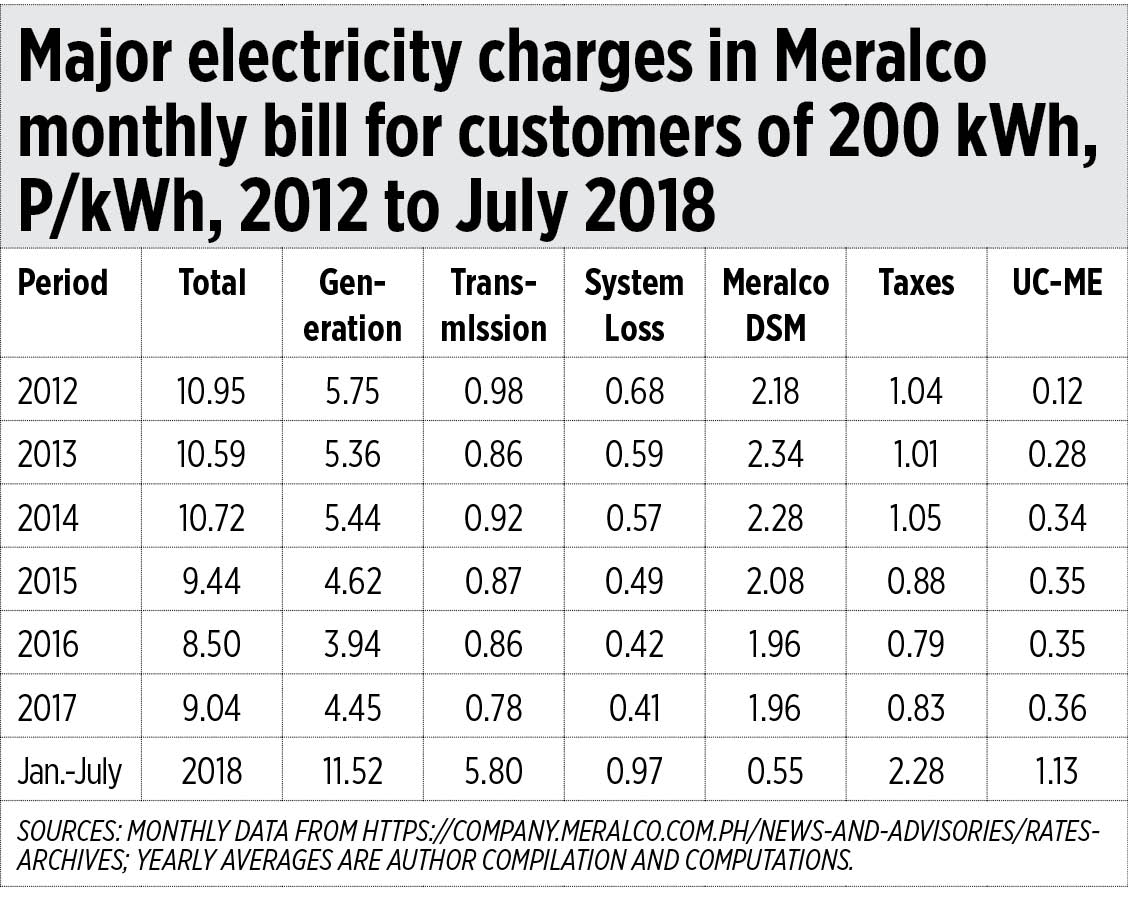
So there was no room for “overcharging” in the overall rates in the Meralco DSM. The “overcharging” by P100+ billion allegation is simply a warped, garbled and fictional narrative that is driven by politics and not by economics and actual numbers.

The Meralco competitive selection process should proceed.

2. DoE-USAID forum on “Advancing Energy Security through Championing Local Actions”

This was held on Nov. 17 at the Grand Hyatt Hotel in BGC, Taguig City. It is good that USAID is helping local government units innovate more on local energy efficiency and conservation plan and energy management. But there is one problem here — LGUs are encouraged to focus more on energy conservation and even consumption cuts, instead of expanding more power generation from more sources.

Big LGUs like the cities of Iloilo, Bacolod, Cebu and Davao should attract more big investments from both FDIs and local businesses. But if they see blackouts just around the corner due to insufficient power supply, or they must buy big generator sets and automatically raise their capex and opex and hence, the cost of business, very likely many potential investors will not come. LGUs will lose, not benefit, from this situation.

3. DoE-US cooperation on harnessing civilian nuclear power for sustainable development or “Agreement 123”

On Oct. 16, Energy Secretary Raphael Lotilla signed that bilateral agreement with the US during President Ferdinand R. Marcos, Jr.’s attendance at the APEC summit. The agreement covers not just nuclear power development but also nuclear technology application in plant breeding, livestock production, insect pest control, soil and crop management, food safety, health and medicine, and many more. Beautiful move, Secretary Lotilla.

4. Pandesal Forum on nuclear energy

On Nov. 24, I attended the Pandesal Forum on nuclear energy. The main speakers were Congressman Mark O. Cojuangco, chairman of the House special committee on nuclear energy, and Gayle Certeza, lead convenor of Alpas Pinas, a nuclear energy education and advocacy NGO. Wilson Flores was the moderator.

As background, see these recent reports in BusinessWorld: “Nuclear deal seen addressing PHL need for baseload power” (Nov. 19), “House approves bill creating nuclear regulator” (Nov. 22).

The proposed “Philippine National Nuclear Energy Safety Act” (House Bill 9293, passed on third reading) seeks to establish the Philippine Atomic Regulatory Authority, which will have “sole and exclusive jurisdiction to exercise regulatory control for the peaceful, safe and secure uses of nuclear energy and radiation sources.”

This is a beautiful bill and must become a law. It will complement DoE-US Agreement 123. I support the pivot to nuclear power development, whether large nuclear plants of 1,000 MW, or small modular reactors (SMR) of 20-40 MW, or micro modular reactors of 5 MW or less. Stable, reliable, running 24/7 at competitive prices. We need them, especially on off-grid islands. They should have SMRs so we can abolish the UC-ME someday, now at 22 centavos/kWh when it should be zero.


Bienvenido S. Oplas, Jr. is the president of Bienvenido S. Oplas, Jr. Research Consultancy Services, and Minimal Government Thinkers.

minimalgovernment@gmail.com