Home Blog Page 392

Spanish prosecutors drop abuse case against Julio Iglesias

MADRID — Prosecutors at Spain’s High Court have shelved a preliminary investigation into singer Julio Iglesias, saying on Friday that the court lacked jurisdiction as the alleged crimes were abroad and the accusers did not reside in the country.

Rights group Women’s Link Worldwide had filed the complaint on Jan. 5 on behalf of two women said to have worked in Mr. Iglesias’ Caribbean residences over a 10-month period in 2021, based on an investigation by US broadcaster Univision and Spanish outlet elDiario.es.

The accusations included human trafficking for forced labor and servitude, sexual assault and violations of workers’ rights. Mr. Iglesias described them as “completely false” in various social media posts.

Attempts by Reuters to contact representatives of Mr. Iglesias, 82, have gone unanswered. His record label Sony has declined to comment on the case.

The prosecutor’s office said in a filing seen by Reuters that the High Court was unable to try Mr. Iglesias as the alleged crimes were in the Dominican Republic and the Bahamas, adding that prosecution could still be sought in those two countries.

In addition, the alleged victims were not Spanish and did not reside in Spain, it said, citing Supreme Court jurisprudence that limited the legal principle of universal jurisdiction. — Reuters

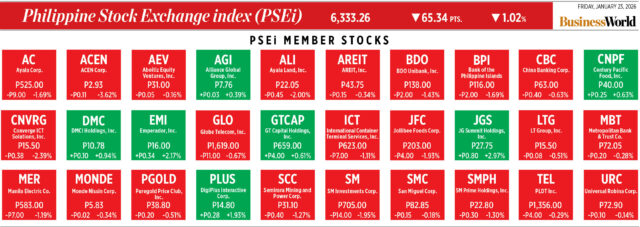
How PSEi member stocks performed — January 23, 2026

Here’s a quick glance at how PSEi stocks fared on Friday, January 23, 2026.


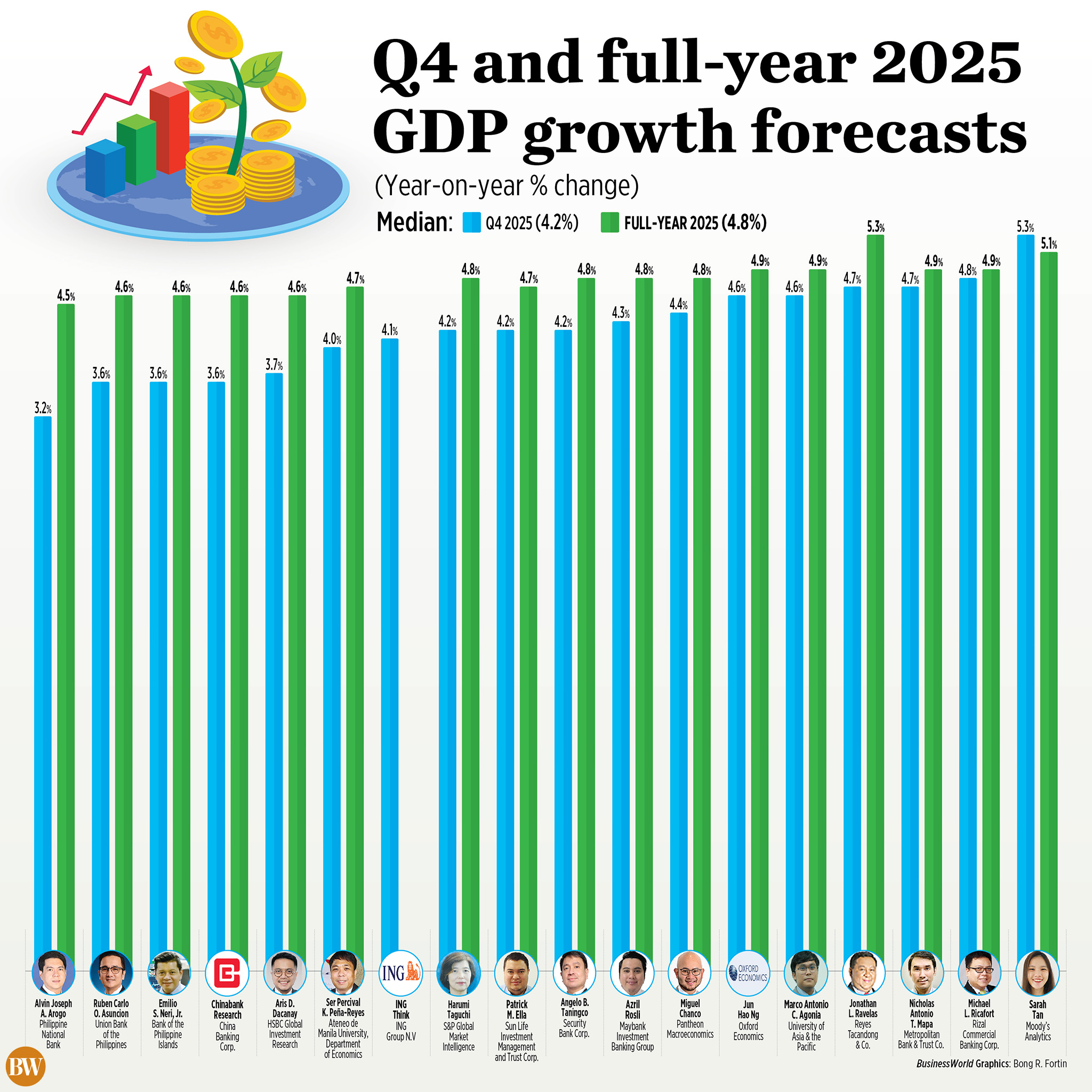
Q4 and full-year 2025 GDP growth forecasts

THE PHILIPPINE ECONOMY likely expanded at a slower pace in the fourth quarter of 2025, bringing full-year growth below the government’s target amid a corruption scandal, analysts said. Read the full story.


Stocks to move sideways as mart eyes GDP data

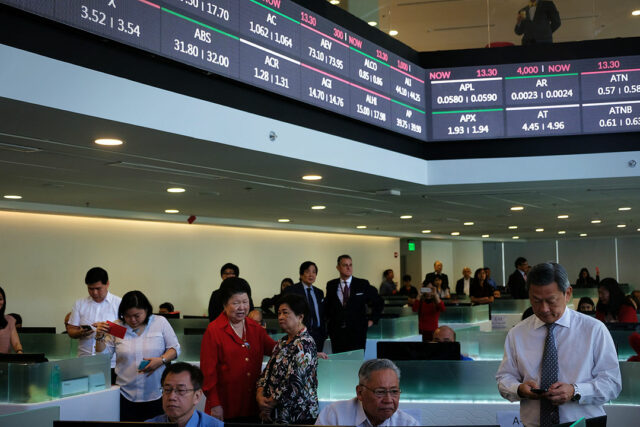
BW FILE PHOTO

PHILIPPINE STOCKS may move sideways this week as investors wait for the release of fourth-quarter and full-year 2025 gross domestic product (GDP) data.

On Friday, the Philippine Stock Exchange index (PSEi) fell by 1.02% or 65.34 points to end at 6,333.26, while the broader all shares index went down by 0.54% or 19.69 points to close at 3,599.31.

Week on week, the PSEi dropped by 131.41 points from its Jan. 16 finish of 6,464.67.

“The local bourse retreated, weighed in part by renewed geopolitical tensions between the US and European Union,” 2TradeAsia.com said in a market note.

“The local market snapped its four-week rally last week as offshore trade and geopolitical concerns weighed on investor sentiment. In the decline, the bourse gave up its position above the 6,400 level,” Japhet Louis O. Tantiangco, research manager at Philstocks Financial, Inc., said via Viber.

Markets hit a rocky patch last week due to the fallout from US President Donald J. Trump’s aggressive stance to acquire Greenland, which threatened a new trade war with Europe, Reuters reported. But major equity indexes rebounded later in the week after Mr. Trump backed off tariff threats, suggesting a deal was in sight for Greenland.

For this week, Mr. Tantiangco said the main trading driver will be the latest Philippine GDP data.

“Focus is expected to be on the Philippines’ fourth-quarter and full-year 2025 gross domestic product data as this would give clues on the local economy’s state and direction. A significant improvement from the third quarter’s 4% growth may spark positive sentiment, but a print slower may cause the market to decline further,” he said.

A BusinessWorld poll of 18 economists and analysts yielded a median estimate of 4.2% for fourth-quarter growth. If realized, this would put the full-year average at 4.8%, below the government’s 5.5%-6.5% target.

“Chart-wise, the local market is still considered to be on an uptrend. Its 50-day and 200-day exponential moving averages are about to form a golden cross, which is a bullish signal,” Mr. Tantiangco said.

“However, we’re also starting to see signs that the market’s momentum is waning… Its moving average convergence/divergence line has already crossed below the signal line, signaling bearish movements in the short run.”

He put the PSEi’s trading range for this week at 6,150 to 6,400.

For its part, 2TradeAsia.com placed the PSEi’s immediate support at 6,300 and resistance at 6,500.

“Domestic assets are navigating the second-degree effects of this global volatility, particularly through the lens of US dollar-Philippine peso fluctuations and redirected capital flows. As capital seeks alternatives, the Philippines stands as a potential beneficiary of ‘hot money’ flows within the region, though broad-based gains are likely to be capped by local inflationary concerns and geopolitical tensions.” — A.G.C. Magno

Construction of Taguig terminal set to start Q2

BW FILE PHOTO

THE Department of Transportation (DoTr) said construction of the Taguig City Integrated Terminal Exchange (TCITx) is set to begin in the second quarter with the concession holder being pressed to make progress on completing the design.

“Based on our schedule, it should be in the second quarter this year. We need to push our concessionaire to fast-track the design so we can begin construction on time,” Undersecretary for Road Transport and Infrastructure Mark Steven C. Pastor told reporters recently. 

The TCITx project was awarded to Ayala Land, Inc. (ALI) and is expected to be fully operational by the first quarter of 2028. Located at ALI’s Arca South mixed-use development, TCITx will rise over 5.57 hectares and handle up to 160,000 passengers and 5,200 vehicles daily.

“This year, we will start the civil works. It actually took a while because we had to wait for the reconfigured alignment of SEMME (Southeast Metro Manila Expressway),” he said, noting that the project is now at the pre-construction phase.

According to the Public-Private Partnership (PPP) Center, TCITx is estimated to cost around P5.20 billion. The project will link with the North-South Commuter Railway (NSCR) and the Metro Manila Subway Project. It will also have connections to provincial and city buses, as well as other public utility vehicles.

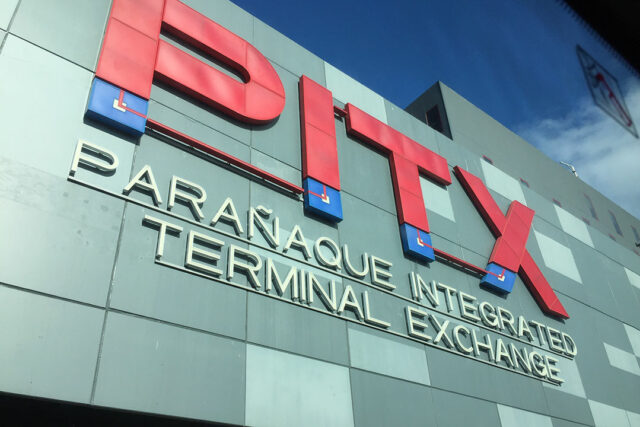
TCITx is expected to benefit commuters from Metro Manila, Laguna, Cavite, and Batangas. It is designed to function similarly to the Parañaque Integrated Terminal Exchange.

The DoTr said that the plan to build a Northern ITX is still in the feasibility study stage.

“We are currently looking for candidate sites,” Mr. Pastor said, including locations in Quezon City, Valenzuela, and Caloocan.

“Similar to PITX, that is the intention (to connect to an existing or future railway). We have the NSCR in Valenzuela, (so) we are looking at that area, if there is a viable parcel of land where we can construct an ITX,” he said.

He added that the DoTr is also considering the possibility of tapping a private partner to construct the project. — Ashley Erika O. Jose

2026 farm output seen driven by further swine, poultry recovery

STOCK PHOTO | Image by Barbara Barbosa from Pexels

THE Department of Agriculture (DA) said growth in agricultural production will be led by a continuing recovery in the hog and poultry industries, adding to expected record production for the staple crop, rice.

Agriculture Assistant Secretary Arnel V. de Mesa said palay (unmilled rice) production is expected to hit 20.3 million metric tons (MMT) in 2026, according to projections issued by the National Rice Program. The record was set in 2023 at 20.06 MMT.

“In 2026, we are expecting palay production to be better. We are expecting the production to be bigger than in previous years. The same goes for corn,” he said at a briefing.

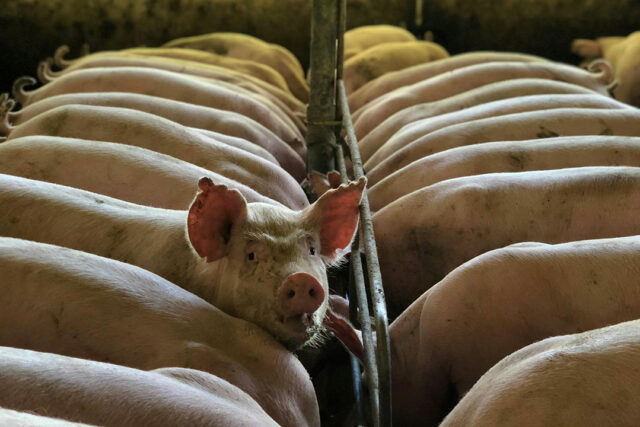
The DA also expects further recovery in the livestock sector, particularly in the swine industry, while poultry production is projected to continue leading the sector’s growth.

Mr. De Mesa said the DA is still working on final projections and the overall target for agricultural output in 2026.

He added that the DA also estimates output to have improved in 2025. “For the fourth quarter of 2025, the output was good. Hopefully, the full-year output for 2025 will be higher,” Mr. De Mesa said.

Analysts have projected modest growth in agricultural output in 2025, as gains in poultry and crop production likely offset weaker performance in livestock and fisheries.

Former Agriculture Secretary William D. Dar has told BusinessWorld that he estimates farm output to have expanded by about 2% last year, reversing the 2.2% contraction recorded in 2024. — Vonn Andrei E. Villamiel

PEZA planning seamless process for export, investor-visa documentation

THE Philippine Economic Zone Authority (PEZA) said it will streamline documentation requirements further in the first half of the year, with plans to integrate its permit processes with those of the bureaus of Customs (BoC) and Immigration (BI).

PEZA Director General Tereso O. Panga added that the recent reforms announced by the government will help boost the competitiveness of the Philippines as an investment destination in the region.

“For PEZA, these reforms are treated as operational imperatives. In fact, we go beyond our integrity pledge by embedding PEZA’s integrity framework in our operating systems,” he said in a social media post.

“In support of these big bold reforms, PEZA will formally roll out this month our export documentation under the permit management system (PMS) module of the PEZA One Portal System,” he added.

In the first half, Mr. Panga expects the module to also include its ecozone transfer system to be bundled with the e-LoA (letter of authority).

“(This will) make our electronic permitting and monitoring systems seamless with the Bureau of Customs,” he added.

In the first quarter, PEZA is also set to launch the PEZA Visa Online System with the Bureau of Immigration.

“(This will) make the issuance of PEZA visas for foreign nationals and their dependents faster, more predictable, and investor-friendly,” he added.

The agency will also be working with the Bureau of Internal Revenue (BIR) for the establishment of a dedicated registered business enterprise taxpayer service.

PEZA will also be working with the Board of Investments (BoI) for the implementation of the Comprehensive Automotive Resurgence Strategy (CARS) and the Revitalizing the Automotive Industry for Competitiveness Enhancement (RACE) programs.

“Big reforms matter, and PEZA is ready to execute and partner with other government agencies to create synergies that ensure outcomes that create a better ecosystem for domestic and international investors within and outside of the ecozones,” he said.

He said that if the Philippines maintains its status as one of the fastest-growing economies in the Association of Southeast Asian Nations (ASEAN), the country “can aspire to be number 2 or 3 in ASEAN in terms of foreign direct investment, exports, and real gross domestic product. — Justine Irish D. Tabile

DBM’s Toledo sees 2026 growth at ‘midpoint’ of 5-6% target

ROLANDO U. TOLEDO — DBM.GOV.PH

GROWTH in 2026 is expected to come in at “the midpoint” of the government’s 5-6% official target band, the Department of Budget and Management (DBM) said.

The government is projecting the gross domestic product (GDP) growth to “settle around the midpoint of the target range,” Acting Budget Secretary Rolando U. Toledo said in a statement on Jan. 23, when asked if it the upper end of band is achievable.

Mr. Toledo, who chairs the Development Budget Coordination Committee, said while growth expectations for 2026 have been moderated, “the economic managers view this period as an opportunity to recalibrate policy priorities.”

In particular, he referred to strengthening the formulation and updating of integrated sectoral master plans, particularly in infrastructure.

“This is intended to improve the quality, sequencing, and fiscal discipline of public spending,” Mr. Toledo said.

Economy Secretary Arsenio M. Balisacan said economic growth may have slowed to between 4.8% and 5% in 2025, prompting the scaling back of growth targets. The economy had slowed in the wake of the infrastructure corruption scandal, which triggered a review of many public-works projects.

The Philippine Statistics Authority will release fourth-quarter and 2025 GDP data on Jan. 29.

Mr. Toledo said the government is continuing to bolster oversight and monitoring mechanisms, including expanded use of real-time project tracking and automated geo-tagging of infrastructure projects.

“The FY 2026 budget reflects the need to balance development priorities with fiscal constraints, resulting in difficult trade-offs during budget preparation,” he said.

The ASEAN+3 Macroeconomic Research Office (AMRO) projected that higher tariffs may threaten the Philippines’ private investment outlook.

“Private investment sentiment and exports are clouded by US tariff uncertainty, and public investment may continue to be dampened by flood control controversies,” AMRO Chief Economist Dong He said in an e-mailed statement to BusinessWorld last week.

Meanwhile, domestic demand is expected to slow in the first half of the year, but should recover by the second.

Despite this, Mr. He sees no pose persistent risks to the economic outlook of 5.3% growth in 2026. — Aubrey Rose A. Inosante

Cement industry to complete decarbonization plan soon

PHILSTAR FILE PHOTO

THE Cement Manufacturers Association of the Philippines, Inc. (CeMAP) said it is looking to present a decarbonization roadmap for the industry to the Association of Southeast Asian Nations (ASEAN), which the Philippines chairs this year.

CeMAP President and Vice Chairman John Reinier H. Dizon said the group is working with the United Nations Industrial Development Organization in preparing a roadmap that will help reduce the industry’s carbon emissions.

“It is almost done … We will finish it next month, before the end of February,” he told reporters last week.

“We will try to present it at the ASEAN … We will be the second in the region,” he added, noting that the first such plan was completed by Thailand.

Under the roadmap, the Philippine cement industry will set a target every five years between 2030 and 2050, with net-zero as the ultimate goal.

“Cement and concrete in general contribute to around 6-7% of greenhouse gas, but we need cement to build houses and roads, so we are just doing our part on how we can reduce our carbon footprint,” he said.

The group aims to achieve the plan’s targets via the increased usage of alternative fuels, among others.

“Typically we use coal, which is fossil-based. And of course, it emits carbon dioxide,” he said.

He added that the process of cooking the limestone used for cement, also produces carbon dioxide.

“We have two main actions: we want to introduce more alternative fuels, and in the production of cement, we want to use less clinker,” he said.

In particular, he said that the industry is looking at waste-to-energy as an alternative, noting its role in reducing waste.

He said that the roadmap is also aligned with recently signed laws: the New Government Procurement Reform Act and the Tatak Pinoy Act. — Justine Irish D. Tabile

PHL gains from ASEAN integration seen uneven due to gaps in competitiveness

PHILIPPINE gains from deeper integration with the Association of Southeast Asian Nations (ASEAN) are expected to be even due to issues related to competitiveness and digital readiness, a government think tank said.

In a report, the Philippine Institute for Development Studies (PIDS) added that the Philippines risks falling behind in reaping the benefits from its regional commitments.

“The progress toward ASEAN Economic Community (AEC) integration reveals a mixed landscape for the Philippines,” PIDS said in a report issued on Jan. 22.

This year, the Philippines is preparing to take the chairmanship of ASEAN.

“Notable gains have been made in trade openness, macroeconomic stability, and human development. However, significant challenges persist in sectoral productivity, climate resilience, and governance,” it added.

PIDS estimated that roughly 46% of the targets outlined in the Philippine Development Plan (PDP) 2023-2028 are unlikely to be achieved, based on indicators from the AEC (ASEAN Economic Community) Blueprint 2025.

This shortfall may be notable on sectors such as agriculture, infrastructure, peace and security, and social protection, “described as critical to regional and global competitiveness.”

“While the PDP is broadly aligned with AEC pillars, gaps remain in translating alignment into results,” it said.

It also noted that the country reduced import tariffs from ASEAN Free Trade Agreement partners to 1.05% in 2022, yet extra-ASEAN trade relative to GDP remains low.

Last year, the ASEAN-China Free Trade Area was signed to bring the region’s economic ties with China more in line with other global arrangement.

“The study notes that ASEAN’s deep trade and investment ties with China — while economically beneficial — also expose the region to spillover risks from geopolitical tensions,” it said.

Instead, it pushed for diversification and regional frameworks such as the Regional Comprehensive Economic Partnership to sustain investor confidence.

“There is no clear ownership or champion for ‘A Global ASEAN’ — a missed opportunity to frame global competitiveness, diplomacy, and sustainability under one coherent agenda,” the authors said.

Meanwhile, the think tank cautioned that a “business-as-usual” stance could erode the Philippines’ capacity to fulfill ASEAN commitments.

In response, PIDS recommended deepening intra-ASEAN economic integration by lowering trade costs, boosting micro, small and medium enterprise participation in regional value chains, reassessing non-tariff measures, and establishing targeted investment corridors.

It also called for faster digital adoption through stronger regulation, wider rural connectivity, digital skills training, and improved government system interoperability.

The discussion paper, “ASEAN Economic Community through the Years: Benchmarking, Emerging Trends, and Future Pathways,” was written by Francis Mark A. Quimba, Mark Anthony A. Barral, and Alliah Mae C. Salazar.  Aubrey Rose A. Inosante

Harnessing responsible AI for organizational resilience

IN BRIEF:

• Responsible AI enables organizations to anticipate and manage complex, interconnected risks by shifting from reactive compliance to predictive, data-driven decision-making.

• Integrating governance, risk, and compliance teams early in AI initiatives ensures transparency, ethical use, and alignment with organizational risk appetite.

• When adopted strategically with clear frameworks and leadership buy-in, AI strengthens organizational resilience, trust, and long-term value creation.

Artificial intelligence (AI) is a powerful accelerator that many industries recognize for its ability to predict, analyze, and detect anomalies. In risk and compliance, it uses data to identify patterns and anticipate issues before they happen. As organizations increasingly integrate AI into their operations, the concept of responsible AI has emerged as a crucial framework.

In November, board members, senior executives, chief audit executives, compliance officers, chief risk officers, and advisers gathered at the SGV Knowledge Institute and SGV Consulting forum titled, “Navigating Enterprise Resilience through the Synergy of Governance, Risk, and Compliance.”

In the first session, the nature of risk today was best described as NAVI: nonlinear, accelerated, volatile and interconnected. A single disruption can rapidly propagate across functions, geographies and stakeholders. Traditional compliance risks are now part of a broader spectrum that includes operational, strategic, and reputational risks. A single incident, such as a data breach, can trigger a cascade of operational and regulatory challenges, ultimately impacting stakeholder trust and organizational value.

The second panel discussion, titled “Leveraging Responsible AI in Risk, Compliance, and Internal Audit,” centered on how organizations can effectively harness AI to enhance their governance, risk, and compliance (GRC) frameworks and drive strategic value without compromising trust.

EMERGING AI TRENDS IN RISK AND COMPLIANCE
AI in the context of risk and compliance is not confined to automation; it also enables smarter decisions, using data to identify patterns, predict outcomes, and optimize processes. This means anticipating issues before they happen, rather than reacting after the fact.

Explainable AI, defined as a set of processes and methods used to describe an AI model, its expected impact, and potential biases, allows boards and regulators to determine the reasons behind decisions made by machine learning (ML) algorithms. It is no longer enough for a model to simply provide answers, and explainable AI lets human users comprehend and trust those answers. On the other hand, generative AI, which creates content by learning patterns from massive datasets, is starting to reshape internal audit by summarizing findings, drafting reports, and simulating risk scenarios. Similarly, predictive AI, which uses statistical analysis and ML to identify patterns, anticipate behaviors, and forecast upcoming events, are moving organizations from static risk registers to dynamic, real-time risk monitoring.

These advancements come with responsibilities, and data quality, governance, and ethical use are all non-negotiable. As a framework, responsible AI provides guardrails in the form of clear policies, transparency, and accountability, ensuring that innovation does not compromise trust.

For AI to guide organizations effectively, Chee Kong Wong, APAC Risk Leader and GRC Technology Leader of EY Oceania, said companies need a holistic framework. “Set a clear vision for AI, understand its use cases, establish governance models, integrate risk frameworks, define policies and controls, and ensure continuous monitoring.”

Michelle Alarcon, President and Co-Founder of the Analytics and AI Association of the Philippines, emphasized that GRC teams should be involved from the ideation stage, not after prototypes are built, to avoid risks such as exposing confidential data. “Early collaboration helps identify potential risks upfront, making Responsible AI part of the development process.”

AI IN ACTION
The panelists also gave practical examples of AI in action. Alarcon noted that while GRC teams may not initiate AI use cases, they should adopt a data-driven approach. As an example, credit risk scoring exemplifies how GRC can intersect with AI.

Jose Roy Hipolito, Risk and Compliance Head of MediCard Philippines, Inc., said that MediCard uses AI to analyze biomarkers and predict anomalies or elevated health risks for more efficient and effective customer health management. “Previously, this was manual across multiple providers; now AI captures, synthesizes, and analyzes data, improving efficiency and accuracy,” he said.

In addition, the discussion underscored the shift from reactive to predictive AI in risk management. Organizations usually begin with reactive AI, responding to issues as they arise, but predictive AI presents an advantage through a preventative approach. Wong said proactive risk management can turn potential threats into opportunities, explaining that “predictive AI enables organizations to scan millions of data points for early warning signals, allowing proactive action before issues escalate.”

Organizations that manage to fully and effectively integrate AI into their operations will be faster to adapt, harder to disrupt, and more resilient in the face of uncertainty. However, early adopters in particular face challenges that lead to limited use cases for AI.

According to Alarcon, “Early adoption often stems from the fear of missing out, leading to superficial use cases like writing better e-mails. The real challenge isn’t skills — it’s leveraging AI’s full potential.” She further added that organizations will have to move beyond experimentation and focus on strategic applications that deliver exponential value.

NAVIGATING AI ADOPTION RESPONSIBLY AND EFFECTIVELY
As organizations navigate the complexities of AI adoption, it is crucial for leadership to recognize that using AI responsibly strengthens resilience while supporting long-term objectives. Hipolito further stated, “The success of AI adoption depends on user mindset and alignment with the organization’s risk appetite. Risk practitioners should emphasize that AI is not just a tool — it’s a strategic enabler.”

According to Alarcon, AI must be recognized as a structural change in operations. “Boards should plan for governance, training, and ethical frameworks to manage this new dynamic.”

Transparent communication regarding the associated risks, benefits, and governance structures is vital for securing leadership buy-in and ensuring responsible scaling. “The message to boards should be clear: AI adoption is not optional for competitive resilience,” Wong said.

Responsible AI shouldn’t be considered a brake. It helps organizations accelerate safely, allowing innovation with guardrails, strategy with ethics, and speed with trust. By fostering collaboration, embracing predictive capabilities, and leveraging available tools and frameworks, organizations can navigate the complexities of AI adoption responsibly and effectively.

This article is for general information only and is not a substitute for professional advice where the facts and circumstances warrant. The views and opinions expressed above are those of the authors and do not necessarily represent the views of SGV & Co.


Lee Carlo B. Abadia and Carlo Kristle G. Dimarucut are technology consulting principals of SGV & Co.


Political noise clouds investor outlook as Marcos faces impeachment bids

PHILIPPINE STAR/RYAN BALDEMOR

By Chloe Mari A. Hufana, Reporter

FOREIGN AND DOMESTIC investors remain wary of impeachment proceedings, which economists said could heighten policy uncertainty and governance risks, as the Philippines’ two highest officials face ouster complaints that may weigh on market sentiment.

“Impeachment proceedings can weigh on confidence in policymaking by distracting attention from execution and reinforcing perceptions of institutional fragility, making stability, transparency and clear economic direction even more critical,” John Paolo R. Rivera, a senior research fellow at the Philippine Institute for Development Studies, told BusinessWorld in a Viber message.

He noted that credibility shocks often lead companies to delay investment, raise risk premium and soften capital inflows even when fundamentals remain stable.

The Philippine economy grew 4% in the third quarter of 2025, the slowest in more than four years, which Economic Secretary Arsenio M. Balisacan partly attributed to lower infrastructure spending amid the flood control controversy. The country’s full-year gross domestic product report will be released on Jan. 29.

President Ferdinand R. Marcos, Jr. is facing three ouster bids after he was accused of benefiting from the infrastructure projects, though the last two cases were declined by the House of Representatives last week in the absence of its secretary-general.

Vice-President Sara Duterte-Carpio may face renewed calls for impeachment on Feb. 6, when the one-year bar rule lapses. An impeachment complaint filed against her in 2025 alleged betrayal of public trust and corruption.

Michael L. Ricafort, chief economist at Rizal Commercial Banking Corp., said the recent political noise could derail priority reforms meant to strengthen governance and fiscal management.

“Any resulting political uncertainty could weigh on investor sentiment, prompting a cautious, wait-and-see stance that could slow economic growth,” he said via Facebook Messenger.

“Until the dust settles, political stability remains one of the key considerations for investors to ensure policy predictability, which is critical to their ability to make money in the country — the main motivation to invest,” he added.

The Presidential Palace last week warned that impeachment complaints against the President could hurt economic confidence and damage the country’s image overseas, potentially weighing on investment sentiment and foreign relations.

Palace Press Officer Clarissa A. Castro said such proceedings are viewed negatively by some economists since they signal dissatisfaction with government performance.

The Philippines is grappling with a high-profile flood control controversy involving mismanagement and overpricing in multibillion-peso projects intended to curb seasonal flooding.

Investigations have pointed to possible kickbacks and irregular contracts linking private contractors to government officials, with Mr. Marcos also implicated.

The controversy has turned into a political flashpoint, driving calls for accountability and underpinning impeachment complaints against the President. On Thursday, about 30 activists led by Bagong Alyansang Makabayan tried to file a complaint alleging betrayal of public trust tied to the scandal.

A separate self-described nonpartisan group also sought to lodge its own complaint, but both attempts were rejected on procedural grounds.

Efforts to impeach Mr. Marcos gained momentum after an earlier complaint accused him of benefiting from irregular contracts. That filing is expected to be taken up by the House justice committee once Congress reconvenes.

Complainants have described the alleged infrastructure graft as “systematic” and “brazen,” accusing the President of being the “ultimate recipient and beneficiary” of kickbacks.

Support from minority party-list lawmakers strengthened the leftist complaint, though constitutional limits allow only one impeachment proceeding against the same official within a calendar year, raising questions over the viability of subsequent filings.

Ms. Castro earlier said the President denied any impeachable wrongdoing and challenged the allegations as unsubstantiated.

Under the Constitution, any Filipino may file an impeachment complaint, but it must be endorsed by at least one-third of all congressmen before it can be sent to the Senate, which sits as an impeachment court.