Home Blog Page 3869

Philippines posts ‘walking pneumonia’ case

BW FILE PHOTO

The Philippines has recorded four cases of mycoplasma pneumoniae, which has overwhelmed children’s hospitals in China, according to the Department of Health (DoH).

The four cases of the disease known as “walking pneumonia” were found among people with influenza-like illness as of Nov. 25, it said in a statement.  One case was recorded in January, one in July and two in September.

On Tuesday, Health Secretary Teodoro J. Herbosa said that there was no outbreak of walking pneumonia in the Philippines amid rising respiratory illness cases in China and other countries.

DoH said mycoplasma pneumoniae is not a new pathogen and had been detected in the country.

Health Undersecretary Eric Tayag earlier said there have been no recorded walking pneumonia cases in the country because there is no routine testing for the disease. He said the bacteria is 90% to 95% drug-resistant in China.

The disease is a common bacterial infection that usually affects younger children and is treated by antibiotics, according to the World Health Organization (WHO). — Kyle Aristophere T. Atienza

Defense program bill passed

PHILIPPINE STAR/EDD GUMBAN

Philippine senators on Wednesday approved on second reading a bill that seeks to revitalize the country’s defense program and encourage businesses to invest in local defense equipment.

Senate Bill 2455 will task the Department of National Defense to craft a self-reliant defense posture program that will encourage manufacturers to produce defense and weapon systems in the Philippines and promote their exports to other countries.

Under the measure the Defense department will be allotted P1 billion as seed money to finance the program.

“It is imperative to revitalize the country’s self-reliance defense posture program and to fully harness the potential of the defense industry at a time when security threats are imminent and continue to evolve,” according to a copy of the bill. — John Victor D. Ordonez

Shares go down on profit taking, lack of drivers

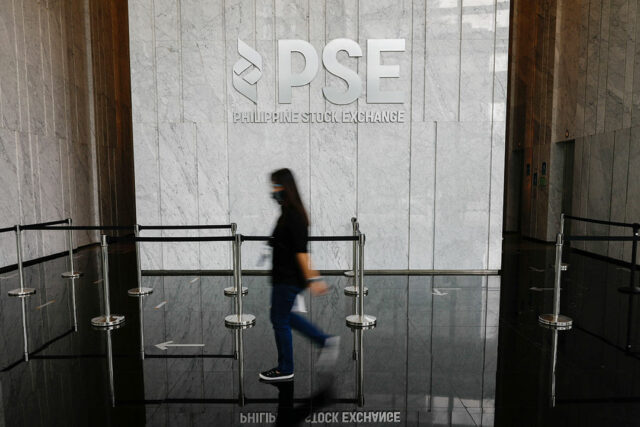
The lobby of the Philippine Stock Exchange in Taguig City, Sept. 30, 2020. — REUTERS

PHILIPPINE SHARES closed lower on Wednesday as investors pocketed their profits after the market’s three-day rally amid a lack of fresh leads and as the country’s outstanding debt reached another record high.

The bellwether Philippine Stock Exchange index (PSEi) dropped by 3.10 points or 0.04% to finish at 6,305.85 on Wednesday, while the broader all shares index inched down by 0.36 point or 0.01% to close at 3,351.66.

“The local bourse declined by 3.10 points to 6,305.85 as investors booked some gains after the three consecutive days of market rally. In addition, the national government’s outstanding debt, which reached a record of P14.48 trillion as of end-October, somehow weighed on sentiment,” Philstocks Financial, Inc. Research Analyst Claire T. Alviar said in a Viber message.

The National Government’s outstanding debt went up by 1.49% from P14.27 trillion as of end-September, data from the Bureau of the Treasury showed.

Year on year, the debt stock rose by 6.16% from P13.64 trillion. It also increased by 7.91% from P13.42 trillion at the end of December 2022.

“Philippine shares closed almost flat, with investors trying to get more cues from overseas that the world’s largest economy is still on an uninterrupted path to recovery,” Regina Capital Development Corp. Head of Sales Luis A. Limlingan said in a Viber message.

“Despite the losses in the US [overnight], the past five weeks of consecutive gains means that all three stock indexes are still on track to end the quarter and year with big gains,” he added.

Wall Street finished mixed on Tuesday after fresh employment data bolstered bets that the US Federal Reserve will cut interest rates as soon as March, Reuters reported.

The S&P 500 declined 0.06% to end the session at 4,567.18 points.

The Nasdaq gained 0.31% to 14,229.91 points, while Dow Jones Industrial Average declined 0.22% to 36,124.56 points.

“The stock market is down as 6,300 is proving to be a tough resistance. The market awaits more catalyst for 6,399 to become new support,” First Metro Investment Corp. Head of Research Cristina S. Ulang said in a Viber message.

The majority of sectoral indices closed lower on Wednesday. Financials declined by 15.63 points or 0.89% to 1,732.20; mining and oil retreated by 64.22 points or 0.65% to 9,688.55; industrials went down by 25.22 points or 0.28% to 8,803.83; and property dropped by 7.66 points or 0.27% to 2,758.22.

Meanwhile, services climbed by 14.38 points or 0.92% to 1,562.69, and holding firms rose by 17.33 points or 0.29% to 5,977.67. 

Value turnover rose to P5.67 billion on Wednesday with 345.22 million issues changing hands from the P4.01 billion with 622.4 million issues seen on Tuesday.

Decliners outnumbered advancers, 92 versus 79, while 50 names closed unchanged.

Net foreign buying stood at P378.57 million on Wednesday versus the P182.43 million in net selling logged on Tuesday. — R.M.D. Ochave with Reuters

Peso strengthens further vs dollar

BW FILE PHOTO

THE PESO hit a new four-month high against the dollar on Wednesday after inflation eased to a 20-month low in November and amid weakening global prospects as China’s credit rating outlook was downgraded.

The local unit closed at P55.305 per dollar on Wednesday, strengthening by 1.5 centavos from its P55.32 finish on Tuesday, based on Bankers Association of the Philippines data.

This was the peso’s strongest close since its P55.19 per dollar finish on Aug. 2.

The peso opened Wednesday’s session stronger at P55.30 against the dollar. Its intraday best was at P55.295, while its weakest showing was at P55.36 versus the greenback.

Dollars exchanged went down to $1.03 billion on Wednesday from $1.35 billion on Tuesday.

The peso continued to be supported by easing inflation, as well as lower global crude oil prices, Rizal Commercial Banking Corp. Chief Economist Michael L. Ricafort said in a Viber message.

Headline inflation slowed to 4.1% in November from 4.9% in October and 8% in the same period last year. This was within the Bangko Sentral ng Pilipinas’ (BSP) 4-4.8% forecast and below the median estimate of 4.4% by 15 economists in a BusinessWorld poll conducted last week.

Year to date, inflation averaged 6.2%, faster than 5.6% in the same period last year.

The peso was also supported by weakening global sentiment after China’s credit outlook was downgraded by Moody’s Investors Service and softer US job openings data, a trader said in an e-mail.

The dollar was near a two-week high against a basket of currencies on Wednesday as investors assessed US economic data that showed a cooling labor market, while wagering the Federal Reserve will cut rates next year, Reuters reported.

The spotlight in Asia was on China, where the yuan extended losses as markets grappled with rating agency Moody’s cut to the Asian giant’s credit outlook.

The dollar index, which measures the US currency against six rivals, was 0.029% lower at 103.93, having climbed 0.3% overnight. The index is up 0.5% this month, after sliding 3% in November, its steepest monthly decline in a year.

Data on Tuesday showed US job openings fell to more than a 2-1/2-year low in October, the strongest sign yet that higher interest rates were dampening demand for workers. Data also showed there were 1.34 vacancies for every unemployed person in October, the lowest since August 2021.

For Thursday, the trader sees the peso moving between P55.20 and P55.45 per dollar, while Mr. Ricafort expects it to range from P55.20 to P55.45. — AMCS with Reuters

Senate OKs bill vs agri smugglers

The Philippine Senate on Wednesday approved on second reading a priority bill that seeks to impose harsher penalties on smugglers of agricultural products.

Senate Bill 2432 will lower the value of smuggled agriculture and fishery products to P1 million from P10 million for the act to be considered economic sabotage.

Violators face life imprisonment and a fine worth thrice the value of agricultural and fishery products that they smuggled.

Senator Cynthia A. Villar, the bill’s author and sponsor, earlier said the government has been losing at least P200 billion in revenue each year to smuggling. — John Victor D. Ordonez

Rightsizing bill filed at Senate 

A BILL that seeks to streamline the government bureaucracy by getting rid of obsolete positions to improve the delivery of state services has been filed at the Senate.

“This measure aims to implement a systemic reform to promote and maintain an effective, efficient, economical, responsive and progressive Philippine government,” Senator Joel J. Villanueva, who filed Senate Bill 2502 on Dec. 5, said in the measure’s explanatory note.

Under the bill, Congress, the Judiciary, constitutional commissions, the Ombusdman and local governments may restructure their offices.

Affected state workers with five to 11 years of service would be entitled to half their monthly salary for every year of service.

Those with 31 years of employment will be entitled to one and a quarter months’ salary for every year of service.

The President may streamline and scale down redundant functions that could be handled by local governments.

A committee will also be formed to oversee the rightsizing of the Executive branch, which will be headed by the executive secretary and co-headed by the Budget chief.

Government employees excluded from the rightsizing program are teachers, military and police. — John Victor D. Ordonez

Bus owner in crash to cooperate with probe

THE OPERATOR of a passenger bus that fell off a ravine in Hamtic, Antique province on Tuesday that killed several people said it would cooperate with a government investigation.

Vallacar Transit, Inc., which operates Ceres Bus Liner, in a statement on Wednesday said it has reported the incident to the Land Transportation and Franchising Regulatory Board.

The passenger bus fell off a ravine while on its way to Culasi, Antique from Iloilo. The bus driver, conductor and inspector were among those who died.

Broderick Train, chief of the provincial disaster agency, told a news briefing at least 17 people died.

Vallacar Transit, Inc. said it had suspended all 12 remaining units under the franchise of the bus involved in the accident. — Jomel R. Paguian

Free college entrance exam bill OK’d

PHILSTAR FILE PHOTO

THE SENATE on Wednesday approved on second reading a bill that seeks to waive entrance examination fees for poor graduates or graduating students in private colleges.

Under Senate Bill 2441, students may avail themselves of the exemption if they belong to the top 10% of their graduating class and if their combined household income is below the poverty threshold defined by the National Economic and Development Authority.

The measure also mandates the Commission on Higher Education to sanction officials and employees of private higher education institutions that refuse to comply with the waiver.    John Victor D. Ordoñez

Amending 1931 radio law seen as key to improving connectivity

BW FILE PHOTO

NATIONAL ECONOMIC and Development Authority (NEDA) Secretary Arsenio M. Balisacan said he will push to amend the law regulating radio communications (Act No. 3846) to help improve digital connectivity.

On the sidelines of a forum hosted by NEDA and the US Agency for International Development (USAID) on Wednesday, Mr. Balisacan told reporters that amending outdated laws on connectivity should be a priority.

“I want to get more data so that we can present to the Cabinet, to the President, to the LEDAC (Legislative Executive Development Advisory Council), the urgency of doing this,” he said.  

Act No. 3846 has been in place for 92 years. It created the Radio Control Division at the Bureau of Posts, under the general supervision of the Secretary of Commerce and Communications.

During the forum, Scott Minehane, a consultant to USAID’s Better Access and Connectivity (BEACON) project, cited the need to reform radio spectrum management.

Spectrum management is based on the 1931 law, as well as the Public Telecommunications Policy Act of 1995, when wireless technology was mainly used for radio broadcasts.

“These laws limit the use of spectrum to enfranchised entities, which require entrants, even those that use new types of internet technology, to make investments in a traditional network,” Mr. Minehane said.

“The outdated provisions contained in those laws continue to limit the country’s ability to maximize the benefits and uses of new wireless technologies such as 5G and future 6G (in 2030) as well as to free up or reallocate idle or new spectrum,” he said.

The digital economy accounted for 9.4% or P2.08 trillion of gross domestic product in 2022, up from P1.87 trillion in 2021, according to the Philippine Statistics Authority.

“By sticking to an administrative approach in assigning spectrum, the government continues to miss out on the opportunity to generate substantial revenue from having a more competitive assignment process,” Mr. Minehane said.

He said adopting best-practice spectrum management — which adheres to the principles of efficiency, transparency, and non-discrimination — would bring significant benefits to the economy.

Mr. Minehane added spectrum is considered a limited public resource that must be managed efficiently to boost digital and economic transformation.

Several bills on spectrum management have been filed in Congress but these have all failed to gain traction. — Keisha B. Ta-asan

DoE calls for accelerated retirement, repurposing of coal-fired power plants

PIXABAY

THE Department of Energy (DoE) has called for the early retirement or repurposing of coal-fired power plants to help it meet the goal of raising the share of renewables in the power generation mix.

“The government is encouraging a voluntary early and orderly decommissioning or repurposing of existing coal-fired power plants, while securing a stable supply and addressing the climate emergency by ramping up our renewable energy (RE) target of 50% share by 2040,” the DoE said in a statement late Tuesday.

Decisions by the private sector to retire coal-fired plants and transition to RE “are purely market-driven and based on economics of which projects provide the most return to investors,” it said.

Support for a coal phasedown is gaining momentum after ACEN Corp., the listed energy arm of the Ayala Group, pioneered the voluntary retirement of its 246-megawatt (MW) South Luzon Thermal Coal-Fired Power Plant.

“This is consistent with our view that it must be voluntary and must make business sense in a power sector like the Philippines that is privately owned, market driven and unsubsidized,” the DoE said.

“ACEN has our full support for this initiative, and we will explore ways to facilitate this program through access to climate financing,” it added.

In 2020, the government issued a moratorium on greenfield coal-fired plants, signaling a shift to a more flexible power mix.

The DoE puts the number of coal-fired plants connected to the grid at 62 as of August, with total installed capacity of 12,472.6 MW.

Some 29 coal-fired plants are in Luzon with a combined installed capacity of 8,792.1 MW. The Visayas hosts 14 with capacity of 1,412.5 MW, while Mindanao has 19 coal-fired plants with capacity of 2,268 MW.

RE accounted for about 22% of the Philippines’ energy mix, with coal-fired power plants providing nearly 60% as of the end of 2022.

The government hopes to increase RE share to 35% by 2030 and 50% by 2040.

Michael L. Ricafort, chief economist of Rizal Commercial Banking Corp., said that the call for accelerated retirement is “a delicate balancing act” for the Philippines, with power an important consideration for foreign investors and locators.

“This is consistent with the global trend of increased compliance with ESG (environmental, social, and corporate governance) standards as encouraged by regulators even before the pandemic,” he said in a Viber message.

The DoE also encouraged efforts to incentivize business owners and institutions that will participate in similar undertakings and work towards energy transition.

“But we must also emphasize that our energy transition is beyond coal retirement,” the DoE said. “It also entails expanding our people’s access to electricity in remote islands, building a smart and green grid and improving the distribution systems, putting up more energy storage systems, and making energy affordable for all.”

The DoE said that climate financing will be crucial for the Philippines in effectively pursuing its energy transition.

On Monday, the Asian Development Bank (ADB) said it is allocating $10 billion in climate finance for the Philippines starting next year until 2029.

The ADB said the funds will allow the Philippines to carry out its climate action commitments under the Paris Agreement.

The Paris agreement aims to keep the rise in global temperatures to below 2°C. — Sheldeen Joy Talavera


Farmers seek details of Indian rice import plan

REUTERS

THE Department of Agriculture has been asked to disclose the details of its plan to import Indian rice, the Federation of Free Farmers (FFF) said on Wednesday.

Agriculture Secretary Francisco Tiu Laurel, Jr. said during a Commission on Appointments hearing on Tuesday that the grain shipments would be sufficient to meet rice demand up to January or February.

The Indian government has allocated a quota of 295,000 metric tons (MT) of non-basmati white rice to the Philippines, after having declared a freeze on such exports to ensure its own domestic supply.

“It is not clear if a government agency will undertake the shipment, notwithstanding the fact that the Rice Tariffication Law prohibits imports by the National Food Authority (NFA)… (or if) the private sector will do the importing,” FFF National Manager Raul Q. Montemayor said in a statement.

Under Republic Act No. 11203, importing rice was removed from the NFA’s functions. Private traders have instead been allowed to bring in rice shipments while paying a 35% tariff on Southeast Asian grain. 

As of Nov. 16, rice imports amounted to 2.93 million MT, according to the Bureau of Plant Industry. 

On Monday, Mr. Laurel had reduced the deadline for rice traders to bring in their imports to 30 days, regardless of its country of origin, through Memorandum Circular No. 53.

Mr. Montemayor added that the FFF is calling for the reinstatement of the 50% tariff on rice sourced from non-ASEAN suppliers.

“Imports from non-ASEAN countries have not increased significantly despite the tariff reduction. Retail prices have not dropped, and most of the rice imports are for premium grades for sale to well-off consumers,” he said, citing data from the Philippine Statistics Authority.

Since 2021, the tariff on non-ASEAN grain was cut to 35%, equaling the tariffs on ASEAN and non-ASEAN rice.

Executive Order No. 10, signed by President Ferdinand R. Marcos, Jr. last year extended the lower tariffs until Dec. 31, 2023.

The FFF has argued in a Tariff Commission hearing that government losses from the tariff cuts have topped P1 billion. — Adrian H. Halili

FTA utilization tracker to be co-developed with South Korea

REUTERS

THE Department of Trade and Industry (DTI) said it will co-develop with a South Korean partner a digital platform to promote and increase free trade agreement (FTA) utilization.

In a statement, the DTI said it signed the record of discussions for the development and implementation of the Origin Management System for the Promotion of FTAs in the Philippines project with the Korea Institute for Advancement of Technology.

“This is a vital tool for the Philippines to optimize the Philippines-South Korea FTA and all other Philippine FTAs and preferential trade arrangements,” Undersecretary for Industry Development, Trade and Investment Promotion Group Ceferino S. Rodolfo said.

“The best time to prepare for an FTA is before it is even implemented or while it is being negotiated,” he added.

The project will run until December 2025. Its features include the development of an origin management system which will allow exporters to determine whether their products qualify under the respective rules of origin requirements of FTAs.

It will also develop an artificial intelligence-enabled harmonized system (HS) classification tool that will enable exporters to determine the HS codes for their products.

The South Korean government’s designated trade automation business service provider, Korea Trade Network, will serve as the implementing consortium for the project, while the DTI’s Export Marketing Bureau will serve as the implementing lead for the Philippine side.

Rizal Commercial Banking Corp. Chief Economist Michael L. Ricafort said the use of digital platforms by FTA member countries will further boost international trade, transactions and overall business.

“This will translate to higher sales, earnings, employment and other business activities that can further boost gross domestic product growth,” Mr. Ricafort said.

“Additionally, online transactions significantly increase the market reach of many businesses and that could be optimized further with FTAs,” he added.

In September, the Philippines and South Korea signed an FTA which is expected to further open up both economies and help mitigate supply chain disruptions. — Justine Irish D. Tabile