Home Blog Page 3862

An investment and economic czar to push fast forward

TRAVELSCAPE-FREEPIK

This administration is ending the year with a pivotal move on the economic front.

On Dec. 15, President Ferdinand Marcos, Jr. issued Executive Order 49 that created the Office of the Special Assistant to the President for Investment and Economic Affairs (OSAPIEA).

The new office will advise the President on economic concerns based on the most recent economic data, market trends and economic developments as well as help identify priority programs, activities, and projects in coordination with the economic development group.

The OSAPIEA will supervise and monitor, on behalf of the President, the economic agencies of the government including the Department of Finance, the National Economic and Development Authority (NEDA), the Department of Budget and Management, the Department of Trade and Industry, as well as their respective agencies.

The secretary of the OSAPIEA will head the economic team, in effect functioning at a higher post than the secretaries of Finance and of NEDA.

Needless to say, the choice of who becomes the head of the OSAPIEA is at once prominent and crucial, imbued with crafting policy and setting a strategic direction for the Philippine economy.

The first secretary of the office, Robinsons Land President and CEO Frederick D. Go, is an excellent choice. His talent and impeccable record as an industry leader is a valuable infusion to what was once dubbed as the economic “dream team” of the administration.

Under Mr. Go’s leadership, Robinsons Land significantly grew in asset size and expanded its portfolio such that it now includes a mix of shopping malls, office buildings, hotels and resorts, industrial facilities, and mixed-use developments.

Mr. Go in fact has been serving since the start of this year, the personal choice of President Marcos as the Presidential Adviser on Investment and Economic Affairs. In this advisory capacity, he vigorously worked on boost the country’s economy and create more job opportunities by pushing for investments in a diverse range of industries, including agriculture, renewable energy, infrastructure, manufacturing, digitalization, tourism, mining and the electronics sector. He also emphasized the importance of positioning the electronics sector to capture the growing exodus of foreign manufacturers out of China.

As the new czar of the economic team, Mr. Go faces a daunting task ahead. We wish to convey our support for and confidence in him.

***

The Philippines has been a consumer-driven economy for a long time. This has its merits, but as we have seen over the years, it also has its adverse consequences. It has exposed our vulnerability to external developments, specifically to geopolitical tensions and unforeseen risks. Disruptions of the global supply chain could paralyze the mobility of goods and drive prices higher.

And while the volume of our trade with the rest of the world has been robust, we have been incurring a trade deficit for years, and the countries from where we import derive more economic benefits from our importation. Meanwhile, local industries suffer from the deluge of cheap consumer goods from other countries.

The Stratbase ADR Institute has been advocating a pivot to investment-led growth for quite some time now. Investments have a great multiplier effect — think infrastructure, jobs, income — and allow the economy to grow resiliently and sustainably. Specifically, the manufacturing sector has a lot of room to grow, and it can potentially usher in the kind of growth that the Philippines needs in order to take its rightful place in the world market.

The challenge, then, is to encourage and keep investments. Good governance is the central thrust. Our rules have to be consistent, their application fair and even, the regulatory environment predictable. Transparency and advocacy must be the norm, with red tape, graft and corruption eliminated. Technology must be employed as an ally to achieve efficiency and minimize human discretion that could open opportunities for irregularity.

There have been some initiatives to this end. For example, the Philippines has implemented “green lanes” for strategic investments, expediting the permit and license acquisition process. There is also Executive Order 32, which streamlines the permitting process for the establishment of telecommunication infrastructure.

Secretary Go, having spent at least three decades in the private sector, is aware of the realities and struggles of the private sector on the ground, especially in how they deal with the national and local government to see their projects through. He knows firsthand how important multisectoral collaboration and partnerships are — and how to effectively navigate the dynamics of competing interests to achieve the strategic objective.

We laud the President’s decision to appoint Mr. Go at the OSAPIEA. He is no stranger to the mutually reinforcing relationship between the government and the private sector, which is recognized by Filipinos to have a pivotal role in national development, serving as a dynamic engine for economic growth, innovation, and employment generation.

The times ahead are challenging, but also exciting. We already know the destination: to have a resilient, sustainable economy powered by investments, toward a prosperity that is felt by all. With a wise appointment and a policy strategy backed by actual experience, we are a little more hopeful that our economic team would be in a better position to steer us in that direction.

Let make a Philippine economic boom happen in 2024.


Victor Andres “Dindo” C. Manhit is the president of the Stratbase ADR Institute.

CTA partially grants Ayala Corp.’s tax refund claim

CTA.JUDICIARY.GOV.PH

THE Court of Tax Appeals (CTA) partially granted Ayala Corp. its tax refund claim of P212.93 million for its total excess and unutilized creditable taxes for 2016 and 2017.

In a 33-page ruling dated Dec. 11, the CTA Special First Division determined that only P209.3 million can be refunded from the company’s requested sum covering its two-year creditable withholding taxes (CWTs).

For the CWTs in 2016, the appellate court granted a P93.61-million refund from the company’s requested sum of P95.99 million.

For 2017, a refund of P115.69 million was determined from the requested amount of P116.94 million.

The tax court ruled that income payments, exclusive of value-added tax (VAT), were accurately reported in the company’s general ledgers (GLs) and income tax returns (ITRs). It noted that the computation of CWTs was incorrect, as it was based on income payments inclusive of VAT instead of exclusive of VAT.

The Ayala Corp. “has sufficiently proven its entitlement to the issuance of TCC (tax credit certificate) in the total amount of P209,295,557.96 representing its excess and unutilized CWTs for calendar year 2016 and 2017,” read part of the ruling penned by CTA Presiding Judge Roman G. Del Rosario.

The corporation argued that it is entitled to a tax refund as its two-year unutilized CWTs were not carried over to 2018, citing that the tax court has previously granted similar claims in the past.

On the other hand, the commissioner of internal revenue (CIR) contended that Ayala Corp. did not provide sufficient time to verify the validity of its claim, citing that only six days were given from filing to take action on the claim.

Ayala Corp. filed a claim for the issuance of a TCC on March 28, 2019. Without waiting for the CIR’s action on its claim, the corporation filed a petition for review before the CTA on April 3, 2019. Jomel R. Paguian

Swift passage of CREATE MORE bill seen to help PHL attract more investments

REUTERS

By Beatriz Marie D. Cruz, Reporter

AS THE PHILIPPINES steps into 2024, a swift enactment of amendments to the Corporate Recovery and Tax Incentives for Enterprises (CREATE) Act is highly anticipated by business groups to attract a surge in foreign investments.

Speaking to BusinessWorld, Philippine Chamber of Commerce and Industry (PCCI) President George T. Barcelon expressed optimism about the potential impact of changes under the CREATE MORE (CREATE to Maximize Opportunities for Reinvigorating the Economy) bill, which is currently being taken up in the House of Representatives.

He said companies considering relocation are likely to appreciate the flexibility the Philippines would offer in encouraging foreign direct investments (FDI). “Let’s say an operation from China,” he said, could be enticed to relocate once it sees the advantages of new incentives and policies in the country.

These companies are typically export-oriented, said Mr. Barcelon, so they tend to choose to be located in any area they are entitled to the full benefit of such incentives under CREATE MORE. “That would definitely help make our country more attractive,” he added.

Based on a Fiscal Incentives Review Board (FIRB) report released last October, the bill focuses on key reforms that include streamlining the tax refund process for registered business enterprises and implementing a risk-based classification system for claims and audits.

But one of its salient features is to boost the country’s foreign market presence by expanding the enhanced deduction regime. This involves increasing the deduction for power expenses from 150% to 200% and introducing a 200% deduction for expenses related to approved trade fairs, exhibitions, and missions.

Ebb Hinchliffe, American Chamber of Commerce of the Philippines (AmCham) executive director, said the enactment of the CREATE MORE bill would help them promote the country as an operable investment site in an upcoming US trade mission in March 2024.

“[The year] 2024 is shaping up to be a banner year for AmCham. Not only the benefits of CREATE MORE but also the recent ruling allowing 100% ownership of renewables,” he said in a Viber chat.

AmCham has been batting for the streamlining of FIRB processes, the clarification of work-from-home arrangements for companies under the Philippine Economic Zone Authority (PEZA), and timely tax refunds, Mr. Hinchliffe said.

CREATE was signed in to law in 2021 to aid enterprises who have yet to recover from the coronavirus pandemic. And one of its aims is to enhance the efficiency, timeliness, and predictability of VAT refunds.

While the law was able to grant several fiscal incentives to registered companies and projects, key industry sectors were called to solve bottlenecks in the law.

One of the major concerns from CREATE was the VAT zero-rating on local purchases, as it would require claimants to prove that their local purchases are “directly and exclusively” used in their registered activities.

The information technology and business process management (IT-BPM) sector also sought clarification on work-from-home arrangements, after the FIRB denied requests to allow the set-up.

The CREATE MORE bill was approved by the House Ways and Means Committee on Nov. 21, following instructions from President Ferdinand R. Marcos, Jr. to speed up its passage, said panel chairman and Albay Rep. Jose Ma. Clemente “Joey” S. Salceda.

Under CREATE MORE, local and export companies, even those inside ecozones and freeports, would continue to enjoy duty exemptions, VAT exemption on importation, and the VAT zero-rating of local purchases as provided in their respective investment promotion agency (IPA) registrations.

“Registered export enterprises shall enjoy non-income tax incentives, such as duty exemption on importation of capital equipment, raw materials, spare parts or accessories, VAT exemption on importation and VAT zero-rating on local purchases, as long as the registered export enterprise maintains 70% of the total annual production as export sale and continues to be registered in good standing with the IPA,” according to a copy of the bill.

The measure also proposes to lower corporate income tax (CIT) to 20% for those under the enhanced deduction regime from 20-25%.

Under the measure, the IT-BPM sector will be allowed to “conduct business under alternative work arrangements.”

Bienvenido S. Oplas, Jr., president of think tank Minimal Government Thinkers, said a lower CIT would ensure a favorable business climate in the Philippines.

“Better yet bring it down to a 17% flat rate… to keep up with tax competition in CIT at least in the ASEAN-6 (Association of Southeast Asian Nations),” Mr. Oplas said in a Viber message.

Among six ASEAN countries, the Philippines has the highest CIT rate at 25%, compared to Malaysia (24%), Indonesia (22%), Vietnam (20%), Thailand (20%), and Singapore (17%).

“More companies paying a lower tax rate may produce more revenues than few companies paying a higher tax rate,” he added.

Terry L. Ridon, a public investment analyst and convenor of think tank InfraWatch PH, said Congress should not only legislate on tax rates to entice investors.

“Reducing corporate tax rates is no magic bullet to broaden foreign investments to the country, as other impediments remain, such as red tape and corruption,” Mr. Ridon, also a former lawmaker, said via Viber.

CREATE MORE empowers the President to motu proprio grant incentive packages, essentially removing the FIRB’s capacity to assess and recommend fiscal incentives. Mr. Salceda said this amendment was specifically requested by Mr. Marcos.

In a Nov. 8 committee meeting, Finance Assistant Secretary Juvy C. Danofrata, who also heads the FIRB Secretariat, said the board seeks to ensure “fiscal responsibility” when granting exemptions or tax incentives.

“Before CREATE, there’s really no conscious effort on the part of anybody except, I think, the DoF (Department of Finance) to look into what is the cost and what is the benefit [of tax incentives and exemptions] to the economy,” she told congressmen.

Anthony B. Rivera, director for commercial affairs at the Philippine Trade and Investments Center in Taipei, said changes made under the CREATE law must ensure ease of doing business to attract more Taiwanese investors.

“They (Taiwanese enterprises) would like to have an enabling environment that will lower their costs and have faster processing of VAT refunds,” Mr. Rivera said in a Viber message.

Finance Secretary Benjamin E. Diokno earlier said that amendments to the CREATE law will improve the country’s investment climate.

“The proposed amendments to the CREATE Act will enhance the incentive system, clarify the rules and policies on the grant and administration of incentives to qualified enterprises, and address issues affecting the country’s investment climate,” Mr. Diokno said on Oct. 25.

Singapore inflation slows in Nov.

UNPLASH

SINGAPORE — Singapore’s key consumer price gauge slowed to 3.2% in November on the year, in line with expectations, official data showed on Tuesday, and headline inflation fell to 3.6%.

In a joint statement, the Monetary Authority of Singapore and the trade ministry said headline and core inflation were projected to average 3-4% and 2.5-3.5% respectively in 2024.

The core inflation rate — which excludes private road transport and accommodation costs — slowed from 3.3% in October, while headline inflation dropped from 4.7% in October, and was lower in November than economists’ forecast of 3.8%.

The central bank is set to review monetary policy settings next month after it changed the frequency of policy reviews from a semi-annual to a quarterly schedule.

Manufacturing data, also released on Tuesday, showed that manufacturing output increased 1% in November on a year-on-year basis. — Reuters

New Year’s Eve Parties in the City and Beyond

BULACAN.GOV.PH

BUSINESSWORLD has compiled this list of performances and parties for you to send away the old year and bring in the new with a bang. The city will be hopping with parties left and right, but then, one can always choose to jet off to Hong Kong.

Makati brings back New Year Countdown at Ayala Avenue

AYALA Land and Make It Makati, in collaboration with the local Government of Makati, are presenting “Nostalgia Meets the Future: Ayala Avenue New Year’s Eve Countdown to 2024.” It will happen on Dec. 31 starting 7 p.m. at the intersection of Makati Avenue and Ayala Avenue. The event features Asia’s Songbird, Regine Velasquez, together with P-Pop sensation, SB19. Joining them on the stage are Sponge Cola, Al James, and a team of talented musical theatre artists led by Gab Pangilinan and Myke Salomon. It will be hosted by Baus Rufo and Ai Dela Cruz, with direction from Paolo Valenciano. The highlight will be a  lights and fireworks show illuminating the Makati skyline. As the clock strikes midnight, DJ Brian Cua and DJ Mike Lavet will lead the crowd into an all-night dance party. “Nostalgia Meets the Future: Ayala Avenue New Year’s Eve Countdown to 2024” is open to everyone, free of charge, and requires no registration.

Newport’s New Year Countdown concert and parties

TO end the year, some of original Pilipino music’s (OPM) finest will take center stage in The Grand Countdown to 2024. It will be headlined by Sharon Cuneta and Ogie Olcasid, together with Jona, Arthur Nery, and Katrina Velarde. The New Year’s extravaganza also treats revelers to lavish feasts and numerous raffles on Dec. 31 at the Marriott Grand Ballroom. Over at the Newport Grand Wing, there will also be a “Blast from the Past” poolside countdown party at the Vega Pool, filled with 70s disco-era, groovy performances from DJ Chelle Ibañez and the HydroProject Band. At Newport Garden Wing, the “New Year’s Eve Countdown to 2024” kicks off with yuletide chorale performances at The Plaza at 6 p.m., with international DJ Ian Sndrz taking over from 10 p.m. onwards. Tickets for these shows are available at TicketWorld outlets.

Eastwood City to hold New Year Countdown event

ON Dec. 31, starting 6 p.m., Eastwood City will be having its New Year Countdown show which boasts a star-studded lineup. Performers will include Morisette Amon, Silent Sanctuary, and Armi Millare, along with loveteam KD Estrada and Alexa Ilacad, Sunkissed Lola, Player Two, and P-Pop group 1st One. The event will be hosted by Janeena Chan and Mikee Reyes.

HK to stream New Year Countdown firework musical

FOR the arrival of 2024, Hong Kong (HK) is putting on its largest New Year’s Eve firework display to date on Dec. 31 starting at 11:45 p.m. As the clock inches closer to midnight, the façade of the Hong Kong Convention and Exhibition Centre (HKCEC) will be adorned with a large-scale countdown clock. At the stroke of midnight, the numerals 2024 will light up the harbor-front building, setting off a 12-minute firework musical set against the iconic Hong Kong skyline, surpassing any previous New Year’s Eve displays in the city in both coverage and duration. The New Year countdown spectacle will be shared with viewers worldwide via youtube.com/@hongkong and facebook.com/discoverhongkong.

What I got wrong about remote work

THE END of one year and the start of another is always a good time to admit one’s mistakes. And I got something wrong — really wrong — about remote work.

In 2020, when offices shuttered and many knowledge workers began routinely clocking in from home, many skeptics decried the arrangement’s loneliness and isolation. This, I argued, was shortsighted — because although remote workers might be alone much of the day, it’s perfectly possible (in normal, non-pandemic times) to have a social life outside of work.

But after nearly three full years of remote and hybrid arrangements, the evidence is in: Most people working from home are seeing less of their friends than before COVID.

This surprised me. I thought that when pandemic-era isolation ended, remote employees would use the time saved on commuting to reinvest in their non-work relationships. Without a long commute, it would be easier to invite friends over for a home-cooked meal. Increased flexibility would allow for more midday walk-and-talks and coffee dates.

To borrow an economic metaphor, I didn’t think remote work would shrink the pie of camaraderie; personal friendships would just steal some market share from professional connections.

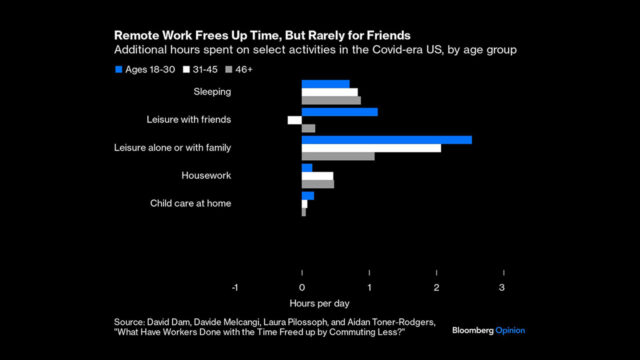
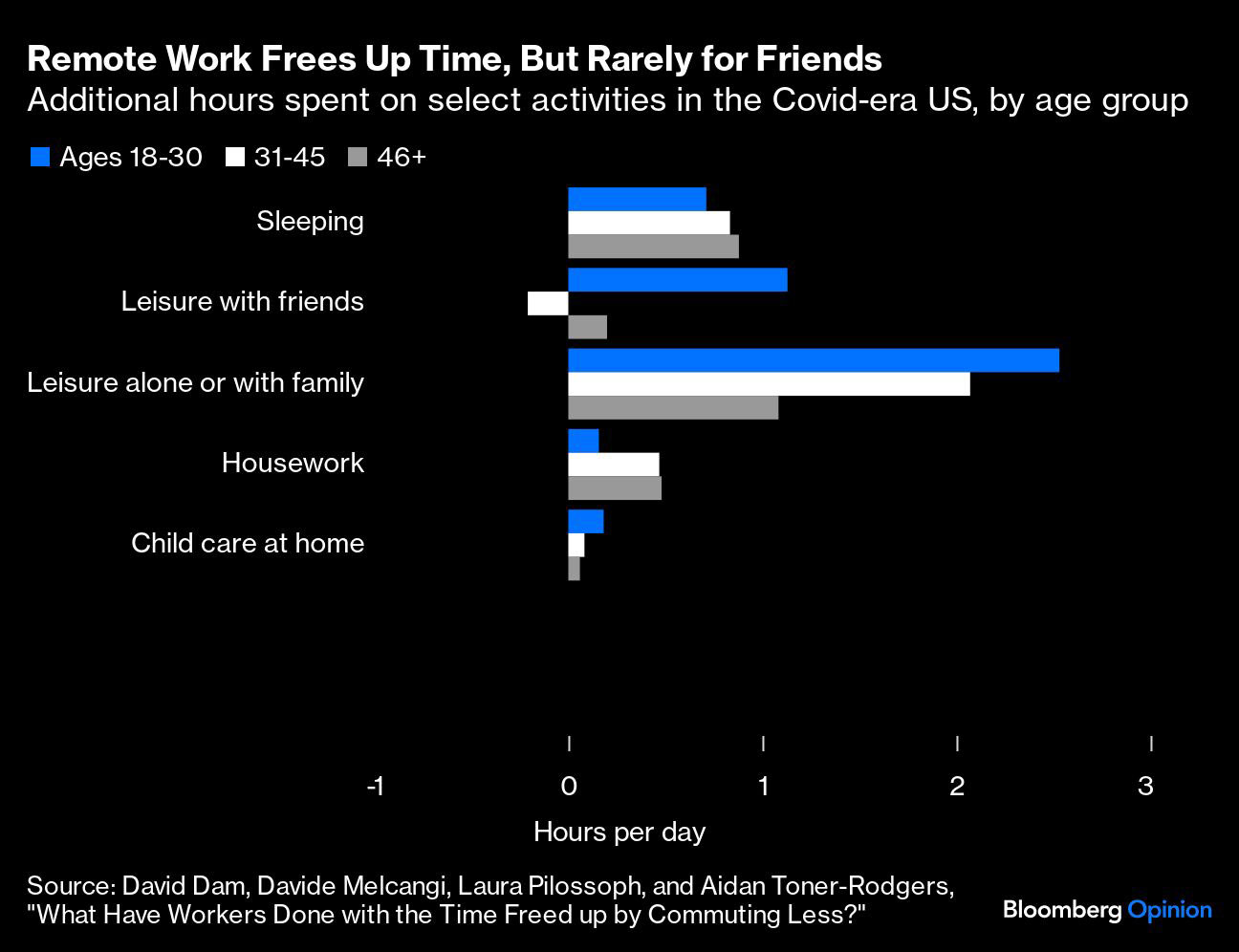
This hasn’t come to pass. Multiple studies have looked at how remote workers have reallocated their commute time. For the most part, they just start work earlier and finish later. They also spend more time sleeping, cooking, doing chores and exercising. Parents spend more time caring for children.

And although remote workers do gain more leisure time, only workers younger than 30 actually use it to get out of the house and hang out with friends. Those of us older than 30? We’re spending more time relaxing at home — either alone or with our families.

It’s alarming that mid- and late-career remote workers are spending markedly less time socializing. Adults weren’t exactly getting in a lot of quality time before the pandemic. Political scientist Robert Putnam chronicled the decline in civic and social connections in his 2001 book Bowling Alone. US Surgeon General Vivek Murthy has been warning of a “loneliness epidemic” since at least 2017, when he wrote that “loneliness and weak social connections are associated with a reduction in lifespan similar to that caused by smoking 15 cigarettes a day.”

In The Good Life: Lessons from the World’s Longest Scientific Study of Happiness, by psychiatrist Robert Waldinger and psychologist Marc Schulz, the authors share results from the decades-long Harvard Study of Adult Development. The overwhelming finding: The biggest factor in life satisfaction is our relationships with other people.

Friendships are a basic human need, up there with sleep, food and exercise. And when I interviewed Schulz earlier this year, he emphasized that for a lot of people, work can be a pretty good source of friends. That’s one reason retirees often report more feelings of loneliness. In-person work provides forced social interaction.

Of course, that’s exactly why so many people prefer to work remotely; hard pass on the awkward office small talk! But even though many of us think we dread meaningless prattle, there have been a number of studies showing that short conversations with total strangers boost mood. Even introverts feel better after chatting with a barista, a bus driver or a receptionist. A natter with colleagues improves collaboration. Remote workers miss out on those conversations.

That’s not to say that the answer is to return to HQ for 40 hours each week. For one thing, the nature of work has shifted, such that even if you’re sitting near some co-workers, you’re more likely to be communicating electronically than in person.

For another, returning to HQ may not actually put us closer to our colleagues: 31% of people now report to a boss in a different city, about a 10-percentage-point jump since before the pandemic. These are called “distributed teams,” but such teams generally aren’t evenly dispersed; some people are clumped together in one office, with the rest elsewhere. The share of employees who work “elsewhere” has been rising.

Those are among the reasons that even if remote work entails some trade-offs, many of us are likely to keep doing it — plus, of course, factors like long commutes and the inflexible realities of school and day-care schedules.

To be sure, remote work need not be lonely. A recent study published in the Journal of Research in Personality found that we can spend long stretches in solitude — up to 75% of waking hours, which is more than a standard workday — before feelings of loneliness start to rise. And today’s remote work norms are impossible to fully tease apart from COVID; the pandemic itself got a lot of us over-30 folks out of the habit of socializing regardless of our work arrangements. But the data make clear that those who work from home must begin to be much more intentional about spending time with other humans.

Simply put, remote workers over 30 need to spend more time with their friends. If you’re thinking of resolutions for 2024, that’s not a bad place to start.

BLOOMBERG OPINION

SN Aboitiz keen on CBK hydro plants

RENEWABLE ENERGY company SN Aboitiz Power Group (SNAP) has expressed interest in the 796.64-megawatt (MW) Caliraya-Botocan-Kalayaan (CBK) hydroelectric power project in Laguna.

“CBK is interesting, right? Because energy storage is a very important part of the portfolio especially when we realize our aspirations for the renewable energy portfolio standard,” SNAP President and Chief Executive Officer Joseph S. Yu told reporters in a recent interview.

The Power Sector Assets and Liabilities Management Corp. (PSALM) held an investors forum on Dec. 1 to generate interest in the privatization of the CBK hydroelectric power plants, as well as the rehabilitation and asset management plan for the Agus-Pulangi hydroelectric power plants with a private partner.

The public bidding and contract turnover to the winning bidder of the CBK project is set to be held in the second semester of 2024.

“It’s a very interesting project, so yes it’s very interesting for us kasi (because) it will require a fair bit of creativity and it will be a fun exercise,” Mr. Yu said.

SNAP is a joint venture between Aboitiz Power Corp. and Norwegian company Scatec. It owns and operates the 112.5-MW Ambuklao and 140-MW Binga hydroelectric power plants in Benguet; the 388-MW Magat hydroelectric power plant on the border of Isabela and Ifugao; and the 8.5-MW Maris hydroelectric power plant in Isabela.

The CBK hydro facilities are currently under a 25-year build-rehabilitate-operate-transfer scheme run by independent power producer CBK Power Co. Ltd. — a 50:50 partnership between Electric Power Development Co., Ltd. (J-Power) and Sumitomo Corp. of Japan — which will expire in 2026.

These facilities are composed of the 39.37-MW Caliraya in Lumban; 22.91-MW Botocan in Majayjay; and 366-MW Kalayaan I and 368.36-MW Kalayaan II in Laguna.

In October, the Asian Development Bank was awarded a contract as the transaction advisor to help PSALM monetize the CBK hydroelectric power plant complex.

Its advisory services, through its Office of Markets Development and Public-Private Partnerships, will support the transfer of the facilities to the private sector “at an optimal value for the government.”

This is also while ensuring that the government’s objectives of energy security and grid stability are met. — Sheldeen Joy Talavera

Welcoming audiences back to movie theaters

MYRIAM TIRLER / HANS LUCAS VIA REUTERS CONNECT

By Brontë H. Lacsamana, Reporter

CINEMAS and other places of entertainment are hopeful as they aim for resilience amid economic risks. Since reopening in 2021 after the pandemic-induced lockdowns, movie theaters are attracting more audience members through upgraded facilities and an increased variety of film choices.

Ayala Malls Cinemas reports that operations have been picking up. In September, the division reported that “watching movies in cinemas, long cherished by Filipinos, is experiencing a renaissance.”

“Philippine cinemas successfully achieved a robust box office performance for the year 2022. The same performance was reached as early as September 2023,” said Emee Aganon, head of Ayala Malls Cinemas, in an interview with BusinessWorld.

This year, this renaissance manifested in blockbuster favorites like Barbie, The Little Mermaid, and Insidious: The Red Door, as well as the acclaimed Cinemalaya film festival.

Barbie was Warner Bros. Pictures Philippines’ biggest release in 2023, spurred on by toy box photo booth campaigns in malls nationwide. Meanwhile, its “partner-in-crime” in the “Barbenheimer” moviegoing phenomenon, Oppenheimer, was the highest-grossing IMAX release in 2023, according to Universal Pictures Philippines.

“These films drew substantial audiences back to theaters,” said Ayala Malls Cinemas via e-mail.

MAKING FILMS MORE ACCESSIBLE
Steven Tan, president of SM Supermalls, said in December that SM Cinemas’ response to the returning demand is to make films more accessible to Filipinos.

At the opening ceremony of the French Film Festival, which was done in partnership with the French Embassy, he said, “Film is such a compelling medium to enrich our perspective. This is why we expanded the film festival to two of our iconic SM Supermalls, making French cinema more accessible than ever before.” The festival was held at the cinemas of the SM Mall of Asia and SM Megamall.

Regular tickets for those films cost P150 while tickets for students, seniors, and persons with disabilities (PWDs) cost P100.

Most notably, Filipinos’ clamor for accessible films was seen on Oct. 15, during SM Cinemas’ 65th anniversary, when eight titles were available for only P65 across SM Cinemas nationwide.

Photos of long queues at the mall went viral as audiences chose from the eclectic mix of American, Asian, and Filipino selections under the one-day promo. The films were Instant Daddy, The Creator, The Expendables, Forbidden Play, Monster, Coffee Wars, and Dr. Cheon and the Lost Talisman.

In a disclosure on Nov. 6, SM Prime said “cinemas, event ticket sales, and other revenues increased significantly to P7.7 billion from P3.5 billion in the same period last year” — a whopping 120% increase.

NOT AT PRE-PANDEMIC LEVELS YET
However, despite the seemingly positive growth in the country’s cinema exhibition industry, it pales in comparison to pre-pandemic times.

Ms. Aganon of Ayala Malls Cinemas notes: “Although there’s a considerable improvement compared to the previous year, it’s important to note that the current performance is still 60% below pre-pandemic levels.”

Both companies acknowledge the arduous journey ahead for cinema operators. They cite the potential occurrence of another pandemic, evolving consumer behaviors, and the persistent issue of piracy.

But there will always be people who will want to go to the movie theater, according to Mr. Tan of SM Supermalls. This is why SM opened many cinemas in some of their malls this year: in Bataan, in Sto. Tomas in Batangas, and in Pulilan in Bulacan. Its newest IMAX theater opened in SM Iloilo just last month.

As the country’s largest cinema operator, it has 384 screens combined nationwide.

BETTER TECHNOLOGY
To keep Filipinos coming back to the movies, it’s also essential to continue bettering their current offerings, as per Ayala Malls Cinemas, a major runner-up cinema operator in the Philippines.

“Cinemas play an integral role in the malling experience for Filipinos. Along with our competitors, we persistently invest in upgrades and introduce new formats to enhance the overall cinematic experience,” said Ms. Aganon.

Both companies told BusinessWorld that audiences can look forward to more cutting-edge projectors, state-of-the-art sound systems, comfortable seats, and enhanced online ticketing systems.

Given these technical advantages, the question that emerges is: What experiences do cinemas offer that (admittedly convenient) streaming platforms don’t? Many point to the communality of watching with a crowd and the sense of exploration provided by an in-person venue, program, or festival.

“There’s something about watching films collectively, with the audience reacting together, that strengthens bonds,” said Mariel Nini, officer in charge of the National Commission for Culture and the Arts’ (NCCA) Sentro Rizal International Cultural Affairs Office.

FILM FESTIVALS GO ON-SITE
At the sidelines of the Tingin Southeast Asian Film Festival in September, she noted that although many online platforms have mushroomed, moviegoers are still coming back to the theaters. “There has been clamor for in-person screenings,” she added, on why film festivals are now veering away from the purely online format they adopted during the COVID-19 pandemic.

Patrick Campos, a University of the Philippines Film Institute (UPFI) professor and Tingin’s festival programmer, said that the lockdown “has certainly changed people’s viewing habits, although Filipinos’ exposure to Southeast Asian and world cinema remains the same.”

“Our interest in films from the region is piqued not by popularity, but by thoughtful programming, and audiences turn to festivals to gain insight into other cultures and histories,” he told BusinessWorld back in September.

This is also the reason the Film Development Council of the Philippines (FDCP) licensed the rights to various world cinema titles for commercial release in Ayala Malls Cinemas in August. These included Cannes-winning titles Aftersun by Charlotte Wells and Return to Seoul by Davy Chou.

“More than its aim to encourage audiences to return to the cinemas, this program aims to further expose moviegoers to titles that would help them expand their horizons,” said FDCP Chairman Tirso Cruz III in a statement.

2023 also saw a colorful array of film festivals from embassies such as Japanese, Korean, Spanish, Italian, and so on — all held in person — as well as a much bigger QCinema International Film Festival.

In November, QCinema screened nearly 70 films from the Philippines and around the world, welcoming three times more guests and filmmakers compared to last year, said Ed Lejano, its festival director.

“We know there’s a strong filmgoing market here. Yes, streaming platforms have become the most popular form of entertainment for Filipinos nowadays, but film festivals are back with a vengeance,” he told the press at the launch.

AFTER THE HOLLYWOOD STRIKES
Moving forward, these festivals showing independent and acclaimed foreign titles will be providing a variety to complement the blockbusters peddled by the Philippines’ major cinema operators.

Both SM and Ayala have said they are eagerly anticipating the Hollywood movie lineup for 2024, despite the delays caused by the actors’ and writers’ strikes in the USA.

“Currently, the ratio of foreign movies to local movies stands at 70:30,” said Ms. Aganon of Ayala Malls Cinemas. “We hope that this will improve with more contribution from local movie producers.”

She added that partnerships with foreign distributors will be broadening their offerings. This includes concert films featuring the successful live performances of popular global artists such as Taylor Swift, Beyoncé, Coldplay, BTS and other notable K-pop groups.

For renowned Filipino screenwriter Ricardo “Ricky” Lee, the variety of films in theaters is essential to not only entertain audiences, but also inspire them.

“Aspiring artists and writers, upon seeing the variety of films in theaters, get a strong push to explore storytelling possibilities. These avenues embolden the youth,” he told BusinessWorld at the sidelines of QCinema’s opening night.

“I’m also very optimistic about Filipino audiences. I don’t think streaming will go away because it’s convenient, but I think people are realizing how great it is to watch on a big screen. There will always be a place for it,” Mr. Lee added.

UPFI’s Mr. Campos concludes that pitting movie theaters against streaming platforms is not necessary: “It is not that one is better than the other, but that each mode of distribution and consumption should be considered distinct and worthy of being explored separately.”

IMF pushes for better liquidity management, debt pricing and supply

THE BANGKO SENTRAL ng Pilipinas (BSP) can further improve liquidity management and debt pricing and supply in the country by developing more instruments and collaborating with the Treasury for its open market operations, the International Monetary Fund (IMF) said.

The IMF, in its staff report for the Philippines following its Article IV consultation, said the BSP could further refine its operational framework as it aims to reduce the reserve requirement ratio (RRR).   

In June, the BSP cut the RRR for big banks by 250 basis points (bps) to 9.5%. It also lowered the ratio for digital banks by 200 bps to 6% and by 100 bps for thrift banks, and rural and cooperative banks to 2% and 1%, respectively.

However, the adjustment in reserve requirements coincided with the expiration of a pandemic relief measure and was combined with an introduction of the 56-day securities, which mopped up any excess liquidity from the RRR cuts. 

“In the future, the BSP could manage banking system liquidity more flexibly by expanding the use of market-based operations like reverse repurchase operations (RRPs). This approach is now viable due to large-scale purchases of government bonds during the COVID-19 (coronavirus disease 2019),” the IMF said.

The IMF also noted that the BSP has shifted to a variable rate format in the auction for the overnight RRP facility in September, which introduced a formal overnight RRP rate and renamed the BSP’s key policy rate to the target RRP rate.

“As the BSP is exiting from the extraordinary liquidity support measures introduced during the pandemic and letting maturing treasury securities run-off, its communication of the desired size of its balance sheet in normal times including the use of its portfolio of treasury securities would be helpful,” it said. 

The changes to the RRP facility are part of BSP reforms that started in 2016, which was when the central bank adopted the interest rate corridor (IRC) framework to help bring short-term market rates closer to its policy rate for better monetary policy transmission.

The RRP facility is part of BSP’s monetary operations to help manage the amount of money circulating in the economy by selling government securities, which the central bank commits to buy back at a later date.   

The BSP and the Bureau of the Treasury (BTr) could also collaborate more to improve the securities market and to further develop a credible yield curve, the IMF said in its report.

“The main issue facing the short-end of the curve is a large discrepancy between yields on BSP bills and Treasury bills. This discrepancy has created challenges for the banking sector in pricing debt instruments accurately, with the Bloomberg valuation tool relying exclusively on government bond yields and banks starting to use the RRP rate explicitly for pricing working capital loans,” it said.

A smooth yield curve would help support the development of a derivatives market for hedging purposes, the IMF said.

“To harmonize the two markets, the BTr should refrain from keeping supply at the short end artificially low by transitioning to a price-taker model during bond auctions. Reducing the number of individual bond series on offer and consolidating maturities into a reduced number of benchmark bonds would help concentrate trading activity,” it said.

The BSP and the BTr could also work on streamlining approved participants in each market because the exclusion of nonbanks from the BSP bill market is a large contributing factor for the observed yield discrepancy, it added.

“Other issues in the two markets, such as the obligations and performance of primary dealers including market-making and facilitating the use of repos of government securities, should also be addressed,” the IMF said.

Meanwhile, the BSP intends to utilize its government securities holdings to support its monetary operations and enhance the transmission of monetary policy.

The central bank is also working on expanding the list of market players with access to BSP bills and has requested follow-up technical assistance from the IMF on developing a benchmark yield curve.

“The BTr has the view that the yield differential is partly due to excess structural liquidity which will decline over time,” the IMF added. — K.B. Ta-asan

God save the King’s hands

KING CHARLES — REUTERS

Charles makes ‘sausage fingers’ joke in coronation film

BRITAIN’S King Charles poked fun at his “sausage fingers” — a topic that has drawn immense media attention and internet memes in recent years — in a behind-the-scenes documentary that charts the royal family’s preparations for his coronation.

When his son, Prince William, struggles to fasten one of the ceremonial robes, Charles tells him not to worry, as he does not have “sausage fingers” like himself, the BBC cited the then 74-year old monarch as saying on camera.

British tabloids ran stories, ranging from lengthy explainers to more light-hearted takes, focusing on Charles’ fingers in the days leading up to the historic ceremony earlier in the year.

Some even brought in doctors to weigh in on whether there may be an actual cause for concern about the new monarch’s chubby digits. Speculations have ranged from oedema and arthritis to infections and allergies.

Internet searches for “sausage fingers” peaked in the run-up to the May 6 ceremony in Britain, according to data from Google Trends.

The 90-minute documentary, which had private access to follow the first year of the new reign after the death of Queen Elizabeth in 2022, is due to air the day after Christmas, or Boxing Day, as it is celebrated in Britain.

It features Justin Welby, Archbishop of Canterbury and the spiritual leader of the worldwide Anglican Communion, forgetting his lines during a rehearsal.

“I have a memory that is probably about as good as our spaniel — in other words zero,” Mr. Welby says, about not knowing the words. — Reuters

Ample opportunity to be heard 

@DRAZEN ZIGIC-FREEPIK

Every employer has the right to exercise its management prerogative in the conduct of its business affairs, and this prerogative includes the right to dismiss its employees. In the Philippines, the employer’s prerogative to terminate an employee should muster both substantive and procedural due process.

Substantive due process is met when there exists a just or an authorized cause provided under Articles 297 and 298 of the Labor Code, respectively. With respect to termination under just causes, procedural due process is hurdled when the employer complies with the twin-notice requirement, and after granting the said employee an ample opportunity to be heard.

Notably, “ample opportunity to be heard” has been the phrase used under the Labor Code, particularly Article 292 thereof, which states that “the employer shall furnish the worker whose employment is sought to be terminated a written notice containing a statement the causes for termination and shall afford the latter ample opportunity to be heard x x x.”

Interestingly, however, under Section 2(d), Rule I, Book VI of the Implementing Rules of the Labor Code, a “hearing or conference” shall be observed by the employer, if only to comply with the procedural due process in termination cases. The provision reads:

“Section 2. Security of Tenure. — x x x

(d) In all cases of termination of employment, the following standards of due process shall be substantially observed:

For termination of employment based on just causes as defined in Article 282 of the Labor Code:

x x x

(ii) A hearing or conference during which the employee concerned, with the assistance of counsel if he so desires, is given opportunity to respond to the charge, present his evidence or rebut the evidence presented against him.”

With the apparent conflict between the text of the Labor Code vis-a-vis its Implementing Rules, an employer may be confused on whether to merely grant the erring employee an ample opportunity to be heard, or to mandatorily conduct a hearing or conference to hear the employee’s possible defenses.

THE GENERAL LAW PREVAILS
In 2009, the Supreme Court had the occasion to discuss this apparent conflict in the case of Perez v. Philippine Telegraph and Telephone Co., et al. (G.R. No. 152048, 7 April 2009), where it ruled that in case of conflict between a general law and its implementing rules, the former prevails.

According to the Supreme Court, an implementing rule cannot expand nor amend the scope of the law it implements, considering that the authority to promulgate implementing rules proceeds from the law itself.

Therefore, with respect to procedural due process in termination based on just causes, granting the erring employee an “ample opportunity to be heard” satisfies the requirement of the law.

AMPLE OPPORTUNITY
What then is the yardstick of this ample opportunity to be heard given to erring employees?

According to the Supreme Court in the Perez case, the fact that it is couched in general language reveals the legislative intent to give some degree of flexibility or adaptability to meet the peculiarities of a given situation. To require a single rigid proceeding such as a formal hearing will defeat the intent of the law.

Admittedly, an ample opportunity to be heard is broad enough to substantially include a formal hearing or conference. However, this is also satisfied when the employee is given a meaningful opportunity to controvert the charges and allegations hurled against him or her, and to submit evidence in support thereof. “To be heard” does not mean verbal argumentation alone inasmuch as the employee may just as effectively be heard through written explanations, or whatever submissions where the employee may substantiate his or her defenses.

In Autobus Workers’ Union v. NLRC (G.R. No. 117453, 26 June 1998), the Supreme Court ruled that “there is no violation of due process even if no hearing was conducted, where the party was given a chance to explain his side of the controversy. What is frowned upon is the denial of the opportunity to be heard.”

Clearly, in cases of termination for just causes, it is already enough that the employee is given the chance to air his or her side, and that a formal hearing or conference, while maybe preferred and ideal, is not required.

INSTANCES WHERE A HEARING OR CONFERENCE IS MANDATORY
While the Perez case laid down the general rule that a formal hearing or conference is not required in termination cases, it also enunciated several exceptions to this rule, to wit: (i) when requested by the employee in writing, (ii) when substantial evidentiary disputes exist, (iii) when a company rule or practice requires it, or (iv) when similar circumstances justify it.

Meaning to say, if the employee himself or herself requests the management in writing that a formal hearing be conducted, if only to properly ventilate his or her possible defenses, then the employer must ensure to afford the employee a formal hearing or conference. The same can be said when substantial evidentiary disputes exist, such as when material and relevant proofs to support the allegations and defenses lie contrary to each other.

Moreover, a formal hearing is mandatory when it is provided in the company rules, or it has evolved into a company practice. It is said that for a benefit to become a company practice, such as granting the employees an opportunity to attend a formal hearing during termination cases, it must be done for a long period of time, and that it has been made consistently and deliberately. As a catch-all exception, a hearing is likewise mandatory when circumstances, similar to the recognized exceptions, are in play.

In the final analysis, both employers and employees must note that a formal hearing is not mandatory, so long as the employee is given a fair and reasonable opportunity to explain his or her defenses and controverting evidence. Unless and until the aforementioned exceptions exist, “ample opportunity to be heard” does not equate to the conduct of a formal hearing or conference.

The views and opinions expressed in this article are those of the author. This article is for general informational and educational purposes only and not offered as and does not constitute legal advice or opinion.


Khen C. Aquino is an associate of the Cebu Branch of the Angara Abello Concepcion Regala & Cruz Law Offices (ACCRALAW).

kcaquino@accralaw.com

Globe anticipates growth of its fiber broadband business

REUTERS

GLOBE Telecom, Inc. is expecting its broadband business to expand further after recording a significant growth in the company’s broadband revenues, the telecommunications company said.

“We’re seeing an encouraging uptrend in our fiber broadband business, and our commitment to delivering exceptional service is stronger than ever,” Raymond Policarpio, vice-president of Globe At Home Brand Management, said in a media release on Tuesday.

Globe said it had reported an 18% growth in its year-to-date fiber broadband revenues, which it attributed to the growing demand for internet connectivity in the country.

The company has also recorded a decline in fixed wireless revenues, which it said is an indication of a market shift toward fiber offerings.

“Our focus is not just on expanding our reach but also on acquiring quality subscribers who value longevity and reliability,” Mr. Policarpio said.

The company noted that it is also targeting to widen its fiber connectivity in underserved areas through its fiber prepaid offerings.

“This unlimited prepaid fiber service offers cost-effective options for superior connectivity, ensuring that high-speed internet is within everyone’s reach,” Globe said.

In the third quarter, Globe recorded an attributable comprehensive net income of P4.97 billion down by 27% from P6.81 billion a year ago, amid higher non-operating charges for the period.

The telecommunications company recorded consolidated revenues of P44.27 billion in the quarter, a 3.2% increase from P42.88 billion a year ago, amid strong service revenues.

From January to September, Globe’s attributable comprehensive net profit fell by 27.1% to P19.29 billion from P26.46 billion in the same period last year.

Its nine-month consolidated revenues stood at P133.79 billion, 2.8% higher than the previous year’s P130.2 billion. — Ashley Erika O. Jose