Home Blog Page 3830

CHED tells state universities: Decide now on whether to keep senior high programs

PHILIPPINE STAR/ WALTER BOLLOZOS

By Jomel R. Paguian

THE COMMISSION on Higher Education (CHED) said on Monday that it is up to government-funded universities and colleges to decide whether or not they would continue offering senior high school (SHS) programs.

In a press briefing, CHED Chairman Prospero E. De Vera, III still made it clear that state universities and colleges (SUCs) and local universities and colleges (LUCs) are no longer required to offer the program under the law.

However, Mr. De Vera said the boards of regents of SUCs and LUCs could decide on retaining their respective SHS programs; but in doing so, they should decide immediately on their plans.

Asked by reporters when they should finalize their decisions, the CHED chair replied: “They should take this up and discuss this immediately so that we will know the situation on the ground, and we will know the options available and possible.”

Mr. De Vera said that when deciding to continue SHS programs, public universities should assess the capability of Department of Education (DepEd) schools in their areas to deliver the additional two years of high school education.

SUCs and LUCs may consider extending their SHS programs if they deem it necessary to meet the demand in some areas.

“If there is capacity in regular (DepEd) high schools, that’s where students should go. Because the SUCs also need the facilities for their own students because their enrollment has also increased tremendously,” said Mr. De Vera.

“There is no one-size-fits-all decision on this because the SUCs are differently located, they have different capacities, and they have different facilities. That is why it is the SUCs who should look into this,” he added.

In a memorandum issued last month, the CHED reminded public universities to terminate their SHS programs, which were initially intended to be offered only during the K-12 transition period which was from school years 2016-2017 to 2020-2021.

P3B to fix school buildings OK’d

PHILIPPINE STAR/ WALTER BOLLOZOS

THE DEPARTMENT of Budget and Management (DBM) has approved the release of P3.049 billion for the repair of government school buildings throughout the country.

The DBM said the release will cover the funding requirements for the repair and rehabilitation of elementary and secondary school buildings.

“An amount of P1.861 billion was initially released from the total authorized appropriations of P4.911 billion, which will be utilized for the rehabilitation, renovation, repair and improvement of kindergarten, elementary, and secondary school buildings following the Repair All Policy,” the DBM said.

The funding will be released to the Department of Public Works and Highways under the 2023 General Appropriations Act. — Luisa Maria Jacinta C. Jocson

Germany, PHL eye improved ties

THE FOREIGN ministers of Germany and the Philippines are set to meet in Manila this week to discuss further boosting bilateral ties, particularly in maritime cooperation, trade and investments.

The Philippine Department of Foreign Affairs (DFA) confirmed on Monday the visit of German Foreign Minister Annalena Charlotte A. Baerbock on Jan. 11-12 and her meeting with host country counterpart, Secretary Enrique A. Manalo.

“There is a commonality between the Philippines and Germany when it comes to a rules-based order, and it’s also interesting that the German Minister will be visiting the Coast Guard,” DFA Spokesperson Ma. Teresita C. Daza told reporters in a virtual briefing. “Hopefully, the meeting will result discovering what other training programs can by Germany to the Philippine Coast Guard.”

She said the meeting would celebrate the 70th anniversary of Philippine-Germany diplomatic relations. 

While in town, Ms. Baerbock is also scheduled to visit the Technical Skills Development Authority offices.

The Philippines wants to expand its trade with Germany, especially in terms of electronics and bananas.

In 2022, Germany was the Philippines’ 12th largest trading partner with trade amounting to P4.7 billion that year, Ms. Daza noted. There are about 31,660 Filipinos based in Germany, she added. — John Victor D. Ordoñez

Bill on cheaper rice pushed

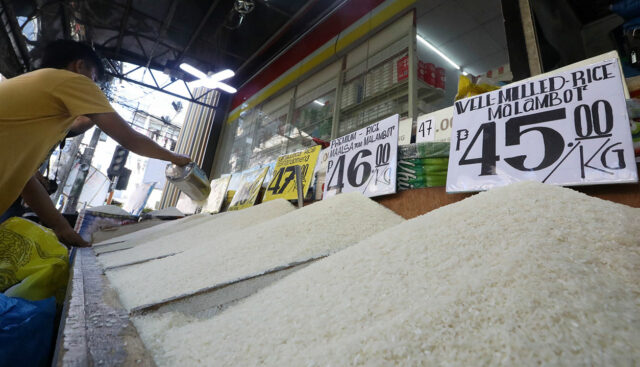
Rice dealers display rice in Trabajo Market, Sampaloc, Manila, Aug. 10, 2023. — PHILIPPINE STAR/EDD GUMBAN

A CONGRESSMAN is not giving up on the Marcos administration’s campaign promise to drive down rice prices to P20 a kilo, filing a bill in September that not only seeks to make that happen but also ensure that rice farmers make a profit.

“If we want to attain [the price of] P20 per kilogram of rice, the [proposed] Cheaper Rice Act is the solution, which we should prioritize in passing,” Party-list Rep. Wilbert T. Lee said in a statement on Monday.

His House Bill No. 9020 even seeks to impose an additional P5 to P10 in the price of rice on sold by farmers to the Department of Agriculture to ensure profit. “If profit is ensured, farmers will increase their production and supply, which will help lower rice prices in the market,” Mr. Lee said in Filipino.

He added that rice profit would discourage farmers from selling their lands and may even pass on their farming practices to its next generations.

The bill also seeks the creation of the Rice Incentivization, Self-Sufficiency, and Enterprise (RISE) Program, which would develop a pricing structure for palay, a payout system for farmers, and a regular monitoring system for palay and rice prices.

It also proposes the creation of a price stabilization fund to shoulder the payouts and subsidies for farmers in buying and producing palay.

The committee expected to manage the fund will be headed by the Secretary of Trade and Industry and a “Rice Czar” to be appointed by the President.

During a House committee meeting in August last year, Agriculture Undersecretary Leocadio Sebastian said it “may be difficult” to bring rice prices down to P20 in the next two years, contrary to a campaign promise made by President Ferdinand R. Marcos, Jr. — Beatriz Marie D. Cruz

Gov’t touts farm roads built

PHILSTAR FILE PHOTO

THE PHILIPPINE government has built around 67,328.92 kilometers of farm-to-market roads last year, which is more than half of its goal of building 131,410.66 km in six years, President Ferdinand R. Marcos, Jr. said on Monday.

“It is a testament to the magnitude of accomplishment of the government,” he said in a video posted on his Instagram account. “It is a connection between all the different communities, but of course its main purpose is to connect the markets and the producers — to our agricultural sectors.”

He said the past year’s accomplishments amount to about 51% of the administration’s goal to build over 131,000 km of farm-to-market roads in his six-year term. 

Last November, the Department of Agrarian Reform (DAR) said it had won technical approval for building modular steel bridges for farm-to-market roads. The project would cost P28.23 billion to implement.

Lawmakers had allotted over P17.27 billion in this year’s P5.768-trillion national budget to build these roads. Congress also included about P31 billion to aid farmers implement projects to boost rice production. — John Victor D. Ordoñez

House leader backs ‘Cha-cha’

PHILSTAR FILE PHOTO

A LEADER in the House of Representatives supported on Monday proposals to change the 1987 Constitution, saying the amendments should not come later as it would give the impression that politicians are merely attempting to extend elected officials’ terms of office.

“It is better to initiate Charter change (“Cha-cha”) long before the 2028 presidential elections, so that the public can rest assured that this is no attempt to extend President [Ferdinand R. Marcos Jr.]’s term,” Albay Rep. Jose Ma. Clemente S. Salceda, who heads the House Ways and Means Committee, said in a statement.

“The time to do it is now, when there is also enough time to do it before the 2025 midterm elections.

“It is natural and normal for democracies to revise their Constitutions, to suit the evolving needs of the times, as well as to adjust for conditions that framers did not foresee,” he said.

Mr. Salceda noted that the United States Constitution, which heavily inspired the Philippines’ own charter, has been amended 27 times.

“In contrast, we have not amended the 1987 Constitution for almost 40 years now, despite having provisions that obviously require revision. In many ways, we are unnatural for the way we hold the 1987 Constitution as if it were unerring,” Mr. Salceda said.

Before Congress adjourned for the Christmas break, House Speaker Ferdinand Martin G. Romualdez revived talks to amend the 1987 Constitution to ease economic restrictions.

The lower chamber in March passed Resolution of Both Houses No. 6, calling to amend the Constitution through a constitutional convention. The measure was not approved in the Senate.

Last week, Albay Rep. Edcel C. Lagman said municipal mayors were allegedly asked to give P100 for every constituent that signs a petition to amend the Constitution through a people’s initiative.

“If the campaign for people’s initiative to amend the Constitution is inspired by noble and patriotic motives, then why buy the people’s will?” he said in a statement.

Mr. Lagman added that the act violates Section 261 of the Omnibus Election Code in relation to Sec. 19 of the Initiative and Referendum Act. — Beatriz Marie D. Cruz

Dividends from state-owned firms up 46% in 2023

DIVIDENDS generated by government-owned or -controlled corporations (GOCCs) rose 46% in 2023, the Department of Finance (DoF) said.

In a statement on Monday, the department said that its Privatization and Corporate Affairs Group collected P99.98 billion in dividends from GOCCs last year.

“The increased dividend collection is a result of fiscal discipline that the DoF continues to instill in GOCCs. These dividends will help manage our deficit and will be used to support the country’s development needs,” Finance Secretary Benjamin E. Diokno said.

The Bangko Sentral ng Pilipinas (BSP) was the top contributor in 2023, with dividends amounting to P55.61 billion.

The Philippine Deposit Insurance Corp. remitted P14.05 billion, while the Philippine Amusement and Gaming Corp. contributed P6.96 billion.

Other top contributors were the Philippine Ports Authority (P4.44 billion), the Power Sector Assets & Liabilities Management Corp. (P3.15 billion), the Philippine Charity Sweepstakes Office (P2.67 billion), the Philippine National Oil Co. (P1.68 billion), the Subic Bay Metropolitan Authority (P1.52 billion), the National Transmission Corp. (P1.48 billion), the Philippine Reclamation Authority (P1.35 billion) and the Clark Development Corp. (P1.21 billion.)

As of Dec. 31, a total of 51 GOCCs remitted dividends to the Bureau of the Treasury.

By law, GOCCs are required to declare and remit at least 50% of their net earnings to the National Government.

“The dividends have been a major source of non-tax revenues to fund the accelerated implementation of programs on infrastructure and various social and economic programs of the government,” the DoF added. — Luisa Maria Jacinta C. Jocson

Palay production targeted to exceed 20 million MT in 2024

REUTERS

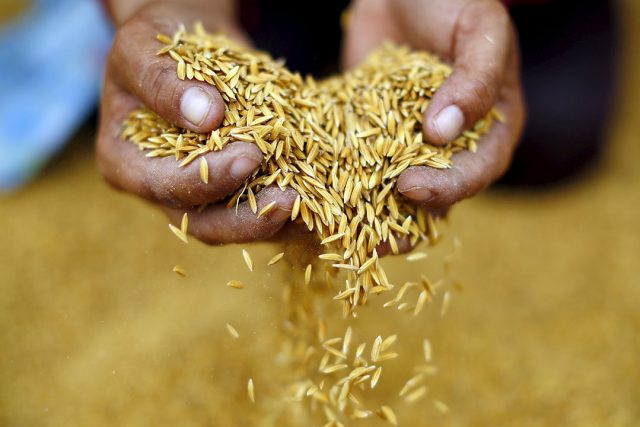
THE palay production target has been set at no less than 20 million metric tons (MT) this year, the Department of Agriculture (DA) said.

“Last year, our target was 20 million MT, so it shouldn’t be below than (that),” DA Spokesperson Arnel V. de Mesa told reporters on Monday.

Mr. De Mesa added that the DA is taking steps to mitigate the impact of El Niño on rice production during the dry season.

“The harvest (tends to be higher) during the wet season, because the area planted to rice is bigger especially for rain-fed areas. El Niño will hit during the dry season and the water in the dams is still good,” he added.

The El Niño is expected to bring dry spells and drought to 63 provinces.

The government weather service, known as PAGASA (Philippine Atmospheric, Geophysical and Astronomical Services Administration), has said that the most intense phase of El Niño may run until the second quarter.

President Ferdinand R. Marcos, Jr., has ordered the creation of an interagency task force to address the effects of the weather phenomenon.

“Our mitigation measures are already in place. One of our strategies is to plant hybrid (seed), at least 1 million hectares, this dry season due to their higher yields,” Mr. De Mesa said.

He added that the DA is expecting the land planted to hybrid seed to offset the loss of riceland that cannot be cultivated due to the lack of water.

Meanwhile, Mr. De Mesa said that rice prices will continue to rise entering the lean months between harvests.

“Right now, rice prices are a bit higher because we are entering the lean season, and we have no more local production,” he added. “Our only source is imports and the price of imports is high right now.”

The DA has said that it is expecting 500,000 MT of imported rice to arrive as the government builds up reserves in preparation for the worst of El Niño.

The government has also extended the lowered tariffs on rice via Executive Order No. 50. Rates for rice imports were kept at 35% regardless of the minimum access volume and country of origin.

As of Jan. 8, the price of well-milled rice in Metro Manila markets was P40-55 per kilogram, while regular-milled rice was fetched P43 to P52 per kilo. 

On the other hand, imported well-milled rice was selling for P50 to P58 per kilo. — Adrian H. Halili

Agri officials making big push to enhance dry-season rice harvest

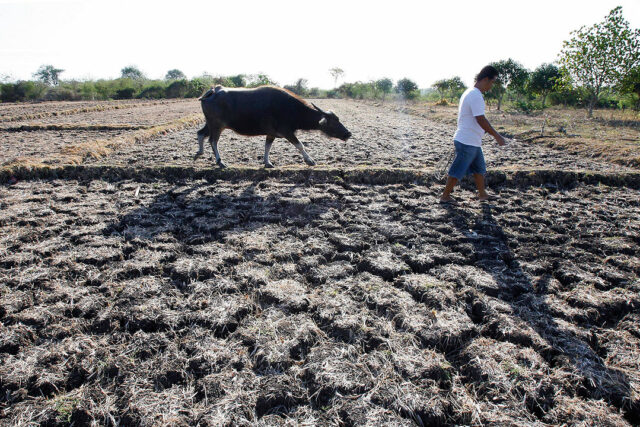
A farmer guides his carabao on dry and cracked farmland in San Juan town, Batangas, April 18, 2010. — REUTERS

THE Department of Agriculture (DA) said it will meet with rice farmers to identify strategies to boost production for the dry-season crop.

In a special order, the DA authorized the Masagana Rice Industry Development Program (MRIDP) to consult with the rice industry to identify and map areas deemed vulnerable during the dry season.

According to the government weather service, known as PAGASA (Philippine Atmospheric, Geophysical and Astronomical Services Administration), droughts and dry spells brought about by El Niño will affect about 63 provinces and dampen their rice output.

PAGASA expects El Niño to intensify this month, persisting until May.

It added that the consultations will develop plans for distributing seed, fertilizer discount vouchers, soil ameliorants and biocontrol agents.

The Visayas agriculture cluster, which includes Region 6,7, and 8, will meet on Jan. 9, while the Mindanao cluster meeting (Regions 9 to 11) will meet on Jan. 11.

It added that the date has not been set for the Calabarzon, Mimaropa, and Region 5 cluster meetings.

The MRIDP aims to stabilize the rice supply at between 24.99 million metric tons (MT) and 26.86 million MT, in the process lowering growth in rice prices to less than 1% annually.

It also seeks to increase farmer incomes by 54% and ensure adequate reserves held by the National Food Authority. — Adrian H. Halili

Philippine current account deficit seen possibly widening in 2024 — BMI

ICTSI

THE current account deficit may widen in 2024 as the global economy will likely slow further this year, with the resulting weak external demand dampening exports and tourism receipts, BMI Country Risk & Industry Research said.

In a report on Monday, BMI Country Risk & Industry Research said the current account deficit as a percentage of gross domestic product (GDP) could widen to 2.8% in 2024, from an estimated 2.6% in 2023.

“We expect the current account shortfall to widen from an estimated 2.6% of GDP in 2023 to 2.8% in 2024, leaving the deficit much larger than its 2015-2019 average of 0.4%,” BMI said.

The 2024 forecast is less optimistic than that issued by the Bangko Sentral ng Pilipinas (BSP), which projects a $9.5-billion deficit, equivalent to 2% of GDP this year.

The BSP also sees the current account deficit to narrow to $11.2 billion (2.5% of GDP) in 2023, from the $18.1 billion (4.5% of GDP) shortfall in 2022.

“Our 2024 forecast stands in stark contrast to the government’s expectations for a further narrowing. The BSP thinks that trade activity will rebound in 2024 but we believe otherwise. Instead, we think that the global economy is set to slow further which will exert pressure on the country’s external sector,” BMI said.

The BSP reported a current account deficit of $10.9 billion in the first nine months of 2023, equivalent to 3.5% of GDP.

According to BMI, global economic growth may slow to 2.1% in 2024 from an estimated 2.5% last year, as the US and China could experience shallow recessions in the second half.

“Contrary to regional trends, the Chinese economy is expected to miss out on the impending recovery, with growth decelerating significantly from an estimated 5.5% in 2023 to 4.7% in 2024,” BMI said.

“This is particularly relevant for the Philippines, as the US and China combined represent nearly one-third of the Philippines’ outbound shipments,” it added.

The Philippine Statistics Authority reported a trade deficit of $4.17 billion in October, against the $3.31-billion deficit a year earlier.  

Export revenue dropped 17.5% year on year to $6.36 billion in October while merchandise imports declined 4.4% to $10.54 billion.

The US remained the top destination of Philippine exports, accounting for $1.02 billion or 16% of the total in October. This was followed by Japan ($902.65 million or 14.2%) and China ($880.37 million or 13.8%). 

On the other hand, imports will likely surge this year due to a rebound in domestic demand and an improvement in economic activity.

“Diminishing price pressures are projected to bolster real household incomes and consequently, consumer spending,” BMI said.

Headline inflation eased for a third straight month in December, hitting a 22-month low of 3.9% from 4.1% in November. This was also the first time inflation settled within the 2-4% target range in 20 months.

Full-year inflation stood at 6% in 2023, higher than the 5.8% in 2022. It marked the second straight year that average inflation breached the BSP’s 2-4% target.

The central bank expects full-year inflation to ease to 3.7% this year and 3.2% in 2025, according to its baseline inflation forecasts.

Income from tourism receipts may also moderate in 2024, BMI said. International visitors to the Philippines totaled 1.3 million in the third quarter, 35% lower than pre-pandemic levels.

“Our calculations suggest that in 2023, a traveler’s expenditure was 23% (after accounting for inflation) higher than the average from 2015 to 2019,” BMI said.

“A plausible explanation for this is the significant build-up in travel demand created by lockdowns during the coronavirus pandemic, a phenomenon that we anticipate will eventually subside,” it said.

Meanwhile, foreign direct investment (FDI) may pick up in the coming quarters as central banks, including the Federal Reserve, will likely start policy easing in the second half.

“Consequently, the investment climate for the coming year appears more promising than it did in 2023. A growing emphasis from (the government) on fostering a business-friendly environment should also contribute positively to attracting foreign investments,” BMI said.

Net FDI inflows declined 42.2% year on year to $422 million in September. This was also 46.5% lower than the $790 million worth of net inflows in August.

The September total was the lowest monthly net inflow of FDI in over three years, or since the $314 million posted in April 2020 at the height of the coronavirus pandemic lockdowns. — Keisha B. Ta-asan


Food exporters warned of China crackdown on expired registrations

THE Department of Trade and Industry (DTI) said the Import and Export Food Safety Bureau of the General Administration of Customs of China (GACC) has called on Philippine producers to renew their registrations.

In an advisory posted last week, the DTI said the GACC has noted that a number of Philippine aquaculture enterprises hold expired registrations or are close to expiry.

The GACC said that it is requiring overseas food production enterprises exporting to China to renew their registrations and file their applications for renewal three to six months before the expiry date.

“Failure to apply for renewal of registration or failure to provide timely explanation, in writing, the reason for late renewal may result in deregistration,” according to the advisory. 

Asked to comment, the Philippine Exporters Confederation, Inc. said this it has previously aired its concern the first time the requirement was imposed by China as it “poses another burden to our exporters.”

According to the advisory, Philippine aquaculture companies planning to renew their GACC registration should work through with the Fisheries Inspection Section of the Bureau of Fisheries and Aquatic Resources.

Meanwhile, exporters of fresh fruit and vegetables and of processed foods work with the Bureau of Plant Industry’s National Plant Quarantine Services Division and the Food and Drug Administration’s Center for Food Regulation and Research, respectively.

Exporters of other food products are required to directly register through the GACC website.

GACC registration takes place via the China Single Window online system, also known as CIFER. Registrations are valid for five years.

China was among the top five export trading partners of the Philippines in October, accounting for $880.37 million or 13.8% of the Philippines’ total exports, according to preliminary data from the Philippine Statistics Authority. 

In the 10 months to October, Philippine exports to China amounted to $9.12 billion, or about 15% of total export.

In the 10 months, $643.35 million of the exports consisted of fresh food, processed food, aquaculture and beverages. — Justine Irish D. Tabile

DTI: Senior citizen discount issues form tiny share of consumer complaints

PHILIPPINE STAR/MIGUEL DE GUZMAN

THE Department of Trade and Industry (DTI) said that it received relatively few complaints in 2023 from senior citizens over the honoring of their discount privileges.

“We received only 136 complaints… so it is a very small number and most of them have been referred to the Office for Senior Citizens Affairs (OSCA),” Trade Secretary Alfredo E. Pascual told reporters last week.

Asked to comment, Assistant Trade Secretary for the Consumer Protection Group Amanda F. Nograles said in a Viber message that overall, consumer-related complaints received by the department last year totaled less than 30,000.

“Of the total, only 136 complaints (concern) senior citizen discounts and privileges,” she said.

Ms. Nograles said that the 20% discount for senior citizens and their value-added tax exemption is within the mandate of OSCA and National Commission of Senior Citizens (NCSC). 

“The role of the DTI concerning senior citizens’ discounts will (involve) the 5% special discount for basic necessities and prime commodities (BNPCs) if senior citizens are buying from supermarkets and groceries,” Ms. Nograles said. 

Ms. Nograles said that the department has been accepting complaints about the implementation of the 20% discount in observance of a “no wrong door policy.”

“Since this is ultimately a consumer issue, we accept the complaints and then we refer those to OSCA in the respective local government units to file a case,” she said.

“The primary mandate of the DTI is only to ensure the 5% discount on the selling of BNPCs to senior citizens, but the 20% discount in pharmacies and other establishments (is) within the mandate of the OSCA and NCSC,” she added.

Republic Act No. 9994 or the Expanded Senior Citizens Act of 2010 grants senior citizens a 20% discount and an exemption from the value-added tax on applicable goods for their exclusive use and enjoyment.

The government may also grant special discounts to senior citizens on the purchase of BNPCs, subject to the guidelines set by the DTI and the Department of Agriculture.

Ms. Nograles, however, reminded consumers that they are not allowed to avail of double discounts and that establishments should allow consumers to choose whatever they deem is a better discount.

“The rule is if the item is on a promotional discount and a senior citizen is buying the item, it should be the consumer’s choice what discount to use whichever is more favorable,” she said. — Justine Irish D. Tabile