Home Blog Page 3717

Philippines says China’s claim over Scarborough shoal have no legal basis

A LANDSAT 7 image of Scarborough Shoal in the West Philippine Sea. — WIKIPEDIA

MANILA — China’s repeated claims of sovereignty over the Scarborough shoal in the South China Sea has no legal basis under international law, a senior Philippine security official said on Wednesday.

“Since the Philippines exercises sovereign rights over Bajo de Masinloc and its surrounding waters under international law, only the Philippines has the authority to exercise maritime law enforcement functions to the exclusion of other countries,” Jonathan Malaya, spokesperson at the Philippines’ national Security Council said in a statement, referring to the disputed shoal by the Philippine name.

China’s coastguard late on Tuesday said Beijing indisputable sovereignty over the shoal, which is located within the Philippines’ exclusive economic zone. — Reuters

Pacific Islands need to boost digital security to join undersea cable, says US official

FREEPIK
SYDNEY — Pacific Islands nations that want to connect to US-funded undersea cables will need to secure their digital ecosystems to guard against data risks from China, a senior US State Department official said.
The United States pledged last year to jointly fund two undersea cables, to be built by Google connecting the US territory of Guam with hubs in Fiji and French Polynesia, and further branching out across remote Pacific Islands.
The proposed intra-Pacific cable project has offered to branch out to Papua New Guinea, Samoa, Tuvalu, Fiji, Nauru, Marshall Islands, Kiribati, Cook Islands, Wallis and Futuna, and the Federated States of Micronesia.
The US Department of State’s ambassador at large for cyberspace and digital policy, Nathaniel Fick, visited Fiji this week as Washington prioritizes which islands will have the opportunity to plug in.
The digital ecosystems in countries connecting to the cables need to be secured “from end to end”, which excluded what he called “untrusted” Chinese-built datacenters or phone towers, he told reporters in Sydney on Wednesday.
“Investing a lot of money in these nodes is going to require these states to behave in some ways that mitigate the risk, to the greatest possible extent,” he said.
“It’s going to be in their interests to do that if they want to be trusted nodes for the long haul and attract continued investment.”
China and the US are jostling for influence in the Pacific Islands with competing offers for infrastructure. The Solomon Islands, which struck a security pact with Beijing, is rolling out a Chinese-funded mobile network built by Chinese telecommunications company Huawei.
Australian telecommunications company Telstra, a partner in the new US-backed project, said in a statement this month the cables will “dramatically improve the diversity of paths between Guam to Australia via Fiji and other Pacific islands, and between the US mainland and Australia”.
Guam is home to US military facilities that would be key to responding to any conflict in the Asia-Pacific region, and Microsoft warned last year it had been targeted by a Chinese hacker group, Volt Typhoon, seeking to disrupt critical communications infrastructure between the US and Asia in any future crisis. China said the hacking allegations were disinformation. – Reuters

Mexican leak of journalists’ personal data raises security worries

REUTERS/KACPER PEMPEL/FILE PHOTO
MEXICO CITY — The theft of the personal data of hundreds of journalists in Mexico, including addresses and copies of voter ID cards and passports, has raised fresh safety concerns in one of the most dangerous countries in the world for media professionals.
After media reports, Mexican authorities on Monday said government computers were hacked on Jan. 22 and promised an investigation. Officials said the personal data of at least 263 journalists, whom they did not publicly identify, was illegally accessed and released.
The officials said an individual, whom they did not name, used a former government employee’s account to take the data. The individual had a Spanish IP address, they said.
The leak exposes the journalists to potential identity theft and could compromise their physical security because the data includes home addresses. Among the victims are reporters at leading media such as La Jornada, El Universal, and Expansion, as well as Reuters. La Jornada and Expansion did not immediately respond to a request for comment.
“The safety of our journalists is paramount, and we are deeply troubled by this leak of personal data. We await the results of the investigation by Mexico’s transparency institute, which we hope will be prompt and thorough,” a Reuters spokesperson said. The institute is an autonomous government agency.
The reporters provided the personal data at the request of Mexico’s presidential office as part of its vetting of journalists who participate in President Andres Manuel Lopez Obrador’s daily morning press conference.
Lopez Obrador said the unlawful disclosure was the result of a hack, and suggested it was perpetrated by his political opponents “in an attempt to sow the idea that we pursue and censor, that we’re dictators,” though he provided no evidence.
Alberto Morales Mendoza, an El Universal reporter whose data was breached, expressed concern about his address becoming widely known and being at risk of financial crimes.
“What I’m most worried about is possible identity theft and that someone misuses my personal data to commit fraud,” said Mr. Morales, designated as the paper’s spokesman on the matter.
A Mexican journalist whose data was taken and who has previously faced death threats said, “I obviously feel like the risks I face have grown.”
Mexico is one of the world’s most dangerous countries for journalists outside active war zones as reporters investigate its notorious organized crime and corruption. International free-speech organization Article 19 has documented 163 journalist murders in Mexico since 2000.
Photos of passports, Mexican government-issued identity cards and work visas, all containing potentially sensitive data, began circulating online and in some local media reports on Friday following the data leak.
Officials informed journalists of the “possible violation” on Monday after some saw images of their personal documents in news reports.
The government’s digital strategy coordinator said computer systems did not send an alert about the hack because the data was accessed with a password. — Reuters

Philippine economy loses some steam in Q4, misses full-year 2023 growth target

Buildings are seen along EDSA in Quezon City, July 3. PHOTO BY MIGUEL DE GUZMAN, The Philippine Star

MANILA – The Philippines missed its full year growth target after the economy lost some steam in the last quarter of the year as a contraction in government spending offset a slight rebound in domestic demand.

Gross domestic product in the fourth quarter expanded 5.6%, ahead of the 5.2% pace forecast in a Reuters poll, but slower than the 6.0% growth in the prior quarter, the statistics agency said on Wednesday.

That brought full-year growth to 5.6%, below the government’s 6.0%-7.0% target, but it still remained one of the fastest growing economies in Asia.

On a seasonally adjusted basis, the Philippine economy grew 2.1% quarter-on-quarter, above the 1.4% growth forecast in a Reuters poll, and weaker than the 3.8% pace in the third quarter.

“We need to relentlessly manage elevated prices,” National Economic and Development Authority Secretary Arsenio Balisacan told a media briefing.

Data showed consumption in the fourth quarter grew 5.3%, slightly better than the previous quarter’s 5.1%, while government spending contracted 1.8%, reversing the previous three month’s 6.7% growth. — Reuters

US needs to work with greater intensity in the Pacific – NZ foreign minister

STOCK PHOTO | Image by Kerin Gedge from Unsplash
WELLINGTON — New Zealand will start talks on Wednesday with Australia about cooperating with the AUKUS trilateral defense partnership between, Foreign Minister Winston Peters said, adding Washington needed to do more in the Pacific to counter other political influences there.
Mr. Peters heads to Australia on Wednesday for an inaugural joint meeting of New Zealand and Australian foreign and defense ministers, and said the talks would also canvas what joining an expanded AUKUS grouping of Australia, Britain and the US would mean for Wellington.
“Pillar two (of AUKUS) is the examination we’re going to look at beginning tonight and tomorrow and going forward,” he told Reuters in an interview.
“Pillar two” of the AUKUS pact is separate from the first pillar designed to deliver nuclear-powered attack submarines to Australia, but what any new agreement would entail is not yet public. New Zealand has had a nuclear free policy since the 1980s, damaging defense ties with the US, and there has been no indication this will change.
Mr. Peters also said the US has neglected the Pacific since the Second World War, and that created a vacuum that others had filled.
“They have certainly upped their game, but they need to work with greater intensity on the immediate problems at the ground level of many of the island nations,” he said.
Mr. Peters did not mention China by name, but jostling between Washington and Beijing for influence in the Pacific has increased in recent years over issues including security, defense, aid and infrastructure.
Mr. Peters, who held the role of foreign minister from 2005 to 2008 and again from 2017 to 2020, returned to the role in late 2023 when a new conservative coalition government was elected.
In 2017, he launched a “Pacific Reset” pouring aid and boosting engagement with the region in an effort to woo small neighbouring Pacific island nations at a time when China was dramatically increasing its presence in the region.
Mr. Peters criticized the prior government for not taking a stand on political issues.
“Taking some glorified isolationist stance in this new environment is not in our national interest,” he said.
“It’s so fundamental that if you don’t have capacity to ensure you’ve got peace in any environment then there’s a high likelihood that you’re not going to have it.”
The current New Zealand government has asked ministries to cut spending since they came into office as they try to return the country’s accounts to surplus. Mr. Peters, however, said that he would like to be able to expand the reach of the country’s foreign office.
“We are not an indulgent Foreign Service, we are undercooked compared to those countries we compare ourselves to,” Mr. Peters said. “We need more people out there particularly on the trade side.”
New Zealand was not in a “benign security environment” and the country needed to build secure relationships and partnerships in the region, he said.
“We are going to make, alongside our friends, a stand for the safety and the security of the part of the world we live in.” — Reuters

Universal Music to not renew licensing agreement with TikTok

REUTERS
UNIVERSAL Music Group (UMG) will cease licensing content to TikTok and TikTok Music services, as the music label said on Tuesday that its agreement with the social media platform expiring on Jan. 31 has not been renewed.
UMG has been pressing TikTok for appropriate artist and songwriter compensations in their contract renewal discussions, among other things, it said in a letter addressed to its artist and songwriter community.
If UMG fails to reach an agreement with TikTok, all of its songs will be removed from the service once the deal expires on Wednesday, a UMG spokesperson said.
In its letter, UMG accused TikTok of “trying to build a music-based business, without paying fair value for the music.”
UMG said TikTok proposed paying artists and songwriters at a rate that is a “fraction of the rate” that similarly situated major social platforms pay.
TikTok accounts for only about 1% of UMG’s total revenue, the music label said.
TikTok did not immediately respond to a Reuters request for comment.
The company had reached a deal with social media platform TikTok in February 2021, which allowed users on the app to be able to incorporate clips from UMG’s music catalog on their videos. — Reuters

Taiwan angered at ‘unilateral’ China change to Taiwan Strait flight path

A globe is seen in front of Chinese and Taiwanese flags in this illustration, Aug. 6, 2022. — REUTERS/DADO RUVIC/ILLUSTRATION
TAIPEI — Taiwan’s government expressed anger after China “unilaterally” changed a flight path close to the sensitive median line in the Taiwan Strait, saying it appeared to be a deliberate attempt to change the status quo for possible military means.
China’s civil aviation administration said in a short statement late Tuesday that from Thursday it was cancelling an “offset measure” for the southbound operation of the M503 flight route, which is just west of the strait’s median line.
The median line had for years served as an unofficial barrier between Chinese-claimed Taiwan and China, but China says it does not recognize its existence and Chinese warplanes now regularly fly over it as Beijing seeks to pressure Taipei to accept its sovereignty claims.
China also said it was opening routes from west to east – in other words in the direction of Taiwan – on two flight paths from the Chinese cities of Xiamen and Fuzhou which are close to the Taiwanese-controlled island groups of Kinmen and Matsu, which have regular flights to Taiwan.
Taiwan’s civil aviation administration and China-policy making Mainland Affairs Council both labeled the moves as “unilateral” and that they strongly protested it.
The Mainland Affairs Council said China was ignoring flight safety, disrespecting Taiwan and trying to “package” civil aviation for political or military considerations to potentially change the status quo in the strait.
“If the mainland side clings obstinately to its course, it must bear any serious consequences affecting cross-strait relations,” it said.
Chieh Chung, a military researcher at Taiwan’s National Policy Foundation, said the new route would be about 7 km (4.3 miles) from the median line, which would squeeze the pre-warning and reaction time for Taiwan’s air defences.
“It is trying to completely eliminate and deny the existence of the median line,” he said.
China’s Taiwan Affairs Office described the changes as “routine” and to help alleviate pressure on air space.
Speaking at a regular news conference in Beijing on Wednesday, Chen Binhua, a spokesperson for the office, said the “so-called median line does not exist”.
“The M503 route is for civil aviation and is in the Shanghai flight information region. It is to alleviate congestion for the related airspace and routes, and ensure aviation safety,” he said.
The M503 route is mostly used by Chinese airlines and also by foreign airlines going to and from cities like Shanghai to Southeast Asia.
Flights to and from Taiwan and China’s Xiamen and Fuzhou take a circuitous route skirting the median line, rather than flying directly across the strait.
Taiwan has complained about the M503 route before, in 2018, when it said China opened the northbound part of it without first informing Taipei in contravention of a 2015 deal to first discuss such flight paths. — Reuters

MTRCB bans Private Convos with Doc Rica

A television program featuring a sex therapist who discusses various issues of an intimate nature has been banned by the Movie and Television Review and Classification Board (MTRCB).

The program, Private Convos with Doc Rica, hosted by Rica Cruz, PhD, was banned “for airing a program that purely appeals to ‘prurient interest’ and for failure to adhere to the MTRCB Rating guidelines,” according to an MTRCB statement released on Jan. 30, explaining a ruling made on Jan. 24.

“In the exercise of its regulatory powers, the MTRCB hereby prohibits the television program Private Convos with Doc Rica from exportation, copying, distribution, sale, lease, exhibition, and/or television broadcast in all media platforms within the jurisdiction of the MTRCB, commencing from the finality of this decision,” says the Board ruling.

Aside from Private Convos, Rica Cruz, PhD, who is described on her X (formerly Twitter) channel as a sexologist and sex researcher, is also the founder of the blog and sex therapy app Unprude and the Conservative Ako podcast.

Among the program’s guests have been singer/host Ice Seguerra, social media personality Macoy Dubs, actress Krista Miller, model Cat Alano, and pastor Cris Torres Lomotan.

The MTRCB’s Monitoring and Inspection Unit submitted an Incident Report on Aug. 24, 2023, “that highlighted episodes that featured discussions on sexual experiences and fantasies, including the use of inappropriate language.” In particular, the report concerned the episode on Sept. 6 where there was a discussion on sexual awakening, “during which explicit terms such as ‘self-masturbation, anal sex, and oral sex’ were used in the conversation.” The report also noted that there had been numerous complaints from parents about the program.

“After a thorough examination of the case, including a comprehensive analysis of the position papers submitted by the Respondents, the Board determined that the respondent Private Convos with Doc Rica television program format involved detailed discussions of guests’ sexual awakenings, leading to explicit narrations of intimate experiences, and employed language deemed unsuitable for broadcasting,” the MTRCB said.

The MTRCB disagreed “that the program, in totality, is imbued with ‘educational and social value,’” as asserted by the respondents.

The Board also raised concerns over the appropriateness of the medium and time slot chosen for dissemination, considering the content of the episodes.

The Board pointed out that the timeslot that the program airs in is within “Child-Viewing Hours,” although the episodes that were the subject of the complaints had been used as “filler in the afternoon time slot,” said the respondents. The show normally airs on Wednesdays, 9:30 p.m., on OneNews.

“With the freedom to broadcast content comes a responsibility. We implore broadcasters and content providers to be circumspect and responsible in their creative processes, acknowledging the profound influence that on-screen content holds,” MTRCB Chairperson and Chief Executive Officer, Lala Sotto, was quoted as saying in the statement.

Private Convos with Doc Rica premiered on May 2023. It can also be viewed on YouTube.

Agricultural output up 0.4% in 2023

Farmers are seen in a rice field in Bustos, Bulacan, Oct. 17, 2023. — PHILIPPINE STAR/KJ ROSALES

By Adrian H. Halili, Reporter

THE Philippines’ agricultural output posted modest growth in 2023 as crops, livestock, and poultry production improved, the Philippine Statistics Authority (PSA) said.

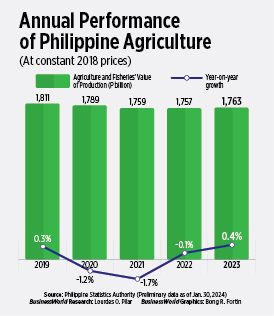
Data from the PSA showed the full-year value of production in agriculture and fisheries at constant 2018 prices expanded by 0.4%, well-below the Department of Agriculture’s 2.3%-2.5% growth target.

This was a reversal of the 0.1% contraction in farm output last year. It was also the first time agricultural output posted growth after three straight years of decline or since the 0.3% growth in 2019.

The PSA attributed the increase to higher production in crops, livestock, and poultry, although this was tempered by the decline in fisheries.

In the fourth quarter, the value of agricultural production rose by 0.7%, a reversal of its 1% drop in the same period in 2022 and the 0.2% decline in the third quarter of 2023.

At current prices, the value of production in agriculture and fisheries rose by 7.8% year on year to P659.02 billion in the fourth quarter.

The agriculture sector contributes around a tenth to overall gross domestic product (GDP). Fourth-quarter and full-year 2023 economic data are scheduled to be released today (Jan. 31).

Elias Jose M. Inciong, president of the United Broiler Raisers Association, said agriculture production may have expanded last year as it was coming from a low base in 2022.

“It is premature to talk about a rebound or even growth,” he said in a Viber message.
Crop output, which accounted for more than half of total agricultural production, inched up 0.1% in the October-to-December period, a reversal of the 1% decline during the same period in 2022.

For the full year, crop production rose by 0.7%, reversing the 1% contraction in 2022.

“For crops, weather was more favorable with less typhoons. Given that, however, output should have been much higher,” Federation of Free Farmers National Manager Raul Q. Montemayor said in a Viber message.

PSA data showed that palay or unmilled rice production went up by 0.2% in the fourth quarter, a turnaround from the 2.5% drop in the same period in 2022. For 2023, palay production jumped by 1.5%, an improvement from the 1% decline in 2022.

Palay production reached 20.06 million metric tons (MT) in 2023, translating to about 13.2 million MT of rice.

Roy S. Kempis, retired Pampanga State Agricultural University professor, said favorable weather conditions helped boost crop production last year.

“The near absence of typhoons that would land on Philippine soil is favorable to crop production, thus, crop output in (the fourth quarter) could prop up overall growth. The use of weather-resilient farming innovations also helped the crop sector grow,” Mr. Kempis said in a Viber message.

Philippine Institute for Development Studies Senior Research Fellow Roehlano M. Briones said in a Viber message the slight rebound in crops was partly due to higher farmgate prices, especially for rice.

The national farmgate price for palay rose 14% to an average of P19.89 per kilo in 2023, the PSA reported.

In the fourth quarter, corn output declined by 1.8%, slightly better than the 6.9% drop in the same period in 2022. However, corn production grew by 1.8% in 2023, a turnaround from the 0.3% dip in 2022.

Other crops also saw double-digit growth in the October-to-December period such as cabbage (15.5%) and sugarcane (10.5%), while increases were seen in mango (7.6%), ampalaya (4%), cacao (3.4%), eggplant (3%), abaca (2.9%), tomato (2.6%), and tobacco (2.1%).

On the other hand, lower production was seen in rubber (-7.5%), onion (-6.8%), potato (-5.3%), sweet potato (-4.7%), calamansi (-4.3%), cassava (-2.7%), coconut (-1.9%), coffee (-1.7%), and banana (-0.2).

“Good prices for agricultural commodities on the part of the farmer-producers (are) the best incentive to production. If we can calibrate the role and margins of traders, we can predict more productivity from the producers,” Danilo V. Fausto, presi-dent of the Philippine Chamber of Agriculture and Food, Inc. said in a Viber message.


LIVESTOCK, POULTRY

Meanwhile, PSA data showed livestock production increased by 2.7% in the fourth quarter, slightly higher than the 2.5% growth a year ago.  

For 2023, livestock output jumped by 2.5%, an improvement from the 1.9% print in 2022. 

In the fourth quarter, dairy production surged by 17.2%, faster than the 1% growth in the same period in 2022.  

Output growth was seen for hogs (3.7%) and goat (1.3%), while lower production was reported for cattle (-2.6%) and carabao (-0.9%). 

PSA data also showed poultry output grew by 7.8% during the fourth quarter, faster than the 1.8% print a year ago. For the full year, poultry production rose by 3.8%, slower than the 7% growth in 2022.  

Mr. Inciong said the growth in the poultry sector could be attributed to more “big players” going into the broiler industry. 

“Aside from local players, such as SMC (San Miguel Corp.), Bounty, Vitarich, and Foster, foreign companies were also aggressive in the loading of broiler breeders,” he said.  

All sub-sectors under poultry showed growth in the fourth quarter, such as chicken (8.1%), chicken egg (7.8%), duck (0.6%), and duck eggs (0.3%). 

“For livestock and poultry, production outputs were the stable and consistent backbone of the overall agricultural output in 2023,” Mr. Kempis said. 

“These two sectors tend to be insulated from climate and weather condition changes, especially with the continuing transformation of housing technologies that allowed for climate-controlled environment in maintaining temperatures appropriate for growing both swine and broiler,” he added. 


FISHERIES SLUMP 

Fisheries production slumped by 5.2% in the fourth quarter, slightly better than the 6.7% decline a year ago.  

For the full year, fisheries output dropped by 6.5%, worsening from the 5% slide in 2022. 

Mr. Kempis said that the effects of the southwest monsoon and north-easterlies may have prevented fisherfolk from venturing to sea, leading to a further decline in production. 

For the October-to-December period, double-digit declines were seen in the production of fimbriated sardines (-34.2%), threadfin bream or bisugo (-31.6%), blue crab (-31.2%), tiger prawn or sugpo (-15.4%), and slipmouth or sapsap (-11%). 

Production also dropped for grouper or lapu lapu (-9.7%), tilapia (-7.5%), squid (-7%), skipjack or gulyasan (-5.8%), milkfish or bangus (-5.8%), big-eyed scad or matangbaka (4.6%), frigate tuna or tulingan (-3.4%), and cavalla or talakitok (-2.6%). 

Meanwhile, growth in production was recorded for bigeye tuna (98.6%), Indian mackerel or alumahan (55.9%), mudcrab or alimango (19%), yellowfin tuna (13.9%), Bali sardinella or tamban (4.3%), round scad or galunggong (0.2%), and seaweed (12.8%). 

“However, capture fisheries continue (their) downward trend as it continues to falter from past overfishing and continuing management measures,” Mr. Briones said, noting a recovery in aquaculture. 


OUTLOOK 

“Our goal is to push the rice harvest volume further but that could be a challenge this year because of water shortage we expect due to El Nino,” Agriculture Secretary Francisco P. Tiu Laurel, Jr. said in a separate statement. 

The ongoing El Niño, which is affecting local agricultural production, is expected to last until the second quarter of the year, according to the state weather bureau. 

“If the peak of El Nino is going to happen in April 2024, more or less many rice plants would have been harvested by then. But the subsequent planting of vegetables would be affected by the lack of water during April to May,” Mr. Kempis said. 

He added that livestock and poultry would remain a “stable provider” for agricultural growth during the year. 

On the other hand, Mr. Inciong said that the poultry sector may face challenges due to lower prices, causing producers to “be more conservative.” 

He added that poor demand conditions, high input costs, and increasing imports may also affect poultry production. 

“(The) fisheries sector will continue to struggle for growth for 2024 in view of overfishing and provisions for government’s post-harvest facilities to kick in as construction and deliveries of infrastructure is ongoing,” Mr. Fausto said. 

Mr. Tiu Laurel said the DA would allocate P5 billion in the next three years to construct several post-harvest facilities and cold storage sites around the country to prevent further losses in crops and fisheries.


IMF hikes PHL growth outlook for this year

Buildings are seen from the Pasig River Esplanade in Lawton Manila. -- EDD GUMBAN, The Philippine Star

By Keisha B. Ta-asan, Reporter

THE PHILIPPINE economy is set to expand by 6% this year amid likely stronger recovery in investments and exports, the International Monetary Fund (IMF) said on Tuesday.

In its January 2024 World Economic Outlook (WEO) update, the IMF upwardly revised its gross domestic product (GDP) growth outlook for the Philippines to 6% from the 5.9% forecast it gave in October.

However, the latest forecast is still below the government’s 6.5-7.5% GDP growth target for 2024.

“Growth in 2024 should be supported by an acceleration in public investment and improved external demand for Philippine exports, exports of services in particular,” IMF Representative to the Philippines Ragnar Gudmundsson said in an e-mail.

The multilateral lender also maintained its growth forecast for 2023 at 5.3% and for 2025 at 6.1%. Both projections are below the government’s targets of 6-7% in 2023 and 6.5-8% next year.

“GDP growth is expected to remain at around 6-6.5% over the medium term, making the Philippines one of the strongest performers in the region and globally,” Mr. Gudmundsson said.

However, he said a more abrupt global economic slowdown due to geopolitical tensions and geoeconomic fragmentation, a weaker recovery in China, or a sudden tightening in financial conditions worldwide are risks to the outlook.

“On the domestic front, steadfast implementation of structural reforms to raise productivity and successful efforts to attract more foreign investment would also contribute to raising growth prospects,” Mr. Gudmundsson said.

The IMF also hiked its 2024 growth projection for the world economy by 0.2 percentage point to 3.1% due to a stronger-than-expected economy in the United States and several large emerging economies. Global growth is also seen picking up to 3.2% in 2025.

The forecasts for 2024 and 2025 are still below the historical average of 3.8%, the IMF said, as elevated monetary policy rates and lack of fiscal support amid high debt may continue to weigh on economic activity.

The multilateral lender also hiked the 2024 forecast for the five economies in the Association of Southeast Asian Nations (ASEAN-5) to 4.7% from 4.5% in the October forecast. For next year, it trimmed the ASEAN-5 forecast by 0.1 percentage point to 4.4%.

ASEAN-5, comprised of the Philippines, Singapore, Malaysia, Vietnam, and Indonesia, is estimated to have expanded 4.2% in 2023.

The IMF noted the global economy is “surprisingly resilient” despite Russia’s invasion of Ukraine and the cost-of-living crisis is proving surprisingly resilient.

“Inflation is falling faster than expected from its 2022 peak, with a smaller-than-expected toll on employment and activity, reflecting favorable supply-side developments and tightening by central banks, which has kept inflation expectations anchored,” it added.

INFLATION OUTLOOK

The IMF upwardly revised its inflation projection for the Philippines this year to 3.7% from 3.2% previously, as global food prices may likely be higher this year.

Still, inflation is expected to be significantly lower this year compared to the 6% average in 2023.

“Inflation is projected to gradually approach the midpoint of the central bank’s 2-4% target range in the second half of 2024 and to average 3% in 2025,” Mr. Gudmundsson said.

The Bangko Sentral ng Pilipinas (BSP) sees headline inflation averaging 3.7% this year, before easing to 3.2% in 2025.

However, should risks materialize, the BSP’s risk-adjusted forecasts show that inflation could settle above the 2-4% target, or at 4.2%, this year before reverting back at 3.4% in 2025.

“The central bank is expected to stay on hold over the coming months to allow inflation expectations to settle more firmly within the target range, which in turn could lead to rate cuts,” Mr. Gudmundsson said.

“Possible rate cuts depend on inflation expectations settling firmly within the BSP’s 2-4% target range,” he added.

The central bank’s key interest rate currently stands at 6.5%, the highest in 16 years. This was after the BSP emerged as the most aggressive central bank in the region after hiking borrowing costs by 450 basis points from May 2022 to October 2023.

The BSP will hold its first policy meeting this year on Feb. 15.

Meanwhile, global headline inflation is expected to fall to 5.8% in 2024 and to 4.4% in 2025, the IMF said.

“With disinflation and steady growth, the likelihood of a hard landing has receded, and risks to global growth are broadly balanced. On the upside, faster disinflation could lead to further easing of financial conditions,” it said.

But supply shocks stemming from the continued attacks in the Red Sea and other disruptions may prolong tight monetary policy settings in economies, the multilateral lender said.

“Policy makers’ near-term challenge is to successfully manage the final descent of inflation to target, calibrating monetary policy in response to underlying inflation dynamics and — where wage and price pressures are clearly dissipating — adjusting to a less restrictive stance,” the IMF added.

PHL ranking improves in global corruption index

Philippine flags are seen along a highway in Metro Manila. -- Photo by Edd Gumban, The Philippine Star

By Kyle Aristophere T. Atienza, Reporter

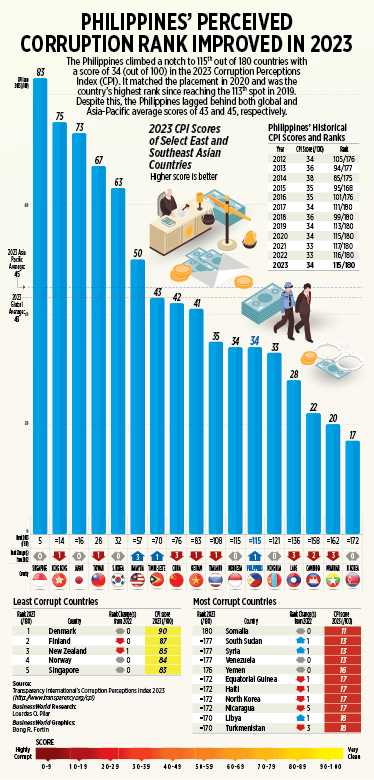
THE PHILIPPINES’ ranking in a global corruption index by Transparency International inched up one spot with its score remaining at a record low, and Filipino governance experts said any significant improvement is unlikely in the near future.

Manila ranked 115th out of 180 countries with a score of 34 in the 2023 Corruption Perceptions Index (CPI), up one spot from 116th in 2022 and up two spots from its worst-ever showing of 117th place in 2021. The Philippines had ranked 115th in 2020, 113th in 2019, and 99th in 2018.

The Philippines’ score of 34 is also well below the global average of 43 and Asia-Pacific region’s average of 45.

Among Asia-Pacific countries, the Philippines’ score lagged behind New Zealand (83), Singapore (83), Australia (75), Hong Kong (75), Japan (73), Bhutan (68), Taiwan (67), South Korea (63), and Malaysia (50). It also lagged Timor-Leste (43), China (42), Vietnam (41), India (39), Nepal (35), and Thailand (35).

Like the Philippines, Indonesia, and Sri Lanka also had a score of 34.

Manila was only ahead of Mongolia (33), Pakistan (29), and Papua New Guinea (29) as well as countries with governments deemed autocratic such as Laos (28), Bangladesh (24), Cambodia (22), Afghanistan (20), Myanmar (20), and North Korea (17).

In the report, the watchdog said Southeast Asian countries have struggled to deliver on anti-corruption efforts, with the Philippines and Thailand remaining “on the lower end of the spectrum.”

It said Malaysia remained above the regional average with robust elections alongside an anti-corruption commission that has delivered on high-profile cases over the last decade.

Prospects were also bleak for Indonesia amid uncertainties on the future of its “severely disempowered” anti-corruption agency, and Vietnam, whose “promising” high-profile anti-corruption campaign has been marred “by the continued restriction of critical voices.”

The one-notch improvement in the Philippine ranking was insignificant “primarily because there is no anti-corruption program that was launched by the Marcos administration,” said Gary Ador Dionisio, dean of the De La Salle – College of Saint Benilde School of Diplomacy and Governance.

It’s “unfortunate” that the Philippine leader failed to push for programs necessary for the elimination of corruption in his second address to Congress in July last year, Ateneo School of Government Dean Philip Arnold P. Tuaño said, “and neither major initiatives in transparency and accountability have been launched.”

Mr. Marcos ran in the presidential election more than two years ago under a platform of unity which, in recent days, turned out to be a promise that is so difficult to fulfill.

His administration is now publicly challenged by the family of Vice-President Sara Duterte-Carpio, who ran in tandem with him in the 2022 elections.

Tensions between the country’s top two officials became more apparent after the President’s allies in Congress stripped Ms. Duterte’s offices as vice-president and Education secretary of proposed confidential and intelligence funds worth P650 million under the 2024 national budget amid public criticism on the latter’s use of secret funds amounting to P125 million in just 11 days in 2022.

During and after the election season, Mr. Marcos had been hounded by questions on the alleged failure of his family to settle a P23-billion estate tax liability that had ballooned to more than P200 billion due to penalties and surcharg-es. The 1997 Supreme Court decision ordering the heirs of the late dictator Ferdinand E. Marcos to pay the estate tax liability became final and executory on March 9, 1999.

“The lack of a comprehensive anti-corruption program simply means that the Marcos administration is afraid of the ghost of the past and even the present,” Mr. Dionisio said.

DUTERTE LEGACY

Under the Duterte administration, the Commission on Audit had flagged many agencies for their deficiencies.

“The various CoA (Commission on Audit) reports show the extent of wastage in public funds that date back to the previous administration which President Marcos and his Cabinet cannot ignore,” said Zyza Nadine Suzara, executive director of governance watchdog iLead. “They need to proactively restore the international community’s trust in our public institutions.”

Francisco A. Magno, director of the Jesse M. Robredo Institute of Governance at De La Salle University, raised concern over the “slow progress” in the prosecution of high-profile cases involving irregularities in public procure-ment flagged by the state auditors and investigated by legislative oversight committees.

“There is also a weakening exercise of media and civil society monitoring of corrupt practices that became palpable under the previous administration and continues under the present one,” he said.

The National Government on Sunday held a major rally under the banner Bagong Pilipinas (New Philippines), with Mr. Marcos saying that change should start with the government.

“Being lazy and slow is not acceptable in government. There is no place for them in public service,” he said in a speech before hundreds of thousands of participants, many of whom were state employees.

“Services must be fast. Projects must be completed on time. Deadlines must be met per schedule,” he added. “Distress calls must be responded to without delay.”

Ms. Suzara said the corruption level in the Philippines is a major barrier to the entry of foreign investments into the country, as it “signals that the current Marcos Jr. administration, like its predecessor, is still not taking good governance seriously.”

“To improve our standing, the Marcos Jr. administration therefore needs to implement reforms that will strengthen transparency and accountability,” she said. “Congress must also do the same especially in performing oversight functions on the national budget.”

But for Terry L. Ridon, convenor of think tank InfraWatch PH, “the public has not yet seen a major corruption scandal involving officials at the highest levels” in Mr. Marcos’ first two years in office, “unlike the major corruption scandals in the previous regime.”

“More significantly, the business and investment climate is better today, with the successive international roadshows participated in by no less than President Marcos himself,” he added.

Mr. Dionisio said prospects for the Philippines’ anti-corruption efforts remain bleak.

“It is very unlikely that we will have a radical improvement of our CPI standing the way our governance is unfolding.”

Q3 GDP growth revised to 6%

A vendor arranges dried fish at a stall in Manila, Aug. 10, 2023. -- Edd Gumban, The Philippine Star

THE PHILIPPINE economy expanded by 6% in the third quarter, slightly faster than initially reported, according to the Philippine Statistics Authority (PSA).

The PSA upwardly revised the country’s gross domestic product (GDP) growth rate to 6% from the 5.9% reported in November last year.

This brought the growth in the first three quarters to 5.6% from 5.5% initial estimate.

The upward revision came ahead of the fourth-quarter and full-year 2023 release of GDP data today (Jan. 31).

Philippine GDP likely expanded by 5.7% in the fourth quarter, based on a BusinessWorld poll of 20 economists. If realized, this would be a tad slower than the third quarter’s revised pace and the 7.1% growth in the final three months of 2022.

The BusinessWorld poll yielded a 5.5% full-year estimate, falling below the government’s 6-7% target growth for 2023.

Should this materialize, it would be slower than the 7.6% growth recorded in 2022.

To meet the lower end of the government target, the Philippine economy should have expanded by at least 7.2% in the fourth quarter.

The PSA said that the main sources of upward revision of the third-quarter print were manufacturing (5.1% from 4.5%), financial and insurance activities (9.6% from 9.5%), and accommodation and food service activities (21% from 20%).

On the expenditure side, private consumption’s third-quarter growth was revised upwards to 5.1% from 5% previously. Government spending was maintained at 6.7%.

Meanwhile, the net primary income from the rest of the world was revised downwards to 111.6% from the preliminary 112.5%.

On the other hand, gross national income for the third quarter was kept at 12.1%.

National account revisions are based on approved revision policy, which is consistent with international standard practice, the PSA said. — Andrea C. Abestano