Home Blog Page 3569

SEC adopts sustainable finance taxonomy guidelines

THE Securities and Exchange Commission (SEC) has adopted the Sustainable Finance Taxonomy Guidelines (SFTG) to promote environmentally and socially sustainable economic activities.

In a statement on Tuesday, the corporate regulator announced the issuance of Memorandum Circular No. 5 on Feb. 23, outlining the guidelines on Philippine Sustainable Finance Taxonomy. The SFTG provides a framework for assessing the environmental and social sustainability of economic activities.

“Issuers of securities shall refer to the SFTG when making investment decisions or designing sustainable financial products and services, among others. They must also comply with the relevant memorandum circulars issued by the SEC when issuing green, social, sustainability, and sustainability-linked bonds,” the SEC said.

The SFTG offers a “simplified approach” on the assessment of micro, small, and medium enterprises (MSMEs) activity for financing, the commission said.

The rules also ensure that MSMEs are not excluded from participating in “sustainable finance.”

“With the Philippine SFTG in place, we hope to channel and amplify more capital toward economic projects that further sustainability goals such as lowering greenhouse gas emissions and bolstering climate resilience, while fostering transparency by reducing the likelihood of greenwashing,” SEC Chairperson Emilio B. Aquino said.

Financing of economic activities is deemed environmentally or socially sustainable and aligned with the SFTG if these are not mentioned in the list of excluded activities. Excluded activities include gambling, lethal defense goods, conflict minerals, extractive mining, and military contracting.

Issuers will then choose the environmental objective (EO) of the activity such as its relevance and strategic alignment, investors or financial institutions’ priority, and government and industry guidance.

“Focusing on an EO should not significantly harm other EOs. Should there be harm, the issuer should verify that the same has been remediated or will be remediated within the required defined period,” the guidelines said.

“Regulated entities should refer to the general guiding questions for the do no significant harm (DNSH) to focus assessment on the potential or actual harm to another EO,” it added.

Following the assessment process, economic activities could be classified as green or those with “substantial contribution” to an EO; amber or those with substantial contribution to an EO but causes harm to another, but which can be remediated within five years, or there is a reliable claim that remediation will take less than 10 years; and red, or those that do not meet the criteria.

“An activity that falls under the Red classification does not meet the higher sustainability ambition of the SFTG or pass the DNSH or minimum social safeguards tests. The classification, however, does not imply that the activity is unsustainable; such an activity may still be eligible for unlabeled financing,” the guidelines said. — Revin Mikhael D. Ochave

RCBC updates sustainable finance framework to align with int’l rules

PHILSTAR FILE PHOTO

RIZAL COMMERCIAL Banking Corp. (RCBC) has amended its sustainable finance framework to align with the updated principles of offshore bond associations, it said on Tuesday.

The lender updated its guidelines to align with the International Capital Market Association’s Green Bond Principles, Social Bond Principles and Sustainability Bond Guidelines and with the Loan Market Association, Asia Pacific Loan Market Association and Loan Syndications and Trading Association’s Green Loan and Social Loan Principles, the Yuchengco-led bank said in a statement.

“We remain to be a catalyst for positive change through responsible finance which can help contribute to the protection and restoration of our planet’s invaluable ecosystems. The amended framework also reinforces our support in addressing societal needs toward sustainable development,” RCBC President and Chief Executive Officer Eugene S. Acevedo said.

RCBC expanded its eligibility criteria for social projects, and for green projects to include a subset of blue projects.

The amendments are also in line with the Securities and Exchange Commission’s Guidelines on Eligible Blue Projects and the International Finance Corp.’s Guidelines for Blue Finance.

Sumitomo Mitsui Banking Corp. Singapore Sustainability Solutions Group Asia Pacific advised RCBC in the amendment of its framework. Sustainalytics also issued a second party opinion for the amendments to ensure they are in line with principles and market practices.

“RCBC publishes the annual limited assurance allocation report and impact report on its website in line with the disclosure requirements of the framework,” the lender said.

“The bank’s Sustainable Finance Framework remains aligned with the four pillars of sustainable finance: use of proceeds, project evaluation and selection, management of proceeds, and reporting,” RCBC added.

The bank in January raised $400 million from its offer of five-year senior unsecured sustainability notes due 2024 that marked its return to the overseas debt market after over three years.

The issuance was almost six times oversubscribed, with orders reaching $2.3 billion coming from more than 164 accounts. The bonds fetched a coupon rate of 5.5% per annum.

RCBC financed over 8,200 projects under eligible green and eligible social categories in 2022 amounting P71.2 billion, it said.

The bank’s attributable net income rose by 1.14% to P12.218 billion last year amid higher loans and deposits.

RCBC’s shares went down by 50 centavos or 2.27% to close at P21.50 each on Tuesday. — A.M.C. Sy

How much did each commodity group contribute to February inflation?

HEADLINE INFLATION accelerated for the first time in five months in February as prices of food, particularly rice, rose faster than expected, according to preliminary data from the Philippine Statistics Authority (PSA). Read the full story.

How much did each commodity group contribute to February inflation?

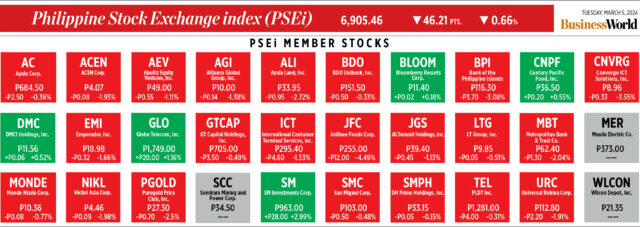
How PSEi member stocks performed — March 5, 2024

Here’s a quick glance at how PSEi stocks fared on Tuesday, March 5, 2024.


Shares close lower as inflation picks up in Feb.

BW FILE PHOTO

PHILIPPINE SHARES closed in the red on Tuesday due to data showing that headline inflation quickened in February.

The bellwether Philippine Stock Exchange index declined by 0.66% or 46.21 points to end at 6,905.46 on Tuesday, while the broader all shares index dropped by 0.4% or 14.68 points to close at 3,604.27.

“This Tuesday, the local market dropped by 46.21 points (-0.66%) to 6,905.46 as investors digested the inflation data for February… This also broke the four-month declining trend of inflation,” Philstocks Financial, Inc. Research and Engagement Officer Mikhail Philippe Q. Plopenio said in a Viber message.

“Philippine shares continued to succumb to profit taking, as the latest consumer price index ticked higher than many analysts’ forecasts,” Regina Capital Development Corp. Head of Sales Luis A. Limlingan likewise said in a Viber message.

Headline inflation accelerated to 3.4% in February from 2.8% in January, the Philippine Statistics Authority reported on Tuesday. Still, the consumer price index (CPI) was slower than the 8.6% print in the same month a year ago.

Last month’s inflation print was above the 3% median estimate in a BusinessWorld poll of 16 analysts conducted last week, but was within the Bangko Sentral ng Pilipinas’ (BSP) 2.8-3.6% forecast for the month.

This also marked the first time that headline inflation picked up month on month since September 2023.

For the first two months, the CPI averaged 3.1%, within the BSP’s 2-4% annual target.

“Wall Street’s decline overnight spilled over to the bourse as well amid profit taking after the S&P 500 and Nasdaq reached record highs last week,” Mr. Plopenio added.

Wall Street stocks closed lower on Monday, backing away from record highs, while US Treasury yields ticked higher as investors looked ahead to key jobs data and Federal Reserve Chair Jerome H. Powell’s congressional testimony later in the week, Reuters reported.

The Dow Jones Industrial Average fell 97.55 points or 0.25% to 38,989.83; the S&P 500 lost 6.13 points or 0.12% to 5,130.95; and the Nasdaq Composite dropped 67.43 points or 0.41% to 16,207.51.

Back home, majority of the sectoral indices ended lower on Tuesday. Financials fell by 1.56% or 31.56 points to 1,990.60; industrials went down by 1.47% or 138.07 points to 9,195.60; property retreated by 1.08% or 31.69 points to 2,883.25; and services dropped by 0.89% or 15.98 points to 1,771.96.

On the other hand, holding firms rose by 0.96% or 62.83 points to 6,568.35, and mining and oil improved by 0.004% or 0.30 point to 8,547.26.

Value turnover dropped to P5.37 billion on Tuesday with 425.75 million issues switching hands from P5.64 billion with 530.17 million shares traded the prior day.

Decliners beat advancers, 113 against 77, while 50 issues closed unchanged.

Net foreign buying fell to P308.84 million on Tuesday from P799.61 million on Monday. — R.M.D. Ochave with Reuters

Peso inches up vs dollar

BW FILE PHOTO

THE PESO inched higher against the dollar on Tuesday amid expectations of weaker US jobs and manufacturing data.

The local unit closed at P55.95 per dollar on Tuesday, rising by two centavos from its P55.97 finish on Monday, Bankers Association of the Philippines data showed.

The peso opened Tuesday’s session weaker at P56 against the dollar. Its worst showing was at P56.04, while its intraday best was its closing level of P55.95 versus the greenback.

Dollars exchanged went up to $821.65 million on Tuesday from $768.2 million on Monday.

“The peso strengthened ahead of a potentially weaker US services PMI (purchasing managers’ index) report,” a trader said in an e-mail.

The peso gained as the dollar moved sideways on expectations of softer US jobs data, Rizal Commercial Banking Corp. Chief Economist Michael L. Ricafort said in a Viber message.

He said weak employment data could justify future rate cuts by the US Federal Reserve.

The Fed raised borrowing costs by 525 basis points from March 2022 to July 2023 to the 5.25-5.5% range.

For Wednesday, the trader said the peso could weaken against the dollar amid market caution ahead of Fed Chair Jerome H. Powell’s semi-annual US Congressional testimony.

The trader sees the peso moving between P55.85 and P56.10 per dollar on Wednesday, while Mr. Ricafort expects it to range from P55.85 to P56.05.

Meanwhile, the dollar was steady against the yuan on Tuesday as markets digested policy statements out of China that were short on big stimulus measures, while a rebound in Tokyo inflation seemed to take Japan a step closer to the end of negative interest rates, Reuters reported.

Spot yuan opened at 7.1950 per dollar and was changing hands at 7.1985, while the offshore yuan was little changed at $7.2100 as markets hoped more concrete stimulus measures would emerge.

The dollar was last at 150.44 yen, having again shied away from resistance around 150.85, which has capped the currency for more than three months now.

A break higher would open the way to November’s top at 151.92, but would also run the risk of provoking Japanese intervention.

The dollar index, which measures the currency against six major peers, edged higher to 103.87. — AMCS with Reuters

4 Philippine Navy officers hurt after China fires water cannons at ship

A Chinese Coast Guard vessel fires its water cannon at Unaizah Mae 4 during a Philippine resupply mission for Filipino troops stationed on BRP Sierra Madre in Second Thomas Shoal on March 5, 2024. — ARMED FORCES OF THE PHILIPPINES

By Kyle Aristophere T. Atienza, Reporter

AT LEAST four Philippine Navy officers were injured on Tuesday after China’s coast guard fired water cannons at one of two wooden civilian boats used in a resupply mission for Filipino troops at a remote outpost in the South China Sea.

The water cannons from two Chinese Coast Guard vessels shattered the windshield of Unaizah Mae 4, “causing minor injuries to at least four personnel on board,” the Philippines’ National Security Council (NSC) said in a statement.

The incident happened while President Ferdinand R. Marcos, Jr. was in Melbourne for a three-day summit between Australia and Southeast Asian nations. On Monday, he vowed to push back if China continues to violate Philippine sovereignty and sea rights.

The Navy officers were treated by Philippine Coast Guard (PCG) personnel from the BRP Sindangan, which was escorting the civilian boat during the mission, NSC said.

Before this, a Chinese coast guard vessel executed “dangerous maneuvers” against the escort ship, leading to a minor collision that resulted in “superficial structural damage” to the hull of the PCG vessel, it added.

It said Unaizah Mae 1, one of the two resupply boats, managed to deliver supplies to BRP Sierra Madre, a World War II-era vessel that Manila deliberately grounded at Second Thomas Shoal in 1999 to assert its sea claims.

“The systematic and consistent manner in which the People’s Republic of China carries out these illegal and irresponsible actions puts into question the sincerity of its calls for peaceful dialogue and lessening tensions,” NSC said.

The Department of Foreign Affairs (DFA) summoned the Chinese deputy chief of mission “to convey the Philippines’ protest against the aggressive actions undertaken by the China Coast Guard and Chinese maritime militia,” the agency said in a WhatsApp group message.

During the meeting, Philippine officials said China’s interference in the Philippines’ “routine and lawful activities in its own exclusive economic zone is unacceptable.” “China’s actions in Ayungin Shoal (Second Thomas Shoal) infringes upon the Philippines’ sovereign rights and jurisdiction.”

“The Philippines demands that Chinese vessels leave the vicinity of Ayungin Shoal immediately.”

Earlier in the day, the Philippine military said the resupply mission seeks to keep Philippine presence within the country’s exclusive economic zone in the South China Sea.

“It also demonstrates the Armed Forces of the Philippines’ commitment to ensuring that every Filipino will rightfully benefit from this resource-rich region.”

The Chinese Coast Guard in a statement posted on its website accused the Philippine vessels of “intrusion,” adding that BRP Sierra Madre had been “illegally grounded” at the shoal.

“The response of the China Coast Guard is in accordance with legal protocols and based on professional procedures,” it said, adding that the Philippines “broke promises, provoked with extortion tactics, sensationalized the story, and kept sabotaging the peace and stability of the South China Sea.”

The Japanese Embassy in Manila said Japan “reiterates its grave concern on the repeated dangerous actions in the South China Sea including the recent use of water cannon by the Chinese Coast Guard.”

“Japan will continue to stand with the Philippines and cooperate with like-minded countries to maintain the peace and stability in the region,” it added.

Second Thomas Shoal is just 240 kilometers west of the Philippine main island of Luzon and is nearly 900 kilometers from Hainan, the nearest major Chinese landmass.

Stanford University’s Gordian Knot Center for National Security Innovation earlier said Chinese maritime militia ships had set up “blockade positions” while the Philippine vessels were on their way to Second Thomas Shoal.

‘DANGEROUS MANEUVERS’
After the incident, Raymond M. Powell, a fellow at the Gordian Knot Center, said China “demonstrated that it is committed to violently enforcing its illegal blockade of the BRP Sierra Madre, the Philippines’ outpost for 25 years located in its own lawful exclusive economic zone.”

“There is no other place in the world where one country is conducting a blockade against another during peacetime,” he told BusinessWorld in an X message.

Mr. Powell said the outrage should serve as an opportunity for the international community to stand beside the Philippines and demand for China to “stop behaving like a pariah nation.”

European Ambassador to the Philippines Luc Veron said in an X post the “pattern of dangerous maneuvers and blocking” by Chinese vessels was troubling.

US Ambassador to the Philippines MaryKay L. Carlson condemned China’s “dangerous maneuvers,” which she said endangered lives and resulted in injuries.

The Philippine Foreign Affairs department said it had filed nine diplomatic protests against China this year, bringing the total since Mr. Marcos assumed office in July 2022 to 142.

Mr. Marcos was in Melbourne for a special summit between ASEAN and Australia, which has boosted its ties with Manila in the face of an increasingly assertive China. 

The Philippine leader during a state visit to Australia last week told Australia’s Parliament Manila is on the frontline of a battle for regional peace.

Mr. Marcos on Monday told a Lowy Institute forum that while the Philippines is compelled to cooperate with China on matters where their interests align, it would “push back when our sworn principles, such as our sovereignty, sovereign rights, and our jurisdiction in the West Philippine Sea are questioned or ignored.”

“We shall never surrender even a square inch of our territory and our maritime jurisdiction,” he said.

“China sends another message of violence as the collision occurred at a time when Marcos met with Australian and Southeast Asian counterparts to lobby for the Philippines’ sovereignty and maritime rights,” said Chester B. Cabalza,  founder of Manila-based International Development and Security Cooperation.

“It goes to show that Beijing detests Manila’s stronger collective deterrence and multilateral track in advocating rules-based actions in the South China Sea,” he said in a Facebook Messenger chat.

He noted that the collision on Tuesday was not the first, adding that the violence perpetrated by Chinese coast guard and maritime militia vessels had malicious intent.

The Chinese Coast Guard rammed a PCG ship and two Philippine resupply ships, one of which was carrying the Philippine military chief, in December.

Almost 200 Chinese militia ships were present near disputed areas of the South China Sea on any given day last year, or a 35% increase, US think tank Asia Maritime Transparency Initiative (AMTI) said in a report on Feb. 28.

It said the contrast between the relatively low Chinese militia presence at Second Thomas Shoal and the intensity of operations during resupply missions indicates that “professional militia ships stand ready to support China Coast Guard operations at short notice at any point of friction.”


Philippines, US to hold drills on islands facing South China Sea, Taiwan

DVIDS/ LANCE CPL. ISAIAH CAMPBELL

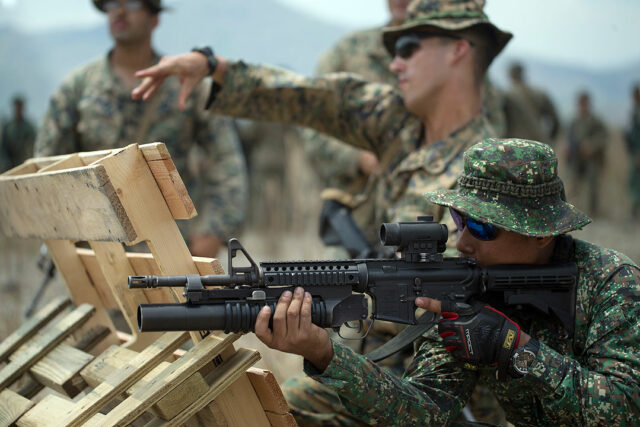
THE PHILIPPINES and the United States will carry out annual military exercises next month in key locations including Philippine islands facing the South China Sea and Taiwan, as tensions with China continue to simmer.

The exercises, called Balikatan or “shoulder-to-shoulder,” will move away from sprawling military camps in the countryside to locations in northern and western regions, Philippine Army Colonel Michael Logico told a news briefing on Tuesday.

The move is consistent with the shift in the country’s focus from internal to external defense.

This year’s exercises, which a Philippine diplomat previously said could be larger than last year’s 17,000-strong drills, will also focus on cybersecurity training and “information warfare.”

Batanes, the island province closest to Taiwan, could again be one of this year’s exercise venues, Mr. Logico said, but he stressed the activities would not focus on the democratically governed island.

“It is natural for us to exercise in those areas because if it’s part of a Philippine territory, it is where we wave our flag, these are the areas we defend,” he said.

China claims Taiwan as its own territory despite the island’s rejection, and routinely stages air and naval military operations near the island.

The exercises will also be held in areas of Palawan province in the South China Sea where frequent maritime run-ins between Manila and Beijing have occurred in the past year.

“These are locations where we can adequately perform joint operations,” Mr. Logico said.

The Philippines on Tuesday accused China’s coast guard of carrying out “dangerous maneuvers” that led to a collision between its ship and a Philippine wooden boat during a resupply mission for Philippine troops at Second Thomas Shoal.

Like last year, Mr. Logico said militaries from both countries would conduct a ship-sinking exercise.

Ties between Washington and Manila have warmed under President Ferdinand R. Marcos, Jr., who last year almost doubled the bases American troops can access under a defense pact.

Australian troops will also join the exercises while the French Navy are participating for the first time, Mr. Logico said. France and the Philippines are both seeking authority to negotiate a military agreement.

Philippine Armed Forces spokesman Francel Margareth Padilla said the exercises would be held from the third week of April to the first week of May. — Reuters

Top Philippine court voids LGUs’ traffic ticketing system

PHILIPPINE STAR/ RUSSEL PALMA

By Chloe Mari A. Hufana

THE PHILIPPINE Supreme Court (SC) has barred local governments in Metro Manila from issuing traffic violation tickets and seizing drivers’ licenses, ordering them to follow the singe-ticketing system enforced by the Metropolitan Manila Development Authority (MMDA).

In a July 2023 decision made public on Tuesday, the tribunal voided a clause in 14 ordinances of cities in the capital region that empowered their own traffic enforcers to issue tickets, as it ruled the MMDA has the exclusive power to come up with road traffic policies.

“The legislative intent is already clear that the MMDA should be the central policymaking body in Metro Manila on matters relating to traffic management, and the entity charged with the enforcement of the same policies,” the court said in a 44-page decision written by Justice Alfredo Benjamin S. Caguioa.

“The law is thus clear and unambiguous,” it said.

The High Court noted that while the MMDA has no police or legislative powers, it has the “primary rule-making powers” in managing Metro Manila traffic.

It said the ruling does not undermine the autonomy of local government units (LGUs) since their interests are amply protected by the very structure of the MMDA.

Except for the MMDA chairman who is appointed by the President, the mayors of the 16 cities and the lone municipality in Metro Manila are all members of the Metro Manila Council — the governing board and policymaking body of the MMDA, it said.

“This structure breathes life to the avowed objectives of the MMDA law, which is to promote efficiency, cohesion, harmony and order in the delivery of metro-wide services such as traffic management in Metro Manila, without undermining local autonomy,” the tribunal said.

The High Court favored several transport groups that filed the lawsuit that questioned the ticketing system of the cities in 2006. The plaintiffs argued that the system violated the law that created the MMDA.

In December 2012, the Court of Appeals sided with the Metro Manila cities and rejected the appeal of the transport groups 10 months later, prompting them to elevate the case to the Supreme Court.

Focus on rice, temper food inflation — Salceda

PHILIPPINE STAR/KRIZ JOHN ROSALES

By Kenneth Christiane L. Basilio

INSTEAD of increasing rice imports, the government should act now to provide support to farmers expecting a harvest around April in hopes of easing food inflation by mid-year, Albay Rep. Jose Maria Clemente S. Salceda said Tuesday.

“If the government were to be obsessed with one thing, it must be rice. Rice is up 23.7 percent year-on-year, and month-on-month inflation was at an elevated 1.0 percent,” Mr. Salceda said in a statement to media in response to latest inflation rate data.

February inflation rose to 3.4% from 2.8% in the previous month, and the Philippine Statistics Authority (PSA) attributed the increase to food inflation, which settled at 4.8% compared to 3.3% in January.

“Moving forward, the interventions of the Department of Agriculture (DA) and the Cabinet as a whole must be laser-focused on rice,” said Mr. Salceda of the staple food in the Philippines.

To ease food inflation, he said the government should strengthen its post-harvest support to farmers by April to reduce damage and losses attributed to the preparation, logistics, and distribution of rice crops, which could reduce price shocks from imported rice products.

“Harvest season begins in April, so we need all post-harvest assistance programs by DA ready for rollout this month,” Mr. Salceda told BusinessWorld in a Viber message.

The economist-lawmaker said this is the “correct approach” over importing more rice, adding that “rice prices could actually stabilize” by June if government acted now.

“Post-harvest losses contribute to around 12% to 17% of total output, reducing them would help insulate us from imported rice price volatilities,” he said.

“We must also ensure that logistics issues at the port, in farm-to-market roads, and other potential supply bottlenecks are eased,” he added.

Group bucks school liberalization

EDUCATION experts on Tuesday told senators that the Philippines does not need more foreign-owned schools to raise the credentials of university students, saying investors are likely to leave a trail of debt after profiting.

“There is a peril to these aggressive foreign investors that will leave you (higher education institutions) dry after they exit and sell,” Genevieve Ledesma Laurel, executive director of the Government-Academe-Industry Network (GAIN), told a Senate hearing looking into Resolution of Both Houses No. 6 (RBH 6), which seeks to ease restrictions to ownership in higher education, public utilities, and advertising.

In the House of Representatives, a similar discussion heard the Korean Chamber of Commerce of the Philippines (KCCP) supporting such amendments, noting that foreign schools in the Philippines would attract more students in the region who prefer global standards in education. 

Back in the Senate, Ms. Laurel pointed out that local universities already have measures in place that allow students to earn international academic credentials through existing global partnerships.

“Retaining the current Constitution is recommended, fostering international collaborations within a controlled framework,” she said.

Commission on Higher Education (CHED) Chairman Prospero E. De Vera III on Monday told congressman that opening up ownership in the sector would help colleges and universities become more globally competitive.

Education Undersecretary Omar Alexander V. Romero opposed the Lower House’s proposal, saying it could affect the sense of nationalism of students.

Changes in the 1987 Constitution would present opportunities for improving the quality of Philippine education but would also pose risks that may “impact the country’s immediate future,” Jose Ramon G. Albert, a senior research fellow of the Philippine Institute for Development Studies told the same hearing, without naming any of the possible downsides.

“I caution the Congress to recognize that there will be unintended consequences to whatever changes we propose,” he told senators.

Gerardo P. Sicat, a former economics professor at the University of the Philippines, said the Philippines is lagging behind its regional neighbors since other countries have benefited from allowing foreign universities to set up shop.

In his statement to the House, KCCP President Hyunchong Joseph Um said that liberalizing the Philippine education industry would further strengthen it as it would attract more foreign students, just like when the Philippines hosted thousands of Koreans interested in learning English in previous years.

“We welcome the liberalization or relaxing of regulations because the world is more globalized,” he said, noting that his sentiments on the matter are shared by the Joint Foreign Chambers of the Philippines (JFC).

“Our group supports the easing of restrictions of foreign direct investment wherever this is possible. We are of the opinion that the removal of economic restrictions would facilitate increased FDI in sectors where such investment is restricted,” the JFC said in a Feb. 26 letter to Speaker Ferdinand Martin G. Romualdez.

Meanwhile, the University of Pennsylvania visiting scholar, Robin Michael U. Garcia, noted how countries with robust economies often have strong academic research capabilities. He added that academic innovation and development is “the path towards economic development.”

Foundation for Economic Freedom (FEF) fellow Victor S. Limlingan also supported full ownership and operation of foreign educational entities in the country, saying it would provide “more choices and opportunities for Filipino students.”

Anthony A. Abad, an international trade and investment expert, told the House that the Philippines should also implement Artificial Intelligence (AI) in its systems related to business and trade to accelerate the entry of investment.

In the Senate, Mr. De Vera said the Philippines must learn from other countries and see how they can limit the autonomy of foreign schools while benefiting from their expertise at the same time.

“While we support the possibility of the constitutional amendment, it will require also a reexamination of the framework for higher education and needed reforms,” he said. “If we amend the Constitution but don’t amend the framework of higher education, it also will not work the way supporters would push for it.”

The Senate plans on finishing the hearings and consultations on RBH 6 before President Ferdinand R. Marcos, Jr.’s address to Congress in July, Senator Juan Edgardo M. Angara told reporters after the hearing. — John Victor D. Ordoñez and Kenneth Christiane L. Basilio

Taguig sued over park dispute

FOUR Makati City employees who were allegedly trapped and harassed at the Makati Park and Garden located in an EMBO village last weekend filed charges against Taguig City Mayor Maria Laarni “Lani” L. Cayetano and her other officers on Tuesday.

A statement from the Makati City Information and Community Relations Department said three of the employees filed illegal detention and grave coercion charges against the mayor and her personnel, claiming they were detained against their will in the vicinity of the park last March 1-3.

Salvador C. Palisa, a maintenance employee assigned to the Makati Aqua Sports Arena (MASA), filed a fourth complaint of grave coercion against the same officials for allegedly being prevented to do his job by Taguig personnel.

These incidents happened amid the feud between the two cities over jurisdiction of 10 EMBO villages. The Taguig City government did not immediately reply to a request for comment.

In September 2022, the Supreme Court ruled it was illegal for Makati to have occupied the 10 EMBO villages for 30 years.

However, the turnover of administration and management of public services and offices established by Makati that are now ruled as part of the territory of Taguig has been a gruelling tug-of-war.

The ten villages are Pembo, Comembo, Cembo, South Cembo, West Rembo, East Rembo, Pitogo, Rizal, Post Proper Northside, and Post Proper Southside. — Chloe Mari A. Hufana