UKRAINE and Russian flags are seen through broken glass in this illustration taken March 1, 2022. — REUTERS
UKRAINE on Sunday rebuffed Pope Francis’s call to negotiate an end to the war with Russia, with President Volodymyr Zelensky saying the pontiff was engaging in “virtual mediation” and his foreign minister saying Kyiv would never capitulate.
Pope Francis said that when things were going badly for a party to a conflict one had to show the “courage of the white flag” and negotiate. The pope’s interview was believed to be the first time Francis has used terms like “white flag” or “defeated” in discussing the Ukraine war, though he has referred in the past to the need for talks.
Mr. Zelensky made no direct reference to Francis or his comments but mentioned religious figures helping inside Ukraine.
“They support us with prayer, with their discussion and with deeds. This is indeed what a church with the people is,” Mr. Zelensky said in his nightly video address.
“Not 2,500 kilometers away, somewhere, virtual mediation between someone who wants to live and someone who wants to destroy you.”
Foreign Minister Dmytro Kuleba, writing on the X messaging platform, said that the strong person in any dispute “stands on the side of good rather than attempting to put them on the same footing and call it ‘negotiations’”.
“Our flag is a yellow and blue one,” Kuleba wrote in English, referring to the Ukrainian national flag. “This is the flag by which we live, die, and prevail. We shall never raise any other flags.”
Mr. Kuleba also pointed to allegations that Pope Pius XII failed to act against the Nazis in Germany in World War II.
“I urge (the Vatican) to avoid repeating the mistakes of the past and to support Ukraine and its people in their just struggle for their lives,” he wrote.
That was a reference to longstanding arguments that Pius took no action despite evidence that emerged during the war of the extent of the Holocaust. A letter made public last year from the Vatican archives appeared to show that Pius was made aware of details of Nazi actions to exterminate Jews as early as 1942.
Supporters of Pius say he worked behind the scenes to help Jews and did not speak out in order to prevent worsening the situation for Catholics in Nazi-occupied Europe. His detractors say he lacked the courage to speak out on information he had despite pleas from Allied powers fighting Germany.
The head of Ukraine’s 5 million-strong Eastern Rite Catholic Church, Archbishop Sviatoslav Shevchuk, also rejected the pope’s comments.
“Ukraine is wounded, but not conquered! Ukraine is exhausted, but it stands and will stand!” the church’s website quoted Shevchuk as saying in New York.
“Believe me, no one has any idea of surrendering.”
Zelensky has called for the withdrawal of all Russian troops and the restoration of Ukraine’s post-Soviet borders. The Kremlin rules out engaging in talks on terms set by Kyiv.
The pope has upset Ukrainian officials several times in the war, including his call last year to Russian youth to take pride as heirs of tsars like Peter the Great, held up by President Vladimir Putin as an example to justify his actions in Ukraine.
European officials supporting Ukraine in efforts to evict Russian troops denounced the pope’s latest comments.
“How about, for balance, encouraging Putin to have the courage to withdraw his army from Ukraine?” Polish Foreign Minister Radoslaw Sikorski wrote on X.
Latvian President Edgars Rinkevics, also writing on X, said:
“One must not capitulate in face of evil, one must fight it and defeat it, so that the evil raises the white flag and capitulates.” — Reuters
Princess of Wales Kate Middleton following Britain’s King Charles’ coronation ceremony, in London, Britain May 6, 2023. — ANTHONY UPTON/POOL VIA REUTERS
LONDON — Several leading news organizations have withdrawn a photograph issued by Kensington Palace of Kate, Britain’s Princess of Wales, after post-publication analysis showed it did not meet their editorial standards.
The palace issued the photograph of Kate and her three children on Sunday, along with a message of thanks from the princess in her first public comments since undergoing abdominal surgery in January.
News agencies including Getty, Reuters, Associated Press and AFP withdrew the photograph later in the day. Reuters picture editors said part of the sleeve of Kate’s daughter’s cardigan did not line up properly, suggesting that the image had been altered.
Reuters could not immediately establish how, why or by whom the alteration had been made.
Leading picture agencies distributing news photographs prohibit the publication of images that have been overly edited.
The Reuters Handbook of Journalism states, for instance, that the editing tool Photoshop can only be used in very limited matters. “We use only a tiny part of its potential capability to format our pictures, crop and size them and balance the tone and color.”
Kensington Palace did not immediately respond to a request for comment.
Getty, Associated Press and AFP also did not immediately respond to a request for comment. Reuters said in a statement it had withdrawn the picture following a post-publication review. “We are reviewing the matter,” a spokesperson said.
The palace said the picture had been taken by Kate’s husband, heir-to-the-throne Prince William, last week. It showed Kate, 42, smiling and looking well, surrounded by Princes George and Louis and Princess Charlotte.
Kate has been absent from public royal life since Christmas Day, sparking rumors and speculation on social media about the health of the princess.
Kensington Palace said at the time of her surgery that Kate was unlikely to return to official duties until after Easter, which falls at the end of this month.
Officials had said they would provide only “significant updates” about her recovery. — Reuters
BRUSSELS – Countries across Europe should prepare for “catastrophic” risks, ranging from floods to deadly heatwaves, as worsening climate change hits every part of their economies and societies this century, the EU Environment Agency said on Monday.
Policymakers need to draw up new plans to address the challenges, the Copenhagen-based body said in its first Europe-wide analysis of climate-related risks.
WHY IT’S IMPORTANT
Europe is the world’s fastest-warming continent, heating up at twice the global rate, the EEA said. Even if countries manage to slow warming, global temperatures are already more than 1C higher than in pre-industrial times.
The EEA said the damage will depend, in part, on whether policymakers act now to prepare societies – for example, by improving insurance coverage, redesigning infrastructure and introducing laws to protect outdoor workers from deadly heat.
Without more urgent action, the EEA said most of the 36 climate risks facing Europe could hit “critical or catastrophic levels” this century. They include risks to health, crop production and infrastructure.
BY THE NUMBERS
In a pessimistic scenario, by the end of the century, the EEA said: “Hundreds of thousands of people would die from heatwaves, and economic losses from coastal floods alone could exceed 1 trillion euros per year.”
That would far exceed the 650 billion euros lost to weather and climate-related extremes across the bloc from 1980 to 2022.
KEY QUOTES
Kate Levick, associate director at climate think-tank E3G, urged governments to respond to the EEA’s findings.
“There’s a particular role for finance ministers to essentially look at what happens to balance sheets, in terms of assets and liabilities at national level, as a result of climate risk,” Ms. Levick said.
WHAT’S NEXT
The European Commission will publish its response to the report on Tuesday. – Reuters
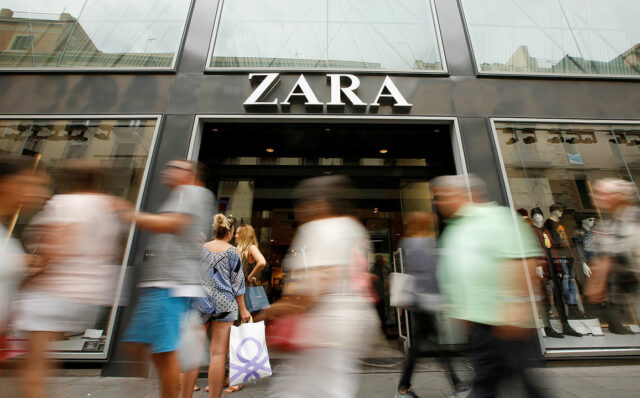
People walk past a Zara store, an Inditex brand, in central Barcelona, Spain, Sept. 20, 2016. — REUTERS/ALBERT GEA
LONDON – Investors want Zara owner Inditex to follow rivals H&M and Primark in making its full list of suppliers public so they can better assess any supply chain risks.
Inditex is an outlier among big clothing retailers in not publishing which factories it sources from. Regulators and investors want greater transparency and better disclosure from companies.
Clothing retailers, in particular, are under pressure to prove that there is no forced labor in their supply chains, and that garment workers are paid decent wages.
Chinese fashion group Shein has come under scrutiny from US lawmakers over supply chain risks ahead of plans for a US listing.
In the European Union, disagreements have stalled proposed rules that would require all big companies to disclose whether supply chains harm the environment or use child labor. Proposed sanctions for not complying could include fines of 5% of revenue.
Fashion brands and retailers, including Adidas, H&M, Hugo Boss, M&S, Nike, Primark, and Puma, already publish detailed supplier lists, including factory names and addresses.
Inditex publishes annually the number of suppliers it sources from in 12 core countries, but gives no information on individual factories.
Reuters asked Inditex shareholders what they wanted to see from the company in terms of improved disclosure.
In response, Dutch asset manager MN said: “In our engagement with Inditex one of the things we ask is if they could disclose a list of their suppliers and the geographical location.”
“Even though Inditex assures us that they have this data available, up until now Inditex is not willing to disclose this information unlike some industry peers who publish extensive supplier lists.”
MN, which manages Dutch pension fund assets, said it was important to have this insight to show whether Inditex has this information available, as well as for its own due diligence.
MN leads the Inditex dialogue for Platform Living Wage Financials (PLWF), a group of 20 institutional investors with combined assets under management of 6.58 trillion euros ($7.16 trillion). It works to promote higher income for garment and footwear industry workers.
Inditex, set to publish annual results on March 13, declined to comment on investors’ demands for it to publish its full supplier list.
“Inditex has a deep commitment to maintaining high standards in its supply chain, and believe that our industry-leading traceability system, which gives us maximum visibility of the supply chain, is key to this,” an Inditex spokesperson said.
Inditex founder Amancio Ortega holds a 59% stake in the company, with a 5% stake held by daughter Sandra Ortega. Together they are worth about $69 billion.
The five Inditex investors who responded to Reuters’ questions hold a combined stake of worth around $2 billion in the company, whose current valuation is about $140 billion.
None of the investors Reuters spoke to are considering divesting from Inditex.
MN said it advised its clients in December to divest from off-price retail chain TJX, which owns Homesense and TK Maxx, and they were divested as of January 1.
“Over the more than three years of engagement we have seen very little improvement on human rights due diligence in their global supply chain,” MN told Reuters.
TJX said it has strengthened its vendor code of conduct and expanded its factory auditing program in recent years.
MORE TRANSPARENCY
Inditex has an agreement with global trade union federation IndustriALL under which it provides it with its full list of suppliers. But IndustriALL wants wider disclosures from all companies, including Inditex, it said.
Know The Chain, a benchmarking initiative for companies and investors to address forced labor in supply chains, gave Inditex a lower overall score in its 2023 assessment than its 2021 assessment.
“The company is encouraged to strengthen its supply chain transparency by disclosing a full, rather than partial, list of its direct suppliers,” Know The Chain said.
Publishing its factories could bring more competition from Inditex rivals for the same suppliers, investors say.
Swetha Ramachandran, portfolio manager at Artemis Investment Management in London, wants to know what share of Inditex revenues is manufactured in each different supplier country. “It would help us determine their supply chain resilience,” she said.
Inditex’s published supply chain figures since 2019 show the company has cut suppliers in China and increased them in Bangladesh and Morocco. But it gives no details on the amount of products it buys from those suppliers.
Grace Su, portfolio manager at Clearbridge Investments, which holds Inditex shares, said she has asked for more clarity and supply chain disclosure.
“It’s very important because of all the scrutiny around ESG, and labor, and inputs. They claim to be a leader in this so it’s really important for them to actually have that level of disclosure.”
Inditex shareholder Schroders tracks companies’ awareness of manufacturing sites, and encourages apparel retailers, including Inditex, to be transparent, said Hannah Shoesmith, head of engagement at the firm.
Improved disclosure, among other environmental, sustainability and governance factors, could influence investment decisions, Marie Payne, responsible investment officer at Inditex shareholder Cardano, said.
Norway’s sovereign wealth fund, which has a $1.4 billion stake in Inditex, said it engages regularly with the company on supply chain risk management, human rights and transparency.
It declined to give details of those discussions. The fund said regarding companies’ supply chain practices in general that “there are continued challenges, including when it comes to traceability and reporting”. – Reuters
The highly anticipated Philippine International Furniture Show, held back-to-back with Interior & Design Manila, opened its doors at the SMX Convention Center Manila, Pasay City, from March 7 to 9, 2024. Renowned for its innovation and elegance, these events continue to elevate the Philippines’ reputation as the ‘Milan of Asia’ on the global design scene.
The event’s opening ceremony was graced by esteemed guests such as the First Lady Liza Marcos; Pasay Mayor Imelda Calixto-Rubiano; Architect Richard Garcia, President, United Architects of the Philippines; Atty. Shereen Gail C. Yu-Pamintuan, Undersecretary for Administration & Finance, Department of Tourism; Eugene Yap, President, Hotel and Restaurant Association of the Philippines; and other dignitaries.
Attendees will have the opportunity to explore a diverse range of exquisite items, from furniture and home décor to lighting, and featuring a mix of timeless classics and modern designs that showcase the incredible creativity and innovation inherent in Filipino craftsmanship. Visitors can immerse themselves in the Philippines’ rich cultural heritage, experiencing not only modern designs but also traditional craftsmanship and techniques displayed at these events.
A major highlight of the expo is the involvement of Filipino weavers, including the Iraya Mangyans of Puerto Galera and the Bangsamoro tribes. These skilled artisans will captivate visitors with live demonstrations, creating one-of-a-kind products that seamlessly blend beauty with functionality. Each product becomes a living narrative interwoven with the rich tapestry of tradition and modernity, allowing visitors to witness the artistry firsthand and gain a deeper understanding of the cultural significance embedded in each creation.
Concurrently, the event will feature the Obra Design Masterclass Program by The Philippine Trade Training Center – Global MSME Academy (PTTC-GMEA), under the Department of Trade and Industry (DTI). This initiative aims to provide specialized furniture training and mentorship opportunities for young designers and scholars, empowering and uplifting local talent within the furniture and creative industries.
Aside from these, the 91st PIA National Convention of Philippine Institute of Architects (PIA) and the Design Horizon: A design symposium on Global Filipino Excellence by Philippine Institute of Interior Designers (PIID) will be held at Interior & Design Manila.
The Philippine International Furniture Show and Interior & Design Manila together offer a unique and immersive experience, inviting visitors to delve into the profound depth and diversity of Filipino design. This expo stands as testaments to the country’s growing influence in the world of design and craftsmanship, showcasing the rich heritage of Filipino design and emphasizing the industry’s commitment to innovation, sustainability, and global collaboration. Beyond the exhibition halls, these events also extend their influence to benefit the Ayala Foundation, Inc., contributing to the organization’s diverse programs dedicated to Education, Sustainable Livelihood, and Love of Country.
For inquiries and concerns, contact Philippine International Furniture Show at info@pifs.ph and Interior Design Manila at info@interioranddesignmanila.com.
The Philippine International Furniture Show is organized by Next One Now, and is co-organized by the Chamber of Furniture Industries of the Philippines (CFIP), the Cebu Furniture Industries Foundation (CFIF), Inc., the Pampanga Furniture Industries Foundation (PFIF), and Global Link MP Events International, Inc. Interior & Design Manila is organized by Global-Link MP Events International, Inc. Both events are supported by the Philippine Institute of Interior.
Spotlight is BusinessWorld’s sponsored section that allows advertisers to amplify their brand and connect with BusinessWorld’s audience by publishing their stories on the BusinessWorld Web site. For more information, send an email to online@bworldonline.com.
Join us on Viber at https://bit.ly/3hv6bLA to get more updates and subscribe to BusinessWorld’s titles and get exclusive content through www.bworld-x.com.
U.S. Secretary of Commerce Gina Raimondo -- REUTERS/Aly Song//File Photo
WASHINGTON – U.S. Commerce Secretary Gina Raimondo is leading a presidential trade and investment mission to the Philippines starting Monday as the United States looks to fortify economic ties across the region.
Ms. Raimondo plans to tout the Philippines as a key hub for regional supply chains and investment in support of the U.S. Indo-Pacific Strategy during the visit on Monday and Tuesday. She will then travel to Thailand for two days of meetings for a presidential export council mission.
“We want to deepen our economic engagement in the Indo-Pacific, which is dynamic – some of the fastest growing, dynamic economies of the world,” Ms. Raimondo said in an interview, saying the trip aims to ramp up “our economic and commercial ties in the Indo-Pacific.”
Security engagements between the Philippines and the United States have stepped up considerably under President Joe Biden and his counterpart Ferdinand Marcos Jr, with both leaders keen to counter what they see as China’s aggressive actions in the South China Sea and near Taiwan.
Ms. Raimondo said she is often asked if the United States is asking countries in the Indo-Pacific to choose between China and the United States.
“Absolutely not – but we want the United States to be the economic partner of choice,” Ms. Raimondo said. “For that to happen, we have to show up and show up in the country with money, with collaboration and consistently show up.”
Ms. Raimondo made a trip in China in August where she met Chinese leaders and touted U.S. firms’ desire to do business in China.
The U.S. delegation to the Philippines includes executives from 22 companies including United Airlines, Alphabet’s Google, Black & Veatch, Visa , EchoStar/DISH, United Parcel Service (UPS), Boston Consulting Group, KKR Asia Pacific, Bechtel, FedEx, Mastercard and Microsoft, the White House said.
United said last week it would launch new flights from Tokyo-Narita to Cebu, Philippines starting July 31. Ms. Raimondo said she hopes there will be new U.S. investment announcements this week in the Philippines and that talks this week will lay the groundwork for future commercial investments.
Ms. Raimondo’s Thailand visit will focus on manufacturing, supply chain resiliency, artificial intelligence, and clean technology. In Bangkok, Ms. Raimondo will participate in a hybrid meeting of the U.S-led Indo-Pacific Economic Framework for Prosperity (IPEF) Ministerial with IPEF partners following meetings in November. — Reuters
Screenshot from the trailer of 'Oppenheimer' | Source: https://www.youtube.com/watch?v=uYPbbksJxIg
LOS ANGELES – “Oppenheimer,” the blockbuster biopic about the race to build the first atomic bomb, claimed the prestigious best picture trophy at the Academy Awards on Sunday.
Director Christopher Nolan’s film starred Irish actor Cillian Murphy as theoretical physicist J. Robert Oppenheimer, leader of the US effort in the 1940s to create a weapon devastating enough to end World War Two.
Mr. Murphy won the best actor trophy, and Nolan was named best director. Emma Stone won best actress for “Poor Things.”
A three-hour historical drama about science and politics, “Oppenheimer” became an unlikely box office hit and grossed $953.8 million, in addition to widespread critical praise.
It was the first of Nolan’s films to win best picture. The director has previously won acclaim for “The Dark Knight” Batman trilogy, “Inception,” “Memento” and other movies.
“Oppenheimer” triumphed over feminist doll adventure “Barbie,” a movie it had battled in a box office showdown dubbed “Barbenheimer.” Other best picture contenders included “The Holdovers,” a dramedy set in a New England boarding school, and the Holocaust tale “The Zone of Interest.”
Mr. Downey, who was nominated for an Oscar in 1993 before his career was derailed by drug use, won his honor for playing Oppenheimer’s professional nemesis.
“I’d like to thank my terrible childhood and the Academy, in that order,” Mr. Downey joked before he saluted his wife Susan, who he said found him as a “snarly rescue pet” and “loved him back to life.”
Ms. Randolph won the best supporting actress trophy for playing a grieving mother and cafeteria worker in the comedy set in a New England boarding school. She shed tears as she accepted her award.
“For so long, I always wanted to be different, and now I realize I just need to be myself,” she said. “I thank you for seeing me.”
British Holocaust drama “The Zone of Interest” was named best international feature. Director Jonathan Glazer addressed the Israel-Gaza conflict in his acceptance speech.
“Right now we stand here as men who refute their Jewishness and the Holocaust being hijacked by an occupation which has led to conflict for so many innocent people. Whether the victims of October the 7th in Israel or the ongoing attack on Gaza. All the victims of this dehumanization. How do we resist?” he said to cheers and applause.
“The Boy and the Heron,” Japanese director Hayao Miyazaki’s semi-autobiographical film about grief, was named best animated feature.
Winners were chosen by the roughly 10,500 members of the Academy of Motion Picture Arts & Sciences.
JIMMY KIMMEL COMPLIMENTS, TAKES JABS AT ACTORS
Talk show host Jimmy Kimmel, hosting the show for the fourth time, opened the ceremony by complimenting, and taking jabs at, many of the nominees and their films.
The comedian praised “Barbie,” the pink-drenched doll adventure, for remaking a “plastic doll nobody even liked anymore” into a feminist icon.
Before the film, there was “a better chance of getting my wife to buy our daughter a pack of Marlboro Reds” than a Barbie, Kimmel said on the broadcast, which was shown live on the US ABC network.
Mr. Kimmel said many of this year’s movies were too long, particularly Martin Scorsese’s 3-1/2-hour epic “Killer of the Flower Moon” about the murders of members of the Osage Nation in 1920s Oklahoma.
“In the time it takes you to watch it, you could drive to Oklahoma and solve the murders,” Mr. Kimmel joked.
As the stars celebrated, hundreds of pro-Palestinian protesters angered by the Israel-Gaza conflict shouted and slowed traffic in the streets surrounding the Dolby Theatre in Hollywood. “While you’re watching, bombs are dropping,” one sign read.
“The Oscars are happening down the road while people are being murdered, killed, bombed,” said 38-year-old business owner Zinab Nassrou.
At the awards venue, a handful of celebrities, including Mahershala Ali and singer Billie Eilish, wore red pins calling for a ceasefire in Gaza.
Actor Mark Ruffalo praised the protesters as he entered the theater and raised a clenched fist. “We need peace,” he said.
A NAVY miniature is seen in front of displayed Chinese and Taiwanese flags in this illustration taken April 11, 2023. — REUTERS
TAIPEI – Taiwan’s top security official told parliament on Monday that China runs “joint combat readiness patrols” near the democratic island every 7-10 days on average, saying Chinese forces were trying to “normalize” drills near Taiwan.
China has in recent years stepped up military activities near Taiwan, with almost daily incursions into the island’s air defense identification zones and regular “combat readiness patrols” that included drills by its air and naval forces.
China claims democratically governed Taiwan as its own territory, over the island’s strong objections.
Taiwan National Security Bureau Director-General Tsai Ming-yen said Beijing usually dispatches around 10 warplanes and 3 to 4 naval ships on joint patrols near Taiwan, calling them part of a “multi-front” effort that also includes economic coercions and misinformation campaign to pressure the island.
“They are tying to normalize their military activities,” Mr. Tsai said, adding that the patrols were occasionally timed to coincide with diplomatic events such as visits to the island by foreign lawmakers.
Mr. Tsai said that Taipei had “close discussions” with international allies on whether a Chinese invasion is imminent and that tensions across the Taiwan Strait have not escalated sharply.
“We do not see any signal of a war in the Taiwan Strait breaking out,” Mr. Tsai said.
Taipei urged Beijing last week not to change the “status quo” around waters near Taiwan’s frontline islands by sending coast guard ships into restricted areas.
Last month Beijing began regular coast guard patrols around the Taiwan-controlled Kinmen islands, which hug the Chinese coast, after two Chinese fishermen died trying to flee Taiwan’s coast guard.
Mr. Tsai said Beijing will probably continue its carrot and stick approach towards Taiwan ahead of the new president’s inauguration speech in May, including boosting relations with Taiwanese who favor closer ties with China while stepping up displays of force.
“They play soft on one hand and hard on the other,” he said.
Vice President Lai Ching-te, whom China views as a separatist, won the presidency in January and will take office on May 20. – Reuters
SHANGHAI, Jan 18 (Reuters) – The night before China’s civil service exam, Melody Zhang anxiously paced up and down the corridor of her dormitory, rehearsing her answers. Only when she got back to her room did she realize she had been crying the whole time.
Ms. Zhang was hoping to start a career in state propaganda after more than 100 unsuccessful job applications in the media industry. With a record 2.6 million people going for 39,600 government jobs amid a youth unemployment crisis, she didn’t get through.
“We were born in the wrong era,” said the 24-year-old graduate from China’s top Renmin University.
“No one cares about their dreams and ambitions anymore in an economic downturn. The endless job-hunting is a torture.”
A crisis of confidence in the economy is deterring consumers from spending and businesses from hiring and investing, in what could become a self-feeding mechanism that erodes China’s long-term economic potential.
China grew 5.2% last year, more than most major economies. But for the unemployed graduates, the property owners who feel poorer as their flats are losing value, and the workers earning less than the year before, the world’s second-largest economy feels like it’s shrinking.
Zhu Tian, economics professor at China Europe International Business School in Shanghai, says the textbook definition of a recession – two consecutive quarters of economic contraction – should not apply to a developing country investing roughly 40% of its output annually, twice the level of the United States.
“We’re in a recession,” Zhu said. “If you talk to 10 people, seven will say we’ve had a bad year.”
“I don’t think the government can afford that. This cannot go on forever,” he said, urging more stimulus measures to break out what could be a “vicious cycle” of low confidence that will affect young people entering the job market in particular.
VANISHING ASPIRATIONS
More than one in five of the roughly 100 million Chinese aged 16-24 were unemployed in June, the last data point before officials suspended the series. China resumed publication of the data on Wednesday, excluding college students from it, to put youth unemployment at 14.9% in December.
China’s Generation Z is the most pessimistic of all age groups, surveys show.
Those who find jobs earn less than they expect as businesses cut costs in response to poor domestic demand. Recruiter Zhaopin found the average salary employers offered in China’s 38 biggest cities fell by 1.3% year-on-year in the fourth quarter.
For an economy which expanded roughly 60-fold in dollar terms since the 1980s, this is a historical shift in mood. That success was achieved largely through gigantic investments in manufacturing and infrastructure, but that model began producing more debt than growth about a decade ago, with total borrowing now reaching levels China struggles to service.
Meanwhile, China trained its students for high-skilled jobs in the services sector rather than factory or construction work. Subdued household consumption and regulatory crackdowns on the finance, tech and education industries have diminished their opportunities.
Janice Zhang, 34, had worked in the tech industry until late 2022 when she quit to handle a family emergency, confident she could easily find a new job given her experience and U.S. education.
But Zhang only found a social media marketing position, where she was expected to put in 15-hour shifts, so she quit after a short while.
The state of the economy makes her feel like a “grain of sand on the beach,” unable to control her own destiny, she said.
“In China, this word ‘aspiration’ has been driving everyone, because they believed tomorrow will be the best time. What I’m trying to conquer in my life now is, in a way, healing the disappointment tomorrow is going to bring.”
PROPERTY CRISIS
Vincent Li, the owner of a high-end coffee shop in Shanghai, took a one-two punch that he says knocked him out of the middle class.
As Chinese cut spending, they prefer cheaper coffee. And the two apartments he bought for 4 million yuan ($558,612) in 2017 on the touristy Hainan island haven’t attracted any renting or buying interest in three years.
“The property market is saturated,” Mr. Li said.
In China, 96% of the roughly 300 million urban households owned at least one apartment in 2019, according to the latest central bank data. A third owned two, and a tenth owned more.
About 70% of household savings are invested in property.
In some cities, apartments have lost two thirds of their value since the real estate market downturn began in 2021, property agents said, making their owners feel less wealthy and slash their spending.
The property sector, which accounted for roughly a quarter of economic activity at its peak, is now seen as a key threat to China’s attempts to escape the middle-income trap.
“The big risk is that the fallout from diminishing old growth sources could become too large to contain and inhibit new growth sources. If that happens, China could become stuck in transition,” said Yuen Yuen Ang, Alfred Chandler Chair of Political Economy at Johns Hopkins University.
It is not just domestic policies impacting life in China. Diplomatic tensions with the West over Taiwan, Ukraine and the South China Sea have contributed to its first ever foreign investment deficit.
Trade bodies have raised alarm over raids on consultancies and due diligence firms and exit bans, among other issues.
US tech restrictions on China prevent David Fincher’s consultancy in Shanghai from doing business in leading-edge semiconductors, blocking off a key source of income.
He is considering moving overseas, fearing more diplomatic tensions or new regulatory shifts from Beijing could make his business untenable.
“You feel like a lobster in a pot,” Mr. Fincher said. “The water gets hotter and you just kind of sit there.”
“I worry about Beijing as much as everybody else.” – Reuters
LONDON – King Charles on Monday hailed the work of the Commonwealth as it celebrates its 75th anniversary this year, although the British monarch will be absent from annual celebrations for the organization he leads as he recuperates from cancer treatment.
The Commonwealth Day events are the most significant annual royal occasion that Charles, 75, will miss since he was forced to postpone public appearances while he undergoes treatment for an unspecified form of cancer.
His wife Queen Camilla will instead lead senior royals when they gather for a service at London’s Westminster Abbey followed by a reception at Commonwealth’s international headquarters.
In a pre-recorded video message to be played during the service, Charles will pay tribute to the work of the voluntary club of 56 nations which evolved out of the British empire and was set up in its current form in 1949.
“As I have said before, the Commonwealth is like the wiring of a house, and its people, our energy and our ideas are the current that runs through those wires,” he says in his message.
Charles will not be the only senior royal who will be absent on Monday. Kate, wife of his eldest son and heir Prince William, will not attend as she continues her recovery from abdominal surgery.
On Sunday, she released her first public message alongside a photograph of her and their three children, taken by William last week, in which she looked happy and healthy.
For most of its existence, the Commonwealth, one of the world’s biggest international organizations covering 2.5 billion people, was led by Charles’ late mother Queen Elizabeth who was instrumental in its creation and regarded it as one of her proudest achievements.
“Having recently celebrated my own seventy-fifth birthday, it warms my heart to reflect on the way the Commonwealth has been a constant throughout my own life – a precious source of strength, inspiration, and pride,” Charles says in his message.
“In recent weeks, I have been most deeply touched by your wonderfully kind and thoughtful good wishes for my health and, in return, can only continue to serve you, to the best of my ability, throughout the Commonwealth.” – Reuters
TOKYO – A growing number of Bank of Japan policymakers are warming to the idea of ending negative interest rates this month on expectations of hefty pay hikes in this year’s annual wage negotiations, four sources familiar with its thinking said.
Upon ending negative rates, the central bank is also likely to overhaul its massive stimulus program that consists of a bond yield control and purchases of riskier assets, they said.
But an imminent shift is a close call as there is no consensus within the nine-member board on whether to pull the trigger at its upcoming March 18-19 meeting, or hold off at least until the subsequent meeting on April 25-26, they say.
Many BOJ policymakers are closely watching the outcome of big firms’ annual wage negotiations with unions on March 13, and the first survey results to be released by labor umbrella Rengo on March 15, to determine how soon to phase out their massive stimulus.
Significant pay hikes will likely heighten the chance of action in March, as the offers by big firms usually set the tone for those by smaller firms nationwide, the sources said on condition of anonymity due to the sensitivity of the matter.
The BOJ hopes that solid wage increases will coax consumers to spend more, boosting demand and prices after years of economic stagnation and deflation.
“If the spring wage negotiation outcome is strong, the BOJ may not necessarily need to wait until April,” one of the sources said, a view echoed by another source.
But the BOJ may hold off until April if many board members prefer to wait for next month’s “tankan” business sentiment survey and the bank’s regional branch managers’ report on the nationwide wage outlook, before making a final decision, they said.
The yen JPY=EBS has been rising against the dollar on growing speculation that the BOJ could end negative rates soon, and bets of imminent rate cuts by the US Federal Reserve. It rose to 146.95 to the dollar on Friday, its highest level since early February.
WEAK DATA A RISK
The BOJ has long targeted inflation at 2%, and has guided short-term rates at -0.1% and the 10-year bond yield around 0% under a policy dubbed yield curve control (YCC).
With inflation exceeding the target for well over a year and prospects for sustained wage gains heightening, many market players expect the central bank to end its negative interest rate policy this month or in April.
Upon pulling short-term rates out of negative territory, the central bank is likely to ditch its 10-year bond yield target, the sources said.
To avoid an abrupt spike in long-term rates, the BOJ will likely commit to intervening in the market when needed to stem sharp rises, or offer guidance on the amount of government bonds it will keep buying, they said.
Japan’s Jiji news agency reported on Friday the BOJ is considering replacing YCC with a new quantitative framework that will show in advance how much bonds it will buy in the future.
Prospects of continued solid wage growth, driven by rising living costs and an intensifying labor shortage, have heightened momentum for an end to negative rates in March.
Japan’s largest trade union group Rengo said on Thursday average wage hike demands hit 5.85% for this year, topping 5% for the first time in 30 years.
BOJ board member Naoki Tamura, a former commercial bank executive, has been the most vocal advocate of an early exit from negative rates, signaling in August last year that the bank could take such action by March 2024.
Fellow board member Hajime Takata also called for an overhaul of the BOJ’s stimulus program last week, saying that Japan was finally seeing prospects for durably achieving the bank’s inflation target.
If a majority of the nine-member board vote in favor of ending negative rates, it would pave the way for Japan’s first rate hike since 2007.
But there is uncertainty on whether any proposal to end negative rates in March would gain enough votes, as some board members may feel cautious about exiting amid recent weak signs in consumption and the broader economy.
Preliminary data suggested Japan’s economy slipped into recession in the fourth quarter due to weak domestic demand, though more recent readings pointed to stronger capital expenditure that will likely lead to an upgrade when revised gross domestic product figures are published on March 11.
Household spending also dropped 2.5% in December from a year earlier, extending its decline for a 10th month, due to supply disruptions of cars and continued declines in real wages.
Board member Seiji Adachi has said it might take until after the April 2024 start of the next fiscal year to determine whether conditions are conducive to ending negative rates.
Two other members, Toyoaki Nakamura and Asahi Noguchi, have also voiced caution over a premature withdrawal of monetary support.
Sources have told Reuters earlier that the BOJ will downgrade its assessment on consumption and output, nodding to recent weak signs in the economy. – Reuters
(From L-R) News5 Anchor Jester G. Delos Santos (moderator and host), Eduardo V. Francisco of BDO Capital, Mikhail Philippe Plopenio of Philstocks Financial, Inc., April Lynn C. Lee-Tan of COL Financial, and Michael Gerard D. Enriquez of Sun Life Investment Management and Trust Corp. during the panel discussion of a BusinessWorld Insights forum last Feb. 27 — Photos by Erikka Mediarito/The Philippine Star
BusinessWorld’s annual stock market forum explores prospects, headwinds for local bourse in 2024
By Mhicole A. Moral, Special Features and Content Writer
While picking up from the significant drops in performance due to various factors such as global trade wars, geopolitical conflict, and a worldwide pandemic, the Philippine Stock Exchange (PSE) closed the year 2023 with a slight loss, ending at 6,450.04 with a year-to-date loss of 1.77%. Investors and analysts, however, are seeing a lot of hope in 2024. The PSE itself anticipates that local equities would recover lost ground in 2024 as a result of monetary policy relaxation and the ongoing revving up of the economy post-pandemic. The local stock barometer, meanwhile, is forecast to move inside the 6,800 to 8,300 zone this year.
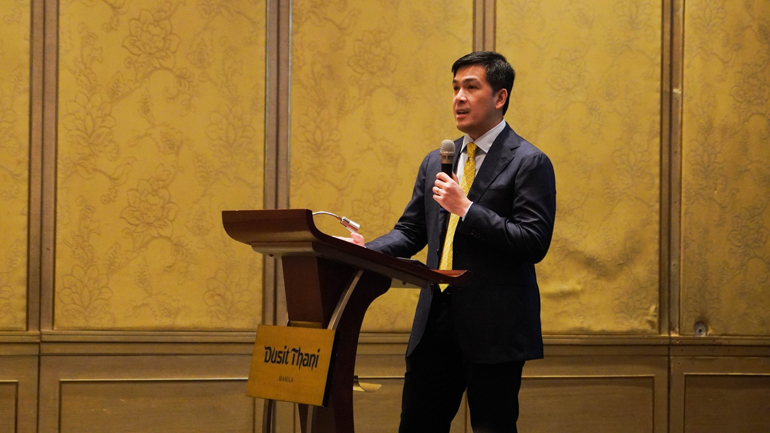
More predictions on the future of the Philippine stock market, as well as the opportunities and challenges that lie ahead, were explored in a BusinessWorld Insights forum, themed “Stock Market Outlook 2024,” last Feb. 27 at Dusit Thani Manila.
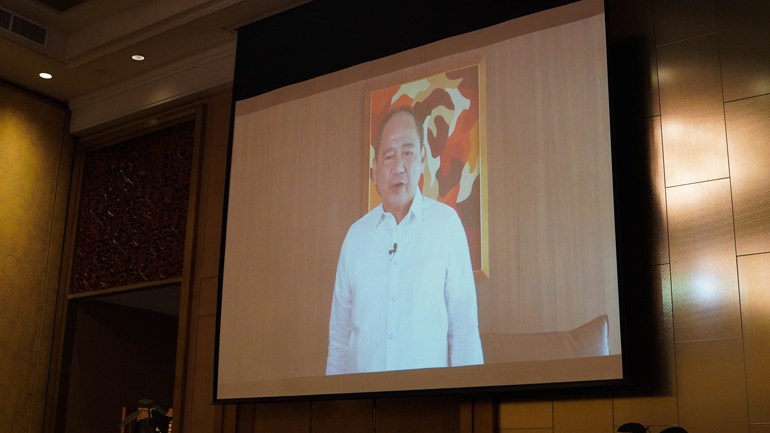
Ramon S. Monzon, president and CEO of the Philippine Stock Exchange, delivers his keynote address in a recorded video.
In his keynote speech, PSE President and CEO Ramon S. Monzon said that the Philippine stock market is showing signs of revival after a prolonged period of stagnation. He revealed that the market closed positively, reflecting a 6.8% increase for the year.
“For January 2024, foreign investors were net buyers in the amount of P4.49 billion compared to being net sellers in the amount of P53.65 billion for the whole year of 2023. The country’s economic indicators remain strong as GDP grew by 5.6% in 2023,” he said in a recorded video.
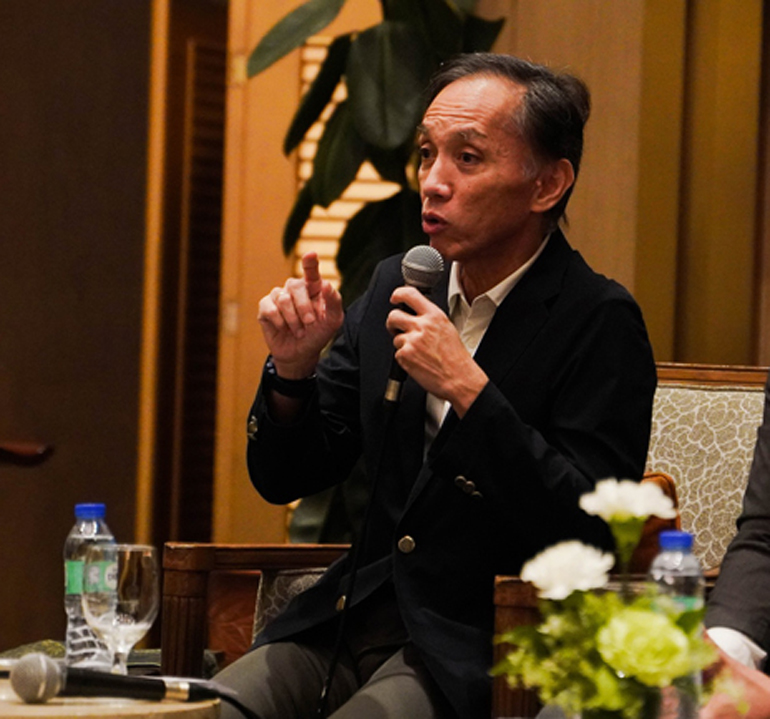
Similarly, Michael Gerard D. Enriquez, president of Sun Life Investment Management and Trust Corp. (SLIMTC), also noted the country’s economic backdrop, albeit seeing challenges still under way for the stock market.
Sun Life Investment Management and Trust Corp. President Michael Gerard D. Enriquez
“[For] the overall economy of the Philippines, we’re expecting a 6% growth for this year. So, economic backdrop is very supportive of a good year for the Philippines. [Valuations are] very attractive but remains to be just attractive. It’s not moving higher,” said Mr. Enriquez.
He mentioned that historically, the Philippine stock market has averaged around 15 times, with the potential to surge to over 20 times during bull phases. Mr. Enriquez highlighted the significance of the 8.4% earnings-per-share (EPS) growth, coupled with a 12.8 times price-to-earnings (P/E) multiple.
“We’ve all seen how the market has really close to 7,000 during the last week. So, the next question, will it continue? Will it hold on to this rally? Every year, in fact, we have noted strong start of the year, only to realize that it weighs down towards the latter part of the year,” he emphasized.
Mr. Enriquez also said that despite the performance of local companies in the Philippines, with continuous growth emerging from the pandemic, there seems to be a disconnect between corporate success and financial market performance.
Despite resilient corporate earnings and attractive valuations, the Philippine Stock Exchange Index (PSEi) has lingered between 6,000 and 6,800. Mr. Enriquez attributed this underappreciation to macroeconomic headwinds that have affected investor sentiment, hindering a more robust influx of capital.
“Over the last two years, we have been experiencing such a high interest rate in our economy. And for an investor, if your bank offers you 5%-6% time deposit rates, you’d probably go to your bank and not invest in these assets or revenues. Plus, you’d probably hear of a lot of the geopolitical risks happening. And because of those, a lot of the investors are just staying put on fixing our business,” he said. “However, we have noted a lot of developments over the last three months to support our case. We’ve been experiencing macro headwinds,” he said.
Influential risks
COL Financial First Vice-President For Corporate Strategy and Chief Investor Relations Officer April Lynn C. Lee-Tan
April Lee-Tan, chief equity strategist of COL Financial Group, Inc., said that the global economic landscape in 2023 witnessed a surge in inflation and interest rates, not sparing the Philippines. The combination of these two factors had a negative impact on both consumer spending and investment.
She considers the state of the US economy and stock market as the most significant risk.
“For me, the biggest risk is the US economy and the stock market because, in my opinion, I feel that they are facing a heightened risk of a recession. If that happens, there’s potentially a bear market,” she said. “Historically, the Philippine market has never escaped from a contagion. We’ve always suffered from a contagion. So, if that happens, could this time be different?”
Ms. April Lee-Tan also points out that the government’s budget for 2024 has seen a notable increase of approximately 9%, with an 8% rise in productive uses. However, she raises concerns about the optimistic assumptions made during the budgeting process.
“The GDP growth forecast to achieve the budget was around 6.5%-7.5%, and the consensus forecast for GDP growth is around 5.8%. So, if your GDP growth is lower than what you’re projecting, of course, you would get less revenue,” she said. “Unfortunately, my worry is either the government fulfills the 8%-9% increase in the budget at the expense of a much larger deficit, or it can just do what it did last year — underperformed.”
While there are positive notes, such as higher-than-expected job numbers and a 3.3% fourth-quarter GDP growth, Ms. Lee-Tan emphasizes the need for cautious optimism.
“It’s hard to say with conviction that things would not suffer from a hard landing when you have other information, such as the decline in the number of hours worked, which seems to imply that a lot of employers are hiring temps instead of full-time workers,” she shared. “And then the GDP growth, which was really very strong, was driven by the government. But if you look at both of them, they’re not very healthy.”
Another key factor influencing the global economic landscape is the role of the United States Federal Reserve. Ms. Lee-Tan pointed out the historical challenge faced by the Fed in orchestrating a soft landing after raising interest rates. The correlation between rate hikes and economic recessions is evident in the chart presented, raising concerns about the potential impact on the Philippine stock market.
“The Fed has a difficult task of staging a soft landing. [You] will notice that every time the Fed raises rates or almost 100% of the time, the economy suffers from a recession. There have been times where it never happened, say in the 1990s or in the 1980s. But, usually it doesn’t happen if there is no yield curve. Unfortunately, the yield curve in the US has been in birth as of July of 2020,” said Ms. Lee-Tan.
Comparing the Philippine stock market to the US market, Ms. Lee-Tan noted that while the Philippines is relatively inexpensive, the US market is considered expensive, trading at around 20 times earnings. This suggests that the Philippines may not have fully priced in the global economic challenges, presenting both risks and opportunities for investors. However, historical trends indicate that during crises, investors tend to flock to the US dollar as a safe haven, potentially limiting the positive impact on the Philippine stock market.
Predictions
Philstocks Financial, Inc. Research and Client Engagement Officer Mikhail Philippe Q. Plopenio
Mikhail Philippe Q. Plopenio, research and client engagement officer of Philstocks Financial, Inc., said that understanding the trajectory of the stock market in the past year is crucial in projecting what to expect in 2024.
He noted that the Philippine stock market faced significant challenges in the past year, as it experienced a downward trend. Although attempts were made to rally the market, they were unsuccessful, and as a result, the market moved sideways in the middle of 2023, followed by a further decline in the second half. In fact, the market’s struggle was evident in the tepid value turnover, which was down by 18.09%, indicating that investors preferred to stay on the sidelines. Net foreign outflows amounted to 49.08 billion, highlighting the continuous exodus of foreign funds.
Despite the challenges, he mentioned that the market’s P/E ratio reached attractive levels in 2023.
“If you are to look at the market’s P-Racial, it’s at attractive levels,” he explained. “In fact, the P-Racial of the PSEi as of [the] end of 2023 was 13.2 times [higher]. Comparing it to the historical performance, it was the lowest since 2009, 12.6 times. And if we are to compare it to our regional peers, it’s also undervalued as the industry; the regional average was 17.6 times. So, this goes to show that the market is already at bargain levels.”
According to Mr. Plopenio, this apparent undervaluation sparks questions about whether being at bargain levels alone is sufficient for investors.
He anticipates the Philippine Peso to average between 54.80 to 55.80 against the US dollar, driven by a surplus in the balance of payments. This surplus is expected to result from increased service exports, a surge in Overseas Filipino Workers’ remittances, and a rebound in net foreign direct investments.
In terms of inflation, a decline is projected for 2024, attributed to base effects and the impact of the central bank’s tightening measures in previous years.
“For the prices, we expect inflation to decline this 2024 and settle within the 3.8% to 4.2% average. As we all know, this is due to base effects as inflation has peaked in the recent year. Also, the impact of the tightening of the BSP in the previous years is expected to take effect this year, which would somehow affect demand-side inflation,” he added.
He also predicted that there are expectations that the Bangko Sentral ng Pilipinas (BSP) will cut interest rates twice by 2.25 basis points in the second half of the year. This move would bring down policy rates to 6% by the end of 2024.
“As interest rates are expected to be cut this year, we expect the GDP to grow by 5.4% to 5.8% this year. This is on the assumption that consumption will remain robust for this year, as we expect a decline in inflation and labor market remains to be tight this year,” he explained.
In the context of the anticipated positive macroeconomic environment, the PSEi is expected to achieve earnings-per-share (EPS) growth of 5% to 15%. Mr. Plopenio suggests that if these projections are met, the PSEi could end the year within the range of 69.98 to 76.65. This translates to a potential upside of 8.51% to 18.84% based on fundamentals.
While the overall outlook is positive, Mr. Plopenio highlights several narratives that could impact market sentiment. These include the Fed’s policy decisions, China’s economic recovery, tensions in the Red Sea, the US presidential elections, and the Israel-Hamas conflict.
Infrastructure push
SLIMTC’s Mr. Enriquez made a compelling case for a shift in the status quo. He argued that despite the prevailing challenges, the current market landscape presents an opportunity for change. He mentioned that one of the underlying themes that sets the tone for the Philippines in 2024 is the government’s renewed emphasis on infrastructure development.
“I think it’s really helping a lot on how the government has been promoting the Philippines and bringing forth a lot of the major infrastructure projects,” he added. “Recently, [we’ve] been seeing a lot of news about the completion of the subway. Again, it’s good headline for the Philippines, and I believe this is one key aspect that’s missing that can tie up the entire theme of why invest in the Philippines and why not another country in Asia.”
BDO Capital President Eduardo V. Francisco
Similarly, Eduardo V. Francisco, president of BDO Capital, noted that one of the primary indicators of the Philippine government’s commitment to economic development is its approach to infrastructure projects. Mr. Francisco highlighted the significance of the recent infrastructure developments. Despite delays and concerns regarding project viability, the government persisted, demonstrating a seriousness that bodes well for the country’s economic prospects.
Mr. Francisco addressed a common misconception about foreign participation in Public-Private Partnership (PPP) projects. While it might seem that local conglomerates dominate these bids, foreign entities do actively participate.
“The foreigners always want to participate in the PPP projects. It just so happens that when the actual bidding occurs, the [conglomerates] are sometimes, or maybe oftentimes, more bullish. They’re willing to take on more risks. So, it’s not that the foreign [investors] are not bidding,” he added. “They’re bidding, but sometimes their IRR requirements are higher because they have country risk versus if you’re domestic. You don’t factor in the regulatory or the political risk. But that doesn’t mean that the foreign [investors] are not interested. It just means that the foreign [investors] lose out to the locals, but they are participating.”
Cautious moves
Moreover, Mr. Francisco revealed that beyond the visible stock market transactions, there is various activities occurring, particularly in mergers and acquisitions (M&A). However, due to disclosure regulations and strategic considerations, many details are not immediately available to the public. The deliberate choice of using non-listed corporations or subsidiaries by buyers reflects the complexity of market dynamics and the need to navigate disclosure rules. He suggests that there is considerable excitement and caution within the financial sector as various entities explore opportunities and strategic moves.
Meanwhile, Ms. Lee-Tan of COL Financial emphasizes the significant role that interest rates and inflation play in determining the health of the stock market. If interest rates decline and inflation is kept in check, it can create an environment conducive to market growth. The lowered interest rates may prompt investors to seek alternatives to traditional savings, such as exploring the stock market for potentially higher returns.
On the other hand, Mr. Enriquez mentioned that investors are looking past inflation and slowly repositioning themselves in the local equity market. Institutional buyers have been overweighing their allocation into domestic equities.
“You’d probably see a lot of liquidity,” he predicted. “If you look at the results of the banks, it’s telling. Deposits increased by more than 10%. Loan growth was significant in spite of the higher margins, net interest margin. And what more if you see rates start to go down, then probably there would be more appetite for consumers, for companies to really take on loans for expansion. And in spite of the high interest rate environment, the confidence is telling that they are willing to borrow to expand to buy big-ticket items. So, I think that’s something that is really going beyond inflation and high interest rates, more than just a stock market. And it has to translate to asset prices.”
As the stock market experienced a pullback after reaching 6,900, Mr. Plopenio of Philstocks advised investors to stay ahead by diversifying their portfolios. While there are positive prospects for the year, he acknowledged the existing risks, emphasizing the need for a diversified approach to protect investors from market volatility.
“There are bright prospects for this year that we should be looking forward to, however, there’s still risks, so being diversified will protect the investors,” he said.
Similarly, Ms. Lee-Tan suggests a strategy which entails capitalizing on stocks that exhibit strong intrinsic value.
“We’re also recommending a higher-than-normal allocation to cash. But, that’s it. It’s not because we’re super bearish. It’s more like assuming that the US does suffer from recession in a bear market, when the stock market moves down, that is the time to deploy the cash because we may think that cash mask is any way to work almost over an amount of money,” she said.
Moreover, Mr. Enriquez explained that the movement towards more typical interest rate levels has significant implications for investors. Historically low interest rates have fueled stock market growth, but a return to normalcy could introduce new challenges.
“As we see the government really serious in its infrastructure push, I think that is something that can definitely be a tailwind for investors to continue to pour money into the stock market,” he reiterated. “Thereby, hopefully in the next 3-5 years seeing the all-time high of the market at 9,000 or 100 in the next 3-5 years.”
This BusinessWorld Insights forum was presented together with Citicore Energy REIT Corp.; in cooperation with Sun Life Philippines and SM Investments Corp.; and was sponsored by AppleOne, BDO Capital, EastWest Bank Corp., Figaro Coffee Group, Megaworld Corp., and Meralco; with the support of the Philippine Chamber of Commerce and Industry, Philippine Franchise Association, and official media partner The Philippine STAR.






 Attendees will have the opportunity to explore a diverse range of exquisite items, from furniture and home décor to lighting, and featuring a mix of timeless classics and modern designs that showcase the incredible creativity and innovation inherent in Filipino craftsmanship. Visitors can immerse themselves in the Philippines’ rich cultural heritage, experiencing not only modern designs but also traditional craftsmanship and techniques displayed at these events.
 Concurrently, the event will feature the Obra Design Masterclass Program by The Philippine Trade Training Center – Global MSME Academy (PTTC-GMEA), under the Department of Trade and Industry (DTI). This initiative aims to provide specialized furniture training and mentorship opportunities for young designers and scholars, empowering and uplifting local talent within the furniture and creative industries.
 For inquiries and concerns, contact Philippine International Furniture Show at info@pifs.ph and Interior Design Manila at info@interioranddesignmanila.com.