Home Blog Page 3445

Tribunal voids Duterte order revoking former rebel soldier’s amnesty

PHILSTAR FILE PHOTO

THE PHILIPPINE Supreme Court (SC) has upheld the validity of the amnesty given to a former senator and rebel soldier, nullifying ex-President Rodrigo R. Duterte’s order.

The President did not have the power to void Antonio F. Trillanes IV’s amnesty without congressional approval, the tribunal ruled in a decision written by Justice Ma. Filomena D. Singh.

“The court also grounded its ruling on the primacy of the Bill of Rights and reaffirmed that neither the government nor any of its officials, including the President, are above the law,” the court said in a statement on Wednesday night.

The High Court struck down Mr. Duterte’s Proclamation No. 572, which in 2018 revoked the 2010 amnesty given to the former senator by the late President Benigno S.C. Aquino III. Mr. Duterte also ordered government prosecutors to revive rebellion and other charges against him.

Mr. Duterte said the amnesty was void because Mr. Trillanes had failed to file the official amnesty application form and admit guilt for his crimes.

The top court said Mr. Duterte’s proclamation violated Mr. Trillanes’ constitutional rights against double jeopardy and ex post facto laws, which punish actions retroactively.

The tribunal also said there was “convincing evidence” that Mr. Trillanes had filed his amnesty request.

“The decision affirms that in balancing the exercise of presidential prerogatives and the protection of the citizens’ rights, the Constitution and the laws remain as the court’s anchor and rudder,” the Court said.

In 2003, Mr. Trillanes led more than 300 junior officers and enlisted men of the Armed Forces of the Philippines in a mutiny against the government of then President Gloria Macapagal Arroyo.

The rebels occupied the Oakwood Premier Ayala Center (now Ascott Makati), an apartment tower in Makati City, to protest rampant state corruption.

The mutiny lasted only 18 hours. Mr. Trillanes and his men were charged in a general court martial. He was detained for more than seven years.

Four years later, Mr. Trillanes, Brigadier General Danilo Lim and 25 others charged in the Oakwood mutiny walked out of their trial and marched toward the Manila Peninsula Hotel in Makati.

They seized control of the hotel and called for the ouster of Ms. Arroyo.

The coup was over by 5:10 p.m. after government troops broke through the hotel. Mr. Trillanes and Mr. Lim surrendered supposedly to avoid the loss of lives. — Chloe Mari A. Hufana


Marcos orders broad solution to Manila’s traffic problem

PHILIPPINE STAR/ MIGUEL DE GUZMAN

PHILIPPINE President Ferdinand R. Marcos, Jr. wants a comprehensive approach to the capital region’s traffic crisis, one of his economic managers said on Thursday.

Officials on Wednesday discussed traffic issues during a Cabinet meeting, where Mr. Marcos ordered agencies to submit recommendations, National Economic and Development Authority Secretary Arsenio M. Balisacan told a palace briefing.

“What the President really wants is a comprehensive, holistic approach to solving the traffic problem, not a piecemeal approach as has been the case all these years,” he said.

“In the planning of our transport system, we should be looking at the intermodal transport system and see how they operate efficiently as a whole… If there’s a chokepoint in one, it affects the whole system. That’s why we really look at it as a system — and that’s the direction of the President.”

The Management Association of the Philippines last month called for a state of calamity declaration in Metro Manila so the President can use his special powers to solve traffic congestion in Manila and nearby cities.

The group also urged the President to appoint a traffic czar.

Traffic congestion in Metro Manila is costing the Philippine economy at least P3.5 billion daily or P1.27 trillion annually, according to a Japan International Cooperation Agency study.

MAP Transportation and Infrastructure Committee Chairman Eduardo H. Yap said at a Mar. 21 House of Representatives hearing that events causing P1 billion in damage qualify as calamities. — Kyle Aristophere T. Atienza

DICT suspects domestic hackers, blames ‘outdated’ systems for DoST data breach

TOWFIQU BARBHUIYA-UNSPLASH

By Ashley Erika O. Jose, Reporter

STATE officials suspect domestic hackers behind the recent breaching of the Department of Science and Technology’s (DoST) network systems, compromising about two terabytes of data.

In a media briefing on Thursday, Department of Information and Communications Technology (DICT) Assistant Secretary Renato A. Paraiso downplayed the scale of the incident, but exposed the bigger challenge of updating network systems vulnerable to such attacks.

“Security protocols were actually in place,” said Mr. Paraiso as he revealed that 20 systems of the DoST were compromised. “It is not because there is no system in place. It is just that it might be outdated — outdated in terms of capabilities and the systems employed by the threat actors.”

While authorities were still working to gain full access to its compromised network systems and studying the extent of the attacks, the DICT downplayed the impact of this latest cyberattack on a state agency.

“[The compromised data] involves research, when you say research, this involves designs of proposed inventions or maybe even inventions that were completed. Information of their scientists and their members were also compromised and their login accesses,” he said.

“In terms of size, this is recently one of the biggest but comparatively, the impact is not that big, because some designs, files in the systems were already obsolete” he added.

What is more disturbing is that the threat actors were able to penetrate the system because the DoST’s network is likely outdated and the government’s procurement process is slow amid a rapidly evolving information communications and technology landscape.

“Our government’s procurement process is kind of slow. It takes at least 60 days to procure a system and systems you employ now might be obsolete in six months’ time,” said the DICT official.

With the recent hacking incident, the government is urged to prepare for similar attacks in the future, Ronald B. Gustilo, national campaigner for Digital Pinoys, said.

“The government should prepare for more of these attacks. Their contingency measures should be in place and the quick response teams always ready,” Mr. Gustilo said in a Viber message.

He said the government should allocate a higher budget to be able to update its technology realtime and hire more experts to monitor its systems.

“More than being either quick or slow with regard to their response, we find it appealing that in a span of a few months, DoST was attacked twice. This should not have happened in the first place,” Mr. Gustilo said.

“The recent DoST incident is an indicator that there is still a lot to be done for the Critical Information Infrastructure of the Philippines,” Sam Jacoba, founding president of the National Association of Data Protection Officers of the Philippines, said in a Viber message.

Critical information infrastructure is interconnected with information systems and networks.

“The challenge now is how to bring back the operations of the DoST that have been impacted by the hack, and recover or reconstruct the digital assets within those information systems,” Mr. Jacoba said.

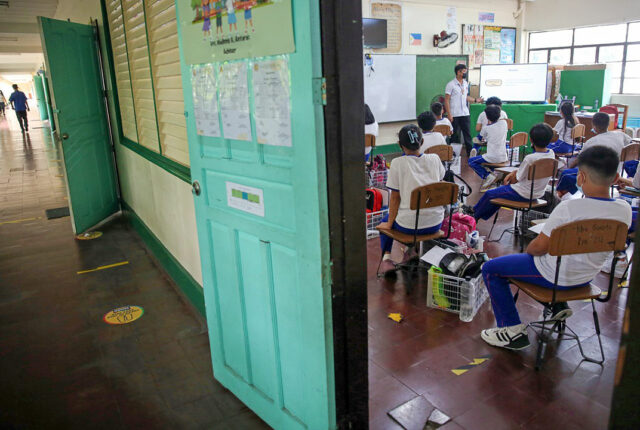
DBM OK’s release of P5.8-B budget for new classrooms

PHILIPPINE STAR/KRIZ JOHN ROSALES

THE DEPARTMENT of Budget and Management (DBM) on Thursday said it approved the release of P5.83 billion to help build classrooms nationwide.

In a statement, the agency said the money would be given to the Department of Education (DepEd) and Department of Public Works and Highways.

The amount is enough to build 1,834 classrooms in 216 sites across the country, it said.

“The timely release of funds for the project signifies our dedication and commitment to help in building a brighter future for our young learners,” Budget Secretary Amenah F. Pangandaman, who approved fund release on March 18, said in the statement.

The budget is meant for the construction of school buildings for kindergarten, elementary and secondary education public schools. It will also be used to build technical and vocational schools.

It may also be used to install or upgrade facilities for persons with disabilities, in compliance with accessibility and universal design principles. The amount would also be used for water and sanitation facilities, as well as site improvements, the Budget department said.

The funding also supports the first batch of DepEd’s basic education facilities fund, which covers the maintenance of school facilities, repair and rehabilitation of classrooms and replacement of old buildings.

Last year, the Education department failed to meet its target of building 6,379 classrooms, having built only 3,600 classrooms.

An average classroom costs about P2.5 million each, Education Undersecretary Epimaco V. Densing III told a Senate hearing last year.

But DepEd needs about P105 billion yearly to address the Philippines’ classroom shortage by 2030, he said. — Beatriz Marie D. Cruz

Marcos: April 10 a holiday 

A BOY reads the Koran at the Golden Mosque in Quiapo, Manila on the eve of Ramadan. — PHILIPPINE STAR/ RUSSEL PALMA

PHILIPPINE President Ferdinand R. Marcos, Jr. has declared April 10, Wednesday a holiday in observance of Eid’l Fitr or the Feast of Ramadhan. 

The regular holiday would “bring the religious and cultural significance of Eid’l Fitr to the fore of national consciousness,” according to Proclamation 514 signed by Executive Secretary Lucas P. Bersamin on April 4.

It would also “allow the entire Filipino nation to join their Muslim brothers and sisters in peace and harmony.”

April 9 on Tuesday is also a holiday in observance of the Day of Valor. — KATA

Expanded Maoist amnesty eyed

THE MARCOS government seeks to expand the amnesty program for Maoist rebels to cover more members once a final peace agreement is reached, according to National Security Adviser Eduardo M. Año.

“Normally, amnesty is being [implemented] after peace talks,” he told a palace briefing.

He also said President Ferdinand R. Marcos, Jr. has ordered the “immediate implementation” of a presidential proclamation granting amnesty to 40,000 ex-members of the Communist Party of the Philippines and its armed and political wings.

This is given that Congress has already concurred with the proclamation, he added. — Kyle Aristophere T. Atienza

Peso climbs on Powell comments

BW FILE PHOTO

THE PESO recovered against the dollar on Thursday after US Federal Reserve Chair Jerome H. Powell affirmed that the US central bank will cut rates this year.

The local unit closed at P56.355 per dollar on Thursday, strengthening by nine centavos from its P56.445 finish on Wednesday, Bankers Association of the Philippines data showed.

The peso opened Thursday’s session at P56.35 against the dollar, which was also its intraday best. Its weakest showing was at P56.50 versus the greenback.

Dollars exchanged rose to $1.26 billion on Thursday from $1.19 billion on Wednesday.

The peso gained on Thursday as the dollar generally weakened after Mr. Powell said the Fed would still likely begin its easing cycle this year, Rizal Commercial Banking Corp. Chief Economist Michael L. Ricafort said in a Viber message.

Federal Reserve officials including Mr. Powell on Wednesday continued focusing on the need for more debate and data before interest rates are cut, a move financial markets expect to occur in June, Reuters reported.

“Recent readings on both job gains and inflation have come in higher than expected,” Mr. Powell said in a speech to the Stanford Graduate School of Business. While policy makers generally agree that rates can fall later this year, he said this will happen only when they “have greater confidence that inflation is moving sustainably down” to the Fed’s 2% target.

“The peso appreciated following the softer-than-expected US services report for March 2024,” a trader added in an e-mail.

For Friday, the trader sees the peso moving between P56.20 and P56.45 per dollar, while Mr. Ricafort expects it to range from P56.25 to P56.45. — A.M.C. Sy with Reuters

Shares end lower as NG debt rises to fresh high

REUTERS

PHILIPPINE TOCKS nded lower for a third straight day on Thursday as the National Government’s (NG) outstanding debt hit another record high.

The bellwether Philippine Stock Exchange index (PSEi) fell by 0.53% or 36.76 points to end at 6,827.06 on Thursday, while the broader all shares index dropped by 0.25% or 9.06 points to finish at 3,580.32.

“This Thursday, the local market dropped by 36.76 points (-0.53%) to 6,827.06 as local economic worries take over sentiment while catalysts are yet to be seen. Investors digested the national government’s outstanding debt which rose 2.63% month on month to a record high of P15.18 trillion,” Philstocks Financial, Inc. Research and Engagement Officer Mikhail Philippe Q. Plopenio said in a Viber message.

Year on year, NG debt increased by 10.37% from P13.75 trillion in February 2023, Bureau of the Treasury data showed.

“Additionally, inflation concerns were heightened as the Department of Agriculture (DA) expects that rice prices will remain elevated until the middle of the year. With its latest move, the market is now near its 6,800 minor support,” Mr. Plopenio said.

The DA said on Wednesday that rice prices are expected to remain high until midyear as the agriculture sector reels from the impact of the El Niño weather event.

Agricultural damage caused by the El Niño has risen to P2.63 billion, affecting 54,203 farmers and 53,879 hectares of farmland, according to the DA. Rice was the most affected crop with 72,733 metric tons of damage, equivalent to P1.7 billion or about 65% of total agricultural losses.

“Philippine shares were sold down once again on fears that the United States Federal Reserve may keep rates higher for longer weighed on stocks,” Regina Capital Development Corp. Head of Sales Luis A. Limlingan added in a Viber message.

“On the data front, investors are watching for important data releases this week. They’ll be checking initial jobless claims for the week ending March 30 to understand the job market. Also, Thursday brings the US trade deficit for February, giving insight into trade trends. But the big focus is on Friday when March’s nonfarm payrolls will be released, offering a key measure of employment,” he added.

Majority of sectoral indices ended lower. Services dropped by 1.26% or 23.71 points to 1,846.84; industrials retreated by 0.9% or 81.04 points to 8,890.03; property lost 0.53% or 14.85 points to end at 2,756.84; and holding firms went down by 0.38% or 24.95 points to 6,414.37.

Meanwhile. mining and oil rose by 0.56% or 46.38 points to 8,190.55, and financials went up by 0.26% or 5.39 points to 2,031.21.

Value turnover climbed to P4.38 billion on Thursday with 510.46 million issues changing hands from the P4.29 billion with 701.33 million shares traded on Wednesday.

Decliners beat advancers, 101 versus 77, while 53 names were unchanged.

Net foreign selling went down to P567.31 million on Thursday from P670.32 million on Wednesday. — R.M.D. Ochave

No repatriation call from Taiwan

DMW FACEBOOK PAGE

THE DEPARTMENT of Migrant Workers (DMW) said on Thursday that it has yet to receive any request for repatriation as it closely monitors the situation of thousands of Filipinos in Taiwan and Japan, which were both jolted by strong earthquakes in the past two days.

In a virtual briefing, DMW Officer-in-Charge Hans Leo J. Cacdac said there are 1,400 overseas Filipino workers (OFWs) in Hualien county, the epicenter of the 7.2-magnitude quake that struck Taiwan on Wednesday morning.

About 5,000 Filipinos were affected by the tremor, but three were reported to have been slightly hurt. “The epicenter of the earthquake is far from where a majority of OFWs are (Northern part of Taipei),” Mr. Cacdac said.

Meanwhile, Japan was also struck with a 6.0 magnitude earthquake on Thursday off the coast of Fukushima prefecture.

The DMW said it has activated its protocols, particularly in Tokyo and Osaka, to provide any assistance necessary to Filipinos affected by the quake.

As aftershocks continue to rattle both Taiwan and Japan, the Philippine government advised OFWs there to stay updated on safety advisories and to coordinate with the nearest Philippine embassy or consulate for any assistance required. — Chloe Mari A. Hufana

Congressman pushes ‘Cha-cha’

PHILIPPINE STAR/MICHAEL VARCAS

CONGRESS should remain resolute in pursuing amendments to the 1987 Philippine Constitution despite public disapproval, a congressman said on Thursday.

In a statement sent to the press, Cagayan de Oro Rep. Rufus B. Rodriguez said the House of Representatives and the Senate should continue to pursue amending the economic provisions of the Charter as it would improve the country’s business climate.

“The national leadership… believes that changing the restrictive economic provisions of the Constitution would benefit the country as it would result in more foreign investments coming in,” he said.

A Pulse Asia Research, Inc. poll result last month said seven of 10 Filipinos are against constitutional amendments, signaling unfavorable public sentiment for Charter change, loosely referred to as “Cha-cha.”

“The right decisions are not always popular,” he said, referring to poll results.

He said the testimony of resource persons showing support for economic Charter change during House committee deliberations is a testament to the need to open the limiting economic provisions of the Constitution.

“We are falling behind in terms of FDIs (Foreign Direct Investments) in ASEAN,” Mr. Rodriguez, who also chairs the House Committee of Constitutional Amendments, said in mixed English and Filipino.

POLITICAL AMENDMENTS URGED
Earlier this week, an adviser to President Ferdinand R. Marcos, Jr. sent the House of Representatives a letter recommending the addition of political amendments to the Constitution.

In the letter sent on Wednesday, Presidential Adviser for Poverty Alleviation Lorenzo “Larry” G. Gadon called on legislators to consider extending the term limits of elected local officials to from three years to six years; increasing the number of seats at the Senate from 24 to 48; and transitioning the country into a Parliamentary system of government.

Asked for a comment, Party-list Rep. France L. Castro said Mr. Gadon’s recommendation revealed Mr. Marcos’ underlying intent in amending the Constitution.

“As a member of the Marcos administration, Larry Gadon’s (recommendation) revealed President Marcos’ desire to amend the political provisions of the Constitution,” she said in Filipino through a Viber message.

Ateneo Policy Center Senior Research Fellow Michael Henry Ll. Yusingco told BusinessWorld in a Facebook Messenger chat that Mr. Gadon’s sudden introduction of political amendments may lead the people to reject Charter change entirely.

“These are the proposals that trigger the people’s distrust because these proposals are arguably designed to benefit only those already in power,” he said.

At present, the measure proposing Charter amendments would only change certain economic provisions, Mr. Rodriguez said in his statement.

“We are limiting the proposed changes only to three areas,” he said. “There is no proposal to extend the term of any elective official, there is no political amendment.” — Kenneth Christiane L. Basilio

More rice deals needed — senator

REUTERS

THE PHILIPPINES must seek more rice deals with countries like India and Vietnam since the country’s grain production still needs improvement, Senator Sherwin T. Gatchalian told a forum at the Senate on Thursday.

“It is important to strive for 98 or even 100% rice sufficiency, but in the meantime, it is important that we have concrete agreements with countries that export rice,” the senator, speaking in mixed English and Filipino, said.

He said that the Philippines still has ways to go in being self-sufficient in its rice production since it imports about 3 million metric tons (MT) a year.

Last Wednesday, the Department of Agriculture said rice prices are expected to stay high until midyear as the agriculture sector reels from the shocks of the El Niño weather phenomenon.

Agricultural damage caused by El Niño has risen to P2.63 billion, affecting 54,203 farmers and 53,879 hectares of farmland, based on the agency’s data.

The Bureau of Plant Industry has said Philippine rice imports reached 995,841 as of March 21.

The US Department of Agriculture expects Philippine rice imports to reach 4 million MT this year.

“We should help revive the agriculture sector since due to the extreme heat, it would take time for them to do so,” Mr. Gatchalian said in mixed English and Filipino. “The sector needs to have funding for our farmers to livelihoods and for them to revive their crops.”

In October, India gave the Philippines a quota of 295,000 MT of non-basmati white rice, after imposing restrictions on exporting the grain to ensure the sufficiency of domestic supply.

Vietnam in January agreed to supply 1.5 to 2 million MT of white rice to the Philippines “at a competitive and affordable price” for five years. — John Victor D. Ordoñez

PHL, Japan urged to push RE

PHILIPPINE STAR/EDD GUMBAN

THE DEAL between the Philippines and Japan on strengthening collaborative projects should focus on the advancement of renewable energy (RE) instead of liquefied natural gas (LNG), a clean energy think tank said.

“We are a country whose abundant renewable energy resources makes a 100% transition aligned to the 1.5 °C climate goal possible. The focus should be on unlocking this, and not in putting up more gas,” Gerry C. Arances, executive director of the Center for Energy, Ecology, and Development, said in a statement.

The think tank raised its concerns on the memorandum of understanding (MoU) signed between Japan Bank for International Cooperation and private companies such as San Miguel Corp., Aboitiz Power Corp., and Metro Pacific Investment Corp.

Earlier, the Department of Energy (DoE) said it held a dialogue with a Japanese mission which seeks to strengthen their cooperation on developing collaborative projects that will advance efforts for decarbonization.

These include the utilization of liquefied natural gas (LNG) as a transition fuel, renewable energy development, building resilient energy infrastructure and introduction of technologies that will reduce greenhouse gas emissions.

The projects will be developed through the Asia Zero Emission Community (AZEC) Japan-Philippines Project Development Platform which seeks collaborative projects based on the MoUs.

“LNG champions Japan and the United States should use the upcoming talks to make amends and ensure the prioritization of renewables in the Philippines and other emerging economies in the region, not gas or false solutions,” Mr. Arances said. — Sheldeen Joy Talavera