Home Blog Page 3421

KISS follows ABBA into the musical AI afterlife

KISS recently agreed a lucrative sale of the band’s back catalog and brand in a deal worth a reported $300 million. — AMAZON.COM

GENE SIMMONS is one of the shrewdest marketing minds ever to wear face paint and lick a bass guitar. The KISS co-founder and his bandmates pioneered the original fandom (KISS Army), invented the speculative NFT (photos of the band without make-up that self-destructed in five minutes), and recently agreed a lucrative sale of the band’s back catalog and brand in a deal worth a reported $300 million.

It’s the kind of price tag that raises eyebrows, particularly after the poor performance of music-catalog buyer Hipgnosis Songs Fund Ltd., which failed to deliver on its promise of turning musical rights into the new gold. But acquirers Pophouse Entertainment Group AB have also bought KISS’s name, image and likenesses — not just the songs — paving the way for everything from face-paint filters to digital avatars similar to those fronting Pophouse’s immersive ABBA Voyager show, which rakes in $2 million a week. KISS isn’t ABBA, but it does have devoted fans. “The music will continue to live on,” Pophouse’s Johan Lagerlof told me. “They’re multi-generational.”

The bigger question here is what this means for a wider music industry looking for life after streaming. Spotify Technology SA has been around for some 15 years; initially a digital underdog saving record labels from piracy, it’s now a billionaire-led incumbent that’s expanding into audio books and podcasts as music growth starts to slow and competition from social media rises. The price paid for the KISS rights shows a lot of hope being pinned on the market for everything that isn’t the actual listening bit — merchandise, branding, hologram shows — which is currently worth an estimated $3.5 billion, according to consultancy MIDiA Research.

The optimistic take is that, from a fan’s point of view, there’s something encouraging about the opportunity to engage with different formats than a Spotify playlist that puts the universe of music in our pockets but lacks emotional connection to the artist. This isn’t just about holograms or photo filters: Producer and songwriter James Blake recently launched a subscription platform called Vault, which he describes as a “backstage pass” for fans who want more from their favorite artists than they get from streaming. Spotify itself is said to be mulling “superfan clubs.” One can question how much this is really worth, but clearly the gurus of K-Pop and label Universal Music Group NV are banking on fan spending.

The worrying bit is that technology and artificial intelligence are getting so much better at capturing what makes artists human — right down to voice, playing style, and composition — that artists overall are looking more vulnerable. The “Elvis police” at the Graceland estate in the 1990s used to track down unauthorized coffee mugs and Presley impersonators to get their cut; today they’re grappling with deepfakes, voice clones, and holograms. No doubt Pophouse has what it takes to protect KISS in an AI world, but a recent letter signed by hundreds of artists including Billie Eilish and Nicki Minaj suggests widespread worry from younger stars about future compensation and consent in a world of spookily powerful music-generating software.

The other depressing possibility in a world dominated by digital avatars of our favorite bands is that it will make it even harder for new artists to break through and create superfans of their own. The streaming payout model is already skewed heavily to the top 1% of artists, as our $10.99 monthly subscription fees go to the most-listened to artists across the platform rather than our own individual preferences. If live entertainment becomes dominated not just by the Taylor Swifts of the world but acts that have shuffled off this mortal coil, one might expect to hear more stories of musicians going into law or real estate to make a living.

Deals like KISS’s should be a call to action. We need to get much better at defining and protecting artists’ “likeness.” Tennessee’s ELVIS Act (Ensuring Likeness, Voice, and Image Security Act) is a good start, codifying the protection of recognizable voices against unauthorized use — think the audio deepfake “Heart On My Sleeve” that went viral last year after claiming to be a duet between Drake and the Weeknd. But it’s only a start.

We should also push for streaming payouts at platforms like Spotify to become fairer and more transparent. Subscription prices are going up, but more artists are being demonetized at the bottom of the listening chain. Given streaming isn’t going away, new payout models or artist development funds would at least ensure a future pipeline of new talent.

When Spotify went public, Mr. Simmons of KISS called it a “terrific” company, but added that the combination of its technology and the grip of record labels meant new artists were getting “slaughtered” as analog dollars become digital dimes. Let’s hope his warning lives as long as his artificial intelligence (AI) avatar likely will. — Bloomberg Opinion


Metro Manila construction material retail price growth slowest in over four years

A worker cuts metal in a construction area in Binondo, Manila on March 24, 2022. — PHILIPPINE STAR/RUSSELL PALMA

RETAIL PRICE growth of construction materials in Metro Manila eased in March, the slowest pace in over four years, the Philippine Statistics Authority (PSA) reported on Monday.

Preliminary data from the PSA showed that the construction materials retail price index (CMRPI) slowed to 0.6% year on year in March, slower than the 1.1% recorded in February and 4.1% in March last year.

Growth in the CMRPI in the National Capital Region (NCR) was the weakest since 0.1% in December 2019.

Analysts attributed the slowdown in CMRPI to the slower demand in construction amid elevated interest rates.

Jonathan L. Ravelas, senior adviser at professional service firm Reyes Tacandong & Co., said in a Viber message that there is not much activity in the construction sector due to a cautious expansion plan amid high inflation and higher interest rates.

As of April 2024, the Bangko Sentral ng Pilipinas (BSP) kept policy rates unchanged at 6.5% for a fourth straight meeting as inflation is expected to accelerate in the coming months.

Inflation accelerated for a second month in March to 3.7% from 3.4% in February. Despite the quicker growth, March was the fourth consecutive month that headline inflation was within the BSP’s 2-4% target range.

“With interest rates remaining elevated, consumer propensity to spend on big-ticket items, including commercial and residential structures, is also constrained,” John Paolo R. Rivera, president and chief economist at Oikonomia Advisory & Research, Inc., said in a Viber message.

From May 2022 to October 2023, the BSP hiked borrowing costs by a cumulative 450 basis points (bps) to tame inflation.

CMRPI in NCR averaged 1.1% in the first quarter, significantly slower than the 5% in the first three months of 2023.

By commodity, the PSA said the slower annual increment in the heavily weighted index of tinsmithry materials was the primary driver of the slower growth of CMRPI. Tinsmithry eased to 2.4% in March from 3.1% the previous month.

This was followed by masonry materials, which declined to 0.2%, a reversal from 0.4% in February; miscellaneous construction materials (-1.5% from -1.0%); plumbing materials (-0.2% from 0.3%); painting and related compounds (2.0% from 2.1%); and electrical materials (0.9% from 1.0%).

Only carpentry materials inched up to 0.2% in March from 0.1% last month.

Mr. Rivera said the slowdown in CMRPI may continue as there is still no clear indication of interest rates being relaxed in the coming months.

Mr. Ravelas said that a rebound is expected during the dry season, which is good for construction.

“However, higher costs could be the caveat,” he added. — Andrea C. Abestano

PBB books higher net income

PHILIPPINE BUSINESS Bank, Inc. (PBB) saw its net income rise by 39.08% in 2023 as it continued to benefit from a high interest rate environment.

The bank’s net profit stood at P1.82 billion in 2023, up from P1.31 billion in 2022, its financial statement disclosed to the stock exchange on Monday showed.

“PBB’s outstanding performance in 2023 was driven by the bank’s asset expansion, improved interest rate margins, and lower cost-to-income ratio,” PBB Chief Operating Officer Cynthia A. Almirez said in a statement.

This translated to a return on equity of 11.19% and a return on assets of 1.26%, up from 9.03% and 0.98%, respectively.

The lender’s net interest income stood at P6.42 billion in 2023, up by 15.76% from P5.55 billion a year prior.

As a result, PBB’s net interest margin improved to 4.63% from 4.33%.

Other income likewise rose by 3.63% to P980.55 million from P946.19 million driven by trading gains and fee income.

Meanwhile, expenses grew by 5.21% to P4.01 billion from P3.81 billion.

The bank’s net loans grew by 13.54% to P117.56 billion in 2023 from P103.54 billion in 2022 as it saw increased demand for financing amid the economy’s continued recovery, PBB said.

PBB’s non-performing loan ratio went up to 5.7% from 5.37%.

On the funding side, total deposits grew by 10.65% to P126.72 billion from P114.53 billion. Low-cost current account savings account deposits ended at P68.3 billion, while time deposits reached P58.4 billion.

PBB’s total assets stood at P154.41 billion at end-2023, up by 14.76% from P134.55 billion.

Total equity was at P18.01 billion, up by 23.59% from P14.58 billion.

The bank’s capital adequacy ratio was at 13.15%, down from 13.85%. Its minimum liquidity ratio was at 25.83%, up from 21.75%.

PBB’s shares rose by 20 centavos or 2.30% to end at P8.90 apiece on Monday. — A.M.C. Sy

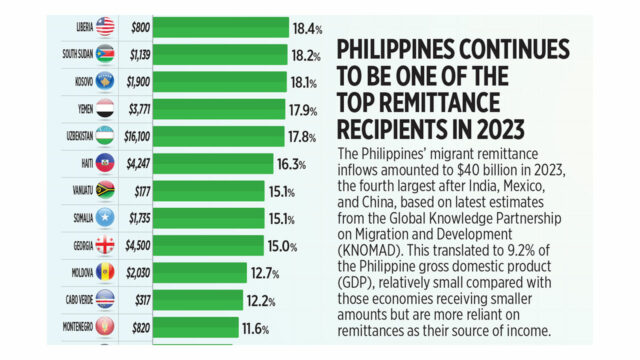
Philippines continues to be one of the top remittance recipients in 2023 

The Philippines’ migrant remittance inflows amounted to $40 billion in 2023, the fourth largest after India, Mexico, and China, based on latest estimates from the Global Knowledge Partnership on Migration and Development (KNOMAD). This translated to 9.2% of the Philippine gross domestic product (GDP), relatively small compared with those economies receiving smaller amounts but are more reliant on remittances as their source of income.


Philippines continues to be one of the top remittance recipients in 2023

Improving state revenue and boosting FDIs

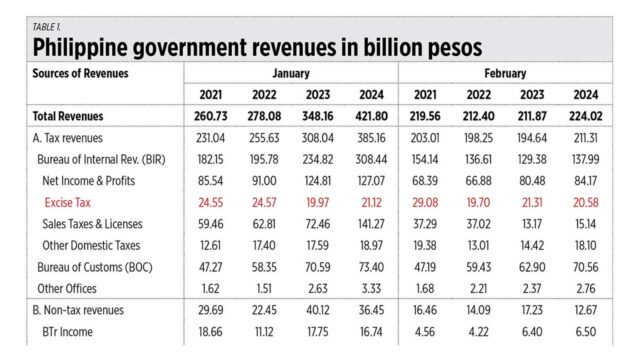
Mid-April of each year is the deadline for the filing of income tax with no penalty and many taxpayers beat the deadline, so government revenues are highest in April each year. I checked the revenues for the first two months of 2024 and compared them with the same period in 2021 to 2023.

Practically all major sources of revenues increased in that period, except for excise tax collections by the Bureau of Internal Revenue (BIR), and fees and charges by other agencies (see Table 1).

Among the related reports in BusinessWorld last week were: “Budget deficit projected to narrow further this year” (April 10), “Tobacco growers: Illegal vapes threatening farmer livelihoods” (April 14), and, “BIR releases implementing rules for Ease of Paying Taxes law” (April 14).

The illicit trade in tobacco products, cigarettes, and e-cigarettes and heated products is the major cause of the decline in excise tax collections. Congressman Joey Salceda made an estimate last October, saying that some P60 billion/year in tax revenues is lost due to tobacco smuggling and illicit trade.

It seems that the key government agencies in charge of controlling smuggling and illicit trade like the Philippine Coast Guard (PCG), the Philippine National Police (PNP), the National Bureau of Investigation (NBI), local government units (LGUs), the Bureau of Customs (BoC), and even the BIR are not doing enough to control this major tax leakage, even if their agencies and LGUs’ yearly budgets rely on more taxes.

Perhaps cabinet-level inter-agency action among the Department of Finance (with the BoC and BIR), the Department of the Interior and Local Government (with the Philippine National Police and the LGUs), the Department of Transportation (with the coast guard), and the Justice department (with the NBI) is needed. The budget deficit at around P1.5 trillion/year and public borrowings have been more than P2 trillion/year since 2020 — this should be enough reason for agencies to control tax leaks.

THE EASE OF DOING BUSINESS
On the ease of paying taxes, Finance Secretary Ralph G. Recto said that “the filing and payment of taxes is now easier than ever. (Taxpayers) have an indispensable role to play in our nation’s progress… These revenues will fuel our economic engine towards Bagong Pilipinas — lower poverty rates; increased infrastructure and human capital investments; more quality jobs for our people.”

You are correct there, Mr. Recto. The ease of paying taxes, ease of doing business, and the quality of public infrastructure are among the concerns of investors, local and foreign.

Last week, a new paper, “How to change a constitution by hand-waving (Or, the unbearable lightness of evidence in support of lifting foreign ownership restrictions)” was released by nine faculty members of UP School of Economics (UPSE) and UP Los Baños (UPLB), including two of my former UPSE teachers Noel de Dios and Orville Solon, my former boss Florian Alburo, and undergrad contemporaries Aleli Kraft and Oggie Arcenas.

The authors argued that “evidence shows that lifting equity restrictions is not a necessary condition for explaining the inward stocks of foreign direct investment (FDI) in the cited countries, including the Philippines. While restrictive equity rules may represent a hindrance to FDI, their potential effects are small and sometimes insignificant in comparison to other explanatory variables such as the ease of doing business, physical infrastructure, and perceived corruption.”

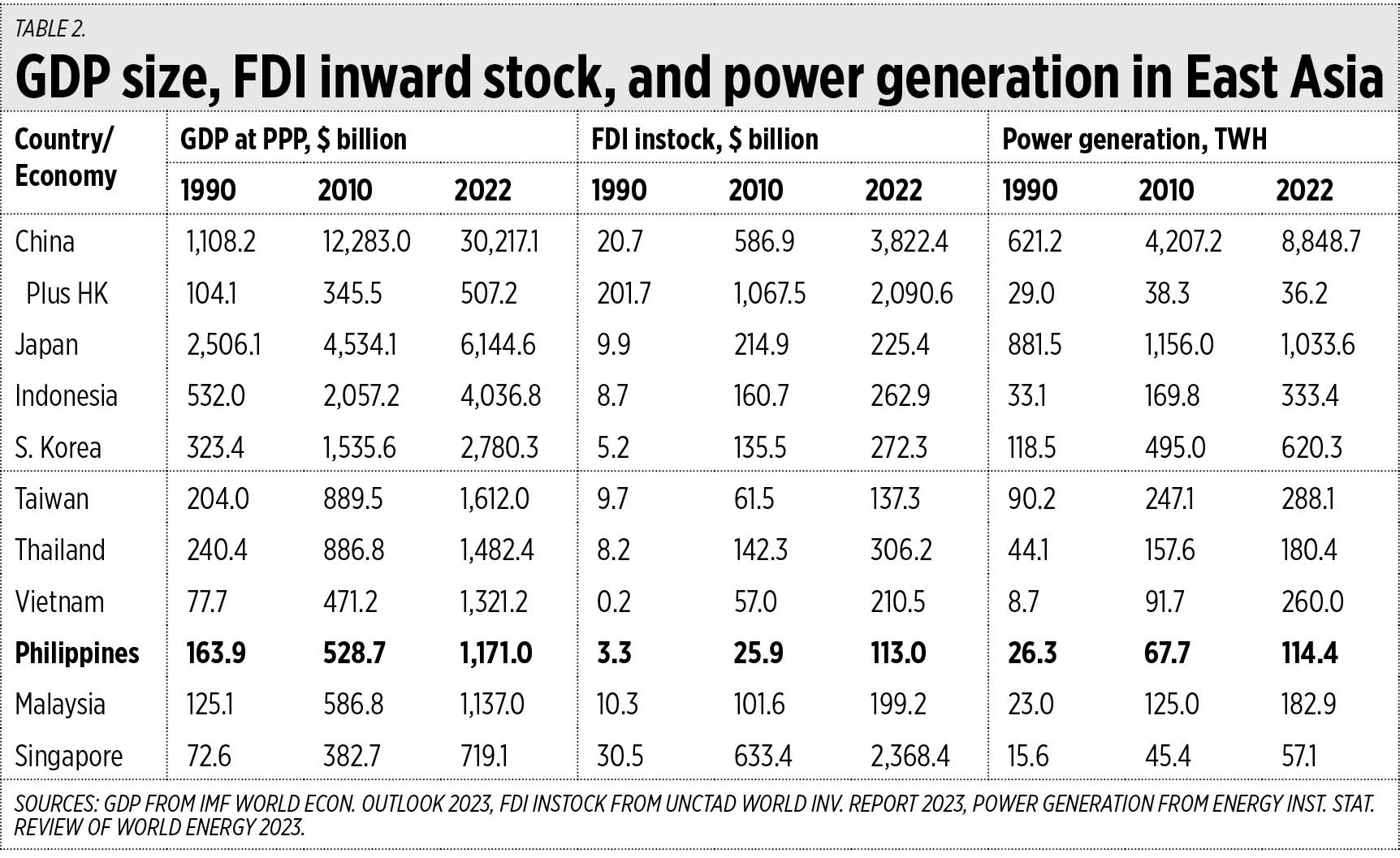
They presented several tables showing, among others, that the FDI Regulatory Restrictiveness Index (RRI) is high in the Philippines compared to Vietnam and other ASEAN countries. They did not show the actual level of FDIs through time, so I checked the numbers.

Countries with high GDP size at purchasing power parity (PPP) values also have high levels of FDI inward stock (inflows minus outflows through time). And speaking of infrastructure, electricity generation is a big factor, with considerations of whether investors can avoid occasional blackouts and pay low electricity prices. Among East Asian nations, the Philippines is below-average in GDP size, in FDI in-stock, and in power generation (see Table 2).

So, the UPSE economists are correct in saying that there are many other factors aside from Constitutional restrictions that limit the entry, if not scare away, potential FDIs. Especially when you consider that the government is trying to attract more public-private partnership (PPP) involvement in many infrastructure projects.

Last week, on April 12, the Investment Coordination Committee-Cabinet Committee (ICC-CC) held a meeting presided by National Economic and Development Authority (NEDA) Secretary and ICC-CC Co-Chair Arsenio M. Balisacan.  Participating in the meeting were Department of Budget and Management (DBM) Secretary Amenah F. Pangandaman and Special Assistant to the President for Investment and Economic Affairs Secretary Frederick Go, and Finance undersecretaries who represented Mr. Recto who was still in Washington, DC.

The ICC-CC officials discussed PPP projects for the  approval of the NEDA Board, plus guidelines on the approval of national PPP proposals following the PPP Code Implementing Rules and Regulations.

Other officials I saw in the meeting photos were DBM Undersecretary Joselito R. Basilio, PPP Center Executive Director Cynthia C. Hernandez, Finance Undersecretary Joven Z. Balbosa, NEDA Assistant Secretary Erick Planta, and Monetary Board member Romy Bernardo.

Ms. Pangandaman and Mr. Basilio are persistent in their views that public expenditure should be focused on improving the overall productivity of our people via soft and hard infrastructure programs. They are correct. The latest labor force data showed that our unemployment rate in February declined again, to only 3.5% of the 50.75 million Filipinos in the labor force. This is lower than the February 2023 unemployment rate of 4.8%. Public spending should focus on that important goal of more job creation and reducing the unemployment rate in the country.


Bienvenido S. Oplas, Jr. is the president of Bienvenido S. Oplas, Jr. Research Consultancy Services, and Minimal Government Thinkers. He is an international fellow of the Tholos Foundation.

minimalgovernment@gmail.com

PHL startup Mayani selected for Temasek Trust’s mentorship program

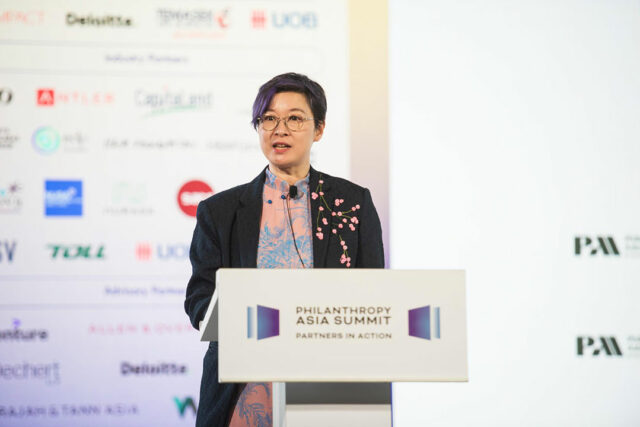
Dawn Chan, chief executive officer of CIIP and Managing Director of Investments at Temasek Trust Capital, gives a speech at the launch of the 12-month Amplifier mentorship program in Singapore on April 15, 2024.

By Kyle Aristophere T. Atienza, Reporter

SINGAPORE — A Philippine startup helping agricultural value chains has been included in a global mentorship program that seeks to help sustainability-driven startups to become commercially viable.

Mayani will receive up to S$250,000 in funding after it was selected to be among the five startups across the world that will benefit from the year-long Amplifier mentorship program of Temasek Trust ecosystem entities — the Centre for Impact Investing and Practices (CIIP) and Philanthropy Asia Alliance (PAA).

Supported by the Impact Innovation Partner Mastercard Center for Inclusive Growth, the program received 139 submissions from 35 countries spanning the areas of energy and power, sustainable food and land conservation, oceans conservation, circularity and waste, among others.

Mayani seeks to reshape rural agricultural value chains in the Philippines by harnessing technology to provide sustainable pathways to markets, boost yield and climate resilience through quality agri-inputs, and drive financial inclusion through alternative rural financing.

Mayani said it has so far signed up more than 139,000 farmers and partnered with over 500 stores.

The startup in 2023 announced its successful seed raise of $1.7 million from a global coalition of investors and has since expanded its grassroots footprint of organized farmers and fisherfolk across seven Philippine regions.

Dawn Chan, chief executive officer of CIIP and Managing Director of Investments at Temasek Trust Capital, said Mayani has also been recognized for its focus on smallholder farmers and fisherfolk.

“Amplifier came at a crucial juncture of MAYANI’s journey as we’re now tackling some of the most pressing problems looming over the agri-fisheries sector: from extreme weather conditions like droughts and biodiversity degradation, to rural financial exclusion and food insecurity,” Mayani CEO and co-founder JT Solis said.

“The sector is challenged in ways that we’ve never seen before. And in our pursuit of those multifaceted solutions that can drive financial returns and positive impact in equal measure, we wanted to leverage Amplifier and the Temasek Trust ecosystem entities CIIP and PAA in charting out that path ahead,” he added.

Among the five startups chosen for the mentorship program is US-based Circ, Inc., which recycle global fashion waste back into textiles and recover cellulosic and synthetic fibers back into the textile supply chain, and Hong Kong-based GRST, which utilizes a water-based electrode coating process to manufacture sustainable lithium-ion batteries with low carbon footprint and high recyclability.

Also included in the list were Indonesia’s MYCL, a biotech company that develops a low-carbon emission composite and leather-like material called MyleaTM, which is used in making footwear, automotive interiors, and building materials.

Indonesia’s Sampangan, which converts all types of unsorted waste into Versatile raw materials through carbonization technology, was also selected for the year-long mentorship program.

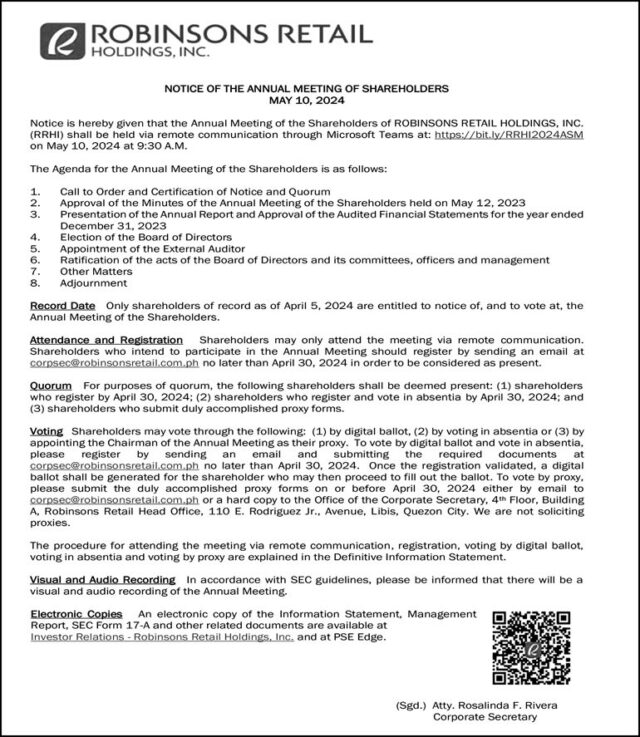
Robinsons Retail Holdings notifies shareholders of virtual annual meeting on May 10


Spotlight is BusinessWorld’s sponsored section that allows advertisers to amplify their brand and connect with BusinessWorld’s audience by publishing their stories on the BusinessWorld Web site. For more information, send an email to online@bworldonline.com.

Join us on Viber at https://bit.ly/3hv6bLA to get more updates and subscribe to BusinessWorld’s titles and get exclusive content through www.bworld-x.com.

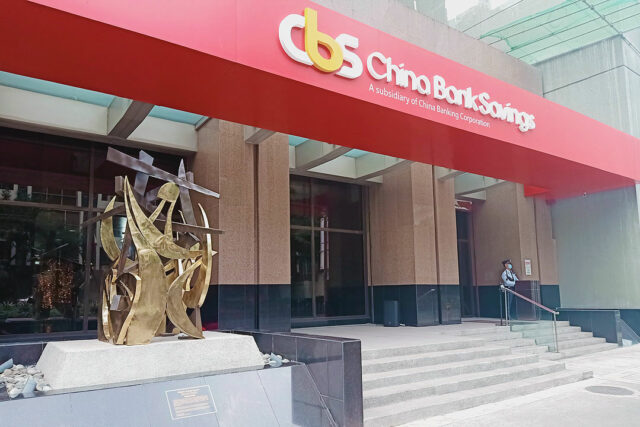
China Bank Savings posts record net profit in 2023

BW FILE PHOTO

CHINA BANK Savings (CBS), the thrift arm of listed China Banking Corp. (China Bank), booked a record net income in 2023, it said on Monday.

CBS’ net profit rose by 17% year on year to P1.85 billion, it said in a statement.

The bank recorded P113 billion in loans in 2023, up by 25% from 2022, as its customer base grew by 21% year on year.

As of the first quarter, its customer base has expanded by 22% from the end-2023 level, CBS added.

The bank had P153.45 billion in resources as of Dec. 31, 2023.

“We are aware of the challenges facing the banking sector this year. Inflation just won’t go away, and movements in international banking continue to be a key consideration for local monetary policy,” CBS President James Christian T. Dee said.

“Through our consumer loans, salary loans, SME (small and medium enterprise) loans, and teacher’s loans, we will continue to expand our reach. As we do so, we will strengthen our financial inclusion advocacy to bring more Filipinos into the formal banking sector,” he said.

CBS’ parent China Bank recorded a 15% growth in its net income to P22 billion last year. — B.M.D. Cruz

Entertainment News (04/16/24)


Robinsons Magnolia to hold Vet Appreciation Day

APRIL 18 is Vet Appreciation Day at Robinsons Magnolia. Animal lovers, pet owners and their pets, students, families, and aspiring veterinarians can join talks on animal health and welfare, food safety, and environmental conservation. There will be a pet parade featuring cats and dogs, games, and raffle draws. There will be free pet services as well, including Pet Bakuna (free anti-rabies vaccination) and Pet Konsulta (free vet consultation). Vet Appreciation Day will be held at the Activity Area of Robinsons Magnolia on April 18, from 10 a.m. onwards. The Robinsons Malls Happy Pets Club, the Quezon City Veterinary Department, and the Society for the Advancement of Veterinary Education and Research, will celebrate the doctors who help keep pets healthy.


Abigail gets midnight screening on April 17

ABIGAIL (played by Alisha Weir), the kidnapped ballerina and — unbeknownst to her captors — very hungry vampire, is out for blood. The horror movie Abigail premieres in cinemas April 17 with a midnight screening. The members of the kidnap crew, who dwindle as the night wears on, are played by Melissa Barrera, Dan Stevens, Kathryn Newton, Kevin Durand, Will Catlett, Angus Cloud, and Giancarlo Esposito.


Yeng Constantino performs at City of Dreams

CENTERPLAY at City of Dreams Manila will be turning the spotlight on Filipino pop rock star Yeng Constantino. She will have a concert there on April 23 at 9 p.m., the 7th in the monthly CenterPlay Live Concert Series. Some of her chart-topping songs include “Hawak Kamay,” “Salamat,” “Cool Off,” “Lapit,” “Chinito,” and “Ikaw,” some of which will be sung at the concert. There will also be performances from the Swerve band and DJs from 8 p.m. to 1:30 a.m. Guests can reserve a seat or a table with consumables starting at P2,950. VIP couch seats for a party of eight will be available for P23,600 and VIP Small Tables for a group of four at P11,800, inclusive of consumables. For reservations, call 8800-8080 or e-mail guestservices@cod-manila.com.


Interactive activities for kids from Promil

THE PROMIL Gifted Brain Room, the first of its kind in the country, is now open at Robinsons Galleria. It showcases interactive activities that encourage children to play and exercise their mental skills at the same time. Presented by Wyeth Nutrition and done in collaboration with Mystery Manila, the Promil Gifted Brain Room welcomes children ages three to seven years old to four mission rooms, each of which highlights one of the Four Brain Developmental Milestones: focus, memory, language, and problem solving skills. The Promil Gifted Brain Room is open until May 15. Slots can be reserved for free at promil.mysterymanila.com.


Perrie of Little Mix goes solo

GLOBAL music superstar Perrie has unveiled her long-awaited debut solo single, “Forget About Us,” a bittersweet uptempo pop song co-written with Ed Sheeran and David Hodges. The track aims to introduce Perrie as a solo artist by highlighting her vocal talent. “Relationships have been a huge part of my life and they’ve made me who I am now. I think it’s a nice sentiment to be honest about and it’s super relatable,” she said of the song. It is accompanied by a music video directed by Jake Nava and shot in Cape Town. “Forget About Us” is out now on all digital streaming platforms.


Bacolod calls for entries to Sept. film fest

THE BACOLOD City government launched a film festival which will showcase the creativity of filmmakers in the city. Mayor Alfredo Abelardo “Albee” Benitez officially announced the call for entries, in accordance with the recently approved City Ordinance No. 1061, also known as the Bacolod Film Festival Ordinance. Ten filmmakers and residents of Bacolod City will receive production grants worth P300,000 each to shoot their short films. These will be shown during the film festival in September, with an awards night to be held as a culminating event.


Crwn marks debut album with launch party

AFTER 11 years of creative partnerships, producer King Puentespina, known as Crwn (stylized as crwn), will be launching his long-awaited debut album, Séance, on May 11. The day will be marked by an event called The Gathering that will give fans the chance to experience the album’s dynamism live with all its collaborators. The dance music-centric album has a roster of 11 songs, both familiar and new. Details regarding the event’s location and additional featured artists will be unveiled in the coming weeks. Fans can secure their tickets for The Gathering on May 11 through the following link: bit.ly/seancebycrwn.


Korean alt-pop artist t024 drops new single

T024, an alternative pop duo from South Korea, has released their new single, “Cedarwood & Tangerine,” a nostalgic track that aims to immerse listeners in a multisensory experience. “You know how sometimes you randomly smell something and it just takes you back? Like, it brings up a picture in your head or a certain vibe, even if you can’t pinpoint all the details. I thought that was super interesting and it’s actually what got me to write this song,” said Senji, singer-songwriter of t024. “Cedarwood & Tangerine” is a sneak peek of the duo’s inaugural EP. It is out now on all streaming platforms.


SB19’s Justin releases Maroon 5 cover

P-POP star Justin, best known as a member of SB19, has released a new song, “Sunday Morning,” via Sony Music Entertainment. The track reimagines the Maroon 5 classic with a jazz-infused flavor. It is produced by RADKIDZ’s Josue, who turned the 2004 smash into a contemporary jam. “Sunday Morning is one of my personal favorites and it’s one of my go-to karaoke staples since childhood. I was supposed to perform the song in the Asian leg of the PAGTATAG! World Tour, but the shows got canceled as we were resolving some internal issues,” Justin said in a statement. It is out now on all digital streaming platforms.


UST’s student-led media agency to debut two shows

MORF, an agency formed in 2023 by third-year Communication students from the University of Santo Tomas, will be producing two shows as part of COMMTV, an annual interclass competition for TV production run by the school. The first, Beyond the Arch, is an interview series that features Thomasian alumni reminiscing about their time in college and visiting important spots that have changed or disappeared from the campus. The second, Battle of The Hustle, is a reality game that features select students who will launch their businesses and compete to win titles. They will be streamed live on the Facebook page of UST Tiger TV sometime in April and May. Visit @morfcollective across different social media platforms for more details.


The Garfield Movie comes to PHL cinemas in May

A NEW Garfield adventure is in store with The Garfield Movie, starring Chris Pratt as the voice of everyone’s favorite lazy orange tabby. Also featuring the voice of Samuel L. Jackson as Garfield’s dad, it opens in cinemas May 29. The film sees Garfield in a wild outdoor adventure after joining his long-lost father, scruffy street cat Vic, on a hilarious, high-stakes heist. It is directed by Mark Dindal and is based on the Garfield characters created by Jim Davis. It premiers in the Philippines on May 29 under Columbia Pictures.

Robinsons Hotels expects up to 70% occupancy rate for Go Hotels Plus Mandaluyong

ROBINSONS HOTELS and Resorts (RHR) said it expects a 60%-70% occupancy rate for Go Hotels Plus Mandaluyong’s pilot year following its refurbishment.

Go Hotels Mandaluyong, which opened in 2010, was highlighted by the company as a significant contributor to the expansion of the budget hotel chain nationwide.

The hotel’s “no-frills” concept played a crucial role in establishing a distinct identity for the brand, the company said in a statement last week.

The hotel offers 222 deluxe and disability-friendly rooms, featuring queen-size or twin beds.

Located in Robinsons Cybergate Plaza EDSA in Mandaluyong, the hotel is situated near Ninoy Aquino International Airport and within walking distance of Manila Metro Rail Transit System 3 Boni Station and EDSA carousel.

“The newly launched Go Hotels Plus Mandaluyong has been receiving rave reviews from our guests. This has already translated into revenue growth for the hotel and is expected to further increase throughout the year,” RHR Senior Vice-President and Business General Manager Barun Jolly said in an e-mailed statement. 

“We forecast 2024 to be a strong year with revenue numbers well above 2019 and this growth is seen across our portfolio of 30 hotels,” he added.

As the hotel upgraded its brand, changes were seen in the modern design and amenities such as a hair dryer, dental kits, and hygiene kits being readily available.

In addition to the existing deluxe twin and queen rooms, a new room category with bunk beds for sharing is not offered for budget-conscious groups.

The lobby, now bigger and equipped with WiFi connection, serves as a recreational and working area.

According to Mr. Jolly, there will be an increase in pricing due to the added feature but still affordable.

RHR reintroduced Go Hotels Plus in 2022, as the economy and the leisure sector were recovering from the COVID-19 pandemic. The first Go Hotels Plus was opened in Tuguegarao, followed by the opening of the second Go Hotels in Naga, South Luzon.

The total portfolio of the budget hotel chain, including Go Hotels and Go Hotels Plus combined, comprises 17 properties nationwide, including four franchised hotels under the Roxaco group. — Aubrey Rose A. Inosante

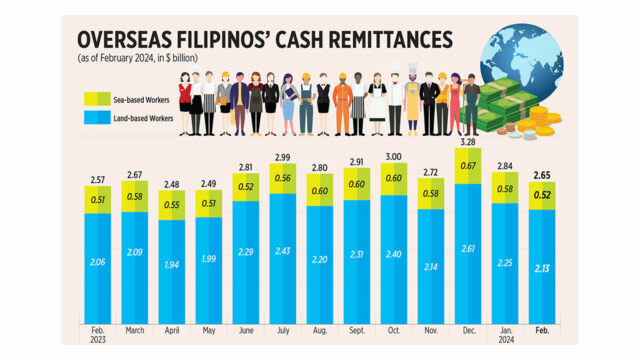
Overseas Filipinos’ Cash Remittances

MONEY SENT HOME by overseas Filipino workers (OFWs) rose by 3% in February, the Bangko Sentral ng Pilipinas (BSP) said on Monday. Read the full story.


Overseas Filipinos’ Cash Remittances

Continuing Conversations: Intersection of higher education and SDGs

FREEPIK

The UNESCO Multisectoral Regional Office in Bangkok, in partnership with The University of Tokyo and Waseda University, held the 5th Multistakeholders’ Meeting on Internationalization of Higher Education in Asia and the Pacific in Bangkok, Thailand in December 2023. This author was part of the contingent comprised of academics and experts from various institutions in Asia and the Pacific. The meeting highlighted the unique position of higher education in addressing global common challenges, including the Sustainable Development Goals (SDGs) which recognize ending poverty, improving education, promoting gender equality, addressing climate change, among others, as universal problems that necessitate an urgent call to action.

At the heart of the multisectoral meeting was a conscious decision to reaffirm the contribution of higher education across selected SDGs as it intersects with each in achieving their respective goals.

Under SDG4 (Quality Education), one of the key targets is Target 4.3 which aims, by 2030, to “ensure equal access for all women and men to affordable and quality technical, vocational and tertiary education, including university.” While current efforts to foster equal access focus largely on reforming internal admissions guidelines, a complementary strategy to achieve this is to promote the internationalization of higher education, defined as “the process of integrating an international, intercultural, or global dimension into the purpose, functions or delivery of postsecondary education” (Knight, 2015). Aside from deepening awareness and tolerance of cross cultures, internationalization plays an integral role in promoting access to quality education at the tertiary level while also fostering diversity and equity. International higher education has a lot of potential in making quality education more accessible for a wider audience, non-elites included, as efforts to democratize international education practices continue to find a space in academic discussions.

At the recently held International Symposium on Democratizing International Student Mobility Partnerships, held at Waseda University in Tokyo in February, emphasis was placed on exploring ways on how to make it possible for international education to be “inclusive, equitable, and rooted in democratic principles.” In the same vein, international education partnerships fostered between the global north and the global south provide an avenue for equitable collaboration in the sense that the latter has a chance to have a more prominent role in leading and setting the tone of proposed projects based on a history of cooperation and mutual trust.

SDG5
Though higher education intersects most prominently with SDG4, its contribution in the promotion of other SDGs cannot be underestimated. For SDG5 (Gender Equality), there is a conscious effort within higher education institutions (HEIs) to include gender policies in their mandate. Whether this is in the form of putting in place mechanisms to protect faculty or students from discrimination or gender-related abuse, or establishing protocols and offering trainings toward maintaining a gender-responsive academic community, the commitment to achieving specific targets of SDG5, particularly Target 5.1 which aims to “end all forms of discrimination against women and girls everywhere,” is undeniably present.

At the Ateneo de Manila University, the establishment of the Gender and Development Office as well as the University Gender Hub offers a clear direction on the university’s efforts to ensure that gender equality protocols towards making the campus a safe space for everyone, particularly women, are in place at the level of policy, audit, curriculum, research, and services.

Most universities also put a lot of effort in advancing social mobility and research among and by females, helping identify gaps in gender equality not only in the academe but in society as a whole. Emphasis on academic institutions’ policies on gender equality, in terms of recruitment and the promotion of women in the academic community, has never been more pronounced as they are in current times. There is a conscious effort to include in university policies directives that would increase the representation of women in academia. This is demonstrated in the case of OECD countries, where women students’ participation in higher education has been on the rise since the 1990s, with an average projection of 58% participation over their male counterparts by 2025 (UNESCO-IESALC, 2023). Data also shows that for female teachers at the tertiary level, global gender parity is projected to be achieved by 2045 across most regions including East Asia and the Pacific (UNESCO-IESALC, 2023).

SDG11 AND SDG13
SDG 11 (Sustainable Cities and Communities) calls for sustainable cities that are inclusive, safe, and could facilitate opportunities with basic services such as transportation and housing for all.

HEIs’ contribution at the institutional level involves efforts to integrate urban planning, environment, and community development in its policymaking as well as in providing meaningful platforms that engage various stakeholders in the academic community as they attempt to integrate SDG11 targets in teaching, research, and curricula design. While higher education involvement in SDG11 target areas are not as pronounced vis-à-vis efforts to achieve the targets for SDG4 and SDG5, there are considerable efforts from universities worldwide to participate in activities that can contribute toward having more sustainable communities.

A recent report by UNESCO-IESALC and Times Higher Education (2023) which measured institutional contribution to SDG11 across the areas of research, support for arts and heritage, and sustainable practices, indicated a small but steady increase between 2020 to 2023 in the number of universities submitting data regarding what they have been doing towards making cities and human settlements more sustainable, inclusive, resilient, and safe.

The intersection between higher education and SDG13 (Climate Action), particularly Target 13.3 which focuses on “improving education, awareness-raising, and human and institutional capacity on climate change mitigation, adaptation, impact reduction and early warning” is best underscored by the complex roles that many universities have been taking on where combating the challenges of climate change is concerned.

Universities are vital platforms for teaching, learning, and doing research on measures to mitigate climate change impacts and over the years, there have been great strides in integrating climate and environment-related topics in higher education curriculum. As climate change is one of the most contentious issues that humanity faces, higher education service providers enjoy this privileged but critical role of educating and eventually shaping the behavior of future policymakers, scientists, practitioners, and community leaders who are expected to come up with innovative strategies to address climate change and its impact that cuts across environment, social, political, and economic dimensions (Leal Filho et al., 2023).

Beyond learning, universities also have the capacity to be agents of advocacy and activism toward more sustainable practices. There is also room for collaboration between educational institutions and the government as seen in the recent reaffirmation of the partnership between the University of the Philippines – National College of Public Administration and Governance (UP-NCPAG) and the Climate Change Commission (CCC) in order to advance climate governance (CCC, 2024).

CONTINUING CONVERSATIONS
While not exhaustive, the aforementioned initiatives illustrate the evolving role of higher education in contributing to the attainment of societal goals outside the traditional confines of teaching, research, and extension or community work.

There is greater expectation for higher education to tackle common global problems such as the SDGs as it does intersect in achieving key target points for each goal. Central to these intersections is the unique position of HEIs to collaborate with key stakeholders such as governments and international partners in order to come up with significant strategies that will change the face of how the next generations are to solve universal problems with better and more sustainable ways.


Pilar Preciousa Pajayon-Berse, PhD. is an assistant professor at the Department of Political Science, Ateneo de Manila University.