Home Blog Page 3419

No spike in oil prices for now amid Mideast tension

Fuel retailers said pump prices would increase by P0.40 per liter of gasoline, P0.95 per liter of diesel, and P0.85 per liter of kerosene, effective on Tuesday (April 16). — REUTERS

THE DEPARTMENT of Energy (DoE) does not see a spike in pump prices amid concerns of a wider conflict in the Middle East after Iran’s retaliatory attack against Israel.

Energy Secretary Raphael P.M. Lotilla said that they would monitor oil prices for the week.

“While the market may initially have reacted, we hope that it will normalize,” he told reporters.

Tensions in the Middle East have escalated after Iran launched hundreds of drones and missiles at Israel late on Saturday. This was in retaliation for an alleged Israeli attack on the Iranian consulate in Syria earlier this month.

“The increasing price is brought about by the OPEC+ reduction and not necessarily related to this conflict,” Rino E. Abad, director of the Oil Industry Management Bureau, told reporters on the sidelines of an event in Taguig City.

Earlier this month, the Organization of the Petroleum Exporting Countries (OPEC) and its allies, also known as OPEC+, agreed to maintain oil output cuts until end-June.

Mr. Abad said they have seen a consistent increase in oil prices.

“It seems like there really is a shortage from a fundamental perspective of supply-demand, which is brought about primarily by the production cut, not necessarily about the conflict,” he added.

However, Mr. Abad warned that problems could arise if the conflict affects the Persian Gulf.

“The closure of the Persian Gulf would be difficult because fuel tankers won’t be able to pass through,” he said in Filipino.

The Philippines is a net importer of petroleum products. In the first half of 2023, the country imported 3.476 billion liters of crude oil, 23.7% higher than in 2022, data from the DoE showed.

Rizal Commercial Banking Corp. Chief Economist Michael L. Ricafort said there would still be volatility in global crude oil prices due to geopolitical tensions.

“Though NYMEX (New York Mercantile Exchange) crude oil prices are slightly lower today at $85 per barrel levels versus $86 a week ago, it could still lead to some pickup in prices since the Philippines is a net-importing country and imports all of its oil requirements,” he said in a Viber message.

Gerry C. Arances, executive director of think tank Center for Energy, Ecology and Development, said that the administration of President Ferdinand R. Marcos, Jr. should prepare and implement subsidies to the most vulnerable sectors in case of a spike in oil prices.

“If regional tensions worsen and Hormuz becomes a trigger point, the worldwide oil and gas supply will contract and countries will compete with each other for the available supply,” he said in a Viber message.

“The Israel-Iran conflict, like other geopolitical conflicts in the past few years, should serve as a wake-up call for the Philippine government to raise its ambition and accelerate the transition to renewable energy,” Mr. Arances added.

The Development Budget Coordination Committee (DBCC) earlier this month kept the assumptions for Dubai crude oil price at $70 to $90 per barrel for this year and $65 to $85 per barrel for 2025 to 2028. “This reflects the latest futures prices and forecasts that suggest tempered global crude oil prices over the medium term,” the DBCC said.

In separate advisories on Monday, oil companies said pump prices would increase by P0.40 per liter of gasoline, P0.95 per liter of diesel and P0.85 per liter of kerosene, effective on Tuesday (April 16).

This marks the fifth straight week that prices of gasoline have increased, and the second consecutive week of price hikes for diesel and kerosene.

This would bring the total adjustment of gasoline this year to a net increase of P9.70 per liter, diesel at P7 per liter, and kerosene at P2.25 per liter.

POTENTIAL IMPACT
Meanwhile, the British Chamber of Commerce Philippines (BCCP) and the UK Department for Business and Trade acknowledged the heightened tensions in the Middle East, calling for restraint by leaders.

In a statement sent on Monday, BCCP Executive Director Chris Nelson said the growing tension in the Middle East could potentially impact oil prices, interest rates, and the stock market. These could also lead to another spike in inflation and disruption in supply chains.

“We all hope for restraint and what we can try to do is how we can assist the Philippines with supply opportunities. I would just reiterate that inflation is a key concern in many countries. I would say that the UK is working hard with the Philippines on the supply chain,” Mr. Nelson said.

The Bangko Sentral ng Pilipinas (BSP) sees inflation averaging 3.8% this year and 3.2% next year. It kept the key policy rate steady at 6.5% for a fourth straight meeting.

Mr. Nelson said that the UK could help in terms of securing the supply of meat, particularly pork, in the Philippines,

“We would once again say that we would like to see the complete implementation of Executive Order (EO) 50 and no alteration of approach on the minimum access volume which could reduce supply and potentially have an impact on inflation,” he said.

Last December, President Ferdinand R. Marcos, Jr. signed EO 50 which extended the lower tariffs on pork, corn, and rice for another year.

Meanwhile, UK Department for Business and Trade Philippine Country Director James Thackery highlighted the UK’s expertise in clean energy and infrastructure.

He said that the recent trilateral partnership among the US, Japan, and the Philippines presents an opportunity “to deepen (the UK’s) partnership with the Philippines.”

He added that the UK is interested in establishing a Joint Economic and Trade Committee in the Philippines and the Comprehensive and Progressive Agreement for Trans-Pacific Partnership. — Sheldeen Joy Talavera and Justine Irish D. Tabile

Jet fuel prices may challenge airlines after Q1 boost — analysts

STOCK PHOTO | Image by Rudy Dong from Unsplash

By Ashley Erika O. Jose, Reporter

A SURGE in demand during Holy Week and the start of the summer season likely boosted revenue growth for airline companies in the first quarter (Q1), according to analysts, but cautioned about potential challenges ahead due to rising jet fuel prices.

“The surge in travel demand coinciding with the timing of the Holy Week, which occurred in late March,  and the onset of the summer season would’ve likely supported the revenue growth of airline companies in the first quarter,” China Bank Securities Corp. Research Director Rastine Mackie D. Mercado said in an e-mail on Monday.

However, the volatility of the fuel market due to the ongoing geopolitical tensions and the additional output cut by the Organization of the Petroleum Exporting Countries and their allies including Russia (OPEC+) may hurt airlines growth for the period, he added.

“Prospects of higher jet fuel prices, driven by geopolitical tensions in the Middle East, and prolonged oil output cuts from OPEC+ could lead to some demand and margin pressures in the near term,” he also said. 

In March, members of OPEC+ announced that they would extend the oil output cut of about 2.2 million barrels per day until the second quarter to maintain a balanced oil market supply.

On Monday, oil companies were set to hike pump prices by P0.40 per liter for gasoline, P0.95 per liter for diesel, and P0.85 per liter for kerosene.

These price adjustments brought a year-to-date net increase of P9.70 for gasoline, P7 for diesel, and P2.25 for kerosene.

The Department of Energy said that surging oil prices are expected to continue due to the OPEC+ cut, while downplaying the impact of the ongoing Israel-Iran conflict.

The Civil Aeronautics Board (CAB) has retained the airline fuel surcharge at Level 6 for April.

Latest data from the Energy department showed that Dubai crude climbed by nearly $4 per barrel for the first week of April. The international prices of gasoline, diesel, and kerosene have also increased by about $2.40, $3.60, and $3.40 per barrel, respectively.

Rizal Commercial Banking Corp. Chief Economist Michael L. Ricafort also said that the volatility of oil prices could pose risks to airline operations, as it may drive operating costs to increase further.

“Number of domestic airline passengers already exceeded pre-pandemic levels. Offsetting risk factor is the volatility in global crude oil prices amid increased tensions in the Middle East that could increase operating costs and could narrow profit margins,” he said in a Viber message.

For Globalinks Securities and Stocks, Inc. Head of Sales Trading Toby Allan C. Arce, airlines are still expected to significantly benefit from the post-pandemic revenge travel trend.

“Philippine airline companies seem positive based on the momentum gained in 2023 and early 2024,” he said, adding that growth may be sustained despite the changing market environment.

“Sustained growth will depend on the ability of airlines to adapt to changing market conditions, diversify their revenue streams, and mitigate risks associated with external factors beyond their control.” 

For 2023, Cebu Air, Inc., the operator of budget carrier Cebu Pacific, registered a net income of P7.9 billion for 2023, reversing its losses in 2022.

The company recorded an operating income of P8.6 billion, while its EBITDA, or earnings before interest, taxes, depreciation, and amortization, reached P21.8 billion, marking a significant increase from the P664 million in 2022.

Its total expenses climbed 20% to P82 billion, which it attributed to higher fuel costs and fleet-related expenses.

PAL Holdings, Inc., the listed operator of flag carrier Philippine Airlines (PAL), saw its attributable net income more than double to P16.81 billion last year.

PAL noted that its jet fuel consumption rose by 8% due to increased flight activity last year. The company added that fuel costs accounted for 45.3% of its overall expenses.

“The post-pandemic revenge travel trend indeed seems to have benefited airlines… While the outlook appears positive, sustaining this growth and maintaining strong financial results in the first quarter of 2024 may face challenges. External factors such economic instability, and unpredictable shifts in travel restrictions,” Mr. Arce said. 

To recall, CAB recorded a total of 50.18 million passenger volumes for 2023 covering both domestic and international flights.

The Tourism department reported 5.45 million international visitors in 2023, surpassing the year’s target of 4.8 million.

For 2024, the department aims to attract 7.7 million international visitors.

Flag carrier PAL said it expects passenger volume to rise up to 20% in 2024 from its more than 14 million passengers in 2023.

Last year, the airline company carried a total of 14.7 million passengers, marking a 58% increase from the 9.3 million passengers recorded in 2022.

Data provided by the company showed that PAL managed to mount a total of 105,294 flights last year, 35.8% higher than the 77,533 total flights in 2022. Meanwhile, Cebu Pacific flew over 20 million passengers on more than 140,000 flights. This translated to approximately a 41% increase in passengers and a 30% increase in flights compared to the previous year.

CREC taps RCBC for up to P20-B financing

SAAVEDRA-LED Citicore Renewable Energy Corp. (CREC) has secured a financing deal with Rizal Commercial Banking Corp. (RCBC) totaling up to P20 billion to fund solar projects.

The initial tranche of P9 billion was arranged by RCBC Capital Corp., CREC said in a statement on Monday.

“The structure is believed to be the first-of-its-kind project financing in the Philippines, which covers various project portfolios instead of the typical per-project financing structure,” the company said.

Proceeds from the initial funding tranche will be used for CREC’s development of solar power plant projects in Batangas, Pampanga, and Negros Occidental.

These have a combined installed generating capacity of at least 600-megawatt direct current and up to approximately one gigawatt of solar energy capacity.

The company is targeting to complete the commercial operations of the first and second phases of the Negros Occidental project in September 2024 and 2025, respectively.

Meanwhile, the expected commercial operation dates for the first and second phases of both Batangas and Pampanga projects are December 2024 and 2025, respectively.

“RCBC’s support will assist us to fulfill our 1 GW (gigawatt),” CREC President and Chief Executive Officer Oliver Tan said. “We thank RCBC for their trust in us and we will endeavor to meet our goals with excellence.”

CREC is aiming to list its shares on the Philippine Stock Exchange on May 31, according to its prospectus dated April 3.

The company is set to offer 1.79 billion common shares at a maximum price of P3.88 apiece, including an additional 267.86 million shares for overallotment. — Sheldeen Joy Talavera

ICTSI receives green light for Visayas Container Terminal

ICTSI.COM

THE Philippine Ports Authority (PPA) has issued a notice to proceed to International Container Terminal Services, Inc. (ICTSI) for the rehabilitation and operation of the Visayas Container Terminal (VCT), formerly known as the Iloilo Commercial Port Complex in Western Visayas, the company said.

The Razon-led port operator is set to commence operations and upgrade the facility upon signing the notice to proceed, the company told the stock exchange on Monday.

ICTSI said it will work on improving terminal productivity and service quality by investing in the development and rehabilitation of the terminal’s infrastructure and deploying cargo-handling equipment.

The PPA awarded in January the 25-year contract to operate the VCT to ICTSI, the port’s lone bidder.

The contract includes a concession fee of P750 million, PPA said. This amount is 50% higher than the P500 million minimum fixed fee set by the agency in its bid invitation.

“Our significant investments in modern infrastructure, cargo-handling equipment, and operational efficiency will drive this transformation,” Christian R. Gonzalez, ICTSI executive vice-president said in a statement.

The VCT has about 627 meters of operational quay length and 20 hectares of land for container and general cargo storage, warehousing, and other cargo-handling activities.

The facility caters to Iloilo province and the entire Panay Island. Situated apart from older port facilities on Panay Island’s southern coast in Panay Gulf, it benefits from being one of the country’s safest harbors, according to ICTSI.

ICTSI said capacity and efficiency constraints have hindered the seaport’s full potential as it aims to unlock the facility’s full potential.

Currently, the seaport managed a total volume of 100,000 twenty-foot equivalent unit or TEUs and two million metric tons of non-containerized cargo annually.

“iCTSI’s involvement will transform the port, addressing these challenges and unlocking its economic benefits. The port will be operated exclusively to serve foreign vessels and cargoes, with a provision for domestic vessels and cargoes in the initial five years,” the company said. — Ashley Erika O. Jose

First half seen challenging for IPOs

By Sheldeen Joy Talavera, Reporter

GOING public in the first half of 2024 may be challenging due to the uptick in inflation and hawkish policy stance from the central bank, analysts said.

“We are now seeing volatility in equity markets due to stubborn inflation, a potential delay in interest rate cuts, and elevated geopolitical risk,” China Bank Capital Corp. Managing Director Juan Paolo E. Colet said in a Viber message last week.

“As a result, it has become more challenging to do an IPO (initial public offering) during the first half of this year,” he added.

Headline inflation accelerated to 3.7% year on year in March, data from the Philippine Statistics Authority showed. This is within the forecast of the Bangko Sentral ng Pilipinas for the month of 3.4% to 4.2%.

The Monetary Board last week kept rates steady at 6.5% for a fourth straight meeting and signaled a possible delay in rate cuts due to upside risks in inflation.

Mr. Colet said that elevated interest rates impact equity valuations and reduce the appetite for equities “because investors can get fairly attractive returns by investing in debt instruments that are considered safer than stocks.”

“Tight monetary policy tends to slow down the economy by making borrowing more expensive, so those factors also impact the prospects of a company,” he said.

“If we the goal is to raise as much volume at the best valuation, it might be better to wait until we see a tapering of inflation and a clearer path to monetary policy easing before launching a sizable IPO,” Mr. Colet said.

Toby Allan C. Arce, head of sales trading at Globalinks Securities and Stocks, Inc., said that while the environment for conducting IPOs may be more challenging, “it’s not necessarily prohibitive.”

“Companies considering IPOs would need to carefully assess market conditions, investor sentiment, and their own business fundamentals before proceeding,” he said in a Viber message.

Despite the uptick in inflation and hawkish cues from the central bank, the market environment remains favorable for potential IPOs, according to Rastine Mackie D. Mercado, research director at China Bank Securities Corp.

“While investor appetite for equities is seeing some softness due to changing expectations on rate cut timings, especially from the US Federal Reserve, we think that this should firm up through the coming months especially as major central banks start to cut rates,” he said.

Markets are likely to watch out the take-up and price performance of the first IPO of the year “as this could help set the pace for succeeding issuances,” he added.

Mining company OceanaGold Philippines, Inc. is targeting to publicly list on May 13, based on the updated prospectus of its Australian-Canadian parent company OceanaGold Corp.

On Friday, the company secured the approval of the Philippine Stock Exchange (PSE) for its P7.9-billion IPO. It will offer 456 million common shares at a price of up to P17.28 each.

Another planned IPO for this year is Saavedra-led Citicore Renewable Energy Corp. (CREC), which is aiming to list its shares on the PSE on May 31, based on its prospectus dated April 3.

CREC is set to offer 1.79 billion common shares at a maximum price of P3.88 apiece, including an additional 267.86 million shares for overallotment.

The company trimmed its planned IPO size to P7.9 billion from P12.9 billion. The move came after SM Investment Corp. invested P5 billion in its subsidiary Citicore Energy REIT Corp. (CREIT).

CREIT is the country’s first real estate investment trust listing focused on renewable energy.

For 2024, the PSE is targeting to have at least six IPOs and is expecting about P40 billion worth of capital to be raised.

“While inflation and interest rates do play a significant role in shaping market sentiment, other factors such as investor confidence, economic growth prospects, industry trends, and geopolitical factors also come into play,” Mr. Arce said.

Alternergy, NGCP ink interconnection deal for Alabat wind

UNSPLASH

ALTERNERGY Holdings Corp., through its subsidiary Alternergy Tanay Wind Corp. (ATWC), has signed an agreement with the National Grid Corporation of the Philippines (NGCP) to connect its 100-megawatt (MW) Tanay Wind Power Project in Rizal to the grid.

“The ICA (interconnection agreement) signing for the Tanay Wind Power Project is a big step,” ATWC President Knud Hedeager said in a statement on Monday.

“NGCP’s approval is a positive response to fostering connectivity for renewable energy projects and increased critical energy infrastructures,” he added.

The agreement was done weeks after the signing for ICA of the 64-MW Alabat Wind Power Project in Quezon province.

“Similar to the ICA for the Alabat Wind Power Project, NGCP stands to provide assistance to Alternergy’s Tanay Wind Power Project which will contribute substantial renewable capacity to the grid to bolster the country’s energy sufficiency and sustainability,” NGCP President and Chief Executive Officer Anthony L. Almeda said.

“As the transmission network provider and system operator, NGCP’s mandate is to expand the capacity and reliability of the grid to accommodate new generation projects,” he added.

The Tanay Wind Power Project is set to commence development phase after obtaining the certificate of confirmation of commerciality from the Department of Energy.

It has also completed and signed the commercial contracts, particularly the wind turbine supply agreement and the balance of plant engineering, procurement, and construction contract.

The company has committed to deliver the wind project by end of 2025.

Alternergy aims to develop up to 1,370 MW of renewable energy sources such as onshore and offshore wind, solar, and run-of-river hydropower.

At the local bourse on Monday, the company’s shares went down by P0.01 or 1.39% to close at P0.71 each. — Sheldeen Joy Talavera

SMC signs biggest Asian dollar loan in 2024 to repay debt

FREEPIK

SAN MIGUEL Corp. (SMC) has signed the biggest syndicated dollar loan in Asia so far this year to refinance a similar borrowing facility due in December, according to people familiar with the matter.

The conglomerate inked the $2-billion deal last week with 35 banks under which it will pay an interest rate of 180 basis points over the benchmark Secured Overnight Financing Rate to borrow for five years, said the people who requested anonymity discussing private matters.

The loan is the biggest in US currency terms this year in Asia outside Japan, data compiled by Bloomberg show.

San Miguel, a power-to-ports conglomerate which is the Philippines’ largest firm by revenue, did not immediately respond to a text message from Bloomberg seeking comment.

The deal will help San Miguel ease repayment pressures stemming from the more than $3 billion of debt it had coming due in 2024.

The company said last month it was optimistic the Philippines’ healthy macroeconomic fundamentals and its own strategy will support its growth momentum this year.

San Miguel’s net income jumped 67% last year even as sales fell 4%, according to a stock exchange filing published last month.

The conglomerate’s interest-bearing debt was little changed at P1.4 trillion ($24.7 billion) as of December 2023 from a year earlier, while its total assets were about P2.5 trillion, based on the filing.

The mandated lead arrangers and bookrunners for the latest loan deal were Australia & New Zealand Banking Group Ltd., Bank of China Ltd.’s Hong Kong branch, CTBC Bank Co., ING Groep N.V., Maybank Kim Eng Securities Pte., Mitsubishi UFJ Financial Group, Inc., Mizuho Bank, Ltd., Rabobank Group, Standard Chartered Plc., and Sumitomo Mitsui Banking Corp., according to the people.

Each of the above banks underwrote about $112 million each, the people said. — Bloomberg

Shakey’s Pizza targeting at least 400 new stores across brands in 2024

SHAKEY'S PHILIPPINES FACEBOOK PAGE

LISTED food service company Shakey’s Pizza Asia Ventures, Inc. (SPAVI) said it aims to add at least 400 new stores and outlets across its brand portfolio this year.

“We plan to expand our network footprint by at least 400 stores and outlets,” SPAVI President and Chief Executive Officer Vicente L. Gregorio said in a stock exchange disclosure on Monday.

SPAVI opened 369 new stores and outlets last year. The new openings pushed SPAVI’s global network to 2,141 restaurants including 268 Shakey’s stores, 77 Peri-Peri stores, and 1,784 Potato Corner stores.

Mr. Gregorio also said that SPAVI is hoping to grow its top line and bottomline by the “mid-teens” this year.

“For 2024, inflationary challenges persist, so we remain vigilant and cautious. On the other hand, we see commodity prices beginning to ease towards the end of 2023,” he said.

“With robust double-digit growth coming from a high base and amidst dynamic macroeconomic backdrop, our built-up multi-brand portfolio primes us for sustainable growth in the years to come,” he added.

The company’s brand portfolio includes Shakey’s Pizza Parlor, Peri-Peri Charcoal Chicken & Sauce Bar, Potato Corner, R&B Milk Tea, and Project Pie.

SPAVI saw a 23% jump in its 2023 net income to P1.08 billion from P874 million the year before.

System-wide sales increased by 32% to P18.64 billion while consolidated revenue grew by 39% to P14.13 billion.

“In 2023, SPAVI continued to see healthy foot traffic, which buoyed the dine-In segment and helped boost same-store sales growth to 13%. In the fourth quarter, the dine-in segment increased by 11%, as guests celebrated the holiday season,” the company said.

SPAVI said its gross profit increased by 21% while gross margins softened due to higher input costs, inflation, and reinvestment in infrastructure to support expansion.

“We are grateful for the double-digit growth of our portfolio in 2023. However, persistent inflationary pressures continue to dampen consumer sentiment, leading to a softer growth performance during the second half of the year. Nonetheless, we are pleased to deliver record-high fourth quarter sales, supported by a festive comeback in December,” Mr. Gregorio said.

On Monday, SPAVI shares were unchanged at P10 per share. — Revin Mikhael D. Ochave

First Gen awards LNG contract to Chinese company

LOPEZ-LED First Gen Corp. has awarded a contract to Chinese company CNOOC Gas and Power Trading & Marketing Ltd. for supplying a liquefied natural gas (LNG) cargo.

CNOOC will send one LNG cargo of approximately 130,000 cubic meters next month via a delivered ex-ship basis at the port located at First Gen Clean Energy Complex, the company said in a statement.

It will be unloaded into the storage tanks of the BW Batangas, a floating storage regasification unit.

The LNG will be used by First Gen’s existing gas-fired power plants in the complex.

The company has four existing gas-fired power plants with a combined capacity of 2,017 megawatts that have been supplied with gas from the Malampaya field, the country’s sole natural gas provider.

The awarded contract was from the initiated fifth tender process for LNG cargo last month. Based on the bid notice, the delivery window will commence from May 25 to May 31, 2024.

FGEN LNG, a subsidiary of First Gen, constructed an interim offshore LNG terminal and executed a five-year time charter party for BW Batangas to provide LNG storage and regasification services.

The company said the terminal is expected to “play a critical role in ensuring the energy security of the Luzon grid and the Philippines.”

Meanwhile, CNOOC is said to be the “largest offshore oil and gas producer in China,” according to its website.

It has businesses in oil and gas exploration and development, professional technical services, refining product sales and fertilizers, natural gas production and power generation, and financial services, as well as new energy business like offshore wind power. — Sheldeen Joy Talavera

Taylor Swift songs back on TikTok despite Universal Music dispute

TAYLOR SWIFT is back on TikTok just in time for the launch of her new album, The Tortured Poets Department. — AMAZON.COM

TAYLOR SWIFT’s music has resurfaced on ByteDance Ltd.’s TikTok despite an ongoing dispute between her record label and the social video platform. The timing coincides with the impending release of her newest album, The Tortured Poets Department, on April 19.

Universal Music Group NV pulled music from both its recording artists and songwriters from TikTok in February after failing to come to terms on a new licensing agreement. Universal said TikTok failed to adequately compensate it for the songs, while TikTok accused the record label of putting its own interests above that of its artists. The two companies have yet to announce a new deal.

Ms. Swift’s move could derail Universal’s broader position that it doesn’t need TikTok to promote new music. It might also put pressure on the label to put its other musicians back on the platform. Ariana Grande released her latest album, Eternal Sunshine, last month, and her songs haven’t yet appeared on TikTok. The album and its singles were sold and streamed in high numbers, however.

Representatives for Universal and TikTok didn’t immediately respond to requests for comment. — Bloomberg

Presenting provocative, psychosexual power dynamics

A STILL from Your Mother’s Son

Movie Review
Your Mother’s Son
Directed by Jun Robles Lana

By Brontë H. Lacsamana, Reporter

YOUR MOTHER’S SON (or, its superior curse-like title in Tagalog, Anak Ka ng Ina Mo) is acclaimed director Jun Robles Lana’s foray into the bomba genre, which at its worst is known for cheap sexual thrills and at its best can comment on Philippine society through the use of gratuitous sex scenes.

This film achieves the latter. It even opens with a caravan blasting a campaign jingle and tossing out flyers for a politician running for upcoming elections. It’s set in the throes of the COVID-19 pandemic, where employment is scarce, and people are confined mostly in their small communities.

It is in this environment that the director, Jun Robles Lana, brings us a twisted Freudian tale involving the manipulative Sarah (played as an equally desirable and abusive mother figure by Sue Prado); the impulsive delinquent son Emman (played by an explosive Kokoy de Santos); and the strange newcomer to the family, Oliver (played with an initial innocence by Miggy Jimenez). Without spoiling how they evolve throughout the film, each plays their part to perfection.

As mentioned, this psychosexual melodrama goes beyond being a fucked-up chamber piece. It is injected with brushstrokes of the Filipino penchant for letting unchanging, unfair, uncaring authority figures run things. Not everything totally matches up and reflects that message, though, with the victims in this story obsessed with their abuser in a way that does not quite parallel how Filipinos romanticize politicians in power. Still, the allegory is a thoughtful one, showing how people are groomed to be subservient.

None of the characters are free of fault, by the way. They are all unlikeable in their own ways, even the struggling, often off-the-rails friend Amy (played well by Elora Españo, though she sometimes overdoes the Bisaya accent to the point of pastiche). Most notable is De Santos’ choice to play Emman as a possessive, vaping fuckboy, which is an irritating persona to bestow on a lead, but one that is believably plentiful among Filipino youth. What he lost in his formative years was merely touched upon, a shame since it would have helped the audience empathize with him more, minimized in favor of focusing on his present anger with the situation.

The cinematography has striking moments, and the pacing and build-up in the narrative are seamless. It evokes a bit of In the Realm of the Senses, a bit of raunchy Vivamax fare, and a bit of the zeitgeist-appropriate dramedy that director Lana is better known for — explaining why it is disjointed in parts — but which bits you like is entirely up to your filmgoing palate.

There’s camp and shock value, all within this attempt to be a searing indictment of society. Desire here can be read as a way to mask the repression the characters are facing, but it can also be read as a weapon in itself that keeps the repressed obedient to authority.

Anak Ka ng Ina Mo aligns the disgusting internal power struggle of a lost, lustful group with that of the Filipino people. An engrossing albeit uncomfortable film to watch, but great to discuss with others afterwards, especially considering how divisive it can be.

It premiered in the Philippines at the Gateway Cineplex, in Quezon City’s Araneta City, at The IdeaFirst Company’s EnlighTEN Film Festival, which celebrates the production outfit’s 10th anniversary. Other titles being screened include Die Beautiful, Anino sa Likod ng Buwan, Manananggal sa Unit 23B, Distance, I America, and Sleepless. The festival runs until April 16.

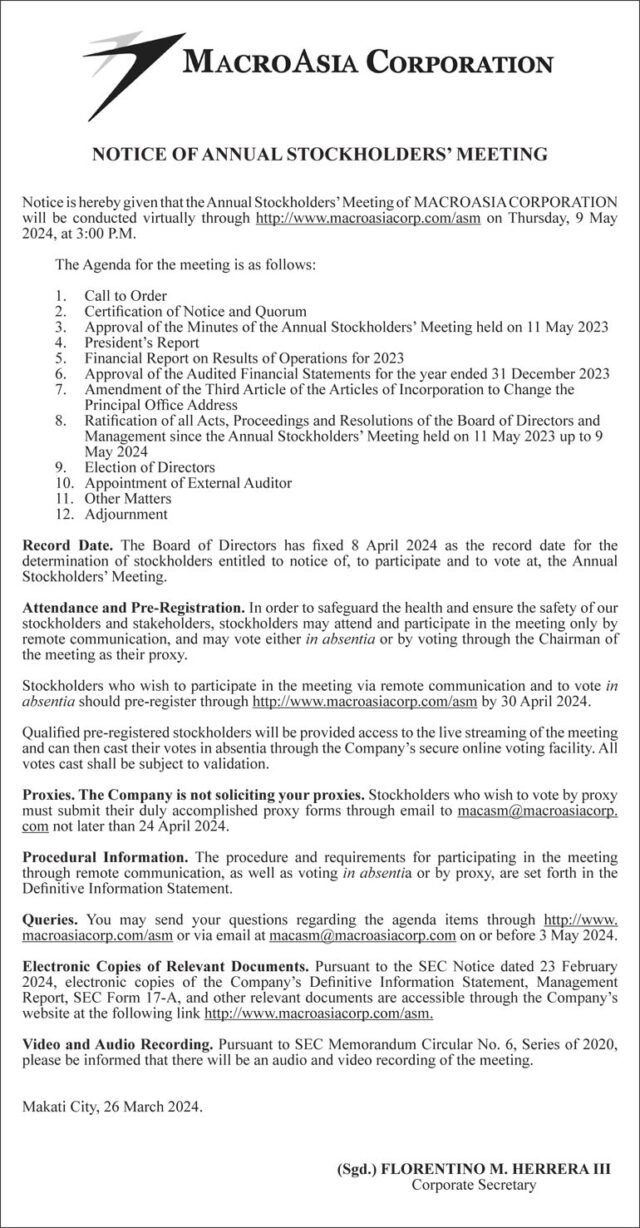
MacroAsia Corporation’s Annual Stockholders’ Meeting to be held virtually on May 9


Spotlight is BusinessWorld’s sponsored section that allows advertisers to amplify their brand and connect with BusinessWorld’s audience by publishing their stories on the BusinessWorld Web site. For more information, send an email to online@bworldonline.com.

Join us on Viber at https://bit.ly/3hv6bLA to get more updates and subscribe to BusinessWorld’s titles and get exclusive content through www.bworld-x.com.