Home Blog Page 3418

Technical outage crippled Dutch air traffic for hours, authorities say

Image by Andy Choinski from Pixabay

AMSTERDAM — Dutch airspace was almost completely closed for nearly three hours late on Monday and early on Tuesday due to a technical outage of air traffic control systems, local authorities said.

The outage occurred at 11 p.m. local time (2100 GMT) on Monday and was resolved almost three hours later, Air Traffic Control Netherlands said.

During that time very limited air traffic was handled in Dutch airspace, while flights were diverted to other airports in the region.

The air traffic control authorities said they were investigating the outage, and gave no further details on the cause.

“We are aware of the unpleasant consequences this has for passengers, airlines, and the airport. Further investigation is being conducted into the cause of the malfunction that occurred,” they said in a statement.

The outage mainly hit traffic to and from Amsterdam’s Schiphol airport, one of Europe’s busiest hubs, although the number of flights affected was limited because the problems occurred at night. — Reuters

WHO warns of falsified cough syrup ingredients seized in Pakistan

UNITED STATES MISSION GENEVA

THE WORLD Health Organization (WHO) issued an alert on Monday warning drugmakers of five contaminated batches of propylene glycol, an ingredient used in medicinal syrups, that appear to have been falsely labelled as manufactured by Dow Chemical units in Asia and Europe.

The Drug Regulatory Authority of Pakistan (DRAP) issued three alerts between January and March over high levels of ethylene glycol (EG), an industrial solvent known to be toxic, found in drums purportedly made by subsidiaries of Dow Chemical in Thailand, Germany and Singapore.

DRAP sent suspect drums of propylene glycol, a sweet-tasting alcohol used in over-the-counter medicines such as cough syrups, for testing. The samples were found to have EG contamination of 0.76-100%, according to the WHO. International manufacturing standards say only trace amounts of EG, below 0.1%, can be considered safe.

Contaminated cough syrups made in India and Indonesia have been linked to deaths of more than 300 children globally since late 2022. The medicines were found to contain high levels of EG and diethylene glycol, leading to acute kidney injury and death. In the Indonesia case, authorities found that one supplier had placed false Dow Thailand labels onto drums containing EG that it sold to a distributor for pharmaceutical use.

Several of the batches seized by DRAP were labelled as having been manufactured in 2023, the WHO said, months after the agency issued a global alert calling on drugmakers to verify the quality of their suppliers.

The WHO said Dow confirmed that the materials identified in its Monday alert and found by DRAP were not manufactured or supplied by the company.

“The propylene glycol materials identified in this alert are considered to have been deliberately and fraudulently mislabelled,” the WHO said, noting batches may have been distributed to other countries and still be in storage.

Dow did not immediately respond to a request for comment. — Reuters

Fire breaks out at Copenhagen’s historic stock exchange building

EN.WIKIPEDIA.ORG

COPENHAGEN — A fire hit Copenhagen’s Old Stock Exchange on Tuesday, one of the Danish capital’s best-known buildings, engulfing its spire which collapsed onto the roof in a scene reminiscent of the 2019 blaze at Paris’ Notre-Dame cathedral.

There were no immediate reports of injuries, police said.

Video from the scene showed people carrying large paintings away from the building to save the historic artefacts from the flames.

“Horrible pictures from the Bourse. So sad. An iconic building that means a lot to all of us … Our own Notre-Dame moment,” Defense Minister Troels Lund Poulsen wrote on X.

The historic building, whose spire was shaped as the tails of four dragons intertwined, had been under renovation when the fire broke out.

The scaffolding around the building made it harder for the emergency services to get through to the flames, while the copper roof was preserving the heat, the Copenhagen fire department said.

The nearby finance ministry was evacuated as a result of the fire, the police said.

The Dutch Renaissance style building no longer houses the Danish stock exchange, but serves as headquarters for the Danish Chamber of Commerce.

“We are met by a terrible sight. The Bourse is on fire,” the Chamber of Commerce wrote on X.

It was not immediately clear what caused the blaze.

Copenhagen police asked people to avoid driving in the inner part of the city.

The Danish Chamber of Commerce, which has owned the building since 1857, has worked on restoring it to the style of Denmark’s King Christian IV, who had the building constructed in the 17th century.

“400 years of Danish cultural heritage in flames,” Culture Minister Jakob Engel-Schmidt wrote on X. — Reuters

D-Link partners with VST ECS to drive innovation

D-Link, a leading global provider of networking solutions, and VST ECS, a premier IT distributor with an extensive channel network in the Philippines, announced its distribution agreement today. The partnership aims to accelerate innovation across the country. 

The agreement was formally announced at a launch event held at Shangri-La at the Fort on March 12, 2024 attended by key representatives from both companies and channel partners. 

D-Link Southeast Asia President Jacky Chang emphasized the significance of the partnership for both companies.

“VST ECS’s established distribution network throughout the country is essential to making D-Link’s innovative networking solutions more accessible than ever before,” Chang said. “This expanded reach will allow us to connect with a wider audience and contribute to the advancement of the IT sector in the Philippines.”

VST ECS President Jimmy Go echoed Chang’s sentiment, highlighting the company’s commitment to the partnership.

“We are delighted to add D-Link’s business and home networking solutions to our portfolio,” Go said. “This strategic alliance empowers us and our extensive channel network to capitalize on growing opportunities across various segments. Together, we are confident in delivering cutting-edge solutions that drive connectivity, productivity, and profitability.”

The event featured a presentation by D-Link Regional Product Director Sam Wong, who provided an overview of the company’s latest offerings, including 5G/4G mobile routers, WIFI 6 routers, and Nuclias Cloud solutions. The presentation aimed to highlight the business opportunities for IT resellers, telecommunications companies, and system integrators to leverage D-Link’s technology and deliver high-quality services to clients in the Philippines.

D-Link Philippines Country Sales Manager Nina Diaz and VST-ECS Senior Product Manager for D-Link Edgar Contreras presented the D-Link Registered Partners Program and Incentive Trip, highlighting the value proposition for VSTECS channel partners.

To know more about D-Link products, please contact Edgar Contreras @econtreras@msi-ecs.com.ph.


Spotlight is BusinessWorld’s sponsored section that allows advertisers to amplify their brand and connect with BusinessWorld’s audience by publishing their stories on the BusinessWorld Web site. For more information, send an email to online@bworldonline.com.

Join us on Viber at https://bit.ly/3hv6bLA to get more updates and subscribe to BusinessWorld’s titles and get exclusive content through www.bworld-x.com.

Israeli military vows response to Iran attack as calls for restraint mount

REUTERS

 – Israelis awaited word on how Prime Minister Benjamin Netanyahu would respond to Iran’s first-ever direct attack as international pressure for restraint grew amid fears of an escalation of the conflict in the Middle East.

Netanyahu on Monday summoned his war cabinet for the second time in less than 24 hours to weigh a response to Iran’s weekend missile and drone attack, a government source said.

Military Chief of Staff Herzi Halevi said Israel would respond. He provided no details.

“This launch of so many missiles, cruise missiles, and drones into Israeli territory will be met with a response,” he said at the Nevatim Airbase in southern Israel, which sustained some damage in Saturday night’s attack.

The prospect of Israeli retaliation has alarmed many Iranians already enduring economic pain and tighter social and political controls since protests in 2022-23.

Iran launched the attack in retaliation for what it says was an April 1 Israeli airstrike on its embassy compound in Damascus, and signaled that it does not seek further escalation.

While the attack caused no deaths and limited damage, it has increased fears of open warfare between the long-time foes and fueled concerns that violence rooted in the Gaza war is spreading.

US President Joe Biden told Netanyahu at the weekend that the United States, which helped Israel blunt the Iranian attack, will not participate in an Israeli counter-strike.

Since the war in Gaza began in October, clashes have erupted between Israel and Iran-aligned groups in Lebanon, Syria, Yemen and Iraq. Israel said four of its soldiers were wounded hundreds of meters inside Lebanese territory overnight.

It appeared to be the first such known incident since the Gaza war erupted, although there have been several exchanges of fire between Israel and Lebanon’s armed group Hezbollah.

“We’re on the edge of the cliff and we have to move away from it,” Josep Borrell, the European Union’s foreign affairs chief, told Spanish radio station Onda Cero. “We have to step on the brakes and reverse gear.”

French President Emmanuel Macron, German Chancellor Olaf Scholz and British Foreign Secretary David Cameron made similar appeals. Washington and United Nations Secretary-General Antonio Guterres also have called for restraint.

White House national security spokesman John Kirby declined on Monday to say if Biden urged Netanyahu in talks on Saturday night to exercise restraint in responding to Iran.

“We don’t want to see a war with Iran. We don’t want to see a regional conflict,” Kirby told a briefing, adding that it was for Israel to decide “whether and how they’ll respond.”

US Defense Secretary Lloyd Austin, in calls on Monday with counterparts in the Middle East and Europe, said “while the United States does not seek escalation, we will continue to defend Israel and U.S. personnel,” the Pentagon said.

Russia has refrained from publicly criticizing its ally Iran but has also urged restraint.

“Further escalation is in no one’s interests,” Kremlin spokesman Dmitry Peskov said.

China said it believed Iran could “handle the situation well and spare the region further turmoil” while safeguarding its sovereignty and dignity.

Chinese Foreign Minister Wang Yi told his Iranian counterpart Hossein Amir-Abdollahian in a phone call on Monday that China also appreciated Iran’s emphasis on not targeting regional and neighboring countries, according to the official Xinhua news agency on Tuesday.

Iran mounted its attack after the April 1 killing in Damascus of seven Iranian Revolutionary Guards officers, including two senior commanders. Israel neither confirmed nor denied carrying out the strike.


G7 MULLS IRAN SANCTIONS

Iran’s retaliatory attack, involving more than 300 missiles and drones, caused modest damage in Israel and wounded a 7-year-old girl. Most were shot down by Israel’s Iron Dome defense system and with help from the U.S., Britain, France and Jordan.

In Gaza itself, where more than 33,000 Palestinians have been killed in the Israeli offensive according to Gaza health ministry figures, Iran’s action drew applause.

Israel began its campaign against Hamas after the Palestinian militant group attacked Israel on Oct. 7, killing 1,200 people and taking 253 hostages by Israeli tallies.

British Prime Minister Rishi Sunak said the Group of Seven major democracies were working on a package of coordinated measures against Iran.

“I spoke to my fellow G7 leaders, we are united in our condemnation of this attack,” Sunak said in parliament.

Italy, which holds the rotating G7 presidency, said it was open to new sanctions and suggested any new measures would target individuals. In an interview with Reuters, Italian Foreign Minister Antonio Tajani said all G7 members would have to back new sanctions.

Iran’s attack has disrupted travel, with at least a dozen airlines cancelling or rerouting flights, and Europe’s aviation regulator reaffirming advice that airlines use caution in Israeli and Iranian airspace. – Reuters

Baidu says AI chatbot ‘Ernie Bot’ has amassed 200 million users

REUTERS

 – China’s Baidu said on Tuesday its artificial intelligence chatbot “Ernie Bot” has garnered more than 200 million users as it seeks to remain China’s most popular ChatGPT-like chatbot amid increasingly fierce competition.

Robin Li, CEO of the Chinese internet company, revealed the new milestone at a conference in Shenzhen on Tuesday. The chatbot was released to the public eight months ago.

The company last shared its user base number in December when it reached over 100 million.

Mr. Li also said that Ernie Bot’s application programming interface (API) is being used 200 million times everyday, meaning the chatbot was requested by its user to conduct tasks that many times a day.

The number enterprise clients for the chatbot reached 85,000, Mr. Li added.

Last March, Ernie Bot was the first locally developed ChatGPT-like chatbot to be announced in China, but it only won approval for public release in August, one of the first eight AI chatbots China approved.

Unlike many other countries, China bars companies from rolling out generative AI services before obtaining an approval from Beijing.

Recent data shows that rival domestic AI services, particularly the “Kimi” chatbot from a 12-month-old, Alibaba-backed start-up named Moonshot AI, are quickly catching up on Ernie Bot despite obtaining approval for public release later.

Data from AIcpb.com, a site that tracks user visits to online AI services, show that Ernie Bot was visited a total of 14.9 million times across its app and website last month.

However, Kimi was not far behind, with a total of 12.6 million visits in the same month.

And Kimi, which obtained its approval for public release in November, was growing much faster, with visits jumping 321.6% in March from February, while the number of visits to Ernie Bot grew more than 48%, AIcpb.com data shows.

Globally, Chinese generative AI services still lag far behind their Western counterparts. According to AIcpb.com, OpenAI’s ChatGPT remains the world’s most popular generative AI service, with total traffic to the product growing 9% to reach 1.86 billion views last month. – Reuters

China’s Q1 GDP growth tops forecasts on policy support

RALF LEINEWEBER-UNSPLASH

 – China’s economy grew faster-than-expected in the first quarter, data showed on Tuesday, offering some relief to officials as they try to shore up growth in the face of protracted weakness in the property sector and mounting local government debt.

The government has unveiled fiscal and monetary policy measures in a bid to achieve what analysts have described as an ambitious 2024 GDP growth target of around 5%, noting that last year’s growth rate of 5.2% was likely flattered by a rebound from a COVID-hit 2022.

Gross domestic product (GDP) grew 5.3% in January-March from the year earlier, data released by the National Bureau of Statistics showed, comfortably above analysts’ expectations in a Reuters poll for a 4.6% increase and slightly faster than the 5.2% expansion in the previous three months.

“The result is positive for the economy to hit its target. Momentum appears to be stable for now, evidenced by the March data not surprising on the upside,” said Jeff Ng, head of Asia macro strategy at SMBC in Singapore

“I think sentiments are still leaning bearish. I’m anticipating some reversal, possibly from the last quarter of 2024.”

On a quarter-by-quarter basis, GDP grew 1.6% in the first quarter, above the forecast for growth of 1.4%.

The world’s second-largest economy has struggled to mount a strong and sustainable post-COVID bounce, burdened by a protracted property downturn, mounting local government debts and weak private-sector spending.

Fitch cut its outlook on China’s sovereign credit rating to negative last week, citing risks to public finances as Beijing channels more spending towards infrastructure and high-tech manufacturing, amid a shift away from the property sector.

The government is drawing on infrastructure work – a well-used playbook- to help lift the economy as consumers are wary of spending and businesses lack confidence to expand.

China’s consumer inflation cooled more than expected in March, while producer price deflation persisted, pointing to subdued domestic demand and reinforcing market calls for more stimulus to spur demand.

The economy was off to a solid start this year, but March data on exports, consumer inflation and bank lending showed that momentum could falter again.

Separate data on factory output and retail sales, released alongside the GDP report, also showed momentum is slowing.

Industrial output in March grew 4.5% from a year earlier, compared with a forecast increase of 6.0% and a gain of 7.0% for the January-February period.

Growth of retail sales, a gauge of consumption, rose 3.1% year-on-year in March, against a forecast increase of 4.6% and slowing from a 5.5% increase in the January-February period.

Fixed asset investment grew an annual 4.5% over the first three months of 2024, versus expectations for a 4.1% rise. It expanded 4.2% in the January-February period.

“On the face of it, the headline number looks good… but I think the momentum is actually quite weak at the end,” said Alvin Tan, head of Asia FX strategy at RBC Capital Markets in Singapore.


CHALLENGES

The crisis in the property sector has been a major drag on China’s economy as it has rippled across business and consumer confidence, investment plans, hiring decisions and stock prices.

The government is drawing on infrastructure work – a well-used playbook – to help lift the economy as consumers are wary of spending and businesses lack confidence to expand.

. The People’s Bank of China (PBOC) has pledged to step up policy support for the economy this year.

Analysts expect further cuts in banks’ reserve requirement ratio and interest rates.

With the Federal Reserve and other developed economies showing no urgency to start cutting interest rates, China may also face a longer period of subpar export growth in a further blow to policymakers’ hopes of engineering a strong economic recovery.

Adding to the challenge for China, authorities also have to contend with ongoing tensions with the United States over trade, technology and geopolitics. – Reuters

Divers in the Philippines create nurseries for rescued coral

PHILSTAR FILE PHOTO

 – A group of scuba diving experts and enthusiasts are setting up coral nurseries in a popular dive spot south of Philippine capital Manila to help in the propagation and recovery of damaged coral.

In coastal town Bauan in Batangas province, divers collect coral damaged and dislodged by natural calamities and man-made interference such as plastic waste and dynamite fishing, and salvage living parts before placing them in coral nurseries.

“If we select those that are actually more tolerant to climate change, to higher temperature, that can survive higher temperature, then you can actually propagate more, so next time you are actually like building a reef of the future,” said marine scientist Sam Shu Qin, co-founder of non-profit conservationist group Our Singapore Reefs which is taking part in the initiative.

Bauan, a two-hour drive from Manila, boasts a diverse coral population which has attracted diving enthusiasts for decades. But its coral has frequently suffered from natural hazards such as typhoons and human-caused destruction, endangering the ecosystem and tourism industry.

In 2020, parts of surrounding Batangas province suffered a mass coral bleaching event – when high temperature turns coral white through algae loss – with about 72 kilometers (45 miles) of coastline affected, said conservationist group Reef Watch Philippines.

It prompted Bauan-based scuba diving instructor and resort owner Carmela Sevilla to plant nurseries for detached coral, and invite likeminded conservationists to join the initiative.

Aside from providing a home for orphaned coral, nurseries serve as repositories in case there is a need to replenish coral amid environmental challenges brought by climate change, such as mass bleaching.

The Philippines is an archipelago of more than 7,600 islands with nearly 36,300 km of coastline, making it one of the world’s most marine resource-rich countries.

But some areas may suffer in what the US National Oceanic and Atmospheric Administration expects to be declared the fourth mass global bleaching event within the next three months.

“The goal is not to make such a huge difference, to be able to stop climate change or be able to really create a huge impact on conservation,” said Ms. Sevilla who, with volunteers, has so far collected 64 pieces of damaged coral for two nurseries.

“Small efforts are what will make a difference because it builds up over time, it builds up slowly, and it’s something that can last, and it helps create an impact,” she said. – Reuters

Paxys to hold annual meeting of stockholders on May 10


Spotlight is BusinessWorld’s sponsored section that allows advertisers to amplify their brand and connect with BusinessWorld’s audience by publishing their stories on the BusinessWorld Web site. For more information, send an email to online@bworldonline.com.

Join us on Viber at https://bit.ly/3hv6bLA to get more updates and subscribe to BusinessWorld’s titles and get exclusive content through www.bworld-x.com.

Remittances rise 3% in February

Cash remittances coursed through banks rose by 3% to $2.65 billion in February. — REUTERS

By Aaron Michael C. Sy, Reporter

MONEY SENT HOME by overseas Filipino workers (OFWs) rose by 3% in February, the Bangko Sentral ng Pilipinas (BSP) said on Monday.

Data from the central bank showed cash remittances coursed through banks rose to $2.65 billion from $2.57 billion a year earlier.   

Month on month, the tally was 6.7% lower than $2.84 billion in January.

Overseas Filipinos’ Cash Remittances

The growth in cash remittances was also faster than 2.7% in January and 2.4% a year ago.

“The expansion in cash remittances in February 2024 was due to growth in receipts from both land- and sea-based workers,” the BSP said.

Remittances from land-based workers rose 3.4% to $2.13 billion, while money sent by sea-based workers edged up 1.2% to $520 million.

“We’ve seen that the uptick in February inflation had an impact in terms of the real Philippine peso value of remittances,” Carlo O. Asuncion, chief economist at Union Bank of the Philippines, Inc., said. “Thus, we think that inflation may pose this challenge until El Niño challenges start to fade in the second half of 2024.”

Inflation quickened to 3.4% in February from 2.8% in January, but this was slower than 8.6% a year ago. February marked the third straight month that inflation was within the 2-4% target range.

For the January-to-February period, cash remittances increased by 2.8% to $5.48 billion from $5.33 billion a year ago.

“The growth in cash remittances from the United States, Saudi Arabia, Singapore, and the United Arab Emirates (UAE) contributed mainly to the increase in remittances in January-February 2024,” the BSP said.

The United States accounted for 41.4% of overall remittances in the first two months of the year. Singapore was the second-biggest source of remittances at 7.3%, followed by Saudia Arabia (5.6%), Japan (5.2%) and the United Kingdom (4.8%).

Other sources of remittances were the UAE (3.8%), Canada (3.2%), Taiwan (2.9%), Qatar (2.8%) and Malaysia (2.5%).

Mr. Asuncion also noted that the share of remittances from Middle East countries had dropped.

“I noticed that there were marked share declines for host countries from the Middle East, but there has also been marked share upticks from other host countries like the US, Japan and the United Kingdom,” he said.

In a Viber message, Rizal Commercial Banking Corp. Chief Economist Michael L. Ricafort said the continued increase in remittances is a bright spot for the Philippine economy because it drives consumer spending.

Meanwhile, personal remittances from OFWs also went up by 3% in February to $2.95 billion.

Remittances from workers with more than one-year contracts went up by 3.3% to $2.31 billion, while money sent by OFWs with less than one-year contracts inched up by 1.7% to $570 million.

Year to date, personal remittances rose by 2.8% to $6.1 billion from $5.93 billion a year ago.

Mr. Ricafort said he expects modest growth in remittances in the next few months.

“For the coming months, single-digit growth in OFW remittances could still continue as OFW families/dependents still need to cope with relatively higher prices/inflation locally that would require sending more remittances,” he said.

Risks of an economic slowdown or a recession in the US could also drag remittance growth because it could lead to job losses for OFWs, Mr. Ricafort added.

Mr. Asuncion said he expects remittances to grow by 3% this year, and 2.8% in 2025.

“We still think that remittances will rise as expected despite rising geopolitical risks, particularly in the Middle East,” he said.

Meanwhile, Bank of the Philippine Islands Lead Economist Emilio S. Neri, Jr. said remittance growth could accelerate due to increased OFW deployment this year.

“OFW deployment hit a record high in 2023…We expect the growing size of overseas Filipinos to send more just as new workers are sent abroad,” he said.

The BSP expects cash remittances to grow by 3% this year.

Philippines faces $16-B funding gap for green transition

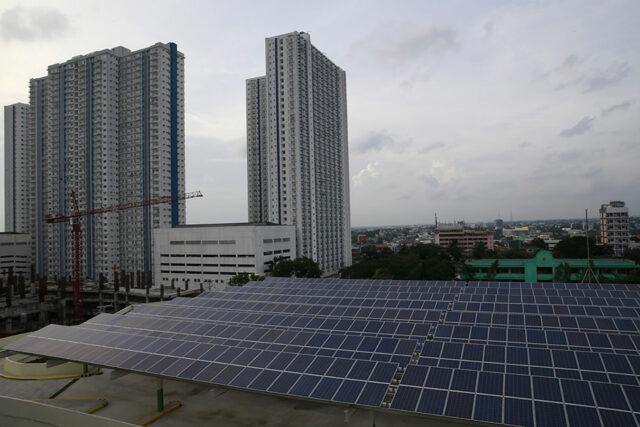
Solar panels are seen on the roof deck of a mall in Quezon City, July 13, 2015. — REUTERS

By Kyle Aristophere T. Atienza, Reporter

SINGAPORE — The Philippines saw a 57% increase in “green” investments to $1.46 billion in 2023, but still falls short of the over $16 billion in required capital investments needed for its green transition, a report showed.

Private green investments in the Philippines accounted for nearly a fourth of the $6.3 billion in total green investments in Southeast Asia last year, according to the 2024 Green Economy Report for Southeast Asia.

“However, an investment gap exists, and significant efforts must be made to meet the required capital investment of $16.6 billion,” it said, noting that the Philippines could achieve this by boosting blended finance, improving renewable regulations and strengthening regional collaboration.

The report by Bain & Company, GenZero, Standard Chartered and Temasek was launched at the 2024 Ecosperity forum, which gathered leaders across the world to track developments in the global green economy.

The Philippines’ score in Bain & Company’s 2024 Green Economy Index increased by three points to 39 from the previous year. The report said the Philippines’ “upward trajectory” was driven by progress within corporates’ ambitions and roadmaps.

Vietnam recorded the biggest improvement — up by five points to 38 — but it still lagged behind the Philippines along with Cambodia (38), which saw a three-point increase.

Singapore had the highest score at 55, up by four points from the previous year. It was followed by Malaysia (43), Indonesia (41) and Thailand (39).

Laos and Myanmar got a score of 30 and 27, respectively. Brunei got 8.

The region is “woefully off-track” on green investments, said Kimberly Tan, GenZero’s managing director.

Green investments in Southeast Asia jumped by 21% to $6.3 billion last year, mainly due to renewable energy projects and “green” data centers. Malaysia and Laos saw a 326% and 126% surge, respectively, in green investments.

However, Southeast Asia is still facing a $1.5-trillion investment gap until 2030 to fund its green transition. Clean energy accounts for only 10% of power supplies in the region, with fossil fuel subsidies being about five times higher than renewable investments, according to the report.

“Despite Southeast Asia’s structural challenges, immense potential exists to accelerate the energy transition and build the green economy,” Dale Hardcastle, director of the Global Sustainability Innovation Center at Bain & Company, said in a statement. “Focusing on proven solutions to decarbonize and accelerators such as blended finance or other incentives can catalyze investment, while governments need to figure out the more complex changes.”

The Philippines lacks sector-specific emission targets, and only four of 10 major emitting companies have set net-zero and emissions goals, according to the report.

However, it said domestic investments in infrastructure for green energy are “brisk.”

Philippine renewable energy investments have risen after it allowed full foreign ownership in the sector starting November 2022. It also established special lanes to expedite such projects.

The report said the Philippines should build more solar projects through blended finance, establish a clear framework to enforce renewable portfolio standards and develop a comprehensive energy roadmap to give investors predictability.

“It is an exciting time in the Philippines, with generational changes happening in digital payments, infrastructure and climate transition,” Mike Samson, chief executive officer at Standard Chartered Bank Philippines, said in a statement. “The Philippines is on the cusp of significant growth.”

Mr. Samson said the Philippines should work with its Southeast Asian neighbors on technological transfer and co-innovation of clean technologies; cross-border investments in “greenification” of manufacturing and nickel processing; and shared agreements on key standards.

DEFORESTATION
Meanwhile, the report cited “further deforestation” in the Philippines due to continued commodity-driven forest loss from mining, forestry and other urbanization activities.

Environment Secretary Antonia Yulo-Loyzaga said in a panel discussion after the launch of the green economy report that “there are great opportunities” in the Philippines for “reforestation, afforestation and for carbon sequestration.”

The Philippines has 30 million hectares of land, 15 million of which are classified as forests.

She said the Department of Finance is working with the World Bank and the ADB to finalize a policy framework for emission trading schemes and a possible carbon tax.

“We are looking at bilateral as well as multilateral consultations,” Ms. Loyzaga said.

The report noted only Indonesia, Malaysia, Singapore and Vietnam have been able to put a price on carbon.

Several Philippine agencies such as the Justice and Energy departments and a presidential investments office were also looking for another possible offshore gas field, she said.

The Malampaya gas field, the country’s sole indigenous source of natural gas that accounts for at least 40% of electricity needs in the capital region, is projected to run dry by 2027.

Philippine agencies were also updating guidelines for offshore wind and floating solar projects, Ms. Loyzaga said.


PHL may explore gas reserves within ‘nonconflict’ areas

PHILSTAR FILE PHOTO

By John Victor D. Ordoñez, Reporter

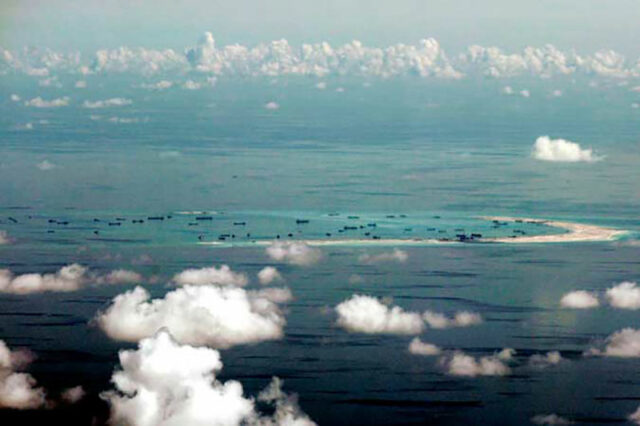
PHILIPPINE President Ferdinand R. Marcos, Jr. on Monday said the Philippines is looking into exploring gas reserves in nonconflict areas within the country’s exclusive economic zone in the South China Sea, as it tries to diversify its energy mix and boost its power generation capacity.

“It is important to the Philippines that we explore those reserves and see exactly what there are and how we go about exploiting them and bringing that gas supply to the Philippines,” he said during a forum organized by the Foreign Correspondents Association of the Philippines.

“So, the low-hanging fruit will be those reserves that are within our exclusive economic zone that are not in a conflict area.”

The Philippines is hard-pressed to find other sources of indigenous energy as the Malampaya gas field, which supplies a fifth of the country’s power requirements, nears depletion.

The gas field is expected to run out of easily recoverable gas using current techniques by 2027.

PXP Energy Corp.’s exploration work at Reed Bank, another potential source of gas in disputed waters, remains suspended due to tensions with China.

“That’s the correct move. It’s quite urgent for our energy security for us to look for oil and gas reserves since Malampaya’s reserves are dwindling fast,” Calixto V. Chikiamco, Foundation for Economic Freedom president, said in a Viber message. 

Mr. Marcos said the government is looking at liquified natural gas (LNG) as a transition fuel to renewable energy (RE).

“And that is why it is imperative for the Philippines to now examine… (in order) to guarantee the supply of LNG to our country so that we have sufficient power,” he said.

“But with all the plans that we have, essentially to industrialize the Philippines, essentially to enter into the digital space, all of these require a great deal of power.”

The government aims to boost the share of RE in the power generation mix to 35% by 2030 and to 50% by 2040. Renewables currently account for 22% of the Philippine energy mix.

Mr. Marcos said talks with China regarding oil and gas exploration in the South China Sea have not progressed due to disagreements on which areas fall within their respective territories.

He said Manila is likely to pursue these ventures with corporations since the country is not yet capable of large-scale heavy engineering in exploring these areas.

China claims more than 80% of the South China Sea, which is seen as a substantial source of oil and gas deposits and where billions of dollars of trade pass through each year.

“The upstream oil and gas sector is fully aligned with the government’s initiatives to explore hydrocarbon boundaries, prominently in the West Philippine Sea,” Edgar Benedict C. Cutiongco, president of the Philippine Petroleum Association of the Upstream Oil and Gas Industry, told BusinessWorld in a text message.

The Philippines should still focus on harnessing renewable energy sources such as geothermal, wind and solar power to reduce its reliance on oil and coal, John Paolo R. Rivera, president and chief economist at Oikonomia Advisory & Research, Inc., said in a Viber message.

Philippine Ambassador to the US Jose Manuel D. Romualdez has said Manila is “working closely with our allies not only the US but also Japan and Australia” to exploit resources in the South China Sea.

China, however, has said any plans for resource exploitation in the waterway should not involve countries outside the region.

“Even if we do well with the nonconflict areas, we still have to look at all the others, whether they be in conflict areas or otherwise,” Mr. Marcos said.