Home Blog Page 3188

California court weighs fate of law treating app-based drivers as contractors

STOCK PHOTO | Image by freestocks-photos from Pixabay

Judges on California’s top court on Tuesday considered whether voters had the power to allow app-based services such as Uber UBER.N and Lyft LYFT.O to classify drivers in the state as independent contractors rather than as employees with greater benefits.

The seven-member California Supreme Court heard oral arguments in San Francisco in a lawsuit by the Service Employees International Union (SEIU) and four drivers who say a 2020 ballot measure known as Proposition 22 was unconstitutional.

The measure exempts app-based drivers from a 2019 state law that narrowed the circumstances in which many workers can be treated as contractors.

Whether gig workers should be treated as employees or contractors is a crucial issue for the ride service industry, Employees are entitled to the minimum wage, overtime pay, reimbursements for expenses and other protections that do not extend to independent contractors, who as a result can cost companies up to 30% less, according to several studies.

Uber, Lyft and other app-based services spent more than $200 million on a campaign to pass Prop 22 and have said that without it, the increased costs could force them to stop doing business in California, the largest U.S. state.

Prop 22, which was passed in November 2020 by nearly 60% of voters in California, allows app-based transportation services to classify drivers as independent contractors as long as they are paid at least 120% of the minimum wage while passengers are in the car and drivers receive expense reimbursements and subsidies to pay for health insurance.

A lower appeals court last year rejected SEIU’s argument that Prop 22 improperly limited the legislature’s exclusive power to regulate the state’s workers’ compensation system by barring app-based drivers from receiving those benefits, which are only granted to employees.

Most of Tuesday’s arguments revolved around whether that authority, outlined in the state constitution, was truly exclusive.

At least three judges suggested that California’s constitution requires the legislature to share lawmaking power with the electorate, just as it mandates that bills must be presented to the governor before they become law.

They told SEIU’s lawyer Scott Kronland that if the legislature disapproves of Prop 22 it could pass laws extending benefits to app-based drivers.

“Prop 22 … only speaks of the classification as employees or independent contractors for the purposes of the labor code,” Justice Goodwin Liu said, referring to California employment law. “But the labor code is not frozen in time.”

Kronland told the court that a provision in Prop 22 barring any amendments would make it difficult for lawmakers to counteract the measure.

At the same time, the judges seemed skeptical of some arguments by the state and Protect App-Based Drivers and Services, an industry-backed group that intervened in the case to defend Prop 22.

Two judges suggested that giving voters control over the workers’ compensation system meant that they could eliminate it altogether, which would seem to infringe on the “plenary” – or absolute – power that the constitution grants to the legislature.

That “turns ‘plenary’ into ‘it’s plenary until it’s nothing.’ That doesn’t feel very plenary to me,” Justice Joshua Groban said.

NATIONWIDE BATTLE

California is just one front in a nationwide legal battle over the classification of gig drivers and other contract workers. Lawmakers in Minnesota passed a measure over the weekend that would set a minimum wage of $1.28 per mile and 31 cents per minute for gig drivers, replacing a higher minimum adopted by Minneapolis that spurred Uber and Lyft to threaten to cease operating in the city.

Earlier this month, the top court in Massachusetts heard arguments over whether competing ballot proposals that would redefine the relationship between app-based companies and drivers should be allowed to go before voters in November. One proposal supported by industry groups mirrors Prop 22, while another would allow drivers to unionize.

Last week a trial kicked off in a lawsuit by the Massachusetts attorney general accusing Uber and Lyft of unlawfully classifying drivers as contractors to avoid treating them as employees entitled to a minimum wage, overtime and earned sick time.

The California Supreme Court typically issues rulings within 90 days of hearing arguments. — Reuters


Britain selects site in Wales for new nuclear power plant

STOCK PHOTO | Image by Markus Distelrath from Pixabay

LONDON – Britain said on Wednesday it wanted to build a new large-scale nuclear power station in north Wales, naming a site on the island of Anglesey as its preferred location and launching talks with international energy companies about building the plant.

As part of efforts to meet climate targets and boost energy security, Britain is seeking to increase its nuclear power capacity by 2050 to 24 gigawatts, equivalent to about a quarter of projected electricity demand, from about 14% currently.

The Wylfa coastal site on the island of Anglesey was used for nuclear power generation between 1971 and 2015. That plant is currently being decommissioned.

The new plant at the site could generate enough power for six million homes for 60 years, and would be similar in scale to projects underway at Hinkley and Sizewell in England, the government said in a statement.

In 2020 Japan’s Hitachi scrapped plans to build a nuclear plant at Wylfa after failing to find private investors or secure sufficient government support.

The government did not name the firms that would be involved in discussions to develop the new project.

Earlier in May, the Financial Times reported South Korea’s Korea Electric Power Corp (KEPCO) was in talks with the government to build a plant at Wylfa. — Reuters

Republican-led US states challenge White House environmental review reforms

Official White House Photo by Cameron Smith

Republican attorney generals from 20 US states sued the Biden administration on Tuesday, seeking to block new reforms to the US environmental review process for major projects such as transmission lines and wind and solar farms.

States including Iowa, North Dakota, Texas and Florida challenged reforms included in a rule finalized in April by the White House Council on Environmental Quality in North Dakota federal court, arguing they go beyond the agency’s authority, would increase project costs and unfairly favor clean energy projects.

The reforms aim to streamline analysis under the National Environmental Policy Act, or NEPA, a bedrock environmental law that requires environmental reviews for major projects that receive federal permits or funding. NEPA reviews are the frequent focus of litigation, which can delay construction on projects for years.

The states said the regulations also require agencies to consider a wider range of a project’s impacts during environmental reviews including climate change and environmental justice considerations, which will cause project delays even though those factors are not explicitly detailed in NEPA’s text.

They said the rule changes will make it more difficult for some projects to receive approvals if they might impact disadvantaged or minority communities.

The rule will impose improper bureaucratic roadblocks for projects including highways or fossil fuel power plants “by forcing social, environmental and race-based regulations on developers,” the states said in a statement.

A White House spokesperson said the rule will speed up project reviews and make sure industry can move forward with key investments and projects, but declined to comment on the lawsuit directly.

The reforms build on and expand initial work to reform the NEPA process finalized in 2022, when the Biden administration began rolling back Trump administration changes that made the process less stringent.

The earlier Biden administration changes required federal agencies to consider the direct, indirect and cumulative impacts of proposed projects or actions.

The White House’s Council on Environmental Quality has called the newest reforms a “core element” of Biden’s efforts to build out clean energy systems and to rebuild American infrastructure.

It said in April that the new reforms are consistent with the agency’s legal authority. — Reuters

Score the biggest discounts at the Smart Summer Sale

Now is the best time to upgrade to a new device as Smart Communications, Inc. (Smart) is holding its biggest device sale, offering huge discounts and affordable financing options on select iPhone and Android handsets and the Smart Bro 5G Pocket Pro.

Running until June 5, 2024, the Smart Summer Sale will take place at 18 Smart Stores nationwide, including CDO Limketkai, Festival Mall, Market Market, Robinsons Manila, SM Bacolod, SM Baguio, SM Batangas, SM Cebu, SM Davao, SM Fairview, SM Iloilo, SM Megamall, SM North Edsa, SM Olongapo, SM San Lazaro, SM San Pablo, SM Tuguegarao, and Smart Tower Makati.

“The Smart Summer Sale is our way of giving back to our beloved customers for their continued support. We invite everyone to head to the nearest Smart Store and take this opportunity to finally upgrade to a 5G device and make the most of the leveled-up mobile experience that Smart 5G delivers,” said John Y. Palanca, Head for Sales and Development at PLDT and Smart.

Here are some of the biggest deals you shouldn’t miss during the Smart Summer Sale:

Switch to a FREE Smart Prepaid eSIM with Magic Data

For non-Smart subscribers, get a Smart Prepaid/TNT eSIM or switch to a Smart Prepaid eSIM for FREE without changing your phone number.

Just make sure you have your Unique Subscriber Code from your current network provider and submit the required documents—such as a valid government ID, a screenshot of their current balance, and a signed application form, among others.

The Smart Prepaid eSIM is bundled with Magic Data 99, which comes with 2 GB non-expiring data so you’re ready to connect online right away.

On the other hand, if you are already a Smart subscriber, you can also conveniently upgrade to a Smart Prepaid eSIM  for FREE by simply presenting your eSIM-capable device at participating Smart Stores.

Enjoy up to 30% discount on 5G devices

Smart offers up to 30% discount on Android devices such as the Samsung Galaxy S24 Ultra and OPPO’s latest releases, Reno 11 5G and Reno 11 5G Pro. For instance, you can get the Samsung A15 for as low as P378 per month for 24 months; or  the Samsung S24 Ultra for only P3,290 per month over 24 months. You can also take home the OPPO N3 Flip for only P2,213 per month or the OPPO Reno 11 Pro 5G for only P953 per month, both over 24 months. All these prices are available to UnionBank credit cardholders with 0% installment. Android devices are also available at discounted prices for straight payment via cash or credit card.

Every device comes with a FREE Smart Prepaid eSIM and Magic Data 99. Smart Postpaid subscribers can get their dream devices with Smart Signature Plans+, which offers data-packed plans for uninterrupted connectivity.

The best iPhone deals ever

Been planning to upgrade to an iPhone? Here’s your chance to take advantage of amazing deals as Smart’s Summer Sale offers iPhones on various payment terms – straight payment, 12-month, or 24-month payment terms.

You can get an iPhone 11 (64GB) for only P904 per month for 24 months, or the latest iPhone 15 (128GB) for just P2,033 per month over 24 months, among other iPhone deals.

Save P5,000 on Smart Bro 5G Pocket Pro

If you need high-speed shared connectivity without tethering to your 5G phone, you can get the Smart Bro 5G Pocket Pro for a discounted price of only Php 7,995, down from its original price of Php12,995. This powerhouse device can connect up to 15 gadgets simultaneously to the Smart 5G network and comes with Php250 worth of load and a FREE car charger, enabling users to activate and connect their new Smart Bro 5G Pocket Pro from the get-go. This special offer is good until supplies last so better hurry!

Enjoy easy and flexible financing options

To make all these offers even easier on the pocket, Smart has partnered with leading consumer finance company Home Credit, giving customers access to flexible payment options for their device purchases at participating Smart Stores.

Smart has also teamed up with UnionBank to make available flexible 0% installment for 12 or 24 months to subscribers with exclusive offers.

Whether you are going around the city or enjoying a beach getaway, you can rely on Smart’s mobile network, which was recently awarded for delivering the Best Coverage Experience in the Philippines by network analytics firm Opensignal.

Mark your calendar for the Smart Summer Sale!

Stay updated by following Smart’s official accounts on Facebook, X, Instagram, and TikTok to know more.


Spotlight is BusinessWorld’s sponsored section that allows advertisers to amplify their brand and connect with BusinessWorld’s audience by publishing their stories on the BusinessWorld Web site. For more information, send an email to online@bworldonline.com.

Join us on Viber at https://bit.ly/3hv6bLA to get more updates and subscribe to BusinessWorld’s titles and get exclusive content through www.bworld-x.com.

Peso hits 58:$1 as Fed stays hawkish

THE PESO closed at P58.27 per dollar on Tuesday, weakening by 37 centavos from its P57.90 finish on Monday. — REUTERS

By Luisa Maria Jacinta C. Jocson, Reporter

THE BANGKO SENTRAL ng Pilipinas (BSP) warned it will intervene in the foreign exchange market as the Philippine peso on Tuesday closed at the 58-per-dollar level for the first time in over 18 months.

“The BSP continues to monitor the foreign exchange market but allows the market to function without aiming to protect a certain exchange rate. Nonetheless, the BSP will participate in the market when necessary to smoothen excessive volatility and restore order during periods of stress,” BSP Governor Eli M. Remolona, Jr. said in a statement.

The peso closed at P58.27 per dollar on Tuesday, weakening by 37 centavos from its P57.90 finish on Monday.

Peso drops to 1.5-year low

This was the peso’s weakest close in more than 18 months or since it closed at P57.275 per dollar on Nov. 8, 2022.

Tuesday was also the peso’s first time closing at the P58-per-dollar level since Nov. 10, 2022.

The local unit opened Monday’s session at P57.97 against the dollar, which was also its intraday best. Its worst showing was at P58.28 versus the greenback.

Year to date, it depreciated by P2.90 from its P55.37-per-dollar close on Dec. 29, 2023.

Mr. Remolona noted the peso’s weakness against the US dollar was in line with other currencies in the region.

“The dollar continued to strengthen as the Federal Reserve signaled delay in cutting interest rates,” he said.

US Federal Reserve officials on Monday hesitated to declare that inflation is on a sustainable path to the 2% target rate, according to Reuters.

A trader in an e-mail said that the depreciation of the peso was due to “continuous hawkish guidance” from Fed officials.

The trader said that prospects of the BSP cutting ahead of the Fed may have also exerted pressure on the peso.

Last week, Mr. Remolona hinted that the BSP can begin its policy easing cycle before the Fed, with the earliest rate cut possibly in August.

“It is crucial to note that while the dollar-peso exchange rate is something that the BSP does not explicitly manage, the domestic central bank might consider adjusting policy rates once the weakness of the peso poses considerable upside risk on the medium-term inflation outlook,” the trader added.

Security Bank Corp. Chief Economist Robert Dan J. Roces said that the BSP will “defend the peso as necessary and when very volatile.”

“The peso’s weakness seems to be in-line with movement of other regional currencies. Add to that statements by several Fed officials last night reiterating hawkishness and last week’s dovish BSP sentiment which seem to have carried over in (Monday’s) and (Tuesday’s) sessions,” he said in a Viber message.

Rizal Commercial Banking Corp. Chief Economist Michael L. Ricafort said in a Viber message that the US dollar-peso exchange rate was higher “after cautious and higher-for-longer signals from most Fed officials recently that partly reduced the odds of Fed rate cuts lately to less than two.”

“It is important to note that the US dollar-peso exchange rate already posted a bigger increase compared to most ASEAN (Association of Southeast Asian Nations) currencies since the start of 2024 (at +5.2%) and since the Russia-Ukraine conflict started on Feb. 22, 2022 (at +14%),” Mr. Ricafort said.

Mr. Ricafort sees the peso trading between P58.15 and P58.35 on Wednesday.

On the other hand, the trader sees the currency ranging from P58.1 to P58.35 on Wednesday.

‘MINIMAL’ IMPACT
Finance Secretary Ralph G. Recto also on Tuesday said that the peso’s recent weak performance will only have a “minimal” impact on inflation.

“The depreciation may cause upside pressure on inflation. But I expect it to be minimal. It is a concern, but not alarming,” he told BusinessWorld in a Viber message.

Headline inflation accelerated for a third straight month to 3.8% in April.

In the first four months, inflation averaged 3.4%. The BSP expects inflation to settle at 3.5% this year.

“Our number one mission is still to reduce food inflation and thereby reduce interest rates later on,” Mr. Recto added.

The Monetary Board kept its benchmark rate at a 17-year high of 6.5% at its May meeting. The BSP raised borrowing costs by a cumulative 450 basis points from May 2022 to October 2023.

The BSP has said that inflation may temporarily accelerate above the 2-4% target band in the next two quarters. Mr. Remolona has also said that risks to the inflation outlook remain tilted to the upside.

Philippines’ BoP deficit widens

REUTERS

THE COUNTRY’S balance of payments (BoP) deficit widened in April as the government paid back foreign debt and the trade balance remained in a deficit, the Bangko Sentral ng Pilipinas (BSP) said.

Data from the central bank showed the BoP position widened to a $639-million deficit in April from the $148-million gap a year ago.

This was also a reversal from the $1.17-billion surplus recorded in March.

Philippines: Balance of Payments (BoP) PositionThe BoP measures the country’s transactions with the rest of the world at a given time. A deficit means more funds left the economy than what went in, while a surplus shows that more money entered the Philippines.

“The BoP deficit in April 2024 reflected outflows arising mainly from the National Government’s (NG) net foreign currency withdrawals from its deposits with the BSP to settle its foreign currency debt obligations and pay for its various expenditures,” the central bank said in a statement.

In the first four months, the BoP position swung to a deficit of $401 million from the $3.3-billion surplus posted a year ago.

“Based on preliminary data, this cumulative BoP deficit reflected mainly the NG’s repayments of its foreign loans coupled with the continued trade in goods deficit,” it added.

The trade deficit sharply narrowed to $3.18 billion in March from the $5.02-billion deficit a year ago. In the first quarter, the trade deficit shrank by 22.2% year on year to $11.24 billion.

Rizal Commercial Banking Corp. Chief Economist Michael L. Ricafort said that the BoP deficit was due to payment of foreign obligations. This included the scheduled repayment of $365 million in matured Japanese yen bonds on April 12.

In the first quarter, debt repayments jumped by 74% to P986.036 billion. These include the P93.37 billion in principal payments on external debt and P54.11-billion in interest payments on external debt.

At its end-April position, the BoP reflected a final gross international reserve (GIR) level of $102.6 billion, 1.4% lower than $104.1 billion as of end-March.

The dollar reserves were enough to cover 5.8 times the country’s short-term external debt based on original maturity and 3.6 times based on residual maturity.

It is also equivalent to 7.6 months’ worth of imports of goods and payments of services and primary income.

An ample level of foreign exchange buffers safeguards an economy from market volatility and is an assurance of the country’s capability to pay debts in the event of an economic downturn.

For the coming months, Mr. Ricafort said that the BoP position could improve “partly due to proceeds of the National Government’s foreign currency-denominated borrowing that would also be added to the country’s BoP and GIR as well as from official development assistance and other multilateral sources.”

In May, the government raised $2 billion from its issuance of the dual-tranche 10- and 25-year fixed-rate dollar bonds. This was the Philippines’ first global bond sale for this year.

Mr. Ricafort also noted continued growth in remittances, business process outsourcing (BPO) revenues, foreign tourism receipts and foreign direct investments would help support the BoP position.

This year, the BSP expects the country’s BoP position to end at a $700-million deficit, equivalent to 0.1% of GDP. — Luisa Maria Jacinta C. Jocson

Infrastructure spending increased by 15% in March, says Budget dep’t

Infrastructure spending jumped by 15% in March. — PHILIPPINE STAR/MIGUEL DE GUZMAN

By Beatriz Marie D. Cruz, Reporter

STATE SPENDING on infrastructure rose by 15% in March as the government ramped up disbursements for public works and defense modernization projects, the Department of Budget and Management (DBM) said. 

In its latest National Government (NG) disbursement report, spending on infrastructure and other capital outlays jumped by 15.1% to P96.3 billion in March from P83.7 billion in the same month last year.   

Month on month, infrastructure spending rose by a fifth from P79.4 billion in February.

The uptick in March was attributed mainly to the Department of Public Works and Highways’ (DPWH) increased spending for the construction of road infrastructure.

“The sharp increase was largely due to the strong spending performance of the DPWH for payment of progress billings (i.e., completed/partially completed works) for various road infrastructure programs (e.g., road and bridge networks, flood control/mitigation structures, right-of-way acquisition), alongside payment of mobilization fees/advances to contractors for infrastructure projects under the 2024 budget,” the department said in a press release. 

Infrastructure spending rose due to direct payments made by the Department of Transportation for foreign-assisted railway projects such as the Capacity Enhancement of Mass Transit Systems in Metro Manila and the Malolos-Clark Railway Project.

The DBM said disbursements for the Department of National Defense’s (DND) Armed Forces of the Philippines (AFP) modernization program also contributed to the higher spending.

For the first quarter, infrastructure and other capital outlays went up by 10.2% to P216.8 billion from P196.7 billion in the same period in 2023.

Overall infrastructure disbursements, which include infrastructure components of subsidy/equity to government corporations and transfers to local government units (LGUs), rose by 9.3% year on year to P266.3 billion in the period ending March.

“The sturdy growth of the total infrastructure spending resulted mainly from the implementation of road infrastructure projects of the DPWH and defense modernization projects of the DND, alongside the higher local development fund of LGUs — equivalent to 20% of their National Tax Allotment shares,” the department said.

The Philippine Statistics Authority earlier reported that government-led construction grew by 12.4% in the first quarter, contributing 2.9 percentage points (ppts) to the construction sector’s 6.8% growth and around 0.44 ppt to the 5.7% quarterly gross domestic product (GDP) growth.

Terry L. Ridon, a public investment analyst and convenor of think tank InfraWatch PH, said that efficient spending of public funds helped the government outpace last year’s infrastructure spending performance so far.   

“This means that the government has been more efficient in the disbursement of public funds compared to the previous year, particularly in terms of improving the absorptive capacity of agencies to implement projects,” he said in a Viber message.

“What the government needs to avoid would be unexpected project delays, such as right-of-way concerns which can delay project implementation for months, even years,” he added.

President Ferdinand R. Marcos, Jr. earlier issued several Executive Orders to fast-track the approval process for the government’s infrastructure flagship projects as well as address right-of-way concerns.

The DBM expects infrastructure spending to increase in the second quarter as the government ramps up construction projects and activities before the rainy season.

“Disbursements are foreseen to gradually increase in the current quarter as the DPWH and other agencies with capital outlay projects capitalize on the summer season for their construction projects/activities.”

Spending on government programs in health, education, agriculture, social and employment as well as the release government employees’ midyear bonus would also spur economic growth, DBM added.

Government employees started receiving their midyear bonus on May 15.

“These would hopefully help stir more economic activity and prop up growth, particularly in public construction, the services and industry sectors, as well as household final consumption,” it said.

Rizal Commercial Banking Corp. Chief Economist Michael L. Ricafort expects faster infrastructure spending in the coming months.

“There would be greater urgency to accelerate infrastructure spending and other government spending on other projects and programs, especially later in 2024 up to early 2025 in view of the preparations for the May 2025 midterm elections,” he said in a Facebook Messenger chat.

He said the government needs to boost infrastructure spending to drive economic activity, noting that lackluster infrastructure spending had contributed to slower economic growth in 2023 and early 2024.

The government’s infrastructure program for this year is set at P1.472 trillion, equivalent to 5.6% of GDP.

Filipinos now spending more on home redesign post-COVID

The coronavirus pandemic has prompted many Filipinos to redesign certain areas of their home. — REUTERS

By Joseph L. Garcia, Senior Reporter

THE GLOBAL coronavirus pandemic has forced Filipinos to rethink spaces and redesign certain areas of their home to make these more work-friendly.

Business establishments such as restaurants have also renovated their spaces so they can offer more immersive and multisensory experiences to customers while fostering human connection.

“The pandemic highlighted the need for adaptable living and working spaces that prioritized the health and safety of users,” Carla Mae Leonor, director of public relations at the Philippine Institute of Interior Designers, said in an interview.

“With this come solutions that ensure flexibility, incorporating movable partitions, multifunctional furniture and convertible rooms to accommodate changing needs, such as remote work and distance learning,” she added.

After being stuck at home for a long time, consumers are also seeking out experiences that can’t be replicated at home, the interior designer said.

“From immersive and multisensory dining to events and spaces that foster human connection, these brought about new hospitality spaces that provide bubble-type sanctuaries that provide resort-style amenities within a controlled space,” she said.



Some restaurants also offer dining experiences that include immersive and multi-sensory features that foster human connection, she added.

Architect Carlos Cham noted that in the first two years of the pandemic in 2020 and 2021, his company Cham-Candelaria, Inc., which specialized in restaurant and residential clients, did not have any building projects.

“All construction was put on hold for the first two years,” he said in an e-mail. “Construction only resumed, with very strict protocols, when the situation became lighter, and the vaccines started coming out.”

Philippine building activity declined by 28.5% at the height of the pandemic in 2020, but started recovering in the following year by posting growth of 31.4%, according to data from the local statistics agency.

Philippine construction had a market size of $65.2 billion (P3.7 trillion) in 2023 and it is expected to achieve an average annual growth rate of more than 7% from 2025 to 2028, according to a GlobalData report in March.

The government’s focus on infrastructure and energy development will support market expansion in real terms this year, it added.

“Fine-tuning every inch of Filipinos’ homes has become a way of cocooning to make their spaces enjoyable,” Ms. Leonor said.

They have come to adopt themes such as outdoor living, “feel-good” designs and hospitality industry-inspired interiors.

The kitchen has likewise been converted from a workspace into a living space, with more interiors attuned to hosting, she added.

‘RITUALS AND HABITS’
“At-home entertaining will remain a popular choice for cautious consumers,” Ms. Leonor said.

Other changes include improvements to workspaces at home due to the work-from-home or hybrid setup spawned by the pandemic.

“Improvised workspaces are being replaced with comfortable long-term solutions,” she said.

She also cited the rise of pet-friendly buildings. “Resilient in the face of the economic downturn, the pet economy will continue to thrive,” she said, noting that new themes in interior design include making more pet-friendly spaces.

Mr. Cham said having open-air spaces for both residential and commercial projects has become a standard requirement.

“Minimalist designs are sought after not only due to the clean aesthetics but also for their practicality and function,” the architect said.

His clients also prefer more natural light and ventilation. “People really learned to appreciate this.”

Ms. Leonor cited the rise of health-friendly materials in interior spaces.

“While personal standards for health and safety can be subjective, there are guidelines that are followed by licensed interior designers,” she pointed out.

One of these is the use of smart materials that deter or destroy bacteria. “Protective materials have become central to everyday living as hygiene and protection were ramped up in light of the coronavirus pandemic.”

Consumers also no longer just protect themselves through clothing but also with the finishes that they use within their spaces, she said.

While these have mostly been used by the healthcare sector, since the pandemic, sanitizing and microbe-fighting materials are making the jump to the commercial and residential sectors.

Mr. Cham said clients who want to cut costs still use traditional concrete hollow blocks or reinforced concrete. Those who want faster construction time have turned to steel or pre-cast.

“Cost and time will always be the main factors,” he said. “It still depends on how clients would want to have it.”

Ms. Leonor said Filipinos should future-proof their spaces against future health catastrophes.

“Rethinking how we look at value also puts our minds in the right place when we design our spaces,” she said. “Hiring licensed and professional designers, for example, can ensure the best solutions are explored and the needs of the space and the users are considered in the process of designing solutions.”

Interior designers are up to date with the latest technologies and innovations and know best how to meet the needs of a client, whether they require special treatment to ensure safety, well-being and comfort, she said.

She likewise noted that antimicrobial and antiviral finishes and technology coming into the market can now be used.

People should choose suppliers with sustainability credentials to “ensure synthetic and chemical compounds do not just end in landfills or leach into wastewater post-purchase,” she added.

One can also go local, thanks to efforts to create bio-based plant- and protein-derived fibers, textiles and materials “that create healthier alternatives and promote the use of locally designed and locally made products.”

“The rituals and habits built during the pandemic have affected the preferences and priorities of consumers,” Ms. Leonor said. The past years highlighted the relationship between humans and the environment, and this shifted the appreciation of users for well-designed spaces and objects.

“The spaces we inhabit are extensions of ourselves and are therefore worth investing in,” she said. This perspective will be carried on beyond the post-pandemic recovery and will push interior designers to develop ways to make people safer and healthier and their lives more enjoyable, she added.

“Design will always continue to grow and adapt to users’ behaviors and needs,” Mr. Cham said.

DMCI Holdings looking to add copper, gold, coal mining assets

LISTED conglomerate DMCI Holdings, Inc. said it is exploring new copper, gold, and coal assets to boost its mining business.

“We’re currently looking at large mining assets, probably copper and gold, and maybe an additional coal mine in Mindanao, if possible, provided that it is open pit,” DMCI Chairman and President Isidro A. Consunji said during the company’s virtual annual stockholders’ meeting on Tuesday.

“Aside from that, we just intend to continue with our aggressive organic growth,” he added.

DMCI has presence in the mining sector through its subsidiary DMCI Mining Corp., which operates open-pit mines in Palawan and Zambales via units Berong Nickel Corp. and Zambales Diversified Metals Corp. The companies extract nickel ore, chromite, and iron laterite using surface mining techniques.

The conglomerate is also engaged in coal mining through Semirara Mining and Power Corp. (SMPC).

According to Mr. Consunji, one of the challenges faced by DMCI is securing permits for its nickel projects.

“Right now, we have various nickel assets that are not being operational, waiting for the perfection of the required operational licenses and permits. A lot of these projects are expected to be completed before the end of this year,” he said.

“Hopefully, two areas in particular, one in Zambales and one in Long Point, Palawan should be operational before the end of this year,” he added.

Mr. Consunji also said the sales of the conglomerate’s real estate unit, DMCI Homes, are expected to return to pre-pandemic levels by 2025.

He noted that DMCI Homes has some excess supply of finished units that are currently being sold.

 “At the moment, DMCI (Homes) sales are slightly below pre-pandemic level. But we expect by 2025 with the leisure projects and other upper and lower market segments, DMCI Homes will exceed pre-pandemic levels of sales,” he said.

 Mr. Consunji added that DMCI is focused on participating in the government’s infrastructure projects.

 “We expect DMCI to be in a strong competitive position to compete in these mega infrastructure projects. We see no reason why it cannot be competitive, given our track records in developing previous mega infrastructure projects.”

 On the recent acquisition of Cemex Holdings Philippines, Inc. (CHP), Mr. Consunji said that this will create synergy with the conglomerate’s other businesses.  

 DMCI, SMPC, and Dacon Corp. recently announced the acquisition of CHP for $305.6 million under a share purchase agreement. The transaction is expected to close before the end of 2024.

 DMCI bought the entire shares of Cemex Asia B.V. in Cemex Asian South East Corp. (CASEC), the majority owner of CHP with an 89.96% equity interest. Dacon has been appointed as the bidder for the mandatory tender offer to acquire the remaining 10.14% of the total issued and outstanding capital stock of CHP.

 Under the transaction, DMCI is set to acquire a 56.75% stake in CASEC, Dacon will secure 32.12%, and SMPC will purchase the remaining 11.13%.

 On Tuesday, DMCI stocks improved by 0.75% or eight centavos to P10.78 each. — Revin Mikhael D. Ochave

PHINMA Corp. to acquire Petra Cement for P500 million

LISTED conglomerate PHINMA Corp. said it will acquire cement manufacturer Petra Cement, Inc. for P500 million to strengthen its cement business.

The conglomerate, through its subsidiary Philcement Corp., signed a share purchase deal on May 20 with Petra Cement, PHINMA Corp. said in a stock exchange disclosure on Tuesday.

 “Philcement Mindanao Corp., a subsidiary of Philcement, will pay a consideration of P500 million in exchange for 100% of the outstanding shares of Petra Cement,” PHINMA Corp. said.

The transaction is expected to be closed by Dec. 31.

 The acquisition follows the manufacturing and sale agreement signed by Philcement and Petra Cement on Jan. 11.

 Philcement will operate Petra Cement’s plant in President Manuel A. Roxas, Zamboanga del Norte.

The agreement also covers the production, distribution, and retail of cement products.

 The plant has a cement grinding facility with a capacity of 500,000 metric tons per annum that caters to the Northern Mindanao market.

 “This is aligned with Philcement’s growth strategy and its promise to assure Filipino consumers with reliable, high quality supply of cement products under its legacy brand, Union Cement,” PHINMA Corp. said.

 Philcement is a 60% owned unit of PHINMA Corp. It has business interests in the production, importation, processing, distribution, and sale of cement products. It currently operates a cement processing facility in the Freeport Area of Bataan in Mariveles.

 Philcement Mindanao is a 70% owned subsidiary of Philcement.

 For the first quarter, PHINMA Corp. saw a 1.2% increase in its net income to P490.53 million as consolidated revenue surged by 14% to P5.45 billion led by its education business.

 PHINMA Corp. shares rose by 1.49% or 30 centavos to P20.45 each on Tuesday. — Revin Mikhael D. Ochave

Gold treasures reunited at the Ayala Museum

GOLD items displayed on white backgrounds are from the Ayala Museum’s collection while gold items on blue are from the Bangko Sentral ng Pilipinas. — AYALA MUSEUM

BELTS, necklaces, bangles, scale pans, and other golden items — 38 in all — from the Bangko Sentral ng Pilipinas’ (BSP) pre-colonial gold collection have been reunited with the Ayala Museum’s existing collection of gold. Forty-three years after being discovered in the same landfill, these objects can now be seen together again for the first time, at the exhibitionReuniting the Surigao Treasure” which officially opened on May 16.

At the exhibit launch, guests were ushered upstairs to the museum’s 4th floor in groups. Ayala Museum senior director Ma. Elizabeth “Mariles” Gustilo prefaced the visit by emphasizing the historical significance of the artifacts, and the exhibit’s timely opening for the museum’s 50th anniversary.

“Ayala Museum was established 50 years ago by the Filipinas Foundation, now known as the Ayala Foundation, to empower Filipinos through a deeper understanding of our traditions, art, history, and culture,” said Ms. Gustilo.

“We mark this milestone expression of love of country with what is appropriately something old, something borrowed, and something blue.”

The Philippines’ two priceless gold collections were reunited thanks to curator Dr. Florina Capistrano-Baker. The 38 gold items loaned from the BSP fill in gaps in the precolonial picture painted by the 1,000 artifacts on permanent display at the Ayala Museum.

ORIGINS OF THE TREASURE
The gold objects in the exhibition were uncovered on April 27, 1981.

Edilberto “Berto” Morales, a heavy machinery operator working on an irrigation project in Sitio Magroyong, barrio San Miguel, Surigao del Sur, unexpectedly unearthed golden objects scattered along a 100-meter stretch of landfill quarried from a nearby mountaintop.

“This accidental discovery, along with others recovered by other treasure hunters who collectively swooped into Magroyong, are collectively known as the Surigao Treasure,” explained Ms. Capistrano-Baker, at a tour of the newly mounted exhibit.

Though a few gold items were hacked apart and melted down by treasure hunters, many were saved through the efforts of Dr. Jaime Laya, then BSP governor, and private collectors National Artist for Architecture Leandro Locsin and his wife Cecilia, whose collection eventually went to the Ayala Museum.

“The Surigao collections at BSP and Ayala were recovered from a single culture area associated with the ancient kingdom of Butuan. They are twins separated at birth, now reunited,” Ms. Capistrano-Baker said.

To emphasize which objects belong to which collections, the items from the Ayala collection are displayed with a white background, while those from the BSP are shown on a blue background. When items from both collections are shown together, the pieces from each are shown with the corresponding color.

ITEMS THAT GO TOGETHER
The exhibition finally gets to tell a fuller story of precolonial Butuan.

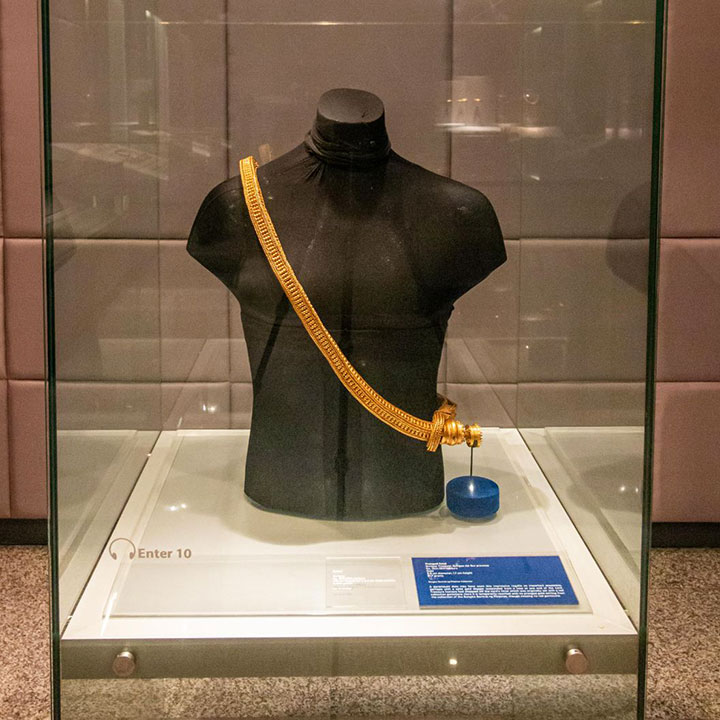
The most impressive object is a massive, four-kilogram gold chain believed to be a Hindu upavita, or sacred thread, a mainstay at the Ayala Museum. A pronged finial, or distinctive ornament, from the BSP’s collection now completes the chain at the waist.

“The finial was offered to Mrs. Locsin with the red gemstone, but she thought it looked like a bicycle bell and passed on it. But when she saw the chain, she realized they were meant to go together but couldn’t run after the finial anymore since it already went to BSP,” said Ms. Capistrano-Baker.

While now reunited, it unfortunately remains incomplete — the red gemstone has not been seen since it was offered to Mrs. Locsin.

Also paired together are intricately woven gold waistbands, seven of the belts from the BSP collection now joining multiple sashes and buckles from Ayala’s collection. They are solid proof of the power and opulence once found in ancient Butuan in northeastern Mindanao.

Other remarkable objects from BSP include a 4.5-meter long kamagi chain consisting of 12 necklaces connected end-to-end, weighing almost 1.5 kilograms, gold bangles set with semi-precious stones, and necklaces consisting of susô beads.

Ms. Capistrano-Baker pointed to a screen mounted in the exhibition, which shows a video documentary by Cheche Lazaro under Probe TV. There, she said, Mr. Laya recollects the journey of the treasure.

“When Mang Berto found the long kamagi chain, he wrapped it around his waist several times to hide it from coworkers, which ended up at the BSP. There’s also the gold bowl which he initially thought was a helmet, now part of the Ayala Museum’s collection,” she said.

Another interesting reunion is that of Ayala Museum’s gold balance scale that likely belonged to a rich merchant, and the BSP’s gold weighing scale pan. These are seen as evidence of the Butuan culture’s advanced trading with neighboring polities long before European contact.

“This extraordinary collaboration reunites in one exhibition for a limited time entwined treasures from the country’s two premiere gold collections, allowing us to lift the veil of collective amnesia and reclaim the contours of our half-forgotten precolonial past,” Ms. Capistrano-Baker said.

“Reuniting the Surigao Treasure” is now open to the public and will be on view at the Ayala Museum in Makati until 2027. — Brontë H. Lacsamana

Gov’t partially awards T-bonds

BW FILE PHOTO

THE GOVERNMENT made a partial award of the new Treasury bonds (T-bonds) it offered on Tuesday with a coupon rate above secondary market levels amid hawkish signals from the US Federal Reserve and as the peso touched the P58-per-dollar level, renewing inflation concerns.

The Bureau of the Treasury (BTr) raised just P22.717 billion via the fresh 20-year bonds it auctioned off on Tuesday, lower than the P30-billion program, despite total bids reaching P37.919 billion.

The bonds were awarded at a coupon rate of 6.875%. Accepted yields ranged from 6.6% to 6.95% for an average rate of 6.797%.

The coupon fetched for the tenor was 20.3 basis points (bps) higher than the 6.672% quoted for the 20-year bond at the secondary market prior to the auction, based on PHP Bloomberg Valuation Service Reference Rates data provided by the Treasury.

“The higher T-bond rate awarded today was primarily driven by hawkish policy guidance from various US Federal Reserve officials and the anticipated impact of the weaker peso on local inflation and interest rates,” a trader said in an e-mail on Tuesday.

The government partially awarded its T-bond offer amid higher bid yields, Rizal Commercial Banking Corp. Chief Economist Michael L. Ricafort likewise said in a Viber message.

Investors asked for higher rates amid the peso’s weakness as this could lead to increased import prices that could stoke inflation anew, Mr. Ricafort said.

“Most Fed officials also signaled a cautious stance recently.”

The peso on Tuesday closed at a near 19-month low of P58.27 against the dollar, slumping by 37 centavos from the previous day.

This was the local unit’s weakest close since it ended at P58.275 on Nov. 8, 2022 and was the first time it closed at the P58-per-dollar level since Nov. 10, 2022’s P58.19.

Year to date, the peso has lost P2.90 from its end-2023 close of P55.37. The peso’s record low is at P59 per dollar, which it last hit on Oct. 17, 2022.

Bangko Sentral ng Pilipinas (BSP) Governor Eli M. Remolona, Jr. on Tuesday said the peso’s weakening was mostly driven by a strong dollar after Fed officials signaled that they could delay cutting interest rates.

Mr. Remolona said they continue to monitor the foreign exchange market and will intervene if necessary to “smoothen excessive volatility and restore order during periods of stress.”

Federal Reserve officials are not ready to say inflation is heading to the central bank’s 2% target after data last week showed a welcome easing in consumer price pressures in April, with several on Monday calling for continued policy caution, Reuters reported.

Consumer prices cooled in April, and retail spending did not increase at all, two welcome signs that the economy may be losing some steam in the face of a policy rate that the Fed has held in the 5.25%-5.5% range since last July.

But Fed policy makers, stung by a string of higher-than-expected inflation readings for the three months prior, remain cautious and want to make sure pricing pressures are fully on track back to the Fed’s 2% target rate before starting to cut its benchmark interest rate.

The Fed’s next policy meeting is June 11-12. Traders in contracts tied to the central bank’s policy rate currently do not expect an interest rate cut until September.

Meanwhile, Philippine headline inflation quickened to 3.8% year on year in April from 3.7% in March. Still, this was slower than the 6.6% print in the same month a year ago.

For the first four months, the consumer price index averaged 3.4%, below the BSP’s 3.5% baseline forecast and within its 2-4% target for the year.

The BSP last week kept its policy rate unchanged at a 17-year high of 6.5% for a fifth straight meeting but signaled that it could cut borrowing costs as early as August or before the Fed following slower-than-expected April inflation.

The government wants to raise P210 billion from the domestic market this month, or P60 billion from Treasury bills and P150 billion via T-bonds. It borrows from local and foreign sources to help fund its budget deficit, which is capped at P1.48 trillion or 5.6% of gross domestic product for this year. — A.M.C. Sy with Reuters