Home Blog Page 2793

Dozens of tornadoes strike Oklahoma, killing at least four

STOCK PHOTO | Image by Nature Nomad from Pixabay

At least four people died, including a four-month-old baby, and scores were injured in Oklahoma this weekend after dozens of twisters swept the US Southern Plains, while weather alerts on Sunday put more than 7 million Americans under tornado warnings.

Oklahoma Governor Kevin Stitt on Sunday declared a disaster emergency for the state, freeing up more money for first responders and recovery operations.

“Definitely the most damage since I’ve been governor,” Stitt said in Sulphur, one of the hardest-hit communities, on Sunday afternoon as he provided an update on fatalities and damage. Stitt began his first term as governor in 2019.

In a call with the Oklahoma governor, President Joe Biden offered the full support of the federal government to help with the recovery efforts, the White House said in a statement on Sunday.

Mr. Biden on Sunday declared a major disaster over the severe winter storms that flooded the State of Washington and Kansas, the White House said in a statement. The president ordered federal assistance to supplement recovery efforts in the areas affected by the winter storms.

Storm warnings for high winds, heavy rain and hail also were issued by the National Weather Service on Sunday for more than 47 million people stretching from East Texas north through Illinois and Wisconsin.

The NWS reported 38 possible twisters hit the area and that the worst of the storms rolled through Central Oklahoma on Saturday into early Sunday morning, spreading into northwest Texas, western Missouri and Kansas.

The Oklahoma Department of Emergency Management said area hospitals reported 100 injuries. Twisters destroyed or damaged dozens of structures, including the hospital in the town of Marietta, although no injuries were reported there.

More than 20,000 customers in the state remained without power as of Sunday evening, according to officials, as emergency personnel worked to clear roads and repair power lines. – Reuters

China firms go ‘underground’ on Russia payments as banks pull back

WIKIMEDIA/MIL.RU

An appliance maker in southern China is finding it hard to ship its products to Russia, not because of any problems with the gadgets but because China’s big banks are throttling payments for such transactions out of concern over US sanctions.

To settle payments for its electrical goods, the Guangdong-based company is considering using currency brokers active along China’s border with Russia, said the company’s founder, Mr. Wang, who asked to be identified only by his family name.

The US has imposed an array of sanctions on Russia and Russian entities since the country invaded Ukraine in 2022.

Now the threat of extending these to banks in China – a country Washington blames for “powering” Moscow’s war effort – is chilling the finance that lubricates even non-military trade from China to Russia.

This is posing a growing problem for small Chinese exporters, said seven trading and banking sources familiar with the situation.

As China’s big banks pull back from financing Russia-related transactions, some Chinese companies are turning to small banks on the border and underground financing channels such as money brokers – even banned cryptocurrency – the sources told Reuters.

Others have retreated entirely from the Russian market, the sources said.

“You simply cannot do business properly using the official channels,” Mr. Wang said, as big banks now take months rather than days to clear payments from Russia, forcing him to tap unorthodox payment channels or shrink his business.


GOING ‘UNDERGROUND’

A manager at a large state-owned bank he previously used told Wang the lender was worried about possible U.S. sanctions in dealing with Russian transactions, Wang said.

A banker at one of China’s Big Four state banks said it had tightened scrutiny of Russia-related businesses to avert sanctions risk. “The main reason is to avoid unnecessary troubles,” said the banker, who asked not to be named.

Since last month, Chinese banks have intensified their scrutiny of Russia-related transactions or halted business altogether to avoid being targeted by US sanctions, the sources said.

“Transactions between China and Russia will increasingly go through underground channels,” said the head of a trade body in a southeastern province that represents Chinese businesses with Russian interests. “But these methods carry significant risks.”

Making payments in crypto, banned in China since 2021, might be the only option, said a Moscow-based Russian banker, as “it’s impossible to pass through KYC (know-your-customer) at Chinese banks, big or small”.

The sources spoke on condition of anonymity, citing the sensitivity of the topic. Reuters could not determine the extent of transactions that had shifted from major banks to more obscure routes.

China’s foreign ministry is not aware of the practices described by the businesspeople to arrange payments or troubles in settling payments through major Chinese banks, a spokesperson said, referring questions to “the relevant authorities”.

The People’s Bank of China and the National Financial Regulatory Administration, the country’s banking sector regulator, did not respond to Reuters requests for comment.


SANCTIONS WARNING

US Secretary of State Antony Blinken, after meeting China’s top diplomat Wang Yi for five and a half hours in Beijing on Friday, said he had expressed “serious concern” that Beijing was “powering Russia’s brutal war of aggression against Ukraine”.

Still, his visit, which included meeting President Xi Jinping, was the latest in a series of steps that have tempered the public acrimony that drove relations between the world’s biggest economies to historic lows last year.

While officials have warned that the United States was ready to take action against Chinese financial institutions facilitating trade in goods with dual civilian and military applications and the US preliminarily has discussed sanctions on some Chinese banks, a US official told Reuters last week Washington does not yet have a plan to implement such measures.

The Chinese foreign ministry spokesperson said, “China does not accept any illegal, unilateral sanctions. Normal trade cooperation between China and Russia is not subject to disruption by any third party.”

A State Department spokesperson, asked about Reuters findings that Chinese banks were curbing payments from Russia and the impact on some Chinese companies, said, “Fueling Russia’s defense industrial base not only threatens Ukrainian security, it threatens European security.

“Beijing cannot achieve better relations with Europe while supporting the greatest threat to European security since the end of the Cold War,” the spokesperson said.

Mr. Blinken made clear to Chinese officials “that ensuring transatlantic security is a core US interest,” the spokesperson said. “If China does not address this problem, the United States will.”

Nearly all major Chinese banks have suspended settlements from Russia since the beginning of March, said a manager at a listed electronics company in Guangdong.

Some of the biggest state-owned lenders have reported drops in Russia-related business, reversing a surge in assets after Russia’s invasion.

Among the Big Four, China Construction Bank posted a drop of 14% in its Russian subsidiary’s assets last year and Agricultural Bank of China a 7% decline, according to their latest filings.

By contrast, Industrial and Commercial Bank of China, the country’s biggest lender, reported a 43% jump in assets of its Russian unit. Bank of China (BOC), the fourth-largest, did not give the breakdown.


‘CHANNEL CAN BE SHUT’

The four banks did not respond to requests for comment on their Russian businesses or the impact on Chinese companies.

Some rural banks in northeast China along the Russian border can still collect payments, but this has led to a bottleneck, with some businesspeople saying they have been lining up for months to open accounts.

A chemical and machinery company in Jiangsu province has been waiting for three months to open an account at Jilin Hunchun Rural Commercial Bank in the northeastern province of Jilin, said Mr. Liu, who works at the firm and also asked to be identified by family name.

Calls to the bank seeking comment went unanswered.

BOC has blocked a payment from Liu’s Russian clients since February, and a bank loan officer said firms exporting heavy equipment face more stringent reviews in receiving payments, Mr. Liu said.

The manager at the listed Guangdong company said their firm had opened accounts at seven banks since last month but none agreed to accept payments from Russia.

“We gave up on the Russian market,” the manager said. “We eventually didn’t receive more than 10 million yuan ($1.4 million) in payments from the Russian side, and we just gave up. The process of collecting payments is extremely annoying.”

Wang is also having second thoughts about his Russian business.

“I may gradually shrink my business in Russia as the slow process of collecting money is not good for the company’s liquidity management,” he said.

“What’s more, you don’t know what will happen in the future. The channel can be shut completely one day.” – Reuters


Philippine students suffer in wilting heat, thwarting education efforts

PHILIPPINE STAR/ WALTER BOLLOZOS

MANILA – Sweltering heat in the Philippines can curb farm production, disrupt water and power and weigh on businesses, but it also takes a toll on students, hampering the Southeast Asian nation’s efforts to catch up to its neighbors in education.

Heat indices have hit 50 degrees Celsius (122 degrees Fahrenheit) in various regions in the Philippines, as the weather phenomenon El Nino intensifies the heat enveloping the nation in its summer months of March to May.

The Philippines scores among the lowest in the world in math, science and reading, partly because of years of inadequate remote learning during the pandemic, according to the Program for International Student Assessment, an international study of education systems.

“It is extremely hot now. The heat burns my skin, it’s not like the usual (summer) heat that is tolerable,” said senior high school student Kirt Mahusay, 23, whose education was halted during COVID-19.

Thousands of schools have suspended classes due to the heat, affecting more than 3.6 million students, education ministry data shows.

“In May, we’re expecting more class suspensions because of the heatwaves. We’re seeing an average of more than 52 degrees Celsius (125 F), so you could imagine how stressful that would be for learners,” said Xerxes Castro, basic education adviser for the Save the Children Philippines.

The wilting heat – part of a band spreading across much of South and Southeast Asia, exacerbated by climate change – makes it harder for students to learn.

Children are particularly vulnerable to heat-related illnesses such as dizziness, vomiting and fainting when exposed to extreme heat for long periods, according to Save the Children Philippines.

Students and teachers have expressed concerns about difficulties in remote teaching and learning, especially in poorer areas where homes are not conducive for studying and may lack access to good internet connectivity.

“I could not focus because I get dizzy” from the heat, Esmaira Solaiman, a 20-year-old senior high school student whose learning was delayed during the pandemic, said after attending an online class from home.

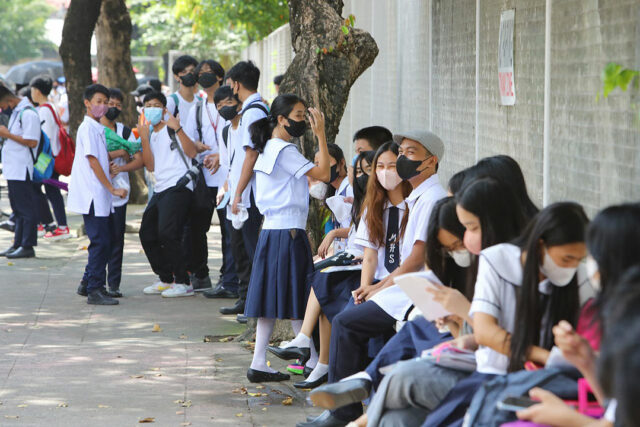
Students attending in-person classes in the capital Manila resort to portable fans, notebooks and even cardboard boxes for a bit of breeze to offer relief.

“My blood pressure is already increasing because of the heat,” said 62-year-old secondary school teacher Memia Santos. “Our backs are wet and at times we get dizzy.” — Reuters

Digital life-insurer Singlife Philippines wins four Digital CX Awards from The Digital Banker

Singlife Philippines was recognized for its groundbreaking initiatives and redefining excellence in digital customer experience, receiving accolades for Best Insurance Provider for Digital CX in the Philippines, Best InsurTech for Digital CX, Best Digital CX - Account Opening and Customer Onboarding (Insurance), and was Highly Acclaimed for Best Digital Life Insurance." -- Photo Release
Singlife Philippines was recognized for its groundbreaking initiatives and redefining excellence in digital customer experience, receiving accolades for Best Insurance Provider for Digital CX in the Philippines, Best InsurTech for Digital CX, Best Digital CX – Account Opening and Customer Onboarding (Insurance), and was Highly Acclaimed for Best Digital Life Insurance.” — Photo Release

Singlife Philippines, the country’s premier digital life insurer, has been honored with four prestigious awards at the 2024 Digital CX Awards, hosted by The Digital Banker at Marina Bay Sands in Singapore on April 25.

“Singlife Philippines was launched in 2020 on a bold vision to utilize cutting-edge digital technology to expand financial inclusion,” says Sherie Ng, co-founder and executive director, Singlife Philippines.

“Our commitment has been unwavering—to make affordable life insurance accessible to more Filipinos through a digital-first approach. These accolades will further fuel our passion and inspire us to deepen our innovations and impact, reflecting strong support for our pioneering and disruptive approach, and signaling an exciting future for an all-digital insurance experience,” she added.

Singlife Philippines was recognized for its groundbreaking initiatives and redefining excellence in digital customer experience, receiving accolades for Best Insurance Provider for Digital CX in the Philippines, Best InsurTech for Digital CX, Best Digital CX – Account Opening and Customer Onboarding (Insurance), and was Highly Acclaimed for Best Digital Life Insurance.”

The Digital Banker is a globally trusted news, business intelligence and research provider for the worldwide financial services sector. The Digital CX Awards evaluates the best-in-class entries based on key criteria encompassing digital innovation, engagement, personalization, and user experience.

“Singlife Philippines is grateful to The Digital Banker for this recognition. This is a testament to all the great work that our team has been doing to make access to meaningful life insurance products easier, faster and more affordable for our customers. We dedicate this award to our customers, who are the inspiration for everything we do. This win is for all of you,” Ng said.

Best Insurance Provider

“Singlife Philippines is a truly progressive insurance provider that is truly making protection solutions accessible and affordable for Filipinos,” The Digital Banker noted.

Singlife Philippines has nearly one million customers to date, all of which have purchased life insurance products purely digitally through mobile phones.

Customers have responded positively to Singlife Philippines’ user-friendly platforms and personalized offerings. Testament to the high overall customer satisfaction is Singlife Philippines’ excellent 4.8/5-star rating on the customer review platform Trustpilot and its double digit repurchase rate.

Best InsurTech for Digital CX

Singlife Philippines received praise from The Digital Banker for its “smooth digital processes, hassle-free protection purchases and efficient claims management reflecting well with clients.”

Additionally, The Digital Banker stated that “Singlife Philippines, through leveraging emerging technologies and employing a customer-centric and mobile-first approach, effectively breaks the mold of traditional insurance, facilitating personalized experiences and simplified processes, as well as empowering Filipinos to take control of their financial well-being.”

Best Digital CX – Account Opening and Customer Onboarding (Insurance)

Customers appreciate Singlife Philippines’ mobile-based account opening process for its clear onboarding instructions and instant access to its financial tools.

The Digital Banker cited that “over 90% of customers have completed onboarding within 5 minutes, a testament to the efficiency and ease of use of existing processes.”

Highly Acclaimed for Best Digital Life Insurance

Singlife Philippines recorded an average customer satisfaction score, or CSAT, of 91% as of January 2024, thanks to a fully digital distribution model that produced excellent customer ratings.

The Digital Banker acknowledged that users were drawn to the company’s “smooth digital process, hassle-free policy purchase and reliable claims experience.”

In continuous pursuit of its mission

“Kudos to everyone who believed in our vision, to the team who ventured with us into uncharted territory, to our customers who inspire us every day and to the investors who steadfastly supported us in bringing this vision to life. We extend our heartfelt gratitude to all of you—this victory belongs to you!” Ng exclaimed.

Singlife Philippines is continuously pursuing its mission to democratize access to meaningful life insurance products by developing much-needed and innovative life products and teaming up with strategic partners to expand its reach to even more Filipinos.

To learn more about Singlife Philippines, visit www.singlife.com.ph, or view the products on GCash under GInsure. Follow Singlife Philippines on FacebookInstagram and Tiktok.


Spotlight is BusinessWorld’s sponsored section that allows advertisers to amplify their brand and connect with BusinessWorld’s audience by publishing their stories on the BusinessWorld Web site. For more information, send an email to online@bworldonline.com.

Join us on Viber at https://bit.ly/3hv6bLA to get more updates and subscribe to BusinessWorld’s titles and get exclusive content through www.bworld-x.com.

Lamudi’s Property Fair opens in Metro Manila on May 3, heads to Cebu in August

The Lamudi Property Fair returns to TriNoma for the Metro Manila leg of the country’s biggest property expo. It brings top real estate developers together to present exciting deals for active home seekers. Meanwhile, real estate professionals can look forward to exclusive accreditation announcements.

Co-presented by IKEA, Lamudi Property Fair 2024 is gearing up to be the largest property festival in the Philippines, with engaging activities and informative program segments for real estate professionals and property seekers from all walks of life. Family members of Overseas Filipino Workers (OFW) can also explore available properties at the fair on behalf of their loved ones abroad.

Mark your May calendars and catch the three-day property expo at the TriNoma Activity Center from May 3 to 5, 2024. Meanwhile, those living in Metro Cebu can catch the Cebu leg of the Lamudi Property Fair from Aug. 16 to 18, 2024.

Here’s what you can expect from the event:

Exclusive Deals and Discounts for All Attendees

With more than 3,000 pre-event registrations and almost 2,000 live attendees last summer, Lamudi Property Fair 2023 showed solid proof of vibrant real estate interest in the Philippines. Amidst fun games and raffles in July 2023, property seekers were eager to explore different property types that developers had to offer, from condominium units to houses and lots.

This time around, the three-day property expo will return to TriNoma from May 3 to 5, 2024, to provide the best real estate deals, daily raffles, and other exciting activities for active home seekers.

Engaging Learning Sessions for Seekers and Sellers

Home seekers and real estate professionals alike can look forward to an educational and engaging Lamudi Property Fair 2024 weekend. Lamudi Academy will play a vital role in the event by providing free learning sessions to educate home seekers and property sellers on sound decision-making.

Exciting Activities Prepared by Top Real Estate Players

Lamudi Property Fair 2024, co-presented by IKEA, connects active home seekers with the best deals from the country’s top real estate developers. Live attendees are free to canvass projects, explore process walkthroughs, learn more about home buying, and participate in various booth activities all day.

Many of the country’s top real estate developers will exhibit their projects at the three-day expo in TriNoma, including platinum sponsors RLC Residences, Ayala Land, Avida, and Amaia. The event’s gold sponsors are AboitizLand, Inc., PH1 World Developers, and Filinvest Alabang.

Lamudi Property Fair 2024’s event partners include:

  • IKEA
  • RLC Residences
  • Ayala Land
  • Avida
  • Amaia
  • Aboitiz Land
  • PH1 World Developers
  • Filinvest Alabang
  • Vista Manors by Vista Land
  • BPI Buena Mano
  • Taylormade Construction and Realty Corp.
  • Picar Development Corp.
  • Community Creators, Inc.
  • Eton Properties
  • DMCI Homes
  • Hausland Development Corporation
  • Primehomes Real Estate Development, Inc.

The brokerage firm PropertyPRO will also showcase available listings at the event.

The property expo’s media partners are the Philippine Daily Inquirer, Inquirer Property, Manila Bulletin, The Philippine Star, BusinessWorld, Manila Standard, Malaya Business Insight, and The Manila Times.

Our media support includes Real Estate Blog PH, Media Blast Digital, Negosentro, Property Finds Asia, Village Connection PH, Executive Chronicles, and Yo Manila.

Lamudi Property Fair 2024 supports the company’s goal of providing Filipinos with a one-stop platform to find their dream home. Apart from the Metro Manila leg, which will take place from May 3 to 5, 2024, the property expo will return to Cebu in August — five years after the success of Lamudi’s property fair in Cebu in 2019.

Register now and participate in the biggest property expo of the year! For partnership opportunities, please email mark.bailey@lamudi.com.ph.


Spotlight is BusinessWorld’s sponsored section that allows advertisers to amplify their brand and connect with BusinessWorld’s audience by publishing their stories on the BusinessWorld Web site. For more information, send an email to online@bworldonline.com.

Join us on Viber at https://bit.ly/3hv6bLA to get more updates and subscribe to BusinessWorld’s titles and get exclusive content through www.bworld-x.com.

NG gross borrowings fall in March

REUTERS/THOMAS WHITE/ILLUSTRATION

By Luisa Maria Jacinta C. Jocson, Reporter

THE NATIONAL Government’s (NG) gross borrowings declined in March as external debt dropped by nearly half, data from the Bureau of the Treasury (BTr) showed.

Gross borrowings fell by 12.8% to P207.265 billion in March from P237.602 billion in the same month a year earlier.

BTr data showed that gross external debt slumped by 44.4% to P50.87 billion during the month from P91.557 billion a year ago.

This consisted of P39.137 billion in program loans and P11.733 billion in new project loans.

On the other hand, domestic debt rose by 7.1% to P156.395 billion from P146.045 billion in March 2023. This accounted for over three-fourths or 75.5% of the total gross borrowings during the month.

Broken down, domestic borrowings were composed of P120 billion in fixed-rate Treasury bonds and P36.395 billion in Treasury bills.

In the first quarter, gross borrowings slipped by 12.4% to P830.389 billion from P948.09 billion a year ago.

Gross domestic borrowings stood at P713.132 billion in the January-to-March period, up by 9.2% from P652.986 billion a year ago.

Domestic debt, which accounted for 85.9% of the total borrowings, consisted of P341.412 billion in retail Treasury bonds (RTBs), P310 billion in fixed-rate Treasury bonds and P61.72 billion in Treasury bills.

On the other hand, external gross borrowings plunged by 60.3% to P117.257 billion in the period ending March from P295.104 billion a year ago.

This was made up of P95.435 billion in program loans and P21.822 billion in new project loans.

Rizal Commercial Banking Corp. Chief Economist Michael L. Ricafort said that the decline in March borrowings may be due to the RTB issuance in February.

“That could have front loaded some of the borrowing requirements for March 2024,” he said in a Viber message.

In February, the government raised a record P584.86 billion from its offering of five-year RTBs.

Mr. Ricafort also noted the first quarter was lower year on year since there were no global bond issuances.

In January 2023, the government raised $3 billion from its US dollar bond issuance.

Finance Secretary Ralph G. Recto has said that the Treasury is still finalizing the details of its first global bond offering this year.

Ruben Carlo O. Asuncion, chief economist at Union Bank of the Philippines, said that the drop in gross borrowings is likely an indicator of the NG’s fiscal consolidation efforts.

“However, this may also mean a subdued fiscal stimulus for the period,” he added.

For April, Mr. Ricafort said that the seasonal increase in tax collections would boost the government’s cash position.

“(This) could help improve the fiscal position in terms of narrower budget deficit, at the very least, or could even lead to a possible budget surplus for the month — a consistent pattern seen for many years,” he added.

The deadline for the filing of annual income tax returns was on April 15. The Bureau of Internal Revenue (BIR) is expected to collect about P406 billion during the month.

Separate BTr data showed that the budget deficit narrowed by 6.82% to P195.9 billion in March. For the first quarter, the fiscal gap widened by 0.65% to P272.6 billion.

This year, the budget deficit ceiling is set at P1.48 trillion or equivalent to 5.6% of gross domestic product.

The government’s borrowing program is set at P2.46 trillion, with P1.85 trillion to be raised from the domestic market and P606.85 billion from foreign sources, according to the latest Budget of Expenditures and Sources of Financing data.

Peso weakness to persist — analysts

BW FILE PHOTO

THE PESO may continue to depreciate further this year amid broad dollar strength, but the Philippine central bank may not need to intervene yet, analysts said.

“The peso’s recent depreciation is a concern, but it’s part of a larger global trend,” Security Bank Corp. Chief Economist Robert Dan J. Roces said in a Viber message.

Bangko Sentral ng Pilipinas (BSP) Governor Eli M. Remolona, Jr. on Thursday said that the local currency’s recent performance has been due to the US dollar’s strength rather than the peso’s weakness.

He cited escalating tensions from the Middle East that led to “safe haven flows into the US dollar at the expense of most other currencies.”

The local unit closed at P57.71 against the dollar on Friday, strengthening by seven centavos from its P57.78 finish on Thursday. Its close on Thursday was its weakest finish in more than 17 months or since the P58.19 close on Nov. 10, 2022.

Year to date, the local unit depreciated by P2.34 from its P55.37 finish on Dec. 29, 2023.

“We already predicted last year that the peso-dollar exchange rate would reach P58 in 2024,” De La Salle University School of Economics professor Jesus Felipe said in an e-mail.

Mr. Felipe said that the peso will likely stay in the P57-to-P58 range this year.

Latest Development Budget Coordination Committee assumptions show that the peso may range from P55 to P57 for 2024.

The exchange rate is also directly affected by the current account balance, ratio of Philippine export prices to world import prices and the current policy rate, Mr. Felipe said.

Ateneo de Manila economics professor Leonardo A. Lanzona said the US dollar’s recent strength is also due to the strong performance of the US economy.

“Unless the Philippine economy matches with the US economic growth, the value of the peso will continue to decline. Now, this is not necessarily bad for the economy because it incentivizes greater exports,” he said in an e-mail.

INTERVENTION?
Mr. Remolona has said that the central bank “stands ready” to defend the currency if needed, after the peso closed at its weakest level in nearly 17 months against the dollar on Thursday.

“Nonetheless, the BSP continues to monitor the market and stands ready to manage any unnecessary movement and excessive volatility,” he said on Thursday evening.

In October 2022, the peso reached a record low of P59 against the dollar. This added to inflationary pressures and prompted the BSP to intervene in the foreign exchange (forex) market and raised interest rates.

Mr. Remolona also said that the BSP allows adjustments to happen unless the forex movements are “very sharp.”

Enrico P. Villanueva, a senior lecturer at the University of the Philippines Los Baños Economics Department, said that the BSP is correct to allow forex adjustments to happen.

“It is BSP’s mandate to ensure financial stability, but not dictate or control the level of the exchange rate of peso against dollar,” he said via Facebook Messenger.

Mr. Felipe also noted that the BSP is unlikely to intervene. “Not at this level and as long as movements are very smooth,” he added.

The BSP would intervene if necessary to maintain stability, Mr. Roces said.

“Although, what these interventions are remain vague, based on the recent gross international reserves (GIR) we have ample external cover for this,” he said.

“As such, recent movements have been market driven and there aren’t any inherent weakness in the peso. The main catalyst has been the signal out of the US Fed about the need to maintain elevated rates for longer, and likely a knee-jerk reaction regionally following Indonesia’s surprise rate hike,” he added.

Policy makers at the US Federal Reserve have signaled that they are not rushing to cut rates anytime soon due to persistent inflation.

The Fed is set to have its next meeting this week (April 30-May 1).

Mr. Remolona earlier said that the peso’s recent drop has been due to signals of policy easing delays by the Fed. He also said that the peso weakness is unlikely to impact the BSP’s monetary decisions.

Finance Secretary Ralph G. Recto also said last week that the peso depreciation is not enough reason to raise rates.

From May 2022 to October, the Monetary Board has hiked borrowing costs by 450 basis points to bring the benchmark rate to a near 17-year high of 6.5%. At its April meeting, the BSP stood pat for a fourth straight meeting.

The Monetary Board is set to have its next policy meeting on May 16. Luisa Maria Jacinta C. Jocson

ERC urged to hike reserve power capacity

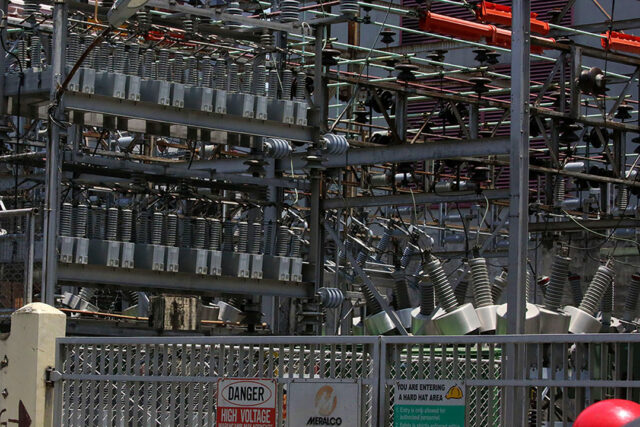
A power substation is seen in Malate, Manila, April 18, 2024. — PHILIPPINE STAR/EDD GUMBAN

THE ENERGY REGULATORY Commission (ERC) should raise the required reserve power capacity of the grid to prevent more outages in the future, an energy think tank said.

“Having an increased reserve power capacity in the grid can mitigate strains and potential power outages by ensuring a greater backup power supply in instances of unexpected shutdown of power plants,” Noel M. Baga, convenor of the Center for Energy Research and Policy, said in a message.

Sought for comment, ERC Chairperson Monalisa C. Dimalanta said that increasing reserve capacity “is part of the government’s campaign to increase investments in the generation sector.”

State of power plants in the Luzon grid“Increasing supply in the system also means we increase the capacities available for reserve,” Ms. Dimalanta said in a Viber message.

Reserves, commonly referred to as ancillary services, are services needed to “maintain balance in the power system to ensure normal frequency and voltage levels in response to demand changes, variability of renewable energy, and possible loss of a large generating unit,” according to the Department of Energy (DoE).

The country’s main grids have been under red and yellow alerts in the past week as some power plants went on forced outages.

Yellow alerts are issued when the supply available to the grid falls below a designated safety threshold. If the supply further deteriorates, a red alert is declared.

The Luzon, Visayas, and Mindanao grids have required average regulating reserves of 557 megawatts (MW), 116 MW, and 103 MW, respectively, according to the bulletin dated April 24 from the National Grid Corp. of the Philippines (NGCP).

The NGCP has implemented ancillary services procurement agreements from competitive biddings amounting to 257.78 MW in Luzon and 68.61 MW in Mindanao.

Last week, the DoE said more yellow alerts, and possibly red alerts, are expected until May due to higher-than-expected temperatures and rising power demand.

Mr. Baga said the ERC should enforce strict regulations on the maintenance and operation of power plants, “imposing penalties for breakdowns leading to power outages.”

“The ERC needs to enhance its regulatory oversight by requiring power plants to adhere to high performance standards and to replace outdated equipment, and penalizing power plants for breakdowns that cause unscheduled outages,” he said.

In 2023, the ERC imposed approximately P60 million worth of penalties against generation companies for breaching the allowable number of outage days.

Meanwhile, Leonardo A. Lanzona, Jr., economics professor at Ateneo de Manila University, said in an e-mail that the “fragility of the current power grid structure in terms of addressing socioeconomic shift has not been addressed.”

“All of these can be tied to the inability of the government to develop a response to extreme weather shifts due to climate change,” he said.

“This weakness belies all claims that the country has become richer, and its economic foundation is well grounded, wasting all opportunities for growth.”

In its background paper, the World Bank said that the Philippines was considered the fourth most-affected country by extreme weather events.

Mr. Lanzona said that the government needs to focus on strengthening the domestic economy first instead of focusing on foreign investments and “devising piecemeal solutions.” — Sheldeen Joy Talavera

BusinessWorld’s Patricia Mirasol wins award

PATRICIA B. MIRASOL, a multimedia producer at BusinessWorld, won the Best in Health Innovation and Collaboration Reporting category at the 2023 Community Press Awards of the Philippine Press Institute (PPI).

Ms. Mirasol tied as Outstanding National Journalist for the category with Pam Pastor of the Philippine Daily Inquirer. This is the first time the PPI has given out this award, in partnership with the Pharmaceutical and Healthcare Association of the Philippines.

BusinessWorld was also a finalist for Outstanding National Newspaper.

SM Prime targets two China mall openings by 2025

LISTED property developer SM Prime Holdings, Inc. continues its mall expansion in China with two planned openings by 2025, the president of its malls unit said.

The scheduled openings next year will be in Fujian Province, comprising phase 4 of SM Xiamen and a mall project in Haicheng town, said Steven T. Tan, president of SM Prime’s mall unit SM Supermalls.

He also said that another mall project is slated for opening by 2026.

“We still see a lot of potential for our China malls,” Mr. Tan said during a briefing last week.

SM started construction of SM Xiamen Phase 4 in February 2021, with a total investment of 1.148 billion yuan, according to the company’s website. The project is planned to have five 15 to 19-storey towers connected by a five-storey podium.

SM Xiamen Phase 4 has a total construction area of over 260,000 square meters (sq.m.), including an office area of nearly 120,000 sq.m., a commercial area of over 30,000 sq.m., and 1,643 parking spaces.

Mr. Tan said the company is bullish on Fujian’s prospects despite China’s economic slowdown.

“We still believe in the China market. China is so big and Fujian is not really that greatly affected and most of our anchor projects are in Fujian,” he said.

 “We still believe in the prospect of China and, therefore, we will still continue to expand our footprint in China,” he added.

 Meanwhile, SM Prime President Jeffrey C. Lim said that the company is not focused on land banking efforts in China as it is only developing existing properties.

 “Our developments will basically focus on the Fujian province area. These are existing properties. We have existing malls. We just have to improve the efficiency and productivity of these malls,” he said.

 “We have to develop them because Fujian province is a market where we are doing very well in China,” he added.

Based on its website, SM’s malls in China include SM Xiamen (Phases 1, 2, and 3), SM City Chengdu, SM City Chongqing, SM City Tianjin, SM City Suzhou, SM City Yangzhou, SM City Zibo, and SM City Jinjiang.

Back home, SM Prime is eyeing to open four malls this year that will add over 440,000 sq.m. of gross floor area to the company’s mall portfolio. The new openings are in Caloocan, San Fernando (La Union), Laoag, and Cebu.

SM Prime earmarked P100 billion for its capital expenditure budget this year.

Shares of SM Prime were last traded on April 26 at P28.35 per share. — Revin Mikhael D. Ochave

MPTC says barrierless toll system to cost up to P10 billion

METRO Pacific Tollways Corp. (MPTC) said it plans to allocate up to P10 billion for the implementation of a barrierless toll system.

“This could range from P8 billion to P10 billion — all in all, the major components, removal of the roadside, information at the back office, vehicle classification,” MPTC President and Chief Executive Officer Rogelio L. Singson told reporters last week.

The first stage of the barrierless tollways will be the implementation of cashless transactions, followed by the interoperability or the introduction of the unified radio frequency identification (RFID) wallet system along expressways.

The Toll Regulatory Board (TRB) aims to implement the unified wallet system by July. However, Mr. Singson said that both MPTC and San Miguel Corp. will only be able to implement an interoperable wallet by October.

“At the latest, by October this year, SMC and MPTC will establish an interoperable wallet, utilizing a single ID. This initiative has received full support from the government. Before transitioning to a barrierless system, we require the government’s support,” he said.

Easytrip is used on MPTC’s North Luzon Expressway, Subic–Clark–Tarlac Expressway, Manila–Cavite Expressway, and Cavite–Laguna Expressway.

Meanwhile, Autosweep is used on the San Miguel group’s Skyway, South Luzon Expressway, NAIA Expressway, Southern Tagalog Arterial Road Tollway, and Tarlac-Pangasinan-La Union Expressway. Autosweep is also used on the Villar group’s Muntinlupa Cavite Expressway.

MPTC is the tollways unit of Metro Pacific Investments Corp., one of three key Philippine units of Hong Kong-based First Pacific Co. Ltd., the others being Philex Mining Corp. and PLDT, Inc.

Hastings Holdings, Inc., a unit of PLDT Beneficial Trust Fund subsidiary MediaQuest Holdings, Inc., has a majority stake in BusinessWorld through the Philippine Star Group, which it controls. — Ashley Erika O. Jose

ENEX to seek partners for gas exploration contract 

AYALA-LED ENEX Energy Corp. said it will seek partners for its natural gas service contract once the company resumes exploration within the Palawan Basin.

“We continue to explore bringing in the right partner or sponsor to undertake the exploration and development activities once it is possible to do so,” Enex Chairman Eric T. Francia said during the company’s annual stockholders’ meeting last week. 

ENEX, formerly ACE Enexor, Inc., is a unit of listed company ACEN Corp. It explores for crude oil and natural gas.

In 2023, ACEN Corp. announced that the Department of Energy (DoE) granted a declaration of force majeure for its unit’s drilling operations within SC 55.

It said  the DoE agreed to allow the request of its subsidiary, Palawan55 Exploration and Production Corp., for a force majeure relief due to the “operational and financial risks” associated with drilling operations in the West Philippine Sea.

Petroleum SC 55 is a deep-water block in the southwest Palawan Basin covering an area of 9,880 square kilometers.

The SC 55 in Palawan is estimated to have some 2.2 trillion cubic feet of natural gas, the Energy department said. 

Mr. Francia said the country must develop its indigenous energy resources as its only indigenous commercial source of natural gas, the Malampaya gas field is expected to have a declining output. 

“The use of (LNG) had begun in order to address the declining output of Malampaya gas. Reliance on imported LNG, however, has put an upward pressure on the cost of fuel and therefore the cost of gas power,” Mr. Francia said. 

Further, the company said it is still keen on building a liquefied natural gas (LNG) fired plant in Batangas.

The company’s investee company, the Batangas Clean Energy is currently developing a 1,100 megawatt combined cycle gas turbine project Batangas.

For now the project is awaiting a competitive selection process to secure an offtake contract for the project, Mr. Francia said. — Ashley Erika O. Jose