Home Blog Page 2728

Embracing innovation, expanding reach through digitalization
By Mhicole A. Moral, Special Features and Content Writer

FOR DECADES, traditional media — comprising print newspapers, magazines, television, and radio — served as primary channels for information dissemination and entertainment. However, there has been a recent shift towards digital media consumption, facilitated by the rapid proliferation of smartphones, the availability of the internet, and the rise of social media platforms, which have redefined how audiences engage with content.

As a result, traditional media, which once dominated the information and entertainment space, has had to evolve to remain relevant as digital consumption becomes the norm.

BusinessWorld, the oldest business newspaper in the Philippines and the first business daily in Southeast Asia, has been a trusted source of business news and analysis for over three decades. Founded in 1967 as BusinessDay by the esteemed journalist Raul L. Locsin, its mission was to provide “competent and responsible reporting on the news.”

In 1987, BusinessDay was rebranded as BusinessWorld, signifying a significant change in its identity. This change occurred during political and economic disruption in the Philippines as the country shifted to a more democratic government after years of Martial Law. The new identity symbolized a renewed dedication to serving as a public trust, emphasizing the provision of precise and timely news to business leaders and decision-makers.

Over the years, BusinessWorld has weathered various challenges, particularly with the rise of digital media and shifting consumer habits. In response, the publication has embarked on a digital transformation journey, striving to maintain its reputation as a leading source of business news in the country while adapting to the demands of an evolving media environment.

Today, BusinessWorld operates as a multimedia company, providing news and content not only through print but also through digital platforms, continuously aiming to bridge the gap between traditional and new media by effectively engaging audiences and maintaining the integrity of information dissemination.

“The very inspiration that helped BusinessWorld transform into a multimedia company is understanding its audience, which is the business community, from what information they would like to consume and what they need,” said Lucien C. Dy Tioco, executive vice-president of BusinessWorld and its umbrella organization, the PhilSTAR Media Group (PMG).

According to BusinessWorld Digital Services Head Jose Niño D. Nicolas III, the integration of multimedia content into traditional news workflows has been one of the most significant challenges for BusinessWorld as the digital age demands a multi-platform approach where content must be engaging, interactive, and available in various formats.

“Print is very conscious of the physical space occupied, while television worries about airtime,” he explained. “Multimedia, by definition, is the ability to relay information or produce content that utilizes different forms of media cohesively. In effect, multimedia journalism has to take into account not just the written literature, but also the visual and audible content. With digital, it adds more layers to the complexity of multimedia, which include interactivity and engagement.”

FUTURE-PROOFING BUSINESSWORLD
Even before the pandemic drastically altered the business environment, BusinessWorld had already laid the groundwork for digital transformation.

“During the pandemic, we were able to come up with digital-only projects. All of these are done in order for us to be present and accessible to our audience. Wherever they are, we continue to be available for them,” BusinessWorld Digital Sales Lead Jao A. Malapo shared.

For instance, BusinessWorld Insights, which initially launched as an online-only initiative, expanded into in-person events once restrictions eased. The flexibility of BusinessWorld’s digital platforms allowed the company to remain agile, swiftly adapting to changes in the media landscape while maintaining consistent engagement with its audience.

Mr. Malapo said that the company’s adaptability has proven crucial in addressing the evolving needs of clients, particularly those looking for multimedia and digital solutions to traditional print campaigns.

Meanwhile, digital sales have become a viable and significant revenue stream, supplementing traditional print-based revenue. Mr. Malapo mentioned that the company’s ability to offer comprehensive digital services, such as sponsored content, video production, and online events, has broadened its appeal to clients.

“These platforms allow for deeper collaborations between BusinessWorld and its clients, moving beyond simple advertising to more integrated solutions that meet specific business needs,” he added.

As mentioned, a key factor in BusinessWorld’s digital expansion is its emphasis on partnerships and collaborations. Collaborations with clients, sponsors, and partner organizations are not just important but crucial to the success of the company’s digital platforms. These collaborations promote BusinessWorld’s capabilities and enable the company to stay in tune with industry trends and the evolving needs of the business community.

“By working closely with clients, we gain valuable insights into market trends and challenges, which in turn helps shape our future offerings. For example, through our collaborations with various industries, we were able to develop more relevant content, programs, and platforms that resonate with our target audience,” said Mr. Malapo.

SHARING CREDIBLE BUSINESS NEWS IN THE DIGITAL AGE

BusinessWorld is one of the first news organizations in the Philippines to ever have a website, recalled Mr. Nicolas. In fact, this foresight of the late Mr. Locsin enabled the company to acknowledge the importance of digital in the future.

The launch of BusinessWorld Online (www.bworldonline.com) marked the beginning of the publication’s digital journey, providing readers with easy access to its rich archive of articles and up-to-date news in real-time.

To further extend its reach, the media company has effectively leveraged social media platforms such as Facebook, X (formerly Twitter), Instagram, and — recently — Threads. These channels serve as key mediums for engaging with a broader audience, sharing timely news updates, and driving traffic to other platforms.

Aren Mae M. Cayetano, social media specialist at BusinessWorld, said, “We continue to use various social media platforms to connect with our target audience. By customizing our content to fit our audience’s preferences, BusinessWorld maximizes its reach and influence across different social media channels.”

“BusinessWorld is unlike any other mainstream news media organization. As most live and die by social media, BusinessWorld enjoys a very good niche of professionals and entrepreneurs, which is evidently shown in the organization’s web analytics. Direct and organic search traffic make up 90% of BusinessWorld’s web analytics,” Mr. Nicolas said.

However, maintaining its niche while producing quality content presents a challenge, according to the Digital Services Head.

“Social media has always been influenced by algorithms on trends and relevance, but organizations such as BusinessWorld cannot sacrifice their identity just to be able to go with the flow,” he stressed.

“A delicate balance between identity, relevance, and engagement has to be struck,” he continued. “That is what BusinessWorld is relentlessly trying to achieve, and it will not resort to brute-force strategies just to be noticed.”

Meanwhile, the addition of digital services requires not only a change in how content is produced but also how it is presented and consumed. BusinessWorld has embraced various digital platforms, including explainer videos on YouTube, podcasts on Spotify, and interactive multimedia content on its website and social media platforms, to engage with its audience in new ways.

DIGITAL MEANS FOR EXPANDING REACH
One of the standout initiatives in BusinessWorld’s digital strategy is the BusinessWorld B-Side podcast. Launched as a way to reach professionals who may not have time to read or watch the news, B-Side has become a popular source of business and economic information.
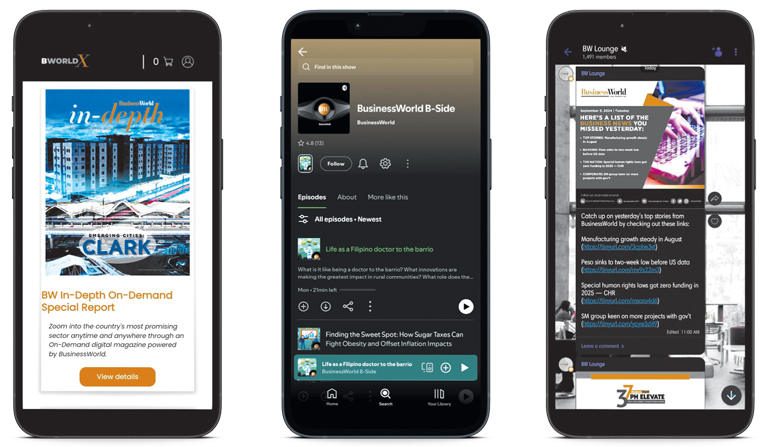
From left: BWORLDX, BUSINESSWORLD B-SIDE and BW LOUNGE

“BusinessWorld’s niche is composed of highly educated professionals and entrepreneurs who have a natural hunger for information. However, being always on the go, it is a reasonable assumption that these people do not have the time to read or watch the news. Podcasts fill in that void since it only entails the audience to consume information by just listening,” said Mr. Nicolas.

To date, the B-Side podcast has almost 6,000 listeners, usually from the Philippines, Singapore, India, Canada, and Saudi Arabia, who mostly found the podcast through searches.

Another way that BusinessWorld demonstrates its multimedia capabilities is Launchpad, a weekly section dedicated to micro, small, and medium-sized enterprises (MSMEs). It covers business advice, market trends, funding opportunities, and relevant government regulations, among others. Launchpad releases a story published in print, coupled with a video published on BusinessWorld’s website and social media channels expounding further on the subject featured in the story. With such content, Launchpad aims to be a valuable resource for entrepreneurs looking to stay updated about the country’s MSME industry.

Moreover, BusinessWorld has wielded the power of multimedia through multimedia reports that bring together written content, images, and videos to deliver a more engaging reading experience. These can be seen in the publication’s multimedia report back in 2022 titled “The Promise of Power,” which looked into the Bataan Nuclear Power Plant. Last year, BusinessWorld has also presented “Letters to the Mountains: A day in the life of a Cordillera mailman,” a multimedia report on the postal service challenges in the country, highlighting the Philippine Post Office.

Aside from BusinessWorld Online, the multimedia content provider has extended its reach in the digital space through a subscription-based e-commerce site BWorldX (www.bworld-x.com).

Serving as a one-stop shop for BusinessWorld’s library of content, from print and digital publications to access to BusinessWorld’s events, BWorldX collates the print and e-paper versions of BusinessWorld; print and digital copies of the Top 1000 Corporations in the Philippines; the BusinessWorld In-Depth digital magazine; BusinessWorld Insights webinars; live access and videos from BusinessWorld One-on-One interviews and BusinessWorld Economic Forum; episodes of the BusinessWorld B-Side podcast; and access to BusinessWorld’s Viber community, The Lounge, into a single site.

Mr. Dy Tioco previously mentioned that BWorldX seeks to address the needs of its distinct audience for “a constant stream of timely, truthful, and substantial information that will further grow and nurture their learning,”

“As we bring all these (contents) together, and add much more, into a single accessible space, BWorldX is more than your typical subscription-based website. We intend it to be the place you turn to whenever you need the business intelligence that BusinessWorld excellently provides,” Mr. Dy Tioco added.

Part of BWorldX’s exclusive offerings, BusinessWorld In-Depth is an on-demand digital magazine that serves as a venue to take a closer look into issues and developments in business, for instance the country’s mall culture or the prospects of Clark as an emerging city, which were featured in recent issues. The digital magazine also brings timely information much closer to one’s fingertips, as regularly done with BusinessWorld’s Quarterly Banking Reports.

BusinessWorld has also created a Viber community for content promotion and event announcements, named The Lounge. According to Mr. Malapo, this initiative further illustrates how BusinessWorld is leveraging new media to stay connected with its audience.

AMPLIFYING BRANDS’ MESSAGES
Besides expanding BusinessWorld’s presence among its audiences beyond print, its digital channels have also served as a venue for brands to amplify their messages and get them further across their target audiences among BusinessWorld’s followers and subscribers.

BusinessWorld One-on-One interview series, in partnership with EastWest Ageas Insurance, helped audiences get to know its chief executive officer and president, Sjoerd Smeets.

Back in December last year, the BusinessWorld One-on-One interview series, in partnership with EastWest Ageas Insurance, helped audiences get to know Sjoerd Smeets, chief executive officer and president of EastWest Ageas Insurance. On that video, which can be viewed on BusinessWorld’s Facebook and YouTube pages, Mr. Smeets shared his vision for EastWest Ageas Insurance and how the Filipino customer is at the heart of it all.
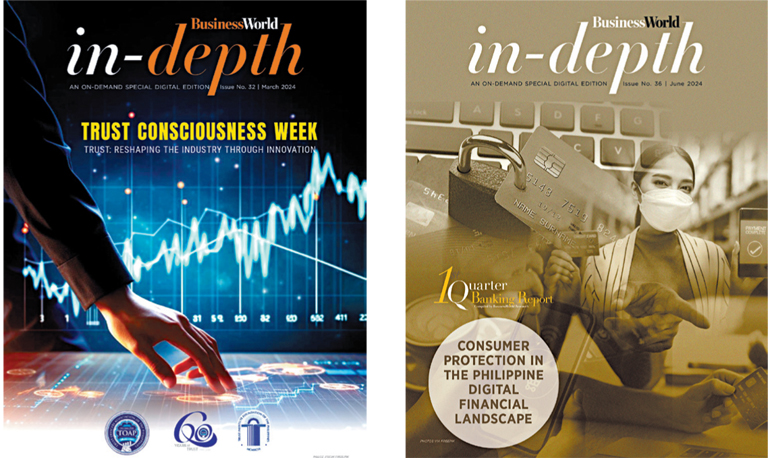
From left: BusinessWorld In-Depth has collaborated with some institutions to commemorate their events. BusinessWorld’s Quarterly Banking Reports are also delivered as In-Depth issues, available on BWorldX.

In-Depth, meanwhile, had been putting the spotlight on organizations as they observe significant events in their industries. Together with the Trust Officers Association of the Philippines, BusinessWorld In-Depth released last March an issue celebrating the Trust Consciousness Week, which was then themed “Trust: Reshaping the Industry Through Innovation.” Bankers Institute of the Philippines, Inc. (BAIPHIL) also collaborated with BusinessWorld last March for an In-Depth issue commemorating both the BAIPHIL Training and Development Week and the institute’s 83rd anniversary.

Last March, BusinessWorld B-Side released a special edition in partnership with IBM Philippines, where Commercial Territory Sales Leader Christine Llanto-Ravelo shared the opportunities that generative artificial intelligence (genAI) opens to women in workplaces and boardrooms.
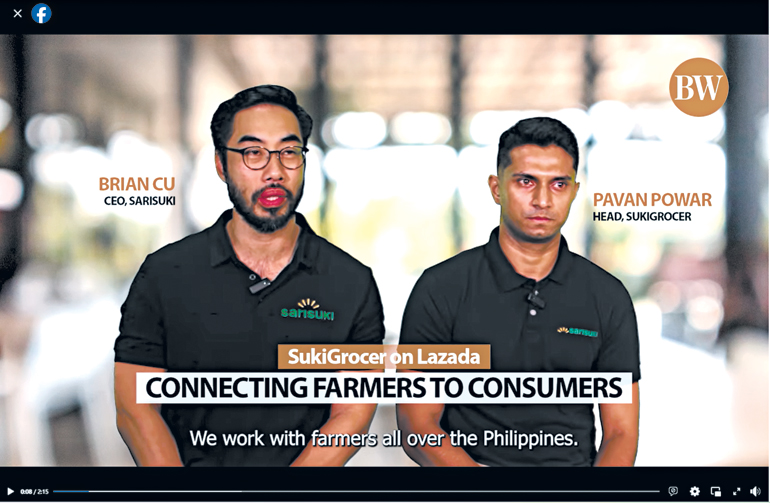
BusinessWorld Spotlight, in partnership with Lazada, features a video interview with SukiGrocer.

Most recently, last August, BusinessWorld’s Spotlight section featured a video interview with SukiGrocer as they discussed about the ease of doing business as a seller in the popular e-commerce platform Lazada.

LEVERAGING ANALYTICS, GENAI
BusinessWorld also leverages web and social media analytics to gain insights into its audience’s preferences and habits. For example, the organization has found that its audience frequently checks for the foreign exchange (FOREX) and stock market news before 9 a.m., prompting BusinessWorld to share relevant updates during that time.

“We use different key performance indicators (KPIs) to evaluate the success of our digital initiatives for BusinessWorld. By monitoring these KPIs, we can determine the effectiveness of our strategies, make data-driven adjustments to upcoming digital projects, and work on improving our presence online to meet our business objectives,” said Ms. Cayetano.

In addition to traditional analytics, BusinessWorld has begun to experiment with genAI to further refine its content strategy.

“GenAI is not meant to write stories in place of journalists,” Mr. Nicolas explained, “but it can help speed up analyzing relevant points and topics so that content is richer, more engaging, and comprehensive. BusinessWorld strives to combine web and social media analytics with the power of genAI to deliver the best experience and most relevant information to its audience.”

Looking ahead, BusinessWorld aims to expand its multimedia offerings, with plans to introduce more video content and interactive reports, striving to have a significant impact on the Philippine business community.

“BusinessWorld has the tenacity to thrive on each platform and to apply and leverage its strengths on them. This is how we refine our content. I believe what sets us ahead is creating an entrepreneurial culture, which is a key ingredient in our digital transformation. Innovation has the potential to generate exciting growth for the company that we have never imagined before,” said Mr. Dy Tioco.


Building on shifting sands

BusinessWorld President and CEO Miguel G. Belmonte — PHILIPPINE STAR/JESSE BUSTOS

BusinessWorld’s growth amid an ever-changing media landscape

By Bjorn Biel M. Beltran, Special Features and Content Assistant Editor

The story of media has always been one of constant change. The printing press gave rise to radio, which then gave way into television, each new medium expanding the reach of information further than ever before. What once lived exclusively in newsprint became available as pixels on a computer screen. Today, every headline, broadcast, and television program can be accessed through a mobile phone — literally an entire world of information at the swipe of a finger.

But while change is inherent in media, this does not make it any easier for those who have built their legacies within it. The media industry in a way is an empire built on sand that is constantly shifting with the tide of technology — one that lives by one eternal rule: adapt, or become irrelevant.

Miguel G. Belmonte, president and chief executive officer of BusinessWorld, has been keenly aware of this since assuming his position nearly a decade ago.

“The media landscape is in some ways very different from what it was for so many years before. Whenever there were issues concerning traditional media back then, we always knew immediately how to handle it. It was practically second nature to us,” he recalled in an interview.

“The world has changed so much. I have to admit that sometimes, I worry about it.”

When he joined the company back in 2015, BusinessWorld was already struggling to adjust to a world that was becoming increasingly digital very quickly. It took only a few years of refining its operational strategy and strengthening its core for the company to turn it around.

Photo by Joy D. Dagun

Now, on its 37th anniversary, BusinessWorld has become not only the leading business newspaper in the Philippines but a formidable multimedia presence. Despite a multitude of challenges, BusinessWorld has found success for itself in hosting events and conferences, and gaining substantial revenues from advertising across different platforms, to the point that it had even started outperforming its print-era earnings.

Mr. Belmonte attributes this success to the company’s focus on its niche market and strengths, rather than trying to compete directly with other English broadsheets in the country.

“Before, it was really so basic. We earned from advertising and circulation. Those were really the two main revenue-generating departments,” he said. “It’s not that way anymore.”

“One of the things that we’re doing better now is to determine our niche, where our strength is. We don’t try to compete with other broadsheets. We don’t try to step on their territory. What we’re doing is we develop our own territory. We build on that, we defend it, we continuously try to grow within that territory. That has proven to be very successful so far,” he added.

This strength lies in BusinessWorld’s journalistic reputation and credibility. Editor-in-Chief Cathy Rose A. Garcia noted that BusinessWorld has always provided insights into market trends, corporate developments, and economic policies, and this forte has never changed since the company’s foundation.

BusinessWorld Editor-in-Chief Cathy Rose A. Garcia — Photo by Jayson John Marinas

“We have always been a key resource for business professionals, investors, and policy makers,” she said. “BusinessWorld also provides a platform for discussion and debate on important economic and business issues. Through our business news reporting, we aim to help the public understand complex issues, policies, and trends facing the Philippines. For instance, our analysis reports aim to help the public understand how policy changes may impact [not only] the economy but also their lives.”

The emphasis on clear and accurate reporting is paramount. “We want to demystify business and finance for a broader Filipino audience, especially the younger generation. Financial literacy is very important. When individuals and businesses make informed financial decisions, this can lead to a stronger and more resilient economy,” she added.

As the way audiences consume news is constantly evolving, however, and it is not always easy to find the best method to achieve this goal. Associate Editor Bettina V. Roc said that nowadays, news organizations have to compete with content creators on social media platforms, forcing them to experiment with new, more easily digestible methods for news delivery like short-form reels.

“Since I edit for the newspaper, the written medium still allows for context and background, which I feel is largely omitted when social media is used for reporting,” she said.

And while concessions have to be made to more effectively inform the public — she herself admits to actively limiting her use of technical jargon in editing stories — the standards of journalism remain the same as ever.

“Regardless of medium, I still stand by that principle, along with accuracy and fairness, when covering stories or deciding which articles to prioritize. I think it should never come to a point where journalism values have to be sacrificed for the sake of being first, riding on a trend, or getting the most clicks,” she said.

Not all change is good, after all. Associate Editor Arjay L. Balinbin noted that the most recent shake-up in journalism, the coronavirus disease 2019 (COVID-19) pandemic, saw many journalists adopt a hybrid or even fully virtual model of covering news. But while such virtual formats provide more convenience and efficiency, they come with the irreconcilable drawback of having limited access to sources and in-depth information.

“Balancing traditional journalism values with the demands of the digital age means upholding standards of accuracy, fairness, and thoroughness, while leveraging digital tools for broader audience engagement,” he said.

For Mr. Belmonte, he is content in leaving BusinessWorld’s future in the hands of the company’s new generation of editors and reporters.

“I believe in our young team. And I know that the future of our company is more in their hands than it is in mine or my generation,” he said.

“My position is that I’m going to put my trust on our young people to determine the direction that our company will take. We’re just going to support them and guide them where we can guide them.”

The faith in the next generation is mirrored across BusinessWorld’s leadership. Executive Vice-President Lucien C. Dy Tioco acknowledged that the past few years at the company have been turbulent, particularly because of the accelerated adoption of digital platforms that resulted from the pandemic, but he sees these challenges as opportunities to innovate.

BusinessWorld Executive Vice-President Lucien C. Dy Tioco — Photo by Arjale Jayrie Queral

“In my years of experience being in the media business, I have kept my competitive edge by building a culture of innovation,” he said. “Even with the challenges that print has faced, innovation has kept us excited over the opportunities over the threats.”

He further explained that by strengthening what BusinessWorld is and by taking care of its equity, its command of influence, and its engagement with the business community, the company continues to remain a strong and reliable partner for both its audience and its advertisers.

“First and foremost, we help brands and companies bridge their business objectives through our platforms and the community, industry and government sectors that we are engaged in. I am proud to say how much we kept our advertisers through our multimedia initiatives,” he said.

“The very purpose of BusinessWorld is to grow our business community by igniting programs and initiatives that will keep our economy healthy and progressive, where a vast amount of wealth and opportunities will be spread to the Filipino people. This is what keeps us inspired to keep innovating.”

Vice-President for Sales and Marketing Jay R. Sarmiento pointed out that for BusinessWorld, the pivot to digital and events while maintaining its presence as a print newspaper has been instrumental in sustaining the business and making it even more profitable post-pandemic.

“Transformation does not necessarily mean technology. Transformation can take the form of ways, culture and even mindset,” she added.

BusinessWorld’s office in New Manila, Quezon City — Photo by Thea Mairi A. Castillo

As for the future, Mr. Belmonte hopes that would be enough. In an ever-changing industry like media, nothing is ever assured. What was once tried-and-true may not be so a few years down the line. After all, a few decades ago all they had to think to make a profit about was advertising and circulation. Digital transformation, audience engagement, and content diversification may be enough today; but what of tomorrow?

“We’re still looking,” he said. “We’re still experimenting.”

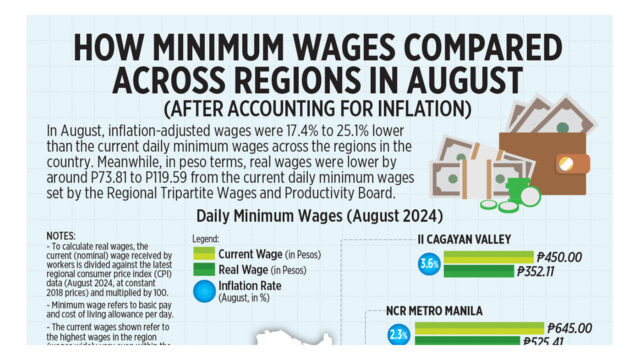
How minimum wages compared across regions in August

(After accounting for inflation)

In August, inflation-adjusted wages were 17.4% to 25.1% lower than the current daily minimum wages across the regions in the country. Meanwhile, in peso terms, real wages were lower by around P73.81 to P119.59 from the current daily minimum wages set by the Regional Tripartite Wages and Productivity Board.

How minimum wages compared across regions in March

Rustan’s makes a case for in-store shopping: VIP service and authenticity

WHILE the pandemic accelerated the online shopping game, some habits die hard. While many people do buy hard-to-find items and very cheap staples online, there’s still something to be said about feeling and testing luxury merchandise in person.

We proved that at a visit to Rustan’s Makati on Sept. 5 for the Rustan’s Beauty Addict: Race Off to Beauty, patterned after Formula One races.

Games were played at brands like L’Occitane, Diptyque, Malin+Goetz, Grown Alchemist, L:a Bruket, Saturday Skin, RMS Beauty, Stila, Phyto, Aveda, and Chanel for a chance to win prizes. There were also talks on various topics relating to beauty (inside and out) from speakers like Jeanette Ipapo-Tuason, founder and CEO of Tuason Racing (who talked about self-empowerment and maintaining grace under pressure) and masterclasses by celebrity make-up artists, RB Chanco and Justin Soriano using products from Laura Mercier.

Jackie Avecilla, head of Marketing for Rustan’s, told BusinessWorld about the advantages of in-person shopping. “We take pride in two things: namely our authenticity. When you shop in Rustan’s, you’re sure that the products that you get are really the real deal. Online? You can’t be sure where it’s coming from, if it’s really authentic,” she said. The other thing they’re proud of is their customer service: “You can always buy products online or wherever, but when you come here, you are really treated like a VIP.”

On that note, Rustan’s itself has an online store, but its stocks are comparatively bare next to their in-store shelves, not to mention other online platforms. Ms. Avecilla says, “True. A lot of our brands are not yet on the rustans.com website. We are working on that.

“It’s not as simple [setting things up online]… there are commercial deals when it comes to that. Contracts and all. We work with the likes of Chanel and Tom Ford, and all that,” she said. “But everything’s here. Everything you can’t buy on our online site, you can definitely get here [in the store].”

The Beauty section, according to Ms. Avecilla, is still a top performer at their stores. “Beauty is like our number one category in Rustan’s. We have several [strong categories],” she says, listing their home, jewelry, and men’s and women’s fashions. But, “Beauty remains to be our strongest and number one, even through the pandemic, and even up to now.

“We just love to look and feel beautiful inside and out. The easiest way to do that is through beauty products. It can just be a red lipstick, or fragrance,” she added. “That’s a gateway. It’s an entry point for customers who really want to get into luxury.”

While Rustan’s Makati’s beauty and menswear floors have been renovated, more changes are planned. “We’re slowly renovating other parts as well. Soon — I can’t give you a definite timeline — we’re even renovating the exterior,” she said. Renovations are also on the horizon for their other stores in Shangri-la, Alabang, and Cebu.

Meanwhile, members of the Beauty Addict loyalty program can look forward to a series of specials from The Beauty Source. From Sept. 6 to 30, members can take advantage of a “times five” points multiplier on all beauty purchases at Rustan’s The Beauty Source. From Sept. 1 to Oct. 31, members making a minimum purchase of P30,000 at The Beauty Source will receive a JBL Go 4 Ultra-Portable Bluetooth Speaker, available in three colorways: black, blue, and red. From Sept. 1 to Nov. 30, every P5,000 spent at there earns Beauty Addict members one e-raffle entry for a chance to win prizes. The grand prize is a four-day, three-night stay for two in the Executive Suite of The Ritz-Carlton, Dubai International Financial Center — inclusive of roundtrip Business Class flights, courtesy of Philippine Airlines. In addition, the Grand prize winner will also get the chance to rent a Ferrari 488 Spyder for a day or enjoy the Caravanserai Desert Safari for two. The second prize is a P100,000 shopping spree at Rustan’s The Beauty Source, and the third prize is a pair of His and Hers Apple Watch Series 9 with Sport Band. — Joseph L. Garcia

‘Gateway EV’ BYD Seagull set to land this month

PHOTO FROM BYD PHILIPPINES

ACMOBILITY, through BYD Cars Philippines, recently showcased the BYD Seagull during the BYD Tech Tour at Ayala TriNoma Mall, Quezon City. Set to formally be launched later this September, the pure-electric hatchback’s early appearance before its official launch is set to “excite the market with an all-new, (value-rich) battery electric vehicle from the global number-one nEV brand,” said the company in a release.

The BYD Seagull bears a “distinctive angular design, offering a fresh and contemporary edge in the growing EV landscape.” Notably, ACMobility is positioning the product as its entry-level offering while still offering “state-of-the-art features,” and predicts the Seagull will “significantly impact the entry-level EV segment.”

Said BYD Philippines Managing Director Bob Palanca, “We at BYD Cars Philippines are excited to give the public a sneak peek of what we believe will redefine what affordable, fun, and practical electric mobility is in the country. For those in the market for their first electric vehicle, the BYD Seagull is the ideal entry into the electric mobility lifestyle. BYD dealerships, our website, and our social media channels will gladly answer your inquiries and handle your reservations for the BYD Seagull.”

BYD Philippines said that interested parties may leave their details to get dibs on test driving, and to make reservations, at a BYD dealership through social media channels. For more information about the BYD Seagull, visit https://bydcarsphilippines.com/byd-seagull-teaser.

Norway reports outbreak of bluetongue disease in sheep

REUTERS

PARIS — Norway has reported an outbreak of bluetongue disease on a sheep farm in the southern part of the country, the World Organisation for Animal Health (WOAH) said.

Bluetongue can be deadly for domestic ruminants such as sheep, cattle, and goats. A new variant of the disease has been circulating in northern Europe since late last year, leading to vaccination campaigns in affected countries like France.

The outbreak in Norway was the country’s first since 2010, though the strain of the virus was not yet identified, WOAH said in a note, citing information from the Norwegian authorities.

“Two affected sheep were killed for animal welfare reasons before disease confirmation. Samples were taken on those two animals and sent to be analyzed to the Norwegian Veterinary Institute, which confirmed the disease,” WOAH said in the note. The sick animals were part of a flock of 56 sheep, it said. — Reuters

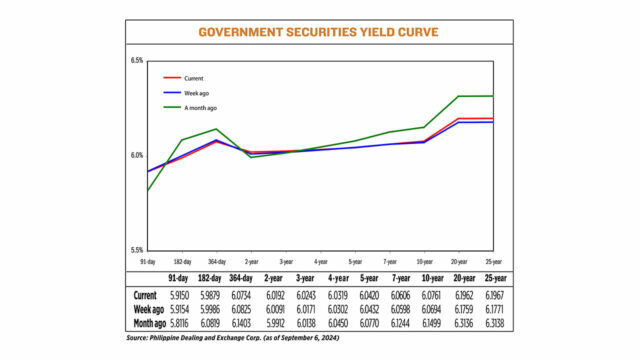
Yields end mixed amid US, PHL economic data

YIELDS on government securities (GS) ended mixed last week as the market mainly consolidated ahead of key US economic data and following slower-than-expected Philippine headline inflation in August.

GS yields, which move opposite to prices, inched up by 0.41 basis point (bp) on average week on week on Friday, according to PHP Bloomberg Valuation Service Reference Rates data published on the Philippine Dealing System’s website.

Yields on the short end of the curve dropped. Rates of the 91-, 182-, and 364-day Treasury bills (T-bills) slipped by 0.04 bp (to 5.9150%), 1.07 bps (to 5.9879%), and 0.91 bp (6.0734%) week on week, respectively.

At the belly, most tenors rallied except for the five-year bond, which saw its yield decline by 0.12 bp to 6.0420%. Rates of the two- three-, four-, and seven-year Treasury bonds (T-bonds) went up by 1.01 bps (to 6.0192%), 0.72 bp (6.0243%), 0.17 bp (6.0319%), and 0.08 bp (6.0606%) respectively.

Lastly, rates of all tenors at the long end rose. The 10-, 20-, and 25-year debt papers saw their yields increase by 0.67 bp (to 6.0761%), 2.03 bps (6.1962%), and 1.96 bps (6.1967%) respectively.

GS volume traded was at P30.76 billion on Friday, higher than the P16.01 billion recorded a week earlier.

“Despite well-subscribed T-bills and 20-year bond auctions and a better-than-expected inflation print, yields were consolidating last week as the market was focused on US numbers and anticipation of a Federal Reserve action by the middle of this month,” Security Bank Corp. Chief Investment Officer for Trust and Asset Management Group Noel S. Reyes said in an e-mail.

Mr. Reyes said US economic data released last week, including reports on manufacturing and employment, pointed to an “increased dovish bias for the Fed, fueling further division about how much the Fed will cut (25 bps or 50 bps).”

“A 50-bp cut may lead market to believe the Fed is behind the curve, hence the caution last week. The market did see pockets of buying when yields went up midweek, but still not enough to stir a rally given the focus on the US economy and the Fed’s possible action. Overall, week on week, yields were up 1-3 bps,” he added.

US employment increased less than expected in August, but a drop in the jobless rate to 4.2% suggested the labor market was not falling off the cliff to warrant a half-point interest rate cut from the Federal Reserve this month, Reuters reported.

The closely watched employment report from the Labor department on Friday also showed solid wage growth last month, which should help to support consumer spending and keep the economy out of recession for now. Nonetheless, labor market momentum has slowed, with 86,000 fewer jobs added in June and July than previously reported.

The report led to a chorus of Fed officials declaring that the US central bank was ready to start cutting rates at its policy meeting in about two weeks. Higher borrowing costs are curbing overall demand in the economy.

Nonfarm payrolls increased by 142,000 jobs last month after a downwardly revised 89,000 rise in July, which was the smallest gain since an outright decline in December 2020, the Labor department’s Bureau of Labor Statistics said. Economists polled by Reuters had forecast payrolls increasing by 160,000 jobs after a previously reported 114,000 gain in July.

June payrolls were revised down by 61,000 jobs to 118,000. The slowdown in employment growth is coming from a step-down in hiring. Layoffs remain at historic low levels.

In addition to waning demand evident in declining job openings, the below-expectations rise in employment last month likely reflected a seasonal quirk, characterized by a tendency for August payrolls to initially print lower relative to the consensus estimate before being revised higher later.

Financial markets initially raised the chances of a half-point rate cut at the Fed’s Sept. 17-18 policy meeting to above 50% before slashing them to 25%, CME Group’s FedWatch Tool showed. The odds of a 25-bp rate reduction increased to 75% from 57% earlier.

Fed Governor Christopher Waller said on Friday “the time has come” for the central bank to begin a series of interest rate cuts this month, adding “if the data suggests the need for larger cuts, then I will support that as well.”

The Fed has maintained its policy rate in the current 5.25%-5.5% range for more than a year, having raised it by 525 bps in 2022 and 2023.

Meanwhile, Philippine headline inflation eased to a seven-month low of 3.3% in August from 4.4% in July and 5.3% in the same month a year ago, the government reported on Thursday.

This was within the Bangko Sentral ng Pilipinas’ (BSP) 3.2-4% forecast for the month and was well below the 3.7% median estimate in a BusinessWorld poll of 15 analysts.

“With August inflation lower than expected at 3.3%, prospects of another 25-bp cut before the end of the year is likely,” Jonathan L. Ravelas, senior adviser at professional service firm Reyes Tacandong & Co., said in a Viber message.

The BSP on Aug. 15 reduced its policy rate by 25 bps to 6.25%, marking its first easing move in nearly four years.

BSP Governor Eli M. Remolona, Jr. has said they could cut rates by another 25 bps within the year. The Monetary Board’s last two policy-setting meetings this year are on Oct. 17 and Dec. 19.

For this week, both Mr. Reyes and Mr. Ravelas said GS yields could move sideways amid a lack of leads.

“All eyes will focus on the US CPI (consumer price index) midweek since there are not much economic data coming out in the Philippines. Expectations are for a low print, which should intensify talks of how much the Fed cuts…,” Mr. Reyes said.

US consumer inflation data will be released on Sept. 11 (Wednesday).

Local GS yields may remain range-bound before the Fed’s policy review next week, he added. — P.O.A. Montalvo with Reuters

Easing the socioeconomic burden of childhood cancers

PHILIPPINE STAR/EDD GUMBAN

As the country observes Childhood Cancer Awareness Month this September, it is important to consider the current challenges and opportunities in enhancing the treatment of Filipino children living with cancer.

Over 4,700 children (aged zero to 19 years) are expected to be diagnosed with cancer each year in the Philippines, with leukemia accounting for approximately 49% of childhood cancers, according to the World Health Organization (WHO). Nearly two-thirds (67%) are diagnosed with advanced cancer. In the Philippines, childhood cancers are associated with a 25%-50% five-year overall survival rate, compared to 80% in many high-income countries, WHO data show. Each year, an estimated 1,700 Filipino children die due to cancer.

A recent scientific paper by Columbres, et. al. revealed that up to 80% of families of Filipino children with cancer may abandon treatment due to the heavy economic burden associated with pediatric cancer care. Published in June 2024 in The Lancet Regional Health Western Pacific, the paper entitled “Pediatric cancers and family financial toxicity in the Philippines: insights for Southeast Asia and similarly resourced settings” describes how financial toxicity affects families of pediatric patients with cancer in the country. As defined, “financial toxicity” refers to the problems faced by patients and their families in paying for medical care.

Columbres, et. al. identified “myriad barriers” to childhood cancer care in the country, including limited access to oncologists, few pediatric oncology referral centers, variable health literacy and cancer awareness, geographical factors, limited funding, and poor financial security at the baseline for many families.

Noting that PhilHealth covers early-stage cancer treatments with limited coverage for more advanced diseases, the authors stressed that the majority of cancer care costs are paid by families of cancer patients; moreover, families of pediatric cancer patients often face higher out-of-pocket expenses compared with adults with cancer.

Columbres, et. al. identified three elements of financial toxicity associated with pediatric cancer care in the country. Direct costs include the cost of treatment and surgery, among others. Indirect costs include the cost of transportation to treatment centers, lodging during treatment, and parents’ ability to hold a down a job during their child’s treatment. Psychosocial distress may push parents and caregivers to resort to negative coping mechanisms such as self-blame and borrowing money or pawning assets, which may lead to compromised caregiver health and wellbeing.

The authors presented several recommendations to mitigate the financial toxicity faced by pediatric cancer patients and their families. First, equip local clinicians to screen patients and their families for financial toxicity early on in the pediatric cancer treatment course, and guide clinicians regarding available financial toxicity screening resources that have been developed and have shown promise in other low- and middle-income countries (LMICs). These resources include the Comprehensive Score for Financial Toxicity (COST) and Patient-reported Outcome for Fighting Financial Toxicity (PROFFIT).

Second, connect families of pediatric cancer patients to free or low-cost financial assistance services such as the Philippine Charity Sweepstakes Office (PCSO) Individual Medical Assistance Program (IMAP), and the Department of Health (DoH) Acute Lymphoblastic Leukemia Medicines Access Program (ALLMAP), among others.

Third, improve concrete financial support by reevaluating the PhilHealth Z-benefit package in terms of current usage and areas for improvement, and doubling efforts to turn the provisions of the National Integrated Cancer Control Act (NICCA) into material support for childhood cancer patients and their families.

Fourth, improve access to pediatric oncology clinical trial participation by expanding recruitment efforts, providing regular updates on the Philippine Health Research Registry, and increasing funding and strengthening pediatric oncology clinical trials to improve access and guide practice guidelines.

Lastly, enhance the role of community health workers in care and health education to correct oncology- and treatment-related misconceptions through programs such as the Abot Kamay Ako at ang PSMO (AKAP) Barangay Health Worker (BHW) Training and Workshop online educational course. Additionally, reduce the burden of the referral pathway from primary to tertiary centers.

The passage in 2019 of the NICCA and the Universal Health Coverage (UHC) Act represents a major step in enhancing cancer care in the country. As Columbres, et. al. rightly pointed out, all that is needed is the full implementation of the two landmark pieces of health legislation in order to provide concrete support and comprehensive benefits to cancer patients and their families.

The research-based pharmaceutical industry is dedicated to improving cancer management based on more effective partnerships and collaborative approaches to providing access to healthcare. We work constantly to adapt R&D and models to improve access to innovative treatments. We believe that the capacity to strengthen health literacy and healthcare workforce must be increased. To address existing health inequities and gaps in cancer care management, palliative care also needs to become more efficient.

Our industry stands with the government and other key stakeholders in ongoing efforts to provide quality cancer care, reduce the burden of cancer, and strengthen the country’s health system by building capacity in policy and research.


Teodoro B. Padilla is the executive director of Pharmaceutical and Healthcare Association of the Philippines which represents the biopharmaceutical medicines and vaccines industry in the country. Its members are in the forefront of research and development efforts for COVID-19 and other diseases that  affect Filipinos.

Davao City Bulk Water Supply project receives recognition from Int’l Finance Awards

THE UK-based International Finance Awards has recognized the Davao City Bulk Water Supply project as the top public-private partnership (PPP) in the Philippines for 2024, highlighting its impact on sustainable urban development.

The water project is a joint venture between the Davao City Water District (DCWD) and Aboitiz InfraCapital’s Apo Agua Infrastructura, Inc.

Apo Agua manages the Davao City Bulk Water supply facility, which has a treatment capacity of over 300 million liters per day, while the DCWD is in charge of water distribution across Davao City.

“This recognition highlights the strength of Apo Agua’s collaboration with the DCWD, a partnership founded on a shared commitment to providing sustainable water for all,” Aboitiz InfraCapital Head of Water Business and Apo Agua President Eduardo V. Aboitiz said in an e-mailed statement on Sunday.

“This award underscores the essential role of public-private partnerships in driving critical infrastructure development and meeting the evolving needs of communities. We are incredibly proud to be part of Davao City’s progress and remain dedicated to supporting the city’s future growth,” he added.

The Davao City Bulk Water supply project has an integrated hydroelectric power plant that fully powers the facility. The system uses the same water for power generation and treatment before distribution.

The project, which started in December last year, was undertaken to meet the growing water demand of Davao City.

It provides water to more than one million people in Davao City, which relied on groundwater sources for over five decades.

Aboitiz Infracapital is the infrastructure arm of the Aboitiz Group. It has business interests in economic estates, water, digital infrastructure, and transport and mobility. — Revin Mikhael D. Ochave

Mapping the progress of Philippine businesses

By Jomarc Angelo M. Corpuz, Special Features and Content Writer

FOR NEARLY 40 years, BusinessWorld has kept in step with the growing Filipino community by providing competent and responsible reporting of news as well as industry insights and reports that guide readers with the information they need to make informed decisions for their enterprises.

Two of the business paper’s most anticipated releases, its Quarterly Banking Report (QBR) and BusinessWorld Top 1000 Corporations in the Philippines, are published by its comprehensive Research department. The QBR and the Top 1,000 magazine have long served as solid guides for navigating the Philippine business landscape by offering in-depth analysis and data-driven insights.

The paper’s QBR tracks the quarterly performance of the Philippines’ largest lenders based on their published statements and ranks banks based on the size of their balance sheets. The banking report helps bankers in the country pinpoint strengths and weaknesses in the industry by identifying significant events in the quarter and gathering expert opinions on the issue.

We discuss topics and themes that have impacted the quarter, such as the relevant reports that have significantly influenced the banking sector. Then, we ask reliable and credible sources or those with expertise on our topic about their insights and outlook,” BusinessWorld Deputy Research Head Abigail Marie P. Yraola said.

Furthermore, the strength of BusinessWorld’s QBR lies in its rigorous data collection and analysis processes. To ensure the accuracy of the figures encoded in the report, researchers are assigned to fact-check the data multiple times, Ms. Yraola explained. The department then tallies the quarterly performance of banks by providing indicators such as asset size, capital adequacy, liquidity, total loan size, and earnings.

In recent quarters, several key trends have emerged from the paper’s banking report. The previous QBR highlighted digitalization as one of the drivers for the industry’s growth. The Bangko Sentral ng Pilipinas’ (BSP) programs that aim to promote financial inclusion and improve financial literacy have also boosted the sector’s expansion.

“Developments that are also unlikely to be missed are the use of digital channels, such as ‘buy now, pay later’ services and lending apps, that have seen significant growth, even the use of digital banks and other financial technology services,” Ms. Yraola added.

Meanwhile, the annual Top 1,000 Corporations in the Philippines is recognized as the most credible ranking of the country’s biggest corporations based on their performance over the past year. The annual magazine ranks Filipino stock corporations based on their gross revenues from the most recent fiscal year.

Data for the rankings are obtained from the audited financial statements (AFS) submitted by private companies to the Securities and Exchange Commission (SEC) and the AFS of government-owned and -controlled corporations from the Commission on Audit (CoA).

Through these statements, the rankings are derived from business performances from May and December of the previous year, and January and April of the current year with AFC reported in foreign currencies converted to Philippine peso using conversion rates set by the BSP.

“To ensure credibility and accuracy, we have the computation and methodology for the Top 1000 verified by leading auditing firms in the country,” Ms. Yraola assured.

One noticeable feature in the Top 1000 magazine is the difference between the parent company and consolidated rankings. Parent-only financial statements where companies record equitized earnings of their subsidiaries and associates are included in the main table for the Top 1000; while the conglomerate rankings treat both the parent company and its subsidiaries as a single entity.

Another notable feature of the annual publication is the competitors’ table, which shows how companies fared in their respective sectors factoring in their gross earnings. Data from this table shows that the manufacturing sector led all industries in the most recent Top 1000, with total revenues reaching P5.76 trillion, indicating a 20.7% increase compared to the previous year.

Recent editions of the Top 1000 magazine indicate that corporations on the list have helped the country thrive and reflect positive improvements in the Philippine economy that marked the fastest economic growth since 1976, with a 7.6% increase in gross domestic product (GDP) in 2022.

“[In 2022], the combined revenues of the top 1,000 corporations increased by 21.2% to reach P16.68 trillion, marking the highest growth in two years. Meanwhile, the companies [in the list] recorded an aggregate net income of P1.80 trillion in 2022, an increase of 3.1%. Fourteen sectors also logged double-digit growth in the latest edition, while only two sectors posted a decline,” Ms. Yraola said.

Last year’s magazine saw Petron Corp. dethrone Manila Electric Company (Meralco) as the country’s top-grossing company with the former posting P438.87 billion in gross revenue in 2022 and the latter with only P382.42 billion.

Rounding out the top 10 were Shell Pilipinas Corp. with gross revenue of P292.88 billion; BDO Unibank, Inc. (P209.29 billion); Mercury Drug Corp. (P177.59 billion); PMFTC, Inc. (P176.99 billion); Toyota Motor Philippines Corp. (P173.27 billion); Globe Telecom, Inc. (P158.87 billion); TI (Philippines), Inc. (P154.93 billion); and Philippine Airlines (P145.8 billion).

In the same edition of the publication, Top Frontier Investment Holdings, Inc. barely beat out San Miguel Corp. (SMC) as the leading conglomerate in the annual top 200 list with both companies posting P1.58 trillion in gross revenue in 2022.

Petron and its subsidiaries claimed the third spot with P865.58 billion in gross revenues, followed by SM Investments Corp. (P557.68 billion); Meralco (P445.34 billion); San Miguel Food and Beverage, Inc. (P360.18 billion); Aboitiz Equity Ventures, Inc. (P335.65 billion); Ayala Corp. (P332.62 billion); JG Summit Holdings, Inc. (P313.98 billion); and GT Capital Holdings, Inc. (P245.31 billion).

With the 2024 edition of the Top 1000 issue still in the works, avid readers of the publication can expect to find the same trusted and reliable data, along with an extensive process of how the tables were made.

“Readers should look forward to which sectors experienced growth, as well as any that declined; what developments and economic indicators either fuelled, if not dragged businesses. Additionally, readers should also anticipate which companies made it into the Top 1000 league and how well they performed,” Ms. Yraola said.

Moreover, this year’s Top 1000 will have the benefit of having an interactive and digital format for accessing corporate information and analytics through Top 1000 Premium (https://top1000.bworldonline.com).

The Top 1000 Premium maximizes information from BusinessWorld’s vast repository of data amassed from its most recent Top 1000 editions, from the basic company information to the more intricate income statements and balance sheets. Top 1000 Premium carries up to 10 years of Top 1000 data and gives exclusive access to the magazine’s tables, detailed reports, articles, and infographics, among others. This interactive format provides users who will sign up to the platform with the data they need in a user-friendly manner which allows them to navigate the data and process it themselves.

The platform makes it easier to view how a corporation, a conglomerate, or sector has performed, for instance, in the previous year, alongside how it performed in previous years. It also allows a corporation’s performance to be viewed in comparison with its competitors in its particular industry. The Top 1000 Premium can also narrow down the data viewed from, for example, all the values in an income statement to solely the Revenue, Net Sales, or Net Income.

“I think this digital format will amplify readers’ appreciation of the Top 1000 publication and other reports. An interactive plus digital format is the preferred ‘language’ for audiences these days. They need to access data quickly, and digital adoption has become the new norm,” Ms. Yraola said.

In a modern world where numbers and figures indicate the direction of any corporation, the importance of reliable, data-driven insights cannot be overstated. BusinessWorld’s Quarterly Banking Reports and Top 1000 Corporations in the Philippines have stood the test of time, continue to evolve, and remain indispensable resources for those looking to stay ahead in the competitive Philippine market.

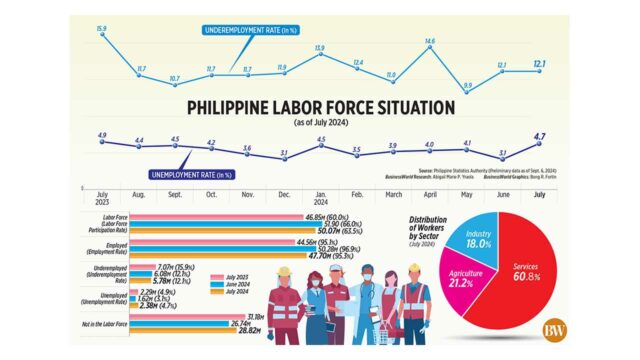
Philippine Labor Force Situation

The country’s jobless rate rose to a one-year high of 4.7% in July as fresh graduates entered the workforce, the Philippine Statistics Authority (PSA) said on Friday. Read the full story.

Philippine Labor Force Situation

Style (09/09/24)


Exhibit honors a design family’s four generations

ON SEPT. 10, the exhibit Love, Marina: The Fashion Legacy of Marina Reyes Antonio will open is SM Aura in BGC, Taguig. It is a tribute to fashion designer Marina Reyes Antonio and the three generations of fashion designers she inspired. The exhibit will show the works — mostly wedding gowns — of Marina Antonio, her daughter Malu Veloso, granddaughters Vicky and Letlet Veloso, and great-granddaughter Hannah Barrera. These include photos and gowns by the multitude of brides who wore creations by the designers on their big day, with the focus being on the matriarch, Marina Antonio. The exhibit will run from Sept. 10 to 24 at the 3rd level of SM Aura.


Fendi revamps bag

CELEBRATING 10 YEARS from its first launch in 2014, for Autumn/Winter 2024 Fendi has revamped its signature By The Way Boston bag, with a new super-relaxed version elevated through the use of Selleria and its intrinsic codes. It follows the luxurious softness and comfort of the season yet remaining faithful to its original Boston design and distinctive features. The bag is available in three sizes — large, medium, and mini. The By The Way Selleria family is crafted in soft Cuoio Romano naturally grained leather, sewn with bold tone-on-tone hand-made macro-stitches which enrich the studded handles, and a Selleria leather tag celebrating a craft with 100 years of history. The deconstructed silhouette results from a spacious, unique interior compartment. The design and functionality of the bag are enhanced with the addition of a knotted leather zip puller, a detachable and adjustable shoulder strap styled with a knot, and a leather keyring. Colorways include cappuccino, dove grey, military green, and classic black, as well as seasonal tones of blue.  The style is available also in FF jacquard for both medium and mini sizes, while the latter is also made in a sculpted shearling variation in baby blue, pink, red, military green, and yellow. The bag will be available in Fendi boutiques worldwide and on fendi.com starting this month.


Kallista by Kohler means designer personal spaces

EXCLUSIVELY AVAILABLE at Sanitec, Kallista by Kohler offers a portfolio of design-driven bath and kitchen hardware by partnering with world-renowned designers, architects, and artists to reimagine every detail. Kallista highlights collections made in collaboration with interior and product designer Laura Kirar, and 2011 Wall Street Journal Innovator of the Year for architecture Bjarke Ingels. Kirar’s Pinna Paletta collection is jewelry-inspired, blending tactile details and sculptural forms. From hand showers and faucets to towel bars and hooks, each bathroom fixture features textural etchings in luxurious finishes such as chrome, unlacquered brass, and polished nickel with antique accents. Sanitec carries another Kirar collection called Kallista Foundations. Notable pieces include the elliptical Myam Vessels which feature a solid bronze cast that develops a unique patina over time. Available in matte black and white, these decorative vessels are perfect for the master bath, powder bath, or entertainment space.  Ingels and Danish design firm KiBiSi collaborated on the Taper collection, marrying advanced engineering with the principles of classic Mid-Century Danish design. The concept removes the multiple components or parts that would usually go into a fixture, and instead keeps it at just one streamlined piece. The Taper Sink Faucet, with its signature cone-to-cylinder, forward-leaning profile, and 90-degree bend merges the countertop, faucet, and running water into one visually seamless design and embodies the collection’s unconventional, playful approach without excess. For more information, visit kohler.ph and follow @KohlerPhilippines on Facebook and @kohler.philippines on Instagram.

ADVERTISEMENT
ADVERTISEMENT