Home Blog Page 2591

PSEi may move sideways in absence of leads

The lobby of the Philippine Stock Exchange in Taguig City, Sept. 30, 2020. — REUTERS

PHILIPPINE SHARES could move sideways this week on expectations of bargain hunting as investors look ahead to the Bangko Sentral ng Pilipinas’ (BSP) next policy review and with the peso’s continued weakness causing the market to stay cautious.

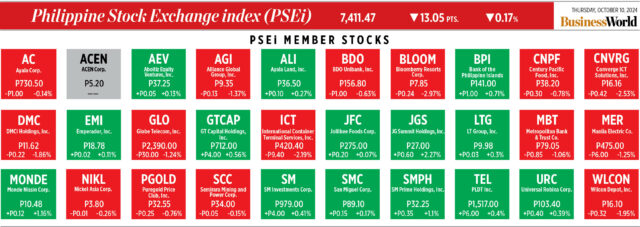
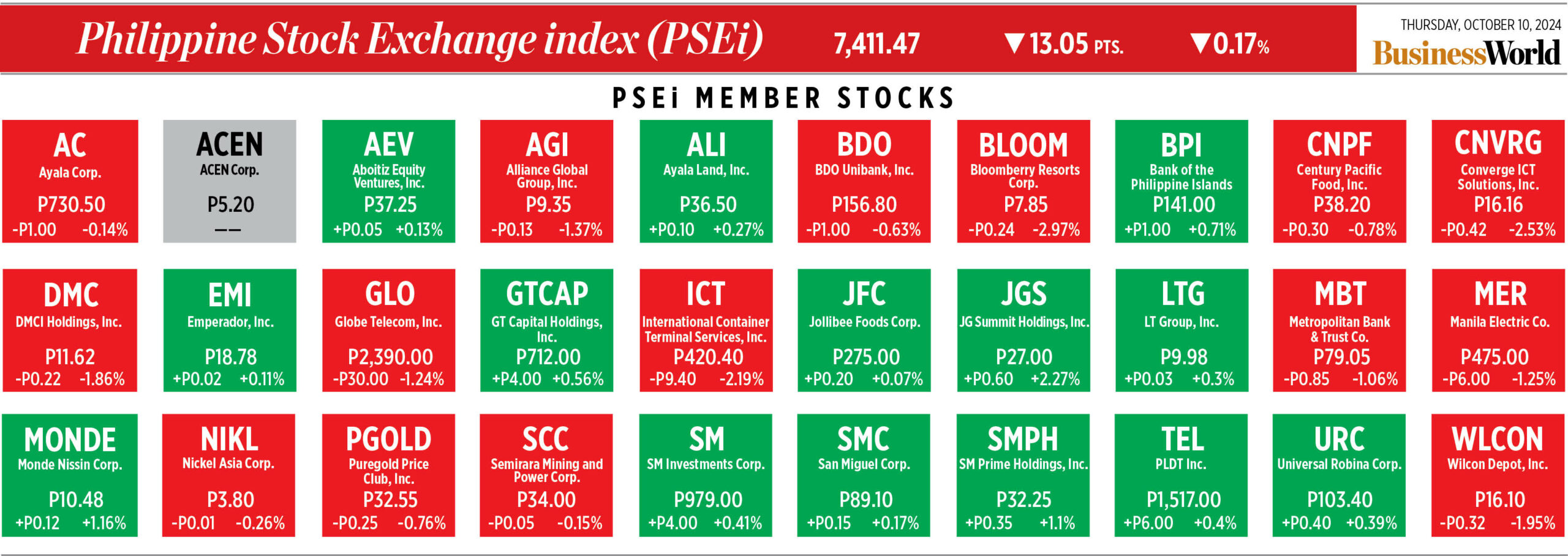
The Philippine Stock Exchange index (PSEi) went down by 0.11% or 7.13 points to close at 6,383.70 on Friday, while the broader all shares index rose by 0.13% or 4.75 points to end at 3,447.75.

Philippine financial markets were closed on Monday (June 17) in observance of Eid’l Adha or the Feast of Sacrifice.

“Unless we see positive developments on the outlook of our interest rates, the local market may only move sideways with bargain hunting providing the upside force. Downside risks including the less dovish outlook of the Federal Reserve and the sustained weakness of the peso may continue to weigh on market sentiment,” Philstocks Financial, Inc. Senior Research Analyst Japhet Louis O. Tantiangco said in a Viber message.

“Last week’s four-day decline is seen to have opened the door for bargain hunting opportunities. However, the optimism needed for the market to rally is not yet seen. Investors are still waiting for positive catalysts, primarily one which would hint of monetary policy easing soon in the Philippines,” Mr. Tantiangco added.

The market could test the 6,400 level this week, he said.

“If it fails to get back above the said line, the market’s new trading range moving forward is seen from 6,150 to 6,400,” he added.

The Monetary Board will hold its next policy review on June 27.

The BSP will probably cut its policy rate after the US Federal Reserve, which has signaled it may start easing as late as December, the Finance chief said on Thursday.

Asked if the BSP would begin its easing cycle once the US central bank cuts rates, Mr. Recto said this was “highly probable.”

The Monetary Board has kept its benchmark rate steady at a 17-year high of 6.5% since October 2023 following cumulative hikes worth 450 basis points (bps) to bring down inflation.

BSP Governor Eli M. Remolona, Jr. has said that the earliest the central bank can begin cutting rates is in August, with a total of 25-50 bps in easing likely this year.

Mr. Remolona earlier said the BSP does not need to wait for the Fed to begin its own easing cycle.

Rizal Commercial Banking Corp. Chief Economist Michael L. Ricafort put the PSEi’s major support at 6,360 and major resistance at 6,560-6,610.

Online brokerage 2TradeAsia.com said in a note that the market’s immediate support is at 6,200-6,250, while resistance is at 6,500.

“There could be a technical correction from [last] week’s low if and when the Fed shifts to a dovish tone given gathering weakness among several inflation-linked economic indicators, such as jobless claims and producer price index,” First Metro Investment Corp. Head of Research Cristina S. Ulang said in a Viber message. — R.M.D. Ochave with Reuters

2025 considered critical year for offshore wind port funding

STOCK PHOTO | Image by Grahame Jenkins from Unsplash

THE Department of Energy (DoE) said funding to make ports ready for the offshore wind industry needs to be budgeted for in the 2025 spending plan to enable power generation by 2028.

“The critical year here is that by 2025, funding should be included in the General Appropriations Act for at least two or three government ports in order for us to realize the first power from offshore wind by 2028,” Energy Undersecretary Giovanni Carlo J. Bacordo told BusinessWorld on the sidelines of a forum last week.

Offshore windfarms need to be serviced from specialized ports hosting maintenance facilities and enabling equipment transport.

“We are working closely with the Philippine Ports Authority as we are the ones highlighting that these ports are needed for offshore wind,” Mr. Bacordo said.

He said a pre-feasibility study of 10 ports is being carried out with technical assistance from the Asian Development Bank.

These ports include Bulalacao, Oriental Mindoro; Culasi, Capiz; Tabaco, Albay; and Pulupandan and San Carlos, both in Negros Occidental.

The others are the Energy Supply Base port facility of Philippine National Oil Co. in Batangas; Bauan International Port, Inc., Batangas; Subic; Iloilo Commercial Port Complex; and Port of Irene, Cagayan.

Mr. Bacordo said that the results of the pre-feasibility study into the first five ports will be available by August while the rest will be out by October.

Kapag lumabas na ’yun (When that comes out), then we will see more investors coming in. Kasi ngayon, malalaman (As we will know) what ports are feasible to proceed to the full FS (feasibility study) or for the full detailed engineering design,” he said.

He said seven more ports have been nominated to the Economic Development Group for possible feasibility study.

The DoE hopes to stage a Green Energy Auction specific to offshore wind in the first half of 2025, Mr. Bacordo said.

The DoE has awarded 91 offshore wind energy service contracts with a potential capacity of 65.12 gigawatts (GW).

Under the Philippine Offshore Wind Roadmap, the Philippines has a potential capacity of about 63 GW from tapping offshore wind resources.

The Philippines has set a target of increasing the share of renewables in the energy mix to 35% by 2030 and 50% by 2040.

Separately, the Philippines is deemed to have adequate facilities to support liquefied natural gas (LNG) shipments for its power plants, according to the Energy Secretary.

“We just want to emphasize that the existing receiving and regasification facilities are actually adequate for purposes of supporting up to 8,000 megawatts capacity of LNG power plants,” Energy Secretary Raphael P.M. Lotilla said in a virtual briefing on Friday.

“And that’s why we need to look at them and to encourage the companies concerned to look at these two separately owned receiving and regasification facilities as one unit,” he added.

In 2023, the Philippines commissioned its first two LNG import terminals in Batangas which are operated by Linseed Field Corp. and FGEN LNG Corp.

“In the future, if it exceeds these levels, then future receiving facilities are also welcome,” Mr. Lotilla said. “But at the moment, of course, we do not want to see an overbuilding of LNG infrastructure because that would impose an additional cost on the entire economy.”

The DoE sees LNG as a suitable transition fuel “by which the private sector investments in this technology will be facilitated as a way to enable the viability of large renewable energy capacity additions and ensure reliability and security of the power system.” — Sheldeen Joy Talavera

No need to cut growth targets, but gov’t should raise revenue — analysts

PHILIPPINE STAR/EDD GUMBAN

THE Development Budget Coordination Committee (DBCC) does not need to scale back its growth targets for this year, but must consider how to raise revenue, and perhaps shed its reluctance to introduce new taxes, analysts said.

“We don’t think there is any need to revise the DBCC growth target,” Aris D. Dacanay, economist for ASEAN (Association of Southeast Asian Nations) at HSBC Global Research, said in an e-mail.

“Our 2024 growth forecast is just a bit lower at 5.8%, and with reforms such as the rice tariff rate cut potentially boosting consumption in the Philippines, the possibility for the economy to reach the lower end of the target isn’t zero.”

Economic managers have yet to announce whether they will revise fiscal targets for this year. In April, the DBCC cut its gross domestic product (GDP) growth target to 6-7% from 6.5-7.5%, backed by concerns over geopolitical instability and trade disruptions.

Mr. Dacanay also noted that the government’s public-to-GDP ratio is expected to fall as the government continues to pay down debt incurred during the coronavirus pandemic.

“What is important to monitor is the direction public debt-to-GDP is going. And despite high fiscal deficits until 2028, public debt-to-GDP is still expected to fall since a big portion of the deficit will be used to pay for the debt incurred during the pandemic (which reduces overall debt).”

The National Government’s debt as a share of GDP fell to 60.2% in the first quarter from 61.1% a year earlier, the Treasury bureau reported. However, this is still above the 60% threshold that multilateral institutions deem manageable for developing economies.

The government’s debt-to-GDP ratio target for this year is 60.3%, with an ultimate goal of 55.9% by 2028, when the current government steps down.

While Mr. Dacanay said there is no urgency to impose new taxes to broaden fiscal space, “any additional revenue from well-designed tax measures will always be good for the economy.”

“For instance, implementing the digital tax will help level the playing field for enterprises who are not doing business in the digital space.”

The Department of Finance (DoF) has said it is not planning to impose new taxes, and will instead push for nontax revenue in its fiscal consolidation plan.

The DoF reported that nontax revenue hit P206.4 billion as of April.

Rizal Commercial Banking Corp. Chief Economist Michael L. Ricafort said that the government must focus on “intensified” tax collection and encourage greater tax compliance by the public to generate sufficient revenue to fund development priorities.

“However… there may be a need to increase tax rates and introduce new taxes, though signaled as a final resort/option, especially if inflation eases/stabilizes further in the coming months,” he said via Messenger chat.

Filomeno S. Sta. Ana III, coordinator at Action for Economic Reforms, said the government should introduce new tax measures while maintaining adequate spending.

“A sound fiscal consolidation plan will necessarily include generation of higher revenue,” he said in a Viber message.

“Cutting spending is one approach but we can only cut the wasteful spending; otherwise, an austerity program will hurt the whole economy and society.”

Proper tax administration is also deemed insufficient to generate the necessary revenue.

“Hence, government has to identify new taxes which are efficient and politically feasible… the point is, government should not reject tax policy as a main strategy for fiscal consolidation,” Mr. Sta. Ana said.

Tax measures that policymakers should consider include increasing rates for sin products like alcoholic drinks and vapes, as well as inflation-adjusted rates for sweetened beverages.

Mr. Sta. Ana also cited the need to reform the pension system for military and uniform personnel and rationalize value-added tax by limiting exemptions to essential goods.

The government must also ramp up spending on state programs in infrastructure, healthcare, disaster risk reduction, and the green energy transition to reach its fiscal targets, he added. — Beatriz Marie D. Cruz

FTA with Europe seen as hedge against deteriorating China ties

Hungary’s Minister of Foreign Affairs Péter Szijjártó — REUTERS

ACCELERATING free trade talks with the European Union (EU) will help the Philippines diversify its trade options away from China as tensions escalate in the South China Sea, economists said.

“Access to the EU market will result in increased trade diversification away from China,” Calixto V. Chikiamco, Foundation for Economic Freedom president, said in a Viber message.

“This (free trade agreement) is very crucial especially if we reach middle-income status and lose our GSP+ privileges to the EU,” he added, referring to the preferential trade scheme the EU makes available only to developing countries.

Hungary, which will assume the EU presidency next month, plans to hold multiple rounds of free trade negotiations that do not consider political issues, Hungary’s Minister of Foreign Affairs Péter Szijjártó told a news briefing last week in Makati.

During his visit, Mr. Szijjártó said Hungary is aware that the Philippines is working under time pressure before its Generalized Scheme of Preferences (GSP+) privileges expire in 2027.

The GSP+ scheme, which requires the Philippines to uphold commitments to 27 international conventions on human rights, labor rights, good governance, and climate action, was extended until 2027. 

Last month, Trade Secretary Alfredo E. Pascual said he expects free trade talks with the EU to finish before 2027.

“Diversification towards other economies will be a continuing challenge, as China remains the country’s top trading partner, and for Europe to fill a possible future gap in trade with China, our trade with the EU should double,” Terry L. Ridon, a public investment analyst and convenor of InfraWatch PH, said via Messenger chat.

Tradeline Philippines estimates total trade between the Philippines and China at $40.3 billion last year, up 2.9%.

Leonardo A. Lanzona, who teaches economics at the Ateneo de Manila, said the Philippines must ensure labor standards are upheld in finalizing the EU trade deal, citing the regional bloc’s strict adherence to global labor market standards.

“The EU would not wish to trade with partners at the expense of worker welfare,” he said via chat.

Jose Enrique A. Africa, executive director of the IBON Foundation think tank, said the Philippines should develop domestic industries before pursuing trade agreements.

“Lack of active government support for Filipino farmers and industry and opening up with FTAs has driven manufacturing to its smallest share of gross domestic product in 75 years and agriculture to its smallest share in history,” he said via Viber.

“An EU-Philippines FTA will most of all benefit the global supply chains of industrial powers — as it is, most Philippine exports to the EU aren’t even Filipino-made and are made by foreign firms in domestic export enclaves — preventing us further from developing Filipino industry.”

China was the Philippines’ largest source of imported goods, valued at $2.27 billion in March, or 24% of the total, according to the Philippine Statistics Authority. Exports to China amounted to $837.51 million, or 13.7% of the total.

Tensions between the Philippines and China have worsened in the past year as Beijing continues to block resupply missions to Second Thomas Shoal, where Manila grounded a World War II-era ship in 1999 to serve as an outpost and assert its sovereignty.

China claims almost all of the vital waterway, including parts claimed by the Philippines, Brunei, Malaysia, Taiwan and Vietnam. A United Nations-backed tribunal based in the Hague in 2016 rejected China’s claims.

“Mechanically pursuing free trade was counterproductive before but especially in today’s conditions of rapidly eroding multilateralism and a slowing global economy. It’s dogmatic and reckless to deny changed global conditions,” Mr. Africa said. — John Victor D. Ordoñez

PHL fruit competitiveness may be key to expanding agri exports

FRUTAS DELIVERY FACEBOOK PAGE

THE GOVERNMENT should focus on expanding production of crops where it enjoys a competitive advantage, such as fruit, to boost agricultural exports, analysts said.

“There is evidence that we are competitive in certain products, particularly fruit,” Ateneo de Manila economics professor Leonardo A. Lanzona said in a Messenger chat.

He added that the government’s role is to facilitate these growers’ expansion to achieve adequate scale to service export markets.

Agricultural exports rose 10.7% to $1.72 billion during the first quarter, according to the Philippine Statistics Authority.

Fermin D. Adriano, former Agriculture Undersecretary for Policy, Planning, and Research, said despite the expansion during the previous quarter, production for exportable farm goods is still facing funding constraints.

“The agri budget provides inadequate support as 60% of (the Department of Agriculture’s) funding goes to supporting rice,” Mr. Adriano said via Viber.

Leading farm exports during the period were edible fruit and nuts, as well as peel of citrus fruit and melons, valued at $517.96 million or 30.1% of the total.

Rizal Commercial Banking Corp. Chief Economist Michael L. Ricafort said improved foreign ties may have contributed to the increase in exports.

“Diversifying further to more export markets, as well as more free trade agreements (FTAs) with more countries on top of the (Regional Comprehensive Economic Partnership) and the South Korea-Philippines FTA will help boost (exports),” Mr. Ricafort said via Viber.

RCEP involves the Association of Southeast Asian Nations, China, Japan, South Korea, New Zealand, and Australia. It took effect in June last year.

It allows minimal to zero restrictions in terms of quantities and seeks to minimize import taxes.

Mr. Lanzona said the Philippines continues to show a deficit in agricultural trade due to its reliance on imports.

The deficit in agricultural trade narrowed to 6.5% during the first quarter, with an increase in exports offsetting a 0.3% decline in imports.

“This suggests we continue to struggle because the economy continues to be import dependent in food products,” he added.

The DA had said that it is seeking to improve agricultural exports, especially tropical fruit like banana, mango, and pineapple.

In January, the DA said it is preparing a Philippine Agricultural Export Development Plan. — Adrian H. Halili

PHL halal exports constrained by certification bottlenecks, says body

DOT PHOTO

THE PHILIPPINES will need more accredited certifying organizations to support the growth of halal exports, according to a United Arab Emirates-headquartered halal certification body.

In a chance interview last week, Prime Group Chief Executive Officer Mary Jane Alvero-Al Mahdi said that their company is the lone certification body for Philippine halal exports.

“There is a need to push for more certification bodies. Right now, we only have 10 or 11 for local, and then for international. It is only us,” Ms. Alvero-Al Mahdi told BusinessWorld.

“We need to have more certification bodies, and these must have the capacity to put up branches in the countries where they have a market,” she added.

She added that the certification bodies must also be accredited by the Gulf Cooperation Council Standardization Organization or by any other countries that have their own standards.

She said international accreditation has helped increase Philippine halal exports; however, she said exporters face higher costs when exporting to some markets.

“Now, in Qatar, aside from being halal-certified, (exporters) need to … provide a certificate of compliance (CoC) requirement,” she said.

“How you get this certificate is through a loading inspection. So, even though they already have a loading inspection in halal-conformity, there is still a requirement for a product-specific inspection,” she added.

She said the additional requirement has been costly to Philippine exporters, especially since there only two accredited certification bodies can issue a CoC. 

The Philippines usually exports processed meat, which some exporters see as a challenge as some markets have specific requirements that are not required under Philippine standards, she added.

Early this year, the Department of Trade and Industry launched the Philippine Halal Development Strategic Plan 2024-2028 which aims to double the number of halal-certified products to 6,000.

The plan also hopes to attract P230 billion in foreign investment and generate 120,000 new jobs.

On Friday, the Department of Tourism opened the first Salaam Halal Travel and Trade Expo in Cubao, to highlight halal-certified and Muslim-friendly products, services, and tourism establishments.

Tourism Secretary Ma. Esperanza Christina G. Frasco said that the event helps bring forward President Ferdinand R. Marcos, Jr.’s ambition of building a reputation for the Philippines as a halal and Muslim-friendly destination.

“We are partnering with our halal certifiers, and we are continuing our efforts to expand the halal tourism portfolio of the Philippines,” she said.

“We saw that if we expand our halal and Muslim friendly tourism offerings, livelihood and employment opportunities will increase even more,” she added.

Malaysian Ambassador to the Philippines Dato’ Abdul Malik Melvin Castelino said that the expo will help put the Philippines on the map for Muslim tourism.

“Malaysia is ready to support the Philippines in this endeavor to, of course, ensure that we continue to grow this very lucrative and, of course, sustainable market,” he said.

“One last thing I’d like to say is that halal is for all. It’s not only for Muslims, but it’s also for every brother and every sector of the Philippines. So even those of the Catholic faith or the other faiths can also enjoy the food and the various products offered by the halal industry,” he added. — Justine Irish D. Tabile

Philippine dairy imports to rise by 7.33% — FAO

REUTERS

PHILIPPINE dairy imports are projected at 2.49 million metric tons (MT), milk equivalent, this year due to higher demand from the food industry, according to the Food and Agriculture Organization (FAO).

The FAO said that this year’s estimates are 7.33% higher than its 2023 projections.

“Food services sales are expected to improve in several leading dairy-importing countries, notably Mexico, the Philippines, Saudi Arabia, Algeria, and Japan,” the FAO added.

It said imports of skim milk powder (SMP) are projected to increase mainly due to higher demand from food processors and lower prices.

“More positive demand prospects are expected in the Philippines and Indonesia, especially after last year’s drops, induced by higher demand from the food processing and services sectors and relatively lower international SMP prices,” it added.

SMP exports from countries like the US, India, Argentina and the UK, are expected to increase due to the higher import demand.

Global trade in SMP is estimated at 2.7 million MT, up 0.7% from a year earlier.

The FAO added that Philippines is expected to import less butter this year.

The Philippines can meet less than 1% of its milk demand from domestic production, with the rest needing to be imported.

The government is aiming to increase dairy production to 80 million liters of milk per year by 2028.

Domestic production is projected at 30 thousand MT in 2024, unchanged from the estimates posted a year earlier. — Adrian H. Halili

Land use, building codes are disaster-mitigation tools — ADB

BW FILE PHOTO

LAND USE policy and updated building codes will help minimize the impacts of disasters in the Asia-Pacific, the Asian Development Bank (ADB) said.

“Decision-making on disaster risk management measures should prioritize reducing harm to welfare, taking into account the impact of disasters on public and household consumption,” Jinqiang Chen, Urban Development Specialist at the bank’s Water and Urban Development Sector Office, said in a blog post.

A “reactive” response to disasters is costly, inefficient, and fails to address the root causes of disasters, he said.

The Philippines’ proposed National Land Use Act has been stuck in a Senate committee for nearly three decades, with groups citing vested interests as the reason for the lack of progress.

Measures seeking to repeal the 46-year-old Building Code, issued as Presidential Decree No. 1096, remain in committee.

The Philippines remains the most disaster-prone country in the world with a score of 46.86 out of 100, according to the 2023 World Risk Index.

The ADB also cited the need for stringent social protection measures like an asset registry system to help guide the distribution of post-disaster support.

Mr. Chen emphasized the importance of regional collaboration to mitigate the impact of disasters.

“Disasters often transcend geographic and political boundaries, regional collaboration allows countries and regions to leverage shared resources, knowledge, and strategies, addressing common risks and challenges.”

Disaster risk management efforts should also prioritize more vulnerable groups like the poor, the elderly, children, and persons with disabilities.

Disasters increase the risk of returning populations back into poverty, Mr. Chen said.

More disaster risk, due to ‘long-practiced risk-insensitive development,’ are also expected to hamper the region in achieving the sustainable development goals by 2030, the ADB added.

“Disaster risk management requires a proactive, integrated approach that prioritizes preventive measures and resilience-building to mitigate the impacts of natural hazards on development and vulnerable populations,” the ADB said. — Beatriz Marie D. Cruz

Priority bills must improve investment conditions, tackle inflation — economists

Office of the Special Assistant to the President for Investment and Economic Affairs Secretary Frederick D. Go — PHILIPPINE STAR/KRIZ JOHN ROSALES

THE PHILIPPINES must pursue its priority legislation with the goal of improving the overall investment environment while addressing broader problems like persistent inflation and plateauing growth, economists said.

Improving conditions for investment must make the risk faced by project proponents more predictable, they said.

Rizal Commercial Banking Corp. Chief Economist Michael L. Ricafort said that the bills singled out as priorities last week by Special Assistant to the President Frederick D. Go will help attract more foreign direct investment, particularly to infrastructure projects.

“The objective is to make doing business easier and more convenient for both local and foreign investors and to make their returns and risks more predictable,” Mr. Ricafort said.

He added that incentives should be more predictable, palatable, and conducive to foreign investors to help them better manage their costs, returns, and earnings expectations.

“This is in line with global best practices to become more competitive with alternative investment destinations in ASEAN,” he said.

Frederick D. Go, the Special Assistant to the President in charge of investment and economic affairs, who holds Cabinet rank, said late Thursday that the bills he plans to work on with Congress once it resumes session on July 22 include amendments to the Corporate Recovery and Tax Incentives for Enterprises (CREATE) Act.

He added that he also considers as priorities a bill that addresses right-of-way issues that have tended to delay infrastructure projects, and one that will create a Department of Water.

Leonardo A. Lanzona, an economics professor at the Ateneo de Manila, said the three bills being pushed to attract foreign investment by the Office of the Special Assistant to the President for Investment and Economic Affairs, while necessary, do not move the needle much from the status quo.

“What is needed are far more urgent and comprehensive plans that address inflation and anemic growth,” Mr. Lanzona said in an e-mail.

“While Mr. Go’s three priority bills are necessary, these have to be formulated and implemented within the context of a more comprehensive industrial policy. Piecemeal programs are not sufficient to attract investment,” he added.

Citing the case of agriculture, he said that the solution need not deal with the problem directly but rather create a “dynamic environment that leads to structural transformation.”

According to Mr. Go, the bill on right of way will help accelerate infrastructure projects like roads, transportation, energy, or water projects.

“For infrastructure, we need a very good law on right of way. A lot of our infrastructure projects need a very efficient way of securing the right of way to speed them up,” he said.

He said that the bill that will create the Department of Water will provide a “more well-orchestrated program to ensure sustainable water and efficient delivery of water service,” which will help keep water costs low.

“We have several bills that affect the economy, and we certainly would like to work very closely with Congress… to get these bills done as soon as possible,” he added. — Justine Irish D. Tabile

Clarifying invoicing requirements: RR No. 7-2024

On June 13, the BIR released Revenue Regulations (RR) No. 11-2024, amending the transitory provisions of RR No. 7-2024 and extending the statutory deadlines for compliance with the new Invoicing requirements under the Ease of Paying Taxes (EoPT) Act. RR No. 7-2024 became a key regulation in implementing EoPT, serving as a framework to guide taxpayers in navigating the new Invoicing requirements. While the implementation of EoPT may be challenging, the BIR remains dauntless and patient in addressing taxpayer concerns by releasing timely regulations.

UNUSED OFFICIAL RECEIPTS
One of the major changes involves paragraph 2.2 of Sec. 8 of RR No. 7-2024, where taxpayers are allowed not only to convert Official Receipts into Invoices but are also to convert Billing Statements/Statements of Account/Statements of Charges into Billing Invoices. Under RR No. 7-2024, taxpayers were only allowed to use these converted Invoices or Billing Invoices until Dec. 31, 2024 only. This was changed in RR No. 11-2024, where taxpayers may now use the same until fully consumed. The additional requirement, however, is that these converted Invoices or Billing Invoices must contain the required information under Sec. 6(B) of RR No. 7-2024, including the quantity, unit cost, and description or nature of the service. If the required information is not readily available in the converted Invoice or Billing Invoice, these may be stamped to comply with these requirements.

Adding to the change brought forth by RR No. 11-2024 in paragraph 2.2 of Sec. 8 of RR No. 7-2024 as mentioned above, the converted Invoices or Billing Invoices may be considered valid for claiming input tax and proof of both sales transactions and payments of the same time from April 27, 2024, until they are fully consumed, provided that there is no missing information as enumerated under Sec. 3(D)(3) of RR No. 7-2024. Any manual or loose leaf “Official Receipt” issued without a stamped “Invoice” will be considered a supplementary document, ineligible for input tax claims.

The stamping of converted Invoices or Billing Invoices does not require approval from the Revenue District Offices/Large Tax Offices/Large Tax Divisions. Taxpayers are reminded that they should still obtain newly printed invoices with an Authorization to Print (ATP) before fully consuming the converted Invoice or Billing Invoice.

Taxpayers are still required to submit an inventory of unused Official Receipts/Billing Statement/Statement of Account/Statement of Charges indicating the number of booklets and corresponding serial numbers on or before July 31.

CASH REGISTERS, (POS), AND E-RECEIPTING OR ELECTRONIC INVOICING SOFTWARE
For taxpayers looking to reconfigure their Computerized Accounting System (CAS)/Computerized Books of Account (CBA) with Accounting Records (AR), the BIR extended the deadline for compliance from June 30 to Dec. 31, 2024. This may be extended for a further six months, subject to approval from the Regional Director or Assistant Commissioner of the Large Taxpayers Service. To recall, the BIR treated the modification of CAS/CBA with AR to comply with EoPT as a major enhancement as it would have a direct effect on the financial aspects.

The BIR also acknowledges and recognizes the challenge of modifying the documents issued by Cash Register Machines (CRM)/Point-Of-Sale (PoS) machines, e-receipting or electronic invoicing software, CAS/CBA with AR, by allowing the use of the invoices bearing the word “Official Receipt” from April 27 until the completion of machine/system reconfiguration/enhancement. These invoices issued while the software is being reconfigured may be considered valid for claiming input tax by the buyer or purchaser until Dec. 31, 2024 or until the completion of machine/system reconfiguration/enhancement, whichever comes first. The BIR added a requirement that the use of these mentioned invoices should have complete information as required under Section 3(D)(3) of RR No. 7-2024.

For CRM/PoS Machines, e-receipting or electronic invoicing software, the change of the word “Official Receipt” to “Invoice,” “Cash Invoice,” “Charge Invoice,” “Credit Invoice,” “Billing Invoice,” or any name describing the transaction, the change is still treated as a minor change or enhancement without the need to report the change to the Revenue District Office(s) having jurisdiction over the place of business of such sales machines.

REVISED PENAL PROVISIONS FOR THE TRANSITORY PROVISIONS OF RR NO. 7-2024
However, after Dec. 31, 2024 or once the machine/system reconfiguration/enhancement has been completed, the issued invoices will not be considered evidence of sales of goods or services and is tantamount to failure to issue or non-issuance of invoices. The same is true for the issuance of manual/loose-leaf “Official Receipts” without converting them to “Invoices” for the sale of goods or services starting April 27.

To recall, the penalty mentioned by the BIR is the penalty of not less than P1,000 but not more than P50,000 and imprisonment of not less than two years but not more than four years pursuant to Sec. 264(a) of the Tax Code.

COLLABORATION BETWEEN THE BIR AND THE PUBLIC
With these changes brought forth by RR No. 11-2024, the BIR hopes to have answered the concerns of taxpayers over the recent regulations for EoPT. The BIR’s efforts in reaching out to taxpayers should be commended. From holding town halls, lecture series, and the like not only for tax practitioners but for taxpayers as well, to issuing multiple regulations to address any questions from the public, the BIR has been working tirelessly hand in hand to deliver the future envisioned by the EoPT Act, which is “to provide a healthy environment for the tax paying public that protects and safeguards taxpayer rights and welfare, as well as assures the fair treatment of taxpayers.”

Let’s Talk Tax is a weekly newspaper column of P&A Grant Thornton that aims to keep the public informed of various developments in taxation. This article is not intended to be a substitute for competent professional advice.


John Patrick L. Paumig is a manager from the Tax Advisory & Compliance division of P&A Grant Thornton, the Philippine member firm of Grant Thornton International Ltd.

pagrantthornton@ph.gt.com

Underdog Meralco finally sheds bridesmaid tag by beating SMB

PBA

FATE couldn’t have scripted a more electrifying moment for the Meralco Bolts.

A money shot in the dying seconds from a star who has endured long years of fruitless title bids  sealed the deal, at the expense of the club long seen as the gold standard of the PBA — mighty San Miguel Beer (SMB).

In their Father’s Day Game 6, the Bolts shed the almost-but-not-quite reputation they’ve been carrying the last few seasons to become the toast of the PBA Philippine Cup.

“It feels like a dream, but at the same time I put the work in for this so I know I deserve this. All the guys in that locker room deserve this as well. I see them work every single day and it’s nice to finally have that breakthrough championship for Meralco,” according to Chris Newsome, wearing the net on his neck shortly after Meralco ushered the SMB Death Squad to the gallows, 80-78, for a 4-2 series triumph.

“I cried tonight as well. Lots of emotions. To make it to the top of the mountain and get knocked down continuously and continuously and to get back up and climb it again and finally get it. You know, there’s not many words to describe it,” according to Chris Banchero, a championship cigar in his mouth.

The first time’s certainly the sweetest for Mr. Newsome, Mr. Banchero, Cliff Hodge and Anjo Caram, who have spent their PBA careers hunting for a title but falling short.

Mr. Hodge has been at it since 2012, Mr. Newsome, the Finals MVP who produced the game winner, since 2015 — all with Meralco. Ditto Anjo Caram, drafted in 2013. Mr. Banchero, who came on board in a 2019 trade, hit paydirt after heartbreaks dating back to his days with Alaska.

“The way God drew it up tonight is something special. June Mar (Fajardo) hit that (tying) three and I’m sure everybody thought that we were going to overtime. Then I threw that pass to Newsome, he knocked it down and the rest is literally history. So it’s a first for a lot of us,” Mr. Banchero said.

“Those guys, Cliff and Newsome and Anjo as well, have been there from their first day of their professional careers and my biggest motivation is for them to finally taste and get what they really deserve. And I’m so happy for them and I hope it’s not the last one they get,” consultant Nenad Vucinic, who has worked in tandem with head coach Luigi Trillo in whipping Meralco into championship form amid a trying campaign, said.

It’s been a winning streak of late for Mr. Hodge, Meralco’s longest tenured player and main hustle guy.

“I want to thank God. I’ve been praying a lot recently and he’s been answering all of my prayers. My wife is pregnant, we’ve been trying to have a baby for six years and she’s five months pregnant, He answered that prayer. I wanted to win the championship, He answered that prayer,” Mr. Hodge said.

As a PBA franchise, the Meralco Bolts have ended the longest wait for a maiden conference title at 13 seasons, eclipsing the 11 of Tanduay. Counting Meralco’s previous stint in the old MICAA, the ballclub hasn’t tasted a championship since 1971. — Olmin Leyba

Blu Boys bow out of Worlds after loss to Czechs

ASAPHIL.COM.PH

THE PHILIPPINES missed its last chance at a World Cup berth after falling to Czechia, 4-2, over the weekend in the 18th WBSC Men’s Softball World Cup group stage in Hermosillo, Mexico.

Needing a win to claim a spot in the playoff round, the Cebuana Lhuillier-bankrolled Blu Boys just couldn’t get anything going with mishits and costly fielding errors in the middle innings that sent them crashing to the sixth and last place in Group A with a 1-4 record.

The Blu Boys almost pulled off a shocking upset of the mighty Venezuelans, who ended up sweeping the bracket in five matches, in the first match of their double-header early in the day before eventually succumbing in another heartbreaking setback, 3-2.

Had the Filipinos won one of the two or both, they would have advanced to the next round where they could have sneaked into the repechage phase in which the winner claims the second and last slot to next year’s World Cup.

Instead, Australia (2-3) and Mexico (2-3) edged Czechia (2-3) via tiebreak and claimed those two spots behind Venezuela (5-0) and Dominican Republic (4-1).

Amateur Softball Association of the Philippines president Jean Henri Lhuillier said the team put up a decent fight in an ultra-competitive field.

“While today’s result isn’t what we hoped for, it will serve as fuel for our next attempt at the World Cup,” Mr. Lhuillier said. — Joey Villar