LONDON — Britain’s government is set to propose a criminal justice system overhaul next week aimed at cutting a backlog of nearly 80,000 cases that has left thousands waiting years for justice.
The Labor government, which has warned the number of cases waiting to be heard could rise to 100,000 by 2028 without action, said the reforms would take forward recommendations from a review conducted earlier this year.
Justice Secretary David Lammy’s office said in a statement on Sunday that he would outline proposals to modernize courts and speed up cases to put victims “front and center.”
“Behind every one of the thousands of cases waiting to go to trial is a human life put on hold,” Mr. Lammy said, adding: “For many victims, justice delayed is justice denied.”
Some hearings are listed as far ahead as 2030, and figures show more than a quarter of cases wait a year or longer, with many victims abandoning proceedings. In rape cases, 60% of complainants withdraw before trial.
The recommendations suggested creating a new division for mid-level offences, limiting jury trials for minor cases, and allowing judge-only trials for complex fraud.
Legal groups have warned against restricting jury trials, which they say is a fundamental right. — Reuters
Pope Leo XIV leads the Angelus prayer on his 70th birthday, from the window of the Apostolic Palace at the Vatican, Sept. 14, 2025. REUTERS/Vincenzo Livieri
ISTANBUL — Pope Leo travels to Lebanon on Sunday, where he is expected to appeal for peace in a country that is a continued target of Israeli air strikes, on the second and final leg of his first overseas trip as leader of the Catholic Church.
The first US pope will arrive from Turkey, where he has been visiting for four days and warned that humanity’s future was at risk because of the world’s unusual number of bloody conflicts and condemned violence in the name of religion.
Leo is due to land at Beirut’s Hariri International Airport at 3:45 p.m. (1345 GMT), ahead of meetings with the president and prime minister and an address to national leaders, the pope’s second to a foreign government.
Lebanon, which has the largest share of Christians in the Middle East, has been rocked by the spillover of the Gaza conflict, as Israel and the Lebanese Shi’ite Muslim militant group Hezbollah went to war, culminating in a devastating Israeli offensive.
Leaders in Lebanon, which hosts 1 million Syrian and Palestinian refugees and is also struggling to recover from years of economic crisis, are worried Israel will dramatically escalate its strikes in coming months.
Hezbollah leader Naim Qassem said on Friday that he hoped Leo’s visit would help bring an end to Israeli attacks.
Lebanon’s diverse communities have also welcomed the papal trip, with leading Druze cleric Sheikh Sami Abi al-Muna saying Lebanon “needs the glimmer of hope represented by this visit.”
POPE VISITING FIVE LEBANESE CITIES AND TOWNS Leo, a relative unknown on the world stage before becoming pope in May, is being closely watched as he makes his first speeches overseas and interacts for the first time with people outside mainly Catholic Italy.
On Saturday, Leo visited Istanbul’s famed Blue Mosque, in his first visit as pope to a Muslim place of worship. He removed his shoes in a sign of respect but did not pray at the mosque as planned, which appeared to surprise Vatican officials.
The pope, 70 and in good health, has a crowded itinerary in Lebanon, visiting five cities and towns from Sunday to Tuesday, when he returns to Rome. Leo will not travel to the south, the target of Israeli strikes.
His schedule includes a prayer at the site of a 2020 chemical explosion at the Beirut Port that killed 200 people and caused billions of dollars’ worth of damage.
He will also lead an outdoor Mass on the Beirut waterfront and visit a psychiatric hospital, one of the few mental health facilities in Lebanon, where carers and residents are eagerly anticipating his arrival. — Reuters
An EasyJet airline’s Airbus A320-214 passenger aircraft, coming from Glasgow, lands at Malaga-Costa del Sol Airport in Malaga, Spain, June 29, 2024. — REUTERS/JON NAZCA
TOKYO/NEW DELHI/PARIS — Global airlines scrambled to fix a software glitch on Airbus A320 jets on Saturday as a partial recall by the European planemaker halted hundreds of flights in Asia and Europe and threatened US travel over the busiest weekend of the year.
Airlines worked through the night after global regulators told them to remedy the problem before resuming flights.
Airlines that said they had completed or nearly finished all their software updates on Saturday included American Airlines, United Airlines, Air India, Delta Air Lines, Hungary’s Wizz Air, Mexico’s Volaris, Air Arabia, Saudi Arabia’s Flyadeal, and Taiwan’s carriers. Many reported no impact on operations.
The overnight effort by airlines appeared to help head off the worst-case scenario and capped the number of flight delays in Asia and Europe. In the United States, which will face high demand after the Thanksgiving holiday period, Transportation Secretary Sean Duffy said that impacted US carriers “have reported great progress, and are on track to meet the deadline of this Sunday at midnight to complete the work.”
He posted on X that travelers “SHOULD NOT expect any major disruptions,” although one US airline, JetBlue, later said it cancelled dozens of flights that had been scheduled for Sunday.
Asia-based aviation analyst Brendan Sobie said the update was “not as chaotic as some people might think,” although “it does create some short-term headaches for operations.”
Airbus Chief Executive Officer Guillaume Faury apologized to airlines and passengers after the surprise recall of 6,000 planes, or more than half of the global A320-family fleet, which recently overtook the Boeing 737 as the industry’s most-delivered model.
“I want to sincerely apologize to our airline customers and passengers who are impacted now,” Mr. Faury posted on LinkedIn.
Friday’s alert followed an unintended loss of altitude on an Oct. 30 JetBlue flight from Cancun, Mexico, to Newark, New Jersey, which injured 10 passengers, according to France’s BEA accident agency, which is probing the incident.
AIRBUS RECALL LUCKY TIMING FOR SOME AIRLINES The alert landed at a time of day when many European airlines and Asian airlines are winding down their schedules, leaving time for repairs. In the United States, however, it came during the day ahead of the busy Thanksgiving holiday travel weekend.
US carrier JetBlue said it cancelled about 70 flights that were scheduled for Sunday, with more cancellations possible. JetBlue expects to finish software updates for 120 planes by Sunday morning, but said fixes for about 30 aircraft would still be “in progress” at that point.
About 140 jets in the company’s fleet of A320, A321 and A220 aircraft did not need the fix, the company said.
American Airlines, the world’s largest A320 operator, said 209 of its 480 jets needed the fix, below initial estimates, most of which it expected to complete by Saturday. United Airlines told Reuters on Saturday that all its aircraft had been updated.
AirAsia, one of the world’s largest A320 customers, said it aimed to complete fixes in 48 hours. India’s aviation regulator said on Saturday that carriers IndiGo and Air India were expected to complete the process on Saturday. ANA Holdings cancelled 95 flights on Saturday, affecting 13,500 travelers.
Taiwan’s low-cost airline Tigerair said eight flights would be delayed on Sunday due to the software issue.
Airlines must revert to a previous version of software in a computer that helps determine the nose angle of the affected jets and in some cases must also change the hardware itself, mainly on older planes in service. The fix must be completed before the planes can fly again with passengers, a process needing two to three hours per jet.
Globally, there are about 11,300 of the single-aisle jets in service, including 6,440 of the core A320 model. Those include some of the largest and busiest low-cost carriers.
Tracker data from Cirium and FlightAware showed most global airports operating with good-to-moderate levels of delays.
By Saturday, Airbus was telling airlines that repairs to some of the A320 jets affected may be less burdensome than first thought, industry sources said, with fewer than the original estimate of 1,000 needing the time-consuming hardware changes.
There were also unresolved questions about the impact of solar flare radiation blamed for the JetBlue incident, which is being treated by French investigators as an “incident,” the lowest of three categories of potential safety emergency.
“Any operational challenges that come at short notice and affecting a large part of your operation is tough to deal with,” said UK-based aviation consultant John Strickland. — Reuters
A worker on the production line for kitchen utensils at a factory near Zhuhai, China. — BLOOMBERG/QILAI SHEN
CHINA’S factory activity improved but remained in contraction in November, extending its streak of declines to a record as the country’s economic slowdown deepens.
The official manufacturing purchasing managers’ index was 49.2, remaining below the 50 mark that separates growth and contraction for an eighth month. The median estimate of economists surveyed by Bloomberg was 49.4.
The non-manufacturing measure of activity in construction and services reached 49.5, after inching up to 50.1 in October, the National Bureau of Statistics said on Sunday. It was the first contraction for the index in nearly three years, driven by weakness in the real estate and residential services sectors.
The readings offer an early glimpse of how the world’s second-biggest economy fared in November, after months of global trade turbulence and an unprecedented decline in investment. So far this quarter, industrial production had its smallest gain since the start of the year, while exports unexpectedly contracted, as global demand failed to offset the slump in shipments to the US.
But tensions with the US have eased after a temporary truce last month following a meeting in South Korea between Presidents Donald J. Trump and Xi Jinping. Key details of the deal, including questions over Chinese shipments of rare earths, are still being negotiated, underscoring the fragility of the agreement.
A diplomatic spat with Japan in recent weeks has added to trade uncertainty, however, as China contemplates economic countermeasures.
Beyond geopolitical risks, weak domestic demand is still casting a pall over the outlook for Chinese factories. Growth in retail sales slowed for the fifth straight month in October, the longest such streak since the country shuttered shops because of the Covid pandemic more than four years ago.
The recent downswing in the economy doesn’t mean that additional stimulus measures are on the table. Chinese policymakers are in no rush to act now that their annual growth target of around 5% for this year looks to be within reach.
China already injected additional stimulus worth 1 trillion yuan ($141 billion) since late September, including unused bond quota for provinces to expand investment and repay arrears owed to companies, as well as new funding for policy banks to spur investment.
Looking at the next five years, Beijing has made clear it plans to keep tech and manufacturing as the top priorities even as it pledged to “significantly” boost the share of consumption in its economy. Net exports contributed nearly a third of China’s growth this year.
China’s economic growth decelerated last quarter to the slowest pace in a year. Analysts see a further slowdown, forecasting the weakest this quarter since the final three months of 2022, when the nation was nearing the end of its Covid Zero lockdowns. — Bloomberg
A Black Friday sale sign is displayed outside a makeup store at Roosevelt Field shopping mall in Garden City, New York, U.S., Nov. 24, 2017. — REUTERS
ARTIFICIAL INTELLIGENCE (AI)-powered shopping tools helped drive a surge in US online spending on Black Friday, as shoppers bypassed crowded stores and turned to chatbots to compare prices and secure discounts amid concerns about tariff-driven price hikes.
US shoppers spent a record $11.8 billion online, up 9.1% from 2024 on the year’s biggest shopping day, according to Adobe Analytics, which tracks 1 trillion visits that shoppers make to online retail websites.
The holiday shopping season arrives amid tighter budgets, unemployment nearing a four-year high, US consumer confidence sagging to a seven-month low and price tags that have shoppers watching every dollar.
Online shopping demand increased as consumers showed savviness in the holiday season, according to Mastercard SpendingPulse, which noted a 10.4% growth in e-commerce sales on Black Friday, compared to an in-store sales growth of 1.7% in 2024.
The AI-driven traffic to US retail sites soared 805% compared to last year, Adobe said, when artificial intelligence tools such as Walmart’s Sparky or Amazon’s Rufus had not yet been launched.
“Consumers are using new tools to get to what they need faster,” said Suzy Davidkhanian, an analyst at eMarketer. “Gift giving can be stressful, and LLMs (large language models) make the discovery process feel quicker and more guided.”
Hot sellers on Black Friday included LEGO sets, Pokemon cards, gaming consoles like the Nintendo Switch and PlayStation 5, and products ranging from Apple AirPods to KitchenAid mixers.
AI AGENTS INFLUENCED $14.2 BILLION IN ONLINE SALES GLOBALLY Globally, AI and agents influenced $14.2 billion in online sales on Black Friday, of which $3 billion came from the US alone, according to software firm Salesforce.
Salesforce, whose data includes non-discretionary items like groceries, reported that US consumers had spent $18 billion online on Black Friday purchases, up 3% from a year ago, with luxury apparel and accessories among the most popular categories.
Although US consumers spent more this Black Friday compared to last year, price increases hampered online demand, according to Salesforce, with shoppers purchasing fewer items at checkout compared to last year.
Discount rates also remained flat when compared to 2024, with AI helping shoppers discover the best deals, and an increase in the price tags made deeper discounts difficult for retailers.
Promotions and discounts may not feel as sharp as last year due to higher product costs driven by inflation and tariffs, according to Ms. Davidkhanian, and the final price doesn’t feel as compelling to shoppers.
The combination of higher prices and flat discounts means the real value of Black Friday bargains has slipped for consumers, according to Michael Ashley Schulman, the chief investment officer at Running Point.
Order volumes fell 1% as average selling prices rose 7%. Consumers also purchased fewer items at checkout, with units per transaction falling 2% on a year-over-year basis, Salesforce said.
“There are two things driving up the average selling price in the United States,” said Caila Schwartz, director of consumer insights at Salesforce.
“The first is absolutely the impact of tariffs, especially on those discretionary categories where we’ve seen a lot of growth in selling price. The other is the fact that we’re seeing a much stronger higher-income earner than average-income earner, evidenced by the strength in the luxury category,” she added.
The spending surge sets the stage for an even bigger Cyber Monday, projected to drive $14.2 billion in sales, up 6.3% on a year-over-year basis and the largest online shopping day of the year, Adobe said. Electronics are expected to see the deepest discounts on Cyber Monday, reaching 30% off list prices, along with strong deals on apparel and computers, Adobe said.
At physical stores, however, the bargain-chasing was relatively subdued on Black Friday, with some shoppers saying they feared overspending amid persistent inflation, trade-driven uncertainty, and a soft labor market. — Reuters
INDIVIDUALS shop for food items inside a supermarket in Quezon City, Jan. 16, 2023. — PHILIPPINE STAR/ MIGUEL DE GUZMAN
MANILA — The Philippine central bank said on Friday it expected annual inflation in November to be between 1.1% to 1.9%.
“Upward price pressures for the month reflect in part the impact of inclement weather as prices of rice, fish, and fruits increased,” the Bangko Sentral ng Pilipinas (BSP) said in a statement.
The BSP said higher electricity and oil prices, as well as the peso depreciation could also contribute to price pressures.
However, these factors could be partially offset by lower prices of meat and vegetables, it added.
“Going forward, the BSP will continue to monitor evolving domestic and international developments affecting the outlook for inflation and growth,” the BSP said.
November inflation data is scheduled to be released on Dec. 5. — withReuters
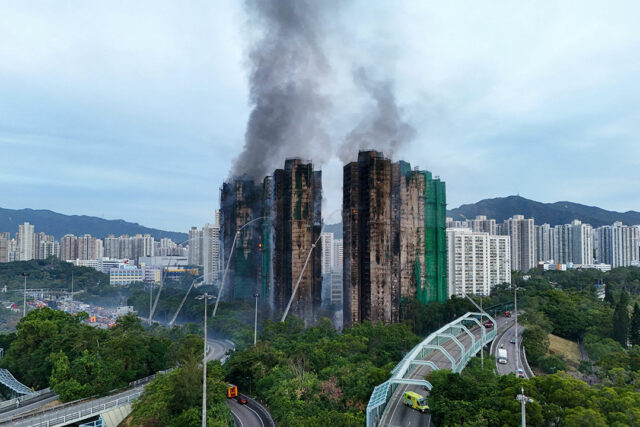
A DRONE view shows flames and thick smoke rising from the Wang Fuk Court housing estate during a major fire in Tai Po, Hong Kong, China, Nov. 27. — REUTERS/TYRONE SIU
HONG KONG — Indonesian domestic helper Fita spoke of the confusion inside the Hong Kong high-rise apartment complex as it was engulfed in flames on Wednesday in the city’s deadliest fire since 1948.
Amid sirens, flying debris and smell of burning, Fita told her employer there was a fire but her boss did not believe her.
After going outside and seeing two buildings burning in the Wang Fuk Court complex she pressed again: “I just straight-talked to my employer – I said you have go down now.”
“It was scary. I was going to cry because I saw a lot of people confused,” Fita, 49, said.
The pair eventually got out and are staying in emergency housing.
Fita said she is now praying for those still missing and trying to track down friends among the dozens of migrant workers in the eight-building complex, seven of which were engulfed in the blaze.
The city is now mourning the 128 people known to have died – a toll that is likely to rise with 200 others still unaccounted for.
Among them are some of the city’s 368,000 foreign domestic helpers, mostly women contracted from low-income Asian countries like the Philippines and Indonesia, who live with their employers, often in cramped spaces.
They assist them with cooking, cleaning and caring for the young and elderly, many earning monthly wages as low as HK$5000 ($642) in one of the world’s most expensive cities.
BABY IN A BLANKET Indonesia said on Saturday that six of its citizens died in the blaze, while the Philippines has said one of its nationals was critically injured, one is missing and 28 are thought to be residents of the area but their whereabouts are unknown.
The injured Philippines worker Rhodora Alcaraz, 28, cradled her employers’ 3-month-old baby in a wet blanket while trapped in a smoke-filled room for several hours before being rescued by firefighters, her sister Raychelle Loreto told Reuters.
Alcaraz, who had only been in Hong Kong for a few days, sent panicked audio messages to her sister in the Philippines via Facebook as the situation escalated.
“I’m feeling very weak. I canít breath,” she said in one of the clips, sobbing and struggling to speak.
“We are poor. Our father is just a fisherman, that is why she decided to work abroad to help the family. We are so proud of our sister and she didn’t leave the baby until they were rescued,” Loreto said.
HELPING HANDS At a sports centre near Wang Fuk, the wooden courts were filled with mattresses and duvets as helpers and outside volunteers sorted through supplies to aid evacuees.
“They’re the backbone of the Hong Kong economy but they’re voiceless, so we’re doing what we can to find them and make sure they’re okay,” said one Hong Kong social worker, who carried a bag of food and clothes but declined to be named.
Some domestic workers who fled the complex spoke of being unable to sleep, trauma and fear for their futures as they still tried to help their host families.
Migrant worker agencies say they hope that Hong Kong government emergency funds to help stricken families will also extend to domestic helpers and assistance can be given to those who have lost passports and identity documents.
Edwina Antonio, executive director at migrant worker refuge Bethune House, said they knew of two workers who had lost their jobs as a result of the fire, possibly because of the employers’ financial plight.
“The employers should also sympathise – if they get terminated and they are traumatised by this incident, it’s a double whammy,” Antonio said. — Reuters
Tourism Secretary Ma. Esperanza Christina G. Frasco — FACEBOOK.COM/DEPARTMENTOFTOURISM
The Department of Tourism (DoT) said on Thursday that the Philippines is advocating for a “one tourism destination” for sustainability and the establishment of a unified visa for the Association of Southeast Asian Nations (ASEAN).
“We are really pushing for regional cooperation for ASEAN as one tourism destination for sustainability in tourism development,” Tourism Secretary Ma. Esperanza Christina G. Frasco told reporters in an interview.
“ASEAN working as one region and one unified tourism destination could really invigorate all of our tourism economies,” she added.
Data from the 2025 Sustainable Travel Survey by travel platform Agoda found that sustainability is among the top priorities considered by travelers in the region when making travel decisions.
The survey revealed that 86% of Filipinos value sustainability in travelling, while other neighboring countries, such as Malaysia (80%) and Vietnam (77%), trailed behind.
“The manner by which we value tourism is not limited to a physical count of visitors alone,” Ms. Frasco said. “But more of the valuation of tourism in terms of livelihood, in terms of economy, and in terms of its ability to sustain the local economies of our destination.”
She noted that the country has also expressed its interest in establishing a unified visa to help boost tourism across the region. “Since our first participation in the ASEAN under this administration, that is an advocacy that we have propounded among our ASEAN neighbors.”
“The Philippines continues to express its desire for this. We anticipate that this can really help us in terms of driving the numbers to the region,” she added.
2026 ASEAN CHAIRMANSHIP The Philippines, as the 2026 chair of ASEAN, will host the ASEAN Tourism Forum (ATF) in Cebu from Jan. 26 to 29, along with the ministerial meeting of ASEAN Tourism Ministers. Among the expected outcomes from the events is the launch of the ASEAN Tourism Strategic Action Plan.
“We hope that with that launch, all countries in ASEAN will continue to firmly commit to the strategic goals that have been identified for us to work together in the years to come,” Ms. Frasco said.
The tourism chief added that the department is responsible for handling hospitality, cultural events, and tours related to the said events.
“Our preparations for that have already begun and are continuing together with our other member government agencies, as well as our coordination with our local government units and our stakeholders.”
The chairmanship of ASEAN, which rotates annually based on alphabetical order of its member states, was passed from Malaysia to the Philippines in October.
The ASEAN chair is expected to lead the ASEAN Summit and related summits, the ASEAN Coordinating Council, the three ASEAN Community Councils, relevant ASEAN Sectoral Ministerial Bodies, and senior officials, and the Committee of Permanent Representatives – Article 31 of the ASEAN Charter.
The Office of the President has requested a P17.5 billion budget from Congress for hosting duties related to the ASEAN events and summits throughout 2026. — Almira Louise S. Martinez
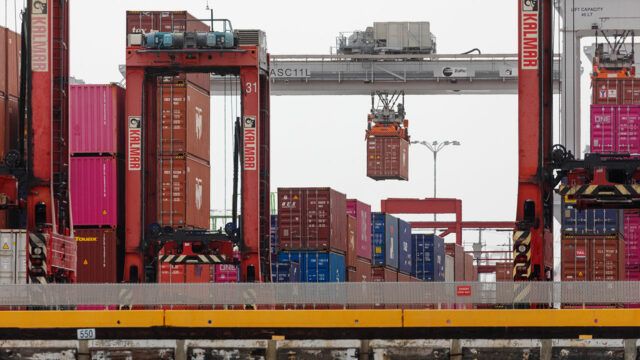
Containers at the Port of Los Angeles in Los Angeles, California, May 12, 2025. — BLOOMBERG
Global merchandise trade slowed last quarter as the boost seen earlier this year from front-loading of orders ahead of US tariffs faded, the World Trade Organization said.
The WTO’s goods barometer dropped to 101.8 in September from 102.2 for June, the Geneva-based organization said on Friday. The baseline of 100 indicates growth over the next quarter that’s in line with medium-term trends.
The data for air freight and container shipping “continue to signal expansion,” even as they weakened from June, “indicating a cooling-off in the transportation of goods worldwide,” the report said. The barometer’s automotive and electronics indexes stabilized and agriculture stayed in contraction, while new export orders showed improvement.
“On balance, the indices show signs of moderation in global trade growth,” the WTO said.
US President Donald Trump’s tariffs of 10% or higher on imports from most major trading partners disrupted international commerce through much of the year, spurring many American importers to front-load orders to avoid paying the import taxes, as well as shifting demand away from markets where the duties are the highest.
US goods imports from China, for instance, sank 22% through August this year, but year-to-date shipments from markets including Vietnam, India, Thailand, Malaysia and Taiwan all gained more than 20%, according to data released in Washington this month.
According to the WTO’s most recent forecast, made on Oct. 7, world trade volume growth this year is expected to be 2.4%, slower than the 2.8% pace posted in 2024. The outlook for next year anticipates a sharp slowdown, to 0.5% growth, the organization said. — Bloomberg
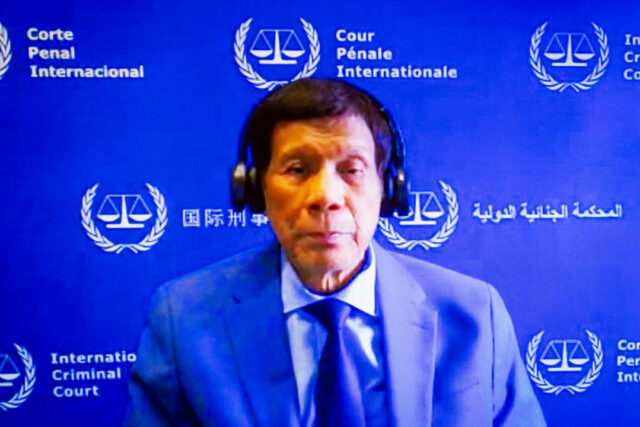
FORMER PRESIDENT RODRIGO R. DUTERTE — INTERNATIONAL CRIMINAL COURT / COUR PÉNALE INTERNATIONALE
THE HAGUE — The International Criminal Court ruled on Friday that the Philippines’ 80-year-old former President Rodrigo Duterte must remain detained despite a defense appeal for his release on grounds of age and declining health.
Mr. Duterte, president from 2016 to 2022, was arrested and taken to The Hague in March over murders during his war on drugs when thousands of alleged narcotics peddlers and users were killed.
The appeals judges shot down a request for provisional release on health grounds, meaning he will have to stay in court detention to await a possible trial.
“The Appeals Chamber found that the defense failed to identify errors” in a lower court decision that Mr. Duterte should stay in detention, presiding judge Luz del Carmen Ibanez Carranza said.
Mr. Duterte was not in court to hear the ruling.
His grandson Omar Mr. Duterte told reporters after the ruling that his grandfather was not a flight risk and should have been released. “Half the time, while we are talking, he doesn’t even know why he’s in there, in detention,” he said.
In the Philippines’ capital Manila, victims’ families watched the hearing together holding signs saying: “Duterte’s detention is our safety, no to interim release”. One person jumped for joy and others clapped as the ruling was read out.
THOUSANDS OF DEATHS
“The trial must go on. It must continue until it is proven that Duterte is guilty,” said Sheerah Escudero, whose brother was killed in 2017 during the drugs war.
The ICC arrest warrant says Mr. Duterte created, funded, and armed death squads.
According to police, 6,200 suspects were killed during anti-drug operations under Mr. Duterte’s presidency. But activists say the real toll was far higher and the ICC prosecutor has said as many as 30,000 people may have died.
Mr. Duterte has long insisted he instructed police to kill only in self-defense and has always defended the crackdown, repeatedly telling his supporters he was ready to “rot in jail” if it meant ridding the Philippines of illicit drugs.
In a statement from Manila, the Mr. Duterte family said they accepted Friday’s court decision with peaceful hearts.
Mr. Duterte’s lawyers have filed several other motions to get the entire case dismissed. — Reuters
LANDBANK President and CEO Lynette V. Ortiz (left photo) engages local enterprises and food sustainability advocates while highlighting the Bank’s P2M QR payment facility and AGRISENSO Plus program during Terra Madre Asia & Pacific 2025 event from November 19 to 23, 2025 in Bacolod City.
LANDBANK reaffirmed its commitment to fostering a sustainable and resilient food system across the country by showcasing its integrated financing programs, capacity-building initiatives, and digital solutions through its support of the inaugural Terra Madre Asia & Pacific 2025, held from Nov. 19 to 23, 2025 in Bacolod City.
Terra Madre Asia & Pacific, part of the global Slow Food Movement, brought together over 2,000 farmers, fishers, international chefs, indigenous leaders, and advocates from across the region to promote “good, clean, and fair” food, biodiversity conservation, and sustainable food systems.
“LANDBANK and Slow Food aligns with sustainable and inclusive agriculture. Through this partnership, we aim to further strengthen local food systems, empower our farmers and fishers, and help ensure that every Filipino has access to nutritious, clean, and fairly produced food,” said LANDBANK President and CEO Lynette V. Ortiz.
Reena Gamboa, Slow Food advocate and Executive Director of Terra Madre Asia & Pacific, emphasizes her commitment to good, clean, and fair food for all—advocating for active support for farmers and safeguarding our environment to ensure everyone has access to proper, sustainable food.
The Slow Food movement, founded in Italy in 1989, is dedicated to protecting local food cultures, traditional farming practices, and biodiversity. It champions food that is good in quality and taste, clean in its respect for the environment, and fair in terms of pricing and conditions for producers. Today, Slow Food is a global network present in more than 160 countries, working with diverse communities to promote sustainable, community-centered food systems.
“Good, clean, and fair food for all is a universal right. To achieve this, we must protect our biodiversity and environment, as this principle is inseparable from supporting our farmers and ensuring everyone has access to proper, quality food,” said Reena Gamboa, Terra Madre Executive Director.
Building on these principles, LANDBANK’s agricultural programs aim to strengthen connections across the value chain. The Bank’s financial and digital services complement community-led efforts by providing stakeholders—from producers to processors to markets—with the tools and support that they need to thrive.
LANDBANK’s participation as a key sponsor of Terra Madre Asia & Pacific 2025 further reflects its support for Slow Food initiatives, underscoring the Bank’s commitment to promoting sustainable agriculture, food security, biodiversity conservation, and climate-resilient, community-driven value chains.
Integrated support for farmers and fishers
LANDBANK First Vice President Allan R. Bisnar
On Nov. 20, LANDBANK First Vice President Allan R. Bisnar introduced AGRISENSO Plus, the Bank’s flagship lending program which delivers comprehensive value-chain support by integrating credit, technical assistance, and digital solutions, along with free life and credit life insurance. The program is designed to empower small farmers and fishers, offering customized financing, market linkages, and data-driven insights to boost productivity and efficiency.
AGRISENSO Plus features a reduced fixed interest rate of 3% per annum for small farmers, fishers, and agrarian reform beneficiaries (ARBs), with competitive rates for associations, cooperatives, micro, small, and medium enterprises (MSMEs), large enterprises, anchor firms, and agriculture graduates.
“AGRISENSO Plus reflects our commitment to strengthening the entire agricultural value chain. By combining accessible financing, capacity-building, and digital solutions, we are enabling our farmers and food producers to thrive in a rapidly changing environment and ensuring that local food systems remain resilient and sustainable,” LANDBANK PCEO Ortiz emphasized.
Complementing the Program is the LANDBANK ASCEND (Agri-Fishery Support through Capability Enhancement for Nationwide Development), a capacity-building initiative that provides training in digital financial literacy, sustainable agriculture, and enterprise development.
As of September 2025, LANDBANK has released over P1.96 billion in loans under the AGRISENSO Plus Lending Program, supporting more than 12,300 borrowers nationwide, most of whom are small farmers and fishers, following successful rollouts in key agricultural hubs across Pampanga, Cagayan, Isabela, Batanes, Bukidnon, Iloilo, Palawan, and Negros Occidental.
Driving inclusion and digital adoption
LANDBANK also showcased its digital innovations, particularly the P2M (Person-to-Merchant) QR payment facility recently launched in Negros Occidental. This interoperable solution allows consumers to enjoy waived transfer fees for purchases of ₱500 and below using QRPh-P2M via the LANDBANK Mobile Banking App, other banking apps, or digital wallets.
LANDBANK P2M merchants, on the other hand, benefit from waived transaction fees, which encourages the adoption of digital payments. This provides farmers, MSMEs, and local enterprises with a faster, more secure, and more convenient way to receive payments—reducing cash-handling risks and expanding digital inclusion in agricultural communities. Business owners can simply enroll their existing LANDBANK accounts, with activation completed within 24 to 48 hours.
Spotlight is BusinessWorld’s sponsored section that allows advertisers to amplify their brand and connect with BusinessWorld’s audience by publishing their stories on the BusinessWorld Web site. For more information, send an email to online@bworldonline.com.
Join us on Viber at https://bit.ly/3hv6bLA to get more updates and subscribe to BusinessWorld’s titles and get exclusive content through www.bworld-x.com.
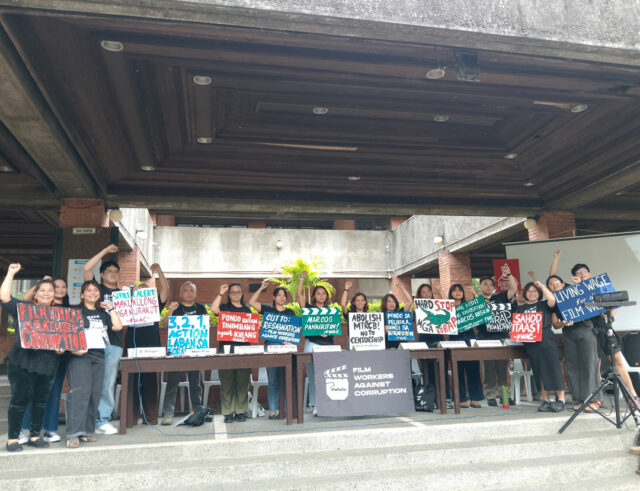
Members of the Film Workers Against Corruption (FWAC) at the press briefing held in UPFI Film Center in Diliman, Quezon City on Nov. 28. — EDG ADRIAN A. EVA
The billions of pesos that may have been siphoned due to the flood control scandal anomalies could have been used to fund the country’s entertainment industry, helping to improve the conditions of undercompensated workers, according to the Film Workers Against Corruption (FWAC) on Friday.
“Filipino filmmakers are no different from workers in other industries—they’re also overworked and underpaid,” JL T. Burgos, Chairperson of Surian ng Sining, said in Filipino during the sidelines of the Film Workers Against Corruption press briefing.
“When funds are corrupted, only a few benefit. If arts and culture were given higher funding, it would greatly help below-the-line workers,” he added.
Mr. Burgos said that most independent entertainment industry workers depend on government grants, as they do not have financial backing from big media companies to produce content.
Through increased government funding, below-the-line workers, who usually work behind the scenes and are often overlooked, would receive fairer compensation, he said.
According to the National Expenditure Program (NEP), for the 2026 fiscal year, P1.8 billion is being allocated to cultural agencies like the National Commission for Culture and the Arts (NCCA) and the National Museum of the Philippines, among other relevant agencies.
For filmmaker Joanne Marian B. Cesario, filmmaker, the budget allocated for cultural agencies is only a fraction of the P100 billion alleged to have been siphoned off through corruption.
“Just compare it to the P100 billion that was pocketed and put in suitcases. The disparity is clear,” she said in Filipino during the briefing.
The insertion was allegedly included in the 2025 national budget, greenlighted by President Ferdinand R. Marcos Jr., according to former lawmaker Elizaldy S. Co.
The group also called for accountability for everyone proven to be involved in the flood control anomaly, including President Ferdinand R. Marcos Jr. if evidence confirms his involvement, as well as for other alleged corruption cases, such as the supposed misuse of confidential funds by Vice President Sarah Jane I. Duterte.
“We are being confronted with two faces of corruption,” Mr. Burgos said, referring to the Marcos and Duterte factions.
“Both are thieves. There is no difference between stealing from the flood control fund and the confidential funds,” he added.
The alliance also urged better implementation of the “Eddie Garcia Law,” which is intended to protect workers’ welfare.
They called for proper enforcement of work hours, fair wages, benefits, and regularization, and for the law to detail standardized salaries for below-the-line workers.
Under Republic Act 11961, employers must provide workers or contractors with a copy of their contracts, specifying their work hours, job position and description, length of employment, and details of their compensation in a language both parties can understand.
The law also requires the provision of wage-related benefits, overtime pay, and social security along with other government-mandated benefits.
The group also called for a reduction of the 30 percent amusement tax on movie and television ticket sales, which is mandated under the Local Government Code (RA 7160), noting that the high rate exacerbates the financial strain of the industry amid limited government funding and alleged misuse of public funds.
The Film Workers Against Corruption said it will join the anti-corruption rally, dubbed “Baha sa Luneta 2.0,” on Nov. 30, to seek accountability for corruption in the government. — Edg Adrian A. Eva