
How PSEi member stocks performed — July 18, 2024
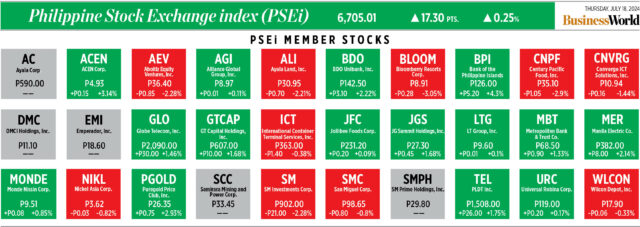
Here’s a quick glance at how PSEi stocks fared on Thursday, July 18, 2024.


Here’s a quick glance at how PSEi stocks fared on Thursday, July 18, 2024.

THE MAIN INDEX rallied on Thursday to end at the 6,700 level for the first time since April amid a strengthening peso and positive economic prospects for the Philippines.
The benchmark Philippine Stock Exchange index (PSEi) rose by 0.25% or 17.30 points to finish at 6,705.01 on Thursday, while the broader all shares index climbed by 0.22% or 8.24 points to end at 3,602.86.
This was the PSEi’s best close since April 29’s 6,769.64 and was the first time it ended at the 6,700 level since the 6,700.49 finish recorded on April 30.
“The local market extended its climb as investors cheered the continuous improvement of the peso against the dollar… The bourse closed above the 6,700 resistance level after testing it in the past few days,” Philstocks Financial, Inc. Research and Engagement Officer Mikhail Philippe Q. Plopenio said in a Viber message.
After hitting 17-month lows last month amid bets on the timing of monetary easing here and in the United States, the peso has since rebounded against the dollar.
On Thursday, the local unit rose for a third straight day, closing at P58.25 versus the greenback, Bankers Association of the Philippines data showed. This was 4.5 centavos stronger than its P58.295 finish on Wednesday and marked the peso’s best close since May 28’s P57.97.
“Also, the Asian Development Bank’s (ADB) projection of the Philippines’ leading the ASEAN (Association of Southeast Asian Nations) region together with Vietnam in terms of economic growth for 2024 and 2025 cheered up investors,” Mr. Plopenio said.
The ADB on Thursday said it expects Philippine gross domestic product (GDP) to grow by 6% this year, at the low end of the government’s 6-7% target. For 2025, the ADB sees Philippine GDP expanding by 6.2%, below the government’s 6.5-7.5% goal.
“Philippine shares continued to rally as regional stocks moved out of the tech-driven firms. Analysts worry that this shift may not protect stocks from potential economic slowdown challenges,” Regina Capital Development Corp. Head of Sales Luis A. Limlingan added in a Viber message.
Sectoral indices were mixed. Financials climbed by 2.55% or 50.90 points to 2,045.25; industrials went up by 0.56% or 51.53 points to 9,222.91; and services rose by 0.26% or 5.30 points to 2,030.09.
Meanwhile, mining and oil fell by 1.79% or 160.97 points to 8,803.27; holding firms went down by 1.13% or 66.39 points to 5,765.43; and property declined by 0.64% or 17.27 points to 2,670.53.
Value turnover rose to P4.61 billion on Thursday with 1.08 billion shares changing hands from the P4.22 billion with 694.38 million stocks traded on Wednesday.
Decliners beat advancers, 89 versus 80, while 59 issues were unchanged.
Net foreign buying dropped to P385.96 million on Thursday from P715.58 million on Wednesday. — RMDO

THE PESO extended its rise against the dollar on Thursday as comments from US Federal Reserve officials supported bets of a September rate cut in the world’s largest economy.
The local unit closed at P58.25 per dollar on Thursday, strengthening by 4.5 centavos from its P58.295 finish on Wednesday, Bankers Association of the Philippines data showed.
This was the peso’s best close in more than a month or since its P57.97-a-dollar finish on May 28.
The peso opened Thursday’s session stronger at P58.25 against the dollar. It climbed to as high as P58.17 during the session, while its worst showing was at P58.333 versus the greenback.
Dollars exchanged went down to $1.17 billion on Thursday from $1.24 billion on Wednesday.
The peso was supported by stronger bets of a dovish Fed, a trader said in a phone interview.
“However, trading was cautious ahead of the ECB’s (European Central Bank) decision overnight,” the trader added.
The local unit climbed as Fed officials signalled a rate cut in the coming months, Rizal Commercial Banking Corp. Chief Economist Michael L. Ricafort added in a Viber message.
Top Federal Reserve officials said on Wednesday the US central bank is “closer” to cutting interest rates given inflation’s improved trajectory and a labor market in better balance, remarks that set the stage for a first reduction in borrowing costs in September, Reuters reported.
Fed Governor Christopher Waller and New York Fed President John Williams both noted the shortening horizon toward looser monetary policy, with Mr. Waller highlighting it in a speech at the Kansas City Fed and Mr. Williams voicing it in a Wall Street Journal interview.
Separately, Richmond Fed President Thomas Barkin said he is “very encouraged” that declines in inflation had begun to broaden. “I’d like to see that continue,” he told a business group in Maryland.
The remarks are the latest in a rush this week of commentary from top US central bank officials — including Fed Chair Jerome H. Powell — to note their increased confidence that the disinflationary trend that began last year is continuing, despite a short-lived bump in inflation earlier this year.
Price pressures appear to be easing across the board, the Fed officials said, with goods prices falling, housing cost increases slowing, and more moderate wage growth feeding into a long-awaited easing of price increases in the services sector.
Mr. Williams and Mr. Waller appeared to rule out a rate cut at the Fed’s July 30-31 policy meeting, a view reflected in financial markets that are now pricing the probability of a move at that meeting at less than 5%.
All three policy makers who spoke on Wednesday were “pointing to September” for a start to the policy easing, Karim Basta, chief economist at III Capital Management, wrote.
More Fed policy makers have suggested they are getting increasingly comfortable that the pace of price increases is more firmly on track back down to 2%, after higher-than-expected readings earlier in the year.
Mr. Powell on Monday also said that inflation readings over the second quarter of this year “add somewhat to confidence” on its downward path, suggesting a start of an easing cycle may not be far off.
For Friday, Mr. Ricafort sees the peso ranging from P58.15 to P58.35 per dollar. Meanwhile, the trader said the local unit may inch closer to the P57 level ahead of the release of latest US labor data. — AMCS with Reuters
By Ashley Erika O. Jose, Reporter
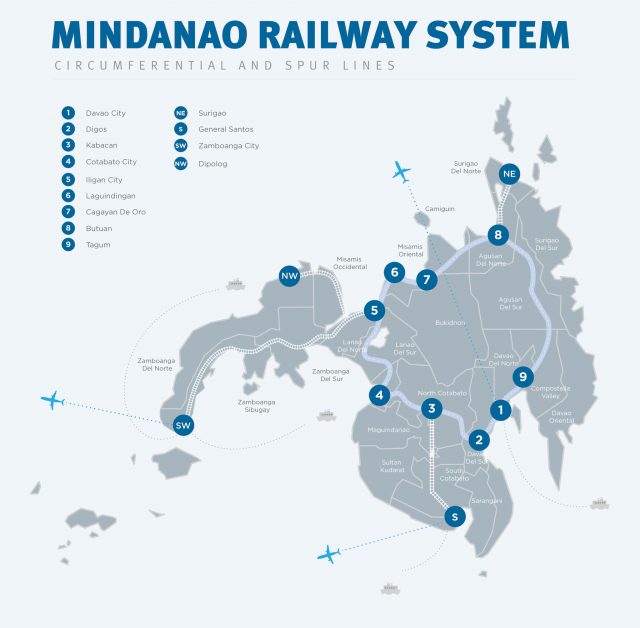
THE Japan International Cooperation Agency (JICA) said it is not ready to make a funding decision on the Mindanao Railway Project as it awaits the completion of a feasibility study with revised project parameters.
“Because the original plan was to be done by China, we did not have any master plan or any feasibility study. It is not mature for JICA to consider,” JICA Chief Representative in the Philippines Takema Sakamoto told BusinessWorld recently.
The Department of Transportation (DoTr) has said it is considering official development assistance (ODA) from various sources, including the World Bank, Asian Development Bank and JICA, after ruling out Chinese funding.
Last year, the DoTr said the Philippines is withdrawing its request for Chinese ODA for the Mindanao Railway, the South Long-Haul railway, and the Subic-Clark Railway project, due to lack of progress on financing.
“We have a long list for the railways sector. From the viewpoint of (JICA) management, jumping into a new project like Mindanao (railway) might be difficult for the Japanese government to raise the needed resources,” he said.
In June, Transportation Secretary Jaime J. Bautista said the DoTr is planning to overhaul the Mindanao Railway Project to use more modern and environment-friendly trains.
The original plan for the Mindanao Railway involved diesel-powered trains.
Non-electrified railways are difficult to attract investors due to global warming concerns, Mr. Sakamoto said.
“But now (Mr. Bautista) is saying that he is now planning to revise the plan, the obsolete, outdated non-electrified system. So, let us see,” he added.
Earlier this year, the DoTr announced that it will continue to work on the first phase of the Mindanao Railway project by pursuing some pre-construction activities despite the absence of funding.
The first phase of the Mindanao Railway project is valued at P83 billion. It will run from Tagum, Davao del Norte to Digos City, Davao del Sur. It is expected to carry 122,000 passengers per day and cut travel time between Tagum and Digos from three hours to one.
JICA has said that it would like to continue funding Philippine railway infrastructure projects.
In March, the government and JICA signed two loan commitments agreements valued at 250 billion yen, which will fund the ongoing construction of the Metro Manila Subway and a road project that includes what would be the longest tunnel in the country.
It also recently partnered with Sumitomo Corp. and Hankyu Corp. to support the operations and maintenance of Light Rail Transit Line 1.

By John Victor D. Ordoñez, Reporter
THE Department of Energy (DoE) said on Thursday that battery technology is evolving fast enough to make its 2050 renewable energy (RE) targets feasible.
“We are trying to encourage more battery systems companies and we hope it will attract better technology,” Energy Undersecretary Sharon S. Garin told a Senate energy committee hearing looking into a bill seeking to develop the midstream natural gas industry.
“We do recognize that there are still limitations (in RE development); we do believe that technology will improve fast enough to catch up by 2050,” she added.
The Philippines is seeking to raise the share of RE in the energy mix from 22% to 35% by 2030 and to 50% by 2040.
She was responding to Senator Sherwin T. Gatchalian’s question on the agency’s efforts to develop more RE projects.
Energy Undersecretary Rowena Cristina L. Guevara has said the DoE plans to hold two green energy auctions before the end of the year, offering geothermal, pump-storage hydro and impounding hydro projects.
The Philippines is about to lose its only indigenous source of gas, the Malampaya gas field. Malampaya is expected to run out of easily recoverable gas using current techniques by 2027.
Legislators have been pushing for measures to ease the process of importing liquefied natural gas (LNG) as Malampaya dwindles.
At the same hearing, Prime Energy Resources Development B.V. Managing Director and General Manager Donnabel Kuizon Cruz pushed for more exploration. She said Philippine exploration activity is lagging the rest of Southeast Asia.
“Indigenous gas ticks all the boxes as a transition fuel, consistently delivering stable prices and reliable fuel supply for generation,” she said.
Center for Energy, Environment and Development, Inc. Deputy Head of Legal Isabel Patricia C. Soresca cited the threat of greater LNG use to coral reef ecosystems, mangroves and water quality.
“Construction of fossil gas-fired plants entails land reclamation and other infrastructure, which will result in sedimentation or the increase of dirt and soil in the water,” she said.
“This damages and hinders the growth and proliferation of coral.”

THE US Nuclear Regulatory Commission (NRC) expects increased engagement in nuclear safety with the Philippines, and also sees the latter’s development of a nuclear power industry attracting interest from US companies.
The two countries have entered into a civil nuclear cooperation agreement, paving the way for the US to export nuclear fuel and equipment.
NRC Chairman Christopher T. Hanson said the US-Philippines Agreement for Cooperation Concerning Peaceful Uses of Nuclear Energy, also known as the “123 Agreement,” took effect on July 2, unlocking more cooperation from the US.
“I think you’re going to see an increase in the activity and the support that the NRC is going to be providing to the Philippine Nuclear Research Institute (PNRI) and its successor organization as the regulatory body,” Mr. Hanson said in a media roundtable on Thursday.
Mr. Hanson is on a two-day trip in the Philippines to meet with Department of Energy (DoE) officials and other officials to discuss US support for the Philippines’ civil nuclear program.
He met with Rep. Mark O. Cojuangco, who chairs the House committee on nuclear energy, to discuss enabling legislation to set up the Philippine nuclear regulator.
He said the NCR will bring three PNRI experts to the US for training in nuclear power engineering and will organize a workshop for nuclear power executives.
“I hope these will enable the Philippines to think about how they might like to pursue the development of their regulatory body,” he said.
Asked about the readiness of the Philippines for nuclear energy, Mr. Hanson said that the Philippines has a strong foundation.
“My view is that the Philippines has a really strong foundation. The Philippine government already regulates the safety and security of radioactive materials for the healthcare and agriculture industries,” he said.
He added that the country has qualified and highly educated workers all over the world who are “ready to come home and support the nuclear program.”
“So, I think there are a lot of really strong things, and the reason for my visit is to talk to officials in the DoE here in the Philippines as well as the PNRI about what their priorities are for developing that nuclear safety framework,” he said.
The 123 Agreement, signed by Washington and Manila in November last year, provides a legal framework for the export of nuclear materials, equipment, and components from the US to the Philippines.
It permits the transfer of information, nuclear material, equipment, and components directly between the Philippines and the US to support potential nuclear power projects with US suppliers.
With the 123 Agreement in place, Mr. Hanson said that the NRC is willing to share its analysis of the licensed nuclear technology that a US company may offer for deployment in the Philippines.
“We can show how we went through that licensing process and performed the technical and confirmatory analyses to reach our determinations,” he said.
“But I want to really stress, though, that it is important, and it’s my goal to help support and develop regulatory bodies here in the Philippines and in other countries who are capable of performing those analyses themselves,” he added. — Justine Irish D. Tabile
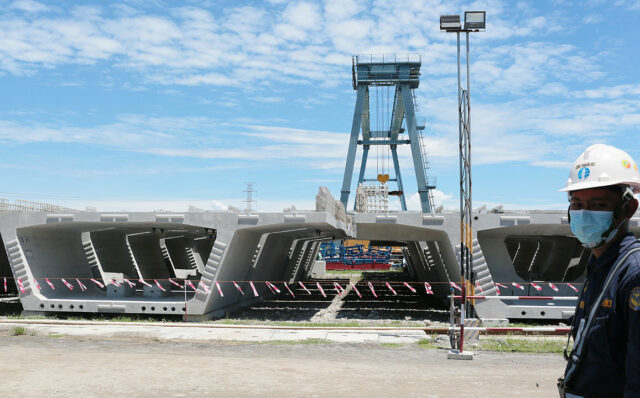
THE Balagtas, Bulacan station of the North-South Commuter Railway (NSCR) is nearing completion, the Transportation department said.
The northern leg of the NSCR will have 10 stations, including Balagtas. The other stations are Tutuban, Solis, Caloocan, West Valenzuela, Meycauayan, Marilao, Bocaue, Guiguinto, and Malolos.
Taken as a whole, the northern leg of the NSCR project has made 60% construction progress as of May, the Philippine National Railways said.
The Transportation department said facilities at the 180-meter long Balagtas station in Bulacan will include a concourse and platform, elevators, escalators and accessibility for senior citizens and persons with disabilities.
“They are making progress at the Balagtas station and Malanday depot. We need to complete, our plan is to have partial operations from Clark Airport to Valenzuela by 2027,” Transportation Secretary Jaime J. Bautista told reporters on the sidelines of a separate media event.
The 147-kilometer NSCR will connect Malolos, Bulacan with Clark International Airport, and Tutuban, Manila with Calamba, Laguna.
The Malanday depot of the NSCR is 72.10% complete. The depot will house the operations center of the railway project.
The P873-billion project is co-financed by the Japan International Cooperation Agency and the Asian Development Bank. It will have 35 stations and three depots.
Once fully operational the NSCR is projected to reduce travel time between Clark and Calamba to two hours, against the current four to 4.5 hours. — Ashley Erika O. Jose

A YELLOW ALERT was raised over the Luzon grid for a second consecutive day after a forced outage at a gas-fired power plant and the derating of a coal-fired power plant, according to the National Grid Corp. of the Philippines (NGCP).
In an advisory early Wednesday, the NGCP said that the Luzon grid will be under yellow alert between 1 p.m. and 10 p.m., though the alert was called off shortly after 1 p.m.
The grid’s available capacity was 12,376 megawatts (MW) against peak demand of 11,794 MW.
The NGCP said that factors that contributed to the raising of yellow alert were the unplanned outage of 417.4-MW San Gabriel Power Plant in Batangas and the inabillity of four units of SMC Limay Coal Power Plant with capacity of 150 MW each.
The yellow was lifted at 1:10 p.m. after demand proved to be less than forecast and the shutdown of SMC Limay 1-4 was delayed.
A yellow alert is issued when the operating margin is insufficient to meet the transmission grid’s contingency requirement.
A total of 1,893.5 MW was unavailable to the grid as 17 power plants have been on forced outage while 10 are derated.
Since April, the Luzon grid has been under red and yellow alerts for 11 and 33 days, respectively.
The Visayas and Mindanao grids are operating normally, according to the NGCP. — Sheldeen Joy Talavera
THE Japan Bank for International Cooperation (JBIC) has expressed interest in Philippine Samurai bond issues and green infrastructure, the Department of Finance (DoF) said.
The interest was conveyed in a meeting between Finance Secretary Ralph G. Recto and JBIC officials, the DoF said.
“JBIC Governor Nobumitsu Hayashi expressed strong interest in Samurai bond issuances, particularly green bonds, and explored potential cooperation in renewable energy projects, such as hydropower and power grids,” the DoF said in a social media post.
The Philippines last issued Samurai bonds in April 2022, raising 70.1 billion yen.
Mr. Recto has said the DoF is looking to issue yen-denominated and dollar-denominated bonds within the year. However, the timing would be determined by the Federal Reserve’s policy easing decisions.
The government plans to borrow $5 billion this year, of which $2 billion was raised from the issue of global bonds in May, leaving $3 billion yet to be raised.
Mr. Recto told the JBIC that the passage of proposed amendments to the Corporate Recovery and Tax Incentives for Enterprises (CREATE) law will exempt export-oriented firms from value-added tax.
The CREATE MORE (Maximize Opportunities for Reinvigorating the Economy) bill is still at the Senate committee level. It is one of the priority measures of the Legislative-Executive Development Advisory Council (LEDAC).
It is expected to offer incentives to attract investments in key sectors, especially mining.
The Philippines, with the world’s fourth-largest copper reserves, fifth-biggest nickel deposits, and substantial cobalt deposits, is positioning for a major role supplying materials for clean-energy technologies. — Beatriz Marie D. Cruz

ANGAT DAM water levels are not expected to be fully replenished by the end of La Niña, according to the Department of Environment and Natural Resources (DENR).
“We just came from El Niño and our dam is not full at all. In fact, the danger even with La Niña is that we won’t be able to fill it up enough,” Environment Undersecretary Carlos Primo C. David told BusinessWorld on the sidelines of a water forum organized by the European Chamber of Commerce of the Philippines.
Mr. David, who also heads the DENR’s Water Resources Management Office, said that the water level in Angat may be insufficient to meet Metro Manila’s needs during the next dry season.
“In the next dry season next year, we (may not) have enough water,” he added.
As of early Thursday, Angat water levels were at 173.2 meters, against the normal high-water level of 210 meters.
Angat Dam is the primary water source for Metro Manila, providing approximately 90% of the capital’s potable water.
Last week, the government weather service, known as PAGASA (Philippine Atmospheric, Geophysical and Astronomical Services Administration), said that there was a 70% chance La Niña will set in between August and October.
Separately, Ana Liz S. Solis, assistant weather services chief at PAGASA said La Niña will increase the likelihood of tropical cyclone activity in the coming months.
“During La Niña, more tropical cyclones track within the Philippine area of responsibility,” Ms. Solis added. — Adrian H. Halili

SIX of 10 Filipinos are satisfied with actions taken by the government of Philippine President Ferdinand R. Marcos, Jr. on the sea dispute with China, according to a Social Weather Stations (SWS) poll conducted days after a June 17 standoff at Second Thomas Shoal in the South China Sea.
Sixty percent of Filipinos said measures including joint patrols and military exercises with “allies, friends and partners” were “sufficient,” based on the June 23-July 1 poll commissioned by think tank Stratbase ADR.
Stratbase said 36% of the 1,500 respondents said these measures are not enough.
The poll showed that 72% of Filipinos wanted the Philippine government to boost security ties with other countries.
The Philippines conducted joint patrols within its exclusive economic zone (EEZ) in the South China Sea with the United States, Australia, Japan and France since last year, amid confrontations between its vessels and larger Chinese Coast Guard ships.
On June 17, Chinese forces with bladed weapons boarded Philippine rubber boats on a resupply mission to BRP Sierra Madre at Second Thomas Shoal and looted rifles, according to the Philippine military.
Philippine Navy forces fought with bare hands and one of them lost a thumb after the rubber boat he was in was rammed by Chinese forces, according to the Philippine military.
The Philippines grounded the BRP Sierra Madre, a World War II-era ships, at the shoal in 1999 to bolster its sea claim. The shoal is 240 kilometers off the coast of Palawan province and is about 900 kilometers from Hainan, the nearest major Chinese landmass.
The incident sparked discussions on the limits of the US-Philippines Mutual Defense Treaty, which compels both sides to defend each other in case of an armed attack, and prompted calls for joint resupply missions.
Stratbase ADR President Victor Andres C. Manhit said the Philippine government should “reinforce cooperation and elevate partnerships” with allies by conducting more joint patrols and military exercises within the Philippine EEZ.
“By conducting joint patrols with like-minded partners and allies, we are sending a strong message that the Philippines is not alone,” he said in a statement.
“Those who attempt to circumvent their obligations and behave aggressively will not be tolerated by the international community,” he added.
Days after the June 17 standoff, the Philippines and China met in Manila under their so-called bilateral consultation mechanism, but security experts doubted Beijing’s sincerity as a China Coast Guard ship (CCG) was deployed off the coast of Palawan and another Chinese ship known as the “The Monster” to Second Thomas Shoal.
The Philippine Navy on Tuesday said it was considering holding resupply missions to BRP Sierra Madre with several nations including the US, Japan, the United Kingdom and Australia.
China’s Monster ship, the largest coast guard vessel in the world, was spotted at Sabina Shoal on July 4, and Philippine Coast Guard (PCG) spokesman Jay Tristan Tarriela on Wednesday said the ship was still in the area.
He said the PCG had spotted another China Coast Guard ship near Lubang Island, which is just 40 kilometers west of Calatagan, Batangas province south of Manila. The ship was moving toward Palawan.
The Navy on Tuesday said they had detected four China Coast Guard vessels at Second Thomas Shoal, which is about 67 kilometers west of Sabina.
The Philippines last week marked the anniversary of a 2016 arbitral ruling that voided China’s expansive claims in the South China Sea, with statements of support from Philippine allies.
Mr. Marcos has pursued closer ties with Western nations amid China’s increasing assertiveness at sea.
Mr. Tarriela earlier this month said Manila had used Canada’s “dark vessel” technology in detecting China’s 12,000-ton Monster ship.
The SWS poll showed that 56% of Filipinos thought the government was doing enough to protect Filipino fishermen in the disputed waterway and in boosting the military.
Most Filipinos also said the government was doing enough to protect marine resources within its exclusive economic zone, and in referring the issue to international organizations like the United Nations and Association of Southeast Asian Nations.
Stratbase said 49% of Filipinos thought it was not enough for the government to demand for China to leave the artificial islands it had built and occupied within the Philippine EEZ. — Kyle Aristophere T. Atienza
