Home Blog Page 2412

[B-SIDE Podcast] What does it take for an employee to stay?

Follow us on Spotify BusinessWorld B-Side

Alcohol drinking has been a vital part of various Filipino celebrations and festivals, creating camaraderie and a celebratory spirit.

Some Filipinos turned to alcohol as a coping mechanism for stress, as it slows down brain function and can induce feelings of relaxation and calmness.

During the pandemic in 2021, more Filipinos became alcohol drinkers, with the Department of Health (DOH) reporting that 40%, or 4 out of 10 Filipinos, were alcohol drinkers.

The DOH warns the public that any amount of alcohol, whether in small or large quantities, is not considered safe for health.

Addressing this concern, Paul Filomeno, a medical doctor and representative of the Philippine Addiction Specialists Society, has discussed the risks of alcohol drinking.

He will also discuss the Sin Tax Coalition’s initiatives to make alcohol products less accessible and marketable among Filipinos.

Interview by Edg Adrian A. Eva
Audio editing by Jayson John D. Mariñas

Follow us on Spotify BusinessWorld B-Side

Flowing To Panalo: Show off the best hand choreo to Flow G’s bars to win exclusive prizes from Puregold

Puregold bolsters its groundbreaking P-Pop and OPM collaboration with a brand-new TikTok challenge from rapstar Flow G. “FLOWers,” rap fans, and Puregold patrons who rejoiced when he dropped his original “Nasa Atin Ang Panalo” single can now leave their own mark on this historic milestone in OPM history — and win exclusive prizes.

The Puregold #PanaloNaWalangHalo TikTok Challenge will have fans trying at a set of Flow G-themed hand choreo all month long, as winners will be selected every week until Aug. 30, 2024.

To join the contest, fans must have a TikTok account and follow the official Puregold TikTok page, @puregoldph. Once that’s done, they must record their performance while using the “Nasa Atin ang Panalo” Hand Choreo filter on TikTok. Each participant must showcase their best hand moves and choreography in their video entries to accompany Flow G’s “Nasa Atin ang Panalo” single. These must be posted on TikTok with captions that include the hashtags #PuregoldNasaAtinAngPanalo, #PuregoldxFlowG, and #PanaloNaWalangHalo.

Every week, 10 participants will be selected, with each winning a complete set of “Nasa Atin ang Panalo” merchandise. This includes an exclusive t-shirt, canvas bag, and a karaoke box.

Given the sheer scale of this Puregold collaboration, with Flow G, BINI, SunKissed Lola, and SB19 leading the way, this is a can’t-miss opportunity for fans looking to own a piece of the “Nasa Atin Ang Panalo” collab for themselves.

Moreover, following the great reception from Flow G’s heartfelt and uplifting bars on his “Nasa Atin Ang Panalo” single, this contest is a perfect way for fans to demonstrate what the single and overarching collaboration means to them. In line with Flow G’s lyrics, this TikTok challenge will spur fans to express how their own experiences led them to believe in themselves, to take chances, and acknowledge the fact that all challenges can be overcome.

“We hope Flow G’s music will continue to be an inspiration to all,” said Puregold Senior Marketing Manager Ivy Hayagan-Piedad. “All of us at Puregold look forward to seeing the talent and creativity on display through this TikTok challenge.”


Spotlight is BusinessWorld’s sponsored section that allows advertisers to amplify their brand and connect with BusinessWorld’s audience by publishing their stories on the BusinessWorld Web site. For more information, send an email to online@bworldonline.com.

Join us on Viber at https://bit.ly/3hv6bLA to get more updates and subscribe to BusinessWorld’s titles and get exclusive content through www.bworld-x.com.

Poll: BSP to cut rates by 25 bps on Aug. 15

SHOPPERS are seen at the Greenhills shopping center in San Juan City. — PHILIPPINE STAR/MIGUEL DE GUZMAN

By Luisa Maria Jacinta C. Jocson, Reporter

THE BANGKO SENTRAL ng Pilipinas (BSP) may cut rates for the first time in nearly four years at its policy-setting meeting this week, according to a majority of analysts polled by BusinessWorld.

A BusinessWorld poll conducted last week showed that nine out of 16 analysts surveyed expect the Monetary Board to deliver a 25-basis-point (bp) rate cut at its meeting on Thursday (Aug. 15), bringing the target reverse repurchase (RRP) rate to 6.25% from the current over 17-year high of 6.5%.

On the other hand, seven others expect the BSP to keep rates steady this week.

Analysts’ Expectations on Policy Rates (August 2024)The last time the BSP reduced rates was in November 2020, when it delivered a 25-bp cut and brought the key rate to 2% to support economic recovery amid the coronavirus pandemic.

From May 2022 to October 2023, the BSP hiked borrowing costs by 450 bps.

Analysts said that the central bank will likely take into consideration the second-quarter gross domestic product (GDP) growth data, which reflected “anemic” household spending amid high interest rates and elevated inflation.

“We expect the BSP to cut the RRP by 25 bps on Aug 15. We think the BSP took note of the components of second-quarter GDP growth showing a sustained weakness in household consumption demand and sustained anemic performance of private construction,” Bank of the Philippine Islands Lead Economist Emilio S. Neri, Jr. said.

Philippine GDP expanded by 6.3% in the second quarter, faster than 5.8% in the previous quarter and 4.3% a year ago. This was also the fastest pace of growth in five quarters or since 6.4% in the first quarter of 2023.

In the second quarter, household consumption also slowed to 4.6% from 5.5% a year ago. Private consumption accounts for about three-fourths of the economy.

“We expect the BSP to cut rates by 25 bps at the Aug. 15 monetary policy meeting, driven by several factors. While second-quarter GDP growth was strong year on year, the quarter-on-quarter growth of 0.5% fell well below the 1.5% trend, suggesting waning momentum,” Security Bank Corp. Chief Economist Robert Dan J. Roces said.

On a seasonally adjusted basis, GDP grew by 0.5% in the second quarter, slowing from 1.1% in the prior quarter.

“The decision remains finely balanced against the strong annual GDP figure and inflation uptick, making the upcoming meeting a close call between maintaining current rates and implementing the expected cut. The outcome will be particularly significant for the Philippines’ economic outlook,” Mr. Roces added.

Metropolitan Bank & Trust Co. Chief Economist Nicholas Antonio T. Mapa said BSP Governor Eli M. Remolona, Jr. has earlier signaled it can cut ahead of the US Federal Reserve.

“If Mr. Remolona adopts a forward-looking approach to monetary policy, we could see the BSP follow through with a rate reduction as early as next week,” he said in a report.

“After carrying out an aggressive tightening cycle in the face of similar US Fed rate hikes and domestic inflation, as well as an ‘emergency’ rate hike last October, it appears Mr. Remolona is pining to cut rates at the soonest opportunity,” he added.

HOLD RATES?
On the other hand, some analysts said they expect the BSP to keep rates steady as the inflation outlook is a bit clouded.

If the BSP holds on Aug. 15, it would mark the seventh straight meeting that the central bank would leave rates unchanged.

“With GDP growth upbeat on an annual basis, but sharply lower quarter on quarter, with a technical recession ‘only’ for consumption, the BSP may delay its rate cut on the 15th, as policy makers will prioritize the return of disinflation later in the year,” Ruben Carlo O. Asuncion, chief economist at Union Bank of the Philippines, Inc., said in an e-mail.

Household spending fell by 0.1% quarter on quarter, extending the 0.2% dip seen in the first quarter.

National Economic and Development Authority Secretary Arsenio M. Balisacan last week said the GDP growth was not as strong as expected, amid the impact of elevated inflation and high interest rates.

Sarah Tan, an economist from Moody’s Analytics, said that the BSP could stand pat amid concerns that inflation could potentially reaccelerate.

“Even though we expect July’s inflation reading to be the peak, the outlook for Philippine inflation has become a little murkier of late. Damage caused by Typhoon Carina could linger over the coming months and electricity rates are also expected to tick up,” she said in an e-mail.

Headline inflation accelerated to a nine-month high of 4.4% in July. The July print also ended seven straight months of inflation settling within the central bank’s 2-4% target band.

For the first seven months, headline inflation averaged 3.7%, above the central bank’s 3.3% full-year forecast.

Mr. Remolona last week said that they are “a little bit less likely” to cut rates at the August meeting amid “slightly worse-than-expected” inflation print.

The central bank chief said they could consider cutting if growth is ‘unexpectedly weak” and if inflation expectations suggest lower inflation going forward. 

Mr. Asuncion expects the BSP to cut rates by October, in line with the Fed’s schedule.

“More broadly, the BSP is unlikely to leapfrog the US Federal Reserve. We expect the Fed’s first rate cut to come in September, with the BSP following suit in October,” Ms. Tan added.

The Fed at the end of July kept the policy rate in the same 5.25%-5.5% range it has been for more than a year but signaled that a rate cut could come as soon as September if inflation continued to cool, Reuters reported.

De La Salle University economist Mitzie Irene P. Conchada also noted other external developments that could prompt the BSP to keep rates unchanged.

“Given the recent developments (slowdown) in the stock market in major economies such as the US, I think the BSP will maintain its rates this Aug. 15.  The possible recession in the US could affect developing economies such as the Philippines,” she said in an e-mail.

OUTLOOK
Patrick M. Ella, economist at Sun Life Investment Management and Trust Corp., said the central bank should be able to push through with its easing cycle for the rest of the year.

“Any inflation uptick for July or even August should not distract from the rate-cutting plan of the BSP as these inflationary trends in July and August are transitory due to the weather disturbance,” he said.

HSBC economist for ASEAN (Association of Southeast Asian Nations) Aris D. Dacanay said that the BSP could cut rates by a total of 50 bps this year, bringing the benchmark rate to 6% by yearend.

“For 2025, we expect the BSP to ease monetary policy faster than the Fed, reaching the end of its easing cycle at 5% by the third quarter of 2025,” he added.

Analysts also noted the possibility of an off-cycle rate cut.

“An off-cycle BSP rate cut, if the Fed initiates rate easing in September, cannot be dismissed as well. We are expecting a modest 25-bp cut if the BSP does proceed with the off-cycle rate cut,” Mr. Asuncion said.

Mr. Remolona earlier said that they are “always open” to off-cycle rate cuts.

The BSP last delivered an off-cycle move in October 2023, when it hiked rates by 25 bps.

“Still, we won’t be surprised if BSP waits for one or two more inflation prints before they decide to carry out their first 25-bp cut. If not in August, they can do an off-cycle reduction in early September or during their scheduled meeting in October,” Mr. Neri said.

Mr. Mapa said the expected BSP easing could help “reinvigorate investment outlays which have been dominated by government spending of late.”

“If BSP opts to pause next week, we believe the rhetoric from both the BSP governor and Finance secretary suggests that rate cuts may be carried via an ‘emergency’ policy meeting, potentially once the August inflation is reported in early September,” he said.

After Aug. 15, the Monetary Board’s remaining policy-setting meetings this year are on Oct. 17 and Dec. 19.


NG debt service bill drops by 25% in June

BW FILE PHOTO

By Beatriz Marie D. Cruz, Reporter

THE NATIONAL Government’s (NG) debt service bill fell by 25.25% in June as amortization payments declined, the Bureau of the Treasury (BTr) said.

Data from the BTr showed that the NG’s debt repayments dropped to P66.08 billion in June from P88.4 billion in the same month a year ago.

Month on month, the debt service bill also dipped by 4.21% from P68.98 billion in May.

The debt service refers to payments made by the National Government on its domestic and foreign debt.

The bulk or 84.21% of the total debt service bill in June went to interest payments.

BTr data showed that interest payments for the month climbed by 5.22% to P55.64 billion in June from P52.88 billion a year ago.

Broken down, interest paid on local debt slid by 8.98% year on year to P36.66 billion.

Domestic interest payments consisted of P13.84 billion in fixed-rate Treasury bonds, P19.18 billion in retail Treasury bonds (T-bonds), P2.3 billion in Treasury bills (T-bills), and others (P1.34 billion).

Interest paid on foreign obligations surged by 50.58% to P18.98 billion in June from P12.6 billion in the same month a year ago.

On the other hand, amortization during the month dropped by 70.63% to P10.43 billion from P35.52 billion a year earlier.

Domestic principal payments fell by 90.79% to P2.58 billion in June from P27.98 billion in the same month in 2023.

Amortization on foreign debt rose by 4.23% to P7.86 billion in June from P7.54 billion a year ago.

The lower year-on-year debt repayments may be linked to the peso depreciation and higher funding needs amid a “persistent” budget deficit, Philippine Institute for Development Studies Senior Research Fellow John Paolo R. Rivera said in a Viber message.

“It can also be due to reallocation of funds to finance areas requiring attention such as recovery from the dry spell and other calamities that hit in June,” he added.

The NG’s budget deficit narrowed by 7.24% to P209.1 billion in June from P225.4 billion a year ago, the BTr said.

FIRST-HALF BILL
Meanwhile, the debt service bill in the first half of the year rose by 41.29% to P1.28 trillion from P907.93 billion in the same period a year ago.

Principal payments accounted for more than 70.59% of the total in the first half.

In the January-to-June period, amortization payments rose by 44.78% to P905.56 billion from P625.47 billion in 2023.

Principal payments made on domestic debt reached P757.43 billion, while payments for foreign obligations reached P148.13 billion during the period.

Meanwhile, total interest payments during the first six months increased by 33.55% to P377.23 billion from P282.46 billion last year.

Foreign interest payments in the first six months amounted to P109.19 billion, while domestic interest payments stood at P268.04 billion.

In the first half, interest payments made to the domestic market include P170.5 billion in fixed-rate Treasury bonds, P74.66 billion in retail Treasury bonds, P15.78 billion in T-bills, and others at P8 billion.

In a Viber chat, Rizal Commercial Banking Corp. Chief Economist Michael L. Ricafort said that the debt service bill could decline in the coming months amid lower maturities of government securities for the remainder of the year.

The NG plans to borrow P630 billion from the domestic market in the third quarter.

Broken down, the BTr is looking to raise P260 billion from T-bills and P370 billion via T-bonds in the period.

The NG’s debt stock rose to a fresh high P15.48 trillion as of end-June from P15.35 trillion as of end-May.

Under the latest Budget of Expenditures and Sources of Financing, this year’s debt service program is set at P2.03 trillion.

Philippine property developers unfazed by gov’t ban on POGOs

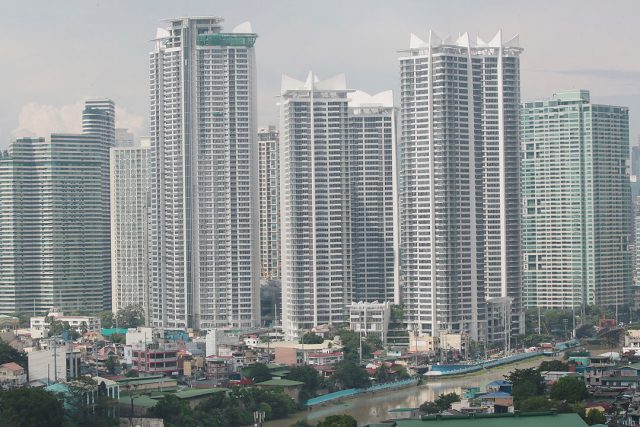
A VIEW of buildings in Makati City. — PHILIPPINE STAR/MICHAEL VARCAS

By Revin Mikhael D. Ochave, Reporter

LOCAL PROPERTY DEVELOPERS are unfazed by the government’s ban on Philippine offshore gaming operators (POGO), saying that it has minimum or no effect on their office and residential businesses.

Anna Ma. Margarita Bautista-Dy, president and chief executive officer of Ayala Land, Inc. (ALI), said during a media briefing last week that the POGO exposure of the company’s residential and office space businesses is “limited.”

“Our direct exposure to POGO is rather limited. Only 1% of our office portfolio is occupied by POGOs,” she said.

“We were never a big POGO locator. It has even gone down over the years. Now, we’re down to 1%. In terms of our sales, we have very little sales to Chinese buyers in general, whether POGO or not,” she added.

Ms. Dy said that ALI conducted checks across its residential buildings following the announcement of the ban and found that only less than 5% are occupied by POGOs or probable POGO employees.

“Our products are not that exposed to the POGO market, either directly in the office or indirectly as tenants for our residential buildings,” she said.

Sy-led conglomerate SM Investments Corp. (SMIC) said the POGO ban also has no impact on their property business. SM Prime Holdings, Inc. develops residential and commercial properties through SM Development Corp.

“Fortunately, (the POGO ban) has no impact to us,” SMIC President and Chief Executive Officer Frederic C. DyBuncio said in a mobile phone message after being asked for comment.

In a recent disclosure, Gotianun-led Filinvest REIT Corp. (FILRT) said that it is not affected by the POGO ban.

The company is the real estate investment trust (REIT) of Filinvest Land, Inc.

“FILRT has no POGO exposure and has been free of POGOs since the second quarter of 2022,” it said.

“The company has been deliberately diversifying its tenant mix, with the addition of traditional tenants and coworking locators,” it added.

Luxury property developer Shang Properties, Inc. recently said that the POGO ban will have no effect on the company’s residential business.   

“The profile of our buyers is mostly Filipinos. We have a healthy mix of foreign buyers which are not China-based, so we’re not as affected,” Shang Properties Executive Vice-President for Commercial Maria Rochelle S. Diaz said at a recent media briefing.

President Ferdinand R. Marcos, Jr. ordered a total ban on POGOs during his third State of the Nation Address last month, citing their links to illicit activities such as financial scams, money laundering, prostitution, and human trafficking.

He also ordered the Philippine Amusement and Gaming Corp. to close all POGO facilities by yearend.

Other companies have also disassociated themselves from POGOs and internet gaming licensees such as listed digital gaming company DigiPlus Interactive Corp., which previously said that it is not covered by the ban. DigiPlus operates platforms such as BingoPlus, ArenaPlus, Perya Game, and BingoPlus Poker.

Agri-tech, wellness entrepreneurs triumph at She Loves Tech Philippine finals

She Loves Tech 2024 Philippines winners Unprude and Farmtri will represent the country in the competition’s Regional Finals in Singapore, competing against other women-founded startups from Southeast Asia.

Singapore-based startup accelerator She Loves Tech, together with QBO Innovation Hub, Ideaspace Ventures, Inc., and with SM Supermalls, empowered 10 Filipina-led tech startups to showcase their innovative and impactful business models in the Philippine finals of She Loves Tech 2024, held last Aug. 2 at SM Aura’s Samsung Hall.

This year’s finalists come from varying industries, including agri-tech, health and wellness, communications for differently-abled people, and more. From this selection of outstanding businesses, Unprude and Farmtri were chosen to represent the Philippines in the Regional Finals, which will be held in Singapore later this year.

The grand winner, Unprude, is an app that encourages self-reflection to help users navigate sexual and life challenges, fostering deeper self-understanding, better relationships, and greater compassion for others.

In second place, Farmtri is a business-to-business digital platform that is innovating the food value chain. It utilizes artificial intelligence to predict market trends that help food businesses and farmers minimize losses and food waste.

She Loves Tech, led and founded by three women, has made supporting and launching women-led businesses their main focus since 2015. This advocacy brought along the establishment of the world’s largest startup competition for women and tech with the same name.


SM Supermalls shares in She Loves Tech’s vision, as one of the largest supporters of micro, small and medium enterprises (MSMEs) and projects that empower women.

SM Cyberzone is also celebrating Cyber Month this August, which means a larger focus on all things tech and how it can help level up anyone’s lifestyle, including through tech-powered job creation and tech-integrated business practices that address sustainability and community-building.

The partnership is also a continuation of SM’s year-round support for women-led businesses and startups, which can be seen through initiatives like SM’s Weekend Marketplace and the SM4SMEs Community Bazaar.

“SM is deeply honored to be partnering with She Loves Tech to host the Philippine leg of this competition. We are excited to see what these brilliant, hardworking, and business-minded women have in store for the betterment of our society,” said Steven Tan, president of SM Supermalls.

Filipino Gen Zs prioritize self-reward when shopping, study finds

Filipino Gen Z spend primarily to reward themselves, according to a joint study by the Filipino-focused sociocultural research firm The Fourth Wall and communications firm Uniquecorn Strategies.

About three out of four Filipino Gen Z consumers living in urban areas said they shop online because they believe that they deserve it. This shopping philosophy is driven by their desire for happiness, fear of missing out on trends, and the need to reward themselves for overcoming work or study-related stress.

The survey revealed that 50% of a typical Filipino Gen Z’s finances come from parental allowances, while the other 50% come from full-time work, businesses, or side gigs. On average, they make six online purchases per month, ranging from a minimum of one to a maximum of 10.

“The young generation is rapidly becoming a significant portion of the consumer market, and is already shaping market trends, especially the e-commerce space,” said John Brylle L. Bae, research director at The Fourth Wall.

“This self-rewarding behavior among Filipino Gen Zs stem from their growing self-awareness, driving them to seek rewards that affirm that sense of self-worth,” he added.

Mr. Bae also attributed this behavior to the Filipino “sayang” mindset, where daily struggles and deprivations lead them to seize rewarding opportunities out of fear of missing out.

The study adds that urban Filipino Gen Zs are intelligent buyers as they splurge based on quality (81%) and price competitiveness (10%). They are most likely to repurchase from the same brand that consistently delivers high-quality and affordable products, but are also willing to try other brands even if they are emotionally attached to their current ones.

The study also found that Filipino Gen Zs buy based on trust and personal affinity. Upon hearing about a product, 81% of them do not purchase immediately but search customer reviews first on shopping platforms and Google.

They still primarily rely on word of mouth to discover products (60%), while others rank social commerce ads (59%) as important to their shopping experience. They take cues from the people they deeply trust, friends, and family. They are also more influenced by honest, objective or out-of-pocket reviews from influencers or content creators with appropriate expertise.

Gen Z is known as the first generation to grow up with the internet and digital devices practically glued to their hands, which means they prefer the convenience of online shopping. Almost all the respondents (92%) use their own mobile phones for purchases and prefer cashless payment methods (53%).

Given this, Uniquecorn Strategies Founder and CEO Dean Bernales said that it is important to understand the consumer behavior of the younger generation.

“Online retailers should pay close attention to the shopping desires and needs of Filipino Gen Zs. Brands need to reassess their supply chain strategies and enhance their social commerce platforms to build trust, create personal connections, and develop a relatable image to capture the young market,” Mr. Bernales said.

As a result, the study identifies several key opportunities for brands to connect with Filipino Gen Z consumers more effectively. There is a significant potential for advertising on more personal yet credible emerging media platforms such as podcasts. Brands can leverage self-expression and identity in their branding to establish a personal affinity with target customer personas.

Additionally, adapting different messaging strategies and formats to align with influencers’ content can appeal to their niche audiences. Creating personalized subscription models for fast-moving consumer goods (FMCGs) can offer an immersive experience while promoting convenience and catering to personal preferences.

Tapping into Gen Z’s hobbies, interests, and desired personal images when developing brands, products, and services can further enhance their engagement and loyalty.

Citing prior research, the study noted that there are about 41 million Gen Zs in the Philippines, making up for about 38% of the total population, according to Philippine Statistics Authority’s latest official 2020 census.

Meralco’s MGen steps back from Laguna hydropower complex bid

BW FILE PHOTO

MERALCO PowerGen Corp. (MGen) opted out of the bidding process for the 796.64-megawatt (MW) Caliraya-Botocan-Kalayaan (CBK) hydroelectric power complex in Laguna, citing constraints within its portfolio as the primary reason.

“Today, there’s still the limited portfolio that we have in order to at least provide the value for CBK that would be competitive,” MGen President and Chief Executive Officer Emmanuel V. Rubio told reporters on July 29.

“We decided not to proceed with that. I think, let the others with the bigger portfolio participate. I think that’s how they’re going to justify the participation of ACEN, First Gen, and Aboitiz,” he said.

Mr. Rubio said that it would be difficult to provide the value for the CBK hydro complex with the upcoming round of the Green Energy Auction (GEA), which involves pumped storage hydro.

MGen, the power generation arm of Manila Electric Co. (Meralco), currently has a total power generation gross capacity of 2,425 MW, utilizing coal, liquefied natural gas, diesel, and solar technologies.

MGen was among the eight qualified bidders identified by the Power Sector Assets and Liabilities Management Corp. for the CBK hydro complex privatization.

Other bidders were Marubeni Corp., Semirara Mining and Power Corp., First Gen Prime Energy Corp., Giga Ace 11, Inc. under ACEN Corp., and Korea Water Resources Corp.

The Thunder Consortium, composed of Aboitiz Renewables, Inc., Electric Power Development Co., and Japanese firm Sumitomo Corp., and the consortium composed of China Huadian Hong Kong Company Ltd. and Citicore Renewable Energy Corp. were also qualified bidders.

The CBK hydro facilities are currently under a 25-year build-rehabilitate-operate-transfer and power purchase agreement between independent power producer CBK Power Co. Ltd. and National Power Corp., which will expire in 2026.

These facilities include the 39.37-MW Caliraya HEPP in Lumban, the 22.91-MW Botocan HEPP in Majayjay, and the 366-MW Kalayaan I and 368.36-MW Kalayaan II pumped storage power plants in Laguna.

The bidding is set to commence this year, with awarding targeted for 2025.

Meanwhile, Mr. Rubio said that MGen’s participation in the third round of the GEA would depend on the prices that will be set.

“It depends on what the prices are, but we would have projects that can participate as long as the prices are acceptable,” he said.

The Department of Energy will offer an estimated 4,399 MW of capacity, covering geothermal, impounding hydro, pumped storage hydro, and run-of-river hydro.

Meralco’s majority owner, Beacon Electric Asset Holdings, Inc., is partly owned by PLDT Inc.

Hastings Holdings, Inc., a unit of PLDT Beneficial Trust Fund subsidiary MediaQuest Holdings, Inc., has an interest in BusinessWorld through the Philippine Star Group, which it controls. — Sheldeen Joy Talavera

Sonet boon

PHOTO BY KAP MACEDA AGUILA

Kia’s crossover contender is flying off the shelves, as expected

EXECUTIVES of Kia Philippines are probably waxing lyrical right now about the Sonet.

Not even two months since the launch of the compact crossover here, more than 700 units already found homes in people’s garages. Said Kia Philippines Motor Corp. (KPMC) President and ACMobility Head of Automotive Distribution and Retail Toti Zara III in a speech ahead of a recent drive with members of the press and content creators, “The whole organization is very excited about the Sonet because we feel it is the right car at the right time, at the right place, at the right price. We in Kia need to seize the opportunity.”

And seize it Kia did, with great results.

Meanwhile, in an interview with “Velocity,” Kia Philippines Marketing Director Patrick Manigbas reported, “The Kia Sonet is now our volume driver, as anticipated. That’s how we planned and positioned it. It’s meeting and even slightly exceeding expectations. A lot of our dealers are already requesting for more units.”

The key, he added, lies in ticking boxes not normally done so in the segment and price point. “We call it an entry-level SUV, but it’s not really entry level in terms of features,” Mr. Manigbas averred. “It has ADAS (advanced driver assistance system), a very capable engine, sunroof. I think it represents the formula of getting the right mix or product balance for the Philippine market.”

The Sonet is said to be in a “sweet spot,” with its pricing allowing it to compete at levels below the traditional “psychic barrier” of P1 million. The base variant 1.5 LX MT is priced at P758,000, the 1.5 LX AT at P888,000, and the 1.5 EX AT at P998,000. Only the range-topping 1.5 SX AT (which we drove) breaches the aforementioned mark, as it is priced at P1.158 million.

“Where would you find advanced driver assist systems in a model in this segment?” stressed Mr. Zara, referring to the SX AT’s lane keeping assist, lane following assist, forward collision avoidance assist, downhill brake control, high beam assist, and driver attention warning — in addition to cruise control which is standard on all variants, save for the entry-level 1.5 LX MT.

As the market response to the Sonet has been better than expected, Kia Philippines now finds itself with a good problem — with supply being overtaken by demand. Aside from the 700 units sold, there is “about the same number of bookings,” shared the executive. “When we launched the car, we had 900 or 1,000 units on the ground, now all spoken for. Unfortunately, we do have back orders; there was a delay in the shipment. We realized that people love the masculine and modern design of the Sonet relative to its direct competitor.” He added cheekily, “You know what that is.”

Mr. Zara promised, “By early fourth quarter we should be able to catch up with customer back orders. We apologize to all our customers who we’ve not been able to serve. We’re addressing it and are encouraged by the market take-up.”

Driving southward from Taguig to Cavite and Batangas, our convoy of Sonet units went through a mix of terrain and driving situations — made even more diverse when the skies dumped rain on us while we were in Tagaytay. Even through twisties and inclines, the Sonet’s 1.5-liter four-cylinder Smartstream gasoline engine, mated to an Intelligent Variable Transmission (IVT), proved adequate for realistic expectations. If you desire a bit more response and agility, keep the drive mode at Sport to more readily access the 115ps and 144Nm of torque promised by the mill. Keeping the revs above 2,000rpm also helps when going uphill.

Inside, the SX AT boasts an all-digital affair, with similarly sized 10.25-inch infotainment and instrument screens. Other touches including two-tone leather seats adding to a more upscale feel and finish. Apple CarPlay and Android Auto connectivity are supported, and the vehicle also offers wireless charging.

The timing of the Sonet’s release, maintained Mr. Zara, coincides with the continued resurgence of the auto industry. “The industry is very strong,” he observed. “It looks like it’s trending to hit more than 474,000 in sales — a record-high. We feel it’s the right time because (Kia) has a very strong and mature dealer network. We’ve completed the transition to the new CI (corporate identity), and we’ve been working on our after-sales… we now have better parts availability and technical competence.”

Joined Mr. Manigbas, “We came into the market targeting millennials, which we call the practical indulgers. To echo Mr. Zara’s point, even during the launch back in June 6, this is the sweet spot in terms of pricing in the market. Those who are looking to buy their first SUV would gravitate to something like this.”

The executive added that the crossover segment is expected to continue growing as more Filipinos — particularly a younger demographic — are able to buy new vehicles. “Sedans will still be there, but we see SUVs really driving growth. That’s the trend we’re seeing.”

Hive Health raises $6.5 million to transform HMO access for more SMEs

From left: Hive Health President and Co-Founder Jiawen Tang and CEO and Co-Founder Camille Ang

Digital health insurance company Hive Health raised $6.5 million in Pre-Series A funding to transform healthcare access for more SMEs in the Philippines.

Key investors of the fund raise included Sy family-backed Gentree Fund and global VC firm BEENEXT. Other institutional investors include Y Combinator, The Graduate Syndicate, Amasia, and Oak Drive Ventures. Angel investors include David Wells, former CFO of Netflix and chairman of Wise; Lee Kheng Nam, former deputy chairman of Temasek subsidiary Vertex Holding; Natasha Reyes, former owner of HMO HPPI; and Dr. Edwin Mercado, founder of one of the largest healthcare systems in the Philippines that is now part of the Healthway Qualimed network.

“We see immense potential in Hive Health’s innovative approach to transforming healthcare for SMEs. Leveraging our extensive local consumer knowledge and operational expertise, we are confident in Hive Health’s ability to cement its market leadership in the SME space and drive significant positive change in the Philippine market. We are excited to support their journey,” said Mark Sng, representing the Gentree Fund.

“We’ve validated that SMEs love what we’ve built and now we want to reach more lives by accelerating our penetration of the underserved SME market in the Philippines,” Hive Health’s CEO and Co-Founder Camille Ang noted. “The fresh funds will help us grow our superstar mission-driven team, and invest in our technology platform and operations to further elevate the patient and employer experience.”

In addition, Hive Health will be expanding its already extensive nationwide network to more healthcare providers, including those in more remote areas of the country.

Founded at Harvard and Stanford Universities in 2021, Hive Health is a full-stack digital health insurer, offering hassle-free, comprehensive HMO health plans for SMEs and startups, encompassing outpatient, inpatient, emergency, and dental care through an extensive nationwide network of 1,700 hospitals and clinics, and over 60,000 doctors across locations.

Prior to this raise, Hive Health made history by being the first startup to acquire one of the pioneering health maintenance organization (HMO) insurance companies in the Philippines, Health Plan Philippines, Inc. (HPPI), securing a full insurance license and 37-year nationwide provider network.

Co-Founders Ms. Ang and Jiawen Tang started Hive Health from a shared discovery that while health insurance is extremely inaccessible in developing countries like the Philippines, there is an opportunity to leverage their unique backgrounds in fintech, data, and public-private partnership to solve this problem.

From their Harvard masters thesis, they learned that out of the 110 million population, less than 10% had access to comprehensive health coverage beyond PhilHealth and over 50% of healthcare costs are still paid out of pocket, resulting in more than 1.5 million Filipinos falling into poverty each year due to health shocks.

Camille and Jiawen set out to change the status quo by questioning: “Why do health plans in the Philippines barely cover critical illnesses or services like mental health and medicine? Why do we need to wait for hours just to get a Letter of Authorization (LOA) to see a doctor? Why is customer service often out of reach?”

Beyond offering innovative, inclusive benefits such as mental health, medicine, and LGBTQIA+ partner coverage, Hive Health has built a digital platform that empowers patients to manage their care easily through its one-of-a-kind vertically integrated telehealth and care coordination model that bridges virtual and in-person care.

Additionally, companies can use Hive Health’s HR dashboard to centrally manage plan enrollments, invoices, and understand employee wellness.

Furthermore, Hive Health has developed its own Electronic Medical Records system and integrated provider portal that facilitates transparent claims management and faster payouts for its partner doctors and clinics.

Change in healthcare is notoriously slow, but we’ve seen promising results from our ‘test fast and fix things’ approach, and the new round of funding will help us accelerate this further,” noted Ms. Tang, also the president of Hive Health. “We have not only iteratively innovated on the traditional aspects of health insurance administration but now are increasingly working towards our ultimate goal of transforming the total patient experience through changing care delivery models.”

Hive Health has built robust foundations from the ground up over the past three years, and it plans to lead the industry in adoption of new technologies such as generative AI and machine learning predictive analytics.

With the growing competition for talent, SMEs have been flocking to this startup to serve their employees, largely from word-of-mouth. From its launch in 2021, Hive Health is now serving hundreds of small and medium businesses and has grown eight times in the past year alone.

Beyond providing more holistic healthcare for employees, one employer shares how critical one’s HMO is for talent acquisition and retention.

“We’re seeing the trend now when people apply for companies. They don’t only look at how much money they’re getting, how big their salary is, but how holistic the package being offered to them is. We make sure that we partner with the right people, with the right benefit partners, and that’s why we chose to partner with Hive Health,” said Sam Tangco, COO of Five Story Group of Companies, who recently renewed their contract with Hive Health.

LRT-1 Cavite extension phases 2, 3 may start construction by 2026

THE SECOND- and third-phase construction of the Light Rail Transit Line 1 (LRT-1) Cavite extension may begin by 2026 amid right-of-way acquisition issues, the Department of Transportation (DoTr) said.

“There are certain utility relocations that need to be done; it is already more than 80% complete, our right-of-way for the [combined] segment two and three. It is just the relocation of utilities and a few lots,” Transportation Undersecretary for Railways Jeremy S. Regino told reporters last week.  

The challenge right now is the pole relocation efforts, Mr. Regino said, adding that it may take a while.  

“Meralco (Manila Electric Co.) is doing its best; they look at themselves as equal stakeholders. They are very cooperative in helping us relocate utilities,” he said.  

With this, the DoTr said it expects to complete the transfer of the right-of-way by the end of next year, paving the way for construction to begin by 2026, Mr. Regino said.

In March, Light Rail Manila Corp. (LRMC), the operator of the LRT-1, said it was on track to launch the first phase of the Cavite extension by the end of the year after reaching 97% completion.  

Last week, LRMC announced that it would temporarily halt LRT-1 operations for three weekends: Aug. 17-18, Aug. 24-25, and Aug. 31 to Sept. 1.

This move aims to expedite the opening of the first phase of the LRT-1 Cavite extension, which is scheduled for completion by the end of 2024.

The LRT-1 Cavite Extension Phase 1 is expected to serve about 600,000 passengers daily.

The first phase will add a total of 6.2 kilometers to the line, connecting Baclaran Station in Pasay City to Dr. Santos Station in Parañaque City, while the Cavite portion, or phases two and three, will cover the Las Piñas, Zapote, and Niog stations.

LRMC is the joint venture of Ayala Corp., Metro Pacific Light Rail Corp., and Macquarie Infrastructure Holdings (Philippines) Pte. Ltd. Metro Pacific Light Rail is a unit of Metro Pacific Investments Corp., which is one of three Philippine subsidiaries of Hong Kong’s First Pacific Co. Ltd., the others being PLDT Inc. and Philex Mining Corp.

Hastings Holdings, Inc., a unit of PLDT Beneficial Trust Fund subsidiary MediaQuest Holdings, Inc., maintains interest in BusinessWorld through the Philippine Star Group, which it controls. — Ashley Erika O. Jose

Paris sets new trend as the product placement Olympics

A ‘VICTORY SELFIE’ taken with a Samsung flip phone by the winners of the men’s artistic gymnastics floor finals at the Paris Olympics — the Philippines’ gold medalist Carlos Yulo (center), along with fellow medalists Artem Dolgopyat of Israel (L), and Jake Jarman of Great Britain (R). — INTERNATIONAL OLYMPIC COMMITTEE

PARIS — Winning athletes in Paris have received their medals on Louis Vuitton trays before being handed a Samsung flip phone to take a “victory selfie,” heralding a new era of product placement at the Olympics that Los Angeles looks set to build upon.

The medalists’ podium photo didn’t happen by chance. Samsung told Reuters it began talks with the International Olympic Committee 18 months ahead of the Games to plot the product placement drive.

The boundary-pushing placement of wares by high-profile sponsors Louis Vuitton Moët Hennessy (LVMH) and Samsung in Paris is illustrative of how sponsors are seeking new commercial opportunities from an event that still has strict rules around advertising inside competition venues.

Samsung said the strategy was “driving awareness of the new Galaxy Z Flip6 globally,” though it did not provide details on sales since the Paris Games opened.

Meanwhile online searches for LVMH grew 43% in the United States during the first week of the Games, according to digital analysis provider Captify.

The opening ceremony saw artists Lady Gaga, Aya Nakamura, and Celine Dion all clad in LVMH brand Dior, whilst the event included a minutes-long video showcasing Louis Vuitton’s design and crafting of the Olympic flame trunks and medal trays.

“Paris has moved things on significantly for all and created something that’s been like a playground for brands — the ultimate playground,” said Steve Martin, founding partner of MSQ Sport and Entertainment, a sports marketing agency.

Paris 2024 has seen sponsors and broadcasters turn to product placement, influencers and celebrity commentators like US rapper Snoop Dogg to reach younger audiences and new markets.

The International Olympic Committee (IOC) this week said it was embracing the trend and facilitating it.

Organizers of Los Angeles 2028 say their Games — with a budget estimated at $6.9 billion — will be privately funded through a combination of sponsorship, ticket revenue, broadcast and merchandise revenues, and not taxpayer money.

LA28 officials told Reuters they had raised more than $1 billion in domestic sponsorship to date, more than Paris had achieved at the same point, and was two thirds of the way toward its goal that exceeds $2 billion.

LA28 anticipates announcing an auto sponsor by the end of the year, LA28 Chief Executive Officer Casey Wasserman told Reuters.

“We’re in the market for the category, we’ve got very active discussions and I imagine that before yearend, we’re likely to announce our partner,” he said.

THE ‘COMEBACK OLYMPICS’
The increased product placement at Paris 2024 is likely to prompt debate over just how far to push it.

Michael Payne, a former IOC marketing director, said the overt display of LVMH wares during the opening ceremony and the “victory selfies” with Samsung’s flip phone threatened to cross a fine line.

“Other sponsors will say, ‘well, why can’t I have something on the medal stand?’” he said. “If you let that genie out of the bottle, you will never put it back,” he told Reuters.

Nonetheless, the IOC appears set on its course.

“This is the path that we are taking, deliberately, and you will see things evolve in that direction in future Games,” Anne-Sophie Voumard, the IOC’s Managing Director of Television and Marketing Services, told reporters this week.

The IOC’s shift was “encouraging,” said Martin Sorrell, the founder and former chief executive of WPP, a leading global advertising group.

Los Angeles’ reputation as a city that oozes celebrity glamor, wealth, and ostentation was a tantalizing prospect for sponsors, said Harry Poole, vice-president of marketing solutions at Excel Sports Management.

“There couldn’t be a better commercial market,” he said. — Reuters