Home Blog Page 234

South Korea, Brazil agree to expand cooperation in key minerals, trade

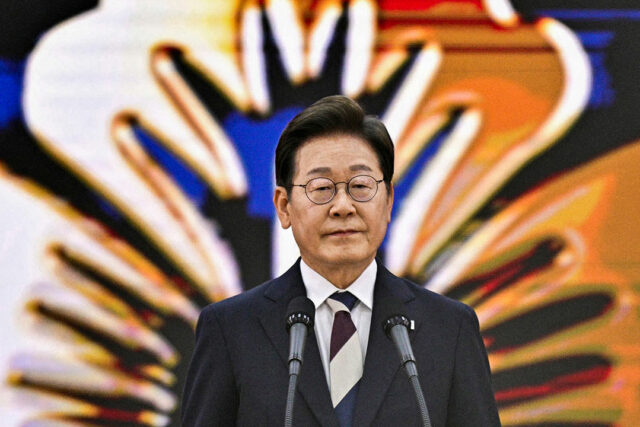
SOUTH KOREA’S President Lee Jae-myung delivers a speech after taking his oath during his inauguration ceremony at the National Assembly in Seoul on June 4, 2025. — REUTERS

SEOUL — South Korean President Lee Jae Myung held summit talks in Seoul on Monday with Brazilian President Luiz Inбcio Lula da Silva, where they agreed to expand cooperation in sectors including trade, key minerals, technology, and culture.

The leaders plan to elevate the bilateral relationship into a strategic partnership, and for the countries to work together to support stability on the Korean Peninsula, Mr. Lee said.

“Peace, built on conditions where conflict isn’t needed, is the strongest form of security,” the South Korean president told a joint press conference.

The leaders oversaw the signing of 10 memorandums of understanding (MOUs) spanning trade and industrial policy, core minerals, digital economy including AI, agriculture, health and biotech, small-business exchanges and joint policing against cybercrime, narcotics, and other transnational threats.

In earlier remarks, Mr. Lee said the two sides adopted a four-year action plan to map out concrete steps for expanding bilateral cooperation, from strategic minerals to defence and space industries, as well as food security.

Brazil is South Korea’s largest trading partner in South America, making economic cooperation a key part of the agenda.

Mr. Lula said Brazil holds large rare-earth reserves and has substantial nickel deposits, and that his government hoped to attract investment from South Korean companies.

In a message posted to X earlier in the day, Mr. Lee welcomed Mr. Lula, who is in Seoul for his first state visit in 21 years, pointing out the similarities in their backgrounds.

“As a former child laborer, you proved with your whole life that democracy is the most powerful tool for social and economic progress,” Mr. Lee wrote.

“I support your life, your struggle and your achievements, which will remain forever in the history of global democracy.”

The leaders, who first met at the G7 summit in Canada last year and later at the G20 summit in South Africa, appear to have bonded over shared experiences of childhood factory work and workplace injuries.

The talks took place in South Korea’s presidential Blue House, the first large-scale official welcome ceremony to be held since Mr. Lee moved his office back to the building.

A state banquet is scheduled for Monday evening where barbecue dishes and Brazilian bossa nova pieces are due to be performed by a Korean jazz band alongside a children’s choir, Mr. Lee’s office said. — Reuters

Court upholds jailing of 12 activists in ‘Hong Kong 47’ subversion case

STOCK PHOTO | Image by Klaus Hausmann from Pixabay

HONG KONG — Hong Kong’s Court of Appeal rejected an appeal by 12 pro‑democracy activists and upheld their jail terms on Monday in a national security case that critics say highlights the China-ruled city’s crackdown on dissent.

The appeal stems from the “Hong Kong 47” case, where many leading pro-democracy activists and politicians were arrested en masse in early 2021 and charged with conspiracy to commit subversion. Following marathon legal proceedings, most of the democrats were eventually sentenced in late 2024 to between 4 and 10 years’ imprisonment, with two others acquitted.

Rights groups and some countries, including the US and Britain, condemned the case as persecution of Hong Kong’s political opposition and called for the immediate release of all those arrested.

Australia’s Foreign Minister Penny Wong said she was “deeply concerned” that Australian citizen Gordon Ng had lost his appeal, noting Canberra has “expressed our strong objections to Chinese and Hong Kong authorities on the continuing broad application of national security legislation”.

Judges Jeremy Poon, Derek Pang, and Anthea Pang wrote in their judgment that the defendants were part of a conspiracy conceived, advocated and pursued by legal scholar Benny Tai to produce a “constitutional mass destruction weapon” aimed at toppling the constitutional order in Hong Kong.

‘WHAT CRIMES HAVE THEY COMMITTED?’
The case centered on an unofficial “primary election” organized by the democrats in mid-2020 to select the strongest candidates for a legislative council election.

The prosecution alleged that the democrats were conspiring to win a majority in order to paralyze the government by indiscriminately vetoing the city’s annual budget in a bid to force Hong Kong’s leader to resign.

The 11 democrats who lost appeals against their convictions included former lawmakers Helena Wong, Lam Cheuk-ting, Raymond Chan and “Long Hair” Leung Kwok-hung; former district councillors Clarisse Yeung, Kalvin Ho and Tat Cheng; and activists Gwyneth Ho, Owen Chow, Winnie Yu, Gordon Ng.

The democrats, and one other activist, Prince Wong, also failed in their appeals against their sentences, with the exception of Gwyneth Ho who only appealed her conviction.

After hearing the result, the defendants appeared calm and waved to their families and supporters.

“What crimes have they committed?” said Chan Po-ying, the wife of activist Leung Kwok-hung, after the ruling, echoing the arguments of some defense lawyers that legislators in Hong Kong were free to vote against any bills and veto the budget as a lawful “check and balance” under the city’s mini-constitution.

ACQUITTAL OF DEMOCRAT UPHELD
Despite the international criticism, Hong Kong and Beijing insist the democrats received a fair trial, and say a China-imposed national security law in 2020 helped restore order to Hong Kong after mass pro-democracy protests the year before.

The judges said any plan to veto the budget indiscriminately, regardless of its content or merits, was “clearly an abuse of the power (of legislators)”.

The judges, however, dismissed an appeal by the Department of Justice against the acquittal of barrister Lawrence Lau, saying he had never openly and directly advocated for the vetoing of the budget, like the others.

Mr. Lau told reporters he was “happy” with the result.

So far, 18 of the 45 convicted democrats have been released after serving their jail terms.

“By failing to overturn these wrongful convictions and sentences today, the court has missed a critical opportunity to correct this mass injustice,” said Fernando Cheung, a spokesman for Amnesty International Hong Kong Overseas.

“Peaceful opposition to a government is not a crime, and all remaining jailed members of the Hong Kong 47 should be released immediately and unconditionally.” — Reuters

[B-SIDE Podcast] Parenting In the Age of Four Generations

Follow us on Spotify BusinessWorld B-Side

Are parents supposed to be disciplinarians? Are they supposed to coddle us? Or are they supposed to be our friends?

In this B-Side episode, BusinessWorld talks together with VP for Corporate & Commercial Strategy, Barbara Young and Program Director & Strategist, Kristine Joyce Erni Santos of Acumen Strategy Consultants, uncovers insights parents of current generations need to better raise children in a way that bridges values across time.

Interview by Beatriz Cruz
Audio editing by Jayson John Marinas

Follow us on Spotify BusinessWorld B-Side

With US tariff rates up in the air, the economic fog again thickens

REUTERS/DADO RUVIC/ILLUSTRATION

WASHINGTON — US and foreign officials, corporate executives, analysts and investors had begun to hope the tumultuous US trade policy reversals of last year were finished. Now they face rekindled uncertainty from a US Supreme Court ruling last week that struck down key parts of President Donald Trump’s tariff plans and his ensuing suggestion of substantial levies coming in an attempted workaround.

Reminiscent of the early months of 2025, when the administration’s tariff proposals seemed to switch on a moment’s notice, the landscape of what goods will be taxed, at which rates, from which exporting countries, is again up in the air. Businesses, many of whom felt they’d found a workable approach to higher tariffs, will now have to decide whether to shift their pricing plans, rush to restock inventories while the tariffs are in limbo, and perhaps whether to delay hiring or investment plans while the situation gets sorted.

“If it shakes the whole equilibrium which people in trade have got used to…it is going to bring about disruptions,” European Central Bank president Christine Lagarde said Sunday on CBS’s “Face the Nation”. “You want to know the rules of the road before you get in the car. It’s the same with trade. It’s the same with investment.” People “want to do business. They don’t want to go into lawsuits,” she said, adding that she hoped any subsequent US tariff plans would be “sufficiently thought through so that we don’t have, again, more challenges, and the proposals will be in compliance with the Constitution.”

The Supreme Court in a 6-3 ruling on Friday voided most of the tariffs Trump imposed last year, finding that the emergency law he relied on did not allow the imposition of tariffs. Using a different statute Trump announced first a 10%, then a 15%, global levy that could last five months while the administration searches for more durable workarounds.

Gregory Daco, chief economist at EY-Parthenon, said even if businesses were finding ways to cope with the previous tariffs, the uncertainty around trade policy had never gone away, and will continue to influence business decision-making.

“We’ve seen extreme volatility by country and by product. That’s very uncertain still,” Daco said. “It’s impossible to plan. You hear that tariffs are off and you are considering how to get refunds. Then a few hours later it’s 10%. Then it’s 15% the next day….Not having that stable framework is hurtful for activity, hiring, investment.”

THE VIEW HAD BEEN CLEARING
The sense that the confusion of 2025 had begun to lift was widespread. US Federal Reserve policymakers for example had become comfortable that the inflation impact of tariffs was about to ease.

That may remain the case, but the situation is also now more fluid as the administration looks at different tariff strategies that could take months to spool out, with likely legal challenges at each turn.

Import tax rates could drop in the short term, but then might rise again over an uncertain timeline as Trump tries to replicate the tariffs the court said the president could not impose by fiat, by using different laws that may require separate investigations or even Congressional action.

The value of such procedural safeguards in producing stable policy was cited by Justice Neil Gorsuch in an opinion supporting the court’s majority. He argued that to survive the legislative process, proposals “must earn such broad support…they tend to endure, allowing ordinary people to plan their lives in ways they cannot when the rules shift from day to day.”

The value of certainty was mentioned often by Fed officials last year. They said the rapid shifts around trade, immigration and other policies had made it hard to read the economy, and seemed to be pushing businesses to the sidelines on hiring and investment decisions.

THE US OUTLOOK HAS BEEN BULLISH
Any economic fallout from the Supreme Court ruling comes at a moment of largely bullish sentiment. In a new poll by the National Association for Business Economics, nearly 60% of economists who responded said they did not expect a recession for at least a year, up from 44% as of August. A solid majority of 74% also said they felt the spread of AI technology would at least “moderately increase productivity growth over the next three to five years,” a potentially significant change in the capacity of the US economy.

The new round of uncertainty may not push that off course, but it could still “ding” US growth in coming months, Bernard Yaros, lead US economist for Oxford Economics, wrote on Friday following the Supreme Court ruling.

He estimated the effective tariff rate, after excluding the levies tossed out by the Supreme Court, would fall from 12.7% to 8.3%. But that leaves open the impact of Trump imposing the new 15% levy across the board — which may or may not apply to countries that have reached separate bilateral deals with Trump, and would only last for five months. The administration, meanwhile, will be looking for more permanent fixes that may require separate investigations and potentially Congressional action.

“Any economic boost from lowering tariffs in the near term will likely be partly offset by prolonged uncertainty,” he said. “Even if the administration replicates the overall level of tariffs using other means, the by-sector and by-country implications could end up looking quite different, which will create another bout of trade policy uncertainty for businesses, investors, and households.” — Reuters

Nearly 200,000 families in Mindanao affected by shear line

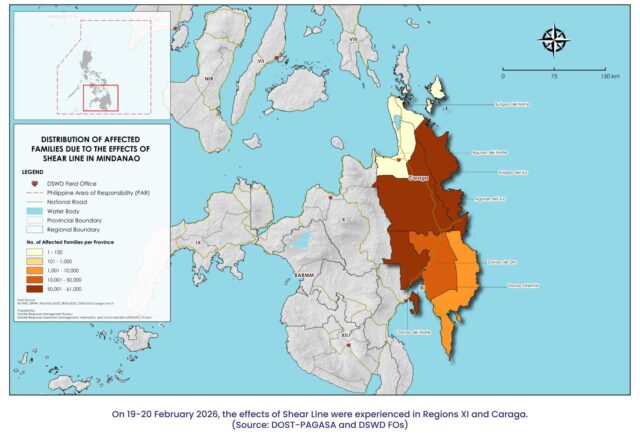
Visualization of the distribution of affected families due to the effects of the shear line.—DOST-PAGASA
Nearly 200,000 families in Mindanao were reported affected by shear line, according to Department of Social Welfare and Development (DSWD) on Monday.

Areas affected include Region XI and Caraga, covering at least 469 villages, or barangays, DSWD said in a 6:00 a.m. progress report.

Of affected families, 2,672 are taking shelter in 74 open evacuation centers, while 22,205 are staying with friends and relatives.

DSWD also reported 27 totally damaged houses and 53 partially damaged houses due to effects of shear line.

Humanitarian assistance of nearly P46 million has been provided to affected families as of report.

Meanwhile, shear line — a zone where cold northeast monsoon winds meet warm easterlies, creating rain clouds — is expected to affect eastern parts of Southern Luzon and Visayas, according to Philippine Atmospheric, Geophysical and Astronomical Services Administration (PAGASA) on Monday.

Cloudy skies with scattered rains are expected in Albay, Sorsogon, Masbate, and Samar, PAGASA said in a 4:00 a.m. advisory.

It also warned of possible flash floods and landslides during moderate to occasionally heavy rains.

The conditions are likewise expected in Palawan and rest of Visayas, while rest of country will be affected by prevailing easterlies and northeast monsoon. — Edg Adrian A. Eva

SM Prime sustains its commitment to future sustainability leaders

SM Prime Holdings, Inc. (SM Prime) continues to advocate sustainability education with its SM Sustainability Scholarship Program in partnership with the University of the Philippines – Los Baños (UPLB).

SM Smart City AVP and Head of Corporate Communications and PR Rida Reyes Castillo (second from right) and Senior PR Manager Kirk Maurice Campos (far left) formally turned over the scholarship assistance to UPLB Vice-Chancellor for Student Affairs Dr. Janette Malata-Silva (center) with Office of Scholarship and Grants Coordinator Ivy Selarde (right).

UPLB Scholars

Now in its third year, the program continues to support scholars taking up sustainability-driven courses, reinforcing SM Prime’s long-term commitment to nurturing sustainability champions for the country.


Spotlight is BusinessWorld’s sponsored section that allows advertisers to amplify their brand and connect with BusinessWorld’s audience by publishing their stories on the BusinessWorld Web site. For more information, send an email to online@bworldonline.com.

Join us on Viber at https://bit.ly/3hv6bLA to get more updates and subscribe to BusinessWorld’s titles and get exclusive content through www.bworld-x.com.

RTOA Davao unveils electric taxis, signals shift toward sustainable transport

LTFRB Region XI Director Nonito “Dondon” Llanos and RTOA Region XI President Ryan Sia lead the ribbon-cutting ceremony, formally marking the launch of EV taxis under the RTOA fleet.
The Regional Taxi Operators Association (RTOA), the largest coalition of local taxi operators in Davao City, has announced a pilot rollout of electric vehicles in its fleet, signaling a strategic shift toward more sustainable urban transport in the region. The initiative was unveiled during a press conference in Davao City, where RTOA presented the initial batch of electric taxi units now cleared to operate as part of its active fleet.
Representing approximately 70% of taxi operators in Davao, RTOA’s initiative reflects a collective effort by local operators to embrace cleaner mobility solutions while ensuring full compliance with existing transport regulations set by the local government and agencies such as the Land Transportation Franchising and Regulatory Board (LTFRB).
“As proud Davaoeños, we stand ready to help lead the shift to sustainable mobility for our kababayans,”  shared RTOA President Ryan Sia. “For decades, we have served Davaoeño commuters, and we welcome every opportunity to raise the standard of service they deserve. Today, we take a meaningful step forward — honoring our responsibility to the public and our duty to the future. We are honored to walk alongside the government in modernizing the local taxi fleet, moving hand in hand with operators and drivers toward a cleaner, safer, and more progressive Davao City.”
RTOA will proactively share operational learnings from the pilot, covering vehicle performance, charging patterns, cost efficiency, and rider feedback, with the local government and transport regulators, including the LTFRB, to help inform a collaborative road map for electric mobility in Davao.
The group noted that regular updates from the pilot can guide practical decisions on charging infrastructure rollout and policy refinements, ensuring that regulations and support systems evolve in step with real-world operating conditions and build a more sustainable environment for EV adoption.
The initiative has the expressed support of the LTFRB, reinforcing RTOA’s position that the adoption of electric vehicles should proceed through established regulatory channels.
“LTFRB acknowledges the importance of the Electric Vehicles Industry Development Act or EVIDA law. It’s very necessary that we have to move forward, we have to transform our taxis into better, comfortable, reliable, environmental, friendly taxis to make sure that the triple S: satisfaction, security, and success will be experienced by our taxi drivers, operators and our passengers,” said LTFRB XI Regional Director Nonito “Dondon” Llanos III during the event.
As RTOA prepares to scale its electric fleet, Mr. Sia said the pilot is only the start — an early but important step that strongly positions local taxi operators to stay competitive as electric mobility takes hold in the Philippine transport landscape.

Spotlight is BusinessWorld’s sponsored section that allows advertisers to amplify their brand and connect with BusinessWorld’s audience by publishing their stories on the BusinessWorld Web site. For more information, send an email to online@bworldonline.com.

Join us on Viber at https://bit.ly/3hv6bLA to get more updates and subscribe to BusinessWorld’s titles and get exclusive content through www.bworld-x.com.

Tariff ruling limits Trump’s leverage but won’t end uncertainty for trade partners

REUTERS

WASHINGTON – The US Supreme Court’s decision to strike down a large swath of President Donald Trump’s tariffs has weakened his ability to threaten and impose tariffs at a moment’s notice, but it won’t end gnawing uncertainty for trade partners or companies.

Trump responded within hours to the ruling on Friday, slapping a new 10% tariff on all imports and ordering new trade investigations that could lead to additional levies in months, while insisting that trade and investment deals reached with nearly 20 countries – most with higher tariffs – should remain untouched.

Less than 24 hours later, he raised the rate of the new tariff to 15% – the maximum level allowed under the law.

Wendy Cutler, a former US trade official and senior vice president at the Asia Society Policy Institute, said Trump’s rapid-fire change was emblematic of the president’s desire – and ability – to keep trading partners on their toes.

“The uncertainty, in his view, just gives him enormous additional leverage beyond the actual tariffs. Because people are worried about what he’ll do.”

But Cutler and other trade experts agree Trump’s wings have been clipped. The 10% replacement tariff lasts only 150 days, and new tariffs imposed under other statutes will take longer to implement, robbing the president of the “anytime, anywhere for any reason” cudgel he used to impose tariffs before his use of the International Emergency Economic Powers Act was nixed.

“He’s lost his favorite tool,” Cutler said. “Particularly for foreign policy matters and things that irk him on other countries that have nothing to do with trade, he’s lost the ability to offer a credible threat.”

William Reinsch, a former senior US government official who is now with the Center for Strategic and International Studies, said the Supreme Court’s solid 6-3 ruling diminished Trump’s ability to threaten other countries.

“It takes away his ability to wave the big stick around,” he said, although the economic impact will be limited, with the 10% tariff and other duties expected in coming months replacing some if not all the tariffs now deemed illegal.

Michael Froman, president of the Council on Foreign Relations, said the ruling and the administration’s response left many questions unanswered, including how importers could get refunds for duties collected illegally, and what further tariffs were still coming.

“Perhaps the most consequential impact of the Supreme Court’s decision is that it should curtail the threat or use of tariffs as the president’s preferred form of leverage or punishment outside the trade domain,” said Froman, who served as former President Barack Obama’s chief trade negotiator from 2013 to 2017.

That development could provide relief to countries scarred by Trump’s unpredictability and repeated use of tariff threats to punish them over non-trade matters, extract concessions and secure foreign investments.

The US president had invoked IEEPA to impose tariffs over a range of non-trade issues, leaving countries bruised and skittish, and heightening uncertainty for companies around the world. He threatened tariffs against European countries over their opposition to his claims on Greenland, against Canada for allowing the importation of electric vehicles from China, and against Brazil for its treatment of far-right former President Jair Bolsonaro, a Trump ally.

NO MORE ‘TRADE BAZOOKA’

Josh Lipsky, chair of international economics at the Atlantic Council, cautioned that it was too early to predict the impact of the Supreme Court’s ruling on Trump’s leverage, given uncertainty about fresh tariffs and the president’s willingness to use a range of tools.

“It’s a significant blow to his international economic trade agenda. It’s not a crippling one, necessarily, because of the other authorities, but we have to see how they play out in practice,” he said. “It feels like the ‘tariff armada’ has come to the rescue despite IEEPA. But how that plays out in terms of leverage is a different question in the months ahead.”

It is also unclear what will happen to nearly 20 framework deals or firmer trade agreements that the Trump administration has reached with countries in recent months that were based on the IEEPA tariff threats.

Trump, US Trade Representative Jamieson Greer and Treasury Secretary Scott Bessent insisted on Friday that the deals should remain in effect, even if those rates were higher than the temporary universal tax.

Analysts said they doubted countries could seek to abrogate or renegotiate deals, out of concern of triggering Trump’s ire.

Miriam Sapiro, a former senior US trade official and adjunct professor of international and public affairs at Columbia University, said Trump might have lost his “trade bazooka,” but she didn’t expect the existing deals to unravel. However, the ruling could give countries more leverage in new or ongoing negotiations with the Trump administration, Sapiro said.

“There’ll still be interest in doing deals because of the uncertainty and the desire to keep the US as a strong ally and strong partner,” she said. “But countries do have a bit more bargaining power than they might have felt they had previously.”

From Trump’s perspective, she said, using IEEPA was a risk he was willing to take because it helped reel in some trade deals quickly, although details still needed to be worked out in some cases and enforcement could be challenging.

Greer told Fox News’ “Special Report” program that IEEPA was the appropriate tool at the time, given Trump’s desire to move quickly and flexibly, and said it had helped open market access for US firms. “We don’t regret it,” he said. “We’ll just use a different tool.”

Initial reactions from overseas were measured as countries assessed the Supreme Court decision. South Korea said it would review the ruling and US response and planned to continue “amicable” talks over implementation of a tariff agreement finalized in November with $350 billion in investment pledges.

Tom Ramage, an economic policy analyst at the Korea Economic Institute of America, said the Trump administration’s continued ability to tap other tariff measures would likely persuade South Korea and its companies to maintain their commitments.

“Anything less could increase the likelihood that the president will impose further retaliation, especially if the administration seeks to make an example of countries that want to back out of negotiated deals,” he wrote on KEI’s website. — Reuters


Mexican drug lord killing sparks revenge attacks; cars and businesses set ablaze, highways blocked

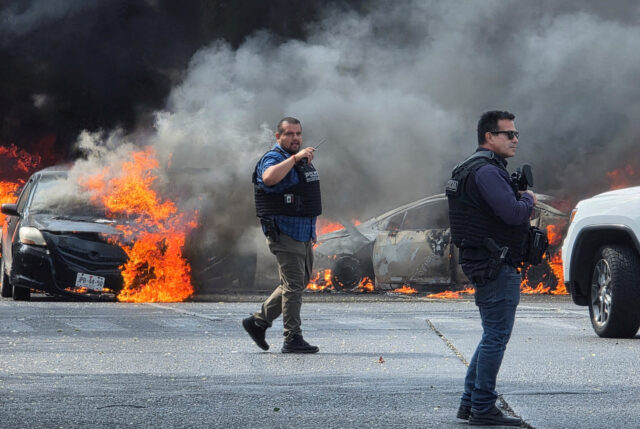
Police officers secure the area where vehicles were set on fire by organized crime members to block a road following a military operation in which a government source said Mexican drug lord Nemesio Oseguera, commonly known as "El Mencho," was killed, in Zapopan, Mexico, Feb. 22, 2026. REUTERS/GILBERTO GALLO

WITHIN hours of the killing of Mexican drug lord Nemesio Oseguera, better known as El Mencho, in a military raid on Sunday, gunmen suspected to be his supporters blocked highways across several states and set cars and businesses ablaze.

In some towns tourists and residents were urged to stay indoors, while truckers were advised to take safe routes or return to their depots until the violence abated.

Several airlines, including Air Canada, United Airlines, and Aeromexico, on Sunday cancelled flights to Puerto Vallarta, a beachside resort town where stunned tourists filmed plumes of smoke rising into the sky from fires.

The burst of violence across more than half a dozen states painted a familiar scene for Mexicans who have spent two decades watching successive governments wage war on drug cartels, ravaging broad swaths of the country.

A member of Mr. Oseguera’s Jalisco New Generation Cartel told Reuters that the blazes and sporadic gunfire were carried out in revenge for the government’s killing of Mr. Oseguera, and warned of further bloodshed as groups move to take control of his cartel.

“The attacks were carried out in revenge for the leader’s death, at first against the government and out of discontent,” the person said, speaking on condition of anonymity.

“But later the internal killings are coming, by the groups moving in to take over.”

In Mexico’s Pacific coast, a five-hour drive from the military operation in the town of Tapalpa that took down the leader of the powerful Jalisco New Generation Cartel, stunned beachgoers on a pier in Puerto Vallarta took out their cell phones to film thick waves of smoke obscuring blue ocean views, showed a video shared with Reuters.

Daniel Drolet, a Canadian who has wintered in Puerto Vallarta for years, said in a phone interview that he was concerned of a new era of violence taking root in the typically placid resort zone.

“I have never seen anything like this before,” he said.

In the state of Jalisco, authorities reported that gunmen had attacked a base for the National Guard military police, and recommended guests remain inside hotels and suspended public transit.

Other scenes of criminal activity and military response were captured in videos shared by government security sources with Reuters: A green military tank made its way through a residential neighborhood in the state of Aguascalientes. Roadblocks paralyzed the highly transited Mexico-Puebla highway. In the state of Colima, cartel members standing in pick-up trucks blocked a road.

A trucking industry group said in a statement it was “profoundly worried” by the highway violence and recommended that truckers keep to safe areas or return to their operating yards until conditions improved.

The state of Guanajuato, a CJNG stronghold, reported 55 incidents across 23 municipalities, with 18 arrests, but said by evening all incidents were under control.

Carlo Gutierrez, who lives in Guadalajara, Jalisco’s capital, said that friends on WhatsApp groups were encouraging people to stay home.

“There is fear and a lot of caution,” he said of the city, one of three main Mexican venues for World Cup soccer matches this summer.

VIOLENCE IN WAKE OF CARTEL ARRESTS, KILLINGS
Authorities have not reported any casualties beyond several cartel members and officials killed during the military operation.

Previous cartel arrests and killings have led to outbreaks of violence – whether by members avenging their fallen leader or rival gangs muscling in on their territory – prompting Mexican authorities to hesitate before launching major campaigns.

In 2019, Ovidio Guzman, a son of Sinaloa Cartel kingpin Joaquin “El Chapo” Guzman, was detained but quickly released, setting off widespread gun battles. His arrest in 2023 set off more violence.

The 2024 arrest of Sinaloa Cartel boss Ismael “El Mayo” Zambada triggered a bloody power struggle in the criminal group that continues unabated more than a year later.

“I’m watching the scenes of violence from Mexico with great sadness and concern,” said US Deputy Secretary of State Christopher Landau, who previously served as ambassador to Mexico, in a post on social media.

“It’s not surprising that the bad guys are responding with terror. But we must never lose our nerve.”

Mexico’s President Claudia Sheinbaum in a social media post acknowledged the violence, but struck a tone of calm.

“In most of the national territory activities are happening with absolute normalcy,” she said. — Reuters

Hundreds protest in Verona ahead of Olympics closing ceremony

A general view shows the Olympic rings on the Cortina Curling Olympic Stadium, which will host the curling, wheelchair curling, and Paralympic closing ceremony during the Milano Cortina Winter Olympic Games 2026, in Cortina, Italy, Jan. 25, 2025. REUTERS/CLAUDIA GRECO

VERONA, Italy — Hundreds of people marched through the streets of Verona a few hours before the Olympics closing ceremony to protest against housing costs and environmental concerns linked to the Winter Games.

The rally, “Olympics? No thanks”, was organized by university groups and associations that oppose hosting an event they say disrupts forests, pours concrete onto fragile land and deepens social inequality.

“We are here to defend our territory from speculation… and from the impossible cost of attending events,” said Giannina Dal Bosco, a 76‑year‑old activist.

Tickets for the ceremony were priced from 950 euros ($1,120) to a top level of 2,900 euros. It started at 8:30 p.m. (1930 GMT) inside Verona’s ancient Roman arena.

One banner read: “Fewer Games for the few, more homes for everyone.”

Francesca, 34, who traveled from Vicenza, about 60 kilometers (40 miles) away, said the landscape had been “disfigured” by new Olympic structures.

“They built concrete monstrosities like the bobsleigh track, which will serve no purpose,” she said. “Public money has been wasted that could have been used for hydrogeological safety and housing plans.”

Several protesters wore keffiyeh scarves and waved Palestinian flags.

Protesters marched for around two hours outside the security perimeter, from the 16th‑century Porta Palio to the 19th‑century Arsenal Square.

They briefly stopped at the point closest to the red zone, unsuccessfully asking to be allowed inside. Before the march moved on, activists painted the words “FIVE CIRCLES, A THOUSAND DEBTS” in large letters on the road.

Verona’s mayor Damiano Tommasi said high‑profile events such as the Olympics always carried the risk of people seeking visibility and trying to exploit the moment, and that it was appropriate to deploy a heightened level of security.

A much larger demonstration — drawing nearly 10,000 people — took place in Milan on the first day of the Games and later turned violent. ($1 = 0.8482 euros). — Reuters

Tehran is ready for nuclear concessions if US meets demands, Iranian official says

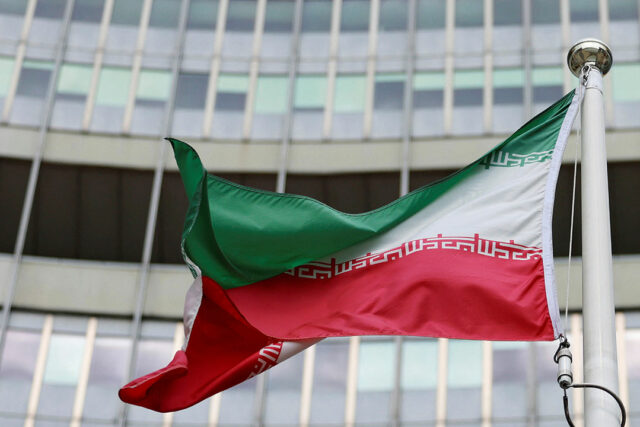
THE Iranian flag flutters outside the IAEA headquarters in Vienna, Austria, June 9, 2025. — REUTERS/LISA LEUTNER

DUBAI — Iran has indicated it is prepared to make concessions on its nuclear program in talks with the US in return for the lifting of sanctions and recognition of its right to enrich uranium, as it seeks to avert a US attack.

Both sides remain sharply divided — even over the scope and sequencing of relief from crippling US sanctions — following two rounds of talks, a senior Iranian official told Reuters.

However, Reuters is reporting for the first time that Iran is offering fresh concessions since their talks ended last week, when the sides appeared far apart and heading closer to military conflict. Analysts say the move suggests Tehran is trying to keep diplomacy alive and stave off a major US strike.

The official said Tehran would seriously consider a combination of sending half of its most highly enriched uranium abroad, diluting the rest and taking part in creating a regional enrichment consortium – an idea periodically raised in years of Iran-linked diplomacy.

Iran would do this in return for US recognition of Iran’s right to “peaceful nuclear enrichment” under a deal that would also include lifting economic sanctions, the official said.

In addition, Iran has offered openings for US companies to participate as contractors in Iran’s large oil and gas industries, the official said, in negotiations to resolve decades of dispute over Tehran’s nuclear activities.

“Within the economic package under negotiation, the United States has also been offered opportunities for serious investment and tangible economic interests in Iran’s oil industry,” the official said.

The White House did not respond immediately to queries on the issue.

Washington views enrichment inside Iran as a potential pathway to nuclear weapons. Iran denies seeking nuclear weapons and wants its right to enrich uranium to be recognized.

Iran and the United States resumed negotiations earlier this month as the US builds up its military capability in the Middle East. Iran has threatened to strike US bases in the region if it is attacked.

The Iranian official said the most recent discussions underscored the gap between the two sides, but stressed that “the possibility of reaching an interim agreement exists” as negotiations continue.

IRAN SEEKS ‘LOGICAL TIMETABLE’ FOR LIFTING SANCTIONS
“The last round of talks showed that US ideas regarding the scope and mechanism of sanctions relief differ from Iran’s demands. Both sides need to reach a logical timetable for lifting sanctions,” the official said.

“This roadmap must be reasonable and based on mutual interests.”

Iran’s Foreign Minister Abbas Araqchi said on Sunday he expects to meet with US President Donald Trump’s special envoy Steve Witkoff in Geneva on Thursday, adding there is still “a good chance” of a diplomatic solution.

Mr. Araqchi said on Friday that he expected to have a draft counterproposal ready within days, while Mr. Trump said he was considering limited military strikes.

Citing officials on both sides and diplomats across the Gulf and Europe, Reuters reported on Friday that Tehran and Washington are sliding rapidly towards military conflict as hopes fade for a diplomatic settlement.

On Sunday, Mr. Witkoff said the president was curious as to why Iran has not yet “capitulated” and agreed to curb its nuclear program.

“Why, under this pressure, with the amount of seapower and naval power over there, why haven’t they come to us and said, ‘We profess we don’t want a weapon, so here’s what we’re prepared to do’? And yet it’s sort of hard to get them to that place,” Mr. Witkoff said on Fox News.

READINESS TO COMPROMISE ON NUCLEAR WORK
Behnam Ben Taleblu, senior director of the Iran program at the Foundation for Defense of Democracies, said Iran’s leadership is seeking to buy time via the talks.

“Iran will use that time for various reasons, including to avoid a strike and to harden nuclear, missile, and military facilities,” he said.

While rejecting a US demand for “zero enrichment” – a major sticking point in past negotiations – Tehran has signalled its readiness to compromise on its nuclear work.

Washington has also demanded that Iran relinquish its stockpile of highly enriched uranium (HEU). The International Atomic Energy Agency last year estimated that stockpile at more than 440 kg of uranium enriched to up to 60% fissile purity, a small step away from the 90% that is considered weapons grade.

Ali Larijani, a close adviser to Iran’s supreme leader, told Al Jazeera TV that Iran was ready to allow extensive IAEA monitoring to prove it is not seeking nuclear weapons.

The agency has been calling on Iran for months to allow for inspection of three nuclear sites that were struck by the US in June last year at the close of a 12-day Israeli bombing campaign. Since then, Tehran has said its uranium enrichment work has stopped.

Satellite images show that Iran has advanced work at a location reportedly bombed by Israel last year, recently building a concrete shield over a new facility at a sensitive military site and covering it in soil, experts say.

BENEFITS FOR BOTH SIDES
Among US demands are restrictions on Tehran’s long-range ballistic missiles and an end to its support for regional proxy groups.

Iran has flatly rejected discussing its missiles, while sources have told Reuters, without elaborating, that “the issue of regional proxies is not a red line for Tehran”.

Iranian authorities have said that a diplomatic solution would provide economic benefits for both Tehran and Washington.

The Iranian official said Tehran would not hand over control of its oil and mineral resources.

“Ultimately, the US can be an economic partner for Iran, nothing more. American companies can always participate as contractors in Iran’s oil and gas fields.” — Reuters

Further easing seen amid growth woes

Last-minute shoppers flock to Blumentritt Market, Dec. 31, 2025. — PHILIPPINE STAR/RYAN BALDEMOR

By Katherine K. Chan, Reporter

THE BANGKO SENTRAL ng Pilipinas (BSP) may extend its easing cycle this year to provide the Philippine economy with more support as lingering uncertainty continues to test consumer and business confidence, analysts said.   

“Against this backdrop of softer demand, elevated real rates, and lingering confidence issues, the door remains open for additional monetary easing,” ING Think Regional Head of Research for Asia-Pacific Deepali Bhargava said in a commentary.

This came even after BSP Governor Eli M. Remolona, Jr. said the policy path ahead is now less certain as they deemed that monetary policy easing may be insufficient to boost economic growth.

At its first policy review of the year, the central bank last week trimmed the key interest rate by 25 basis points (bps) to an over three-year low of 4.25%.

The sixth straight cut brought its total reductions to 225 bps since it began easing in August 2024. 

However, Mr. Remolona earlier left the door open to supporting growth further through monetary policy as long as inflation remains manageable.

In 2025, Philippine economic growth slumped to a post-pandemic low of 4.4% after it posted a 3% expansion in the final quarter of the year, as weak confidence continued to stall investments, consumption and government spending amid the flood control mess. 

This was below the BSP’s 4.6% full-year projection and led the country to miss its growth targets for a third straight year.

Mr. Remolona has said that they expect confidence to recover in a few months as current data point to improving market sentiment, noting that their next policy decision will hinge on how fast confidence will be regained.

Still, the BSP sees Philippine gross domestic product (GDP) growth settling below the government’s 5%-6% target this year as it slashed its projection to 4.6% from 5.4% previously.

For 2027, it expects the GDP to expand by 5.9%, also lower than its earlier estimate of 6.3%.

GROWTH CONCERNS
Continued government underspending may continue to dampen both fiscal outlays as well as household and business confidence, Ms. Bhargava said.

“The latest (fourth-quarter) data show that soft government spending has become a more persistent drag, weighing not only on fiscal outlays but also on business and household confidence,” she said.

“We expect this pressure to persist at least through the first half of 2026, given ongoing investigations and unresolved political uncertainty that continue to dampen sentiment.”

Government spending has fallen for four consecutive months, after it declined by 9.61% year on year to P498.3 billion in November, latest Treasury data showed.

Ms. Bhargava also noted that real rates remain high even as the central bank has eased for a sixth time in a row.

“Real rates remain elevated at around 2.25% even after today’s rate cut, with the latest inflation print at roughly 2%,” she said. “This keeps monetary conditions tighter than what current economic momentum seems able to absorb.”

Maybank economists Azril Rosli and Suhaimi Ilias likewise see the BSP delivering one more final 25-bp cut this year to help the economy rebound following its underperformance last year.

“The Philippine economy grew at its weakest pace in five years in 2025 at 4.4% (2024: 5.7%), undershooting the official national target of 5.5-6.5% growth,” they said in a commentary. “In view of this, we still see room for one final 25-bp cut this year to 4%.”

Meanwhile, Nomura Global Markets Research Chief ASEAN Economist Euben Paracuelles and Research Analyst Yiru Chen maintained their view that the BSP will bring its key policy rate further down to 4%, especially after the central bank veered away from its “nearing the end of the easing cycle” sentiment.

“BSP also sounded dovish by removing the line that the end of the easing cycle is near. We reiterate our forecast that BSP will cut again by 25 bps in April,” they said in a note.

The Monetary Board is set to hold its next rate-setting meeting on April 23.