Home Blog Page 2214

SCG profit climbs 53% on economic upswing

SIAM CEMENT Group (SCG),  a regional conglomerate with subsidiaries in the Philippines, reported a 53% increase in its second-quarter net profit to P5.86 billion ($102 million) compared to the previous quarter, driven by economic upturns across its markets.

Total revenue for the second quarter rose 3% quarter on quarter to P202.46 billion ($3.54 billion), SCG said in a statement e-mailed over the weekend.

“SCG reported a surge in second-quarter profit, buoyed by economic upturns in Vietnam and Indonesia,” it said.

“The company is implementing strategies to counter domestic economic headwinds and global uncertainties, including cost-cutting measures, AI integration, and a push into low-carbon cement,” it added.

For the first half, SCG generated P398.71 billion ($6.98 billion) in total revenue, nearly matching last year’s figures. SCG Chemicals had the highest revenue contribution at 39%.

“High-value-added products and services accounted for 39% of total sales, while environmentally friendly products under the SCG Green Choice brand made up 54%. The company also saw strong growth in its overseas operations, with 44% of total revenue generated outside Thailand,” it said.

SCG managed to sustain its growth trajectory despite headwinds such as the petrochemical downturn, intense competition, and a sluggish domestic economy.

The company increased the use of alternative fuel in its cement operations to mitigate surging energy costs. It also used artificial intelligence to improve operational efficiency by tailoring its product offerings to meet customer needs.

SCG said it is ramping up its global presence and product offerings led by the promotion of the low carbon cement, with exports to the United States surpassing one million tons, as well as ongoing expansion into Vietnam and Australia.

The company’s distribution arm, SCG Distribution and Retail, is also expanding its retail footprint in the Southeast Asian region while SCG Smart Living is introducing new landscape materials and heating, ventilation, and air conditioning systems.

It is also making progress in the construction materials sector, with a focus on high-value products and expanding into new markets like India.

SCG has a presence in the Philippines through seven subsidiaries namely, United Pulp and Paper Co., Inc., Mariwasa Siam Ceramics, Inc., SCG Roofing Philippines, Inc., SCG Trading Philippines, Inc., SCG Marketing Philippines, Inc., Green Siam Resources, Inc., and Green Alternative Technology Specialist, Inc. — Revin Mikhael D. Ochave

Fake cows ready for milking at US state fairs as bird flu threat looms

REUTERS

WEST ALLIS, Wisconsin — In Michigan this year, where dairy workers and herds have fallen ill from bird flu, a pair of unlikely prized cows are being prepped to take the state fair stage.

State fair organizers are this year featuring Milkshake and Buttercup, two life-sized fiberglass cows complete with rubber teats and water-filled udders, for a popular milking demo.

The head of the Minnesota State Fair’s Moo Booth came up with a similar work around for its hands-on milking event: a fake dairy cow named Olympia.

“Normally, we’d have a real cow out there,” said Jill Nathe, the fair’s deputy general manager of agriculture and competition. “We just can’t do that right now.”

As avian influenza continues to spread, infecting cattle herds for the first time this year as well as four dairy workers, US state and county fair organizers have been forced to reimagine nostalgic summer traditions long celebrated by city and rural folk alike.

For farmers and students eager for blue ribbons and bragging rights, the outbreak has forced them to navigate new testing rules and manage logistical headaches in order to obtain a clean bill of health for animals before entering the show ring.

State and local officials say they are trying to protect people and animals from the H5N1 virus as some dairy farmers have declined to test their herds.

Experts worry that further transmission of the virus could help it adapt to spread between humans. The risk of viral spread among herds prompted some county fairs in Michigan to cancel dairy shows, while the Iowa State Fair shuttered its milking barn.

In Minnesota, state fair staff procured extra gloves and face shields from COVID-era stockpiles for the livestock crew, and kept pregnant dairy cows out of the fair’s birthing center.

Several farm states, including Wisconsin, required lactating cattle to test negative within seven days of arriving at the fairgrounds.

Wisconsin dairy farmer Rick Thompson said he had to carefully time visits from his veterinarian, so the milk test results for H5N1 would fall within the required window for different fairs. His vet’s wife personally drove samples to a state lab in Madison to ensure they arrived on time for testing. “It’s not a convenient thing,” said Thompson, 57, who has attended Wisconsin’s state fair for 46 years.

Michigan banned lactating cows from all public exhibitions until the state goes two months without finding an infected herd. With only one state fair per year, the chance has passed for 2024.

Michigan last reported a case on Monday.

“We were all waiting for that 60-day window,” Michigan State Fair livestock director LC Scramlin said. “But we kept having another case and another one happen.”

At the Wisconsin State Fair, where visitors can buy everything from cream puffs to hot tubs, veterinarians inspected cattle before they stepped off their trailers to make sure the animals were healthy upon arrival — a departure from previous years, exhibitors said.

The risk of bird flu was enough to convince Jennifer and Bethany Droessler to keep a lactating cow at home. The sisters from Cuba City, Wisconsin, instead hauled other cattle to show at the event’s Dairy Lane, where fairgoers petted and took selfies with animals topping the scales at more than 1,000 pounds (454 kg).

“We’ll aim for next year and hopefully it won’t be an issue,” said Jennifer Droessler, 30.

More than 190 dairy herds nationwide have been infected since March, and 13 farm workers tested positive following exposure to cows and poultry. The workers all recovered, and the US Centers for Disease Control and Prevention (CDC) says H5N1 remains a low risk for the general public.

Still, CDC is advising people not to eat, drink or touch anything in animal areas at fairs. Several fairgoers in Wisconsin, the No. 2 milk-producer and top cheese-making state, said they were not aware of, or concerned about, the guidelines.

Visitors chomped on treats including taffy apples and cheese curds as they strolled between cows chewing their cud.

“I don’t think it’s a big risk,” said O.E. Glieber of Delafield, Wisconsin, 88, who came to the fair with grandchildren. “The CDC overreacts with a lot of stuff.” — Reuters

To secure peace in the Indo-Pacific region, include Taiwan in the UN system

LISANTO-UNSPLASH

TAIWAN is an indispensable partner in global supply chains, producing more than 90% of the world’s high-end semiconductors and a significant portion of the advanced chips that are driving the AI revolution. Moreover, half of the world’s seaborne trade passes through the Taiwan Strait, making it a key international waterway. Yet even though large parts of the world — and billions of people — have enjoyed great prosperity thanks to the peace and stability that prevails across the strait, China continues to intensify its aggressive actions against Taiwan. Beijing’s attempts to change the status quo across the Taiwan Strait and expand authoritarianism throughout the Indo-Pacific region are a profound threat to peace and security all around the world.

In recent years, global leaders have used both bilateral and multilateral occasions — including the G7, EU, NATO, and ASEAN meetings — to highlight the importance of maintaining peace and stability across the Taiwan Strait. However, despite being aware of the importance of reducing tensions in the region, the United Nations (UN) has yet to take action to address the challenges posed by the PRC (People’s Republic of China) or to incorporate Taiwan in the UN system. As new approaches to engaging with Taiwan have emerged in the global community, yielding huge global benefits, the idea that there must be a choice between the PRC and Taiwan in the UN system is a false dichotomy. Now is the right time for the UN to evolve and to rethink its unjustified policies that exclude Taiwan.

The first and most urgent task that the UN must address is to stop succumbing to the PRC’s pressure and refrain from distorting UN General Assembly (UNGA) Resolution 2758 adopted in 1971 any further. By willfully misrepresenting Resolution 2758 and falsely conflating it with its own “one China principle,” which differs from the “one China policy” adopted by many countries, the PRC has relentlessly suppressed Taiwan’s legitimate right to meaningfully participate in the UN and its specialized agencies.

This misrepresentation has far-reaching consequences beyond denying Taiwanese citizens and journalists access to UN premises and preventing them from visiting, attending meetings, and engaging in newsgathering. In fact, Beijing’s tactic of weaponizing Resolution 2758 to spread the fallacy that Taiwan is part of the PRC is one of the key elements in a wider campaign to establish the legal basis for justifying a future armed invasion of Taiwan. Yet, contrary to the PRC’s false claims, Resolution 2758 merely addresses the issue of China’s representation in the UN. It does not mention Taiwan. It neither states that Taiwan is part of the PRC nor ascribes to the PRC any right to represent Taiwan in the UN system. In other words, the resolution has nothing to do with Taiwan.

This case is illustrative of the PRC’s growing assertiveness in imposing its will on the international stage. And if left unchallenged and uncorrected, Beijing’s false claims will not only alter the status quo across the Taiwan Strait but also jeopardize peace and stability in the Indo-Pacific region and threaten the rules-based international order.

Thankfully, in recent months, several senior US officials have criticized the PRC’s distortion of Resolution 2758 to justify its spurious claim over Taiwan. Furthermore, on July 30, the Inter-Parliamentary Alliance on China, an international organization comprising over 250 members of parliament from 38 countries and the EU, demonstrated concrete support for Taiwan by passing a model resolution on Resolution 2758. To maintain international peace and security as outlined in the UN Charter, the UN must return to and encourage a correct interpretation of Resolution 2758 and explore means of resisting the PRC’s aggressive ambitions.

The PRC’s expansionism will not stop at Taiwan. Recent regulations introduced by the China Coast Guard are part of a broader gray-zone tactic designed to reinforce the PRC’s specious territorial claims and expand its influence. By introducing rules that justify the boarding and detaining of vessels and allow individuals to enter disputed maritime areas, Beijing aims to assert control over international waters and challenge global norms and claims. To ensure global peace and economic stability, the UN and the international community must not only reaffirm their concerns about Beijing’s coercive behavior but also work together to prevent its unlawful schemes.

History has shown that democratic resolve must be demonstrated ahead of time — before it is too late. As the world’s foremost forum for international cooperation, the UN system is ideally positioned to address regional security challenges and support global economic stability. The upcoming 79th UNGA and its Summit of the Future present a timely opportunity to address key security concerns while advancing the broader goals of global sustainable development and building a more resilient global community for current and future generations.

Over many decades, Taiwan has proven to be a responsible and reliable partner to those it has worked with. More recently, we have also made significant contributions to the UN’s Sustainable Development Goals. Embracing Taiwan’s meaningful participation in the UN system would undoubtedly be the UN’s best option for mitigating any potential regional crisis, maintaining peace and stability across the Taiwan Strait, and spurring global prosperity.

Looking ahead, Taiwan will continue to play its part. Working with like-minded countries to maintain healthy and resilient global supply chains — particularly in the semiconductor industry — Taiwan is determined to help power the world forward for many more decades to come.

For a more secure and better world, the UN system needs to include Taiwan.


Lin Chia-Lung is the minister of Foreign Affairs of the Republic of China (Taiwan).

Double-gold medalist Yulo presented with new Chery SUV

Two-time Paris Olympics gold medalist Carlos Yulo with his new Chery Tiggo 7 Pro — PHOTO FROM CHERY AUTO PHILIPPINES

UNITED ASIA Automotive Group, Inc. (UAAGI) recently recognized and awarded Paris Olympics double-gold-medal winner Carlos Yulo with a brand-new Chery Tiggo 7 Pro SUV. In a statement, UAAGI said that — aside from the standard three-year free preventive maintenance service, three-year free roadside assistance, five-year/150,000-km “bumper-to-bumper” warranty, and 10-year engine warranty on the model — the company will give Mr. Yulo free lifetime oil change and vehicle safety checkups on his vehicle.

T-bill, bond rates likely to drop

BW FILE PHOTO

RATES of Treasury bills (T-bills) and Treasury bonds (T-bonds) on offer this week may go down as markets widely expect the US Federal Reserve to begin its easing cycle this month.

The Bureau of the Treasury (BTr) will auction off P20 billion in T-bills on Monday, or P6.5 billion in 91- and 182-day papers and P7 billion in 364-day debt.

On Tuesday, the government will offer P30 billion in reissued 20-year T-bonds with a remaining life of three years and one day.

Yields on the T-bills and T-bonds on offer this week may inch down to mirror the slight week-on-week declines in secondary market rates, Rizal Commercial Banking Corp. Chief Economist Michael L. Ricafort said in a Viber message.

The reissued bonds could fetch yields ranging from 5.975% to 6.05%, a trader said in an e-mail.

At the secondary market, the 91-, 182-, and 364-day T-bills saw their yields go down by 0.93 basis point (bp), 5.73 bps, and 2.13 bps week on week to end at 5.9154%, 5.9986%, and 6.0825%, respectively, based on PHP Bloomberg Valuation Service Reference Rates data as of Aug. 30 published on the Philippine Dealing System’s website.

The 20-year bond also inched down by 0.21 bp week on week to fetch 6.1759%, while the three-year debt, the tenor closest to the remaining life of the papers on offer this week, slipped by 0.06 bp to end at 6.0171% on Friday.

Yields on government debt mostly dropped amid growing expectations of a rate cut at the US central bank’s Sept. 17-18 meeting following Fed Chair Jerome H. Powell’s dovish speech at the Jackson Hole Symposium last month, Mr. Ricafort said, adding these bets were further supported by key economic data released last week.

Mr. Powell last month endorsed an imminent start to interest rate cuts, saying further cooling in the job market would be unwelcome and expressing confidence that inflation is within reach of the US central bank’s 2% target, Reuters reported.

“The time has come for policy to adjust,” Mr. Powell said in a highly anticipated speech to the Kansas City Fed’s annual economic conference in Jackson Hole, Wyoming. “The direction of travel is clear, and the timing and pace of rate cuts will depend on incoming data, the evolving outlook, and the balance of risks.”

Meanwhile, US consumer spending increased solidly in July, suggesting the economy remained on firmer ground early in the third quarter and arguing against a half-percentage-point interest rate cut from the Fed this month.

The report from the Commerce department on Friday also showed prices rising moderately last month, curbing inflation.

Consumer spending, which accounts for more than two-thirds of US economic activity, rose 0.5% last month after advancing by an unrevised 0.3% in June, the Commerce department’s Bureau of Economic Analysis reported. The increase was in line with economists’ expectations.

After adjusting for inflation, consumer spending gained 0.4% after rising 0.3% in June, and implied that spending retained the momentum from the second quarter, when it helped to boost gross domestic product growth to a 3% annualized rate.

August’s employment report scheduled to be released this Friday will likely determine the size of the September rate cut.

On the other hand, the personal consumption expenditures (PCE) price index rose 0.2% in July after an unrevised 0.1% gain in June, the report also showed.

In the 12 months through July, the PCE price index increased 2.5%, matching June’s gain.

The Fed tracks the PCE price measures for its 2% inflation target, and has maintained its policy rate in the current 5.25%-5.50% range for more than a year, having raised it by 525 bps in 2022 and 2023.

Last week, the BTr raised P22.6 billion from the T-bills, higher than the planned P20 billion, as total bids reached P53.4 billion.

Broken down, the Treasury borrowed P6.5 billion as programmed from the 91-day T-bills as tenders for the tenor reached P14.94 billion. The average rate for the three-month papers rose by 2.6 bps to 5.966%. Accepted rates ranged from 5.934% to 5.999%.

Meanwhile, the government hiked its award of 182-day securities to P9.1 billion versus the original P6.5-billion plan as bids for the tenor reached P19.43 billion. The average rate of the six-month T-bill stood at 5.996%, up by 0.7 bp, with accepted rates at 5.96% to 6.025%.

Lastly, the Treasury raised P7 billion as planned via the 364-day debt papers as demand for the tenor totaled P19.01 billion. The average rate of the one-year debt inched down by 0.01 bp to 6.022%, with accepted rates at 5.985% to 6.06%.

Meanwhile, the reissued 20-year bonds on offer on Tuesday were last auctioned off on July 30, where the BTr raised P30 billion as planned at an average rate of 6.009%, below the 8.625% coupon.

The Treasury plans to raise P195 billion from the domestic market this month, or P80 billion through T-bills and P115 billion via T-bonds. — AMCS with Reuters

Geopolitical tensions, policy decisions stoked volatility in markets in second quarter

BW FILE PHOTO

By Lourdes O. Pilar, Researcher

GEOPOLITICAL TENSIONS, climate transition, inflation and various economic developments have led to volatility of the country’s financial market performance in the second quarter.

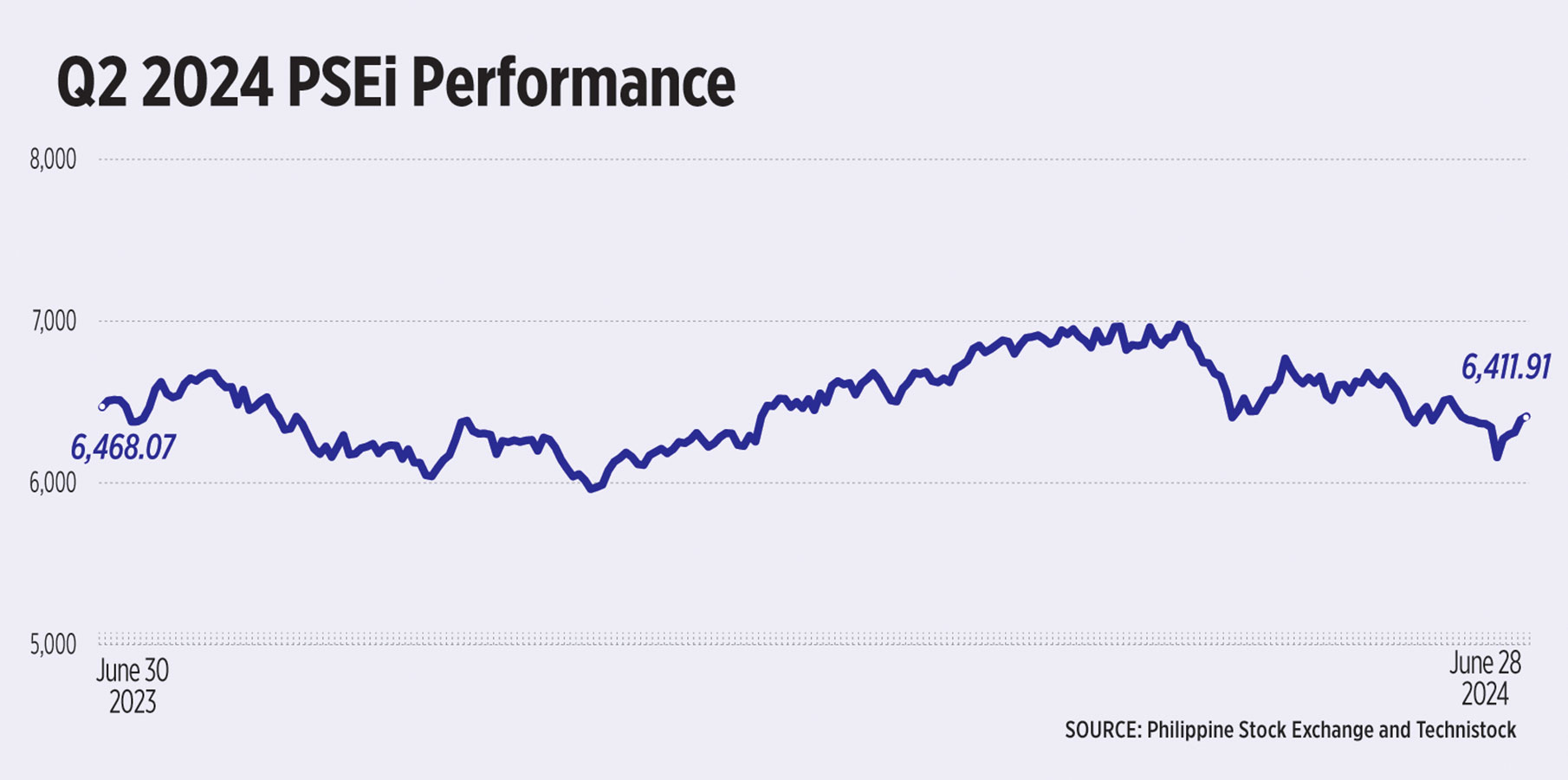
The barometer Philippine Stock Exchange index (PSEi) closed the second quarter at 6,411.91, down 7.1% quarter on quarter. Likewise, the index declined by 1% year on year from the 6,468.07 finish in the second quarter of 2023.

Data from Bankers Association of the Philippines showed that the peso closed at P58.61 against the dollar in the second quarter, depreciating by 4.2% from the previous quarter’s end of P56.24 to a dollar. On an annual basis, the local unit also retreated by 6.2% from P55.20 finish in the second quarter last year.

Demand for Treasury bills auctions saw a total subscription amounting to P600.43 billion with P199 billion total offered amount in the second quarter.

The oversubscription amount of P401.43 billion was higher than the P349.19 billion in the first quarter.

Meanwhile, demand for Treasury bonds reached P611.84 billion, lower than the P1.07 trillion in the first quarter. However, this demand was higher than the aggregate offered amount of P299.21 billion in the second quarter.

At the secondary bond market, domestic yields rose by 25.97 basis points (bps) on a quarter-on-quarter average, based on the PHP Bloomberg Valuation (BVAL) Service Reference Rates published on the Philippine Dealing System’s website.

On a year-on-year basis, yields also grew by 15.18 bps.

“Globally, elevated oil and energy prices in the second quarter from output cuts in the Organization of the Petroleum Exporting Countries (OPEC)+ countries and ongoing conflicts in the Middle East region as well as the reduced, but noticeable pressures from the Russia-Ukraine conflict have led to volatility in global markets,” Union Bank of the Philippines Chief Economist Ruben Carlo O. Asuncion said in an e-mail.

Mr. Asuncion added that at the local scenery, markets were affected by the continuing effects of El Niño that persisted until late May which was followed by climate transitioning to the early onset of La Niña.

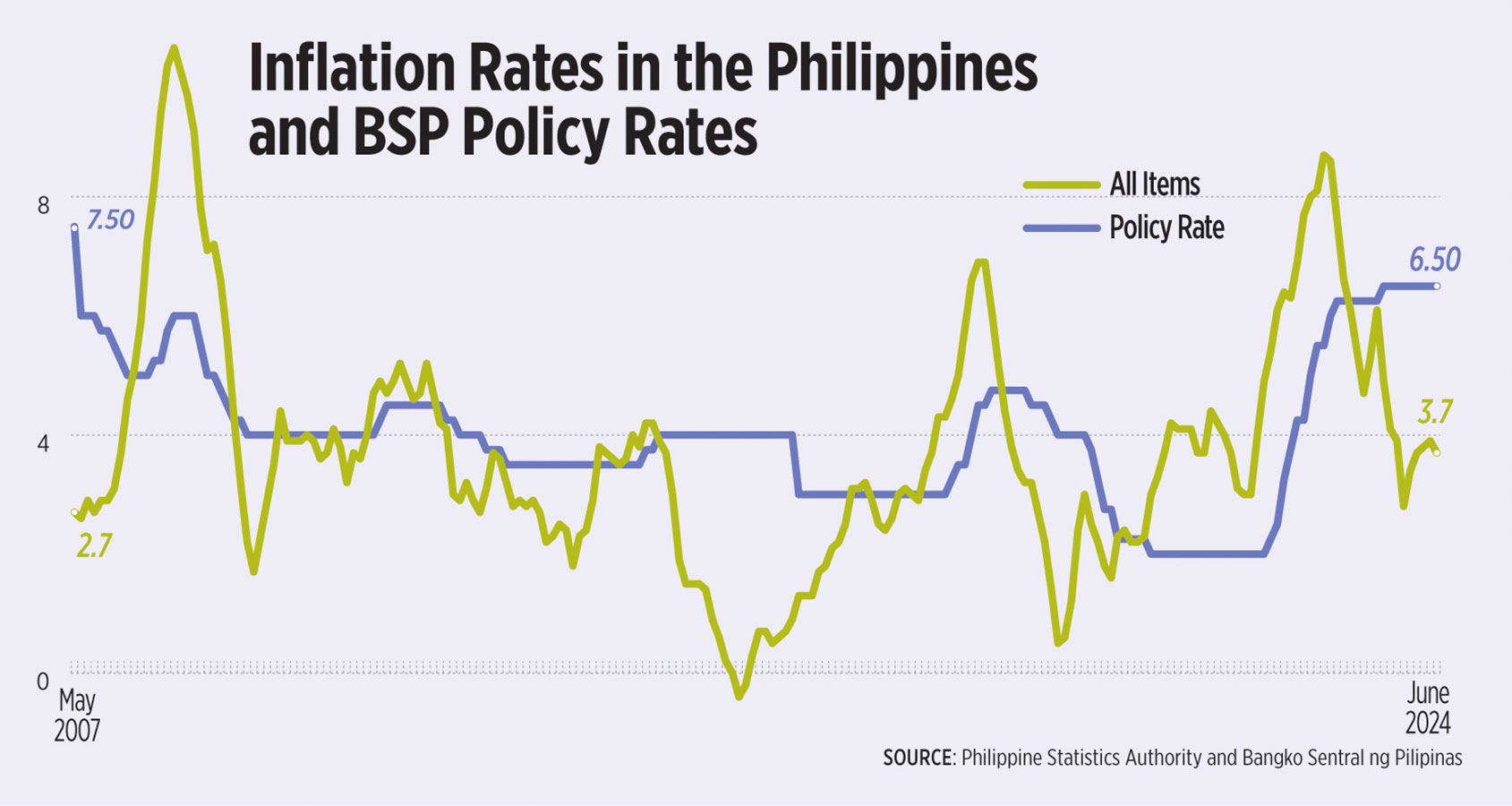
“With disrupted rainfalls and fluctuating climate conditions, pressures on agriculture prices became the leading contributors to inflation in the second quarter with food prices rising at an average 6.3% year on year. Higher inflation led to Bangko Sentral ng Pilipinas (BSP) maintaining rates at 6.5% throughout the quarter leading to lower bond prices and higher yields,” added Mr. Asuncion.

“The ongoing geopolitical tensions and the United States Federal Reserve’s monetary policy decisions have created a volatile environment for global markets, including the Philippines. The fluctuations in commodity prices have also impacted inflation rates and investor sentiment,” Security Bank Corp. Chief Economist Robert Dan J. Roces said in an e-mail.

Mr. Roces added that domestic economic conditions, particularly inflation and gross domestic product (GDP) growth, have been key drivers of market sentiment. The BSP’s monetary policy decisions, aimed at balancing economic growth and price stability, have also influenced interest rates and the peso’s value.

Preliminary data from by the Philippine Statistics Authority (PSA) showed GDP expanded by an annual 6.3% in the April-to-June period. The second-quarter print was stronger than the revised 5.8% growth in the first quarter and 4.3% in the second quarter of 2023.

For the first half, the Philippine economy growth averaged 6%, meeting the low end of the government’s target of 6-7% this year.

In the seven months to July, inflation averaged 3.7%, still within the 2-4% central bank target.

WHAT INDICATORS TO WATCH OUT FOR
Economists noted that the same indicators will continue to persist and will affect the financial market performance in the next quarter.

Mr. Asuncion said that climate conditions in the Philippines is a key development to watch for, which is expected to impact agricultural production due to increased flooding, damaged crops leading to low crop output and higher prices of agricultural produce.

“Rainy season will also impact other sectors such as tourism and potentially increase government spending in construction of public infrastructure and works,” Mr. Asuncion said.

Mr. Asuncion also added that geopolitical conflicts in the Middle East combined with OPEC+ members cutting oil production will continue to pressure oil and energy prices upward.

Maybank Investment Banking Group senior economist, Zamros Bin Dzulkafli, said that, on the foreign exchange front, focus would continue to be on pace of the US Fed easing and the US election uncertainty.

“Our base case scenario remains for a US soft landing and so we expect the US Fed to ease rates gradually with 50 bps of cuts this year. This in turn should continue to support a downward trend for dollar/peso. However, we note that there could be bumps along the way as US data may not necessarily decline in a straight line,” said Mr. Dzulkafli said in an e-mail.

“Remittances are likely also to be higher in the final quarter of this year due to the festive season and that should give some support to the peso. The trade balance would likely remain in deficit amid the country’s weaker export base and import dependency and therefore, the external position should stay as a negative factor for the currency. Our year end forecast for dollar/peso stands at P56.00,” added Mr. Dzulkafli.

Cash remittances in the first semester period jumped by 2.9% year on year to $16.25 billion from $15.8 billion. The BSP expects cash remittances to grow by 3% this year.

In June, the value of exports slumped by 17.3% to $5.57 billion from $6.73 billion a year ago, the first double-digit decline since November 2023. Year to date, exports rose by 3% to $36.41 billion.

On the other hand, the value of imports declined by 7.5% year on year to $9.87 billion in June from $10.67 billion in the same month a year ago. For the first six months, imports slipped by 2.5% to $61.41 billion.

For the first six months of the year, the trade deficit narrowed by 9.5% to $25 billion.

INTEREST RATE CUT
For the first time in almost four years, the Monetary Board last August reduced the target reverse repurchase (RRP) rate by 25 bps to 6.25% from the over 17-year high of 6.5%. Rates on the overnight deposit and lending facilities were also lowered to 5.75% and 6.75%, respectively.

“We forecast that the BSP will continue to cut rates to a cumulative 50 bps to end at a 6% overnight RRP by yearend, and a potential additional 25 bps (total of 75 bps for 2024) is something we think the BSP would definitely consider. Nonetheless, a further 100 bps in 2025 to 5% is what we are also expecting,” Mr. Asuncion said.

Philippine National Bank economist Alvin Joseph A. Arogo said that if headline inflation returns to the target range starting August and the US Fed starts its own easing cycle in September, he anticipated that the BSP’s next move will be another 25 bps cut on Oct. 17.

“As a baseline view, we also believe that the monetary authorities will pause in December to allow the initial rate reductions to work their way through the economy and avoid spiking up inflation pressures. However, another 25 bps of easing is possible if inflation undershoots expectations, the peso strengthens further, and/or the third quarter GDP shows continued weakness in components not linked to government spending,” Mr. Arogo said in an e-mail.

Mr. Arogo forecasts end-of-year RRP rate remain at 6% for 2024 and 5% for 2025.

Mr. Roces said that a rate cut by the US Fed could lead to a weaker US dollar, which would generally benefit the Philippine peso and trade.

“However, it could also increase inflationary pressures if imported goods become more expensive. The BSP will want to carefully assess the potential impact of a weaker dollar on domestic inflation and the economy before making any adjustments to its monetary policy.

In a recent annual economic conference speech, US Fed Chair Jerome H. Powell signaled a start to interest rate cuts, saying further cooling in the job market would be unwelcome and expressing confidence that inflation is within reach of the US central bank’s 2% target.

After more than a year of holding interest rates at 5.25%, the highest level in more than two decades, officials finally have enough confidence to change their stance by cutting rates at their Sept. 17-18 meeting.

“US Fed and local policy rate cuts from 2024-2026 (by a total of about -2.25) would further spur greater business and overall economic activities, faster GDP growth and development in terms of further reduction in borrowing costs and further increase in the demand for loans for consumers, businesses, governments, and other institutions,” Rizal Commercial Banking Corp. Chief Economist Michael L. Ricafort, said in an e-mail.

FIXED-INCOME MARKET
Mr. Asuncion: Based on historical data and Autoregressive Integrated Moving Average (ARIMA) models, we have projected that August’s headline inflation will fall above 4% year on year with September slowing to 3.8% year on year. We forecast that 2024’s year-end inflation will be 3.7%. With inflation expected to slow in the coming months and BSP cutting rates, there will be a decrease in the yield on fixed-income securities.

Mr. Ricafort: For the coming months, barring external risk factors, local inflation could stabilize at 3%-3.5% levels, local policy rates could go down to 4%-5% levels from 2025-2026, local interest rate benchmarks would go down further by another 0.50-1.00 or even more from current levels from 2025-2026, as the US Fed would cut rates by a total of about -2.25 from 2024-2026 (that could matched locally by the BSP).

Mr. Dzulkafli: Expectations of US Fed easing but no major downturn are conducive to higher yielders including the Philippines government bonds. The 10-year RPGB yields may consolidate after a strong rally, then trade on high beta vs the US Treasury.

EQUITIES MARKET
Mr. Asuncion: During second quarter, PSEi index closed at 6,700.49, 6,433.10, and 6,411.91, with July closing at 6,619.09. The PSEi have been upward trending since August, with this week opening at 6,889.87 reflecting the market’s expectations for further rate cuts. Based on historical prices and expectations for a cumulative 50-bp cut this year, the PSEi would increase to close at yearend of 7,200-7,400.

Mr. Ricafort: The local stock market posted huge gains recently after the peso exchange rate remained among the strongest versus the US dollar in more than 4.5 months or since April 2024; also after mostly stronger local GDP, employment, bank loans, and other economic data recently, as well as mostly better corporate sales and earnings reports by some listed companies/conglomerates that fundamentally support higher valuations; after local monetary officials still reiterated possible -0.50 local policy rate cut for the rest of 2024.

Mr. Dzulkafli: We expect that equities market would rally in light of rate cuts that could support economic growth. Lower lending cost could boost both corporate expansion and consumer spending.

FOREIGN EXCHANGE MARKET
Mr. Asuncion: For the remainder of the third quarter, we expect exchange rates to favor the peso owing to increased expectations of a more aggressive US Fed rate cut of 75-100 bps compared to BSP’s rate cut of 25 bps recently. Based on historical prices and ARIMA models, we forecast dollar/peso to close at P56.63 by yearend 2024. The strength of the peso will persist. However, import season (usually strong in 2H historically) may counter this strength.

Mr. Ricafort: Going forward, the performance of the US dollar/peso exchange rate would be partly a function of intervention as consistently seen over the past two years; amid the need to better manage inflation and inflation expectations to fulfill the price stability mandate that would also require stability in the peso exchange rate, which affects import prices and overall inflation.

Mr. Dzulkafli: USDPHP may rebound from current levels as markets expectation of 100 bps of Fed cuts are pared back. The Fed is likely to only gradually ease amid a US soft landing. More concerns about US election uncertainties also look to possibly weigh in, too.


Oasis tickets sell out after technical problems frustrate fans

OASISINET.COM

LONDON — Tickets for next year’s Oasis reunion tour sold out by Saturday evening though fans eager to see the band play live for the first time in 16 years complained of technical issues and long online waits that often ended in disappointment.

Fans trying to access the three websites selling the tickets — Ticketmaster, See Tickets, and Gigsandtours — reported issues including error messages and being kicked off before they could purchase tickets.

It was expected that more than a million tickets for the band’s gigs would sell out within minutes. Instead, the band announced all the tickets in Britain had been sold 10 hours later after many fans had spent the day in online queues.

“There has got to be a fairer, simpler, more efficient way of selling tickets,” said Dan Walker, the British TV presenter, on X. “In the queue, out of the queue, refresh / don’t refresh, wait in line, back of the line.”

Ticketmaster earlier said its website has not crashed and the queue was moving along as fans bought tickets.

Gigsandtours thanked people for their patience and said there had been “extremely high demand.”

At the same time, some tickets were relisted on resale sites such as Viagogo for as much as £8,000 ($10,500).

Oasis announced 17 shows in the United Kingdom and Ireland, with the first due to take place in Cardiff in July 2025, followed by nights in Manchester — where the band was formed in 1991 — London, Edinburgh and Dublin.

The group, whose debut album Definitely Maybe was released 30 years ago, split in 2009 when lead guitarist and main songwriter Noel Gallagher said he could no longer work with his younger brother, Liam, the band’s main singer.

At its peak in the 1990s, Oasis exemplified the soaring appeal of Britpop, with hits like “Wonderwall,” “Live Forever,” and “Champagne Supernova.”

But Noel and Liam were often in conflict and their strained relationship finally snapped in 2009 as they prepared to play a Paris gig.

Since their split, both brothers have continued their musical careers, but always against the backdrop of calls from fans for the band to reunite.

The gigs are expected to provide a multi-million pound boost for Britain and Ireland’s hospitality sectors. — Reuters

Big banks’ asset and loan growth rises in Q2

THE COMBINED ASSETS of the Philippines’ biggest banks rose in the second quarter amid faster economic growth. Read the full story.

Big banks’ asset and loan growth rises in Q2

Ripening Indian crops seen under threat from prolonged monsoon

REUTERS

MUMBAI — India’s monsoon rains are likely to be prolonged into late September this year due to the development of a low-pressure system in the middle of the month, two weather department officials told Reuters.

Above-normal rainfall due to the delayed withdrawal of the monsoon could damage India’s summer-sown crops like rice, cotton, soybean, corn, and pulses, which are typically harvested from mid-September.

The crop damage could lead to food inflation, but the rains may also result in higher soil moisture, benefiting the planting of winter-sown crops such as wheat, rapeseed, and chickpea.

“There is an increased probability of a low-pressure system developing in the third week of September, which could delay the withdrawal of the monsoon,” said a senior official of the India Meteorological Department (IMD), who sought anonymity as the matter is sensitive.

India, the world’s second-largest producer of wheat, sugar, and rice, has imposed various curbs on the export of these farm commodities, and any losses due to excessive rainfall could prompt New Delhi to extend those curbs.

The monsoon generally begins in June and starts to retreat by Sept. 17 from northwestern parts of the country, ending across the country by mid-October.

The lifeblood of a nearly $3.5-trillion economy, the annual monsoon brings almost 70% of the rain India needs to water farms and replenish reservoirs and aquifers.

Without irrigation, nearly half the farmland in the country depends on the rains that usually run from June to September.

Monsoon rainfall in September and October could be influenced by La Niña weather conditions, which are likely to develop from the next month, said another IMD official.

In the past, when La Niña develops during the second half of the monsoon season, it has led to a delayed monsoon withdrawal, said the official, adding that “this year, we could see a similar pattern.”

The two sources shared their assessment ahead of the IMD’s monthly forecast for September rainfall and monsoon withdrawal, which is scheduled for this weekend.

India has received 7% more rainfall than average since the monsoon season began on June 1. However, some states have experienced as much as 66% more rainfall than average, leading to flooding.

Heavy rains during the third and fourth weeks of September and early October could affect early sown crops that are nearing harvest, said Ashwini Bansod, vice-president of commodities research at Phillip Capital India.

“The impact would depend on the intensity and duration of the rainfall. If the rains persist into the first half of October, it could cause more damage if fields get flooded,” Bansod said. — Reuters

Responding to Mpox

WHO.INT

The World Health Organization (WHO) recently declared that the outbreak of Mpox (previously known as monkeypox) in the Democratic Republic of the Congo (DRC), and a growing number of countries in Africa constitutes a public health emergency of international concern (PHEIC).

A PHEIC is “an extraordinary event which is determined to constitute a public health risk to other States through the international spread of disease and to potentially require a coordinated international response.” This definition implies a situation that is serious, sudden, unusual or unexpected; carries implications for public health beyond the affected State’s national border; and may require immediate international action.

Mpox is an infectious disease caused by the monkeypox virus. It can be transmitted through contact with bodily fluids, lesions on the skin or on internal mucosal surfaces, such as in the mouth or throat, respiratory droplets and contaminated objects. Common symptoms include a painful rash, enlarged lymph nodes, fever, headache, muscle ache, back pain, and low energy. Most people fully recover, but some get very sick.

The number of reported Mpox cases has increased steadily over the past decade, with more than 15,600 cases and 537 deaths reported so far this year, the WHO stated. There are two distinct clades of the Mpox virus: Clade I (with subclades Ia and Ib) and Clade II (with subclades IIa and IIb). In 2022-2023, a global outbreak of Mpox was caused by the Clade IIb strain.

Over the past months, an increasing proportion of reported infections have been attributed to Clade I, with the Clade Ib variant first identified in October 2023. This variant is more easily transmitted among humans compared to previous strains and causes more severe disease and has a higher mortality rate, with up to 3.6% of cases resulting in death. In addition, approximately 60% of cases in DRC are in children under 15, rising to 70% when considering those under 18, the WHO said.

To date, the Department of Health (DoH) has confirmed three active cases of Mpox of the milder Clade II variety in the Philippines. This brings the country’s total number of laboratory-confirmed Mpox cases to 12 since July 2022.

The WHO recommends that vaccination against Mpox be considered along with other public health interventions. Getting an Mpox vaccine (pre-exposure prophylaxis) can help prevent infection. It is recommended for people at high risk of getting Mpox, especially during an outbreak. These include healthcare workers at risk of exposure; people in the same household or close community as someone who has Mpox, including children; people who have multiple sex partners, including men who have sex with men; and sex workers of any gender and their clients.

The vaccine can also be administered after a person has been in contact with someone who has Mpox (post-exposure prophylaxis). In these cases, the vaccine should be given less than four days after contact with someone who has Mpox. The vaccine can be given for up to 14 days if the person has not developed symptoms, the WHO explained.

The research-based pharmaceutical industry is deeply concerned about the Mpox outbreak, and we are committed to supporting the global response against Mpox.

“There are several vaccines that might confer some protection against Mpox, and we understand that the companies that manufacture these could further increase production if required,” said Dr. David Reddy, Director General of the International Federation of Pharmaceutical Manufacturers and Associations (IFPMA).

At the moment, there are two approved vaccines which offer protection against Mpox. One of the companies that manufactures Mpox vaccines has informed the Africa Center for Disease Control (CDC) that they have capacity to deliver 2 million doses by the end of this year, and 10 million doses by the end of next year.

Biopharmaceutical companies are also partnering with Gavi (a public-private global health partnership that aims to increase access to immunization in developing countries), the WHO, and Africa CDC to ensure supply and equitable access to vaccines. Subsequently, there are a number of vaccines currently in development against Mpox.

In order for vaccines to effectively be deployed, we also need increased surveillance to inform vaccination strategies, alongside the right regulatory pathways. Furthermore, manufacturers need to receive orders in an efficient way so as to produce output in a timely manner.

Meanwhile, the WHO has published a preliminary landscape of therapeutics licensed or under development while the primary method for diagnosing Mpox is the lab-based PCR test.

“The seriousness of the outbreak serves as another reminder of the importance of supporting the continued development of the vaccines and treatments that are so critical to preparing and responding to global health threats, and that the international community must ensure they can reach the people who need them as quickly as possible,” Dr. Reddy added.

Vaccines, diagnostics, and treatments remain critical to responding to global public health threats. It is essential that we maintain the infrastructure that supports companies to carry out research and development that make these possible.

In responding to and preparing for any future health threats, it is crucial that the global community ensures that the incentives are in place to enable biopharmaceutical innovation to continue supporting mechanisms that equitable access to vaccines, tests, and treatments.


Teodoro B. Padilla is the executive director of Pharmaceutical and Healthcare Association of the Philippines which represents the biopharmaceutical medicines and vaccines industry in the country. Its members are in the forefront of research and development efforts for COVID-19 and other diseases that affect Filipinos.

Jetour Auto Pagsanjan inaugurated

PHOTO FROM JETOUR AUTO PHILIPPINES

PEOPLE living in the Calabarzon or South Tagalog region will now have easier access to Jetour’s offerings as the brand recently opened the Jetour Auto Pagsanjan dealership.

Located in the Areza Commercial Complex in Barangay Biñan, Pagsanjan, Laguna, the facility boasts a seven-vehicle showroom, and two service bays.

Jetour Auto Pagsanjan is owned and operated by the Areza Group of Companies, which was established in 1990 and has steadily grown a diverse and successful array of businesses in the automotive, food services, general merchandise, appliances, manufacturing, and retail industries in and around Laguna province, Jetour Auto Philippines said in a release.

Speaking at the dealership’s grand opening, Jetour Auto Philippines, Inc.(JAPI) Managing Director Miguelito Jose said, “The Calabarzon economic corridor, encompassing the provinces of Cavite, Laguna, Batangas, Rizal, and Quezon, is a virtual sleeping dragon — a vast market for Jetour Auto, ready to be woken up. I have a really good feeling that Jetour Auto Pagsanjan, with the Areza Group of Companies providing unparalleled know-how and wisdom of doing business in this economic corridor, will exceed our expectations.”

JAPI now has a network of 22 dealerships across Metro Manila, Luzon, Visayas, and Mindanao. It is slated to open in seven more locations.

ACEN shares up after Indonesia wind deal

INVESTORS snapped up ACEN Corp. last week after the Ayala-led renewable company partnered with an Indonesian firm to develop over 300 megawatts (MW) of wind energy projects in that country.

Data from the Philippine Stock Exchange showed ACEN was one of the most actively traded stocks in terms of value turnover, with P556.73 million worth of 102.02 million shares exchanging hands from Aug. 27 to 30.

Local financial markets were closed on Aug. 26 due to National Heroes Day.

The Ayala-led firm’s shares closed at P5.44 apiece on Friday, 4.6% higher than its Aug. 22 close of P5.20. Year to date, the stock has increased by 24.2%.

Arielle Anne D. Santos, equity analyst at Regina Capital Development Corp., said that the public viewed the partnership of ACEN with PT Barito positively.

“Such move would enhance ACEN’s regional expansion, leading to upward pressure on the stock,” Ms. Santos said in a Viber message.

Last week, ACEN entered into a partnership with renewable energy company PT Barito Renewables Energy Tbk to advance the development of wind projects with a capacity of 320 MW in Indonesia. 

ACEN said in a statement that the collaboration, which will be executed by its subsidiary ACEN Indonesia Investment Holding Pte. Ltd. and Barito Renewables’ subsidiary PT Barito Wind Energy, brings together the two firms to drive the nation’s shift towards a sustainable energy future.

The partnership builds on the acquisition of three “strategically located” late-stage wind development assets in South Sulawesi, Lombok, and Sukabumi that was announced in January.

The said assets offer a potential capacity of 320 MW of wind energy, supplemented by battery energy storage solutions, which are poised to enhance grid efficiency and stability in the region.

The firm holds about 4.8 gigawatts (GW) of attributable renewable capacity in operation and under construction, and has signed agreements and won competitive tenders worth over one GW.

“ACEN has also been in the spotlight due to its ongoing aggressive expansion in the renewable sector, including new project announcements and updates on existing projects. Market sentiment has been buoyed by the company’s commitment to scaling its renewable portfolio, which is seen as aligning well with global energy transition trends,” Ms. Santos said.

ACEN is looking to expand its renewables capacity to 20 GW by 2030.

Revenue from electricity sales of ACEN went down 6.6% in the first semester to P18.95 billion from P20.29 billion in the six months to June last year.

Its attributable net income, meanwhile, rose by 48.7% to P6.29 billion in the first half.

Ms. Santos said that ACEN is expected to post moderate earnings growth driven by new project completions and favorable market conditions.

“However, full-year earnings will likely be impacted by ongoing capital expenditures and the scaling of new projects. The company’s focus on long-term growth may dampen short-term profitability, but it sets the stage for substantial gains in the coming years,” she said.

“Support is at P5.10 while resistance is at P5.65. In near term, ACEN would likely just be confined within the range,” Ms. Santos said. — C.W.E. Laureta