Home Blog Page 2207

Regulator eyes collection of green energy auction allowance

A man inspects solar panels in this file photo. — PHILIPPINE STAR/EDD GUMBAN

By Sheldeen Joy Talavera, Reporter

THE ENERGY Regulatory Commission (ERC) is looking at collecting a green energy auction allowance (GEA-All) from on-grid consumers once the awarded renewable energy (RE) projects start supplying power to the grid.

The ERC has released proposed guidelines on the collection of GEA-All and disbursement of GEA-All Fund. The rules cover emerging RE resources such as solar photovoltaic, biomass, wind, run-of-river hydro, as well as on-grid areas under the GEA program.

“It’s for the collection of the amounts to be paid by consumers to GEA suppliers to be collected by DUs (distribution utilities) for remittance to TransCo (National Transmission Corp.), similar to the… FIT-All (feed-in tariff allowance),” ERC Chairperson and Chief Executive Officer Monalisa C. Dimalanta said in a Viber message.

Ms. Dimalanta said that GEA-All would be a “new collection once these GEA suppliers start supplying power.”

The FIT-All is a uniform charge billed to all on-grid electricity consumers, as a separate line item in a monthly electricity bill, to cover payments to RE developers under the FIT system.

Similarly, GEA-All will be calculated annually and will be charged to on-grid consumers who are supplied with electricity through the distribution or transmission network.

The allowances that will be collected will be remitted to the GEA-All Fund, which will be established and administered by TransCo.

“These collections shall be held by a government financial institution designated as the trustee of the GEA-All Fund, for the sole and exclusive benefit of the GEA plants as beneficiaries, except for amounts allocated to the administration allowance and disbursement allowance,” the regulator said.

The ERC said that a working capital allowance should be established and collected to serve as a buffer “to address any default or delay in the collection and/or remittance of the GEA-All and/or ACRR (actual cost recovery revenue).”

The GEA program aims to promote RE as one of the country’s primary sources of energy through competitive selection. RE developers compete for incentivized fixed power rates by offering their lowest price for a certain capacity.

The green energy auction was first conducted in 2022 and attracted 1,966.93 megawatts (MW) worth of bids for renewables, while GEA-2 was held in 2023 and awarded 3,440.76 MW.

Sought for comment, Pedro H. Maniego, senior policy advisor of the Institute for Climate and Sustainable Cities, said that the proposed GEA-All rules are mainly based on the rules prescribed for FIT-All.

He said that ceiling prices set by the ERC are usually lower than prices at the Wholesale Electricity Spot Market (WESM), the trading floor of electricity.

“Note that even the FIT rates, which were considered high in 2013 and 2015, actually lowered the electricity prices by reducing WESM prices,” he said in a Viber message.

“The installations entitled to GEAR (green energy auction reserve) prices will provide more supply and moderate spot market prices especially during peak demand periods,” he added.

Terry L. Ridon, a public investment analyst and convenor of think tank InfraWatch PH, said that the GEA is an “acceptable market-driven mechanism to reflect the least cost of power to benefit consumers.”

“This should encourage RE developers to continue investing in the country’s remaining RE allocation, as GEA-All sets the clear mechanism towards cost recovery and stable operations,” he said in a Viber message.

“The regulator, however, should continue monitoring price changes and technological innovation within the sector in order to continuously reflect the least cost of power,” he added.

The Department of Energy (DoE) is set to conduct two rounds of green energy auctions this year.

It is preparing to offer an estimated 4,399 MW of capacity under GEA-3. The auction will cater to non-FIT eligible RE technologies such as geothermal, impounding hydro and pumped-storage hydro, as well as run-of-river hydro which is a FIT-eligible RE technology.

For GEA-4, the auction is designed to cover integrated renewable energy and energy storage system. It involves the integration of renewable energy sources with energy storage technologies like batteries, flywheel or pumped storage hydropower system.

The DoE is also considering offering liquefied natural gas capacities for the upcoming round amid “anticipated high entry of renewable energy into the grid resulting from the GEA.”

The Philippine government has set an ambitious goal of increasing the share of RE in the country’s power generation mix to 35% by 2030 and 50% by 2040.

Studiom: An intimate arts, activities, and experiences center

STUDIOM offers a wide variety of classes, including vocal training and painting.

THE COVID-19 pandemic limited people’s access to social gatherings and opportunities to explore their interests. While it did open up possibilities to do more things online, it exacerbated issues of isolation among adults.

Though the world’s economies have restarted, bringing a resurgence of arts and entertainment events, the social struggle to immerse in various passions led the De los Reyes family to establish STUDIOM — an intimate arts, activities, and experiences center in the heart of Makati.

STUDIOM, a play on the Latin word studium meaning “study,” “zeal,” or “purpose,” offers a plethora of classes, workshops and other activities, like zumba and yoga classes, painting sessions, board and video game nights, vocal coaching, karaoke nights, salsa dance parties, chocolate-making classes, dumpling folding lunches, and nature conservation panels, among others.

“We don’t really offer a menu of activities. We just keep it open and invite people to tell us what their interests are so that we can create new experiences that are not usually routine or typical of what you find in the city,” business analyst Matti de los Reyes, STUDIOM’s chief executive officer, told BusinessWorld in a brief visit to the space.

His father, Ricardo de los Reyes, said that while the idea germinated as a way to provide creative support for a family member diagnosed with autism, it is a place that is open to everybody under the sun.

It’s designed for all adults because it’s our belief that adults want to continue to learn, but there is a dearth of places where they can do that. Many of the learning places are built for children and young people at the prime of their life, like music schools and gyms. We really focus on creating this environment for adults, from the young to the geriatric,” The senior Mr. De los Reyes added.

A THIRD PLACE
The center is inspired by the urban sociology concept of the “third place.”

While the home is described as the first place and the workplace as the second place, venues where people connect with others in the community — public parks, churches, restaurants, theaters, gyms — are the third place. This is what STUDIOM aspires to be, explained the younger Mr. De los Reyes.

“We aim to be a new type of third place — an interesting place for interesting people with interesting interests,” he said.

Recently opened at the Lorraine Tower in Proscenium at Rockwell, the 140-square meter space is located there so that “the center could feed from the dynamism, playfulness, and diversity of the city.” It is reconfigurable to take the form of various settings, be it a gym, a dance hall, an art studio, a kitchen, a lecture hall, a lounge, or a nightclub.

STUDIOM’s programs are just as malleable. Case managers and activity specialists address all requests to learn, no matter how specific.

“If you have a particular interest in music and want to learn more, we could match you up with a master instructor or create a program to teach you, for you to pursue that interest. Maybe you won’t want to start from scratch with the fundamentals, but with a few songs that you actually want to learn on the piano or the guitar,” explained the senior Mr. De los Reyes.

A recent example is Broadway karaoke, which was one session where a group of interested individuals learned to sing Broadway songs with proper voicing and projection — culminating in a fun night of karaoke.

“People can demonstrate what they’ve learned in a safe environment. Ultimately, we bring people together and they form friendships; they become part of a social club built around that common interest,” he said.

INCLUSIVITY
While the participants of that karaoke session were in their 20s and 30s, STUDIOM has had clients as old as 90 taking part in activities like painting and board games. There are also those on the autism spectrum and those with limited physical mobility.

“We break it down so that it becomes accessible. At STUDIOM, anyone of any age or skill level can access activities and experiences that are available to typical people,” said Matti de los Reyes.

Many sessions start at P1,000 for a one-off class, but the fee may go up depending on the needs of a particular interest. A live band or a cast of professional actors will require a larger fee, for instance.

Though STUDIOM’s ideals are to welcome those with special needs, it is simply open to all adults who want to learn something new, be it in a one-on-one session, an intimate group, or a crowd of new faces.

“[The group size] varies from activity to activity,” he added. “If it’s a chocolate making class, it might be 12 people. For a one-day choir, there could be more.”

“What’s important is that we cater to the desire to learn. We give people a creative space to explore and to share.”

STUDIOM is located in Lorraine Tower, Proscenium at Rockwell, Makati City. For more information on its activities, visit STUDIOM’s social media pages on Facebook and Instagram. — Brontë H. Lacsamana

Philippine cinema strengthens its German connection

TALKING MOVIES: (L-R) the talk’s moderator, Mowelfund Film Institute director Ricky Orellana, filmmaker and film historian Nick Deocampo, and cultural researcher Katrin De Guia. — PHOTO BY HANNAH DOROTHY GAON

THE FILM industry in the Philippines is hoping to revive its cultural exchanges with Germany, which have influenced Filipino alternative cinema and film studies over the years. This according to filmmakers and researchers at an Aug. 29 forum organized by the German Embassy at Sine Pop, Quezon City.

“My personal history with Germany started at the Berlin Film Festival in 1982, when I met my producer Hagmut Brockmann, who supplied Super8 films for me to make Oliver,” said Nick Deocampo, a filmmaker and film historian, at the event.

He then cited the films of Raymond Red, also present at the talk, as products of workshops that occurred under the Mowelfund Film Institute (MFI), a hub for filmmakers to learn and practice their art in the 1980s with the help of many German partners.

These included mentors like filmmakers Ingo Petzke and Christoph Janetzko and then-Goethe Institut director, Uwe Schmelter. They had worked closely with Mr. Deocampo when he was the director of MFI and put up film screenings, lectures, and workshops.

“We really blossomed as a film movement in the ’80s, coming from the People Power Revolution and thinking deeply about social change. We related with German abstract and experimental filmmakers, who showed us the medium’s potential to be a revolutionary cinema,” he explained.

Ricky Orellana, the current director of MFI, agreed that the partnerships were essential to establishing “a very strong alternative movement in the Philippines,” now called independent or indie.

It was in 1985 that Mr. Orellana got involved in the alternative scene, when he started enrolling in filmmaking workshops conducted by Mr. Petzke and Mr. Janetzko. His batchmates included Lav Diaz, Larry Mando, Vicky Donato, Rox Lee, and Eli Guieb.

“Those workshops were so successful that Goethe Institut tried to duplicate it in other countries like Thailand, Brazil, and South Korea. The formula was established here,” he said.

Sa Maynila, his own film with Mike Alcazaren and Josephine Atienza made in 1988, is one of many products of these cultural exchanges. MFI will be reintroducing the archived films that came from these workshops and festivals to a new generation, with screenings set for World Heritage Day in October.

SHARED FILM LANGUAGE
For Munich-born, Baguio-based cultural researcher Katrin De Guia, exploring Filipino psychology was a must when she first moved here in 1979. As a student of renowned scholar Virgilio Enriquez, she came to understand local culture through the lens of kapwa psychology.

With this, parallels can be drawn between the Philippines’ and Germany’s filmic languages, oriented towards sharing stories over commercial benefit.

Kapwa means that everyone learns from each other. Individualism is not as necessary as the things that combine us. In Germany, there is a similar word, mitmenschlichkeit, which means that we are all human,” said Ms. De Guia.

However, she added that Germany has lots of artists and intellectuals mainly because of funding and effort in enhancing arts and culture. Her husband, National Artist for Film Kidlat Tahimik (a.k.a. Eric De Guia), managed to make his first film thanks to producers in Berlin, much like Mr. Deocampo.

At the talk, Mr. De Guia explained that alternative cinema aims to peel back the colonial layer from the face of the people.

“The protocols of blockbuster filmmaking that we got from Hollywood are now gospel here, too. We have to remember we are a kapwa culture. Rather than copying successful films, we can put out more Filipino-oriented stories and not lose kapwa in the search for profit,” he said.

MFI’s Mr. Orellana added that archiving is another realm of cinema that has been positively affected by German-Philippine relations. National Artist Gerardo De Leon’s 1961 film Noli Me Tangere, based on the novel by Jose Rizal, was once considered a lost film — until the late archivist Teddy Co found the print and had it restored by the German Federal Archive in 1989.

In relation to that tidbit, Mr. Deocampo posited that the filmmaking workshops and archiving initiatives are but a natural progression of the German-Philippine connection first established by Mr. Rizal himself with scholar Ferdinand Blumentritt (although he was Czech-born).

“That was a partnership in literature, and now we have it in a modern communication medium, cinema, which has a larger audience,” he said. For the upcoming Frankfurt Buchmesse, his books on Philippine film history will be translated into German and published in Germany.

“We can galvanize this relationship with books and with films. We’ve had very rich relations in the past 40 years, since the ’80s. We’re going strong and we’re making it more tangible through this intellectual work.” — Brontë H. Lacsamana

Entertainment News (09/03/24)


CCP Met: Live in HD ends with Dead Man Walking

SEASON 9 of The Met Opera in HD — a collaboration between the Cultural Center of the Philippines (CCP), the Metropolitan Opera of New York, the Filipinas Opera Society Foundation, Inc., and Ayala Malls Cinemas — culminates with Jake Heggie’s contemporary opera Dead Man Walking on Sept. 3, 5:30 p.m., at Greenbelt 3 Cinema 1 in Makati City. Based on a nonfiction book of the same name, this opera explores themes of humanity and justice, its story beginning and ending with a murder. Tickets are priced at P350. Students and young professionals may enjoy the screening for P100 upon presenting a valid ID. Tickets are available at Greenbelt ticket booths and on the website www.sureseats.com.


Bacolod Film Festival to kick off in September

THE Bacolod Film Festival has released the trailers for the 10 films that will be part of the festival program. They are: Chelsea Tasic’s A Flower a Day, Charlene Mead Tupas’ Aninaw, Victor Villanueva’s Blind Date, Poli Gonzales and Massah Gonzales-Gamboa’s Chicken Inasal, Reginald Amador and Zack B. Verzosa’s Glub, Pau Ortaliz Santos and Nina Aira Villanueva’s Laragway sa Karon, Banjo Hinolan’s Manokan Country, Willbryan Garcia’s Puli Na, Diche Lesly, VinJo Entuna’s Sa Pwesto ni Pistong, and Alvin Diaz and Oscar Severino Villanueva’s The Mansion. The films will screen from Sept. 12 to 15 at SM City Bacolod and Ayala Malls Capitol Central. Visit Bacolod Film Festival’s social media pages for more details.


Raymond Lauchengco’s 40th anniversary concert

SINGER, artist, and director Raymond Lauchengco has announced that he will be performing live at The Theatre at Solaire on Nov. 23 in a concert titled Just Got Lucky. The concert will mark the 40th anniversary of his storied music career, and will include the beloved ’80s soundtrack of the Bagets hit movie and generation. For partnership, tickets, and block buying inquiries, e-mail info@raymondlauchengco.com.


Dhruv releases debut album

SINGER-songwriter and producer Dhruv has dropped Private Blizzard, his debut album via Little Worry/RCA Records. The album features Dhruv’s new single “One and Only” alongside previously released tracks like “Grieving,” “Speed of Light,” “How?,” and “Tragedy.” Recorded in Nashville with Grammy-nominated producer JT Daly, Private Blizzard reflects the full range of emotions that the Indian-descended Singaporean musician felt as he set out to make his debut album from a place of creative honesty. The album is out now on all digital music platforms worldwide.


Josh Cullen releases new single

SB19’S Josh Cullen has returned with “Silent Cries,” an emo-type, guitar-driven song that serves as a pre-release single for his upcoming album, Lost and Found, due next month. In it, the P-Pop soloist trades his urban-leaning music for Midwestern emo. The song revisits his past with the accompanying music video following him as he goes to places that were once a vital part of his childhood. “Silent Cries” is out now on all digital music streaming platforms worldwide.


Parqal mall opens outdoor sports complex

PARQAL, the flagship development of Aseana City in Parañaque, has launched Bounce, an outdoor sports complex designed to cater to sports enthusiasts of all levels. The new facility boasts of two multi-purpose courts, ideal for pickleball and volleyball, and a basketball court. There is a full-sized 2,213-sq.m. football pitch, now home to young athletes training under the Azkals Development Academy. Reservations and payments for any of the amenities can be made through www.bounceatparqal.com.


Felip brings 7sins to Japan

COMING from his successful first solo show, 7sins the Album Concert, Felip is now set to bring his 7sins album to Japan. The album takes the form of a physical CD exclusively in Japan, which fans worldwide have begun to pre-order since July via Tower Records Japan, Amazon Japan, and CDJapan. Exclusive 7sins merchandise, content, and a bonus track entitled “Tokyo” will come with the physical CD. Felip held an autograph signing event at Tower Records Shibuya and the album concert at the Shibuya duo Music Exchange. Felip is also known by the stage name Ken, as a main dancer, lead rapper, and vocalist of the P-pop boy group SB19.


MYX brings back VJ Search, MYX Music Awards

THE MYX VJ Search and annual MYX Music Awards will be back this year. Media and entertainment brand MYX announced the news at the end of August. The VJ Search will hold its hunt for video jocks for the first time since its 2019 run. It previously produced MYX VJs and alums like Chino Luis-Pio, Joyce Pring, Aya Fernandez, and Samm Alvero. Meanwhile, the MYX Music Awards will be held in November, when it will recognize today’s hitmakers. It was last held virtually in 2021.


James Reid releases new single

IN light of the resurgence in popularity of his original Pilipino music (OPM) smash hit “Randomantic,” James Reid has returned to the spotlight with a mellow, pop-leaning single titled “Sandal.” The new track, released under Sony Music Entertainment and Careless, has stripped-down acoustic elements and vocals, making up a sweet serenade in the Filipino language. It was written by Mr. Reid and Luke April of the Davao-based hip-hop and R&B group Playertwo. “Sandal” is out now on all digital music platforms worldwide.

SM group keen on more projects with gov’t

BW FILE PHOTO

THE SM group is keen to expand its involvement in government-led infrastructure projects, SM Engineering Design & Development Corp. President Hans T. Sy, Jr. said.

“We’d love to do more (projects) with the government because we’re at the point where it’s really partnership with the government that will truly help the country move forward,” Mr. Sy, Jr. told reporters on the sidelines of an event last week. 

In April, the Department of Transportation (DoTr) began construction on the EDSA Busway Concourse, a key infrastructure project designed to improve commuter access and efficiency.

This initiative is being developed in partnership with SM Prime Holdings, Inc., the property development arm of SM Investments Corp., which has interests in retail, property, banking, and tourism.

The SM group and the DoTr partnered to develop concourses along Epifanio de los Santos Avenue at three locations: SM Mall of Asia in Pasay, SM North EDSA in Quezon City, and SM Megamall in Mandaluyong.

SM Prime is involved in managing and developing various real estate projects, including shopping malls, residential, and commercial properties.

The project will feature a ticketing booth, automatic fare collection turnstiles, ramps, and elevators. Once finished, the project is expected to accommodate around 300,000 commuters daily.

“That is something to be excited about. That is a public-private partnership project with the DoTr,” Mr. Sy noted.

“We plan to showcase exactly what we mean by sustainable transport. So, what we hope to showcase with the North EDSA bus station is an example of how it can be if done properly. So, look out for that. We should be finishing that by the end of this year,” he said.

He added that the station at SM North EDSA is expected to be completed by the end of this year, while the SM Megamall station is scheduled for completion by mid-2025.

The SM group originally intended to complete the stations simultaneously. However, due to right-of-way issues, the completion will now be done in phases.

“Like a lot of government infra projects, (there are) some right-of-way issues. But, you know, that takes a while. Some things don’t generally always pan out the way you want them to pan out,” Mr. Sy said. — A.E.O. Jose

[B-SIDE Podcast] Is it timely to amend and revise the 1987 Constitution?

Follow us on Spotify BusinessWorld B-Side

Since 1997, there have been multiple attempts to amend and revise the 1987 Constitution in response to various challenges the country has faced over the years. Recently, an economic charter change was approved on the third and final reading by Congress, which seeks to amend the 1987 constitution to lift foreign ownership to some vital industries in the country.

To address this concern, Mr. Jemy Gatdula, the Dean of the Institute of Law at the University of Asia and Pacific, and opinions columnist for BusinessWorld shared his insights on the initiative to amend and revise the 1987 Constitution, particularly its economic provisions.

Interview by Edg Adrian A. Eva
Audio editing by Jayson John D. Mariñas

Follow us on Spotify BusinessWorld B-Side

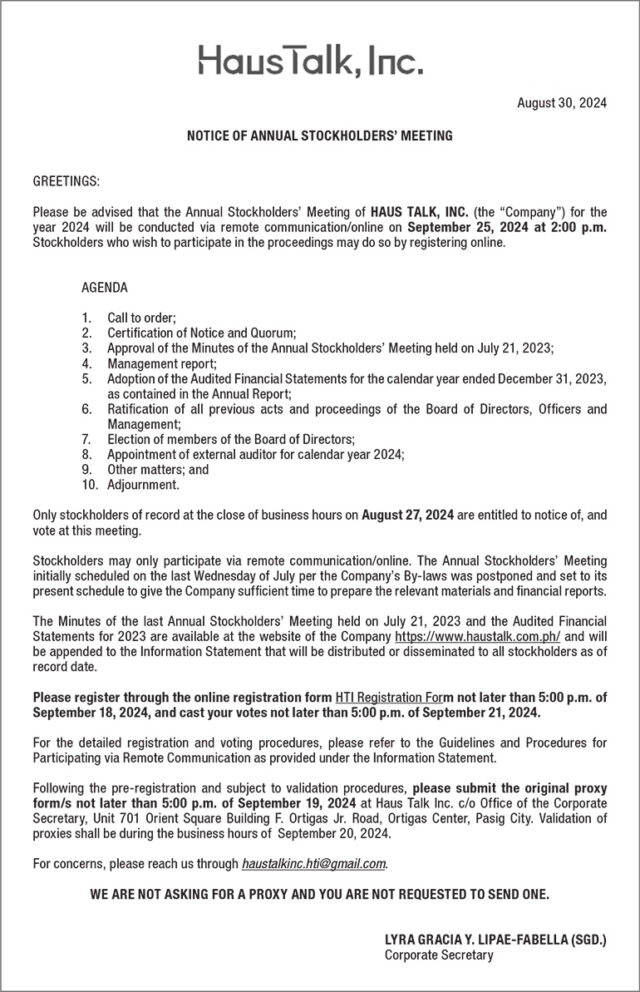
Haus Talk, Inc. to hold Annual Stockholders’ Meeting on Sept. 25 via remote communication


Spotlight is BusinessWorld’s sponsored section that allows advertisers to amplify their brand and connect with BusinessWorld’s audience by publishing their stories on the BusinessWorld Web site. For more information, send an email to online@bworldonline.com.

Join us on Viber at https://bit.ly/3hv6bLA to get more updates and subscribe to BusinessWorld’s titles and get exclusive content through www.bworld-x.com.

Venice Film Festival: The Brutalist epic close to home for its star Adrien Brody

ADRIEN BRODY and Felicity Jones in a scene from The Brutalist. — IMDB

VENICE — The Brutalist, the epic tale of a Hungarian immigrant who flees the horrors of World War II to rebuild his life in the United States, proved a perfect fit for its star Adrien Brody.

Speaking ahead of the movie’s premiere at the Venice Film Festival on Sunday, Mr. Brody said his mother escaped from Hungary and moved across the Atlantic, echoing the journey of the character he plays, a modernist architect named Laszlo Toth.

“Much like Laszlo, (my mother) started again and lost her home and pursued a dream of being an artist,” said Mr. Brody, who won an Oscar for Best Actor for his role in the 2002 Holocaust film The Pianist.

“I understand a great deal about the repercussions of that on her life and her work as an artist,” he told reporters.

Directed by Brady Corbet, The Brutalist shows the Jewish Lazlo struggling to survive in the United States, where a wealthy, arrogant industrialist hires him to create a monumental project that takes over both their lives.

After years of being stuck in her native Hungary, Mr. Brody’s wife Erzsebet, played by British actress Felicity Jones, manages to join him as he threatens to go off the rails.

“Underpinning the story, and particularly for Erzsebet and Laszlo, is this idea of love and the greatest love stories always come with urgency,” Ms. Jones said.

The film, which delivers a sweeping vision of post-war trauma and creative torment, runs at 215 minutes, a challenge for some as attention spans dwindle and cinemas struggle to attract audiences.

But Mr. Corbet said filmmakers needed scope.

“This film does everything that we are told we are not allowed to do. I think it’s quite silly actually to have a conversation about runtime because that’s like criticizing a book for being 700 pages versus 100 pages,” he said.

To re-create the look of films from the last century, Mr. Corbet shot the movie on 70 mm celluloid, eschewing the tricks of digital cinema.

“We did our best to try and evoke a bygone style of filmmaking by not falling back on a lot of those (modern) crutches,” Mr. Corbet said, adding that the film had taken seven years to complete.

It feels like a biopic of someone who existed, but Mr. Corbet said in reality not a single modernist architect from a war-ravaged Europe managed to make the sort of mark in the United States that Mr. Brody’s character achieves.

“The film, it’s dedicated to them, the artists that didn’t get to realize their visions,” he said.

The Brutalist is one of 21 movies competing for the prestigious Golden Lion award at the Venice Film Festival, which will be awarded on Sept. 7. — Reuters

Does Filipino culture hinder economic development?

PHILIPPINE STAR/WALTER BOLLOZOS

With the relatively lackluster performance of the Philippine economy since the country gained independence from the United States 78 years ago, it is often said by many that Filipino culture is to blame. That the Filipinos have a “damaged” culture that tends to inhibit economic growth.

Having heard that statement every now, this led me to give more thought to the worthiness and validity of that statement.

Of course, I needed to first clearly understand what “culture” is and break it down into chewable chunks. The Merriam-Webster’s Collegiate Dictionary that I have shows several senses for the meaning of “culture.” The sense that first appeals to me is: “the customary beliefs, social forms, and material traits of a racial, religious, or social group.” But it looks somewhat broad. So, I thought of referring to another sense to make things easier to handle: “a set of shared attitudes, values, goals and practices that characterize an institution or organization.”

By combining these two senses, I will describe Filipino culture as “shared beliefs, attitudes, values, behavior, practices, and goals of the Filipino nation.” Moreover, I will describe Filipino cultural characterizations collectively as Filipino “cultural traits,” for short. I also interpret the word “shared” not to mean as shared by all Filipinos, but by most. There are always outliers within a whole.

I will limit the identification of Filipino cultural traits to those I consider as having some direct effects on economic development. However, I will also include a cultural trait that I consider as having both direct and indirect effects on economic growth.

Let me now summarize these cultural traits that I have identified.

ATTITUDES AND BEHAVIORS RESULTING FROM RELIGIOUS BELIEFS
These are attitudes and behaviors that are seen to have developed as a result of Christian religious beliefs, like the idea that “God will provide,” predestination, self-sacrifice, the Apocalypse, and similar others. These attitudes and behaviors tend to make people not do much for themselves in relation to economic challenges but instead they tend to wait for sustenance or help seemingly brought through the help and mercy of God. As a result, the economy does not flourish as it otherwise would if the people relied on themselves by working much harder and employing their own ingenuity and creativity in seeking solutions to their economic predicament.

While this inclination might have some truths in the distant past, is it still true today?

This observation has an antecedent, which was expressed by the historian Edward Gibbon in his book, The Decline and Fall of the Roman Empire, where he considered the rise of Christianity as an important cause of the decline and fall of the Roman Empire. The same may be said of the apparent slow economic development during the Middle Ages, commonly referred to before as the Dark Ages, when the influence of Christianity was at its highest point in Europe, the apparent center of world civilization at that time.

However, if such assertion is true, considering the economic development of modern Europe during the past five or so centuries, such attitudes and behaviors might have been transformed for the better over time, especially through influences of such epochal events as: the Renaissance that started in the late 15th Century; the Reformation in the 16th Century, and the consequent Counter Reformation; and the Enlightenment in the 18th Century.

Catholic Philippines, being then a part of Spain, would have been similarly influenced. In addition, the Philippines was subsequently occupied by the US for about 50 years, during which time the local population would have been influenced to some extent by America’s then predominant Protestant ethics of hard work and self-reliance.

Considering the foregoing, I would think that whatever behaviors induced earlier by religious beliefs that tended to lead to economic stagnation or slow growth have been substantially overridden in the Philippines as these had been in Europe. As such, I conclude that current Filipino religious beliefs are not a factor in hindering Philippine economic development.

‘LONG TOWEL’ PRACTICE
This cultural trait relates to the tendency of Filipinos to give financial help, solicited or unsolicited, to relatives and close friends who are in great need of such help. At the outset, this practice has a neutral economic effect as the resulting increased consumption of the receiver merely replaces the equivalent forgone consumption or saving of the provider.

Had the receiver been earning his own income to cover adequately his own consumption and therefore avoiding financial assistance from others, there would have been an incremental economic output that would have led to economic growth. This suggests, though, that the receiver had the option to get work that provides him with sufficient income to meet his own needs. However, my observations of this cultural practice indicate that the receiver cannot in fact find adequate work to provide him with enough income under prevailing circumstances. The receiver is handicapped, quite likely by lack of adequate education and training, and is not able to contribute to increasing the economic output.

PUWEDE NA
This phrase, “puwede na,” is commonly heard in Filipino circles and it means not striving to produce output that bears the best quality possible. It is the opposite of “pulido” which means producing an output of the best possible quality.

I think this work attitude is prevalent among Filipino workers, especially among those not adequately supervised. Such an attitude leads to low-quality products, resulting in low demand for such products and therefore low productive output. Of course, there are business and non-business organizations that adopt a policy of producing work of the highest quality and standards, and accordingly develop adequate and effective control procedures to attain the achievement of such laudable policy. But these are the exceptions, such that the main nationwide endeavors may have been permeated by this attitude of “puwede na,” not only on the part of the workers but also on the part of the entrepreneurs themselves.

As a result, Philippine economic output may have become less competitive, especially when exported abroad. Then clearly, this prevalent attitude of “puwede na” could not lead to higher production and therefore restrains the country’s economic growth.

TARDINESS
Tardiness is a frequent topic in conversations. It is so socially prevalent that it has acquired a metonym in Philippine English: “Filipino Time” or “Philippine Time.”

For employees who are in a controlled time-keeping environment, this cultural tendency may have been suppressed. However, for other situations, especially in various types of meetings and social activities, it is prevalent. To the extent that tardiness results in the loss of productive time of one or more parties in a scheduled meeting or gathering, clearly it reduces economic output.

HIGH RISK AVERSION TO ENTREPRENEURSHIP
There is a clear low incidence of entrepreneurship among native Filipinos. This is evident in the presence, currently and in the past, of only a very few numbers of successful nationwide entrepreneurs of native Filipino ethnicity.

I attribute this condition to the high-risk aversion of native Filipinos to entrepreneurship. This risk aversion could have been handed down unwittingly by generations of native Filipino parents who predominantly encourage their children to study well in school to acquire a good job employment, but very rarely encourage them to get into business where the rewards are potentially much greater.

Many may disagree with me and argue that the reason for this condition is lack of obtainable sources of capital and not high-risk aversion. But this may not be a valid reason when one considers that most non-native first-generation startup entrepreneurs face the same conditions. Or, some may express an alternative reason. That we are not hardworking as compared to non-native entrepreneurs. I don’t think so. My own experience and observation are that native Filipinos work very hard under most conditions, but for someone else and not for themselves.

This attitude of high risk-aversion is, in my view, a significant factor in hindering economic growth.

ELECTION VOTE BUYING AND SELLING
My own observation is that vote buying and selling is universal in the Philippine archipelago. It makes one wonder why our society turns a blind eye to this prevalent practice.

Vote selling, at first sight, may appear to have an immediate, although short term, favorable economic effect. It increases the consumption of the vote sellers. However, we need to consider how the purchase money was sourced. If the purchase money came or would be recovered from public funds, the overall effect is at best neutral. The overall effect would be negative had the purchase money coming from public funds been invested in infrastructure projects and spent on education and training, which expenditures clearly provide long-term benefits.

More importantly, however, vote buying and selling may lead indirectly to significant unfavorable economic effects if those elected under this condition of coerced choice make wrong economic policy decisions, resulting in missed economic growth. And, unfortunately, this is the likely outcome of the result of such vote trading for obvious reasons.

CONCLUSION
It is clear that some Filipino cultural traits hinder economic growth. But these cultural traits are not some dark or evil attitudes and behaviors that the term “damaged culture” implies.

In my view, the ones that result in large negative economic effects are the high-risk aversion to entrepreneurship of ethnic Filipinos and the prevalent practice of vote trading.

Puwede na” and tardiness do lead to unrecoverable lost productive opportunities. On the other hand, I consider “long towel” as more of a consequence of inadequate education and training that makes the receivers of financial assistance unable to contribute more to nationwide economic growth.

I believe that these identified cultural traits can be changed over time such that they do not hinder economic growth through intervention by a strong national leadership who is seriously dedicated to the upliftment of the general welfare. That to me, we, the citizens, must seek. n

(This article reflects the personal opinion of the author and does not reflect the official stand of the Management Association of the Philippines or MAP.)


Benjamin “Ben” R. Punongbayan is currently a member of the MAP Board of Governors. He is the founder of Punongbayan & Araullo/ P&A Grant Thornton.

map@map.org.ph

ben.punongbayan@ph.gt.com

Venice Film Festival: George Clooney, Brad Pitt disappointed their new film skips cinemas

IMDB

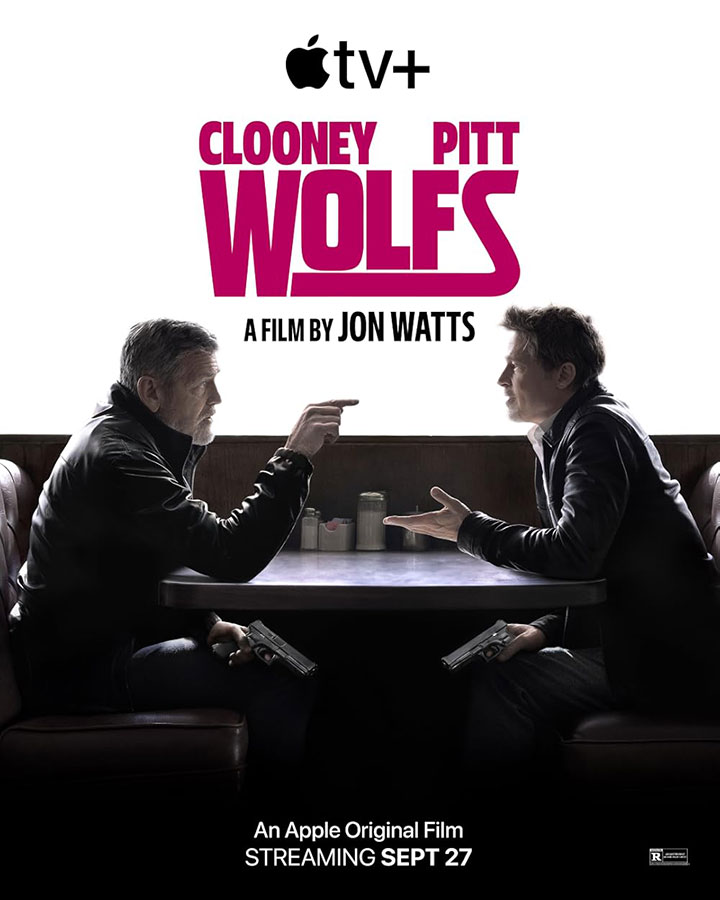
VENICE — Hollywood heavyweights George Clooney and Brad Pitt admit they are disappointed their latest comedy Wolfs is not getting a broad cinema release and instead heading almost straight onto Apple TV.

“It is a bummer,” Mr. Clooney said on Sunday, adding that television streamers, such as Apple, were nevertheless vital to the future of filmmaking, presenting actors with opportunities and generating bigger audiences for their work.

“Streaming, we need it, our industry needs this,” he said.

Written and directed by Jon Watts, Wolfs is an old-fashioned crime caper with Mr. Clooney and Mr. Pitt playing lone-wolf professional fixers who are forced to work together with comically unfortunate consequences.

Apple originally signaled it would place the film in a large number of cinemas before the TV release, but instead opted to show it briefly in a restricted number of United States movie theaters and then run it on its global TV service.

“We’ll always be romantic about the theatrical experience. At the same time, I love the existence of the streamers because we get to see more story, we get to see more talent, it gets more eyes,” said Mr. Pitt. “It’s a delicate balance right now and it’ll right itself.”

Asked what it meant if two of the biggest names in the business could not get a broad cinema release, as they had requested, Mr. Clooney quipped: “Clearly we’re declining.”

Sixteen years after last appearing together in 2008’s Coen brothers’ comedy Burn After Reading, Mr. Pitt and Mr. Clooney said they jumped at the chance to reunite when they read Mr. Watts’ script for Wolfs.

“I got to say, just as I get older, just working with the people that I just really enjoy spending time with has really become important to me,” said Mr. Pitt, who turned 60 last year.

In a news conference full of light-hearted banter, Mr. Clooney, said Mr. Pitt, was fortunate still to be offered parts. “He’s 74 years-old and he’s very lucky at this age to still be working.”

On a more serious note, he denied a New York Times story in August that said both he and Mr. Pitt had been paid more than $35 million each to appear in the film.

“I’m only saying that because I think it’s bad for our industry if that’s what people think is the standard bearer for salaries. I think that’s a terrible thing. It will make it impossible to make a film,” he said.

Wolfs is showing out of competition at the Venice Film Festival, which runs until Sept. 7. — Reuters

Converge says Bifrost cable system finished by Q1 2025

CONVERGE ICT Solutions, Inc. is on track to complete the construction of its international subsea fiber cable networks by next year, its chief operations officer (COO) said.

“We are on track for the Bifrost cable system; we’ll have it by next year,” Converge COO Jesus C. Romero told BusinessWorld on the sidelines of the National Retail Conference and Expo in Pasay City last week.

The Bifrost cable system is expected to be completed by the first quarter (Q1) of next year, and the Asia-Hainan-Hong Kong Express (SEA-H2X) Submarine Cable System is set for completion by the second quarter of 2025, Mr. Romero said.

In April, the listed fiber internet service provider said it was delaying the completion of its international subsea cable project to 2025, compared with the initial target of completing the project this year.

The company attributed this delay to permitting issues, especially since some of the project area will pass through international waters, the company previously said.

Bifrost is a transpacific cable system linking Singapore, Indonesia, the Philippines, Guam, and the west coast of the United States. It stretches 15,000 kilometers and boasts a design capacity of up to 15 terabits per second (Tbps).

The SEA-H2X is a 5,000-kilometer submarine cable system connecting Hong Kong SAR China, Hainan China, the Philippines, Thailand, Malaysia, and Singapore. It features a design capacity of 160 Tbps.

Converge said it is allocating the bulk of its P17 billion to P19 billion capital expenditure budget in 2024 for its subsea cable projects and data center development.

For the second quarter, Converge posted an attributable net income of P2.74 billion, climbing by 29.8% from the P2.11 billion in the same period last year.

Despite posting increased gross expenses for the April-to-June period at P6.18 billion, 15.1% higher than the P5.37 billion previously, the company managed to register higher earnings on elevated revenues.

At the stock exchange on Monday, shares in the company closed ten centavos or 0.67% higher to end at P15.10 apiece. — Ashley Erika O. Jose

T-bill yields mostly steady ahead of CPI

BW FILE PHOTO

THE GOVERNMENT hiked the volume of Treasury bills (T-bills) it awarded on Monday as average yields were mostly steady amid strong investor demand and ahead of the release of August inflation data.

The Bureau of the Treasury (BTr) raised P22.6 billion from the T-bills it auctioned off on Monday, higher than the planned P20 billion, as total bids reached P53.105 billion or more than twice the amount on offer, and just a tad lower than the P53.4 billion in tenders recorded at the Aug. 27 auction.

“The auction was 2.7 times oversubscribed …, prompting the committee to increase the accepted non-competitive bids for the 182-day securities,” the Treasury said in a statement.

Broken down, the BTr borrowed P6.5 billion as programmed from the 91-day T-bills as tenders for the tenor reached P18.01 billion. The three-month papers were quoted at an average rate of 5.947%, 1.9 basis points (bps) lower than 5.966% recorded last week. Accepted rates ranged from 5.94% to 5.96%.

Meanwhile, the government hiked its award of 182-day securities to P9.1 billion versus the original P6.5-billion plan as bids for the tenor reached P19.26 billion. The average rate of the six-month T-bill stood at 6.002%, up by 0.6 bp from the 5.996% fetched last week, with accepted rates at 5.98% to 6.02%.

Lastly, the Treasury raised P7 billion as planned via the 364-day debt papers as demand for the tenor totaled P15.835 billion. The average rate of the one-year debt inched up by 1.8 bps to 6.04% from the 6.022% quoted last week, with accepted rates at 6% to 6.055%.

At the secondary market before the auction, the 91-, 182-, and 364-day T-bills were quoted at 5.9154%, 5.9986%, and 6.0825%, respectively, based on PHP Bloomberg Valuation Service (BVAL) Reference Rates data provided by the Treasury.

The government upsized its T-bill award as the offer was met with strong demand, a trader said in an e-mail.

“The substantial auction volumes this week reflected strong investor demand for shorter-term issuances. Likewise, the mixed movement in yields is likely from uncertainty ahead of the Philippine inflation report this week,” the trader said.

Headline inflation likely eased in August and returned within the central bank’s 2-4% target band amid a drop in prices of rice and fuel, analysts said.

A BusinessWorld poll of 15 analysts conducted last week yielded a median estimate of 3.7% for the August consumer price index (CPI). This is within the 3.2-4% forecast of the Bangko Sentral ng Pilipinas (BSP) for the month.

If realized, this would be slower than the nine-month high of 4.4% in July and the 5.3% print in the same month a year ago.

The Philippine Statistics Authority will release August inflation data on Thursday (Sept. 5).

“Treasury average auction yields were again mostly slightly higher, similar to the week-on-week rise in the comparable short-term PHP BVAL yields, after the latest $2.5-billion Philippine government global bond issuance siphoned off some of the excess liquidity from the financial system… Nevertheless, most T-bill average auctions yields were still slightly below the comparable short-term PHP BVAL yields,” Rizal Commercial Banking Corp. Chief Economist Michael L. Ricafort said in a Viber message.

The government last week raised $2.5 billion from its sale of triple-tranche dollar-denominated global bonds, which marked its second foray into the international debt market this year. IFR reported that the government raised $500 million from 5.5-year bonds, $1.1 billion from 10.5-year notes, and $900 million from 25-year sustainability bonds.

Some investors are also locking in high returns on expectations of monetary easing here and abroad, Mr. Ricafort added.

Markets widely expect a rate cut at the US central bank’s Sept. 17-18 meeting following Fed Chair Jerome H. Powell’s dovish speech at the Jackson Hole Symposium last month. Futures are 100% priced for a cut of 25 bps this month, and imply a 33% probability of 50 bps, Reuters reported. They also have 100 bps of cuts priced in by December, and 120 bps for 2025.

Crucial for the Fed will be the payrolls report on Friday, where analysts look for a rise of 165,000 in jobs and a dip in the unemployment rate to 4.2%.

Meanwhile, the BSP last month cut benchmark interest rates for the first time in almost four years amid an improving inflation and economic outlook, with its governor signaling at least one more reduction before the end of the year.

The Monetary Board on Aug. 15 reduced its policy rate by 25 bps to 6.25%.

BSP Governor Eli M. Remolona, Jr. said they could cut rates by another 25 bps within the year. The Monetary Board’s remaining policy-setting meetings this year are on Oct. 17 and Dec. 19.

On Tuesday, the BTr will offer P30 billion in reissued 20-year Treasury bonds (T-bonds) with a remaining life of three years and one day.

The Treasury wants to raise P195 billion from the domestic market this month, or P80 billion through T-bills and P115 billion via T-bonds.

The government borrows from local and foreign sources to help fund its budget deficit, which is capped at P1.48 trillion or 5.6% of gross domestic product for this year. — AMCS with Reuters