



Home Blog Page 2112

Living large

One seats seven, the other seats five. — PHOTO BY KAP MACEDA AGUILA

Updated Audi Q7, Q8 now here

AUDI PHILIPPINES is turning 20 this year, and it’s certainly a fortuitous time to get busy by way of new releases.

The Ingolstadt-headquartered brand’s local distributor recently presented the newest iterations of its two full-size SUVs in the Audi Q7 and Q8, which are headlined by enhanced design details, lighting upgrades, digital operating systems, and “an even more extensive list of premium features,” said the company.

“As we mark our 20th year of delivering Audi models and services that befit the progressive status of the brand, we are launching the new Audi Q7 and Q8 to represent the start of Audi’s bold product offensive this year. The introduction of these models yet again demonstrate our unwavering commitment to continuously provide consumers with vehicles that come in a diverse selection of powertrain options, distinct performance characteristics, and innovative features unmatched by any other brand in the domestic premium segment,” said Audi Philippines Head Benedicto Coyiuto.

Meanwhile, in his speech, PGA Cars Executive Director Christopher Chan said to expect “numerous activities” from the company — which tucks in not only Audi but luxury brands Bentley, Lamborghini, and Porsche into its portfolio as well. “PGA Cars embarks on a strong product offensive, aligning with the strategies of the four global luxury brands we are partners with. Our close relationship with them gives us access to an extensive portfolio of innovative models, programs and solutions,” he continued.

AUDI Q7
The new Audi Q7, while not an all-new version, is nonetheless “extensively redesigned,” serving up “innovative lighting systems, first-class versatility, and generous space for up to seven passengers and their luggage,” said Audi Philippines. It runs on new 20-inch cast aluminum wheels in five-spoke twin design.

The Q7 dons Matrix LED headlights with dynamic turn signals; daytime running lights are placed higher in the vehicle’s front end. The taillights are also LEDs and “illuminate with improved clarity and contrast.”

New exterior hues are available to the Q7, and it gets a cabin trim that boasts brushed aluminum inlays for “an even higher level of premium identity.” A Black Styling package is said to make the model look sportier, and new 2D-look Audi rings logo in Polar White is a fresh touch.

As a true large SUV, occupants can enjoy generous headroom and elbow room — both for the front and back seats. Meanwhile, the length and back rest angle of all three second-row seats can be individually adjusted, with enough room for child seats to be installed. The third row, comprised of two more seats, can be collapsed electronically to grow the cargo space. With the second-row seatbacks and third-row seatbacks stowed, the Audi Q7 offers almost 2,000 liters of usable space for payload or luggage.

The Q7 gets the latest version of the Audi Virtual Cockpit and MMI system, a Bang & Olufsen premium audio system, four-zone air-conditioning with Air Quality Package, and ambient LED Interior Lighting Package Plus for numerous lighting color options.

The largest model in Audi’s SUV lineup communicates the brand’s most current design language, as in the Audi Singleframe grille. Prominent air intakes are also integrated into the latest model’s design.

Under the hood is a turbocharged 3.0-liter six-cylinder TFSI gasoline engine delivering 340hp and 500Nm, mated with an eight-speed Tiptronic transmission, sending output to the brand’s vaunted Quattro permanent all-wheel drive system, which promises best traction over any terrain. The vehicle attains 100kph from a standstill in 5.6 seconds; top speed is electronically limited to 250kph. The Q7’s adaptive air suspension with controlled damping should deliver an even more comfortable ride — even while cornering, accelerating, or braking hard.

AUDI Q8
The new Q8 employs a more reductive design ethic, bereft of too many decorative elements. The brand’s signature Singleframe grille features octagonal patterns with vertical inlays. Large air intakes aid in both style and performance. The S Line Exterior Package combined with the Black Styling package transform the look of the new Q8 through an array of gloss-black pieces. The theme runs consistently with 21-inch cast aluminum wheels in 5-V spoke design finished in graphite gray.

On the Q8’s high-gloss black B-pillar are the model’s name and variant, while an exhaust system with distinct tailpipes and a light strip spanning the entire width of the vehicle are in the rear.

Matrix LED headlamps with dynamic turn signals also appear on the Q8, as do the daytime running lamps positioned higher on the vehicle. The rings comprising the brand logo appear in Polar White set against a black background.

Among enhancements within are the latest iteration of the Audi Virtual Cockpit and MMI touch response system, silver gray trim with diamond finish inlays, Bang & Olufsen premium audio system, the multi-configurable ambient LED Interior Lighting Package Plus, extended interior elements in leather, seats wrapped in a combination of perforated Valcona leather and Cricket leather, four-zone automatic air-conditioning with the air quality package, and illuminated S Line door sills with aluminum inserts.

A 3.0-liter turbocharged TFSI V6 gasoline provides motivation, producing 340hp and 500Nm of torque. The Q8 can get from zero to 100kph in 5.6 seconds, up to a top rate of 250kph, and drivers can harness the performance via an eight-speed Tiptronic transmission and Quattro ability.

An electronically controlled air suspension system similar to the Q7’s complements the capabilities of the engine, transmission, and quattro all-wheel drive.

“The latest Q7 and Q8 will be followed by several new and exciting Audi models that we will launch throughout our anniversary year. As the company begins a new chapter, we are optimistic that the programs and products we have lined up this year will build upon Audi Philippines’ success story over the past two decades,” declared Audi Philippines Managing Director Paolo Brambilla. — Kap Maceda Aguila

Preventing RSV

Respiratory syncytial virus (RSV) leads to over 30 million severe respiratory infections, 3.5 million hospitalizations, and 100,000 deaths among children under five each year globally. Nearly half of these deaths occur in infants under six months old, the global health group PATH said.

The majority of RSV-related fatalities happen in low- and middle-income countries, where many children die without ever reaching a hospital. This highlights the critical need for early prevention of severe RSV disease, PATH added.

According to the World Health Organization (WHO), RSV is a widespread cause of lower respiratory tract infections across all age groups. PATH noted that RSV is the leading cause of severe respiratory infections and hospitalizations among infants and young children worldwide.

RSV is a widespread respiratory infection that affects the nose, throat, and lungs. Its symptoms are similar to those of the common cold or other respiratory viruses, such as the flu or COVID-19, making it hard to tell them apart.

RSV typically doesn’t lead to serious illness in healthy adults and children, said the US Centers for Disease Control and Prevention (CDC). However, certain groups, particularly older adults and infants under six months old, may develop more severe symptoms and could require hospitalization. The CDC said that symptoms of RSV infection include a runny nose, congestion, decrease in appetite, coughing, sneezing, fever, and wheezing.

The CDC explained that in very young infants with RSV, their only symptoms may be irritability, decreased activity, and breathing difficulties.

The UK National Health Services (NHS) said that those who have higher risk are babies under six months old; young children who were born prematurely; adults over 75 years; babies, children, and adults with a weakened immune system, or long-term lung or heart conditions; and people who smoke tobacco and babies exposed to tobacco smoke.

In some cases, the CDC explained that RSV can lead to serious conditions like bronchiolitis (inflammation in the small airways of the lungs) or pneumonia (lung infection). It is the leading cause of both bronchiolitis and pneumonia in infants under one year old.

RSV can spread in several ways such as when someone with RSV coughs or sneezes near you or by inhaling virus droplets from a cough or sneeze that land in your eyes, nose, or mouth. It can also spread through direct contact, such as kissing the face of a child infected with RSV. One may also be infected by RSV by touching a surface contaminated with the virus and then touching your face before washing your hands.

The CDC said that anyone can catch RSV, but it is most common for infants and toddlers to experience their first infection. Nearly all children will have had RSV by their second birthday, though reinfections can happen at any age.

The CDC said that people with RSV are generally contagious for three to eight days, and may start spreading the virus a day or two before symptoms appear. However, some infants and individuals with weakened immune systems can continue to transmit the virus for up to four weeks or more, even after they no longer show symptoms.

Children are often exposed to RSV in places like schools or childcare centers, and can bring the virus home, spreading it to other family members. RSV can survive for several hours on hard surfaces such as tables and chairs, but it tends to last for a shorter time on softer surfaces such as tissues and hands.

There are ways by which one could help reduce the spread of RSV and other respiratory viruses as outlined by CDC. First, practice good hygiene by covering your coughs and sneezes, washing or sanitizing your hands often, and cleaning frequently touched surfaces. Another way is to take steps to bring in fresh outside air, purify indoor air, or gather outdoors. When sick, it will be best to stay home, isolate and stay away from others.

The US CDC recommends the RSV vaccine for all adults aged 75 and older, as well as for adults aged 60 to 74 who are at higher risk of severe RSV. The CDC added that an RSV antibody is recommended for all babies younger than eight months of age born to mothers who did not receive a maternal RSV vaccine during pregnancy.


Teodoro B. Padilla is the executive director of Pharmaceutical and Healthcare Association of the Philippines, which represents the biopharmaceutical medicines and vaccines industry in the country. Its members are in the forefront of research and development efforts for COVID-19 and other diseases that affect Filipinos.

Indian sugar mills seek higher prices; export contracts remain elusive

REUTERS

MUMBAI — Indian traders are struggling to sign export contracts even after New Delhi allowed the export of 1 million metric tons as mills are seeking a hefty premium over London prices, which overseas buyers are unwilling to pay, four trade sources told Reuters.

The slower pace of shipments from India, the world’s second biggest sugar producer, will support global prices, which this week fell to their lowest in three years.

India on Monday allowed exports of 1 million tons of sugar during the current season to September 2025 to help mills export surplus stocks and prop up local prices.

“After exports were allowed, local prices jumped nearly 10%. Mills are now seeking hefty premiums over global prices to export their allocated quotas,” according to a Mumbai-based dealer with a global trade house.

The Food Ministry has allocated mills a uniform export quota of 3.174% of their three-year average production, which they can export directly or via merchant exporters.

Traders this week contracted 20,000 tons of white and refined sugar for shipment in February between $490 and $510 per ton on a free-on-board (FOB) basis, or nearly $10 to $25 per ton above benchmark London futures, four dealers with trade houses said.

Before export approval, Indian prices were at a big discount to global prices, making exports profitable. However, post-approval, Indian prices surged while global prices declined, reducing the export incentive for mills, according to a New Delhi-based dealer with a trade house.

“Mills need to export their allocated quota before September 2025, so they are not in a hurry to sign deals. Instead, they are waiting for global prices to rise,” the dealer said.

India, which sells sugar to Indonesia, Bangladesh and the United Arab Emirates among others, was the world’s No. 2 exporter during the five years to 2022-23, with volumes averaging 6.8 million tons annually.

Sugar mills in the northern state of Uttar Pradesh, which were allocated 274,184 tons of sugar for export, have sold around 100,000 tons of their quota to merchant exporters, dealers said.

These exporters will secure supplies from the coastal states of Maharashtra and neighboring Karnataka as less freight is required to move sugar from mills to ports in these two states. — Reuters

Philippine Merchandise Trade Performance (Full-Year 2024)

The Philippines’ trade-in-goods deficit widened in 2024, the largest trade gap in over two years as imports picked up while exports continued to decline, the Philippine Statistics Authority (PSA) reported on Friday. Read the full story.

Philippine Merchandise Trade Performance

Semirara shares rise on higher coal shipments and capex

SEMIRARAMINING.COM

SEMIRARA Mining and Power Corp. (SMPC) saw its shares rise last week following news of high coal shipments and higher capital spending for 2025.

The Consunji-led energy company was the 15th most actively traded stock last week, with a total of 10.75 million shares worth P388.45 million changing hands from Jan. 20 to 24, data from the Philippine Stock Exchange showed.

Shares of the company closed at P36.40 apiece, 2% higher than the P35.70 close a week prior. For the year, the stock’s price rose 4.3% from its P34.90 close on the last trading day of 2024.

Positive investor sentiment following news on SMPC hitting a record high on coal shipments in 2024 made the Consunji-led energy company one of the most active stocks traded last week, analysts said.

“We think flows for SMPC in recent weeks are mainly due to positive investor sentiment following their press release on hitting record-high coal shipments in 2024, which should help offset concerns regarding the impact of stabilizing coal selling prices over the past years,” said Rastine Mackie D. Mercado, research director at China Bank Securities Corp., in an e-mail.

Mr. Mercado added that the capex (capital expenditure) guidance reinforces SMPC’s commitment to its coal business despite stabilizing global coal prices, and another major upside catalyst is the potential development of its 700-megawatt San Rafael coal power plant.

“SMPC made record shipments last year as it increased both foreign and domestic shipments by 4% even though it was a volatile year for coal prices. The company gained investors’ confidence as directors were buying the stock as well,” Mercantile Securities Corp. Head Trader Jeff Radley C. See said in a Viber message.

Mr. See added that the company plans to extend the mining life for their current mining sites Molave Pit and Narra Pit, then eventually Acacia Pit.

In a press release, SMPC reported 16.5 million metric tons (MT) in coal shipments for 2024, a 4.4% increase from the previous year, surpassing the previous year’s all-time high of 15.8 million, driven by stronger demand from China and domestic markets.

Broken down, foreign shipments rose by 4% to 8.4 million MT, with exports to China increasing by 46% to 7.6 million MT. Domestic shipments of coal also grew by 4% to 8.0 million MT, driven by increased sales to local cement producers and Calaca power plants.

Peter Louise D. Garnace, equity research analyst at Unicapital Securities, Inc., said in an e-mail that the company’s higher 2025 capex guidance boosted positive sentiment on the stock.

“Management’s higher 2025 capex guidance boosted positive sentiment on the stock as the company allotted over P5.8 billion for the coal segment for re-fleeting initiatives and additional mining and support equipment,” said Mr. Garnace.

“With this additional capex, we see SMPC sustaining a strong coal production target, mitigating the negative impact of weak coal prices on the company’s topline,” he added.

Last week, SMPC reported that it expects its capex budget for this year to reach P6.9 billion, with a significant portion going to its coal business. SMPC said that P5.8 billion is allocated to the coal segment for “re-fleeting initiatives and additional acquisition of mining and support equipment.”

SMPC’s subsidiary SEM-Calaca Power Corp. accounted for P0.7 billion, while P0.4 billion is allocated to Southwest Luzon Power Generation Corp.

For the third quarter, SMPC posted a net income of P3.11 billion, down 8.3% from P3.40 billion in the same period last year. Revenues grew by 12.5% to P13.08 billion from P11.63 billion in the previous year.

Meanwhile, for the first nine months, SMPC’s net income fell by 30.5% to P15.71 billion from P22.62 billion in the same period last year. Year to date, SMPC’s gross revenue amounted to P49.67 billion, declining 11.6% from P56.20 billion reported in 2023.

“For full year 2024, our revenue and net income forecasts are at P64 billion and P20.2 billion, respectively,” Mr. Mercado added.

He gave initial support and resistance at P35.70 per share and P37.00 per share, respectively.

Mr. See said that SMPC will report a lower net income after taxes in 2024 compared to 2023. He gave support and resistance levels of P37.75 per share and P40.70 per share.

“We project SMPC’s fourth-quarter revenue to be higher quarter on quarter amid strong demand from China as well as increased sales to local cement producers and power plants. However, on a year-on-year basis, we expect lower revenues primarily driven by an almost 30% decline in global coal prices,” said Mr. Garnace.

He pegged SMPC’s resistance around P37.00 apiece, while support at P35.00 apiece. — Lourdes O. Pilar

Gifts for the Lunar New Year

Here are a few things that can be given as luxurious gifts for loved ones for the Lunar New Year (the Year of the Wood Snake begins on Jan. 29).

THE ‘MONSTER EYE’ AT FENDI
To mark the Lunar New Year 2025 and celebrate its Centenary, Fendi presents Fendi Eyes, a capsule collection that reimagines the Maison’s DNA elements with a festive and contemporary flair. Designed for both women and men, the collection features a playful reinterpretation of the brand’s signature “monster eye” design, originally inspired by the playful Bag Bugs bag charms.

First introduced in the Spring/Summer 2014 season, the Fendi Eyes motif has since become a beloved emblem. For women, the Fendi Eyes embellish the Mini Peekaboo and Baguette bags through a unique inlay workmanship. This detailing is applied on black archival re-editions and new iterations of the latter in pink and yellow leather. Fendi Roll and Mon Trésor mini bags, pouches, wallets and card cases in a mix of black, yellow, pink and FF logo leather are also featured with the same inlay, along with an assortment of fashion jewelry. Quirky Nano Baguette and bag charms add an extra touch of fun to the accessories lineup.

Key pieces for men include the Peekaboo ISeeU Small and Baguette Soft Trunk bags, both crafted in black Cuoio Romano leather, along with the Fendi Strike Mini backpack, card case, and wallet — all adorned with the brand’s signature FF jacquard in black and gray with red accents.

A version of the Fendi Eyes, featuring the Fendi Roma logo, is applied to the brand’s Flow sneakers and ready-to-wear pieces.

Adding a touch of refinement and good fortune, the capsule collection also revisits the orchid print, originally featured in the Spring/Summer 2015 collection, incorporating Fendi Eyes in a subtle way. The delicate floral pattern, with its soft hues of pink, beige, and red, graces a selection of Women’s ready-to-wear pieces and textiles. The FF logo embraces a bold, multicolored aesthetic, appearing in a cartoon-like interpretation across a range of ready-to-wear pieces and leather goods for Men, including a Shopper Mini, pouch, and card case.

The collection has been available in selected Fendi boutiques and online at fendi.com since Jan. 2.

COS LIMITED EDITION COLLECTION
COS celebrates the 2025 Lunar New Year and Year of the Snake with a limited-edition collection highlighting new energy and good fortune. The collection features bags, bag charms, and a capsule of seasonal ready-to-wear pieces in a fresh color palette.

Four repurposed leather bag charms sit at the heart of the collection, merging modern design with traditional knots. The charms feature hand-made decorations, each a little different from the next. Mini bags in leather or suede complement the charms, which can be mixed and matched based on favorite color combinations or individual sentiments.

The Cross knot is associated with good fortune, bringing prosperity and new beginnings, complemented by yellow jade, symbolizing a long life. The Peace knot represents peace and harmony, while its clear quartz stone is believed to have healing properties and amplify positive energy. The Ice Blossom knot is thought to turn dreams into reality, and the jade is believed to attract wealth, success, and love.

Finally, the Double Ear knot symbolizes a union of two people, with the rose quartz pairing representing all forms of unconditional love.

There is also a capsule collection of ready-to-wear pieces that embrace spring’s vibrant and lively hues. Collection highlights include soft knitwear, tailoring, and accessories.

Alongside the collection, COS is collaborating with Chinese artist Amber Chen this Lunar New Year, showcasing pieces from Chen’s work, The Unwrapped-Wrapper. Her intricate hand-woven jacquards, inspired by traditional Chinese techniques, evoke the beauty and complexity of family ties. Golden ivory complements abstract red and blossom-like patterns, the designs symbolizing hope and good fortune for the year ahead.

The capsule will be available online and at the COS Store in SM Aura Premier this month.

CHERRY BLOSSOM WATCHING INSPIRES SEIKO
The Astron GPS Solar 2025 Limited Edition watches draw inspiration from Yozakura, the Japanese tradition of admiring illuminated cherry blossoms under a starry sky.

These timepieces feature glittering purple gradation dials that evoke petals dancing in the wind. Each dial has a star trail pattern around the circumference. The models are encased in all-black cases and bracelets with a scratch-resistant hard coating.

Designed with comfort in mind, the bracelets are engineered with an adjustment system for the clasp, ensuring easy fine-tuning for the perfect fit.

With GPS Solar technology, the watch adjusts to any time zone at the push of a button, powered entirely by light. SSH171 is powered by Caliber 5X83 Dual-Time Chronograph: its precise chronograph function measures elapsed time to 1/20 of a second. The SSJ029 is equipped with Caliber 3X62 that when exposed to sunlight, the GPS Solar movement connects automatically to the GPS network up to twice a day to maintain an accuracy of one second every 100,000 years.

Other features include a two-year power reserve, overcharge prevention, and a perpetual calendar.

The SSH171 (P162,000) and SSJ029 (P156,000) are now available for pre-order, limited to 1,500 pieces worldwide each. For more information, visit https://shop.seikoboutique.com.ph/ or follow @SeikoPhilippines on Instagram and @official.seikophilippines on Facebook.

Debt yields go down in ‘relief rally’ on Trump

YIELDS on government securities (GS) fell in a “relief rally” last week on US President Donald J. Trump’s softer-than-expected stance on tariffs following his return to the White House.

GS yields, which move opposite to prices, went down by an average of 6.92 basis points (bps) week on week at the secondary market, according to the PHP Bloomberg Valuation Service Reference Rates as of Jan. 24 published on the Philippine Dealing System’s website.

Rates at the short end of the curve fell, with the 91-, 182-, and 364-day Treasury bills (T-bills) declining by 18.51 bps (to 5.3122%), 5.4 bps (5.5721%), and 4.87 bps (5.8467%) week on week, respectively.

At the belly, yields likewise went down across all tenors. The two-, three-, four-, five-, and seven-year Treasury bonds (T-bond) saw their rates decrease by 5.41 bps (to 5.8939%), 8.06 bps (5.9850%), 10.39 bps (6.0418%), 11.44 bps (6.0831%), and 11.48 bps (6.1568%), respectively.

The long end saw mixed yield movements. The rates of the 20- and 25-year T-bonds rose by 4.10 bps and 4.23 to 6.4341% and 6.4342%, respectively. Meanwhile, the 10-year bond fell by 8.81 bps to fetch 6.2452%.

GS volume traded reached P45.12 billion on Friday, higher than the P27.87 billion recorded a week earlier.

“Following a week of underperformance, the local bond market recovered some ground, mainly inspired by President Donald Trump’s less aggressive stance on tariffs. As market fears eased, market sentiment improved, resulting to a well-received 10-year auction and significant buying interest in the liquid parts of the curve,” ATRAM Trust Corp. Vice-President and Head of Fixed Income Strategies Lodevico M. Ulpo, Jr. said in a Viber message.

The market’s strength caused some profit taking, he said, noting that despite the defensive mood, local bonds remain in positive territory.

“By the latter part of the week, the market transitioned to a wait-and-see mode amidst the weakness in US Treasuries and ahead of [this] week’s key events, particularly the Bureau of the Treasury’s (BTr) three-year and 25-year auctions and the first Federal Reserve meeting for 2025,” he said.

Dino Angelo C. Aquino, vice-president and head of fixed income of Security Bank Corp., likewise said the market saw a “relief rally,” with most GS yields moving lower along with US Treasuries following Mr. Trump’s softer stance on tariffs.

The first week of Mr. Trump’s presidency has turned out to be less aggressive on the trade policy front than many in the markets had expected, Reuters reported.

In a Fox News interview, Mr. Trump said he would rather not use tariffs against China and that a phone call with Chinese President Xi Jinping the prior week was friendly.

Mr. Trump had earlier told the World Economic Forum in Davos, via video link from Washington, that he wanted the US-China trade relationship to be “fair.”

US Treasury yields, which have retreated from January’s highs as some of the worry about a renewed spike in inflation has faded, were steady on Friday.

The US 10-year Treasury yield edged lower to 4.6194%, below the prior week’s 14-month high of 4.809%.

Meanwhile, the BTr on Tuesday made a full award of its offer of reissued 10-year bonds amid strong demand, raising P30 billion as planned as total bids reached P93.32 billion or more than thrice the amount on offer.

The bonds, which have a remaining life of nine years and 14 days, were awarded at an average rate of 6.251%. Accepted yields ranged from 6.22% to 6.27%.

To take advantage of strong market appetite for the papers, the Treasury opened its tap facility window and accepted another P10 billion in bids.

For this week, Mr. Aquino said the market will continue to monitor US yield movements, especially with the Fed set to hold its first policy meeting on Jan. 28-29.

“Markets will continue to remain cautious of global market developments given the uncertainties with regards to Mr. Trump’s planned tariffs for Mexico and Canada effective Feb. 1. Players will likely remain defensive, but at the same time, opportunistic, given the attractive levels of yields,” he said.

Mr. Ulpo added that yields could move depending on the result of this week’s T-bond auction.

On Tuesday, the BTr is looking to raise P35 billion via two bond tenors. Broken down, it will offer P15 billion in reissued seven-year T-bonds with a remaining life of three years and two months, and P20 billion in new 25-year papers.

“On the global side, the US Federal Reserve will conduct its first Federal Open Market Committee meeting on Jan. 28-29 to provide insights regarding the future of monetary policy. Another critical factor to be considered includes the looming trade policies of US President Trump and how these will definitively impact global and domestic inflation,” Mr. Ulpo said.

“Looking ahead, yield consolidation will likely persist until further clarity from the Fed is attained, but investors will be more opportunistic in the upcoming bond auctions, especially for the 25-year security.” — Abigail Marie P. Yraola with Reuters

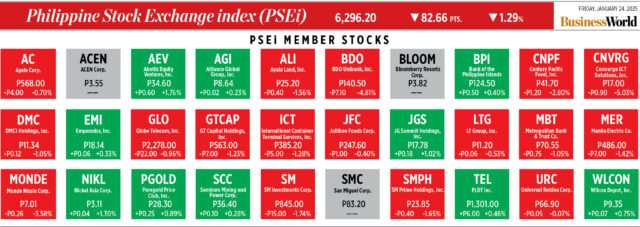
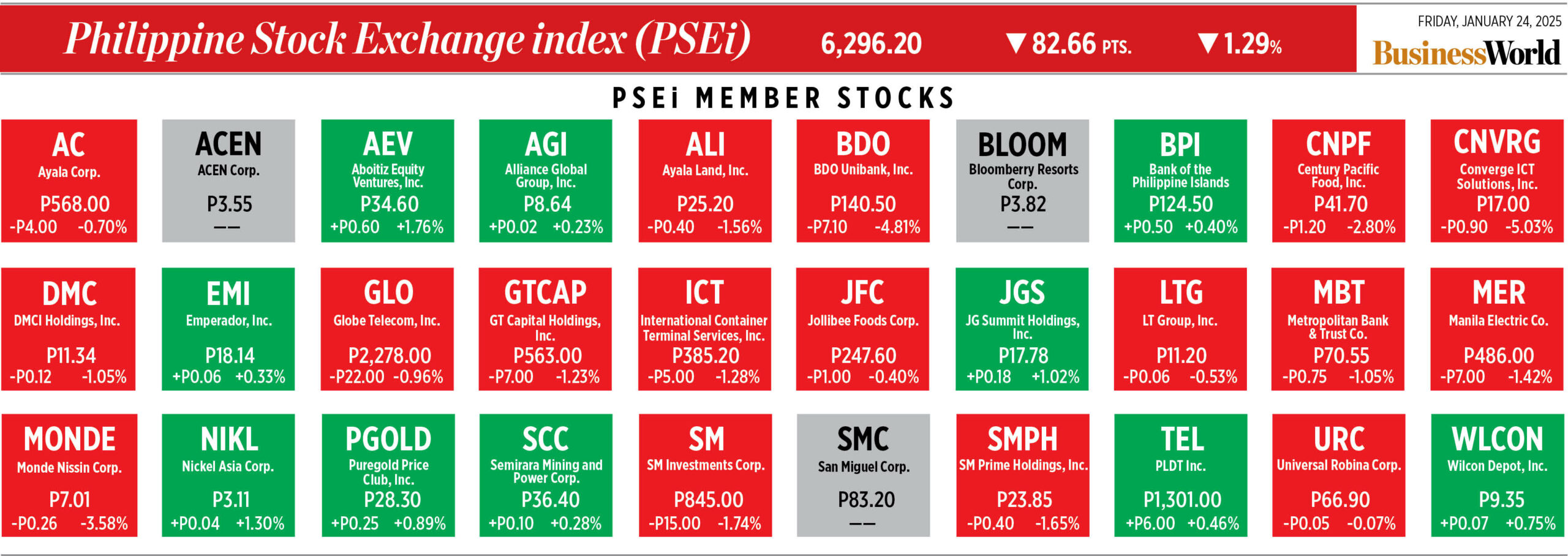
How PSEi member stocks performed — January 24, 2025

Here’s a quick glance at how PSEi stocks fared on Friday, January 24, 2025.


Shares to move sideways before Fed, GDP data

BW FILE PHOTO

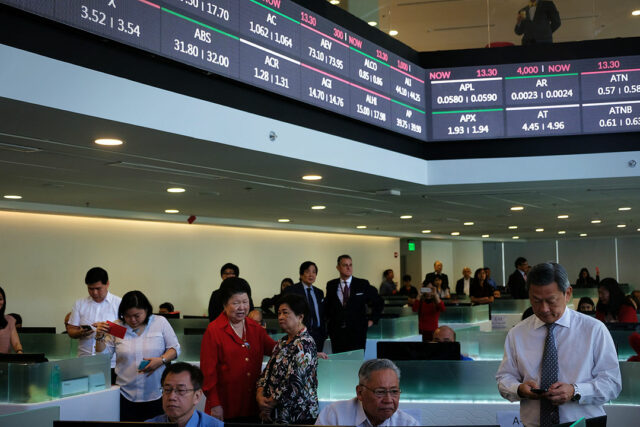
PHILIPPINE SHARES may trade sideways this week as players await the outcome of the US Federal Reserve’s first policy meeting for 2025 and the release of fourth quarter and full-year 2024 Philippine gross domestic product (GDP) data.

The benchmark Philippine Stock Exchange index (PSEi) sank by 1.29% or 82.66 points to close at 6,296.20 on Friday, while the broader all shares index dropped by 0.64% or 24 points to 3,681.34.

Week on week, the PSEi fell by 0.88% or 55.92 points from the 6,352.12 close on Jan. 17, marking its third straight week in the red.

“The local market is already on a three-week decline as bearish sentiment continues to linger driven by worries over the US’ planned protectionist policies, and the possibility of the Philippines not hitting its 2024 economic growth target,” Philstocks Financial, Inc. Senior Research Analyst Japhet Louis O. Tantiangco said in a Viber message.

“Mounting global economic pressure kept local equities from trading above 6,400 ahead of the Fed’s meeting [this] week,” online brokerage firm 2TradeAsia.com said in a market note. “As expected, the news cycle has been so far dominated by President Donald J. Trump’s policy shifts and the adjustments the rest of the world are partaking to minimize damage to output.”

For this week, Mr. Tantiangco said the market’s focus will be on the Fed’s policy review and the Philippine GDP report. The US central bank will hold its two-day meeting on Jan. 28-29, while the Philippine Statistics Authority is set to release fourth quarter full-year 2024 GDP data on Jan. 30 (Thursday).

“GDP growth that hits the government’s target may give the market a boost [this] week. However, growth slower than 2023’s 5.6% may weigh on the bourse. Meanwhile, a Fed rate cut together with a dovish outlook for the US’ monetary policy may push the market higher,” he said.

“With the market at attractive levels, we may see some bargain hunting in [this] week’s trading. However, we do not expect a strong rally yet as investors continue to wait for catalysts.”

He put the PSEi’s support at 6,150 and resistance at 6,400.

National Economic and Development Authority Secretary Arsenio M. Balisacan last week said that Philippine economic growth in 2024 may have fallen short of the government’s 6%-6.5% target due to the typhoons that hit the country in the fourth quarter.

Philippine GDP growth averaged 5.8% in the first nine months of 2024. The economy would have needed to expand by at least 6.5% in the fourth quarter to meet the low end of the government’s goal.

For his part, Rizal Commercial Banking Corp. Chief Economist Michael L. Ricafort placed the market’s support at 6,300 and resistance at 6,500-6,600.

2TradeAsia.com put the PSEi’s immediate support at 6,000-6,100 and resistance at 6,400.

“The 6,300-6,400 zone has always been a critical zone for the PSEi from a charting standpoint,” it said, adding that the Fed’s decision this week could affect this trend. — Revin Mikhael D. Ochave

Peso may rise further before Fed meeting

BW FILE PHOTO

THE PESO may strengthen further against the dollar this week but stay at the P58 level ahead of the US Federal Reserve’s first policy meeting for the year.

The local unit closed at P58.31 per dollar on Friday, surging by 38.20 centavos from its P58.692 finish on Thursday, Bankers Association of the Philippines data showed.

Week on week, the peso likewise rose by 33 centavos from its P58.64 finish on Jan. 17.

The peso gained against the dollar on Friday after US President Donald J. Trump said he wants the Fed to cut interest rates, Rizal Commercial Banking Corp. Chief Economist Michael L. Ricafort said in a Viber message.

“The peso tracked dollar weakness overnight after Trump said that he would demand interest rates to drop immediately at the World Economic Forum,” a trader said by phone.

The dollar was further dragged down after the Bank of Japan raised interest rates to a 17-year high, the trader added.

For this week, the trader said the peso may trade sideways against the dollar as the market awaits signals from the Fed’s policy meeting on Jan. 28-29.

The trader sees the peso moving between P58.20 and P58.50 per dollar this week, while Mr. Ricafort expects it to range from P58.10 to P58.60.

The US dollar slid on Friday and was set for its biggest weekly loss in over a year after Mr. Trump suggested a softer stance on tariffs against China, adding to uncertainty about the trade policy that kept equity markets on edge, Reuters reported.

Mr. Trump told Fox News on Thursday his recent conversation with President Xi Jinping was friendly and he thought he could reach a trade deal with China.

The US dollar dropped as much as 0.8% against a basket of currencies on Friday before narrowing losses at the end of the day to be down 0.65%. But it still had its biggest weekly loss since November 2023, having lost 1.8% since Monday.

Meanwhile, Mr. Trump on Thursday said he wants the Federal Reserve to cut interest rates at a time the central bank has hit pause for an uncertain duration, arguing he understands monetary policy better than those charged with setting it.

The Fed last cut its overnight interest rate target by a quarter percentage point at its December policy meeting to between 4.25% and 4.5%. — A.M.C. Sy with Reuters

Manila: China Coast Guard used sonic device to ‘harass’ PCG near Zambales

PHILIPPINE COAST GUARD PHOTO

By Kyle Aristophere T. Atienza, Reporter

THE PHILIPPINES has accused China of using a long-range acoustic device (LRAD) at the weekend to harass its vessel near the coast of Zambales province, more than two weeks since it started monitoring the area after the deployment of China’s monster ship.

The Philippine Coast Guard (PCG) said China tried to drive away the 44.5-kilometer (km) BRP Cabra by using the acoustic device, which emits high-decibel sound that could damage the ears.

“For the first time, China Coast Guard (CCG) 3103 employed a LRAD to harass the Philippine Coast Guard vessel, attempting to deter proximity,” it said in a statement on Sunday.

The Chinese Embassy in Manila did not immediately reply to a Viber message seeking comment.

The PCG said CCG 3103 replaced another vessel deployed near the coast of Zambales “to maintain the illegal Chinese patrol.” CCG 3103 “appears to be escorted by CCG-5901 or the “Chinese monster ship,” it added.

Chester B. Cabalza, founding president at Manila-based International Development and Security Cooperation, said this was not the first time China’s coast guard used the acoustic device within the Philippines’ exclusive economic zone (EEZ).

“They experimented with the utilization of LRAD in 2023 to annoy Filipino coast guardians, with the harmful intent to cause hearing loss,” he said in a Facebook Messenger chat. “It is still considered as a destructive grey zone tactic, almost parallel to the laser lights that cause blindness.”

The Philippines has accused China of intimidating Filipino fishermen near Scarborough Shoal and normalizing its “illegal presence” after Beijing sent the monster ship, the world’s biggest coast guard vessel, into the Philippine EEZ on Jan. 4.

The PCG said in a separate statement on Sunday that CCG 3103 was operating at a distance of 172.236 km off the coast of Zambales.

“In its radio communications with the PCG vessel, BRP Cabra, it is clear that the Chinese Communist Party is disregarding international law while arrogantly asserting jurisdiction over these waters, which are well beyond the People’s Republic of China’s baseline,” it said.

It said the China Coast Guard has been threatening Philippine vessels, “warning that if we do not leave, they will take necessary measures, and we will bear the consequences.”

The PCG said the threats against the legitimate presence of the Philippines “clearly indicate China’s desire to impose a new order that undermines the rules-based international system.”

“Without needing to emphasize the key points of the 2016 arbitral award, which invalidated their nine-dash line claim, it’s evident that anyone with a sound mind, genuinely concerned about preserving peace and stability in the region, would acknowledge that their presence in the Philippines’ EEZ is both barbaric and illegitimate,” it added.

A United Nations-backed court in the Hague voided China’s expansive claim in the South China Sea in 2016, as it ruled the shoal is a traditional fishing ground for Filipino, Chinese and Vietnamese fishermen.

The PCG said on Saturday night BRP Cabra had managed to prevent the Chinese vessels from approaching the coastline of Zambales, with the CCG being pushed back to 167 km to 176 km from the shore.

“This achievement is a testament to the vigilance and bravery of the men and women aboard BRP Cabra, who have shadowed the CCG at close distances while conducting hourly radio challenges to assert that the Chinese presence violates the Philippine Maritime Zones Act, the United Nations Convention on the Law of the Sea (UNCLOS) and the 2016 arbitral award,” the PCG said.

REGIONAL STABILITY
Meanwhile, Philippine think tank Stratbase ADR said in a statement on Sunday that more countries are pushing for stronger maritime security partnerships with the Philippines this year amid “China’s persistent aggression in the West Philippine Sea.”

“Ambassadors from France, Japan, the European Union, Vietnam, Indonesia and Australia reaffirmed their commitment to safeguarding regional stability and maritime sovereignty,” it said, citing its maritime security forum in Manila last week.

French Ambassador Marie Fontanel said the maritime security cooperation between France and the Philippines is robust, citing key developments such as France’s participation in the 39th US-Philippines Balikatan (shoulder-to-shoulder) exercises and the establishment of a full-fledged defense mission in Manila in June.

“For an archipelagic nation like the Philippines, maritime safety is crucial. Ensuring the efficient transport of people and goods is essential for economic prosperity, while territorial and maritime sovereignty are vital for national security,” she said at the forum.

Japanese Ambassador Endo Kazuya said  “Japan stands ready” to work closely with the Philippines, the Association of Southeast Asian Nations (ASEAN) and the international community “to advance a free and open Indo-Pacific.”

Stratbase said European Union Delegation Ambassador Massimo Santoro said a region free of coercion is “key to our collective stability, peace and prosperity.” “Strategic partnerships are central to the EU’s approach to the Indo-Pacific, promoting cooperation over confrontation.”

Indonesian Ambassador Agus Widjojo said the Philippines and Indonesia should “finds ways to promote regional maritime cooperation in the wider Indo-Pacific region.”

Vietnamese Ambassador to the Philippines Lai Thai Binh noted that “for Vietnam and the Philippines, maritime security is not just a matter of national interest, but a shared regional imperative.” “Addressing these complex challenges requires robust partnerships and a steadfast commitment to upholding international law, particularly the UNCLOS,” he added.

PHL’s 2025 budget law faces legal challenges

PHILIPPINE STAR/EDD GUMBAN

By Kenneth Christiane L. Basilio, Reporter

THE PHILIPPINES’ P6.326-trillion budget this year faces legal hurdles due to unresolved issues stemming from priority allocations and allegedly shady legislative maneuvers in its drafting last year, analysts said at the weekend.

A legal victory for its critics could jeopardize Philippine growth prospects, they added.

“The approved budget for 2025 is evidently driven by the need to appease politicians rather than to address genuine needs of the Filipino people,” former Finance Undersecretary Cielo D. Magno said in a Facebook Messenger chat. “This explains the clearly unconstitutional acts that have been woven into the budget.”

Philippine President Ferdinand R. Marcos, Jr. signed into law the 2025 General Appropriations Act on Dec. 30 but vetoed P194 billion worth of line items that he said were inconsistent with his government’s priorities.

These include appropriations for certain programs of the Department of Public Works and Highways (DPWH) and unprogrammed funds that increased four times, he said.

The budget was again put in the spotlight in mid-January after his predecessor Rodrigo R. Duterte said the budget bill had blank line items whose amounts were later filled out by the Executive branch. Mr. Marcos has accused the tough-talking leader of peddling a lie.

The blank line items contained in the budget were to projects under the Agriculture department, such as irrigation and farm-to-market roads, according to a copy of the budget’s bicameral conference committee report obtained by BusinessWorld.

“If there is truth in the allegation that there were blank items in the bicameral version of the General Appropriations bill, then this will be another ground to question its legality,” Ephraim B. Cortez, president of National Union of Peoples’ Lawyers, said in a Viber message. “This means that the bill was not complete when it was finally approved by Congress.”

Ms. Magno said changing the version of the budget bill approved by lawmakers is prohibited. “There are no additions or amendments that can be made after this point.”

The Philippine Senate and House of Representatives ratified the budget bill on Dec. 11, hours after the bicameral conference committee members reconciled their differences. “After the conference committee has reconciled the provisions for the Senate and House versions of a bill, it signs the report that becomes the basis for the General Appropriations Act,” she pointed out.

“Congress could not have legally filled in any blanks because the legislative process ended after both Houses ratified the reconciled version,” she said. “The Executive branch could not have filled in the blanks either because appropriation is a legislative function.”

Congress should publish the enrolled bill of the budget so the public could check whether there were really blank items, she added.

“Once a bill becomes an enrolled bill, then no changes can be made to it,” Michael Henry Ll. Yusingco, a constitutionalist and senior research fellow at the Ateneo Policy Center, said in a Facebook Messenger chat. “Any change done to an enrolled bill which later becomes law will make this law unconstitutional.”

He added that Mr. Marcos’ certification of the budget bill as urgent was invalid in the absence of a public emergency or calamity.

Civic groups have flagged issues hounding the 2025 budget including allegations that funding for public works dwarfed the budget for education.

“The budget violates the constitutional mandate that the state should give priority to education,” Mr. Cortez said.

GROWTH RISK
The law allotted P1 trillion for the education sector, 4.3% higher than the P1.007-trillion funding for the DPWH.

“While it appears that the education sector got the biggest budget allocation of P1.055-trillion… they included in the education budget the allocations for institutions not considered part of basic or tertiary education,” Mr. Cortez said, referring to military and police academies.

“They lumped them with the education budget to make it appear that it got the highest allocation in the 2025 budget,” he added.

The budget law also violated the 2019 Universal Healthcare Act and Sin Tax Reform Act of 2012, which could also be grounds for its unconstitutionality, according to Filomeno S. Sta. Ana III, Action for Economic Reform coordinator.

Lawmakers scrapped P74 billion in state subsidies for the Philippine Health Insurance Corp. (PhilHealth), citing its ample reserve funds.

“The revenues from tobacco, e-cigarette and sweetened beverage excise taxes are exclusively and strictly for PhilHealth,” he said in a Viber message.

The Philippine government would likely re-enact the 2024 national budget should the Supreme Court void the 2025 spending plan, Ms. Magno said. “This does not preclude congress from enacting another budget, hopefully one that is free from constitutional doubt,” she added.

Voiding the budget law could dampen Philippine economic growth, Michael L. Ricafort, chief economist at Rizal Commercial Banking Corp., said in a Viber message.

“A bigger risk over the past 10 to 20 years has been a re-enacted budget since this would mean lower government spending than was originally planned, which could slow domestic product growth,” he told BusinessWorld.

The government targets 6% to 8% economic growth this year.

A re-enacted budget could cut funding for infrastructure, education and key government priority programs, he added.

It could also disrupt state operations, affecting industries that rely on public spending, John Paolo R. Rivera, a senior research fellow at the Philippine Institute for Development Studies, said in a Viber message.

“Investor confidence would likely be disturbed, as questions about governance, transparency and adherence to constitutional processes will emerge, leading to potential capital flight, a weaker Philippine peso and reduced foreign direct investments,” he added.

The “political capture” of the national budget should be fixed with more transparency and accountability, more responsible decision-making and oversight by a Congress with more integrity, Jose Enrique “Sonny” A. Africa, executive director at think tank IBON Foundation, said in a Viber message.

Civic groups should also be allowed to have a say in the crafting of the budget, Renato B. Magtubo, a former congressman and chairman of Partido Manggagawa, said via Viber. “There should be a sectoral consultation to address budget issues or concerns.”