Home Blog Page 2084

John Amos, star of 1970s TV’s Good Times and Roots, 84

John Amos (R) and Jimmie Walker in a scene from Good Times. — IMDB

LOS ANGELES — John Amos, the US football player turned actor who was acclaimed for his roles in the 1970s TV series Good Times as well as the miniseries Roots, died on Aug. 21 in Los Angeles at age 84, his son Kelly Christopher (K.C.) Amos said.

Mr. Amos’ death, which was due to natural causes according to a press release, was not disclosed until Tuesday.

“It is with heartfelt sadness that I share with you that my father has transitioned,” his son said in a statement.

“He was a man with the kindest heart and a heart of gold … and he was loved the world over,” he added.

Mr. Amos played the dad, James Evans, for 61 episodes of the sitcom Good Times in the mid-1970s and also the older Kunta Kinte in the TV miniseries Roots, based on the 1976 novel about slavery by Alex Haley. He also played the TV weatherman Gordy Howard in The Mary Tyler Moore Show in the same decade.

Mr. Amos also had a brief professional football career in the 1960s.

While filming Good Times, Mr. Amos often advocated for a more authentic representation of the Black American family, criticizing the show’s writers for leaning in to racial stereotypes.

He was also a veteran of the 50th Armored Division of the New Jersey National Guard and honorary master chief of the United States Coast Guard. — Reuters

AI in higher education: bridging students’ and educators’ views

FREEPIK

‘TO AI OR NOT TO AI?’
This is one of the most pressing questions that today’s educators and higher education leaders face. While there is no doubt that artificial intelligence (AI) will play an increasingly central role in people’s lives, many in the education sector remain skeptical — with some even deeming it a harbinger of educational doom. In a study conducted by global educational technology or edtech leader Anthology, 30% or three in every 10 university leaders in the Philippines see generative AI as unethical and should be banned from being used in educational settings.

“There are mixed reactions from educators with regards to AI in the classroom,” Bruce Dahlgren, CEO of Anthology, said in an exclusive statement shared with BusinessWorld. “We recently conducted a survey of university leaders and students in the Philippines about their perceptions of AI. It revealed that university leaders have certain reservations around allowing AI in higher education, perceiving it as being unethical. Students, on the other hand, were optimistic about the role AI could play in increasing engagement and improving teaching and learning methods.”

The study conducted across 11 countries including the Philippines involved 5,000 higher education leaders and students. Key takeaways reveal that Filipino students have the highest level of confidence (54%) that AI will help enhance engagement and interactivity among peers. These two areas are where AI’s impact is expected to be most transformative and where university leaders should focus when considering the use or expansion of AI in higher education.

Additionally, 52% believe that AI has the potential to revolutionize teaching and learning methods. However, the same group expressed discomfort with using chatbots to get quick answers to their questions.

“Regardless of one’s perception of AI in higher education, the reality is that it’s here to stay. As with every new and powerful technology, there are risks and opportunities. Our goal is to help institutions use AI ethically and responsibly to benefit students and institutional operations,” Mr. Dahlgren said.

PROMOTING THE ETHICAL USE OF AI
Anthology, a company founded on the premise of empowering both learners and educators with technology-based solutions, said it believes that the key to answering the question of whether to use AI or not lies not only in the needs of each individual institution, but also in its ethical application.

Higher education is facing serious challenges. Institutions around the world are grappling with issues like student retention, escalating costs, and changing student expectations. “When applied thoughtfully and ethically, AI can touch every aspect of the student experience for the better. The key question is where AI can be applied most effectively. The focus should be on using AI to drive student success, support operational excellence, and improve institutional efficiencies,” said Mr. Dahlgren.

AI is a game-changer in higher education, bridging gaps in accessibility and quality. AI-enabled and data-driven education systems can help students track and acquire skills needed for jobs in their desired fields while exploring how these skills align with other careers.

Additionally, AI can transform school administration processes by reducing time-consuming tasks, enabling staff to focus on important outreach and student support initiatives. It can also assist faculty and educators by streamlining their work so they can spend more time with their students and make learning more equitable. Notably, a separate study published earlier this year highlights that on average, Filipino teachers are overworked by over 400 hours annually.

ADAPTING TO THE NEEDS OF PHILIPPINE HIGHER EDUCATION
Anthology said they are investing a lot of time and resources to provide tailored solutions to each of their partner institutions in the Philippines.

“We provide resources, like Anthology’s AI Policy Framework, available freely to all institutions to help them develop AI policies and programs that are appropriate for their institution. In addition, we are about to launch a tour around the world to promote ethical AI use. We will visit 25 cities — including in the Philippines — to host education sessions that help institutions develop effective policies for ethical AI implementation,” it said.

BSP looks to enhance MSB reporting governance rules

THE BANGKO SENTRAL ng Pilipinas (BSP) is looking to amend the reporting governance framework for money service firms to better regulate these businesses and help mitigate money laundering risks.

In a draft circular uploaded on its website, the central bank said it is seeking to amend sections under the Manual of Regulations for Non-bank Financial Institutions (MORNBFI) to revise the reporting governance framework of money service businesses (MSBs), remittance transfer companies (RTCs), and money changers or foreign exchange dealers (MX/FXDs).

These amendments aim to “enhance regulatory and supervisory activities over MSBs to ensure that attendant risks remain manageable as the industry continually evolves and business models become increasingly complex amidst emergence of new players in remittance and breakthrough financial technology.”

It would also enable the BSP to strengthen its anti-money laundering and combating the financing of terrorism (AML/CFT) policies and initiatives.

“The proper conduct and effective supervision of MSBs are facilitated by the accurate and timely submission of required information concerning their transactions, financial condition, and results of operations.”

“At the same time, high-quality individual MSB reports contribute to the preparation of aggregate statistics that enable MSBs to make better-informed business decisions,” it added.

Regulatory reports must be complete, accurate, timely and adaptable, the central bank said.

MSBs must also establish a reporting system that includes a management information system; written policies and procedures documenting their standards and processes; periodic independent review of reporting processes and procedures; and timely reporting to the board of directors, partners, proprietor and senior management.

It also prescribes monetary penalties for noncompliance ranging from P150 to P1,500 daily for reporting violations.

MSBs shall also have a true and accurate account, record, or statement of their daily transactions, according to the draft circular.

“Records shall also include audio, photographic, and video evidence of events, acts, or transactions of the MSB, including all records of communication, oral (e.g., voice recordings) or written (e.g., letters) of officers and employees of the MSB,” it said.

These records must also be retained for a period of at least five years unless otherwise required by law or other regulations.

MSBs shall also strictly adopt a manual of accounts prescribed under the Financial Reporting Package for MSBs for “prudential reporting purposes.”

The draft rules said that crimes must be reported to the appropriate supervising department of the BSP, regardless of the amount involved. These include estafa, theft, robbery, and falsification, among others.

The amendments also detail the guidelines for audited financial statements.

“The Bangko Sentral recognizes that external auditors play a vital role in contributing to the conduct of effective supervision and sustaining the confidence of the public in the financial system,” it said.

“In this light, the regulations on financial audit aim to enhance the quality of information channeled to the supervisory process and ultimately promote fairness, transparency and accuracy in financial reporting.”

If approved, the circular will form part of the MORNBFI under “M-Regulations.”

“When completed and adopted, is intended to overwrite the existing Section 901-N of MORNBFI to enhance and provide structure to the regulatory standards for MSBs,” the BSP added. — Luisa Maria Jacinta C. Jocson

mWell adds physical therapy services

DIGITAL HEALTHCARE platform mWell has announced the addition of physical therapy services through a partnership with Physiaré Physical Therapy Center.

Physiarés physical therapy services will be integrated into the HealthHub platform, mWell said in an e-mailed statement on Wednesday.

“Our partnership with Physiaré demonstrates mWell’s commitment to supporting health and wellness entrepreneurs as they expand their online presence. By facilitating greater access to healthcare providers, HealthHub empowers Filipinos to choose convenient health solutions, paving the way for healthier, happier lives,” mWell President and Chief Executive Officer (CEO) Chaye A. Cabal-Revilla said.

Using the HealthHub platform, mWell users can book an appointment for specialized rehab therapy, back care, weight management, and conditioning programs.

The HealthHub platform also offers diagnostics and preventive care programs. It also collaborates with accredited clinics and wellness centers.

“With mWell, we are making it easier for clients to access specialized physical therapy programs and guided exercise regimens. Together, we aim to empower individuals to take charge of their health while ensuring they receive the best possible care at any time and from anywhere,” Physiaré CEO Ayeza Gonzales Almario said.

“This collaboration is pivotal in enhancing healthcare efficiency and increasing health awareness, ultimately supporting people’s overall well-being,” she added.

The digital healthcare platform of Metro Pacific Investments Corp. (MPIC), mWell, is a health and wellness mega app that aims to make healthcare accessible, available, and affordable for Filipinos.

Some of its services include 24/7 access to mWell partner-doctors online, fitness and nutrition programs, home care, and emergency services.

Physiaré has five branches, located at SM Aura Premier in Taguig City; Amorsolo St. in Makati City; McKinley Park Residences in Bonifacio Global City; Vista Mall Sta. Rosa in Laguna; and Festival Supermall in Muntinlupa City.

MPIC is one of the three key Philippine units of Hong Kong-based First Pacific Co. Ltd., the others being Philex Mining Corp. and PLDT Inc.

Hastings Holdings, Inc., a unit of PLDT Beneficial Trust Fund subsidiary MediaQuest Holdings, Inc., has a majority share in BusinessWorld through the Philippine Star Group, which it controls. — Revin Mikhael D. Ochave

How PSEi member stocks performed — October 2, 2024

Here’s a quick glance at how PSEi stocks fared on Wednesday, October 2, 2024.


Philippines slips in Global Attractiveness Index

The Philippines fell two places to 69th out of 146 countries in the latest edition of the Global Attractiveness Index (GAI) by The European House – Ambrosetti. The index measures the attractiveness of countries using key performance indicators under four subindices: positioning, dynamicity, sustainability, and future orientation. With an overall score of 34.7, the country was categorized under “medium attractiveness.”

Philippines slips in Global Attractiveness Index

Philippines eyes chartered flights to bring home Filipinos from Lebanon

Smokes rise, amid ongoing cross-border hostilities between Hezbollah and Israeli forces, in Tyre, southern Lebanon Sept. 23, 2024. — REUTERS

By Kyle Aristophere T. Atienza, Reporter

THE PHILIPPINE government on Thursday said it was preparing chartered flights to bring home Filipinos from war-torn Lebanon, as it announced a ban on the deployment of workers there.

There were 101 Filipinos in Lebanon who were ready to be repatriated, but the “challenge is that we do not have flights,” Migrant Workers Undersecretary Bernard Olalia told a news briefing.

He said the government was supposed to bring home 15 Filipinos from the Middle Eastern country on Sept. 25, but it did not push through because the flights were canceled due to the conflict.

“And as a consequence, we are trying to provide chartered flights.”

Mr. Olalia said three more shelters have been secured in Beirut in case more Filipinos signify their intention to leave. He added that the Philippines was having a hard time securing landing rights for chartered flights.

“The other challenge is the exit permits of some of our workers,” he said. “Apart from documented overseas Filipino workers (OFWs), we have undocumented OFWs who need to secure travel documents.”

“And once they are given travel documents, we will help them in securing exit visas or exit permits from the immigration [office] of the Lebanese government.”

Mr. Olalia said the Department of Migrant Workers is studying the possibility of using alternative routes. “Apart from the air route, we will be assessing the sea and the land route should the case or the situation there worsen.”

He said the Philippine government would no longer allow the deployment of OFWs to Lebanon because the Department of Foreign Affairs (DFA) had raised the alert level to 3.

“When Alert Level 3 is imposed, there is a voluntary repatriation, and under this stage, we no longer allow either direct hire or a returning worker to go back there.”

The DFA earlier said it might declare Alert Level 4 in the war-torn country, whose southern part was invaded by Israel to contain the armed group Hezbollah, which had a month-long war with Israel in 2006.

The tension is the latest in a spate of cross-border hostilities after Israel’s bombardment of Gaza.

In a statement earlier this week, the Israeli military said its troops backed by aircraft and artillery had begun “limited, localized and targeted raids against Hezbollah terror targets,” accusing them of posing “immediate threat” to northern Israeli communities.

Hezbollah spokesman Mohammed Afif on Tuesday said there had been “no direct ground clashes” with Israeli forces, denying that they had crossed into southern Lebanon, based on a Reuters report.

The group was “ready for a direct confrontation with the enemy forces that dare or attempt to enter Lebanese territory and to inflict the greatest losses on them.”

The Philippines last month joined 123 other countries in favoring a United Nations resolution urging Israel to end its occupation of Palestinian territories within a year.

Israeli settlement activities involved the transfer of its nationals “into the occupied territories, the confiscation of land, the forced transfer of Palestinian civilians, including Bedouin families,” according to the November resolution.

The settlements also involved “the exploitation of natural resources, the fragmentation of territory and other actions against the Palestinian civilian population.”

The Gaza Strip is one of the two territories occupied by Palestinians — the other being the West Bank, which the Israeli government has been trying to invade in recent years.

The two areas, along with East Jerusalem, came under Israeli occupation after the 1967 Arab-Israeli war. Since the war, Israel has responded to Palestinians’ demand for a homeland through military force.

OFWs IN QATAR
Also on Wednesday, Ana Theresia Hontiveros-Baraquel called for measures to better protect the rights and well-being of migrant Filipinos, as she is set to meet distressed OFWs in Qatar who have been victims of abuse and harassment.

In her official trip to the Middle Eastern nation, the senator will meet with at least 50 OFWs who have suffered at the hands of their employers. She will also meet with Philippine diplomatic and labor officials and migrant community leaders to discuss how the Philippine government could ensure the safety of migrant workers, she said in a statement.

Ms. Hontiveros, who heads the Senate committee on women and children, expressed alarm at the acts of physical and emotional abuse, and unfair labor practices perpetrated against Filipino workers in Qatar, particularly domestic workers.

“According to government records, 57% of OFWs deployed in Qatar are household workers, and a majority of them are women who are especially vulnerable to abuse by employers,” she said.

Ms. Hontiveros said migrant workers offices in Qatar and other similarly situated countries should be properly trained to better help distressed Filipino workers, particularly “runaway” workers who are facing threats from their employers.

She also urged the Department of Migrant Workers and DFA to step up their capacity to monitor and reach out to distressed workers.


Seasoned political figures seek Senate comeback

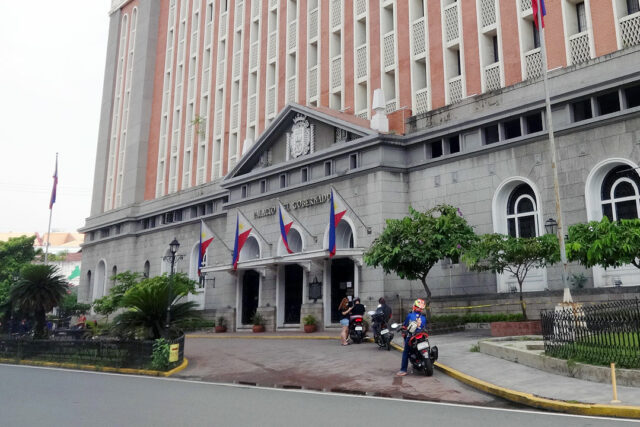
THE COMELEC office in Intramuros, Manila — PATRICK ROQUE

By Chloe Mari A. Hufana, Reporter

PROMINENT politicians allied with President Ferdinand R. Marcos, Jr. formalized their bids for the Senate on the second day of registration on Wednesday.

Former Senate President Vicente C. Sotto III, ex-Senator Panfilo M. Lacson, Sr., and action star turned lawmaker Manuel M. Lapid were among those who filed their certificates of candidacy.

The May 2025 elections will be a litmus test of Mr. Marcos’ popularity and a chance to consolidate power and groom a successor, which the influential Duterte family has signaled it is determined to stop after an acrimonious falling out.

Philippine presidents are limited to a single six-year term.

Though 317 seats at the House of Representatives and thousands of regional and city posts are up for grabs among 18,000 positions, the attention is on 12 spots in the 24-seat Senate, a high-profile chamber with outsized influence and typically stacked with political heavyweights.

Mr. Sotto said he wanted to finish overlooked pet bills including one that seeks to trim the bureaucracy.

“The bill that I filed before that was not acted upon should push through, and that is rightsizing of the government,” he told reporters. He also cited the need to pass an anti-fake news bill, which he proposed in 2019.

Mr. Sotto lost to Vice-President Sara Duterte-Carpio in the 2022 race. He was Senate president during ex-President Rodrigo R. Duterte’s term.

Mr. Lacson, who lost in the 2022 presidential election as Mr. Sotto’s running mate, said he would be a vanguard of the annual national budget. The former national police chief had been against pork barrel insertions when he was a senator.

“I will help President Marcos pursue his administration’s programs to benefit the majority of the Filipino people,” he told reporters “What is right must be kept right, what is wrong must be set right.”

Mr. Lacson said he is running independently despite the President’s endorsement.

Mr. Lapid declined to entertain questions from the media, saying his track record as a politician should speak for itself.

Meanwhile, presidential sister and Senator Maria Imelda Josefa Remedios “Imee” R. Marcos also filed her certificate. She was accompanied by her two sons and her mother, former First Lady Imelda R. Marcos.

Ms. Marcos, who is seeking reelection, earlier declined her brother’s endorsement, which she said was to avoid putting him in a difficult position.

Hansley A. Juliano, a political science professor at the Ateneo de Manila University, called the familiar names “continuity candidates.”

“They have also tended to be on board traditional legislation, be it business-friendly legislation, additional insertions on preferred budget items, and likely establishing factions in the leadup to the election,” he told BusinessWorld in a Facebook Messenger chat.

Philippines’ Taal volcano shoots plume of steam, but alert level low

Tourists enjoy the sight of Taal volcano while walking around Picnic Grove in Tagaytay City, Feb.17, 2024. — PHILIPPINE STAR/MIGUEL DE GUZMAN

THE PHILIPPINES’ Taal Volcano near the capital region erupted on Wednesday, spewing a plume of steam that was more than 2 kilometers (1.24 miles) high, the country’s seismology agency said.

Taal, located about 70 km south of Manila, is one of the world’s smallest active volcanoes, and some of its previous eruptions had affected the capital and air travel.

The agency’s chief Teresito Bacolcol described the eruption as phreatomagmatic, where magma interacts with water and produces a plume of steam.

The volcano sits inside a large lake near the town of Tagaytay in Cavite province.

“This phreatomagmatic eruption was limited at the volcano island,” Mr. Bacolcol said by phone. “We’re looking whether there’s ashfall in the eastern side, but there’s no evacuation yet.”

He added that the alert level remained at the lowest on the scale and there were no immediate reports of injuries.

Despite standing at only 311 meters (1,020-feet), it can be deadly and an eruption in 1911 killed more than 1,300 people.

In July 2021, thousands of people were evacuated after it spewed a kilometer-high plume of gas and steam.

A year earlier, Taal volcano shot a column of ash and steam as high as 15 km into the sky, forcing more than 100,000 people to abandon their homes and triggered widespread disruption in the capital.

The Philippines lies in the so-called Pacific Ring of Fire, a belt of volcanoes around the Pacific Ocean where most of the world’s earthquakes strike. I also lies along the typhoon belt in the Pacific and experiences about 20 storms each year. — Reuters

Civil society acts as government procurement ‘watchdog’ — World Bank

REUTERS

THE PHILIPPINE GOVERNMENT must increase the participation of civil society organizations (CSOs) in monitoring its procurement process to help prevent misuse of state funds, the World Bank said in a blog.

“CSOs often act as watchdogs, ensuring that the bidding process is transparent. Their involvement can help to hold government agencies and contractors accountable, reducing the risk of fraud and mismanagement of public funds,” World Bank Senior Procurement Specialist Dominic R. Aumentado and Government Procurement Policy Board (GPPB) Executive Director Rowena Candice M. Ruiz said in the blog.

Monitoring procurement activities can help avoid fraud and misuse of funds, leading to cost savings, the analysts said.

Republic Act (RA) No. 12009, the New Government Procurement Act, allows at least two observers to sit in procurement proceedings — one representative each from a duly recognized private group and a CSO. This was mandated to ensure transparency in the state’s procurement process.

The new law updates RA 9814, the Government Procurement Reform Act of 2003, to help modernize the country’s procurement process and align it with global standards.

The Philippines is also expected to update its Procurement Observers’ Guide under the old procurement law with the emergence of digitalization and recent policy changes.

The guide details the principles, standards, and procedures for monitoring procurement, which would help CSOs with their monitoring.

The GPPB, as supported by the World Bank, launched a Procurement Observers’ Portal. Under which, CSO observers can access key documents, such as bids, budgets, technical specifications, and supplier profiles. 

Citing the timeliness of the portal, the Washington-based multilateral lender estimates public spending to reach $140 billion by 2028.

“With this increase in spending, the role of CSOs in overseeing procurement becomes increasingly vital in ensuring the integrity and transparency of government decisions involving taxpayers’ money, loans from multilateral and bilateral agencies, and borrowing from private financing,” it said.

The WB cited the need to improve digital tools to expand CSOs role in identifying “red flags” in procurement to contract implementation. — Beatriz Marie D. Cruz

Lawmakers ask Roque to surrender

HERMINIO “HARRY” L. ROQUE — PHILSTAR FILE PHOTO

EX-PRESIDENTIAL spokesperson Herminio “Harry” L. Roque, Jr. should surrender to authorities after the Philippines’ top court dismissed a plea seeking to void a House of Representatives’ arrest warrant against him, lawmakers said on Wednesday.

The House’s so-called “quad-committee” ordered Mr. Roque’s arrest and detention after being cited for contempt the second time for failing to submit subpoenaed documents necessary to the panel’s probe in relation to Philippine Offshore Gaming Operators.

The Supreme Court junked Mr. Roque’s writ of amparo request on Tuesday, citing the motion as not the “proper remedy against congressional contempt and detention orders,” court spokesperson Camille Sue Mae L. Ting said in a media briefing.

“This is not the time for excuses. Atty. Roque should face the music and respond to the allegations in the proper forum,” Sta. Rosa City Rep. Dan S. Fernandez said in a statement in Filipino. “The law must prevail. Roque should not hide behind technicalities or writs that have no basis.”

Mr. Roque’s daughter Hacintha filed the case before the top court alleging the quad committee’s contempt and detention orders threatened Mr. Roque’s rights to life, liberty, and security. 

A writ of amparo is a legal remedy reserved for persons whose personal security is threatened or violated, including extralegal killings and enforced disappearances.

Mr. Roque’s daughter also asked the top court to issue writs of certiorari and prohibition to prevent the House quad committee from requiring him to attend future hearings and produce any additional documents requested by the panel.

Mr. Roque said in a Viber message that he is currently “awaiting decision of Court on certiorari and prohibition.” — Kenneth Christiane L. Basilio

20,000 cybersecurity gaps found

REUTERS

THE DEPARTMENT of Information and Communications Technology (DICT) on Wednesday said it has identified and addressed 20,144 vulnerabilities in the cybersecurity systems of government agencies as of August this year.

DICT Undersecretary David L. Almirol, Jr. presented the number at a Senate Finance Committee hearing on the agency’s proposed P10 billion budget next year.

These gaps in cybersecurity gaps were identified through the DICT’s project SONAR, which scans for these vulnerabilities in state agency networks.

He said his agency is also planning to work with the Civil Service Commission to hire more cybersecurity experts next year to beef up the country’s defenses against hackers.

“Right now, we lack cybersecurity professionals both in the private and public sectors, we don’t even have cybersecurity organizations in the public sector,” he said.

Senator Sherwin T. Gatchalian at the same hearing urged the DICT to keep a close eye on critical infrastructure to protect crucial government data.

“Every day we don’t have an audit, we cannot assure the Filipino people that the government is doing its share to protect our critical infrastructure, especially during times of geopolitical uncertainties,” he said.

Mr. Almirol agreed with the senator, saying his agency is considering proposing an executive order on protecting critical information infrastructure.

President Ferdinand R. Marcos, Jr. this year adopted the National Cybersecurity Plan (NCSP) 2023-2028 to help address the rising number of cyber threats in the Philippines. Crafted by the DICT, the NCSP 2023-2028 outlines the country’s policy direction and operational guidelines for a secure cyberspace.

In 2022, the Philippines only had about 200 cybersecurity professionals compared to Singapore’s 2,000 experts, DICT Secretary Ivan John E. Uy earlier said, noting that 80% of Filipino cyber experts work overseas.

Mr. Uy said cybersecurity experts in the private sector earn about P200,000 a month, while those in the government are only paid P50,000. — John Victor D. Ordoñez