Home Blog Page 1989

Pi Wangkay emerges as Batang Pinoy fastest boy

SPRINTER Pi Durden Wangkay of Biñan, Laguna delivered the worthiest performance yesterday as he emerged the fastest boy in the Batang Pinoy at the Ramon V. Mitra track oval in Puerto Princesa, Palawan.

Mr. Wangkay, 15, timed in 10.88 seconds in the 100 meters (m) and broke his personal best of 11.09 he registered in the national U18 Championship at the PhilsSports track last May.

He also came close to touching the national juniors mark of 10.74 set by Daniel Noval in the Thailand Open 12 years ago.

So fast was Mr. Wangkay that he could have won the 100m in the older, U18 section and bested the winner there — Quezon City’s Elreb Taduran who had 11.08 — and eclipse the 11.3 mark set by Las Piñas’ Alfredo Taduran a year ago in that same discipline in Manila.

Putting icing on Mr. Wangkay’s cake was his completion of a rare sprint treble after he also topped the 200m and 400m days before in this meet bankrolled by the Philippine Sports Commission.

Emerging the prince of the pool was Arvin Taguinota of Pasig, who captured his sixth gold after ruling the boys 12-13 4x50m medley relay where he teamed up with Charles Canlas, Jefferson Sabularse and Marcelino Picardal III and timed in 2:03.69.

Mr. Taguinota, whose coach is Olympian Jessie Lacuna, also reigned supreme in the 200m individual medley, 100m freestyle, 100m and 200m back and 4x50m freestyle relay.

In freestyle wrestling, Surigao del Norte scooped up four mints thanks to Rose Jean Jamero (U15 38kg), Shane Carillo (U15 42kg), Quinnie Bongado (U17 43kg), and Lyka Dalman (U17 57kg). — Joey Villar

Torre is part of FIDE appeals committee of Ding-Gukesh world chess championship

BEHIND the scenes of the heated world chess championship showdown between Chinese Ding Liren and Indian Gukesh Dommaraju in Singapore is a Filipino icon that never ceased to make history.

His name is Eugene Torre.

The 73-year-old living legend is one of the chosen few to be part of the FIDE’s appeals committee that will settle all concerns between the two combatants for this year’s world crown.

“Grateful to the organizer and FIDE for this opportunity to be part of this historic championship,” Mr. Torre told The STAR on Thursday.

Mr. Torre said the emergence of Asia as a superpower in chess is a feat in itself and Messrs. Ding and Gukesh were just proof of it.

Interestingly, it all started in 1974 when Mr. Torre became the region’s first Grandmaster and paved the way for the rest of Asia to follow suit and produced eventual world men’s champions in Indian Vishwanathan Anand and Ding.

The current title clash will also ensure that an Asian will remain a world champion for another year.

“This is the first time in the history of chess that two Asians are playing to determine who will be the next world champion,” he said.

Mr. Torre said he expects a few or no disputes in Singapore.

“Unlikely a dispute will occur here,” said Mr. Torre. “In the 2022 Olympiad in India, I was also part of the Appeals Committee. Out of the many thousands of games played in the Open and Women’s events, we encountered only one dispute.”

To date, the 14-match series is currently tied at 1.5 with Mr. Ding winning the first, the second ending in a draw and Mr. Gukesh seizing the third one on Wednesday night. — Joey Villar

Spencer Dinwiddie’s 21 points carry Mavericks past Knicks

SPENCER DINWIDDIE had 21 points off the bench, Naji Marshall had a game-high 24 and the Dallas Mavericks led almost the entire way in a dominating 129-114 win over the visiting New York Knicks on Wednesday night.

Dallas played without All-Star Luka Doncic for the fourth straight game while he recovers from a sprained wrist. The Mavericks have won three of those four.

Jalen Brunson had a game-high 37 points for the Knicks facing his old team. Karl-Anthony Towns had 25 points and 14 rebounds for New York. It was the Mavericks’ fifth straight win over the Knicks.

The Mavericks seized control of the contest early as the Knicks were cold as ice. New York was 3-for-18 from the floor to start the game and were 0-for-8 from 3-point range in the first quarter. Irving had five first-quarter points as the Mavs led 28-15.

Playing without Doncic and sharpshooter Klay Thompson, the Mavericks spread the ball around and consistently found gaps in the Knicks defense. A trey by Marshall midway through the second quarter pushed the lead to 46-22, the biggest advantage of the first half.

Dallas led 60-38 at the break.

New York would get as close as 12 with 2:33 left in the game after Brunson scored six in a row, but the Mavericks would close things out with Irving feeding Dereck Lively II on a dunk and then Irving feeding Marshall on a fast break to push the lead back to 16 to seal it.

New York never led after the first four minutes. The Knicks shot 46.5% for the game, while the Mavericks shot 56.5%.

A game after scoring a career-high 40 in a win over the Nuggets Monday night, Knicks forward OG Anunoby had eight points on 3-for-15 shooting. — Reuters

No team is perfect

If there’s anything the Hawks’ victory yesterday showed, it’s that any team can win against any other in the National Basketball Association at any given time. The Cavaliers were heavily favored heading into the set-to, and not just because it was going to be held at the Rockets Mortgage FieldHouse. Given that the latter had hitherto been playing winning hoops to the tune of a league-leading 17-1 slate, hosting visitors with a three-game losing streak seemed to be a cakewalk. Instead, the unexpected occurred, providing all and sundry with a fitting reality check.

Not that the Hawks are better off for good with the victory. To be sure, they needed the confidence boost; if for nothing else, it underscored their capacity to stand toe to toe with the best of the best in the NBA. That said, consistency figures to stay elusive for them. For all their desire to compete, they remain hobbled by an uneven roster that features significant handicaps. No team is perfect, but theirs is less than most; even their supposed strengths feature glaring downsides.

Take, for instance, Trae Young, their acknowledged leader and current league pacesetter in assists. Yesterday, he dished out 22 dimes and came up with timely baskets in the clutch to keep the Cavaliers at bay. As transcendent as he was against the Cavaliers, however, there can be no downplaying his diminishing output. His advanced metrics and all his other counting stats are down, further highlighting his negatives. His talents notwithstanding, he will invariably be a liability on defense at 6’1” and 165 pounds.

To be sure, the Hawks have doubled down on their belief that Young is a bona fide foundational piece. Apart from their decision to move erstwhile starter Dejounte Murray, they have consciously surrounded him with pieces seen to complement his table-setting skills. Meanwhile, he is in the midst of a five-year deal that pays him $43.03 million this season, and the depressed market may well compel him to exercise the player option on his contract in 2026. Which is to say they also have no choice but to lean on him for the foreseeable future.

How far will the Hawks go in their 2024-25 campaign? The best-case scenario has them repeating their deep playoff run in 2021. Unfortunately, it has looked more like a pipe dream in recent memory. The good news is that Young possesses the motivation to do extremely well; he has changed agents and ditched adidas for Nike, and is out to prove he deserves to be counted among the league elite. And individual numbers aside, the only way he can win over critics is to steer the red and yellow to success. Whether he will ultimately do so, though, is anybody’s guess.


Anthony L. Cuaycong has been writing Courtside since BusinessWorld introduced a Sports section in 1994. He is a consultant on strategic planning, operations and human resources management, corporate communications, and business development.

Mexico warns Trump tariffs would kill 400,000 US jobs, threatens retaliation

STOCK PHOTO

MEXICO CITY — Mexican President Claudia Sheinbaum said on Wednesday Mexico would retaliate if US President-elect Donald Trump followed through with his proposed 25% across-the-board tariff, a move her government warned could kill 400,000 US jobs and drive up prices for US consumers.

“If there are US tariffs, Mexico would also raise tariffs,” Ms. Sheinbaum said during a press conference, in her clearest statement yet that the country was preparing possible retaliatory trade measures against its top trade partner.

Mexican Economy Minister Marcelo Ebrard, speaking alongside Sheinbaum, called for more regional cooperation and integration instead of a war of retaliatory import taxes.

“It’s a shot in the foot,” Mr. Ebrard said of Mr. Trump’s proposed tariffs, which appear to violate the United States-Mexico-Canada Agreement (USMCA) trade deal between Mexico, Canada and the US.

Mr. Ebrard warned the tariffs would lead to massive US job losses, lower growth and hit US companies producing in Mexico by effectively doubling the taxes they paid. “The impact on companies is huge,” he said.

The proposed tariffs would hit the automotive sector’s top cross-border exporters especially hard, Mr. Ebrard added, namely Ford, General Motors and Stellantis.

Mr. Ebrard noted that 88% of pickup trucks sold in the US are made in Mexico and would see a price increase. These vehicles are popular in rural areas that overwhelmingly voted for Mr. Trump.

“Our estimate is that the average price of these vehicles will increase by $3,000,” Mr. Ebrard said.

Ms. Sheinbaum and Mr. Trump spoke by phone later on Wednesday, with the two discussing topics at the top of Mr. Trump’s agenda.

Mr. Trump had said the tariffs would remain in effect until the flow of drugs — particularly fentanyl — and migrants into the US was controlled.

In a post on his Truth Social platform, Mr. Trump said Ms. Sheinbaum “agreed to stop migration through Mexico, and into the United States, effectively closing our Southern Border.” He described the conversation as “very productive.”

Ms. Sheinbaum later responded on X that she had laid out Mexico’s migration strategy, which “attended to” migrants before they arrived at the US-Mexico border, in her call with Mr. Trump.

“Mexico’s stance is not to close borders, but to build bridges between governments and their peoples,” she added.

In after-hours trading on Wednesday, Mexico’s peso strengthened by as much as nearly 1% against the dollar, reversing losses logged in previous days.

Many analysts regard Mr. Trump’s tariff threats as more of a negotiating tactic than trade policy.

“The lack of a clear link between this threat and questions related to trade suggests the new president plans to use tariffs as a negotiating strategy to achieve goals largely unrelated to trade,” said David Kohl, chief economist at Julius Baer.

PROFIT WIPED OUT
Mexico’s automotive industry is the country’s most important manufacturing sector, exporting predominantly to the United States. It represents nearly 25% of all North American vehicle production.

Analysts at Barclays said they estimate the proposed tariffs “could wipe out effectively all profits” from the Detroit Three automakers.

“While it’s generally understood that a blanket 25% tariff on any vehicles or content from Mexico or Canada could be disruptive, investors under-appreciate how disruptive this could be,” they wrote in a note on Tuesday.

Brian Hughes, a spokesperson for Mr. Trump’s transition team, said the tariffs would protect US manufacturers and workers from “unfair practices of foreign companies and foreign markets.”

Mr. Hughes said Mr. Trump would implement policies to make life affordable and more prosperous for his country.

GM and Stellantis declined to comment. Ford did not comment on how the threatened tariffs would affect its business but said it manufactures more vehicles in the United States than most major automakers.

Mexico’s automotive industry group AMIA said it would prepare for any possibility and wait to see what formal actions are taken.

The Institute of International Finance, a trade group for the global financial services industry, warned Mexico-US relations would be challenging going forward.

“The imposition of tariffs, eventually leading to increased protectionism, and other policies affecting exchange rates and commodity prices could have significant implications for the region,” it said in a note.

The USMCA is up for review in 2026.

Katia Goya, director of international economics at Grupo Financiero Banorte, said it was likely the three USMCA countries would seek wholesale renegotiation of the pact rather than just rubber-stamp it to continue in its current form.

“The effect of a trade-conflict situation is that it will mean lower economic growth in the United States, higher unemployment and higher inflation,” Ms. Goya said.

Mr. Ebrard said USMCA trade amounted to $1.78 trillion in the first nine months of this year.

“We can fragment and divide with tariffs,” Mr. Ebrard said. “Mexico does not want conflicts and divisions, but to build a stronger region.” — Reuters

Britain imposes tougher sanctions on employers exploiting foreign workers

REUTERS

LONDON — Britain on Thursday set out stronger sanctions against employers who exploit foreign workers, following research showing abuses particularly in the social care sector.

Businesses that repeatedly flout visa rules or commit serious employment breaches, such as not paying the minimum wage, will be barred from recruiting foreign workers for two years, up from the current 12 months, the government said.

Seema Malhotra, the minister for migration and citizenship, said worker exploitation was unacceptable.

“Shamefully, these practices have been seen particularly in our care sector, where workers coming to the UK to support our health and social care service have all too often found themselves plunged into unjustifiable insecurity and debt. This can, and must, end.”

Britain opened up a new visa route for social care jobs in 2021 to fill thousands of vacancies, but a range of factors including low pay and poor working conditions have made migrant workers in the sector more vulnerable to exploitative treatment.

Nearly a third of all care workers in England are migrants, having arrived from countries such as India, Nigeria, Zimbabwe and the Philippines.

New research this month showed that nearly 200 British social care providers allowed to employ foreign workers were found to have a record of labor violations.

Since July 2022, about 450 licenses allowing employers to recruit foreign workers have been revoked in the care sector.

Also included in the measures, action plans that bind companies committing minor visa breaches to specific corrective actions will be applied for 12 months, up from three.

The changes will be part of the new Labor government’s Employment Rights Bill. — Reuters

China-Cambodia effort nets 240 Chinese suspects in anti-fraud, gambling campaign

STOCK PHOTO | Image by rawpixel.com from Freepik

BEIJING  — China repatriated 240 arrested Chinese gambling and fraud suspects from Cambodia on Thursday, with over 500 more expected to be escorted back, Chinese state media said, as Beijing stepped up a years-long effort to combat Chinese organized crime in Southeast Asia.

The arrested group constituted the second batch China has chartered planes to repatriate from Cambodia after a first round in April when more than 680 were escorted back, China’s national television broadcaster CCTV reported.

As part of efforts to stem cross-border online gambling and fraud carried out through telecom networks, China has partnered with neighbors such as Cambodia, Myanmar and the Philippines to nab Chinese suspects and have them brought back to China.

The latest deportation follows a week after China and Myanmar dismantled large telecom fraud centers in northern Myanmar, with over 53,000 Chinese nationals arrested since a campaign to combat such fraud began last year.

In September, China and Cambodia strengthened their cooperation against gambling and fraud, signing agreements to enhance law enforcement collaboration and fight Chinese organized crime in the Southeast Asian country.

In 2019, Cambodia banned online gambling, targeting particularly Chinese-run operations that had sprung up in the southern coastal city of Sihanoukville.

“The public security authorities will continue to deepen law enforcement cooperation with relevant countries and regions, carry out focused crackdowns, resolutely dismantle gambling and fraud dens involving Chinese nationals, and firmly curb the high incidence of such crimes,” CCTV said.

China has also repatriated thousands of suspects under its covert global “Operation Fox Hunt” operation launched a decade ago to fight corruption and economic crimes and has since recovered billions of dollars in assets. — Reuters

South Korea battles second day of heavy snow

A MAN takes a photograph of a snow-covered neighborhood as he cleans up the rooftop of a building after a heavy snowfall in Seoul, South Korea, Nov. 28, 2024. — REUTERS

SEOUL — South Korea grappled with heavy snowfall for a second day on Thursday, with dozens of flights canceled, ferry operations suspended and at least four people reported dead in a bitter winter, though conditions showed signs of easing.

The winter snowfall was the third-heaviest in Seoul, the capital, since records began in 1907, the Yonhap news agency said, citing data from the city.

More than 40 cm (16 inches) of snow piled up in parts of Seoul by 8 a.m., forcing the cancellation of more than 140 flights, although weather officials lifted heavy snow warnings in the capital’s metropolitan area by 10 a.m. on Thursday.

One person died and two were injured at a golf range after a net overladen with snow collapsed late on Wednesday, while another was killed in the similar collapse of a protective tent at a car park, media said.

Traffic accidents on highways east of the capital killed at least two more, reports showed. Police said 11 people were injured on Wednesday evening in a 53-vehicle pileup on a highway in the central city of Wonju in Gangwon province.

Seoul’s main airport, Incheon, was the worst affected, with passengers facing delays of two hours on average, while 14% of flights were delayed and 15% canceled on Thursday, plane tracking website Flightradar24 showed.

Authorities said about 142 flights were cancelled, and operations of 99 ferries suspended on 76 routes by Thursday, authorities said, while media reported trains were also delayed.

Schools in the province of Gyeonggi adjoining Seoul received permission to close on Thursday if needed, provincial authorities said.

The unusually heavy November snow has been attributed to the warmer-than-usual temperatures of seawaters west of the Korean peninsula encountering currents of cold air.

Neighboring North Korea has also received more than 10 cm (4 inches) of snow in some areas between Tuesday and Wednesday, state broadcaster Korean Central Television said. — Reuters

Over 50% of French people want government to fall, survey finds

A GENERAL VIEW of Paris and the River Seine, Aug. 1, 2024. — MAJA HITIJ/POOL VIA REUTERS

PARIS  — Some 53% of French people want Prime Minister Michel Barnier’s government to fall due to anger over his proposed budget, according to an Ifop-Fiducial poll for Sud Radio published on Thursday.

The poll indicated that 67% opposed Barnier’s budget, which aims to cut France’s spiraling public deficit through 60 billion euros ($63 billion) in tax hikes and spending cuts, while 33% backed it.

Mr. Barnier’s government could fall before Christmas, and perhaps even by next week, if far-right and leftist foes force a no-confidence motion that he is likely to lose, according to a dozen sources from across the political spectrum.

The findings in the Ifop-Fiducial poll were based on a survey of 1,006 people carried out on Nov. 26 and Nov. 27.

In an Elabe poll for BFM TV on Wednesday, 63% of those surveyed said President Emmanuel Macron should resign if Mr. Barnier’s government fell. — Reuters

Nuclear attack unlikely despite Putin’s warnings, US intelligence says

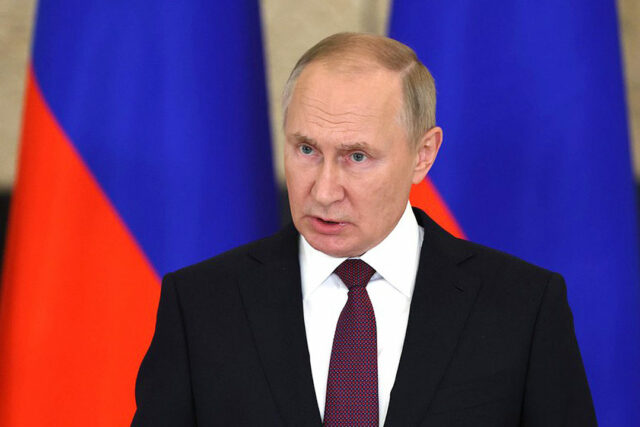
Russian President Vladimir Putin — KREMLIN.RU

NEW YORK/WASHINGTON — The US decision to allow Ukraine to fire American weapons deeper into Russia has not increased the risk of a nuclear attack, which is unlikely, despite Russian President Vladimir Putin’s increasingly bellicose statements, five sources familiar with US intelligence told Reuters.

But Russia is likely to expand a campaign of sabotage against European targets to increase pressure on the West over its support for Kyiv, said two senior officials, a lawmaker and two congressional aides briefed on the matter.

A series of intelligence assessments over the past seven months have concluded nuclear escalation was unlikely to result from a decision to loosen restrictions on Ukraine’s use of US weapons. That view has not changed following President Joseph R. Biden’s changed US stance this month on weapons, said the sources, who were granted anonymity to speak freely about sensitive intelligence.

“The assessments were consistent: The ATACMs (Army Tactical Missile System) weren’t going to change Russia’s nuclear calculus,” said one congressional aide briefed on the intelligence, referring to American missiles with a range of up to 190 miles (306 km).

Russia’s launch of a new ballistic missile last week, which analysts say was meant as a warning to Washington and its European allies, has not changed that conclusion.

One of the five US officials said while Washington assessed that Russia would not seek to escalate with its nuclear forces, it would try to match what it views as US escalation. The official said fielding the new missile was part of that effort.

US officials said the intelligence has helped guide an often divisive debate over recent months inside Biden’s administration about whether Washington loosening restrictions on Ukraine’s use of American weapons was worth the risk of angering Putin.

Officials initially resisted such a move, citing escalation concerns and uncertainty over how Putin would respond. Some of those officials, including in the White House, the Pentagon and the State department, feared lethal retaliation on US military and diplomatic personnel and attacks on North Atlantic Treaty Organization allies.

Others were specifically worried about nuclear escalation. Biden changed his mind because of North Korea’s entry into the war before the U.S. presidential election, US officials have said.

Some officials now believe the escalation concerns, including the nuclear fears, were overblown but stress that the overall situation in Ukraine remains dangerous and that nuclear escalation is not out of the question. Russia’s ability to find other covert ways of retaliating against the West remains a worry.

“Russia’s hybrid response is a concern,” said Angela Stent, director of Eurasian, Russian and East European studies at Georgetown University, referring to Russia’s sabotage in Europe.

“The chance of escalation was never not there. The concern now is greater.”

The White House and the Office of the Director of National Intelligence declined to comment.

The Kremlin did not immediately respond to a request for comment about the intelligence assessments.

REACTION AND COUNTER-REACTION
Since August, when Ukraine launched a surprise incursion into Russia’s Kursk region, Moscow and Kyiv have been locked in a cycle of escalating moves and counter-moves.

Russia has enlisted help from North Korea, which sent between 11,000 and 12,000 soldiers to help its war effort, according to the US.

The same day as Ukraine’s first strike under the relaxed U.S. policy, Russia changed its nuclear doctrine, lowering the threshold for a nuclear strike.

Fear of nuclear escalation has been a factor in U.S. officials’ thinking since Russia invaded Ukraine in early 2022. Central Intelligence Agency Director William Burns has said there was a real risk in late 2022 that Russia could use nuclear weapons against Ukraine.

Even so, the White House moved forward with Ukraine aid, sending billions of dollars’ worth of military assistance.

The concerns faded for some officials as Putin did not act on his threats but remained central to how many in the administration weighed decisions on how the US should support Kyiv.

In May, the White House allowed Ukraine to use American missiles in limited circumstances to strike across the border but not deep inside Russia, citing risk of escalation by Moscow, marginal tactical benefit and a limited supply of ATACMs.

One of the intelligence assessments from early summer, drawn up at the White House’s request, explained that strikes across the border from the Ukrainian city Kharkiv would have limited impact because 90% of Russian aircraft had been moved back from the border — out of distance of the short-range missiles.

But the assessments also noted while Mr. Putin often threatens to use nuclear weapons, Moscow is unlikely to take such a step in part because they do not provide a clear military benefit. Intelligence officials described the nuclear option as a last resort for Russia and that Mr. Putin would resort to other means of reprisal first, noting Russia was already engaged in sabotage and cyberattacks.

Still, some officials inside the White House and Pentagon argued that allowing Kyiv to use the missiles to strike inside Russia would put Kyiv, the US and American allies in unprecedented danger, provoking Mr. Putin to retaliate either through nuclear force or other deadly tactics outside the war zone.

Pentagon officials worried about attacks on US military bases.

THE NORTH KOREA FACTOR
The introduction of North Korean troops convinced the administration, particularly a group of officials at the White House and the Pentagon concerned about escalation, to allow the long-range strikes, said a senior US official.

Russia was making battlefield gains and the North Korean troops were viewed internally as escalation by Moscow necessitating a response from Washington, the official said.

Given the early intelligence assessments downplaying the risk of nuclear escalation, the nuclear fears were overstated and the decision to allow wider use of ATACMs came too late, said a senior US official and a lawmaker, citing Russia’s recent advances.

Intelligence sources say Moscow’s most robust and successful reprisal operations are likely to come through sabotage. Russian intelligence services have launched a massive international effort in Europe to intimidate countries who support Ukraine, one European diplomat said.

A US official added Moscow was actively looking to advance its “gray-zone” warfare against the West and that Russia has an extensive network of agents and it exploring options for using them. — Reuters


Under tariff threat, US vegetable wholesaler warns: ‘People will pay’

SHARON PITTAWAY-UNSPLASH

LOS ANGELES — While most of Los Angeles sleeps, 58-year-old Melquiades Flores starts his day at 1 a.m., supervising the unloading of produce at M&M Tomatoes and Chile Company, the wholesaler he started in 2019.

But the business that Mr. Flores hopes to pass to his children one day is bracing for a disruption.

US President-elect Donald J. Trump has pledged to impose a 25% tariff on all imports from Mexico and Canada when he takes office on Jan. 20, plus an additional 10% tariff on Chinese goods.

“Produce of Mexico” is stamped on almost all the boxes of tomatoes and chilies that arrive at Flores’ downtown warehouse, destined for homes, hotels and restaurant kitchens across the city.

“People will have to pay a higher price. Whatever they charge us, we will pass on to the consumer,” Mr. Flores said from his section of the larger complex, the Los Angeles Wholesale Produce Market.

No matter what happens in January, Mr. Flores says he has no option but to keep importing produce from Mexico, especially in the winter. The chili-growing season in California lasts four months, from August to November, he says. The rest of the year, he gets the produce from the Mexican states of Sinaloa, Baja California and Sonora.

His team stacks boxes upon boxes of tomatoes in every size and shade of red, plus some shiny green ones for making zesty tomatillo sauce.

“Any tariff is an added tax that impacts all of us, including those who buy a pound, two pounds, or a thousand or 10,000 pounds,” said Mr. Flores, who has lived in Los Angeles for 40 years and is originally from the Mexican state of Morelos.

Mr. Trump has pronounced his love of tariffs, presumably for raising revenue and protecting US industries against imports, but he avoids speaking about the inflationary effect or the impact of potential retaliation from the United States’ top three trading partners.

Officials from Mexico, Canada and China and major industry groups have warned that the tariffs Trump proposes would harm the economies of all involved, cause inflation to spike and damage job markets.

“The president should have first seen how much this will impact everyone before speaking,” Flores said. — Reuters

Globe elected to prestigious GSMA Board

Ernest Cu, Globe President and CEO

Ernest Cu represents PH on global mobile telecom organization

Marking an important milestone for Philippine representation on the global stage, Globe has been elected to the prestigious board of the GSMA, a global organization of mobile network operators.

Globe will be represented by Ernest Cu as Globe President and CEO. The Board will serve from January 2025 to December 2026.

The GSMA Board, composed of 26 senior leaders from top telecom companies as well as smaller independent operators from around the world, champions technological progress, interoperability, and international standards across the mobile industry. Together, the members work to unlock the full potential of connectivity, enhancing business environments and driving positive societal change.

In its new role, Globe will have a prominent voice in shaping the future of mobile technology, particularly in advancing digital inclusion and access in developing markets.

During his tenure, Cu will help guide GSMA’s strategic direction, offering insights alongside global leaders to encourage progress in policy, technology, and connectivity within the mobile industry.

“Building a collaborative environment that supports mobile technology and sustainability is essential for creating long-term, positive impact. By promoting digital adoption, we aim to improve lives and stimulate economic growth, particularly in areas lacking connectivity, where access to digital tools can pave the way for new opportunities and empower communities,” Cu said.

Globe’s ongoing mission is to bridge the digital divide and foster inclusive growth in the Philippines, making sure that no Filipino is left behind in the digitalization journey.

To learn more about Globe, visit https://www.globe.com.ph/.


Spotlight is BusinessWorld’s sponsored section that allows advertisers to amplify their brand and connect with BusinessWorld’s audience by publishing their stories on the BusinessWorld Web site. For more information, send an email to online@bworldonline.com.

Join us on Viber at https://bit.ly/3hv6bLA to get more updates and subscribe to BusinessWorld’s titles and get exclusive content through www.bworld-x.com.