Home Blog Page 1989

S&P raises PHL outlook to ‘positive’

ISAWRED-UNSPLASH

By Luisa Maria Jacinta C. Jocson, Reporter

S&P GLOBAL RATINGS affirmed the Philippines’ investment grade rating on Tuesday and raised its outlook to “positive” from “stable” to reflect the economy’s strong growth potential amid improved institutional strength on the back of “effective policy making.”

The debt watcher on Tuesday affirmed its “BBB+” long-term credit rating for the country, which is a notch below the “A” level grade targeted by the government. It also kept its “A-2” short-term rating for the Philippines.

Still, S&P Global raised its rating outlook to “positive” from “stable.” A positive outlook means the Philippines’ credit rating could be raised over the next two years if improvements are sustained.

“Our improved institutional assessment drives our positive outlook on the Philippines. We believe the strengthening of the country’s institutional settings, which had contributed to a significant enhancement in the sovereign’s credit metrics over the past decade, will continue,” S&P Global said in a statement. “This is demonstrated by the strong economic recovery in the last two years, and ongoing reforms to support business and investing conditions.”

“This improvement could lead to stronger sovereign support over the next 12-24 months if the Philippines’ economy maintains its external strength, healthy growth rates, and that fiscal performance will strengthen.”

Bangko Sentral ng Pilipinas (BSP) Governor Eli M. Remolona, Jr. said the debt watcher’s upgraded outlook “reflects the work the government has done to improve the economic, fiscal, and monetary environment, enabling strong growth to continue.”

Finance Secretary Ralph G. Recto likewise said this “reaffirms our stable economic and political environment and that we are on track to achieve a growth-enhancing fiscal consolidation.”

“We have a comprehensive ‘Road to A’ initiative to ensure that we secure more upgrades soon,” he added.

S&P Global said the Philippines’ sovereign rating reflects the economy’s “above-average growth potential.”

“This strength underpins constructive development outcomes. The ratings also benefit from the country’s strong external position,” it added.

For the first nine months of the year, the Philippine economy expanded by 5.8%, slightly below the government’s goal of 6-7% gross domestic product (GDP) growth this year.

The government is targeting 6.5-7.5% GDP growth next year and 6.5-8% growth from 2026 to 2028.

S&P Global expects Philippine GDP growth to average 5.5% this year, driven by exports and easing inflationary pressures.

“Ongoing reform on the business, investment, and tax fronts should benefit growth over the next three to four years.”

The Philippine economy will likely grow at an average of 6.2% a year over the next three years, it added.

“Solid household and corporate balance sheets, and sizable remittance inflows underpin the Philippine economy’s positive medium-term trajectory,” S&P Global said.

“Ongoing efforts to address infrastructure gaps, and improvements in the business climate through regulatory and tax reforms should also support growth in economic productivity.”

FISCAL REFORMS
The government’s fiscal reforms have also boosted the economic outlook, the credit rater said.

“We believe that effective policy making in the Philippines has delivered structural improvements to the country’s credit metrics. Fiscal reforms have raised government revenue as a share of GDP and helped to fund public investment. Improved infrastructure and policy environment have helped to keep economic growth strong in much of the past decade,” it said.

“The government’s fiscal and debt settings had deteriorated due to the economic fallout from the pandemic and the associated extraordinary policy responses. Fiscal buffers built through a long record of prudence before the pandemic thinned, but consolidation has begun with the economic recovery well on track. The Philippines’ low GDP per capita relative to other investment-grade sovereigns temper these strengths,” it added.

Latest data from the Treasury showed that the budget deficit narrowed by 1.35% to P970.2 billion in the first nine months.

The government is seeking to bring the deficit-to-GDP ratio to 5.6% this year and further down to 3.7% by 2028.

“The Philippine government has generally enacted effective and prudent fiscal policies over the past decade. Improvements to the quality of expenditure, manageable fiscal deficits, and relatively low general government indebtedness testify to this,” S&P Global said.

However, the credit rater said restoring fiscal and debt settings to pre-pandemic levels will be challenging and likely be a gradual process.

“The ongoing economic recovery in the Philippines should facilitate a reduction in the general government deficit and a further stabilization of the debt burden,” it said. “It will, however, take several years for fiscal balances to recover to pre-pandemic levels given the eroded fiscal headroom.”

S&P Global added that it expects the country’s net general government debt to gradually decline amid continued fiscal consolidation.

Moving forward, the debt watcher said it could upgrade the Philippines’ credit rating if the current account deficit and fiscal position remain well-managed.

“We may raise the ratings if our expectations of current account deficits tapering over the forecast period are realized such that buffers in the Philippines’ narrow net external asset position are maintained and if the government achieves more rapid fiscal consolidation,” it said.

S&P Global expects the country’s current account deficit to persist but at “modest levels.”

The BSP estimates the current account deficit to reach $6.8 billion this year, equivalent to 1.5% of GDP. In the first half of the year, the country’s current account deficit stood at $7.1 billion, accounting for 3.2% of economic output.

On the other hand, the rating outlook could be revised down to “stable” if economic recovery slows down or if the government’s fiscal and debt positions deteriorate.

“If persistently large current account deficits lead to a structural weakening of the Philippines’ external balance sheet, we would also revise the outlook to stable,” S&P Global added.

GDP growth on track to reach 6-7% target

BW FILE PHOTO

THE COUNTRY is still on track to meet the government’s gross domestic product (GDP) growth targets for this year and the next, the Department of Finance and Department of Budget and Management said.

“For growth, I think achievable, of course. This year, it may be nearer the lower end. For next year, it’s still achievable, 6.5%,” Finance Undersecretary and Chief Economist Domini S. Velasquez told reporters on the sidelines of the BusinessWorld Forecast 2025 forum on Tuesday.

The government is targeting 6-7% GDP growth this year and 6.5-7.5% expansion for 2025.

Separately, Budget Secretary Amenah F. Pangandaman said that the economic team is still confident that they can meet their growth goals.

“As of now, we’re still confident that we will be able to hit our targets, so we will see,” she told reporters on the sidelines of an event in Makati City.

The government is working to expedite the release of the budget and encourage agencies to spend for programs and projects, which would contribute to growth, she said.

In the first nine months, Philippine GDP growth averaged 5.8%. To meet the lower end of this year’s 6-7% target, the economy would need to grow by at least 6.5% in the fourth quarter.

The Development Budget Coordination Committee (DBCC) is set to have its next review in December.

The DBCC last met in June and kept its growth targets for this year up to 2028 but recalibrated its fiscal program.

Ms. Pangandaman said the DBCC will “most likely” revise its macroeconomic assumptions next month but noted that these changes would be “very minimal.”

“Actually, I’m not sure if they can take into consideration the new administration of President (Donald J.) Trump. I think it’s also nice to look at it. That’s what the technical working group is looking at.”

They are also studying the DBCC’s peso assumptions and may consider the incoming Trump administration’s proposed policies and its expected impact on the currency, she said.

“We’re studying that. The recommendation is the previous numbers we saw before. The new administration of President Trump, among others,” Ms. Pangandaman said.

On Tuesday, the peso slipped by a centavo to close at its record low of P59 per dollar, which it last hit on Nov. 21.

The peso sank to the P58 level in late October amid the greenback’s strength in the run-up to the US presidential election.

Mr. Trump’s win in the Nov. 5 vote caused the local unit to hit multi-month lows and eventually return to its all-time trough of P59 last seen in October 2022 as the dollar continued to soar on safe-haven demand as global markets await the new administration’s policy direction.

The DBCC expects the peso to range from P56-58 per dollar this year.

For her part, Ms. Velasquez said reforms such as the Corporate Recovery and Tax Incentives for Enterprises to Maximize Opportunities for Reinvigorating the Economy (CREATE MORE) Act will help drive investments and fuel growth.

Earlier this month, President Ferdinand R. Marcos, Jr. signed into law the CREATE MORE Act, which expands fiscal incentives and lowers corporate income tax on certain foreign enterprises.

Ms. Pangandaman said the economic team will likely conduct international roadshows to promote CREATE MORE to investors.

“We’re just finishing the implementing rules and regulations. By next year probably, we have a chance to go out and promote CREATE MORE.”

These roadshows will likely take place in the United States, Japan, Korea and the Middle East, she said.

“Maybe the US because there’s a new administration and then new policies in terms of their investment decisions,” Ms. Pangandaman added. — Luisa Maria Jacinta C. Jocson

Philippines’ goal to become a trillion-dollar economy ‘feasible’ but ‘not easy’

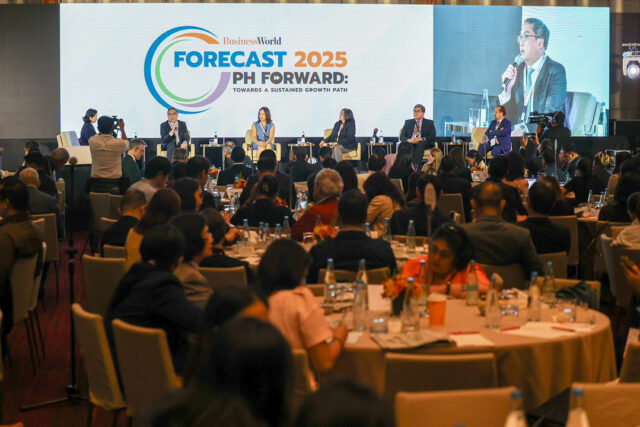
BUSINESSWORLD Forecast 2025, “PH Forward: Towards A Sustained Growth Path,” gathered the Philippine business community to listen to experts discuss the outlook for the economy, as well as challenges that can impact growth. The event was held at the Grand Hyatt Manila, Bonifacio Global City on Tuesday. — PHILIPPINE STAR/JESS BUSTOS

By Aubrey Rose A. Inosante, Reporter

SUSTAINED ECONOMIC GROWTH over the next few years and targeted investments could help the Philippines reach its “ambitious” goal to become a trillion-dollar economy despite domestic and external challenges.

“The path to a trillion-dollar economy is not easy. It’s a very ambitious target. But it is feasible if the Philippines were to again invest in capabilities to better equip for a competitive global economy,” Zafer Mustafaoğlu, World Bank country director for the Philippines, Malaysia, and Brunei, said in a speech at the BusinessWorld Forecast 2025 forum on Tuesday.

Reaching this goal would require “significant annual growth” between now and 2033, Mr. Mustafaoğlu said.

“But it’s not the matter of whether it’s 2033 or 2035, but the point is more on sustaining that growth and chasing that potential to reach the trillion-dollar economy,” he added.


The World Bank expects the Philippines to grow by an average of 6% from 2024 to 2026. In the first nine months, Philippine gross domestic product expanded by 5.8%, slightly below the government’s goal of 6-7% growth this year.

To ensure sustained growth, the country must build an enabling environment for investments, address climate change to reduce its economic impact, and boost the economy’s resilience amid external challenges such as geopolitical risks and protectionism, Mr. Mustafaoğlu said.

The government also needs to “collect revenues effectively, increase spending efficiency, and also mobilize private sector resources to address those global challenges,” he said.

The Philippines must also invest in boosting employment, especially in productive sectors like construction and manufacturing, he added.

Jesus Felipe, a distinguished professor at the De La Salle University Carlos L. Tiu School of Economics, likewise said that becoming a trillion-dollar economy requires “a very strong level of growth.”

“That requires investing in your human capital, strengthening your market, flexibility, competition, investing in digital,” he said.

SOLID FUNDAMENTALS
Pavit Ramachandran, country director for the Philippines at the Asian Development Bank (ADB), said while the country’s growth trajectory remains “very promising,” risks to the outlook remain, such as an unexpected slowdown in major economies, geopolitical tensions, and supply chain disruptions.

ADB expects the Philippine economy to grow by 6% this year and 6.2% in 2025, driven by strong domestic demand, public investment, and infrastructure development.

“The global environment today is presenting unprecedented challenges for highly integrated economies like the Philippines,” he said in a speech delivered via video. “Shifts in trade policies and foreign relations among major advanced economies, such as the United States, Japan, the Europe area, alongside the People’s Republic of China, are reshaping supply chains and investment patterns.”

“Yet, these interdependencies are vulnerable to geopolitical and geoeconomic challenges, which often spill over into commodity and financial markets, affecting investor confidence and consumer sentiment,” he said.

The Philippines is well-positioned to navigate these challenges amid its solid macroeconomic fundamentals, Mr. Ramachandran said.

“The government’s focus on market mobilization, improving the investment climate, and enhancing public financial management again provides a strong foundation for such growth,” he said.

Department of Finance Undersecretary and Chief Economist Domini S. Velasquez said the government’s fiscal consolidation efforts will allow it to increase investments in its priority sectors.

“The Philippines is poised to ascend to upper middle-income in 2025, signifying a stronger and more prosperous economy,” Ms. Velasquez said. “We are steadily reducing our deficit and debt in a way that enables us to finance long-term investments, Corporate Recovery and Tax Incentives for Enterprises to Maximize Opportunities for Reinvigorating the Economy Act, and better jobs, uplift incomes, and ultimately reach our goal of reducing our poverty rate to single-digit levels by 2028.”

The government is also looking to enact reforms to increase foreign direct investments, such as reducing the tax on stock transactions to help boost the Philippine capital markets, she added.

Miguel G. Belmonte, president and chief executive officer of BusinessWorld Publishing Corp., said building a supportive policy environment that encourages investment and fosters resilience is needed to ensure sustained and inclusive Philippine economic growth.

“The government has already made strides and reforms aimed at creating a more favorable business environment for investors. And we’re off to a good start,” Mr. Belmonte said. “With fiscal discipline and measures to secure food and energy supplies, we are better positioned to mitigate shocks and maintain stability.”

“We have a bold but achievable vision to transform the Philippines into a trillion-dollar economy. While it’s not going to be easy to fulfill our goals, especially when challenges loom so large, the dream of sustained and meaningful growth in 2025 is well within our grasp.”

Aboitiz InfraCapital to expand airport assets

NEW BOHOL-PANGLAO INTERNATIONAL AIRPORT — ABOITIZINFRACAPITAL.COM

By Ashley Erika O. Jose, Reporter

ABOITIZ InfraCapital, Inc. is keen to develop and operate more regional airports in the country, its president said.

“If it is something feasible for us, business-wise, then we will definitely participate,” Aboitiz InfraCapital President and Chief Executive Officer Cosette V. Canilao said on the sidelines of BusinessWorld Forecast 2025 forum on Tuesday.

The Department of Transportation expects to start the process of selecting a company to manage and operate the Davao International Airport next year.

The agency has said it is planning to offer the Davao airport via a solicited mode after it signed a transaction advisory service agreement with the International Finance Corp.

Three more airports are slated for privatization next year — the Iloilo, Puerto Princesa, and Kalibo airports. These airports are expected to undergo Swiss challenges.

Asked whether Aboitiz InfraCapital is interested in challenging the original proponent for the Iloilo airport, Ms. Canilao said that the company would further assess the terms. “We will see. I cannot say that we will go for it. But we will certainly evaluate it.”

The group has submitted an unsolicited proposal to develop and improve the Iloilo International Airport. However, Prime Asset Ventures Inc. was given the original proponent status for its proposal to operate, maintain and expand the airport.

The infrastructure arm of the Aboitiz group is set to take over the operations and maintenance, respectively, of two regional airports — the New Bohol-Panglao International Airport and Laguindingan International Airport 2025.

For the New Bohol-Panglao International Airport, the company will partner with the same foreign company it tapped for Laguindingan International Airport, Ms. Canilao said.

Last month, Aboitiz InfraCapital said it would partner with Ireland-based daa International for the upgrade and operation of the Laguindingan International Airport in Misamis Oriental.

For both regional airports, Aboitiz InfraCapital said improvements and modernization efforts would be implemented as early as 2025.

According to the timetable set by the Transportation department, the government will hand over the operations of Laguindingan and Bohol airports to the private operator by April and June, respectively.

Aboitiz InfraCapital plans to expand Laguindingan’s capacity, she said, adding that it is seeking to improve the facilities and develop the traffic movement for Bohol Airport.

“For Laguindingan, we are going to tackle that immediately,” Ms. Canilao said. “For Bohol, it does not require that much rehabilitation… We need to develop the traffic because there are rooms to allow tourists to come in.”

Aboitiz InfraCapital has also taken full control of Mactan-Cebu International Airport after acquiring Megawide Construction Corp.’s remaining equity stake in the airport.

Ateneo Press, UP Press named publishers of the year

UNIVERSITY OF THE PHILIPPINES PRESS FACEBOOK ACCOUNT

Manila Critics Circle to rebrand to Filipino Critics Circle

THE Ateneo de Manila University Press and the University of the Philippines  (UP) Press were jointly named Publisher of the Year at the 42nd National Book Awards on Nov. 23. Each of them had seven winning titles this year.

The event’s organizers — the National Book Development Board (NBDB) and the Manila Critics Circle (MCC) — awarded 33 winners across literary, non-literary, design, and publishing categories.

In light of the Philippines’ selection as the Guest of Honor at the 2025 Frankfurt Book Fair, NBDB Executive Director Charisse Aquino-Tugade noted that the Philippine book publishing scene is in the midst of a historic milestone.

“We are here to finally represent, and to push for our stories out of the periphery and into that much coveted spotlight on the global stage as a central, vital contributor to the world’s literary heritage,” she said in her opening speech.

Ms. Aquino-Tugade acknowledged the contradictions in the milestone. “Some of you may ask, why focus on the international when we have much work to do in sustaining domestic growth? After years of working towards this honor, we have come to realize that creating an international market for our stories and championing the local is far from being mutually exclusive,” she said.

The National Book Awards and the Frankfurt Book Fair are both proof that NBDB aims to “take every possible avenue to let every reader in the world know of not just the endless possibilities and turns that our stories can take, but also of how far we have come as a storytelling nation.”

REBRANDING
Meanwhile, MCC chair Dean Francis Alfar made an announcement with regards to how to better nurture the Philippine literary ecosystem: “As of next year, we are officially rebranding the MCC to Filipino Critics Circle.”

“We’d like to increase our membership with more representation from various sectors outside of Manila, because this is long overdue,” Mr. Alfar said in his closing speech. “We no longer want to be Manila-centric in name.” — Brontë H. Lacsamana


Below is the full list of winners for this year’s National Book Awards:

LITERARY
Best Novel in English1762: A Novel by Vin dela Serna Lopez (Ateneo de Manila University Press)

Special Citation for Novel in EnglishBut for the Lovers by Wilfrido D. Nolledo (Exploding Galaxies)

Best Novel in FilipinoTeorya ng Unang Panahon by Edgar Calabia Samar (Ateneo de Manila University Press)

National Artist Cirilo F. Bautista Prize for Best Book of Short Fiction in EnglishThe Collected Stories of Gregorio C. Brillantes by Gregorio C. Brillantes (Ateneo de Manila University Press)

Gerardo P. Cabochan Prize for Best Book Short Fiction in FilipinoMga Kalansay sa Hardin ng Panginoon: Isang Koleksiyon ng Maikling Kuwento by Ronaldo Soledad Vivo, Jr. (Self-Published)

Pablo A. Tan Prize for Best Book of Nonfiction Prose in EnglishBalik-Tanaw: The Road Taken by Soledad S. Reyes (De La Salle University Publishing House)

Special Citation for Nonfiction Prose in English Daraga: Mirrors & Memory Essays by Marne Kilates (Savage Mind Publishing House)

Best Book of Nonfiction Prose in FilipinoPatining at Iba Pang Sanaysay by Soliman A. Santos (University of the Philippines Press)

Best Anthology in EnglishBordered Lives No More: The Humanities and the Post-COVID-19 Recovery edited by Dinah Roma (De La Salle University Publishing House)

Best Anthology in Filipino — Bata, Hiwaga, Bansa: Pamana ni Rene O. Villanueva sa Panitikang Pambata edited by Eugene Y. Evasco and Cheeno Marlo M. Sayuno (University of the Philippines Press)

Best Book of Literary Criticism/Cultural Studies Ang Bisa ng Pag-uulit sa Katutubong Panitikan by Alvin B. Yapan (Ateneo de Manila University Press)

Best Book on Media StudiesAng Mahaba’t Kagyat ng Buhay ng Indie Sinema edited by Rolando B. Tolentino and Aristotle J. Atienza (University of the Philippines Press in collaboration with QCinema International Film Festival)

Philippine Literary Arts Council Prize for Best Book of Poetry in EnglishIt Is Time to Come Home: New & Collected Poems by Marjorie Evasco (Milflores Publishing, Inc. and De La Salle University Publishing House)

Victorio C. Valledor Prize for Best Book of Poetry in FilipinoTurno Kong Nokturno: Mga Bago at Piling Tula by Lamberto E. Antonio (University of the Philippines Press and UP Institute of Creative Writing)

Best Graphic Novel and Comics in EnglishSa Wala by Renren Galeno  (Komiket Inc.)

Best Graphic Novel and Comics in Filipino Sining Killing by Randy Valiente (Komiket Inc.)

Best Translated Book in EnglishHubad: Ester Tapia by Ester Tapia, translated by Merlie M. Alunan (University of the Philippines Press and UP Institute of Creative Writing)

Best Translated Book in FilipinoPalaisgen: Epikong-bayan ng mga Tagbanua ng Aborlan, Palawan by Paul D. Jagmis Sr., Gem-Gem Bagued, Fernando Lingsan, Delia Jardinero; translated in English by Jonalyn B. Villarosa and in Filipino by Paul D. Jagmis Sr. and Mary Grace A. Jagmis (National Commission for Culture and the Arts)

Best Translated Book in IlokanoTi Bassit a Prinsipe by Antoine de Saint-Exupery; translated by Cles B. Rambaud and Faye Q. Flores-Melegrito (Southern Voices Printing Press)

Best Book on Drama and FilmLutong Bahay by Glecy Cruz Atienza (Sentro ng Wikang Filipino — University of the Philippines Diliman)

Best Book on Short Fiction in BikolKalatraban sa Alkawaraan by Niles Jordan Breis (Ateneo de Naga University Press)

Best Book of Poetry in BikolMayong Katapusan na Pabalon Asin Iba Pang Huyon-Huyon: Mga Rawitdawit by Raul Giga Bradecina (Ateneo de Naga University Press)

NON-LITERARY
Alfonso T. Ongpin Prize for Best Book on Art — Julio Nakpil (1867-1960) Collected Works, Volume Two: Band and Orchestral Music, edited by Maria Alexandra Inigo Chua (University of Santo Tomas Publishing House)

Elfren S. Cruz Prize for Best Book in the Social SciencesPlural Entanglements: Philippine Studies, edited by Dada Docot, Stephan B. Acabado, and Clement C. Camposano (Ateneo de Manila University Press)

Best Book in PhilosophyCritical Theory at the Margins: Applying Herbert Marcuse’s Model of Critical Social Theory to the Philippines by Jeffry Ocay (Aletheia Printing and Publishing House)

John C. Kaw Prize for Best Book on HistoryTales of Post-Plantation: Unlikely Protagonists of Modern Philippine Banana History by Robin Theirs (Ateneo de Manila University Press)

Best Book on Humor, Sports, Lifestyle, and BusinessSalumpuwit, Bangko, Silya, Atbp: Chairs in Filipino Life by Gerard Lico (Arc Lico International Services and College of Architecture, University of the Philippines)

Best Book on Food Heritage Dishes of the Philippines by Lady Camille de Guia (Vibal Group, Inc.)

Best Book in ScienceWild City: A Photographic Guide to Amphibians, Mammals, and Reptiles of Metro Manila by Jelaine Gan, Trinket Constantino, and Abby Favis (University of the Philippines Press)

Best Book in Spirituality and TheologyBabaylan Sing Back: Philippine Shamans and Voice, Gender, and Place by Grace Nono (Ateneo de Manila University Press)

Best Book on Professions A Cardiologist’s Guide to Lowering High Blood Pressure by Alan S. Tenerife (Self-Published)

Hilarion and Esther Vibal Prize for Best Book in JournalismView from the Foxhole: Shaping the Political into the Personal by Joel Pablo Salud (University of the Philippines Press)

DESIGN
Best Book DesignDogs in Philippine History by Ian Christopher B. Alfonso, design also by him (Philippine Historical Association, Project Saysay Inc., and Alaya Publishing)

Gov’t fully awards reissued five-year T-bonds

BW FILE PHOTO

THE GOVERNMENT made a full award of the Treasury bonds (T-bonds) it offered on Tuesday on the back of strong demand for higher-yielding instruments amid developments in the United States.

The Bureau of the Treasury (BTr) raised P15 billion as planned via the reissued five-year bonds it auctioned off on Tuesday as total bids reached P55.841 billion, or almost thrice the amount on offer.

This brought the outstanding volume for the series to P249.7 billion, the Treasury said in a statement.

The bonds, which have a remaining life of four years and five months, were awarded at an average rate of 5.954%. Accepted yields ranged from 5.92% to 5.973%.

The average rate of the reissued papers jumped by 44.6 basis points (bps) from the 5.508% fetched for the series’ last award on Oct. 3. However, this was 54.6 bps lower than the 6.5% coupon for the issue.

Meanwhile, this was 1.7 bp below the 5.971% seen for the same bond series and 0.1 bp lower than the 5.955% quoted for the five-year bond at the secondary market before Tuesday’s auction, based on PHP Bloomberg Valuation Service Reference Rates data provided by the BTr.

The government made a full award of its T-bond offer as the average rate was “broadly in line with prevailing secondary market rates,” the BTr said.

The BTr saw strong demand for its offering amid improved risk appetite among investors following US yield movements after US President-elect Donald J. Trump selected Scott Kenneth Homer Bessent as the US Treasury Secretary, a trader said in a text message.

“This is also the last five-year issuance for the year,” the trader added.

Mr. Trump’s election win has continued to drive US Treasury yields mostly higher on expectations of “more protectionist policies that could lead to higher US inflation and wider budget deficits that could lead to fewer Federal Reserve rate cuts,” Rizal Commercial Banking Corp. Chief Economist Michael L. Ricafort said in a Viber message.

Mr. Trump’s pick to be US Treasury Secretary proved to be a balm for the bond market, while the dollar followed yields lower in a move poised to influence trading in Asia on Tuesday, Reuters reported.

The choice of prominent investor Mr. Bessent made late on Friday, rippled through markets on Monday, after days of speculation over who Mr. Trump would choose to be essentially the highest-ranking US economic official.

Treasury yields, which move opposite to prices, fell sharply, with the benchmark 10-year yield touching its lowest level in more than two weeks. Treasury yields had been rising at a torrid pace, partially due to concerns that Mr. Trump’s presidency would dramatically widen the federal deficit.

But Mr. Bessent was seen as someone who might moderate any negative impact of Mr. Trump’s fiscal policies. Some strategists said his nomination was a relief as he understands markets and his appointment could reduce the severity of potential tariffs, which are favored by Mr. Trump.

Tuesday’s auction was the government’s last T-bond offering for November. The Treasury raised P30 billion as planned via bonds this month as it made full awards at its two auctions.

Overall, the BTr was able to raise the programmed P90 billion via the domestic market in November — P60 billion through Treasury bills (T-bills) and P30 billion from T-bonds.

For December, it plans to raise P75 billion from the local debt market, or P60 billion in T-bills and P15 billion in T-bonds.

The government borrows from local and foreign sources to help fund its budget deficit, which is capped at 6.1% of gross domestic product this year. — Aaron Michael C. Sy with Reuters

San Miguel to finish SLEX expansion in December

COMMONS.WIKIMEDIA.ORG

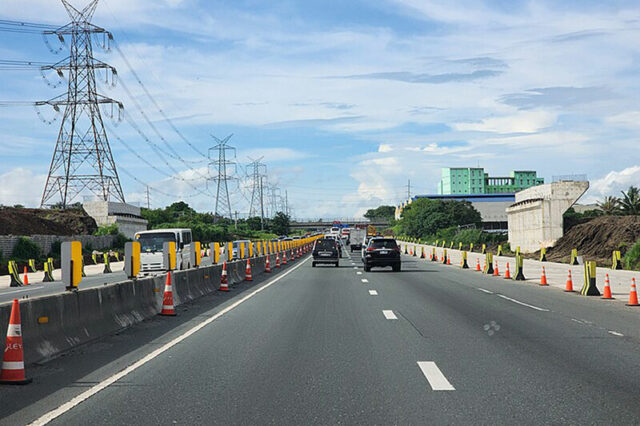
SAN MIGUEL Corp. on Tuesday said it is on track to complete the expansion of the South Luzon Expressway (SLEX) next month.

“The SLEX expansion is a major undertaking that entailed significant effort and investment, and a lot of patience and cooperation from motorists and stakeholders,” San Miguel Chairman and Chief Executive Officer Ramon S. Ang said in a statement. “We are very glad that motorists can soon enjoy faster trips to and from Southern Luzon.”

The project expansion is being undertaken by the company’s unit SMC SLEX, Inc. The project will widen the expressway to six lanes on each side from four.

San Miguel said the full expansion of the project would be completed by July 2025, including construction on the section from Calamba to Sto. Tomas, Batangas and the expansion of 20 bridges connecting to the main lanes of the SLEX.

The project is expected to improve traffic flow and provide seamless connectivity between southern and northern Luzon, San Miguel said.

Aside from the expansion of the SLEX’s carriageways, San Miguel said toll plazas at the SLEX have also been equipped with automatic license plate reading cameras, in line with the government’s target to implement tollways without barriers.

SMC SLEX set aside P12 billion in capital spending to fund its projects last year, including the construction of the Batangas-to-Lucena expressway and the repair and maintenance of the SLEX. — Ashley Erika O. Jose

Gov’t may issue peso Sukuk bonds next year

THE GOVERNMENT could issue peso-denominated Sukuk bonds next year, a central bank official said.

“No amount yet. But in terms of timeline, Sukuk is part of their planned issuance in 2025,” Bangko Sentral ng Pilipinas (BSP) Assistant Governor Arifa A. Ala told reporters on the sidelines of the Philippines Islamic Finance Roadshow on Tuesday.

Ms. Ala added that a peso-denominated Sukuk bond issuance could be an investment opportunity for Islamic banks in the Philippines, which would support their growth.

“If there are banks with Islamic banking windows who would like to invest in government securities, [a peso-denominated Sukuk bond] can be a form of investment for them,” she said.

Asked to confirm the planned issuance, National Treasurer Sharon P. Almanza said in a Viber message: “We are still exploring this.”

BSP Governor Eli M. Remolona, Jr. said in a speech at the same event that he hopes peso-denominated Sukuk bonds could be issued by both the public and private sector.

“We’re looking forward to peso Sukuks and corporate peso Sukuks,” he said.

The government first issued Islamic debt in December 2023, raising $1 billion from the sale of 5.5-year dollar-denominated Sukuk bonds, twice the benchmark size of at least $500 million. Its profit was set at 5.045%.

Sukuk or Islamic bonds are certificates that represent a proportional undivided ownership right in tangible assets, or a pool of tangible assets. These assets could be in a specific project or investment activity that is Shari’ah-compliant.

The markup takes the place of interest, which is illegal in Islamic law. Murabaha is not an interest-bearing loan but is an acceptable form of credit sale under Islamic law. A Sukuk al-Murabaha certificate cannot be traded on the secondary market.

Unlike usual bonds, Sukuk bond issuances must adhere to Islamic principles and must be structured to prohibit elements such interest, uncertainty and investments in businesses that deal with prohibited goods or services.

A report by the Asian Development Bank (ADB) said the Philippine government is looking to incentivize private sector entities to issue Sukuk bonds to help deepen the domestic Islamic capital market.

“Further Sukuk issuances will create new investment opportunities for investors interested in Islamic finance, promote broader participation in the market, and foster economic development,” the multilateral lender said.

“The government has created the enabling environment by amending laws and regulations and providing tax neutrality provisions. These ensure a level playing field and support the long-term growth of the industry,” the ADB said. “While the Philippines Islamic finance industry is nascent, it presents a significant growth opportunity, with the government’s focus on promoting financial inclusion and a more diverse financial landscape.”

ISLAMIC BANKING WINDOW
Meanwhile, Ms. Ala said two foreign financial entities that are both active in the Philippines have signified interest in applying for an Islamic banking window.

“There are a number of banks and nonbanks which signify interest, but I cannot disclose it because they have not really submitted a formal application. But there are a number of interested potential investors,” she said.

The three entities with Islamic banking operations in the country are the state-owned Al Amanah Islamic Investment Bank, Maybank Philippines, which began operations in August, and CARD Bank, Inc., which opened an Islamic banking branch in Cotabato City this year. — Aaron Michael C. Sy

Story on selling virginity tops Palanca Nobela category

FILIPINO author Eros Sanchez Atalia won big at the 72nd Carlos Palanca Memorial Awards for Literature, held at the Philippine International Convention Center on Friday night.

A survivor of COVID-19 and a longtime writer of novels, short stories, and poems, Mr. Atalia received the Grand Prize for the Nobela category for Thirty Virgins and was inducted into the Palanca Hall of Fame for the remarkable feat of winning 1st Prize five times in various categories.

The Palanca’s Novel and Nobela categories are open only every two years.

Mr. Atalia’s winning novel is “inspired by real events.” It came about after the author watched a YouTube video about a woman who auctioned off her virginity.

“I wondered, what if this happened in the Philippines? I contextualized it and localized it, so we follow a main character with a financially troubled family who goes into this line of work,” Mr. Atalia told BusinessWorld at the sidelines of the awarding ceremony.

Ayaw niya sana pero inalukan siya na mag-interbyu doon sa 30 virgins na binebenta ang virginity sa mga tao abroad for P1 million (The character is unwilling at first, but is offered to interview the 30 virgins who sell their virginity to people abroad for P1 million),” he explained.

He said that the challenge with local works about characters forced to operate in morally gray areas is “conveying their importance as stories that can’t be told in a regular classroom, in a Catholic setting.” He revealed that the goal is for the novel to be published by next year.

Meanwhile, University of the Philippines Diliman instructor Lakan Umali was the Grand Prize winner of the Novel category for The Ferdinand Project, a work where “humanity and empathy shine amid dark situations.”

Avoiding spoilers, Ms. Umali described the novel as a playful depiction of the Philippines today. “I think that with the absurdity and chaos of the world around us, we really have to find newer, more playful ways to talk about it without diminishing the gravity of our situation,” she said.

Ms. Umali, who is transgender, told BusinessWorld that this recognition she just received in the field of literature is “a small yet important step in trans representation, showing that queerness is not just political football, but proof of trans people’s existence.”

She hopes to revise her novel based on feedback from her master’s degree thesis advisers at the UP College of Arts and Letters.

NEW HALL OF FAMERS
Aside from Mr. Atalia, three other writers made it this year to the Palanca Hall of Fame, which now totals 30 people.

Cagayan de Oro-based poet Mikael de Lara Co got the award following a win in the Tula category with “Panayam sa Abo.” He also won in this same category last year, with “Epistolaryo ng Bagamundo at ang tugon ng Multo.”

Playwrights and friends Joshua Lim So and Miguel Antonio Alfredo Luarca each entered the elite circle with prizes in the play categories. Mr. So’s Pagkapit Sa Hangin garnered first place as a Filipino one-act play, while Mr. Luarca’s Corridors clinched first place in the English full-length play category.

For Mr. Atalia, being a Hall of Famer legitimizes one’s work. “These are experts, writers, academics, literary scholars who appreciate your work,” he explained.

Nakakatuwa kasi parang naka-tsamba ulit, ‘di ba? Pang-limang tsamba na! (It’s exciting because it still feels like luck, you know? Like you lucked out for the fifth time!)”

The Awards also honored the achievements of 31 new writers from a total of 54 awardees in four divisions: Kabataan, English, Filipino, and Regional Languages.

HOW WE WRITE
Acclaimed Filipino filmmaker Jun Robles Lana was the guest of honor and speaker at this year’s ceremony and the recipient of the Gawad Dangal ng Lahi award.

Mr. Lana has won 12 Palanca Awards prizes and was inducted into the Hall of Fame in 2006. His award-winning films include Mga Kwentong Barbero, Anino sa Likod ng Buwan, Die Beautiful, Kalel, 15, and About Us But Not About Us, his timely stories reflecting contributions to both Philippine literature and cinema.

In his speech, Mr. Lana posed the question: “How do we write in this complex present?”

It is in the context of a fast-changing world inundated with data that he questioned writers’ influence.

“There was a time when we imagined that it was the lack of information that was keeping us in a dictatorship, yet the present has proven us wrong. We now have the information, but how many of us would be able to say that this has brought an exponential growth in our audiences, or that it has meant better conversations?”

Mr. Lana cited the difficulty Filipinos have in determining what are facts, propaganda, and unjustified opinions. He shared his experience as a storyteller and filmmaker, making connections with others who helped nurture his talent and accompany him in navigating the burden of speaking truth in a complicated world.

He concluded: “We write by breaking the silence and the voice of the voiceless, for those who have been marginalized and forgotten, those who struggle in the shadows and the sea and the earth. We write by illuminating stories that would otherwise be kept in the dark, no matter how challenging, because those stories are the ones that will shape our future.” — Brontë H. Lacsamana


Winners of the 72nd Palanca Awards

ENGLISH DIVISION
Novel

1st Prize — The Ferdinand Project by Lakan Ma. Mg. D. Umali

2nd Prize — The People’s Republic of Negros by Michael Aaron Gomez

Short Story

1st prize — “Muted City” by Jan Kevin M. Rivera

2nd Prize — “The Man Who Sold Dignity” by Antonio Hernandez

3rd Prize — “Bee Happy” by Kiefer Adrian Z. Occeño

Short Story for Children

1st Prize — NO WINNER

2nd Prize — NO WINNER

3rd Prize — “A Young Poet Dreams of a Hundred Words that Rhyme with Maynila” by Edgar C. Samar

Essay

1st Prize — “Ghost-hunting in Sagada” by Lioba Asia E. Piluden

2nd Prize — “Another Hope Entirely” by Kara Danielle Eraña Medina

3rd Prize — “A Personal History of Sea Urchins” by Jade Mark B. Capiñanes

Poetry

1st Prize — “Silangan” by Joel M. Toledo

2nd Prize — “La Muerte De La Luz” by Lyde Gerard Sison Villanueva

3rd Prize — “We Are Not Yet Lost” by Ana Maria Segunda K. Lacuesta

Poetry Written for Children

1st Prize — “Every Year, J Gained a Power” by Edgar C. Samar

2nd Prize — “Where are the Dinosaurs?” by Stacy Haynie Bolislis Ayson

3rd Prize — “Thirteen Ways of Looking at Books” by Peter Solis Nery

One-act Play

1st Prize — Unidentified by Eljay Castro Deldoc

2nd Prize — The Impossible Dream by Miguel Antonio Alfredo V. Luarca

3rd Prize — Line Up by Kenneth Theodore Cheng Keng

Full-length Play

1st Prize — Corridors by Miguel Antonio Alfredo V. Luarca

2nd Prize — Birdie by Dustin Edward D. Celestino

3rd Prize — The Echoist by Emilio Antonio Babao Guballa

FILIPINO DIVISION
Nobela

1st Prize — Thirty Virgins by Eros Sanchez Atalia

Special Prize — NO WINNER

Maikling Kuwento

1st Prize — “Gagambang-bahay” by Mark Anthony Angeles

2nd Prize — “Siya si Ril” by Hannah A. Leceña

3rd Prize — “Ang Lungga” by Aljane C. Baterna

Maikling Kuwentong Pambata

1st Prize — “Musikong Bumbong” by Christopher S. Rosales

2nd Prize — “Si Bambalito, ang Batang Bayani ng Bangkusay” by Brian James S. Camaya

3rd Prize — “Atang Para kay Nanang Toyang” by John Patrick F. Solano

Sanaysay

1st Prize — “Tulambuhay ng Isang Makatang Laway” by Tomas F. Agulto

2nd Prize — “Autoetnograpiya ng Luksa” by David R. Corpuz

3rd Prize — “Love Child” by Adelle Liezl Chua

Tula

1st Prize — “Panayam sa Abo” by Mikael de Lara Co

2nd Prize — “Paa, Tuhod, Balikat ng Tagakaulo: Higatang sa Pangil ng Pana-panahong Pagkalugmok” by John Dave B. Pacheco

3rd Prize — “Dugo ng Aking Dugo” by John Brixter M. Tino

Tula Para Sa Mga Bata

1st Prize — “Anak ng Baha! Mga Tulang Pambata” by John Romeo Leongson Venturero

2nd Prize — “Saklolo, Trak ng Bumbero!” by John Michael G. Londres

3rd Prize — “Add to Cart at iba pang mga Tula” by Eros Sanchez Atalia

Dulang May Isang Yugto

1st Prize — Pagkapit Sa Hangin by Joshua Lim So

2nd Prize — Vengeance of the Gods by Hans Pieter Luyun Arao

3rd Prize — Ang Trahedya ni Bert by U Z. Eliserio

Dulang Ganap ang Haba

1st Prize — NO WINNER

2nd Prize — Ardor by Miguel Antonio Alfredo V. Luarca

3rd Prize — Ka Amado by Andrew Aquino Estacio

Dulang Pampelikula

1st prize — Championship by Andrew Bonifacio L. Clete

2nd Prize — Paglilitis by Raymund T. Barcelon

3rd Prize — Dobol by Rian Jay G. Hernandez

REGIONAL DIVISION
Short Story-Cebuano

1st Prize — “Pamalandong ni Antigo Mokayat” by Michael Aaron Gomez

2nd Prize — “Anino” by Reynaldo A. Caturza

3rd Prize — “Maninibya” by Gracelda I. Lina

Short Story-Hiligaynon

1st Prize — “Ang Liwat nga Paglupad ni Lolo” by Serafin I. Plotria, Jr.

2nd Prize — “Labô” by Bryan Mari Argos

3rd Prize — “Anagas, Anagas, Baylo ’Ta Ngalan” by Al Jeffrey L. Gonzales

Short Story-Ilokano

1st Prize — “Panaggawid” by Neyo E. Valdez

2nd Prize — “Uram” by Ma. Lourdes Ladi Opinaldo

3rd Prize — “Anniniwan” by Prodie Gar. Padios

KABATAAN DIVISION
Sanaysay

1st Prize — “Dito sa Kanlungan ng Hiraya’t Katotohanan” by Glorious Zahara Exylin C. Alesna

2nd Prize — “Sinulid at Buhay” by Raya T. Mitra

3rd Prize — “Bura, Sulat” by Lancelot MJ T. Edillor

Essay

1st Prize — “The Digital Snowball” by Brant Angelo S. Ambes

2nd Prize — “My Humanly Unhuman Friend” by Ruth Mecanelle Magolhado

3rd Prize — “Some Things Must Never Change” by Glorious Zahara Exylin C. Alesna

Land lease deal signed for Alabat Wind Power project

A wind turbine is seen in this file photo. — REUTERS

A UNIT of Alternergy Holdings Corp. has sealed a long-term lease with the Philippine National Railways (PNR) for a portion of the latter’s property in Quezon province, making way for its P7-billion wind power project.

Alabat Wind Power Corp. has secured the location for the switching station of its 64-megawatt (MW) Alabat Wind Power project, Alternergy said in a statement on Tuesday.

Situated in the municipalities of Alabat and Quezon, the wind power project is expected to become the first wind project in the province. It is targeted to be completed by end-2025.

“Our collaboration with Alternergy supports the government’s renewable energy targets and is in line with PNR’s sustainability goals,” Deovanni S. Miranda, PNR’s general manager, said in the statement.

Earlier this month, Alternergy said it had infused P1.1 billion in Alabat Wind Power to bankroll the construction of the project.

The company has secured P5.3 billion in project financing from Rizal Commercial Banking Corp. for the project.

With 86 MW of energy capacity in its portfolio, Alternergy is targeting to reach 500 MW of generating capacity by 2026.

Alternergy shares were unchanged at P0.90 each at the close of trading. — Sheldeen Joy Talavera

Duct-taped banana artist says his work is a ‘provocation’ on value of art

SOTHEBYS.COM

ROME — The Italian artist who created the banana duct-taped to a wall that sold last week for $6.2 million, said in an interview published on Friday that the work was a “provocation” and an invitation to appreciate the true value of art.

Comedian, by Maurizio Cattelan, was snapped up on Wednesday last week at auction at Sotheby’s in New York by Chinese cryptocurrency entrepreneur Justin Sun. It first rocked the art world in 2019 on its debut at Miami’s Art Basel.

“It’s a provocation that invites us to reflect on the value of art and the dynamics of (this) market, pushing us to question what this work says about us as viewers,” Mr. Cattelan told Italian daily la Repubblica.

The piece of art, whose first version was made with a banana that cost 25 cents, went from a starting price of $800,000 to $5.2 million, plus a buyer’s fee.

“It’s the market that has decided to take a banana stuck on the wall so seriously. If the system is so frail to slip on a banana skin, maybe it was already slippery,” Mr. Cattelan added.

The artist, 64, is known for his hyper-realistic installations and sculptures, which include a fake horse dangling from a ceiling, the late pope John Paul II being hit by a meteorite, and a marble hand with a raised middle finger outside Milan’s Stock Exchange.

Mr. Cattelan also said he was fast asleep when his banana piece went under the hammer, dreaming that his favorite soccer team Atalanta would beat AC Milan at an upcoming Serie A home game.

Comedian is a laugh against a tired system, an invitation to rediscover the power of irony and simplicity,” the artist said. — Reuters

The demographic dividend of the Philippines: Learning from others

PHILIPPINE STAR/RYAN BALDEMOR

(Part 2)

As we saw in Part 1, the Philippines will continue to have a young and growing population for at least the next 40 years, time enough to give our present and future leaders the opportunity to introduce the necessary reforms in our political and economic institutions so that by the decade of 2040 to 2050, the Philippine economy shall have attained high-income status and, more importantly, bring down the poverty incidence as much as possible close to zero, as Singapore and Malaysia have already done. 

We have to avoid like the plague the fate that has befallen Thailand: becoming a super-aged society before becoming rich.  The main reason for this tragedy that has befallen this otherwise buoyant economy was the overemphasis on birth control as a tool for reducing poverty. In an aggressive campaign to push condoms and pills, the Government created a “contraceptive mentality” that is very difficult to reverse at a time when what society needs is to promote a higher birth rate, as is happening today in most countries that have realized that the real population bomb is the rapid ageing of the population, as Elon Musk repeats almost ad nauseam. This was the actual title of an IMF publication written by demographic experts David Bloom and Leo Zucker of Harvard: Ageing is the Real Population Bomb.

In an opinion column in Bloomberg, Tyler Cowen makes the point that today, “there is some evidence that shrinking populations are bad for the global economy. To me, however, the greater tragedy would be the failure to take full advantage of the planet’s capacity to sustain human life. No kind of family policy should be mandatory. But there should be policies that make a larger family a more appealing option, both economically and otherwise.”

This early in our demographic transition, we should make sure that no government policy, on the pretext of fighting poverty, would instill an anti-family and anti-life mentality among our population. There are many more positive ways of reducing mass poverty through the right policies such as emphasis on rural and agricultural development, delivering quality basic education, promotion of small- and medium-scale enterprises, the upskilling and reskilling of the existing labor force and many others. Learning from the desperate moves of countries like Singapore, China, and Thailand to encourage couples to have more children, it would be wise for the Philippine Population Commission to find other ways of implementing the Reproductive Health Law rather than obsessing over promoting the use of contraceptives.

As our fertility rate already has reached the below-replacement level, population policy should veer away from reproductive health toward human resource development. I particularly take note of an editorial that appeared in the Philippine Daily Inquirer back in 2022 that commented on the ongoing demographic transition that is happening in our country: “To ensure the productivity of the younger generation in the future, the educational system must address the shortcomings of the public school system, as evidenced  by the poor showing of elementary school students in regional and global comparative tests. Government needs to invest more to ensure a quality learning environment that includes more and better equipped classrooms and facilities, better paid teachers, more available learning materials like books and lab facilities, and even basics as adequate lavatories and healthy canteen meals.” As many developed countries are suffering from very low fertility rates and the ageing “population bomb,” it is about time that we consider every baby born to a Filipino family as a singular resource on which to invest.

It is commendable that our industry leaders, strongly encouraged by President Ferdinand “Bongbong” Marcos, Jr., are focusing more on reskilling, upskilling, and retooling the existing work force to match their knowledge and skills with rapidly changing technologies in the agricultural, industrial, and service sectors rather than giving undue emphasis to college degree programs that often fail in producing the right manpower needed by employers. As the editorial quoted above commented: “To prepare young people to join the work force, they must be   oriented toward adjusting to the evolving demands of the job market, such as developing skills in new technologies.  Government must also ensure that there would be jobs for them, once they finish their formal education.”

Despite the serious problem of the low quality of basic education in our public schools (not in the private educational institutions), there are more than enough workers already in our labor force of some 50 million people who can be reskilled, upskilled, and retooled in the technologies related to the so-called Industrial Revolution 4.0 (artificial intelligence, internet of things, robotization, and data analytics). 

Instead of spending our scarce financial resources in preventing the birth of more babies (already at 1.9 per fertile woman), it is not too early to devote more attention to the plight of ageing Filipinos. As the same editorial suggested: “As for the elderly, the country must provide adequate material support for them apart from the pension given by the state-owned retirement bodies. Better and more affordable healthcare, especially the provision of maintenance medicines and medical procedures, is likewise necessary to prevent more serious and costly expenses down the line.” And most importantly for those who, like me, have been blessed with long lives (I am 85 years old), we should be encouraged to continue using our knowledge and skills in producing educational materials, training professionals in our respective fields (especially teachers), sitting in boards of directors, managing some NGOs, mentoring younger professionals, using our green thumb to add to food security by producing high-value crops in our home gardens, etc.

With some people in our government still harping on the need to spread the practice of family planning among Filipinos couples, it is heartening to read opinions in this publication supporting the view that a large population can be an asset to the economy. My fellow columnist in this paper, Bienvenido Oplas, Jr. wrote in one of his columns*: “The fastest growing economies in the world are Asian, led by India, China, the Philippines, and Indonesia with GDP growth of 5% to 7%  in H1 2023, whereas  Europeans were crawling at -0.2% to 1.2% over the same period.” He continued: “I think the main explanation for this is the dynamic domestic economies of these four Asian countries thanks to their big populations: 1.4 billion for China and India, and 275 million and 113 million for Indonesia and the Philippines, respectively.  The beauty of having a big population is it also means there is a big supply of entrepreneurs and workers, producers, and consumers. So, when the global business and economic environment deteriorates, there is a big and strong domestic market to continue the business momentum.”

I could not agree more with Mr. Oplas, who concluded his column with a clear rejection of the continuing obsession with family planning among some government officials by suggesting that “there is a need to relax the implementation of the Reproductive Health (RH) law of 2012 (RA 10354). State funding of population control is wrong.” What we need is a “Productive Human Resource Law”!

(To be continued.)

*Global trade deceleration and economic growth due to large population – https://tinyurl.com/27rbynrc


Bernardo M. Villegas has a Ph.D. in Economics from Harvard, is professor emeritus at the University of Asia and the Pacific, and a visiting professor at the IESE Business School in Barcelona, Spain. He was a member of the 1986 Constitutional Commission.

bernardo.villegas@uap.asia