Home Blog Page 1979

SFA Semicon Philippines sets Dec. 12 as tentative date for voluntary delisting

SFASEMICON.COM.PH

SFA Semicon Philippines Corp. (SSP) has set Dec. 12 as the tentative date for its planned voluntary delisting after the completion of a tender offer by its South Korea-based parent company, SFA Semicon Co. Ltd. (SFA Korea).

“We look forward to your favorable action on our petition to voluntarily delist the company by Dec. 12, 2024,” SSP said in a letter to the Philippine Stock Exchange (PSE) dated Nov. 22 but disclosed on Monday.

SSP sent a letter to the PSE regarding the completion of the tender offer by its parent company.

The tender offer, which ran from Oct. 14 to Nov. 12, saw 192.77-million common shares that were validly tendered, equivalent to 9.43% of SSP’s total issued and outstanding shares.

The tendered shares were purchased by SFA Korea at P2.22 apiece, totaling P427.96 million.

“The tendered shares were crossed through the PSE on Nov. 21, 2024, upon approval by the PSE of a special block sale of the tendered shares, and settlement occurred on Nov. 22, 2024,” SSP said.

SFA Korea now owns 2.03-billion common shares after the tender offer and the settlement of the block sale, increasing its shareholding to 99.41% from the previous 89.98% stake.

The block sale caused SSP’s minimum public float to fall to about 0.59%.

“The bidder’s (SFA Korea) resulting shareholding has exceeded the threshold required to complete the voluntary delisting,” SSP said.

SSP announced its voluntary delisting plan in August. The company raised P468 million from its initial public offering in December 2014 to expand the first phase of its production plant at Clark Freeport in Pampanga.

The company, previously known as Phoenix Semiconductor Philippines Corp., is involved in the manufacturing and assembly of semiconductors and memory devices.

Trading of SSP shares has been suspended since Nov. 21 following the execution of the block sale.

The company’s shares were priced at P1.57 apiece as of Nov. 20. — Revin Mikhael D. Ochave

InLife launches retirement insurance

THE Insular Life Assurance Co., Ltd. (InLife) has launched a retirement insurance product with guaranteed monthly cash payouts.

InLife Retire Assure gives policyholders guaranteed monthly income starting at age 60 until 100, the life insurance company said in a statement on Monday.

“We now live longer because of medical and scientific advances. This means that once one retires at age 60 or 65, one may potentially live 30 or even 35 years beyond retirement. Unfortunately, we found that very few Filipinos are confident about their financial wellness into retirement. This underlines the irony that while our lives continue to extend, there is much to be done to financially prepare for long retirement years,” InLife Chief Marketing Officer Gae L. Martinez said.

“InLife wants our fellow Filipinos to retire without worries. Retirement should be a time to relax, touch base with long-lost friends, start or continue their hobbies, participate in social projects, learn new skills, travel, etc. They should live their lives to the fullest without worrying that they would outlive their savings and burden their loved ones with their future financial needs. But this is only possible with adequate financial planning,” Ms. Martinez added.

The product has a simplified structure that sets aside premiums so they accumulate over time, InLife said.

“InLife Retire Assure aims to take the guesswork out of retirement planning… Once the policyholder retires at age 60 or 65 and insured is still alive and the policy is in force, InLife Retire Assure will provide guaranteed monthly cash payouts to the policyholder. These payouts are further enhanced by cash dividends that have the potential to increase over their retirement years to keep up with the increases in living expenses,” it said.

The policy offers flexible premium payments and payouts that can be paid in five or 10 years, or up to age 59 or 64.

“One may opt for an annual, semi-annual, quarterly, or monthly premium payments. When the plan is due for payouts, they may be made through a peso bank account chosen by the policyholder,” InLife said.

The product also has a life insurance component with a guaranteed issue offer.

“This means anyone who applies for an InLife Retire Assure plan does not need to undergo medical evaluation regardless of one’s health condition to be eligible for coverage.”

InLife recorded a premium income of P15.64 billion and a net income of P2.45 billion in 2023, according to latest data from the Insurance Commission.

It also posted P150.65 billion in assets and recorded a net worth of P46.55 billion at end-2023. — BVR

Agrarian Reform: The agriculture sector’s perennial bogeyman

KIRIL DOBREV-UNSPLASH

The Agrarian Reform Law is one of the most controversial and divisive laws ever enacted in the Philippines. It required the martial law powers of President Ferdinand Marcos, Sr. and the popularity of President Corazon Aquino to have it passed and expanded.

From the time it was crafted and proposed, the Law had invited scores of detractors. Moreover, the volume of criticism and hostility toward it accelerated in step with the continued subpar performance of the agriculture sector.

One is tempted to ask: was the Agrarian Reform Law a mistake? And more importantly, why was it legislated in the first place?  To answer those questions requires looking back at our nation’s history and the antecedents that led to the passage of this landmark piece of legislation.

A BRIEF HISTORY OF LAND OWNERSHIP IN PHL
During the pre-Spanish period, there was no such thing as private land ownership. It was unnecessary because land was plentiful, and we had a sparse population. What was practiced then was communal farming and tribal land control.

When the Spaniards arrived, they introduced the encomienda system or the Royal Land Grant. Huge tracts of land were distributed to the different religious orders and certain favored individuals, who were deemed to have rendered invaluable service to the Crown. As a consequence, from having the freedom to cultivate their land unimpeded, the natives (our ancestors and later their descendants) were now obligated to do forced labor and surrender a substantial portion of the income from the land they tilled to the encomenderos.

Later on, when the barangays were consolidated into municipios, cabezas and gobernadorcillos were appointed to administer and collect taxes. Many of them took advantage of their positions to acquire more land and amass political power. They became abusive landowners to their tenants. As a result, they gained the notorious label of caciques or political bosses.

When the Americans took over the reins of government, the plight of the tenant-farmers remained unchanged. No substantive reforms were introduced.

Finally, when we gained our independence, the role of the encomenderos and caciques was taken over by the local oligarchs.

The main goal of agrarian reform, therefore, was not necessarily to improve the lands’ productivity, although that was in the cards, but rather to dispense social justice. The lands that were unjustly taken away from the natives were to be given back to their descendants to end their centuries-old exploitation.

FAST FORWARD TO THE PRESENT
The opposition’s main argument against agrarian reform is that it fragmented our agricultural lands into small plots. They said this hindered the use of modern machinery and equipment, and the application of advanced farm technology and management, and created diseconomy of scale. All of these factors resulted in low farm productivity and inefficiency. The critics’ reasoning seemed solid and well-founded, but are they infallible?

When Israel’s agricultural experts visited the country a few months back (Israel is a top-notch agriculture-producing nation), they were asked in a forum, “What is the minimum size for an agricultural land to become viable?” The answer was quite revealing. “Size doesn’t matter. Even a land area of 400 square meters or less can be commercially successful for as long as enough investments and the appropriate technology are inputted into the project,” they said.

Now, there’s the rub. Our farms are underperforming because the farmers don’t have enough capital to invest while the government’s assistance is just a pittance.

Several years ago, a Filipino delegation went to Taiwan to observe and learn from a cooperative there. The members of the coop were into high-value vegetable crop production using advanced technology, like greenhouse infrastructure, drip irrigation, etc. They also applied modern processing and packaging in their trading business. The average area owned by each farmer was less than a hectare, with many owning half a hectare. What was fascinating is that the coop’s members are all millionaires!

The above scenarios clearly showed that in agriculture, bigness as a requisite for success is a myth. It has been perpetuated by some economists who were so enamored with the concept of economies of scale that they have discarded the notion that small could also be beautiful. Sure, for certain crops like palm oil and rubber, or integrated farms consisting of various produce, economies of scale are a huge advantage. But not in all crops. The point is, if your land area is small, then choose a suitable crop and apply the appropriate technology, and you could still be successful.

Let’s analyze a specific crop, like rice for example, which is currently planted in small plots for its production. Agrarian reform reduced the size of our average rice farms to 1.3 hectares with an average yield of 4.17 metric tons per hectare. Meanwhile, the best rice-producing farmer in Southeast Asia, the Vietnamese, has an average farm size of only 0.5 hectare and yet has an average yield of six metric tons per hectare. So where are the economies of scale there?

Of course, contributing to Vietnam’s high rice yield is the mighty Mekong River, which helps in irrigating their farms. But since there are new emerging rice varieties that need less water to produce, we should be able to compete with them. In addition, we actually have more than enough rainfall to properly irrigate our farms. We just aren’t wise enough to harness the water by way of constructing catch basins, sabo dams, etc.

Other rice-producing countries in the region have similar average farmland size as we do, with the Asian average being one hectare. In terms of rice crops, therefore, there is no valid argument that the Agrarian Reform Law disadvantaged our farmers from competing with their Asian counterparts.

Lastly, if we consolidate and convert our rice farms into huge plantations, the risk is that we might suffer an even worse rice shortage than what we are experiencing now. Because then, the land would become viable for planting to other crops. Why plant rice, a political commodity whose price is heavily controlled by the government by way of importation, when the land could already support other crops whose earning potential is higher?

There are many factors contributing to our dismal agricultural performance, but agrarian reform is not the main culprit.

In summary, all this talk about agrarian reform is water under the bridge; it is meaningless because the Law is already written in stone. We cannot take back the lands that have already been distributed without courting agrarian unrest, if not outright rebellion. The best we could do is to make it work, notwithstanding its perceived inadequacies.

This article reflects the personal opinion of the author and does not reflect the official stand of the Management Association of the Philippines or MAP.


Edgardo “Ed” C. Amistad is a member of the MAP Agribusiness Committee. He is an adviser of the Philippine Disaster Resilience Foundation and former president of the UCPB-CIIF Finance and Development Corp. and the UCPB-CIIF Foundation.

map@map.org.ph

edgardo.amistad@yahoo.com

Disney’s Moana 2 premiere honors Hawaiian culture

Moana 2 (2024) — IMDB

OAHU — The world premiere of Disney’s Moana 2 sailed into Oahu, Hawaii on Thursday along with a celebration of Pacific Islander heritage.

Moana 2 opens in Philippine theaters on Nov. 27.

In the storyline, three years have passed since Moana’s adventures in the first hit film. “At first, she was wondering if she could be a wayfinder,” Auliʻi Cravalho, who voices the title character, told Reuters.

“By the time we see her again she’s a… master navigator.”

The film also takes Moana on a journey into the future, so she is traveling “even further beyond,” the native Hawaiian actor added.

Moana 2, directed by David Derrick, Jr., Jason Hand, and Dana Ledoux Miller, arrives in theaters on Nov. 27.

In it Moana receives a sudden call from her ancestors to travel the seas and break the god Nalo’s curse, which prevents the people of various islands from reconnecting. She must form her own crew and reunite with her friend, the demigod Maui, played by Dwayne Johnson.

“Maui’s journey in Moana 2 means to me a few things,” Mr. Johnson said. “Number one, legacy, and number two, the character Maui was largely inspired by my grandfather who’s buried here (Hawaii), so it’s pretty meaningful to me,” he added.

The premiere opened with performances from Hawaiian dancers wearing leis and waving Hawaiian flags.

The film is highly anticipated after Disney’s other 2024 animated sequel Inside Out 2 passed the $1-billion mark at the worldwide box office less than three weeks after its release — the fastest that any animated film has reached that level.

The first Moana topped the 2016 Thanksgiving box office rankings, earning a mighty $81.1 million over the five-day holiday period. — Reuters

STI Holdings income jumps on enrollment, efficiency gains

STI.EDU

LISTED STI Education Systems Holdings, Inc. saw a substantial surge in its first-quarter net income for the fiscal year ending June to P263.2 million from P19.75 million the previous year.

The growth came from higher enrollments, cost management initiatives, and sustainability investments, STI said in a stock exchange disclosure on Monday.

Total revenue surged by 60% to P1 billion, led by the 15% increase in total enrollment to a record-high 138,060 students as well as the earlier start of classes for school year 2024-2025.

Commission on Higher Education-regulated programs saw a 20% increase in enrollment to 100,000 students, signaling rising demand for the company’s higher education programs.

Gross profit rose by 87% to P706.2 million.

As of end-September, STI’s total asset value rose by 14% to P17.52 billion from P15.44 billion posted as of end-June.

“The growth was attributed to the rise in receivables arising from current enrollment and continued investments in property and equipment,” the company said.

STI Holdings said it recently acquired properties in Alabang and Tanauan in Batangas for the establishment of future STI Academic Centers, as well as ongoing renovations across existing campuses to expand classroom capacity.

The company also completed a P243.2 million School of Basic Education building at STI West Negros University (STI WNU).

STI said it implemented measures to improve operational efficiency and sustainability, such as the installation of solar panels across various campuses.

STI Holdings has three subsidiaries, namely STI WNU, STI Education Services Group (STI ESG), and iACADEMY.

STI ESG operates 63 campuses nationwide with a total capacity of 146,585 students, while STI WNU in Bacolod City can accommodate up to 15,000 students, and iACADEMY is known for its arts, computing, and design programs.

On Monday, STI shares dropped by 1.56% or two centavos to P1.26 per share. — Revin Mikhael D. Ochave

How Ascott leverages regional locations for growth

NEXT YEAR, Ascott will be opening two hotels — the Somerset Gorordo in Cebu City and Somerset Valero in Makati City. — SOMERSETGORORDO.COM-CEBU.COM

By Beatriz Marie D. Cruz, Reporter

HOSPITALITY CHAIN The Ascott Limited is looking to add more than 2,700 rooms to its portfolio of hotels, resorts, and apartments in the next five years, a company official said.

“We have about 2,700 [rooms] in the pipeline,” Katrina S. Tordilla, senior manager for business development at The Ascott Limited, told BusinessWorld on the sidelines of a Nov. 18 event.

“We’re still looking to add even more as we continuously look for partners and hotel owners who want to be part of our expanding portfolio here in the Philippines,” Ms. Tordilla said in a Viber message.

Ascott is keen on expanding in other “up-and-coming” destinations such as Siargao, Laguna, Cagayan de Oro, and Sto. Tomas, Batangas, she said.

“We’re expanding even in secondary cities nationwide. So, not just in Manila, Makati, or Cebu, but also in destinations that are really up-and-coming.”

The company is also seeking to bolster its food & beverage (F&B) and meetings, incentives, conferences, and exhibitions (MICE) capabilities to cater to regional locations such as Bacolod and Cebu, Ms. Tordilla said.

In Bacolod, many locals do staycations or walk-ins at Ascott’s F&B outlets, with the company having the largest hospitality property in the province, Ms. Tordilla noted.

Cebu is also a strong location for Ascott as it serves as a business hub for the entire Visayas, she added.

Visitors under the MICE segment often book for the weekdays, while tourists and staycationers fill up the rooms during weekends, according to Ms. Tordilla.

“Our product is very flexible for both short-stay and long-stay,” she said.

“So, we have long-stay clients who stay with us from two weeks to six months to a year, and then we also have clients who do day-to-day check-ins and check-outs.”

Next year, Ascott will be opening two hotels — the Somerset Gorordo in Cebu City and Somerset Valero in Makati City, Ms. Tordilla said.

In 2026, the hospitality chain plans to open four more serviced apartments: Ascott Double Dragon Meridian Park Manila in Pasay City, Citadines Greenhills Manila in San Juan City, Citadines Southwoods in Biñan, Laguna, and Citadines Paragon Davao.

The company has over 30 properties in the Philippines under its portfolio, both operational and in the pipeline.

Coin deposit machine collections hit P1.082B

BSP.GOV.PH

THE BANGKO SENTRAL ng Pilipinas’ (BSP) coin deposit machines have collected P1.082 billion worth of coins as of Nov. 15.

This was 7.3% higher than the P1 billion worth of coins collected a month prior, the BSP said in a social media post.

There were 255,906 transactions made involving 280.2 million coins deposited in the machines, central bank data showed.

The BSP and its retail partners launched the deposit machines in June 2023 to help promote efficient coin recirculation.

The project aims to address artificial coin shortage in the financial system and help ensure that the public uses only fit and legal tender.

All denominations of the BSP Coin Series and New Generation Currency Coins Series are accepted by the machines. Unfit and demonetized coins, foreign currency and foreign objects get rejected.

The value of coins deposited in the machines may be credited to a person’s e-wallet or bank account or converted into shopping vouchers.

There are currently 25 deposit machines available in the Greater Manila Area. They can be found in select retail establishments of the SM Store, Robinsons Supermarket and Festival Mall.

The central bank last month said it will expand the coin deposit machine project by installing 25 more units nationwide in 2025 to boost accessibility. — Luisa Maria Jacinta C. Jocson

The world is a decade late and $2 trillion short

HAITHANH/FLICKR

WATCHING another chaotic United Nations climate confab end in disappointment brings to mind that old saw, incorrectly ascribed to Winston Churchill, about America always doing the right thing, but only after it has exhausted every alternative. Except in this case the world’s polluting nations are stuck in the “exhausting alternatives” phase and are quickly running out of time to do the right thing.

We can at least be glad that COP29 — this year’s conference for the UN Framework Convention on Climate Change, held in Baku, Azerbaijan — didn’t end in complete disaster like 2009’s gathering in Copenhagen. After days of bare-knuckle brawling and the near-collapse of negotiations, the bloodied parties staggered away with a commitment from developed nations to triple the amount of money they spend to help developing countries mitigate and adapt to global heating, to $300 billion from $100 billion per year, by 2035. They also vowed to put together a decade-long “roadmap” for hitting the $1.3 trillion in annual financing that poorer countries had demanded. And they established a global carbon-credits market and paid vague homage to a pledge made last year to transition the global economy away from fossil fuels.

This outcome is, to put it mildly, insufficient. To put it not so mildly, it’s pathetic. Even the $1.3 trillion developing nations wanted would have fallen far short of the $2.4 trillion truly needed, according to an estimate by the UN’s Independent High-Level Expert Group on Climate Finance. The clean-energy transition alone could cost $215 trillion by 2050, according to BloombergNEF.

So countries that have emitted almost none of the greenhouse gases heating up the planet but will suffer the brunt of the consequences will end up at least $2 trillion per year short and a decade away from relief. Compared to the $7 trillion in estimated explicit and implicit subsidies the world pays fossil-fuel producers every year, that $300 billion looks even more insulting.

“The $300 billion so-called ‘deal’ that poorer countries have been bullied into accepting is unserious and dangerous — a soulless triumph for the rich, but a genuine disaster for our planet and communities who are being flooded, starved, and displaced today by climate breakdown,” Oxfam International’s climate change policy lead, Nafkote Dabi, said in a statement. “The destruction of our planet is avoidable, but not with this shabby and dishonorable deal.”

Almost as infuriating as the deal’s inadequate sums is its composition. Too much of that $300 billion will come in the form of loans, which will further burden countries already staggering under too much debt. Together, the poorest pay about $70 billion per year in debt servicing costs to richer countries, including the backers of multilateral development banks such as the World Bank, according to the Brookings Institution. That cancels out the bulk of the $100 billion climate-finance commitment that rich countries made in 2009 but have only belatedly begun to fulfill. Instead of piling on more debt, rich countries should be canceling it.

And much of what’s purchased with that $300 billion might be the equivalent of chicken wire and wet newspaper. The World Bank has failed to account for the real climate impact of between $24 billion and $41 billion of its financing over the past seven years, according to Oxfam. The bank registers projects at the time of approval rather than at the time of completion, meaning many works of dubious climate benefit — think gelato shops and coal plants — go on the books as “climate finance.”

Haggling over such relatively petty sums while the world burns is short-sighted and self-defeating. It betrays upside-down priorities that often favor the fossil-fuel producers and rich petrostates that increasingly dominate COP negotiations. The president of COP29’s host country called oil and gas “a gift of God,” and Saudi Arabia was described as a “wrecking ball” in negotiations.

It’s enough to make you wonder why we should keep holding COPs at all. Several climate leaders, including former UN Secretary-General Ban Ki-Moon, published an open letter at the start of COP29 calling to overhaul the process. “It is now clear that the COP is no longer fit for purpose,” they wrote. “Its current structure simply cannot deliver the change at exponential speed and scale, which is essential to ensure a safe climate landing for humanity.”

Major polluters such as the US, China, and the European Commission didn’t bother to send leaders to Baku. COP30, in Brazil, will take place during the first year of the second term of once-and-future President Donald Trump, a climate-change denier who plans to pull the US out of the Paris accords (again). At a time when the goal of holding global warming to 1.5° Celsius of warming above pre-industrial averages is essentially dead, the political mood around the world seems to have soured on aggressive climate action.

And yet COPs, even in their present unfit state, are still essential. Requiring buy-in from everybody from the Marshall Islands to Exxon Mobil Corp. is a recipe for agonizingly slow progress, but it at least keeps the conversation going.

And as my Bloomberg Opinion colleague David Fickling has written, the commitments made in these talks still produce benchmarks that governments take seriously. Otherwise, why would there be so much ferocious haggling over them? Everybody could simply pledge to spend eleventy gazillion dollars and hit Net Zero by next Tuesday and call it a day. That they don’t is actually a cause for hope, if you look at it the right — or naive — way. But being hopeful isn’t the same as ignoring that COP29 makes clear the world is still not taking the climate threat seriously enough.

BLOOMBERG OPINION

Actor Jonathan Bailey comes full circle with Wicked film

Jonathan Bailey and Ethan Slater in a scene from Wicked. — IMDB

LONDON — Bridgerton star Jonathan Bailey says taking on the role of Fiyero, a dashing Winkie country prince, in musical movie Wicked allowed him to return to his roots. The British actor, who gained global fame with the hit Netflix Regency-era series, took ballet lessons as a youngster and began his career as a child actor in theater productions.

“(The role) reminded me of two things in the sort of purest version of who I am. I loved dancing and I loved singing. And to be able to return to that, it all sort of feels full circle,” he said in an interview.

Wicked is based on Stephen Schwartz’s musical of the same name, which itself is an adaptation of the 1995 book by Gregory Maguire. It tells the story of a green-skinned young woman Elphaba (Cynthia Erivo) who goes on to become the Wicked Witch of the West from the classic children’s novel The Wizard of Oz.

Pop star Ariana Grande plays the privileged and popular Glinda who meets Elphaba at Shiz University, where they also befriend Mr. Bailey’s Fiyero.

Mr. Bailey was filming Fellow Travelers in Toronto and Bridgerton in London when rehearsals for Wicked begun and had to get creative to prepare for the film’s elaborate song-and-dance sequences. This meant practicing his steps on a long-haul flight and doing high leg kicks while eating his meals, the actor, 36, said.

Mr. Bailey said his Bridgerton experience helped him approach the highly anticipated production.

“I feel like I have had good training for it,” he said. “I think Bridgerton was an adaptation that was so successful, brilliant and genius and many people loved the books, but I feel the imagery in Wicked is so iconic, so it is slightly different,” said Mr. Bailey, adding “It’s exciting to share another fandom.”

The first chapter of the two-part Wicked film series is now out in Philippine theaters. — Reuters

Meralco awaits regulatory nod for Ultra Safe Nuclear’s reactors

MERALCO.COM.PH

By John Victor D. Ordoñez, Reporter

MANILA Electric Co. (Meralco) is closely monitoring Ultra Safe Nuclear Corp.’s progress in securing US Nuclear Regulatory Commission approval for micromodular nuclear reactors, as it could significantly advance their partnership in the Philippines, its chief operating officer (COO) said.

“There have been delays in securing regulatory approval for Ultra Safe Nuclear Corp., and understandably so because this is a new technology,” Ronnie L. Aperocho, Meralco’s executive vice-president and COO, told BusinessWorld in mixed English and Filipino on the sidelines of a Public Services Committee hearing at the Senate on Monday.

“Hopefully by early next year, there will be clarity (to these delays).”

Meralco earlier signed a deal with the US-based Ultra Safe for a pre-feasibility study on micromodular reactors.

The power distributor last month inked a strategic partnership agreement with South Korea’s Doosan Enerbility Co., Ltd. to explore collaborations on developing low-carbon energy projects and the rehabilitation of the mothballed Bataan Nuclear Power Plant (BNPP).

The companies will also study the use of small modular reactors to help meet the country’s growing power demand and achieve long-term energy security.

At the hearing, Senator and Public Services chairperson Rafael T. Tulfo assigned bills seeking to extend Meralco’s franchise for another 25 years to technical working groups composed of officials from the Department of Energy and Meralco to refine the measures.

One of these bills was filed by Senator Juan Miguel F. Zubiri, which seeks to allow Meralco to continue to construct, operate, and maintain its electric distribution systems in areas such as Metro Manila, Bulacan, Cavite, Laguna, Batangas, and Rizal.

The power distributor delivers electricity to at least 7.75 million Filipinos, making it the main electricity supplier to Metro Manila and nearby areas.

The House of Representatives earlier this month approved on final reading a bill seeking the same franchise renewal, including a provision that will allow Meralco’s franchise to be effective four years ahead of its initial concession’s expiry.

Mr. Aperocho said that Meralco is hoping to have its franchise extended by Congress by early next year to fast-track its plans for capital expenditure infusion for its digitalization efforts.

“We are heavy on capital expenditure infusion to digitalize the grid, undergrounding…” he said.

Kung alam mo kasi franchise mo for the next 25 years, lahat ng investment mo buhos mo na (If you know that your franchise is secured for the next 25 years, you can pour in all your investments),” he added.

Philippine President Ferdinand R. Marcos, Jr. and South Korean president signed a deal to conduct a feasibility study on the rehabilitation of the mothballed BNPP. The Department of Energy and Korea Hydro & Nuclear Power Co., Ltd. agreed to hold a comprehensive technical and economic feasibly study on the plant.

The Philippines is hard-pressed to find other sources of indigenous energy as the Malampaya gas field, which supplies a fifth of its power requirements, nears depletion.

The gas field is expected to run out of easily recoverable gas by 2027.

Manila plans to raise the share of renewable energy in the country’s energy mix to 35% by 2030 and to 50% by 2040 from 22% now.

Meralco’s controlling stakeholder, Beacon Electric Asset Holdings, Inc., is partly owned by PLDT Inc.

Hastings Holdings, Inc., a unit of PLDT Beneficial Trust Fund subsidiary MediaQuest Holdings, Inc., has an interest in BusinessWorld through the Philippine Star Group, which it controls.

Cautious optimism in the post-POGO Metro Manila office market

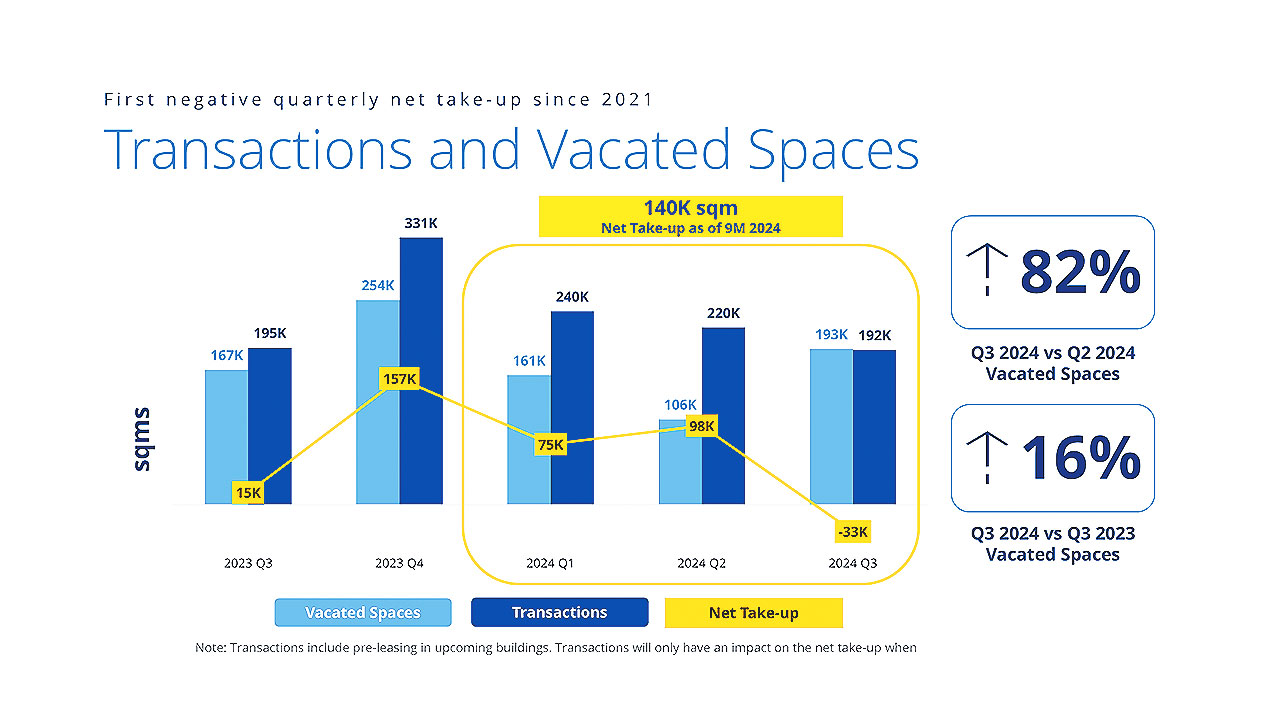
THREE MONTHS since the pronouncement of the ban of Philippine Offshore Gaming Operators (POGOs), Metro Manila’s office market recorded its first negative net take-up in a quarter since the fourth quarter (Q4) of 2021. In Q3 2024, net take-up declined by -33,000 square meters (sq.m.), mainly attributed to lease terminations by POGO and non-renewal of leases that were closed before the pandemic. While this raises some concerns, especially for developers with significant vacancies, other indicators — such as demand — show signs of resilience, offering cautious optimism in a challenging office market.

POGOs HEADING FOR THE EXIT
As of the first nine months of 2024, Colliers has noted new and upcoming surrenders from POGO occupiers in 2024. For Q3 2024 alone, we recorded 57,000 sq.m. of newly vacated spaces and expect another 157,000 sq.m. of vacancies by end of year as some operators have already notified their landlords of their lease terminations and non-renewals. The current POGO occupied stock of 275,000 sq.m. only represents 1.9% of the total stock in Metro Manila. During its peak years, around 1.3 million sq.m. of office space was leased out by POGOs.

Without the POGO ban, the year-to-date net take-up would have reached 195,000 sq.m., surpassing half of 2023’s full-year total of 280,000 sq.m. However, given the expected surrenders, Colliers projects a flat or zero net take-up by year-end, indicating no change in overall occupied space from 2023 to 2024.

ROBUST DEMAND FROM IT-BPM AND TRADITIONAL OCCUPIERS
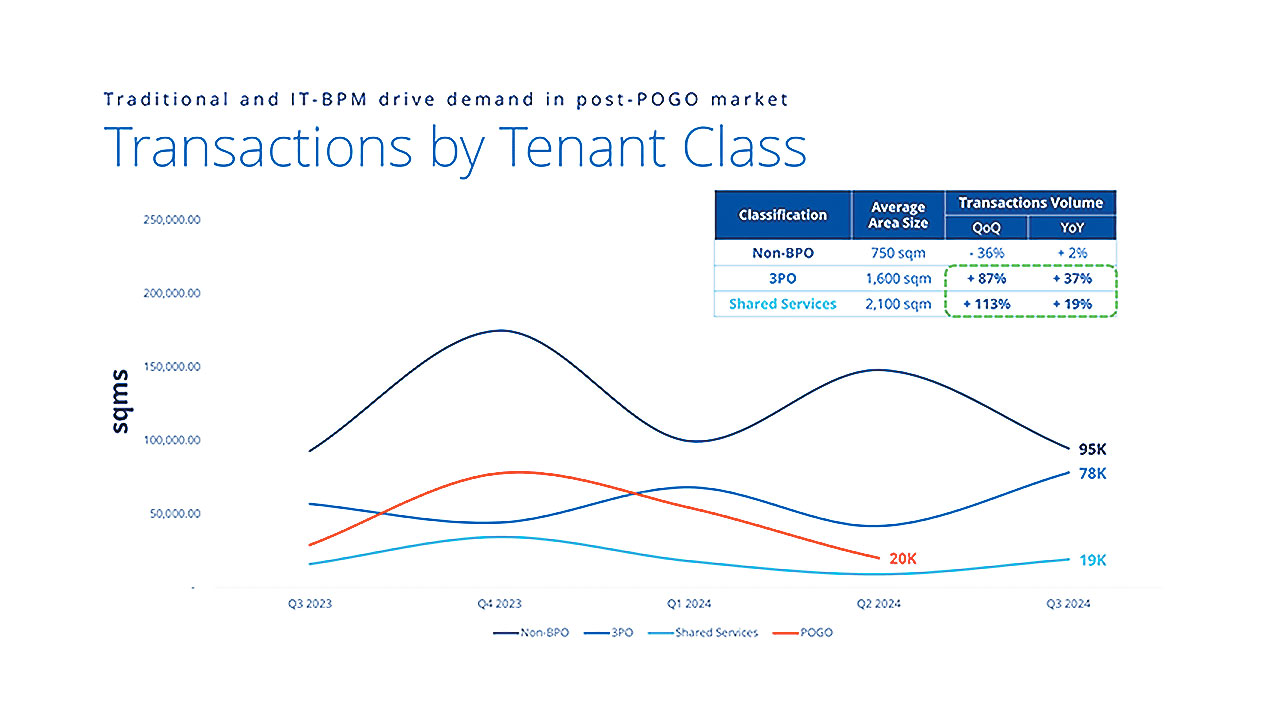
Even without POGOs, office demand in Q3 2024 performed better than the quarterly average of 174,000 sq.m., indicating a robust demand as traditional and outsourcing companies continue to take up space. This also signals that the POGO ban has not dampened demand from these two tenant classes and may even offer them greater flexibility and choice in meeting their office space requirements.

As of Q3 2024, a total of 651,000 sq.m. office transactions were recorded, with new transactions in Q3 2024 amounting to 192,000 sq.m. Deals in Q3 were 12% lower quarter on quarter (QoQ) and 2% lower year on year (YoY). Traditional firms, including government agencies, cornered 53% of the total transactions recorded, followed by third party outsourcing/3POs (29%), POGO (11%), and Shared Services (7%). It is also worth noting that 3POs and Shared Services saw significant increases in transactions volume for both YoY and QoQ.

Expansion remains the primary motivation for office space take-up, accounting for 57%, followed by relocations at 36% and new setups at 7%. Notably, expansions are concentrated in Makati CBD, Fort Bonifacio, Bay Area, Quezon City, and Alabang, where prominent IT-BPM companies have a significant presence. Among IT-BPM firms specifically, expansion drives a substantial 70% of space demand.

Across all submarkets, the Bay Area leads in leasing activity, capturing 26% of Metro Manila’s total transactions, followed by Fort Bonifacio at 18% and Quezon City at 16%. With the recent passage of a tax ordinance incentivizing office expansions and relocations, Quezon City is expected to see further demand growth from traditional occupiers.

The countryside continues its upside momentum as shown by the increase in deals recorded, which is mainly attributed to the expansion of outsourcing companies. Provincial transactions are now at 189,000 sq.m., up from 155,000 sq.m. posted in the same period of 2023. Cebu captured 32% or about 69,000 sq.m. of total provincial transactions and emerges as the only provincial market performing almost at par with primary Metro Manila CBDs such as Makati (88,000 sq.m.) and Ortigas (56,000 sq.m.). Interestingly, provincial transactions now comprise 29% of nationwide deals recorded as of Q3 2024, which was previously hovering between 20-25% in the past four years. Given this, we encourage landlords to ramp up developments in provincial areas to accommodate the demand from outsourcing companies.

HIGHER VACANCY RATES IN POGO-EXPOSED LOCATIONS
As of Q3 2024, overall Metro Manila vacancy marginally rose to 18.5% from 18.3% in Q2 2024. The increase in vacancy is mainly driven by POGO surrenders and non-renewal of leases. Primary CBDs such as Makati, Fort Bonifacio and Ortigas continue to experience below market vacancies and are likely to recover faster versus secondary markets. By end-2024, we project overall market vacancy to reach 20.5% given the expected surrenders from POGOs and non-renewals.

Meanwhile, locations with high POGO exposures such as the Bay Area and Makati Fringe are seen to experience higher vacancy rates by year end. Landlords with POGO exposures are encouraged to give additional concessions for previously vacated POGO spaces. It is important to note that occupiers will take advantage of vacated spaces by POGOs especially if these are workable for them. Landlords may consider providing tenant improvement allowances, reinstating spaces to suit traditional and outsourcing operations and offering flexible commercial terms.

‘SILVER LININGS’ IN A CHALLENGING MARKET
Despite concerns over the current state of Metro Manila’s office market, there are still positive indicators and opportunities for growth — especially when examining the market at a more granular level. Low vacancy markets may be indicative of an opportunity for landlords to enhance their office space offerings and ramp up projects already in the pipeline. Importantly, demand has remained resilient despite current headwinds. The worst-case scenario of zero demand has been avoided, with ongoing office deals from traditional businesses and outsourcing firms underscoring the market’s resiliency.

Given these, landlords are encouraged to provide high-quality office spaces that align with the latest demands for flexibility, wellness, and sustainability. By addressing these specific tenant expectations and remaining attentive to shifts in demand, landlords can capitalize on the existing market opportunities and create spaces that are better positioned to thrive even in a challenging landscape.

Looking ahead, the outcomes of the recent US elections and the resulting policy shifts may have significant implications for business activities, as well as opportunities that may arise for Metro Manila’s office market.


Kevin Jara is a director for Office Services-Tenant Representation while Kath Taburada is senior market analyst, Office Services-Tenant Representation at Colliers Philippines.

ECB policy should not remain restrictive for too long — Lane

PARIS — There is still some way to go before euro zone inflation is sustainably back at 2% but European Central Bank (ECB) policy should not remain restrictive for too long, otherwise price growth could fall below target, Philip Lane, the bank’s chief economist said in an interview.

Euro zone inflation has fallen rapidly in recent months, and policy maker are now debating when they could declare victory and whether the current pace of rate cuts is still appropriate.

“Monetary policy should not remain restrictive for too long,” French newspaper Les Echos quoted Mr. Lane as saying on Monday. “Otherwise, the economy will not grow sufficiently and inflation will, I believe, fall below the target.”

The ECB has cut rates three times already this year but investors now see a 50% chance it will cut by 50 basis points on Dec. 12 instead of the usual 25 given weak growth and rising recession risks.

However, Mr. Lane also appeared to temper expectations, warning that inflation was not yet back to where the ECB wanted it because services price growth is too high and most of the recent fall was due to moderating energy costs.

The ECB thus needed to see some rebalancing in the composition of price growth with a decline in services inflation, so it could still reach its 2% target, even if energy, food and goods prices come under upward pressure.

“There is still some distance to go in terms of adjustment for inflation to return to the desired level in a more sustainable way,” Lane said.

November data due this week is expected to show euro zone inflation accelerating to 2.4% from 2%. It could then rise further at the end of the year before easing back to 2% by mid-2025, economists say. — Reuters