Home Blog Page 1864

The delicate art of campaigning to become Pope

THE SISTINE CHAPEL, where papal conclaves traditionally vote for the next pontiff. — FRANCO ORIGLIA/GETTY IMAGES EUROPE VIA BLOOMBERG

As Pope Francis wrestles with a tenacious pneumonia, devout Roman Catholics praying for his recovery can at least be assured that their church has a time-tested succession process. Indeed, the papal conclave — where cardinal-electors choose the next pontiff — is the world’s oldest surviving electoral system for a head of state, as recently dramatized in the movie Conclave. Theologically, the Holy Spirit shepherds the cardinals — the church’s princes — to their decision. But, as the film shows, that guidance must be channeled through the ambitions of mortal men.

These are men who can’t let their ambition show. It’s unseemly for a cardinal to campaign openly for the papacy — especially while the occupant of the throne of St. Peter’s is still alive. However, as the church enters the holiest period of its calendar — the 40 days of Lent that lead to Good Friday and Easter — Vaticanologists will be scrutinizing those tasked with substituting for Francis at the processions, rituals, and masses that are the sacramental core of Catholic Christianity. Are these the favored candidates of Francis? Or is he trying to keep prelates on one side by offering them flattering roles as his understudies? I assume that Francis has a say in the scheduling. He may have trouble breathing, but the pope is not senescent and remains the church’s absolute monarch on earth. He has reportedly been conducting Vatican business from his bed in Gemelli Hospital, including meeting with his secretary of state, Cardinal Pietro Parolin.

Standing in for the ailing pontiff during Lent offers a cardinal the opportunity to impress his de facto candidacy not just on the nearly 1.4 billion believers around the world but, more specifically, on his peers. It’s a delicate role because the attention can remind electors of flaws as well as strengths. For this week’s Ash Wednesday ceremonies, the Vatican announced that Cardinal Angelo De Donatis will preside over liturgies leading to mass at the Basilica of Santa Sabina, elements of which date back to the 5th century. Last year, De Donatis, 70, was put in charge of the office that oversees excommunication and the forgiveness of serious sins. As such, it’s appropriate for him to oversee the most penitential of church seasons.*

De Donatis is not among the papabili (the “pope-ables” in Italian) listed in the College of Cardinals Report — a website put together by independent Vatican journalists. There will be deeper speculation if any of those 22 frontrunners plays a prominent role in Lenten ceremonies if Francis continues to be hospitalized. My favorite is Cardinal Luis Antonio Tagle of the Philippines, who’s now based in Rome as head of the church’s department of evangelization. I’m being parochial: I was born in the Philippines of Chinese ethnicity, and Tagle has Chinese roots through his maternal grandmother. We’re also roughly the same age.

It helps to be in Rome to be in line to substitute for an ailing pope, as demonstrated by a successful non-campaign for the papacy in 2005. As John Paul II slipped into the final throes of the Parkinson’s Disease that was taking his life, whispers went around that Germany’s Cardinal Joseph Ratzinger was once again a viable candidate. In the previous two years, Vatican observers had increased the odds against his rise to the top: Ratzinger had health issues, including two strokes; he was unpopular because of his role as John Paul’s ideological enforcer (the cardinal was head of the office that was the evolutionary descendant of the Inquisition); his nickname panzerkardinal was far from warm and fuzzy. Many cardinals wanted a more pastoral and less magisterial approach to the papacy — and theologian-in-chief Ratzinger didn’t fit that bill. One insider told my then-Time colleague Jeff Israely, who was the magazine’s Rome bureau chief: “Getting elected Pope is more a question of how many enemies you have than friends. And I thought Ratzinger still had too many enemies.”

In late February, when John Paul was admitted to the hospital, Ratzinger gave a sermon at the funeral of a prominent Catholic layman that outshined in vigor the eulogy delivered by a cardinal who was at the top of papabili lists at the time. Ratzinger prepared the much-anticipated text for the Good Friday readings of the Stations of the Cross — a role likely assigned by John Paul before his health took a turn for the worse. When the pope died six days after Easter, Ratzinger was again in the spotlight as he presided over the April 8 funeral mass. And as dean of the College of Cardinals — another John Paul appointment — he was seen as the man in charge, especially by visiting cardinals from around the world. Ratzinger became the man to see, even if he wasn’t the leader of the Vatican — yet.

By the fourth round of voting at the conclave, Ratzinger had amassed enough support to win the papacy and, without hesitation, chose the name Benedict XVI as if he’d prepared it all along. It was tribute in part to Saint Benedict of Nursia, who laid down the rigid rules for Christian monastic life. But the Holy Spirit moves in mysterious ways. According to one anonymous cardinal who took note of the tallies in the Sistine Chapel, the prelate who came in second place was Jorge Mario Bergoglio, archbishop of Buenos Aires. Eight years later, he would become Pope Francis.

BLOOMBERG OPINION

*De Donatis, 70, reportedly questioned the pope’s decision to waive the statute of limitations to reopen an investigation into decades-old sexual abuse claims against a prominent priest-mosaicist.


In the Lost Lands shows George R.R. Martin’s fantastical future

MILLA JOVOVICH and Dave Bautista in a scene from In the Lost Lands.

LOS ANGELES — English director Paul W.S. Anderson believes that fans of writer George R.R. Martin’s Game of Thrones and House of the Dragon will have their hunger for more fantasy stories satisfied with the film In the Lost Lands.

In the Lost Lands, which arrives in theaters on Friday and is distributed by Vertical, is a movie based on a dark fantasy short story of the same name by Mr. Martin.

“The story has the elements that people are familiar with from George’s work, which they love, the twisted characters, the intrigue, the dark setting, the monsters,” the Resident Evil director told Reuters.

“But then it’s a brand-new landscape, and it’s a world they’ve never seen before. So, it’s got all the content, but it’s not Westeros. It’s something very cinematic. We really tried to build something for the cinema rather than television,” he added.

In the Lost Lands stars Milla Jovovich and Dave Bautista, navigating a tale that is quite different from the dragons and power grabs within the fictional continent of Westeros from the Game of Thrones universe.

The film follows Mr. Bautista’s cowboy-esque drifter Boyce, who wanders the post-apocalyptic landscape of humanity’s future. His path crosses with a mystical witch named Gray Alys, played by Ms. Jovovich, who is very powerful but unable to turn down people’s requests.

A journey begins when a queen sends Gray Alys to the “Lost Lands” to grant her the magical power of transforming into a werewolf.

Together, Gray Alys and Boyce are caught in a political situation and are pursued by the religious arm of the kingdom who want to overthrow the queen.

In addition to his lead acting role, Mr. Bautista served as a producer for the film after regularly not having enough creative input in his other Hollywood roles.

“Because I care about what I’m doing, I care about the projects I’m involved with, I just want to have some say so, and so, that comes with being a producer,” the former wrestler told Reuters.

In the Lost Lands is now showing in Philippine cinemas. — Reuters

Trump deregulation push boosts appeal of bond swap spread wideners

FEDERALRESERVE.GOV

NEW YORK — A potential move by the US Federal Reserve to ease regulations on capital for US banks that would allow them to hold more Treasury securities has unleashed a torrent of so-called swap spread wideners in the bond market.

These are bets that increase demand for US Treasuries that will push their yields lower and closer to those of a competing class of risk-free assets called interest rate swaps. Analysts said this trade has already been successful this year.

The trade has become popular since the Nov. 5 US election on expectations President Donald J. Trump’s administration will push through deregulation, particularly making capital adequacy rules less restrictive for banks.

“Markets have seized on the possibility that looser regulation will free up some capacity for banks to hold more bonds, especially in times of stress,” said Steven Major, the global head of fixed income research at HSBC in Dubai.

“Early positioning from hedge funds was on the view that regulations would be adjusted. There is more to go.”

Swap spreads are a major component of the more than $500-trillion interest rate derivatives market. They express the basis-point difference between the fixed rate of an interest rate swap tied to the current Secured Overnight Financing Rate (SOFR) and the Treasury yield of the same maturity.

Investors and corporations use swaps to hedge interest rate risk or their exposure to US Treasuries, allowing them to exchange fixed-rate cash flows for floating-rate ones, or vice versa.

Swap spreads are currently negative across the curve, meaning yields on Treasuries are higher than those on swaps. But since the beginning of the year, spreads have turned less negative, or in bond market parlance, widened, which means Treasury yields have been trending lower.

US five-year swap spreads have widened since January by about 5 basis points (bps) to minus 29 bps on Tuesday. The spread reflects the difference between five-year Treasury yields currently at 3.925% and five-year swap rates at 3.6201%.

On the long end of the curve, 30-year swap spreads have increased by 8 bps to minus 78 bps.

BALANCE SHEET FLEXIBILITY
Last month, Fed Chair Jerome H. Powell told Congress that it was time for the US central bank to ease the supplementary leverage ratio (SLR), which directs banks to hold capital against investments regardless of their risk and effectively discourages these institutions to hold Treasuries.

The Fed was forced to temporarily waive the SLR after the Treasury market seized up in March 2020, but it let that relief expire a year later.

Cutting SLR would significantly free up additional capacity for banks on their balance sheet, allowing them to add low risk-free assets such as Treasuries without having to allocate capital to cover potential losses.

The net effect of Mr. Powell’s recent comments on the SLR was to push yields lower, consequently widening swap spreads.

Swap spreads across the curve have been negative for years, and this has something to do with the structure of lending between the two risk-free assets.

“The credit risk between Treasury yields and SOFR swap rates is identical,” said Srini Ramaswamy, managing director and head of derivatives strategy at JPMorgan in San Francisco. “Treasury yields are higher and that has something to do with terming out the principal.”

Mr. Ramaswamy cited a five-year SOFR swap rate, for instance, which effectively is the average of rates that one can earn by doing lending in the repurchase or repo market daily for five years. The five-year Treasury note, on the other hand, represents lending money to the US Treasury five years at a time.

“You give up some flexibility when you lend money for five years to the Treasury, so the compensation is higher, as opposed to lending one day at a time in SOFR swaps,” Mr. Ramaswamy said.

And with the recent transition to risk-free SOFR from Libor, or the London Interbank Offered Rate, there is no longer a premium for credit risk embedded in swap rates that lifted them higher over Treasury yields in the past.

Major banks as a result have recommended swap spread wideners to take advantage of looming deregulation.

Barclays, in a research note, recommended swap spread wideners in the belly of the curve, specifically, the seven-year spread, where banks prefer to own Treasuries. It believes a change in the SLR could unlock additional bank demand for Treasuries as these financial institutions grow their assets.

TD Securities, on the other hand, sees more opportunity on the longer end of the curve, particularly in the 30-year sector, where spreads remain historically tight or more negative.

“We believe the widening has more room to run as regulators make progress,” said Gennadiy Goldberg, TD’s head of US rates strategy. — Reuters

ATI deploys new cranes at Manila South Harbor

ASIANTERMINALS.COM.PH

ASIAN TERMINALS, Inc. (ATI) said it has commissioned two ship-to-shore (STS) cranes to increase handling capacity and operational efficiency at Manila South Harbor, its flagship international container terminal.

“The deployment of these two new cranes significantly boosts Manila South Harbor’s capacity and efficiency, allowing us to handle larger vessels and more cargoes, which directly benefit the Philippines as an emerging economic center in the region,” ATI Director William Khoury said in a media release on Thursday.

ATI said the additional cranes at South Harbor will complement its 11 STS cranes, hybrid and conventional rubber-tired gantries, and other cargo-handling equipment.

The company said the cranes are critical to the modernization of Manila South Harbor and aligned with future market requirements.

“This is well-timed with the scheduled completion of Manila South Harbor’s Pier 3 redevelopment, highlighted by its extended quay length to nearly 600 meters to accommodate more and bigger vessels deployed by ATI’s international carrier partners,” ATI said.

The newly deployed cranes are Neo-Panamax cranes manufactured by Shanghai Zhenhua Heavy Industries. These are the largest among ATI’s existing quay-side equipment and are considered the biggest in the Philippines, with an outreach of 58 meters.

“In partnership with the government, we are lining up more investments in the coming years to future-proof our gateway terminals in Manila, Batangas, Cavite, and Laguna in support of the resilient and sustainable growth of the Philippine economy,” Mr. Khoury said.

In 2024, ATI handled a total volume of nearly 1.6 million twenty-foot equivalent units (TEUs), marking a 4% increase from the previous year.

The company said it is now capable of handling nearly 2 million TEUs in annual container throughput following the completion of its landside and seaside development projects, along with the deployment of new cranes.

At the stock exchange on Thursday, shares in the company gained 18 centavos, or 1%, to close at P18.16 apiece. — Ashley Erika O. Jose

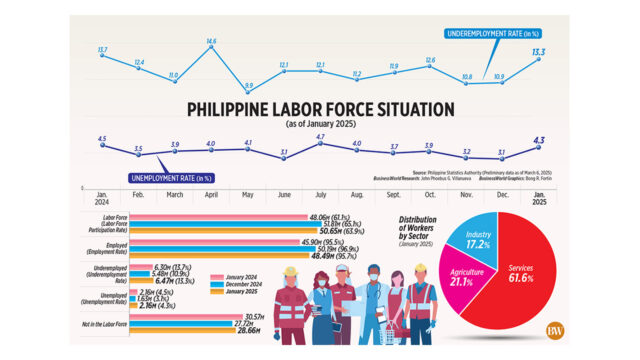
Philippine Labor Force Situation

THE PHILIPPINES’ unemployment rate in January rose to its highest level in six months, as hiring declined after the holiday season, the statistics agency said on Thursday. Read the full story.

Philippine Labor Force Situation

Post-event impressions: ‘An Imaginal Life’

FREEPIK

The energy was high for the master class on “An Imaginal Life.” Soul friends and members of the Carl Jung Circle Center (CJCC) gathered to listen to Dr. Stephen Aizenstat, a psychotherapist, educator, and the founding president of the Pacifica Graduate Institute. He is the spiritual godfather to the Depth Institute of Asia, CJCC’s formal learning arm. The journey mates sat together for the much-anticipated sessions.

Dr. Aizenstat observed the heart-centered connection in the room. He introduced his work — a lifetime of working with dreams and how it has morphed into working with the imagination.

Dr. Rose Marie Yenko, CJCC chair emeritus, explained: “When one talks of imaginal intelligence, this comes from a realization that there is depth in imagination, and that its source is deeply spiritual. Imagination is active in and of itself. The images have a life of their own, and it is autonomous.

“One cannot force the images. One can only be a witnessing presence. When one has a dream, what does one do?

“We ask, ‘Who is vising now? What is happening here? What is the dream’s desire? What is the unfolding story?’

“It is difficult for imagination to flow because the minute we wake up, we tend to reach for a cellphone. This stops the flow of imagination, the flow of curiosity and spontaneity. This gesture causes the portal to imagination to close.

“However, if one pauses and writes down the dream and the images from the dream, there is a chance to have a relationship with the figures in the dream.”

Dr. Aizenstat suggests that we befriend these figures and images.

“They will provide hints, responses to life’s questions, or to one’s life drama,” Dr. Yenko surmised.

As one appreciates images that come forth from one’s dreams, one can also be aware of archetypal figures that were part of one’s inner community.

Dr. Aizenstat said that these figures are considered the supportive soul companions.

In his new book, The Imagination Matrix, he identifies these soul companions. The Dearest Friend, the beloved who give support, care, and love. There is the Witness, who provides a presence who sees us, which is an engaged observer of our life. There is the Mentor, the wise elder, counselor, and adviser, who gives advice without judgment. There is also the Guardian, the protector, the defender, who gives us an attitude of vigilance and watchfulness.

There are also shadow figures such as the shadow soul companions.

One shadow figure is the Dragon, the persecutor, the judge, the critic, and intimidator.

“We are all familiar with this resident in our inner community. A transmutation of this figure will allow us to harness the superpower of this soul companion. One can draw from this power to counteract those who might torment or judge you in the world of daily affairs. As I once mentioned to a client, they must be more careful of you because they have awakened a sleeping dragon,” Dr. Yenko added.

There is the Savior, the rescuer, the martyr — one of the shadow companions. Dr. Aizenstat warns of identifying with the shadowed embodiment of the savior/rescuer when one feels the never-ending obligation to rescue people from difficult and dangerous situations. “When offered in appropriate doses, they are suitable and helpful. When doing good deeds goes into the shadow, this soul companion undermines one’s personhood.”

The concept of soul companions received the most impressions from the community when questions were asked of their reflections.

Some very interesting responses on “The Imaginal Life” session were: “I have to consciously work with my soul companions as a regular practice.” “These archetypal figures are guides and allies from the imaginal realm. They are powerful forces in my soul journey.” “The soul companions help make sense of the presences I feel in my life.” “They are the inner source of my strength.” “Listen to the images. These images are alive.”

We ask ourselves, “Who are your soul companions? Can you identify them? As you become more aware, can they be presences in your daily life that help you, support you, guide you, defend you?”

Dr. Aizenstat notes that these companions can be not only figures but they can be landscapes. They can come from nature (flora, fauna, trees, birds, forest, a pet dog, cat, or horse). They can be from one’s cultural and religious life, from one’s family, one’s favorite literature character, a pop icon, a toy.

See who and what composes your inner community.

Dr. Aizenstat illustrated “the application of image as medicine. Invoking the figure of the divine physician. He demonstrated the reality of an archetypal figure that embodied the presence of a third energy in a relationship or marriage.”

Here are some spontaneous reactions to the session: Magical, enlightening, affirming, healing, strengthening, deepening and calming.

Thank you, Dr. Stephen Aizenstat, for your lectures and all the enriching insights on imagination and for expanding awareness on our journeys and inner lives. You have left a deep impression in our collective spirit.

Congratulations to the Carl Jung Circle Center, especially to its chair emeritus Rose Yenko. We are grateful for the interviews, precious notes and quotes. Thank you, President Oliver Roxas, the officers and the founding members of the CJCC community (2010 to the present). Dr. Dido Gustilo Villasor and Dr. Rene Samaniego, and officers and the members of DIA for making the sessions possible.


Maria Victoria Rufino is an artist, writer and businesswoman. She is president and executive producer of Maverick Productions.

mavrufino@gmail.com

Stuff to Do (03/07/25)


Watch films by Spanish female directors

INSTITUTO CERVANTES, in collaboration with the Embassy of Spain, AECID, and the UP Círculo Hispánico, will present a film series featuring the works directed by contemporary Spanish female filmmakers. The series kicks off on March 7, 2 p.m., at the UPFI Film Center (UP Diliman) with the screening of the drama El Olivo (The Olive Tree), directed by Icíar Bollaín. The next featured film — to be shown on March 13, 2 p.m., at the Instituto Cervantes branch in Intramuros, Manila — is the 2001 movie 15 Years and 1 Day, directed by Gracia Querejeta. On March 20, 2 p.m., at the same venue, the dance biopic Yuli (2018), directed by Icíar Bollaín, will be shown, with a talk following the screening. All films will be shown in their original Spanish, with English subtitles. Admission is free.


Listen to a talk on modern and contemporary art

THE “Paint the Past” talk by Atelier de Legaspi will welcome mallgoers to drop by and learn about modern and contemporary art, particularly paintings. It will take place on March 9, from 1 to 5 p.m., at the Gateway Gallery Studio on the fifth floor of Gateway Mall in Quezon City. It will begin with a talk tracing the evolution of art movements from the Modern to Contemporary Art Period. There will then be a hands-on workshop where Atelier de Legaspi will teach techniques.


View works by women artists at ARTablado

THIS MARCH, Robinsons Land’s ARTablado puts women at the center stage with two exhibitions: Liquid Dreams at Robinsons Galleria featuring four female artists, and Mutya at Robinsons Antipolo featuring students from the Arts and Design track of De La Salle Antipolo. The four artists in the Galleria exhibit are Mylene Quito, Valerie Teng, Isah Rodillo, and Sigwada Knicolai, whose works all delve into abstraction, fluidity, and transformation. Over at Antipolo, the senior high school art students take inspiration from mutya, a Filipino term that connotes beauty, charm and value, all of which manifest in their works. Both exhibits run until March 15.


Attend a concert of composer Pauline Garcia-Viardot

THE Embassy of France and Alliance Française de Manille are inviting the public to the next Jeudi Culturel concert, titled A Tribute to Pauline Garcia-Viardot. In celebration of Francophonie Month and Women’s Month, the evening’s event will celebrate the life and music of a trailblazing French composer and woman of classical music, Pauline Garcia-Viardot. The concert on March 13 starts at 7 p.m., to be held at Alliance Française de Manille in Bel-Air, Makati City. Tickets are priced at P500, inclusive of food. The performance will blend soprano, piano, violin, and storytelling to pay tribute to Madame Viardot’s legacy. Food will be served before the concert while drinks will be available for purchase during the performance.


Listen to the music of composer M.K. Čiurlionis

FOR the 6th concert of the Philippine Philharmonic Orchestra’s (PPO) 40th season, “Forte,” the focus will be on the music of Lithuanian composer M.K. Čiurlionis. Titled Homecoming, the program commemorates the composer’s 150th birth anniversary. Pieces to be performed are Čurlionis’ Miške, Bizet’s Carmen Suite, and Liszt’s Totentanz, with guest pianist Rowena Arrieta. The concert will be on March 14, 7:30 p.m., at the Samsung Performing Arts Theater in Makati City, and will feature the PPO’s guest concertmaster and artist-in-residence Diomedes Saraza, Jr. Tickers range in price from P500 to P3,000.


Listen to Carish’s new song for the heartbroken

EMERGING Filipino musician Carish has just released his newest single, “Permiso.” The R&B track takes on themes of betrayal and emotional turmoil, blending rap with soul sensibilities. The song is now available on all digital streaming platforms.

Chinabank, Manulife Philippines renew bancassurance partnership for 15 years

BW FILE PHOTO

CHINA BANKING Corp. (Chinabank) has renewed its bancassurance partnership with The Manufacturers Life Insurance Co. (Phils.), Inc. (Manulife Philippines) through Manulife Chinabank Life Assurance Corp. (MCBL).

The Sy-led bank’s board of directors ratified the extension of the partnership in a regular meeting on Wednesday, it said in a disclosure to the stock exchange on Thursday.

“This new agreement is subject to approval by the Insurance Commission (IC),” Chinabank said.

MCBL was incorporated in 2007 as a joint venture between Chinabank and Manulife Philippines. Chinabank holds a 40% stake in the company.

The newly ratified agreement extends the two firms’ partnership for another 15 years.

MCBL offers financial protection and wealth management products and services. Under Chinabank and Manulife Philippines’ bancassurance deal, MCBL’s products are offered at Chinabank and China Bank Savings, Inc. branches nationwide.

MCBL booked a premium income of P10.35 billion in 2024, latest data from the Insurance Commission showed. Its net income stood at P1.39 billion last year.

For its part, Manulife Philippines’ premium income stood at P15.83 billion last year, while its net income was at P2.78 billion.

Meanwhile, Chinabank’s attributable net income grew by 12.69% year on year to a record P24.8 billion in 2024 amid sustained core business growth, it reported last week.

The bank’s full-year performance translated to a return on equity of 15.6% and a return on assets of 1.6%.

Net interest income rose by 18.7% year on year to P63.54 billion due to asset base expansion. Net interest margin stood at 4.5%. Its revenues also increased by 21.1% to P65.49 billion.

Chinabank shares dropped by 30 centavos or 0.35% to close at P86.50 apiece on Thursday. — A.M.C. Sy

Managerial pay falls to P1,300 per day in January

PHILIPPINE STAR/BOY SANTOS

MANAGERS averaged daily pay of P1,300 in January, down from P1,356 a year earlier, according to the Philippine Statistics Authority (PSA).

Armed forces occupations were the second highest-paying jobs, with an average daily wage of P1,174 during the period, up from P1,095 a year earlier, according to the PSA’s Labor Force Survey released on Thursday.

Professionals earned daily basic pay of P1,173, followed by technicians and associate professionals with P855.

Clerical support workers earned P739 per day.

Meanwhile, the occupations with the lowest daily basic pay were the following: Elementary occupations (P416); Skilled agricultural, forestry, and fishery workers (P418); Service and sales workers (P531); Plant and machine operators and assemblers (P572); and craft and related trades workers (P573).

The agriculture and forestry sector was the second largest employer in January, making up 21.1% of the labor force, or about 10.24 million workers, the PSA said. Employment in the sector grew by 883,000 in January compared to a year earlier.

“Wages in agriculture are very low since wage orders discount the labor of farm workers on the argument that they live in rural areas where the cost of living is supposed to be cheaper,” University of the Philippines Diliman School of Labor and Industrial Relations Assistant Professor Benjamin B. Velasco told BusinessWorld via Messenger chat.

“Further, productivity is low in agriculture since it is not modernized. So, farm workers end up with depressed wages,” he added, noting this is why underemployment in the sector is also high.

According to PSA Assistant Secretary Divina Gracia L. Del Prado, the industry accounted for 44.5% of total underemployment — defined as those looking for additional work or hours.

The unemployment rate in January fell to 4.3% from 4.5% a year earlier, the PSA reported.

There were about 2.16 million jobless in the first month of the year, unchanged from a year earlier but higher than the 1.63 million in December.

January unemployment was the highest since July 2024, when the indicator was at 4.7%.

Underemployment was 13.3% in January, against 13.6% a year earlier and 10.9% in December.

About 48.49 million Filipinos had jobs in January, against 45.90 million a year earlier and 50.19 million in December. — Chloe Mari A. Hufana

Filinvest REIT, Filinvest Land sign deed of exchange for Festival Mall

COMMONS.WIKIMEDIA.ORG

FILINVEST REIT CORP. (FILRT) has executed a deed of exchange with its parent company and sponsor, Filinvest Land, Inc. (FLI), for the transfer of ownership of Festival Mall in Alabang, Muntinlupa City.

The two companies executed the memorandum of agreement and the deed of exchange on March 5 as part of a P6.26-billion property-for-share swap transaction, FILRT said in a regulatory filing on Thursday.

Under the transaction, FILRT will issue 1.63 billion shares at P3.85 each to FLI in exchange for the ownership of the 121,862-square-meter (sq.m.) main mall of Festival Mall.

The addition of Festival Mall will increase FILRT’s total gross leasable area by 37% to 452,310 sq.m.

The deal expands FILRT’s portfolio into the retail mall segment. Previously, its portfolio consisted of 17 office buildings and 2.9 hectares of land leased to the owner and operator of Crimson Resort & Spa Boracay.

Following the addition of Festival Mall, FILRT’s portfolio mix will comprise 67% offices, 6% hospitality, and 27% retail.

FILRT signed new leases totaling nearly 29,000 sq.m. and renewed more than 42,000 sq.m. of expiring leases last year.

The company posted a 6.3% decline in net income for 2024 to P1.63 billion, as revenue fell by 4.9% to P2.84 billion.

Rental revenue dropped by 5.2% to P2.19 billion, while other income declined by 3.9% to P652.25 million.

On Thursday, FILRT shares rose by 0.96% or three centavos to P3.17 apiece. — Revin Mikhael D. Ochave

Job Losses by Industry (January 2025 vs December 2024, in thousands)

THE PHILIPPINES’ unemployment rate in January rose to its highest level in six months, as hiring declined after the holiday season, the statistics agency said on Thursday. Read the full story.

Job Losses by Industry

Ye be gone: Adidas sells last pair of Yeezy sneakers

THE YEEZY Boost 350 V2

HERZOGENAURACH, Germany — Adidas sold its last pair of Yeezy sneakers at the end of 2024, the sportswear brand said on Wednesday, ending the process of liquidating stock of the lucrative shoe partnership with rapper Ye after splitting from him in October 2022.

Adidas has been trying to put the Yeezy affair behind it since antisemitic rants by Ye, formerly known as Kanye West, forced it to end the highly profitable partnership, denting revenues and driving the company to an annual loss in 2023.

“There is not one Yeezy shoe left, it has all been sold and that episode is behind us,” Chief Financial Officer Harm Ohlmeyer told a press conference on Wednesday after Adidas reported results.

The company has felt the loss of Yeezy particularly in the United States, where the shoes were popular. In its results on Wednesday Adidas said North America sales fell 2% in 2024, “solely due to significantly lower Yeezy sales.”

The company started selling off its remaining stock of Yeezy shoes in May 2023, pledging to donate part of the proceeds to organizations combating antisemitism, including the Anti-Defamation League.

Adidas reported it sold 650 million ($696 million) worth of Yeezy sneakers last year, making a profit of around 200 million.

The year before, Adidas made 750 million in revenue from Yeezy inventory, generating 300 million in operating profit.

The company has set aside 260 million for charitable donations from the proceeds of Yeezy sales, Chief Executive Officer Bjorn Gulden told a press conference. That amounts to about half of the operating profit Adidas made on selling off its stock of the sneakers in 2023 and 2024.

Of that, 200 million is held in a foundation set up by Adidas, while 60 million has already been paid out to charity organizations, Gulden said. — Reuters