Home Blog Page 1812

Most Asian FX subdued; South Korean markets slide on deepening political woes

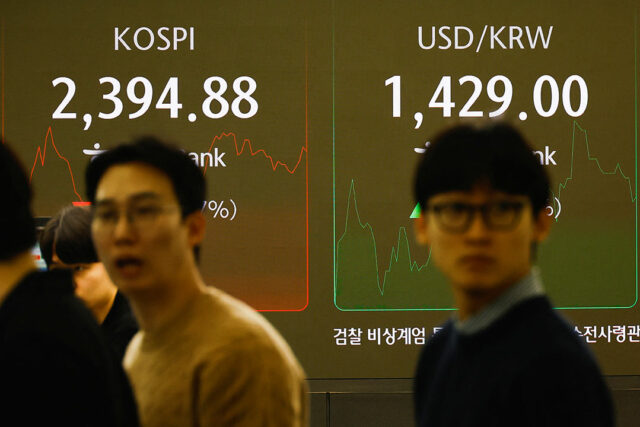
Currency dealers stand in front of electronic boards showing the Korean Composite Stock Price Index (KOSPI) and the exchange rate between the U.S. dollar and South Korean won at a dealing room of a bank, in Seoul, South Korea, Dec. 9, 2024. — REUTERS

Most Asian currencies were muted on Monday, weighed down by high U.S. Treasury yields and a firm dollar while the South Korean markets reversed course to trade slightly lower after last week’s parliament vote to impeach acting President Han Duck-soo.

Most equities in Asia traded in a tight range while shares in Malaysia and Singapore climbed 0.4% and 0.3%, respectively.

The South Korean won slipped 0.1% after rising as much as 0.3% earlier in the session while equities skidded 0.2% after rising up to 1%.

Following the impeachment of Han on Friday, South Korean investigators sought an arrest warrant for suspended President Yoon Suk Yeol on Monday over this month’s short-lived imposition of martial law.

“The political uncertainties and faster rate cut pace should keep the won on the back foot in the coming months,” said Ken Cheung, chief Asia FX strategist at Mizuho Bank.

The won is the worst performing currency in emerging Asia so far this year, having lost more than 12% weighed down by political tensions in the country and economic woes, coupled with fears of U.S. tariffs.

Most other Asian currencies were largely unchanged amid pressure from high U.S. Treasury yields at near eight-month highs and a firm dollar at a multimonth peak.

Mizuho Bank’s Cheung expects persistent dollar strength to weigh on Asian currencies in the first half of 2025. However, U.S. economy’s cyclical softening and tariffs relief could lead to rebounds in Asian currencies, he added.

“The tariff threats are likely to materialize but the implementation may come in lower than expected,” Cheung said.

In Asia, the Indonesian rupiah rose 0.5% but was not far from the more than 4-month low touched on Dec. 19 after the U.S. Federal Reserve adopted a hawkish stance at its policy meeting.

The Thai baht climbed 0.1% after rising as much as 0.4% earlier in the session while equities rose 0.4%.

The strength in the baht “could be driven by a rebound in gold prices and somewhat sideways movement in the U.S. dollar,” said Poon Panichpibool, a markets strategist at Krung Thai Bank.

“There could be some positions adjustment especially for those with net short THB positions after THB could rise beyond the 34.00 support zone.”

Markets are now awaiting Singapore’s GDP data for the fourth quarter and inflation reports from Indonesia and South Korea later this week. — Reuters

Dollar reigns with support of higher yields

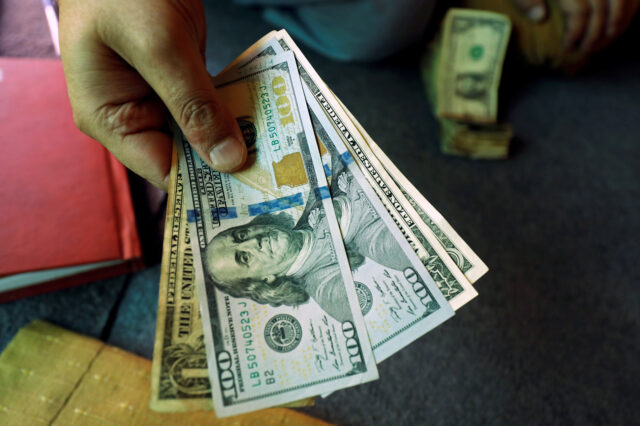
A trader shows U.S. dollar notes at a currency exchange booth in Peshawar, Pakistan. — REUTERS

SINGAPORE — The Japanese yen traded around five-month lows on Monday against a dollar underpinned by rising U.S. yields as thin year-end liquidity kept most currencies in tight ranges.

The yen was changing hands at 157.82 with only the risk of Japanese intervention preventing another test of the 160 level last seen in July.

The dollar index measure against major rivals was flat at 107.99.

The euro stood at $1.0429, not far from recent troughs and in a holding pattern in holiday trading. The currency is heading for a calendar-year drop of roughly 5.5% on the dollar.

Rising U.S. Treasury yields have been a tailwind for the dollar, with the benchmark 10-year note US10YT=RR hitting a more than seven-month high last week. The yield hovered close to that mark on Monday, at 4.625%.

“Despite paid forecasters almost universally calling for a weaker U.S. dollar in 2024, the greenback looks set to close the year higher against all major currencies with the buck reigning supreme,” said Chris Weston, head of research at Australian online broker Pepperstone.

For the month, the dollar index is up 2.3%, bringing year-to-date gains to 6.6%.

It has gained in each of the last three months, helped by expectations President-elect Donald Trump’s policies of looser regulation, tax cuts, tariff hikes and tighter immigration will be both pro-growth and inflationary and keep U.S. yields elevated.

The dollar has gained 10 yen since Dec. 3, with much of the decline in the Japanese currency coming after the Federal Reserve’s Dec. 18 message of caution around future rate cuts.

That view has weighed heavily on the yen, which hit its weakest level since July 17 last week at 158.09 per dollar and has shed 10.6% so far this year.

It came off those lows on Friday after a summary of opinions from the Bank of Japan’s December policy meeting showed some policymakers gaining confidence in an imminent rate increase, while the Japanese central bank also cut its monthly bond purchases.

Still, Japanese yields remain notably low, and recent comments have sown doubts about the BOJ’s commitment to lift rates. The BOJ held interest rates steady at 0.25% at this month’s meeting, and governor Kazuo Ueda said the central bank was scrutinising more data on next year’s wage momentum and clarity on the incoming U.S. administration’s economic policies.

A Reuters poll taken earlier this month showed the BOJ could raise rates to 0.50% by end-March, and interest rates markets are pricing in only a 42% chance of a rate rise in January.

Traders are on watch for any potential intervention by Japanese officials to shore up the currency if it continues to weaken, as they have done multiple times this year.

Japan Finance Minister Katsunobu Kato on Friday reiterated concerns over a sliding yen, repeating his warning to take action against excessive currency moves.

Pepperstone’s Weston said dollar buyers continued to dominate trading in the dollar-yen pair.

“It rarely sits well buying into any market pushing new run highs, but in my view, any upside break of 158.00 is good for chasing – although yen shorts do run the increasing risk of credible MOF yen jawboning and possible intervention,” Weston wrote in a note to clients.

Barring the yen, currency moves in major markets were tepid last week. The yen fell 0.9%, the euro shed 0.2% and sterling rose 0.1% while the dollar index climbed 0.2%.

The next interest rate cut by the European Central Bank could be longer in coming after a recent uptick in inflation, ECB Governing Council member Robert Holzmann was quoted as saying on Saturday.

Leading cryptocurrency bitcoin too was sluggish around $93,052, and is down about 4% on the month after retreating from a record high of $108,379.28 hit on Dec. 17. It has surged about 115% so far this year. — Reuters

From peanut farmer to president: Jimmy Carter passes away at 100

BLOOMBERG

JIMMY CARTER, the former Georgia peanut farmer who as US president brokered a historic and lasting peace accord between Israel and Egypt in a single term marred by soaring inflation, an oil shortage and Iran’s holding of American hostages, has died. He was 100.

Mr. Carter died on Sunday at his home in Plains, Georgia, surrounded by his family, the Carter Center said on Sunday in a statement. Public observances are planned in Atlanta and Washington, followed by a private interment in Plains.

The longest-living former US president ever, Mr. Carter had opted in early 2023 to spend his remaining time at his home in Plains receiving hospice care. He was there alongside Rosalynn, his wife of 77 years, when she died in November 2023 at age 96. And he lived long enough to fulfill a final wish — to cast a ballot for Kamala Harris in the 2024 presidential election.

A Democrat who rose from running his family’s peanut-farming and seed-supply businesses to serving as Georgia governor, Mr. Carter won the White House in 1976 over incumbent Gerald Ford by promising to bring honesty to an office tainted two years earlier by the resignation of Richard Nixon in the culmination of the Watergate scandal.

Ascetic, humble and deeply religious, Mr. Carter was skeptical of the pomp surrounding the presidency and came to Washington with fewer allies and fixed positions than most who hold the job.

His allegiance to an inner moral compass, his vow to support societies that “share with us an abiding respect for individual human rights” and his tendency to speak his mind collided at times with political realities during his four years in office, from 1977 to 1981, and served as a preview of what was to come in a service-filled post-presidency that lasted decades.

Mr. Carter “assembled a new front line on nearly every issue, with no inherited party game plan or ideological playbook to fall back on,” Jonathan Alter wrote in a 2020 biography that painted him as often right in his instincts but flawed in executing government responses. The book was among several in recent years that offered a revised and sunnier view of Mr. Carter’s crisis-plagued tenure.

Though Mr. Carter “left the White House a widely unpopular president,” his achievements “shine brighter over time, few more than his unique determination to put human rights at the forefront of his foreign policy from the start of his presidency,” his chief domestic policy adviser, Stuart Eizenstat, wrote in a 2018 biography of his former boss.

STATE FUNERAL
In a statement on Sunday, President Joseph R. Biden eulogized Mr. Carter as “an extraordinary leader, statesman and humanitarian” who touched the lives of people around the world with “his compassion and moral clarity.” Biden said he’ll be ordering a state funeral for Mr. Carter in Washington.

President-elect Donald J. Trump, who often brought up Mr. Carter’s presidency during this year’s election campaign to needle Mr. Biden, said Mr. Carter faced challenges at a pivotal time in US history. He “did everything in his power to improve the lives of all Americans,” Mr. Trump said on his Truth Social platform. “For that, we all owe him a debt of gratitude.”

The signature achievement of the Carter presidency, the Camp David Accords between Israel and Egypt, led to peaceful co-existence between the Middle East neighbors even as it fell short of resolving the conflict between Israel and the Palestinians.

That and other foreign policy breakthroughs, including a treaty granting Panama ownership of the US-built Panama Canal, were overshadowed by the plight of American hostages held in Iran during the last 444 days of his presidency. They were finally released the day Mr. Carter turned over the Oval Office to Republican Ronald Reagan.

On the domestic front, the Mr. Carter presidency was dogged by economic woes. Inflation reached 13.3% at the end of 1979 compared with 5.2% when he took office in January 1977. The Federal Reserve’s actions to stem price increases pushed home-mortgage rates to almost 15%, and Mr. Carter had to take emergency action to stem a slide in the dollar. There were energy shortages, and oil prices more than doubled.

MALAISE SPEECH
A speech to the nation on July 15, 1979, became emblematic of Mr. Carter’s presidency.

With fuel prices skyrocketing and lines at gas stations lengthening, Mr. Carter told Americans that solving the energy mess “can also help us to conquer the crisis of the spirit in our country.” He said many Americans “now tend to worship self-indulgence and consumption.”

Though Mr. Carter never uttered the word, the address became known as the “malaise” speech and contributed to a sense that Mr. Carter was powerless to change the nation’s course.

“Our memory of the speech comes from those who reworked it, who twisted its words into a blunt instrument that helped them depose a president,” historian Kevin Mattson wrote.

Mr. Carter’s words, he noted, “received immediate applause and yet wound up ensuring his defeat” to Mr. Reagan in the 1980 election.

Just weeks after delivering the speech, Mr. Carter tapped Paul Volcker, president of the Federal Reserve Bank of New York, to take over as chair of the Federal Reserve, replacing G. William Miller, who became Treasury secretary. Mr. Volcker made it clear to Mr. Carter that he would deal head-on with inflation by pursuing tighter monetary policies than Mr. Miller. Mr. Volcker’s policies — which sent interest rates as high as 20% — came at a high price, the fallout contributing to Mr. Reagan’s landslide victory over Mr. Carter in the 1980 election.

Though some of Mr. Volcker’s policies “were politically costly, they were the right thing to do,” Mr. Carter commented upon Mr. Volcker’s death in 2019.

NOBEL PRIZE
Mr. Carter made some of his biggest imprints on the world in the years after he left the White House. He “reinvented the post-presidency,” observed Julian Zelizer, a professor of history at Princeton University and a Carter biographer.

In four-plus decades as an ex-president — the longest such tenure in American history — Mr. Carter waged a worldwide campaign against war, disease and the suppression of human rights through the Atlanta-based Carter Center, which he founded with his wife. The center made particular strides against Guinea worm disease, a parasite spread through contaminated water that can render victims non-functional for months. Worldwide cases dropped to just 14 in 2023 from an estimated 3.5 million in 1986, according to the center.

Mr. Carter was awarded the 2002 Nobel Peace Prize for “decades of untiring effort to find peaceful solutions to international conflicts, to advance democracy and human rights, and to promote economic and social development.”

His post-presidential causes were not without backlash. Fourteen advisers to the Carter Center resigned in protest of his best-selling 2007 book, Palestine: Peace Not Apartheid, which compared Israel to the White governments of South Africa that systematically oppressed Black citizens.

Mr. Carter’s longevity defied the odds. He revealed in 2015 that he had melanoma, a type of cancer, and that it had spread to his brain. He received treatment, recovered and on March 22, 2019, became the longest-living chief executive in US history. In 2021, Jimmy and Rosalynn Mr. Carter celebrated their 75th wedding anniversary.

His Christian faith, he said, made him “absolutely and completely at ease with death.” 

PEANUT FARM
James Earl Carter Jr. was born on Oct. 1, 1924, in Plains, Georgia, the first of four children born to Earl Carter, a farmer, and the former Lillian Gordy, a nurse. He grew up in the nearby hamlet of Archery, where the family owned a peanut farm and a general store. He traveled two miles each day to Plains to attend an all-White school.

Electricity and indoor plumbing didn’t reach the Carter farm until 1935.

Mr. Carter attended the US Naval Academy in Annapolis, Maryland, from 1943 to his graduation in 1946. He began dating a girl from Plains, Rosalynn Smith, when home on breaks. They married in July 1946 and would have four children — sons Jack, Chip and Jeff, and daughter Amy.

While serving in the Navy for seven years, Mr. Carter worked on the development of the nuclear submarine program and rose to the rank of lieutenant. When his father died in 1953, Mr. Carter resigned his commission to return to his family’s peanut-farming business.

In 1962, he was elected to the Georgia Senate and in 1970 was elected governor, having lost his first bid in 1966. His work to end racial discrimination in the state made him a symbol of the “New South.”

At the start of his campaign for the presidency, Mr. Carter was not widely known outside of Georgia and was viewed by analysts as a long shot for the Democratic nomination. He began traveling the country before many other candidates had started their campaigns, pitching his outsider status to voters who had endured the revelations of Watergate and Nixon’s resignation.

Mr. Carter emphasized his religious upbringing — he was a Southern Baptist who often described himself as a “born again” Christian — and promised the American people that he would never lie to them. He won the New Hampshire primary, proving his viability in the North, and defeated Alabama Governor George Wallace in Florida to establish himself as the strongest candidate in the South, on the way to clinching the Democratic nomination.

With Minnesota Democrat Walter Mondale as his running mate, Mr. Carter narrowly beat Mr. Ford, with 50.1% of the vote, and was sworn into office in January 1977 as the 39th US president. Starting what has become a tradition for new presidents, he stepped out of his limousine during the inauguration parade and walked down Washington’s Pennsylvania Avenue to the White House.

BILLY BREW
Mr. Carter’s family included colorful characters such as his sister Ruth, a faith healer, and brother Billy, a gas station operator whose enjoyment of drinking led to the creation of the short-lived Billy Beer brand during his brother’s presidency.

The president’s mother also grabbed media attention. A nurse who tended to Black and White families in the segregated South, she joined the Peace Corps at age 68 and always had a ready quip for the press.

“When I look at my children,” she once cracked, “I say, ‘Lillian, you should have stayed a virgin.’”

As president, Mr. Carter signed legislation creating the cabinet-level Department of Education. He appointed women, Black people and Hispanic people to federal posts in large numbers. He stunned the defense contracting industry by killing the Air Force’s expensive B-1 bomber project, a step later reversed by Mr. Reagan. He signed the law that created the federal Superfund program to clean up hazardous waste sites.

Mr. Carter won praise after his presidency for the steps he had taken toward deregulation, particularly of the airline industry, where the removal of government control of fares and routes promoted competition.

One of his longest battles with Congress involved his proposal to scrap 18 dam and irrigation projects, most of them in the West and South. His “hit list” pleased many environmentalists while angering Westerners, including some fellow Democrats. Congress restored funding for most of the projects.

From his presidency’s earliest days, Mr. Carter sought to highlight and utilize energy shortages to raise support for his domestic agenda. The cabinet-level Department of Energy was created in his administration’s first year, and he had solar panels installed on the roof of the White House. In a televised address to the nation two weeks into his term, Mr. Carter called for a new emphasis on conservation, mirroring the White House’s own push for frugality.

At Camp David, the presidential retreat in Maryland, Mr. Carter guided Egyptian President Anwar Sadat and Israeli Prime Minister Menachem Begin to the 1978 accord that led the next year to the first peace treaty between Israel and an Arab country. The treaty committed Israel to remove its troops and civilian settlements from the Sinai Peninsula and led to billions of dollars in US aid to Israel and Egypt.

The Camp David breakthrough didn’t lead to a broader Mideast peace, however, and Mr. Carter through the years didn’t hide his disappointment. In Palestine: Peace, Not Apartheid, he focused on Israel’s occupation of Arab land as the root cause of continued hostilities.

In a 2010 book based on his White House diaries, Mr. Carter said the US had “defaulted in carrying out one unchallenged and unique responsibility: mediating a peace agreement between Israel and its neighbors.”

OLYMPICS BOYCOTT
In response to the Soviet Union’s invasion of Afghanistan in December 1979, Mr. Carter imposed a trade embargo and organized the boycott of the 1980 Summer Olympic Games in Moscow. Rosalynn Carter said she tried and failed to persuade her husband to wait until after the Iowa presidential caucuses of 1980 to impose the embargo, which hurt US farmers.

“I am much more political than Jimmy and was more concerned about popularity and winning reelection,” Rosalynn wrote in her 1984 memoir, “but I have to say that he had the courage to tackle the important issues, no matter how controversial — or politically damaging — they might be.”

The biggest external crisis of his presidency was precipitated by the Islamic Revolution in Iran that overthrew the shah and installed a theocratic government headed by formerly exiled cleric Ayatollah Ruhollah Khomeini.

On Nov. 4, 1979, radical students overran the US Embassy in Tehran and took more than 60 Americans hostage. Fifty-two of them were held for the last 444 days of Mr. Carter’s term.

In April 1980, Mr. Carter gave the go-ahead for a military assault on the embassy to rescue the hostages. Of the eight helicopters from the USS Nimitz that headed to a desert staging area, from which the raid on Tehran was to commence, three had problems. The mission was aborted, and during preparations for retreat, a helicopter flew into a C-130 transport plane and exploded. Eight American servicemen died.

Stymied by crisis on the domestic and foreign fronts, Mr. Carter lost his bid for reelection in a landslide, with Mr. Reagan winning 44 states. The hostages were released on Jan. 20, 1981, the day Mr. Reagan was sworn into office.

ONE MORE HELICOPTER
“Over the years, in various classrooms and public forums, I have often been asked if there was one substantive action or decision I made as president that I would have changed,” Mr. Carter wrote in White House Diary. “Somewhat facetiously, I have answered, ‘I would have sent one more helicopter to ensure the success of the hostage rescue effort in April 1980.’ But I truly believe that if I had done so, I would have been reelected.”

The Carters returned to Plains after leaving the White House, and Mr. Carter taught scripture at the Maranatha Baptist Church as recently as 2020.

In his brimming post-presidency, Mr. Carter helped arrange peace talks between North and South Korea and a cease-fire in Bosnia. Through the Carter Center, he helped monitor elections around the world to help ensure that they were fair. He traveled to Haiti in 1994 to negotiate the restoration of constitutional government, averting a threatened US-led invasion.

Accepting his Nobel Peace Prize in 2002, as the US under President George W. Bush was preparing to invade Iraq, Mr. Carter made his disapproval clear. “For powerful countries to adopt a principle of preventive war may well set an example that can have catastrophic consequences,” he said.

Mr. Carter attended Mr. Trump’s inauguration in 2017, the sixth and final presidential swearing-in he witnessed after leaving office. Days earlier, he had told congregants at his hometown church that of 22 voters in his family, none had voted for Mr. Trump. But he had been the first former president to accept an invitation to the inauguration, determined to show support for the new US leader.

Mr. Trump “has never been involved in politics before,” Carter explained, according to an account by Voice of America. “He has a lot to learn. He’ll learn — sometimes the hard way, like I did.” — Bloomberg


Korea plane crash probe to focus on bird strike, landing gear failure

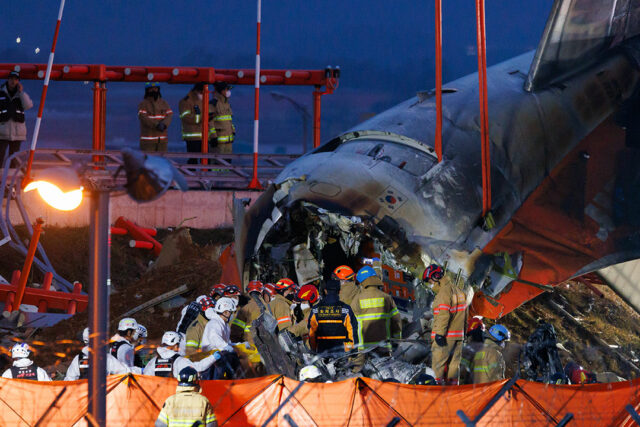
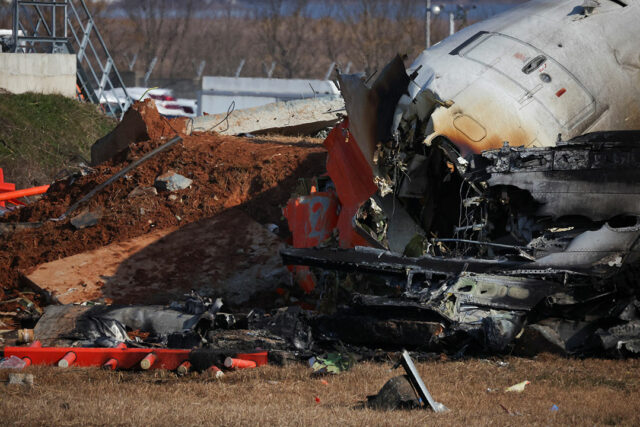
RESCUE WORKERS at the crash site at Muan International Airport on Dec. 29, 2024. — BLOOMBERG

INVESTIGATORS probing the cause of the worst civil aviation accident ever in South Korea will focus on a bird strike and the unusual landing-gear failure in the final moments of the fateful flight that left all but two of the 181 occupants of the Boeing Co. 737 jet dead.

The 737-800 aircraft operated by Jeju Air Co. crashed at Muan International Airport on Sunday morning, skidding along the runway on its belly before smashing into a wall, where it exploded into a ball of fire. Only a pair of flight attendants survived.

While the aircraft was almost entirely destroyed, investigators will have valuable data to work with as they reconstruct the event. One vital key will be a readout of the two flight recorders, which were already pulled from the wreckage, though one device is damaged and may need longer to analyze.

Then there’s footage showing the aircraft during approach with one engine apparently flaming out, alongside videos of the plane coming into the airport and sliding along the runway at high speed, appearing largely intact, before the impact with the embankment.

In another incident on Monday, a Jeju Air plane returned safely to South Korea’s Gimpo Airport after it was found to have a problem with the landing gear immediately after takeoff, Yonhap News reported. South Korean authorities will launch a special inspection into all of the 101 Boeing 737-800 planes operating in the country, while asking Boeing and the maker of the engine to join the investigation.

They will also probe other factors, such as whether the airliner’s personnel followed safety manuals properly, the airport’s measures to prevent bird strikes and if the plane’s power system was shut down before the crash, transport ministry officials said at a briefing Monday.

They will also look into whether the so-called localizer, an instrument set to guide the landing of the plane, had any relevance to the crash.

Shares of Jeju Air declined as much as 16% to a record low in Seoul trading on Monday, while parent AK Holdings, Inc. fell 12%.

The accident poses several unusual mysteries, and investigators have said it’s too soon to speculate what may have caused the crash. Mid-air bird strikes are rare but not entirely uncommon and seldom deadly because aircraft can operate on one engine for some time. Why the landing gear didn’t deploy also remains unclear, or indeed if there’s a link between that malfunction and the bird strike that was discussed between the cockpit and control tower just before the landing.

The pilot, considered an experienced captain with close to 7,000 hours of active duty, issued a mayday emergency call minutes after the control tower warned of a bird strike. He aborted his first landing, started a go-around and switched direction on the runway in his second attempt. The control tower granted clearance to land in the opposite direction, and officials said it’s unlikely that the runway length caused the crash.

The pilot didn’t seem to have sufficient time to try alternative measures such as dumping fuel, a transport ministry official said at Monday’s briefing.

The Boeing 737 involved in the crash is a predecessor to the latest Max variant. It’s considered a reliable workhorse that passed routine maintenance checks, in a country with deep expertise for aircraft servicing. Around the world, there are more than 4,000 planes of this type in service.

Even if one of the black boxes was damaged in the crash, the data storage units can often be reconstructed to aid the investigation. The fortified devices contain vital statistics and performance metrics of a flight, as well as taped conversations and sounds from the cockpit.

Muan’s control tower warned of the risk of a bird strike at 8:57 a.m. local time, about two minutes before the pilot declared an emergency, officials said. The airport had four staffers working to prevent bird strikes at the time of the crash, including one outside the tower.

Birds are an aviation hazard because they can be ingested into the turbine or damage other parts of the plane and cause engine failure. In 2009, an Airbus A320 landed in the Hudson River in New York after a bird strike damaged both engines, in what has become known as the “Miracle on the Hudson” because everyone on board survived.

Jeju Air’s 15-year-old plane, registered HL8088, entered service with the carrier in 2017. It was initially delivered in 2009 to Irish discount airline Ryanair Holdings Plc, according to the Planespotters.net database. The jet was configured to seat as many as 189 passengers. Founded in 2005, Jeju Air operates 42 aircraft, according to its website.

There was no sign of malfunction during regular maintenance checks, Jeju Air Chief Executive Officer Kim E-Bae said at a news briefing. The jet was returning from Bangkok — a 4 1/2 hour flight. The plane, which YTN said had been chartered by a local travel agency for a Christmas holiday trip, earlier left Muan for the Thai capital on Saturday evening.

Muan is a small regional airport located in the country’s south that opened in 2007. It was built to help connect cities including Gwangju and Mokpo and increased its regular service of international flights this year, including those of Jeju Air.

The two surviving flight attendants were taken to the hospital, and one of the two survivors is in the intensive care unit with a thoracic spine fracture, the doctor at the hospital said in a press briefing.

Boeing said it’s in contact with Jeju Air and ready to offer support. Aircraft manufacturers typically send specialists to crash sites to aid an investigation. Recovery of the victims, some of whom were ejected from the aircraft after the impact, has been completed and salvage crews are now searching the wreckage for passengers’ belongings, Yonhap said.

More than 1,500 people including police, military, coast guard and local government personnel are assisting at the crash site, the Ministry of Land, Infrastructure and Transport said. The airport’s runway will remain closed in the coming days.

The accident is the deadliest passenger airline disaster in South Korea, surpassing an Air China plane crash near Busan in 2002 that killed 129 people, according to the Aviation Safety Network. The crash is also among the worst globally this decade.

South Korea is currently experiencing a deepening political crisis after its president provoked public outrage by briefly imposing martial law earlier this month. Acting President Choi Sang-mok declared a week of mourning.

The crash is the second major air disaster in less than a week. An incident in Russian airspace led to the crash of an Azerbaijan Airlines passenger aircraft on Dec. 25, killing dozens.

After a year of not a single fatal accident among the 37 million commercial aircraft movements in 2023, this year has seen a rising number of cases. Early in January, an approaching Japan Airlines Co. Airbus A350 crashed into a small plane on a runway in Tokyo, killing five occupants in the stationary aircraft.

A few days later, a door plug blew out of an airborne Boeing 737 Max 9 flying in the US. Though nobody was killed in that accident, the episode threw the US planemaker into deep crisis because it exposed sloppy workmanship at the company.

In August, a smaller ATR turboprop plane operated by Brazil’s VoePass crashed near Sao Paulo’s Guarulhos International Airport, killing 58 passengers and four crew members. — Bloomberg

Lottery’s $1.26-B winner will need tax attorney, therapist

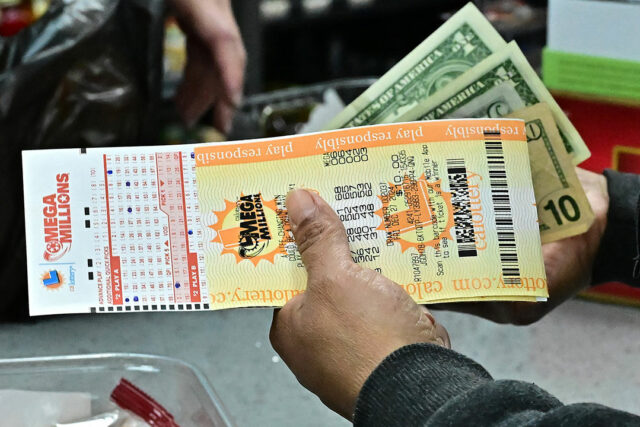
A customer purchases a lottery ticket for the Mega Millions lottery from a store in Hawthorne, California, on Dec. 27. — FREDERIC J. BROWN/AFP/GETTY IMAGES VIA BLOOMBERG

FOR THE WINNER of a $1.26-billion Mega Millions jackpot ticket sold in California, the ecstasy of the big win may soon give way to the anxiety over some big choices.

“This is a life-changing moment and they don’t need to make every decision right away,” said Matthew Liebman, chief executive officer and founding partner of Amplius Wealth Advisors.

Mr. Liebman’s first advice was to build strong relationships with four different advisers: a wealth adviser, a tax accountant, an estate attorney and a therapist before making any decision about payout.

Friday’s jackpot was the fifth-largest Mega Millions prize in US history and the winning ticket was sold at Sunshine Food and Gas in Cottonwood, a census designated area with a population of about 6,000 people, in Shasta County, about 150 miles (241.4 kilometers) north of Sacramento. The identity of the winner (or winners) wasn’t immediately known.

While most lottery grand prize winners typically chose the cash payout, which in this case will be about $571.9 million, financial planners still say there’s reason to opt for the annuity — distributed over 30 annual payments.

“The annuity typically is a bigger payout,” said Anthony Love, managing director of tax and trust at Quotient Wealth Partners. If the winner is young and healthy, it’s probably a better option, he advised. Those who take the annuity can also avoid the potential pitfall of watching their earnings evaporate through bad investments or other financial decisions.

If the winner is older, the lump sum may be the better choice, Mr. Love said. “If you accept the lump sum, you get all the money at one time, you get to invest the money however you want it to be invested, and you’re paying tax at a time where the effective tax rate is the lowest in a generation,” he said.

Massive lottery prizes in the US have become increasingly common in recent years, attributed to changes in game rules and higher ticket prices. Since 2016, more than 10 jackpots have exceeded $1 billion, including three in 2024 alone.

Billionaire Mark Cuban has also had some well-considered advice for lottery winners. He told the Dallas Morning News in 2016 that winners should hire a tax attorney, avoid taking the lump sum and say no to friends and relatives who ask for money. Having a lot of money won’t instantly make you a good investor, so winners should also put money in the bank and keep it safe, he said.

Mr. Liebman, of Amplius Wealth Advisors, also advised the winning ticket holder to take a deep breath.

“I say that seriously because, from what I have understood from past lottery winners, is that it can be a big strain on their mental health,” he said.

The last Mega Millions jackpot win happened in September, when a ticket claimed an $810-million prize. The record-setting Mega Millions jackpot of $1.58 billion was won in Florida in August 2023. Only three larger jackpots, all from Powerball, have surpassed that amount. — Bloomberg

Finland finds drag marks on Baltic seabed after cable damage

FINLAND’s flag is seen on a ferry in Helsinki, June 20, 2023. — BW FILE PHOTO

OSLO — Finnish police said on Sunday they had found tracks that drag on for dozens of kilometers along the bottom of the Baltic Sea where a tanker carrying Russian oil is suspected of breaking a power line and four telecoms cables with its anchor.

The Cook Islands-registered Eagle S was boarded by Finnish police and coast guard officials on Thursday and sailed into Finnish waters where the crew of the impounded tanker is being questioned.

Baltic Sea nations have been on high alert after a string of outages of power cables, telecom links and gas pipelines since Russia invaded Ukraine in 2022. The North Atlantic Treaty Organization said on Friday it would boost its presence in the region.

A break in the 658 megawatt (MW) Estlink 2 power cable between Finland and Estonia occurred at midday on Wednesday, leaving only the 358 MW Estlink 1 linking the two countries, grid operators said. They said Estlink 2 might not be back in service before August.

Finnish police suspect the Eagle S caused the damage by dragging its anchor along the seabed.

Investigators have identified a “dragging track” but have yet to find a missing anchor, Sami Paila, tactical leader and detective chief inspector of Finland’s National Bureau of Investigation, said in a statement.

“The track is dozens of kilometers in length,” Mr. Paila said.

Photos taken of the Eagle S on Friday showed the vessel missing its port side anchor.

Finland’s customs service believes the ship is part of a “shadow fleet” of aging tankers being used to evade sanctions on exports of Russian oil.

The Kremlin said on Friday that Finland’s seizure of the ship was of little concern to it.

Russia has denied involvement in any of the previous Baltic infrastructure damage incidents. — Reuters

South Korea investigators request arrest warrant for Yoon over martial law

YOUTUBE.COM

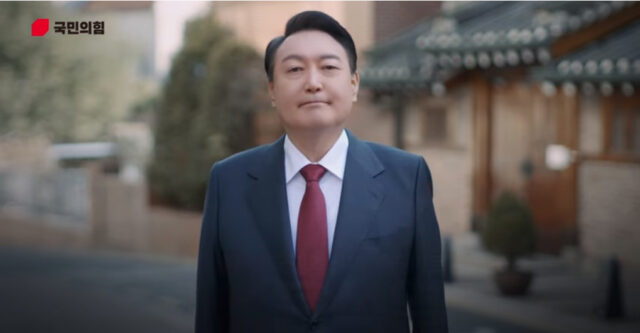
SEOUL — South Korean investigators have sought an arrest warrant for suspended President Yoon Suk Yeol over this month’s short-lived imposition of martial law, an official said on Monday, the first time an incumbent president has faced such action.

Mr. Yoon has failed to respond to a summons for questioning by police and the Corruption Investigation Office for High-ranking Officials who are jointly investigating whether his Dec. 3 martial law declaration amounted to insurrection.

Police have tried but failed to successfully raid the presidential office as part of the investigation.

A Seoul court will decide whether to issue an arrest warrant following the request.

Insurrection is one of the few charges for which a South Korean president does not have immunity.

Yoon Kab-keun, a lawyer for the suspended president, said the arrest request was “unfair” and the anti-corruption agency has no authority to do so.

“Emergency martial law is within the president’s authority,” the lawyer told reporters outside the Seoul Western District Court after submitting a written opinion about the arrest warrant request as well as a letter of appointment of lawyers.

Mr. Yoon was suspended from presidential powers after being impeached by parliament over his decision to briefly impose martial law.

Masked martial law troops equipped with rifles, body armor and night-vision equipment entered the parliament where they faced off with staffers who opposed them with fire extinguishers.

The decree lasted just hours until the parliament voted it down and Mr. Yoon backed down.

The move shocked the nation, which has been a democracy since the 1980s, and caused international alarm among allies like the United States and trading partners with Asia’s 4th largest economy.

A Constitutional Court trial has commenced into whether to reinstate Mr. Yoon or remove him permanently from office. It has 180 days to reach a decision. — Reuters

China’s December manufacturing activity seen expanding for third month — Reuters poll

REUTERS

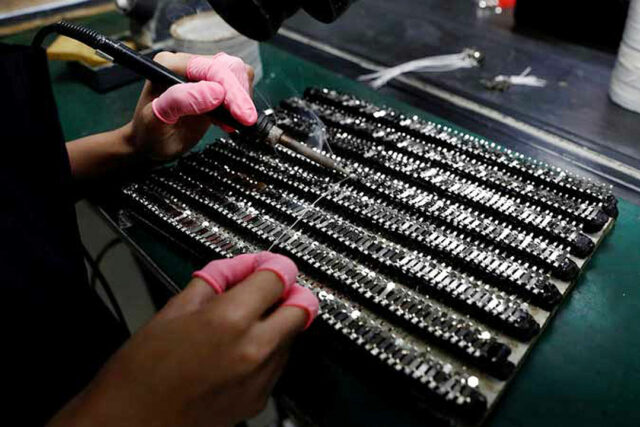
BEIJING — China’s factory activity likely expanded for a third straight month in December, offering a glimmer of optimism to officials trying to steady the world’s No. 2 economy as they brace for further US trade tariffs under a second Trump administration.

A Reuters poll of 28 economists forecast the official purchasing managers’ index (PMI) would remain at 50.3, matching November’s reading and staying above the 50-point threshold that separates growth from contraction in activity.

China’s leaders are hoping policy support measures late this year will bolster the struggling property market, which significantly impact domestic demand.

This move could benefit manufacturers amid a global economic slowdown, reducing their exposure to US President-elect Donald J. Trump’s threat of additional tariffs on Chinese goods.

Mixed industrial output and retail sales data for November released earlier this month underscores how challenging it will be for Beijing to mount a durable economic recovery heading into 2025. Government advisers are recommending that the $19 trillion economy maintain a growth target of around 5% next year and that policymakers ramp up consumer-focused stimulus.

Mr. Trump has vowed to impose a 10% tariff on Chinese goods to compel Beijing to halt the trafficking of Chinese-made chemicals used in fentanyl production. He also threatened tariffs in excess of 60% on Chinese goods during his campaign, posing a major growth risk for the world’s top exporter of goods.

At an agenda-setting meeting earlier this month, policymakers pledged to increase the budget deficit, issue more debt and loosen monetary policy to support economic growth.

The World Bank last week raised its growth forecasts for China for 2024 and 2025, but warned that subdued household and business confidence, along with headwinds in the property sector, would weigh on economic growth next year.

Stabilizing the property sector, which at its peak in 2021 accounted for around a quarter of the economy and where 70% of household savings are parked, is critical for Beijing to revive domestic consumption and improve sentiment among factory owners.

Analysts polled by Reuters forecast the private sector Caixin PMI at 51.7. The data will be released on Thursday. Reuters

Japan’s factory activity shrinks at slower pace, PMI shows

REUTERS

TOKYO — Japan’s factory activity shrank at a slower pace in December as declines in production and new orders eased, a private-sector survey showed on Monday, edging closer to stabilization after recent falls.

The final au Jibun Bank Japan manufacturing purchasing managers’ index (PMI) rose to 49.6 in December, indicating the softest contraction in three months. The index was slightly higher than 49.5 in the flash reading and 49.0 in November but stayed below the 50.0 threshold that separates growth from contraction for the sixth straight month.

“The headline reading moved closer to neutrality amid softer reductions in both production and new order intakes,” said Usamah Bhatti at S&P Global Market Intelligence, which compiled the survey.

The subindex of production shrank for a fourth straight month in December but the contraction was also slower than last month. Manufacturers noted that subdued new orders were the main factor behind the decline in output.

New orders contracted for the 19th straight month on subdued demand in both domestic and key overseas markets. Some firms in the survey suggested the semiconductor market was behind the weakness in new orders.

Employment expanded in December, reversing its fall in November, to reach its highest level since April. Firms in the survey said they hired more workers due to labor shortages as well as in preparation for future demand.

Input prices grew at the strongest pace since August, with firms citing higher costs of raw materials and labor. The weak yen also boosted inflation. To cope with rising prices, firms raised their output prices at the fastest rate in five months.

Manufacturers stayed confident about their outlook as they expect business to expand thanks to the launch and mass production of new products. Reuters

Fiery plane crash kills 179 in worst airline disaster in South Korea

RESCUE WORKERS take part in a salvage operation at the site where an aircraft crashed after it went off the runway at Muan International Airport in Muan, South Korea, Dec. 29, 2024. — REUTERS

MUAN COUNTY, South Korea (UPDATE) — The deadliest air accident ever in South Korea killed 179 people on Sunday, when an airliner belly-landed and skidded off the end of the runway, erupting in a fireball as it slammed into a wall at Muan International Airport.

Jeju Air flight 7C2216, arriving from the Thai capital Bangkok with 175 passengers and six crew on board, was trying to land shortly after 9 a.m. (0000 GMT) at the airport in the south of the country, South Korea’s transport ministry said.

Two crew members survived and were being treated for injuries.

The deadliest air accident on South Korean soil was also the worst involving a South Korean airline in nearly three decades, the transport ministry said.

The twin-engine Boeing 737-800 was seen in local media video skidding down the runway with no visible landing gear before crashing into navigation equipment and a wall in an explosion of flames and debris.

“Only the tail part retains a little bit of shape, and the rest of (the plane) looks almost impossible to recognise,” Muan fire chief Lee Jung-hyun told a press briefing.

The two crew members, a man and a woman, were rescued from the tail section of the burning plane, Lee said. They were being treated at hospitals with medium to severe injuries, said the head of the local public health centre.

Investigators are examining bird strikes and weather conditions as possible factors, Lee said. Yonhap news agency cited airport authorities as saying such a strike may have caused the landing gear to malfunction.

The crash was the worst for any South Korean airline since a 1997 Korean Air crash in Guam that killed more than 200 people, transportation ministry data showed. The previous worst on South Korean soil was an Air China crash that killed 129 in 2002.

Experts said the bird strike report and the way the aircraft attempted to land raised more questions than answers.

“At this point there are a lot more questions than we have answers. Why was the plane going so fast? Why were the flaps not open? Why was the landing gear not down?,” said Gregory Alegi, an aviation expert and former teacher at Italy’s air force academy.

Under global aviation rules, South Korea will lead a civil investigation into the crash and automatically involve the National Transportation Safety Board (NTSB) in the United States where the plane was designed and built.

The NTSB said later it was leading a team of U.S. investigators to help South Korea’s aviation authority. Boeing and the Federal Aviation Administration were also taking part.

‘MY LAST WORDS’
Hours after the crash, family members gathered in the airport’s arrival area, some crying and hugging as Red Cross volunteers handed out blankets.

Many victims appeared to be residents of nearby areas returning from vacation, officials said.

Family members screamed and wept as a medic announced the names of victims identified by their fingerprints.

One relative stood at a microphone to ask for more information from authorities. “My older brother died and I don’t know what’s going on,” he said.

Mortuary vehicles lined up outside to take bodies away, and authorities said a temporary morgue had been established.

A transport ministry official said the control tower had issued a bird strike warning and shortly after the pilots declared mayday and then attempted to land from the opposite direction the plane had come in.

A passenger texted a relative to say a bird was stuck in the wing, the News1 agency reported. The person’s final message was, “Should I say my last words?”

Jeon Je-young, the 71-year-old father of one woman on board, played and replayed a video of the crash.

“When I saw the accident video, the plane seemed out of control,” said Jeon.

“The pilots probably had no choice but to do it. My daughter, who is only in her mid-40s, ended up like this. This is unbelievable,” he said. “She was almost home.”

The Boeing model involved in the crash, a 737-800, is one of the world’s most flown airliners with a generally strong safety record. It was developed well before the MAX variant involved in a recent Boeing safety crisis.

The aircraft was manufactured in 2009, the transport ministry said.

Boeing said in a emailed statement, “We are in contact with Jeju Air regarding flight 2216 and stand ready to support them. We extend our deepest condolences to the families who lost loved ones, and our thoughts remain with the passengers and crew.”

The two CFM56-7B26 engines were manufactured by CFM International, a joint venture between GE Aerospace GE.N and France’s Safran SAF.PA, the transport ministry said.

A CFM spokesperson said, “We are deeply saddened by the loss of Jeju Air flight 2216. We extend our heartfelt sympathies to the families and loved ones of those on board.”

CHALLENGE TO COUNTRY’S NEW INTERIM PRESIDENT
Jeju Air CEO Kim E-bae apologised for the accident, bowing deeply during a televised briefing.

He said the aircraft had no record of accidents and there were no early signs of malfunction. The airline will cooperate with investigators and make supporting the bereaved its top priority, Kim said.

No abnormal conditions were reported when the aircraft left Bangkok’s Suvarnabhumi Airport, said Kerati Kijmanawat, president of Airports of Thailand.

The passengers included two Thai nationals and the rest are believed to be South Koreans, according to the transportation ministry.

It was the first fatal flight for Jeju Air, a low-cost airline founded in 2005 that ranks behind Korean Air Lines and Asiana Airlines as the country’s third largest carrier by passenger numbers.

The accident happened only three weeks after Jeju Air started regular flights from Muan to Bangkok and other Asian cities on Dec. 8.

Muan International is one of South Korea’s smallest airports but it has become much busier in recent years. All domestic and international flights at the airport were cancelled after the accident, Yonhap reported.

South Korean acting President Choi Sang-mok, named interim leader of the country on Friday in an ongoing political crisis, arrived at the scene of the accident and said the government was putting all its resources into dealing with the crash.

Two Thai women were on the plane, aged 22 and 45, Thai government spokesperson Jirayu Houngsub said.

The Thai foreign ministry later confirmed both were among those killed. The embassy in Seoul was coordinating with the South Koreans and arranging for family members to travel from Thailand, the ministry said in a statement.

Thai Prime Minister Paetongtarn Shinawatra sent condolences to the families of the dead and injured in a post on X, saying she had instructed the foreign ministry to provide assistance. — Reuters

Turkey announces $14 billion regional development plan for Kurdish southeast

FREEPIK

 – Turkey announced on Sunday a $14 billion regional development plan that aims to reduce the economic gap between its mainly Kurdish southeast region and the rest of the country.

The announcement comes amid increased hopes for an end to a decades-long insurgency waged by the outlawed Kurdistan Workers Party (PKK) in southeast Turkey as well as the advent of a new leadership in neighboring Syria with cordial ties to Ankara.

The eastern and southeastern provinces of Turkey have long lagged behind other regions of the country in most economic indicators including gross domestic product (GDP) per capita, partly as a result of the insurgency.

Turkish Industry Minister Fatih Kacir told reporters in the southeastern city of Sanliurfa that the government would spend a total 496.2 billion lira ($14.15 billion) on 198 projects across the region in the period to 2028.

“With the implementation of the projects, we anticipate an additional 49,000 lira ($1,400) increase in annual income per capita in the region,” he added.

According to 2023 data, the per capita income of Sanliurfa stood at $4,971, well below the national average of $13,243.

Regarding the prospects for peace in southeast Turkey, two Turkish lawmakers met the PKK’s jailed leader Abdullah Ocalan on Saturday, the first such visit in a nearly a decade, and they quoted him as indicating he might be ready to call on the group’s militants to lay down their weapons.

The visit followed a call by a close ally of Turkish President Tayyip Erdogan on Ocalan to end the PKK’s 40-year insurgency, in which more than 40,000 people have been killed.

The conflict between the Turkish state and PKK, now centered on northern Iraq, was mainly focused in southeast Turkey in the past.

“Terrorism has caused great harm to eastern and southeastern regions of the country… A terror-free Turkey will create great benefit to the region,” Turkish Vice President Cevdet Yilmaz said on Sunday at the event in Sanliurfa.

Turkey and Western countries classify the PKK as a terrorist organization.

Yilmaz also referred to recent developments in Syria, where Islamist rebels backed by Turkey took power this month after the overthrow of President Bashar al-Assad and his flight to Russia.

“The opportunities that will come with the new era in Syria will increase the welfare of our entire country. Our southeastern region will benefit more from these developments,” Yilmaz said. – Reuters

South Korea orders air safety probe after the country’s worst crash kills 179

STOCK PHOTO | Image from Pixabay

 – South Korea’s acting President Choi Sang-mok on Monday ordered an emergency safety inspection of the country’s entire airline operation system as investigators worked to identify victims and find what caused the country’s deadliest air disaster.

The crash on Sunday killed 179 people when a Jeju Air jet belly-landed and skidded off the end of the runway, erupting in a fireball as it slammed into a wall at Muan International Airport. Two crew members were pulled out alive.

The top priority for now is identifying the victims, supporting their families and treating the two survivors, Choi told a disaster management meeting in Seoul.

“Even before the final results are out, we ask that officials transparently disclose the accident investigation process and promptly inform the bereaved families,” he said.

“As soon as the accident recovery is conducted, the Transport Ministry is requested to conduct an emergency safety inspection of the entire aircraft operation system to prevent recurrence of aircraft accidents,” he said.

Jeju Air flight 7C2216, arriving from the Thai capital Bangkok with 175 passengers and six crew on board, was trying to land shortly after 9 a.m. (0000 GMT) on Sunday at the airport in the south of the country.

Investigators are examining bird strikes and weather conditions as possible factors in the crash, fire officials have said. Experts say many questions remain, including why the twin-engine Boeing 737-800appeared to be travelling so fast and why its landing gear did not appear to be down when it skidded down the runway and into a wall.

The crash killed mostly local residents who were returning from holidays in Thailand, while two Thai nationals also died.

On Monday morning, investigators were trying to identify some of the last remaining victims, as anguished families waited inside the Muan airport terminal.

Park Han-shin, who lost his brother in the crash, said he was told by authorities that his brother had been identified but has not been able to see his body.

Park called on other victims’ families to unite in responding to the disaster and recovery efforts, citing a 2014 ferry sinking that killed more than 300 people. Prolonged efforts to identify the victims and cause of the sinking followed that disaster.

Emergency workers were sifting through wreckage that was nearly completely destroyed when the aircraft was engulfed in an explosion of flames and debris at the regional airport near the country’s winding western coastline.

Transportation ministry officials said the jet’s flight data recorder was recovered but appeared to have sustained some damage on the outside and it was not yet clear whether the data was sufficiently intact to be analyzed.

The Muan airport remains closed through Wednesday but the rest of the country’s international and regional airports including the main Incheon International Airport were operating as scheduled.

Shares of South Korean budget carrier Jeju Air hit their lowest level on record on Monday, trading as much as 15.7% lower.

Under global aviation rules, South Korea will lead a civil investigation into the crash and automatically involve the National Transportation Safety Board (NTSB) in the United States where the plane was designed and built.

The NTSB said it was leading a team of U.S. investigators to help South Korea’s aviation authority. Boeing and the Federal Aviation Administration were also taking part.

Choi, who was overseeing recovery efforts and the investigation, became acting leader just three days ago after the country’s president and prime minister were impeached over the imposition of a short-lived martial law. – Reuters