Home Blog Page 1772

EastWest Bank optimistic on net income, lending growth

PHILSTAR FILE PHOTO

EAST WEST Banking Corp. (EastWest Bank) is optimistic about its profit growth this year as it continues to expand its lending business.

“I think we will continue to do well. It’s the focus of the segment — industries and so on. I think we have a good strategy in place and we’re executing it quite well. And then, we’re getting more efficient. We’re trying to get more efficiency and digital capabilities. They’re all coming together… So, we’re optimistic, as always,” EastWest Bank Chief Executive Officer Jerry G. Ngo told reporters on the sidelines of an event last week.

However, it could be hard to top the strong earnings growth that the bank posted in 2024 due to base effects, he said. EastWest Bank’s net income rose by 25% to an all-time high of P7.6 billion last year.

“As you grow bigger, the base effect kicks in. So, we just need to be a bit more balanced in our outlook as we get bigger. But hopefully, we’ll also not just get the same trajectory, but also become more efficient [so that the] underlying performance is better — changing the way we do things,” Mr. Ngo said.

The Gotianun-led bank expects continued lending growth as it expands into various market segments as seen in its recent rollout of co-branded credit cards, with the latest being one in partnership with listed retailer Puregold Price Club, Inc.

“We’re starting to get more collaborations… Hopefully we’ll be doing more,” Mr. Ngo said. “But the loan growth is already fairly large. Again, we need to do more. I’m hoping it has a big impact.”

Potential rate cuts from the central bank could also support overall loan growth, he added.

“Personally, I wish for them to cut because it’s really helpful from a lending perspective. It’s all about the financing cost. [Lower] financing cost creates access to financing. Access to financing leads to consumption. Consumption leads to economic activity, which is what we really need at this point in time,” Mr. Ngo said.

A BusinessWorld poll conducted last week showed that all 17 analysts surveyed expect the Monetary Board to reduce its target reverse repurchase rate by 25 basis points (bps) to 5.5% at its April 10 meeting.

This would mark its first easing move since December and after the Bangko Sentral ng Pilipinas unexpectedly kept benchmark interest rates steady in February to assess the potential impact of the Trump administration’s evolving policies on the Philippine economy.

The Monetary Board has brought down borrowing costs by a cumulative 75 bps since it began its easing cycle in August last year. — Aaron Michael C. Sy

Dining In/Out (04/10/25)


Easter at Solaire Resort North

SOLAIRE Resort North is celebrating Easter for the first time. Start off with an Easter Egg Hunt at the Kids Club where each egg found holds a bounty of prizes. Hunt for eggs from 9 a.m. to 9 p.m. on April 20 to get a chance at winning exclusive vouchers to spend time at selected Solaire Resort North outlets. Relish Easter feasts at FRESH International Buffet, Lucky Noodles, and Manyaman for seafood galore, and for a more elevated celebration, savor in a succulent Easter Sunday brunch with Finestra and Yakumi. For inquiries, visit the Solaire Resort North website at sn.solaireresort.com/offers/rooms-suites/easter-family-fun-escape, or contact 8888-8888 or via e-mail at sn.reservations@solaireresort.com.


Easter down south at Solaire Resort Entertainment City

SOLAIRE Resort Entertainment City offers adventurous and exciting Easter Sunday celebrations for the entire family on April 20. The day starts with a Sunday mass at 10 a.m. in the Grand Ballroom followed by a range of interactive activities like luxurious brunch buffets, Easter egg hunts, bunny hopscotch races, face painting, and egg decorating. Earn special discounts and Easter goodie bags when you accomplish all activities with the family. The Grand Ballroom holds Easter egg hunting for all ages and bouncy inflatables to enjoy. At the Sky Tower area, kids can pick their own eggs to decorate at Waterside, complete a carrot toss at Oasis, and hop through Easter-patterned squares for a fun hopscotch activity at Fresh. At the Theatre Café, kids can enjoy cookies and cupcake decorating, face painting, balloon sculpting, and enhance their creativity through a coloring mural. You might just also catch the Easter Bunny hopping around. Indulge in an Easter brunch buffet at Finestra, Red Lantern, and Yakumi. Finestra offers casatiello, a ham and cheese savory cake together with herbs risotto, poached salmon, and chocolate eggs. Enjoy unlimited flutes of champagne, a seafood tower served directly at your table, a cold cuts station, a roast beef station by the kitchen counter, and luxurious desserts from a rich mille-feuille, macarons, tartalettes, homemade gelato. Eat all you can at Red Lantern with a dim sum buffet featuring crystal skin lobster dumplings, crispy deep-fried cheese and prawn spring rolls, baked signature black pepper wagyu beef tart, steamed Teochew dumpling, and more. At Yakumi, prepare for a sumptuous feast with eight live stations to choose from. Seafood lovers can enjoy grilled Boston lobster, scallops, blue marlin, prawns, and mackerel in the teppanyaki live station. You can also choose from a fine selection of meats like Kinross lamb chops, US ribeye steak, and Japanese sausage. For an Easter-inspired afternoon tea, delight in a wide array of tea sandwiches, delectable pastries and freshly baked scones at Oasis Garden Café. These include a savory chorizo and egg mousse tea sandwich, an orange cinnamon sable, Cheshire Pork Pie with glazed apple, and more. Enjoy it all with a pot of tea, an Easter-inspired mocktail or sparkling wine, and freshly brewed coffee. For inquiries, call 8888-8888 or e-mail reservations@solaireresort.com.


Blast off for Easter at Lanson

LANSON PLACE Mall of Asia invites families and travelers to embark on an interstellar Easter escapade with the Eggs-tronaut Easter Egg Hunt Adventure, an exclusive Holy Week Room Offer, and a cosmic Cyan Easter Lunch Buffet. The centerpiece of the celebration is the Cyan Easter Lunch Buffet on April 20, priced at P3,000 net per person. Families will appreciate exclusive discounts: children aged 0 to five dine for free, while kids aged six to 12 enjoy a 50% discount. As a special treat, one child receives a complimentary Easter Egg Hunt pass for every two full-paying adults, granting access to the Eggs-tronaut Easter Egg Hunt Adventure. The Eggs-tronaut Easter Egg Hunt Adventure will be a galactic journey filled with interactive activities, surprises, and cosmic-themed fun. While kids embark on their Easter space mission, adults can enjoy the exquisite dining offerings at Cyan Modern Kitchen. For guests who wish to attend the Easter event only, tickets are available for P1,800 net per person. For inquiries, visit https://lansonplace.com/mallofasia, e-mail reservations.lpmn@lansonplace.com, or contact 7777-0000.


The Plaza offers Easter treats

CELEBRATE Easter with a spread from The Plaza (aka one of the sources for prime Christmas ham). The Easter Special Bundle has The Plaza Premium Baked Ham (3.15 kilogram), two dozen pan de sal with Premium Glaze, with choice of one sauce (Gutsy Garlic, Sweet Mustard, or Wasabi Mayo), one tray of pasta (Spaghetti Puttanesca, Arrabiata, Bolognese, Carbonara, or Baked Macaroni), at P10,000. Order through https://theplazacatering.com/.


Jollibee helps out on Visita Iglesia

FOR THOSE observing Lenten traditions, Jollibee makes it easy to enjoy a meat-free option with its Tuna Pie with Fries & Drink for P145 (Save P12). Plus, consumers can access Jollibee’s Visita Iglesia Digital Map featuring recommended and notable churches. “Summer is all about creating fun-filled moments with family and friends, and we at Jollibee want to make those experiences even more special,” said Eloise Siccion, assistant vice-president and head of trade marketing group at Jollibee Philippines. “With the Summer Saya Treats, we’re bringing extra saya with sulit promos and exclusive treats that perfectly complement all your summer adventures,” she added. For more updates, follow @Jollibee on Facebook, Instagram, TikTok, and X, or visit https://www.jollibee.com.ph/.


Pizza Hut serves up something fishy

PIZZA HUT has whipped up a brand-new pizza creation that features the savory sweetness of kani complemented by a blend of fresh vegetables and a rich and creamy sauce, available for a limited time only. Savor the new Kreamy Kani Supreme Pizza (starts at P559 for Regular), made with premium kani chunks, green bell peppers, white onion, black olives, mushrooms, and creamy kani balls, all resting on a bed of creamy garlic sauce and mozzarella cheese, which is then drizzled with sweet chili sauce. You’ll also have the option to upgrade your regular Pan Pizza crust to the new Cheesy Kani Stuffed Crust. Watch out for these Kreamy Treat Combos, with three options to choose from: First, there’s the new Kreamy Treat for 2, priced at P899, with one Regular Kreamy Kani Supreme Pizza, one Regular Pasta (Four Cheese Baked Mac or Baked Tomato Cream), a side of Shrimp Poppers, and two servings of ice-cold Pepsi. There’s also the new Kreamy Treat for 4, priced at P1599, with one Large Kreamy Kani Supreme Pizza, one Large Pasta (Four Cheese Baked Mac or Baked Tomato Cream), a side of Shrimp Poppers, Mozzarella Sticks, and one Pepsi pitcher. Finally, there’s the new Kreamy Pizza Duo, priced at P799 for Regular and P1199 for Large, where you’ll get to pair your Kreamy Kani Supreme Pizza with either a Cheese Lovers or a Veggie Lovers Pan pizza. All Kreamy Kani Supreme Pizzas in the combos come with Cheesy Kani Stuffed Crust. Try these new offerings by visiting your nearest Pizza Hut store for dine-in and take-out orders. You can also order for delivery via the 8911-1111 hotline, www.pizzahut.com, or the Pizza Hut mobile app, available for Android and iOS devices; or through Pizza Hut’s official delivery partners GrabFood and Foodpanda.


Araneta City releases Lenten schedule

CHURCHGOERS are invited to attend the Eucharistic celebrations at the Sagrada Familia Church and Araneta City chapels on Palm Sunday, April 13. The malls in Araneta City, including Gateway Mall 1, Gateway Mall 2, Ali Mall, and Farmers Plaza, will remain open on most days during Holy Week. On April 14 to 16, (Holy Monday to Holy Wednesday), malls are open from 10 a.m. to 9 p.m. Malls will be closed on April 17 and 18 (Maundy Thursday and Good Friday), including the Sagrada Familia Church. The malls will reopen on April 19 (Black Saturday) from 10 a.m. to 10 p.m. On April 20 (Easter Sunday) malls will be open from 10 a.m. to 9 p.m. The Stations of the Cross will be on display for viewing at the Sensory Garden (outside Sagrada Familia Church) from April 11 to 20, except on April 17 and 18 (Maundy Thursday and Good Friday). Farmers Market remains operational on Holy Week. Normal operating hours will be in effect to provide fresh produce to patrons even during holidays. Expect some of the shops and tenants to be closed on April 17 and 18, Maundy Thursday and Good Friday.

Rethinking jeepney modernization

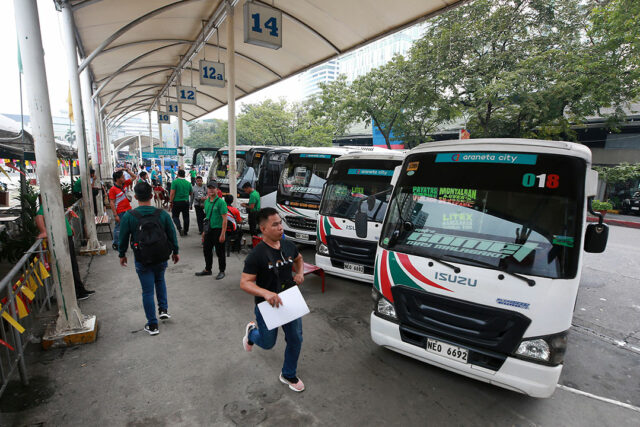
PHILIPPINE STAR/ MIGUEL DE GUZMAN

The government vows to proceed — even at a slower pace — with its long-standing plan to modernize public utility vehicles, particularly jeepneys, to ensure they are roadworthy and up to standard. The plan requires drivers and operators to organize themselves into cooperatives or corporations to qualify for new route franchises.

This move comes even as the Supreme Court has yet to decide on the petition filed by transport operators against the jeepney modernization program. At the center of the case is the required “consolidation” of operators. Drivers and operators argue that this process, if implemented now, will leave many routes unserved.

To date, the Land Transportation Franchising and Regulatory Board (LTFRB) continues to rationalize jeepney routes nationwide. These route plans will determine how many vehicles each route needs and who can get a franchise. Authorities say they aim to rationalize half of the routes by the end of 2025, with the remainder to be completed by the end of 2026.

The process is slow and tedious. It requires the Department of Transportation and the LTFRB — both operating with limited resources — to coordinate with local government units (LGU) nationwide. Together, they must identify viable routes and determine how many vehicles are needed for each.

Only after these new routes are established can the government award franchises. From there, cooperatives and corporations will have around two years to acquire modern vehicles that meet updated standards. All in all, it may take another four years before the public sees new jeepneys on the road.

In the meantime, several key issues remain unresolved. These include how cooperatives can raise enough capital to buy new units; how they can build operational capacity to maintain their fleets; and how they can fairly compensate, train and manage drivers.

In my opinion, the present-day jeepney is an outdated mode of transportation. It was born out of necessity after World War II, when surplus military jeeps were repurposed for mass transit. Eight decades later, that same basic design still dominates our roads as the most common form of public transport.

It is also a fact that small, less-capitalized operators can’t afford to replace their old vehicles, even if they form cooperatives. To be blunt, even after pooling resources, they still lack the capital to build a modern fleet. This, to me, is the crux of the issue.

The high cost of modern jeepneys becomes a “barrier to entry” that excludes poorer operators and favors wealthier ones. As a result, consolidation risks becoming a backdoor for larger corporations to monopolize the jeepney industry under the guise of modernization.

That said, I also believe that any group involved in delivering a vital public service should be financially sound enough to ensure that the service they provide is comfortable, efficient, safe and dignified. The public deserves nothing less, and the government should not settle for anything less.

Commuters deserve a modern, professionalized jeepney industry — one in which drivers earn decent salaries, operators pay the proper taxes and fees and profits are reinvested to improve services.

To achieve this, Congress should consider devolving certain powers to LGUs. There may be a way to empower local governments to take a more direct role in modernizing public transport in their own territories.

Currently, LGUs are already involved in planning local routes, with the LTFRB coordinating and issuing franchises. One idea is to allow LGUs to issue franchises for jeepneys operating exclusively within their jurisdictions — much like they already do with tricycles. The National Government would retain oversight and ensure inter-LGU coordination.

The aim is to make public transport more inclusive, efficient and responsive to the needs of local communities. In this context, we can imagine a tiered system: larger jeepneys or minibuses with LTFRB-issued franchises running inter-city routes along national roads, while smaller, electric jeepneys operate shorter, purely local routes within an LGU.

Local routes make particular sense for electric shuttles, which often have limited range. These routes should still be coordinated with the LTFRB but franchised locally — again, similar to how tricycles are regulated.

Under current law, LGUs have control over tricycle franchises, while jeepney and bus routes fall under the LTFRB. This one-size-fits-all system struggles to meet the diverse needs of cities and municipalities across the country. It creates the impression that centralized planning contributes to unnecessary bureaucratic delays.

We should redefine the LTFRB’s role — from micromanaging routes to enforcing standards. The LTFRB should become the national regulator and standard-setter, responsible for fare guidelines, vehicle specifications and safety regulations. Local route planning can be devolved to LGUs, who understand their own traffic flows and community needs.

This shift can begin as a pilot covering small, electric jeepneys for short-distance routes as supplements to the larger, national routes. LGUs can design and manage these local routes, subject to national standards and approval timelines set by the LTFRB.

The LTFRB would still ensure consistency and facilitate coordination across LGUs, but it would no longer dictate every route detail. This would free up central planners to focus on system-wide integration and allow LGUs to adapt faster to local changes — new roads, new neighborhoods or shifts in commuter demand.

An important part of this system is the establishment of “handoff points” or shared terminals at LGU borders. These would allow passengers to switch from local shuttles to inter-city transport modes. The network would remain interoperable and user-friendly, guided by national standards but managed locally.

In this model, LTFRB becomes a mediator and integrator. It sets unified national standards — for fares, payment systems and vehicle specs — and helps broker inter-LGU agreements. Together with agencies like the MMDA, it ensures seamless travel. A commuter could take a Makati-managed jeepney to the city border and easily transfer to a Quezon City-bound bus or rail line at a designated terminal.

Many LGUs already operate local shuttle services to and from city borders. While these programs remain limited in scope, they prove that cities can run effective transit systems that attract riders and reduce congestion. However, current law prohibits LGUs from operating fare-collecting transport routes. This needs to change.

One option is for the LTFRB to grant franchises to LGUs themselves, allowing them to operate local routes. These LGUs can then sub-franchise smaller routes to local cooperatives. In this scenario, the LGU maintains oversight and ensures service quality.

An LGU could choose to operate the system directly or contract local cooperatives to run day-to-day operations. If cooperatives are involved, LGUs can assist with financing — either by purchasing units outright or leasing them to operators. This addresses the capital shortfall among small operators. Cooperatives would function purely as operators, receiving a share of revenue rather than owning the vehicles.

It may seem like a long shot, but with proper planning and legislation, this approach can work. Congress must consider how to evolve the LTFRB’s role and how to legally empower LGUs to establish local routes and issue franchises — or to hold franchises themselves and contract operators.

Modernizing the jeepney industry is not just about replacing vehicles. It is about building a transport system that works — for commuters, for drivers and for cities. LGUs are closer to the ground and better positioned to lead this transformation. But they need the legal authority to act.


Marvin Tort is a former managing editor of BusinessWorld, and a former chairman of the Philippine Press Council

matort@yahoo.com

Our Home for Business sees growth potential in shifting consumer preferences

FURNITURE RETAILER Our Home is positioning its end-to-end furniture and fit-out solutions, branded as Our Home for Business, to capitalize on the growing demand from real estate developers responding to shifting consumer preferences.

“Given that the B2B (business-to-business) opportunity is substantial, we’re offering more than just convenience-based fit-outs; we provide a comprehensive, end-to-end experience for our corporate clients,” said Bo Evangelista, operations head at Our Home, in an interview with BusinessWorld last week.

Our Home for Business specializes in contract furniture and full-suite B2B services for companies looking to design commercial, residential, and hospitality properties.

The suite of complimentary services includes interior design consultation by in-house professionals, delivery and installation, floral arrangements, post-fit-out check-ins, and after-sales support.

Our Home for Business primarily serves residential rental properties, hotels and guesthouses, restaurants, cafés, office spaces, schools, and retail establishments.

Roy C. Tan, the company’s senior vice-president and business unit head, said Our Home for Business seeks to streamline the traditionally labor-intensive process of setting up physical spaces, from design to installation.

For example, a boutique hotel may have difficulty importing 50 dining or accent chairs, which would be costly if bought from boutique stores.

The company is capitalizing on the growing demand driven by property developments in the tourism, food and beverage, and residential sectors, it said.

“We are highly focused on growth this year. Our aim is to drive the business forward,” Mr. Tan noted.

Property developers and corporations are under pressure to meet the evolving demands in real estate, including flexible workspaces, sustainable design features, and experiential retail and hospitality properties.

“When we see an increase in luxury brands entering the market, it signals to us that there is an increasing demand for aspirational furniture and décor,” said Glowillyn Ramiro Robillo, Our Home’s senior associate vice-president for marketing. — Beatriz Marie D. Cruz

US Easter spending to rise as holiday cheer defies economic gloom

US CONSUMER spending for Easter is expected to rise about 5% this year as Americans snap up candy and gifts to celebrate despite concerns around high inflation and economic uncertainty, a National Retail Federation (NRF) report showed on Tuesday.

Shoppers are expected to spend around $23.6 billion this year, compared with $22.4 billion estimated last year, the trade body’s survey showed, with discount stores once again poised to be the top destination for Easter shopping.

Prices of eggs, traditionally used for Easter decor and games, have nearly doubled from last year as avian influenza wiped out millions of hens and led to a shortage of eggs in February.

Retail bellwether Walmart out eggs from its yearly Easter promotional meal kit, shared late last month at a lower price than 2024.

President Donald J. Trump’s sweeping tariffs on several trade partners have also raised fears of a recession, casting a pall on consumer sentiment in the United States.

However, retailers such as Target and dollar stores that enjoyed an upbeat December quarter thanks to robust Christmas spending have said consumers are expected to shop for Easter with similar interest.

“As we witnessed throughout the pandemic, holidays such as Easter are especially meaningful for Americans during times of uncertainty. And we are continuing to see that trend as consumers prioritize their Easter celebrations this year,” said Katherine Cullen, NRF vice-president of industry and consumer insights.

“From other holidays NRF tracks, we know that consumers who are feeling constrained by higher prices or the economy may cut back in other areas, look to sales or find less costly substitutes in order to preserve their traditional celebrations.”

NRF’s forecast said a majority of consumers were expected to shop inspired by tradition to buy Easter-related items, while 36% were also expected to be influenced by sales and promotions.

Candy, food and gifts are likely to be at the top of shopping lists this Easter, with consumers seen spending a total of $7.4 billion on food, $3.8 billion on gifts and $3.3 billion on candy, the report said. — Reuters

Europe wants to lighten AI compliance burden for startups

REUTERS

BRUSSELS — The European Commission plans to seek feedback to help lighten the regulatory burden for startups struggling to comply with European Union (EU) rules on the use of artificial intelligence (AI), according to a Commission document seen by Reuters.

The move is the latest by the EU executive to water down legislation enacted in recent years following complaints by businesses across Europe about the volume and cost of red tape hampering their operations.

“There is an opportunity to minimize the potential compliance burden of AI Act, particularly for smaller innovators,” said the document, the AI Continent Action Plan.

“The Commission aims to build on the first learnings from the current implementation phase and identify further measures that are needed to facilitate a smooth and simple application of the AI Act,” it said.

EU tech chief Henna Virkkunen was set to present the measure on Wednesday.

The 27-country European Union signed off the landmark AI Act last year, a more comprehensive rulebook than the United States’ light-touch voluntary compliance approach. China’s AI regulations aim to maintain social stability and state control.

The AI Act imposes strict transparency obligations on high-risk AI systems, while the requirements for general-purpose AI models are lighter. Reuters

PHL financial institutions’ trust assets grow to P7.4 trillion in 2024

ASSETS under management (AUMs) of Philippine financial institutions grew by 18.6% to P7.372 trillion in 2024 from P6.215 trillion in 2023, driven by nonbanks as several lenders spun off their trust operations, a report showed.

A report by Regis Partners, Inc. showed that the trust assets of banks and nonbanks also went up by 2.3% quarter on quarter.

“We continue to maintain that, given the size of the domestic AUMs, the Philippine equity market could easily be supported by a shift in AUMs back into local equities. Every 100-basis-point (bp) reallocation into the stock market would be $1.2 billion, in a market turning over barely $100 million a day,” Regis Partners Managing Director and Research Chief Strategist Rafael P. Garchitorena said in a research note on Tuesday.

Broken down, AUMs held within Philippine banks climbed by 6% year on year to P4.451 trillion, making up bulk of the end-2024 total.

Meanwhile, trust assets held by nonbanks surged by 44% to P2.921 trillion.

“This was partly due to two banks — RCBC (Rizal Commercial Banking Corp.) and UnionBank (Union Bank of the Philippines, Inc.) — that spun off their AUMs into “stand-alone trust” vehicles. Those two alone combined for about P300 billion or a third of the growth in nonbank AUMs,” Regis Partners said.

“We also saw a roughly P200-billion growth in AUMs of Sun Life (Sun Life of Canada (Philippines), Inc.), as the new rules allowed the assets of the insurance company to be managed by the trust entity.”

BDO Unibank, Inc. booked consolidated AUMs worth P2.305 trillion last year to top the list, up 15.8% year on year. The parent bank’s AUMs increased by 19.4% to P1.668 trillion, while its subsidiary BDO Private Bank Inc.’s trust assets rose by 7.5% to P638 billion.

This was followed by Bank of the Philippine Islands (BPI), whose assets under management jumped by 25.2% to P1.53 trillion last year, driven by BPI Wealth’s “aggressive push.”

Metropolitan Bank & Trust Co. (Metrobank) had the third-largest total AUMs at P581 billion, up by 16.8% annually.

“Other big movers include Security Bank Corp., which saw AUMs surge by 41.9% to P154 billion, and RCBC, whose AUMs were up 25% year on year to P195 billion,” Regis Partners added.

ATR Asset Management Group (ATRAM Group) also saw its trust assets rise by 15.8% year on year to P363 billion in 2024.

“This does not yet include the recently announced merger between ATRAM and Union Bank Trust. Based on the 2024 numbers, the combined entity would manage about P464 billion, closing the distance to Metrobank’s size,” it said.

Meanwhile, financial institutions’ average net fee incomes as a share of AUMs mostly went down last year, Regis Partners added.

“This to us is consistent with anecdotes that the fastest growing products in 2024 were either fixed income or money market, or foreign exchange-traded funds whose fees are shared with the white-labeled foreign asset manager.” — A.M.C. Sy

Asian Hospital, Inc. announces 2025 Annual Meeting of Stockholders to be conducted online on May 5


Spotlight is BusinessWorld’s sponsored section that allows advertisers to amplify their brand and connect with BusinessWorld’s audience by publishing their stories on the BusinessWorld Web site. For more information, send an email to online@bworldonline.com.

Join us on Viber at https://bit.ly/3hv6bLA to get more updates and subscribe to BusinessWorld’s titles and get exclusive content through www.bworld-x.com.

The Entrepreneur as problem-solver

TENT KING President and CEO Joey Espiritu at the 42nd Agora Awards. — THE 42ND AGORA AWARDS

RJ Ledesma shares the inspirational story of Joey Espiritu, the problem-solving entrepreneur behind Tent King, and a paragon for every entrepreneur.

A surprising number of entrepreneur origin stories are inspirational “zero to hero” stories. These entrepreneurs are often self-made business people who lifted themselves up by their own bootstraps to achieve phenomenal success. Joey Espiritu is one such inspirational hero of mine, transforming a seven-year-old balloon business into Tent King, a tent rental and sales company that serves the whole country, starting with just P3,000. However, what I find truly remarkable isn’t how he expanded his business into catering, chair rental and even food distribution and a tire company. Instead, it is how Joey approached each business as a problem-solver.

Solving pain points is something that aspiring entrepreneurs are taught to do in business school, but few entrepreneurs embody this spirit like Joey Espiritu. His growing empire of related businesses are all built on solving problems for his clients. And, what’s more, he takes this a step further. His greatest motivation as an entrepreneur is serving his employees.

I spoke with Joey Espiritu, who was recently recognized by the Philippine Marketing Association’s Agora Awards. In my conversation with him, he shares how he turned small-scale ideas into large, multi-faceted businesses. His entrepreneurial journey is defined by adaptability, resilience and a commitment to supporting his employees through challenging times. Here are four key business lessons from Joey that every entrepreneur needs to know.

1. ENTREPRENEURS ARE PROBLEM-SOLVERS
Joey’s first major business breakthrough came when a client, a catering company, asked him if he could supply them with tents. Instead of turning down the opportunity, he immediately purchased a tent.

Joey recounts: “My main objective this time is, how can I help this caterer to solve that pain point? So I said, let’s start, I’ll buy one tent. Then from one tent, it became two, three, four, five. Before, we were just in Tagaytay, but right now, we’re in Calabarzon, Metro Manila, Central Luzon, Northern Luzon and the Bicol region.”

This willingness to meet client demands became the foundation of Tent King’s success as the rental business grew to expand across Luzon, with Joey estimating having served 550 events just last December. And today, the company also sells tents across the country, even in the Visayas and Mindanao.

Joey’s example proves that entrepreneurs should be quick to identify and respond to customer needs, even if it requires venturing into new territory. This new territory quickly expanded into establishing new companies to solve his clients’ problems. He established For Rent (chair rental), Manang A (a catering company) and Tire Right (an on-demand tire replacement company initially established to serve his clients’ catering trucks).

2. RESILIENCE DURING CRISES
The growing success of Joey’s companies ground to a halt during the pandemic. And while Tent King received a lifeline selling isolation tents, the business still suffered, and Joey refused to let his employees lose their jobs.

Recognizing the trend of home baking during the pandemic, Joey sought distribution rights for essential products like M.Y. San Graham Crackers. With no FMCG background, he still pursued the opportunity and eventually secured exclusive distribution rights for NutriAsia and Monde Nissin in Southern Luzon.

This pivot proved to be critical in seeing his companies through the pandemic years. In his most desperate hour, Joey learned that in times of crisis, flexibility and resilience are essential. Entrepreneurs should constantly seek new revenue streams that align with current market demands.

3. EMPLOYEE-CENTRIC LEADERSHIP
Joey’s unwavering focus on his employees during the pandemic ensured their job security. He believed that while the pandemic would eventually end, the loyalty and trust he built with his team would have lasting benefits.

He says: “I committed myself that if I’ll be able to survive this, I’ll make sure that I’ll be helping more people as long as I can.”

This dedication to his employees has proven to be one of the cornerstones of Joey’s success. Prioritizing the well-being of employees fosters loyalty and strengthens the company’s foundation for long-term growth.

4. SAY YES TO OPPORTUNITY
Returning to solving pain points and problem-solving, Joey Espiritu’s business hustle reminds me of the advice shared with me by my business partner, Jose “Jomag” Magsaysay, the co-founder of Potato Corner. He said: “You say yes to opportunity, then you find out how to solve it.”

At the same time, Joey admits that saying yes to opportunity can be a challenge. He shares in Filipino: “I’m a caterer who doesn’t know how to cook, a tent supplier who doesn’t know how to make a tent. I’m a chair supplier, but I don’t know how to make a chair. I started an FMCG company, but I don’t know anything about FMCG. You know what? The way I do it is I will just try it. And then along the way, I’m going to learn it.”

Joey Espiritu’s entrepreneurial journey is a testament to the power of adaptability, customer-centric thinking and unwavering support for employees. His success with Tent King offers valuable insights for entrepreneurs aiming to grow and sustain their businesses, even in the face of unexpected challenges.


RJ Ledesma (www.rjledesma.com) is a Hall of Fame Awardee for Best Male Host at the Aliw Awards, a multi-awarded serial entrepreneur, motivational speaker, and business mentor, podcaster, an Honorary Consul, and editor-in-chief of The Business Manual. Mr. Ledesma can be found on LinkedIn, Facebook and Instagram.

The RJ Ledesma Podcast is available on Facebook, Spotify, Google and Apple Podcasts.

Let Mr. Ledesma know if there are other entrepreneurs you’d want him to interview by sending an e-mail to ledesma.rj@gmail.com.

Sustainability, flexibility key to addressing demand for quality office spaces in Metro Manila — experts

ROBINSONSLAND.COM

By Beatriz Marie D. Cruz, Reporter

OFFICE DEVELOPERS in Metro Manila are now adjusting to market changes by prioritizing sustainability and flexibility to meet the growing demand for modern, high-quality office spaces, according to industry leaders.

“As companies increasingly adopt a flight-to-quality approach — prioritizing well-designed, thoughtfully curated, and future-ready office spaces — Robinsons Offices remains committed to elevating its portfolio to meet and exceed these expectations,” Jericho P. Go, Robinsons Land Corp. (RLC) senior vice-president and Robinsons Offices general manager, said in an e-mail.

Office transactions in Metro Manila dropped by 57% year on year in the fourth quarter, driven by the impacts of the US presidential elections and the ban on Philippine offshore gaming operators, according to property consultancy firm Colliers Philippines.

With this, office developers are called to refurbish or reinstate their office spaces to increase their marketability, Colliers said in its latest property market report.

According to Mr. Go, the competitiveness of an office space is driven by several factors, including its location, accessibility, quality and reliability of design and equipment, developer reputation, availability of space, sustainability, and its registration in the Philippine Economic Zone Authority.

In response, Robinsons Offices continues to adopt sustainability practices in its developments, he added.

“Our commitment to sustainability is evident through various green features, such as green certifications (LEED or Leadership in Energy and Environmental Design and the EDGE or the Excellence in Design for Greater Efficiencies), solar panels, electric vehicle charging stations, and hydroponics,” Mr. Go said.

Demand for RLC’s office spaces is also driven by its proximity to malls, residential properties, and transportation hubs, Mr. Go said. It has also been renovating its office buildings aged 10 years and above to support old tenants while attracting new ones.

“By integrating cutting-edge advancements in building design, office layouts, and sustainable features, we ensure our developments remain competitive, modern, and conducive to productivity,” he added.

RLC has office buildings in Mandaluyong, Pasig, Makati, Taguig, and Quezon City.

NEO OFFICES
Meanwhile, office developer NEO leverages sustainability and tenants’ well-being to ensure the attractiveness of its seven certified green office buildings in Bonifacio Global City.

“We implement strict quality control measures and ensure compliance with safety standards, often exceeding building codes through third-party certifications,” Gie Garcia, co-managing director and chief sustainability officer at NEO, said in a separate text message.

After construction, NEO monitors its buildings and seeks tenant feedback,  to understand their need and requirements, Ms. Garcia added.

NEO also organizes activities focused on employees’ wellness and productivity. These include sportsfests, competitions, seminars, and workshops.

“By being creative and flexible, we work hard to provide the space solutions that tenants need and want. This has helped us achieve a market-leading vacancy of below 4% for our portfolio,” Raymond Rufino, chief executive officer of NEO, said in a text message.

Mr. Rufino said the office market in the Philippine capital is fueled by its labor pool and infrastructure.

“As long as we work alongside our fellow office owners and developers to deliver this consistently to tenants, demand for office space will continue to grow as companies scale and expand,” Mr. Rufino said.

Some US consumers stockpile goods ahead of Trump’s new tariffs

PUSHING a shopping cart down the aisle of a Walmart Supercenter, Thomas Jennings, 53, loaded up on juices, condiments and whatever he could think of.

“I’m buying double of whatever — beans, canned goods, flour, you name it,” he said. His strategy is to stock up as much as possible before the Trump administration’s latest round of import tariffs takes effect on Wednesday.

Earlier at Costco, Mr. Jennings bought flour, sugar and water in bulk. “There’s a recession coming and I am preparing for the worst,” he said.

Like a growing number of U.S. shoppers, Mr. Jennings believes retail prices will soon rise because of Trump’s tariffs. The Tax Foundation, a nonpartisan, nonprofit research group, said the new levies will cost Americans $3.1 trillion over the next 10 years, amounting to a roughly $2,100 tax increase per household in 2025 alone.

Even as many shoppers take a wait-and-see approach, some fear that any panic would trigger a stockpiling frenzy that intensifies on expectations of even worse inflation, they told Reuters.

Manish Kapoor, founder of GCG, a supply chain management firm outside Los Angeles, said the tariffs are reawakening fears of empty store shelves encountered during the pandemic, when supply chain disruptions led to product shortages and inflation.

“We saw this during COVID as well, where everybody frantically went and grabbed everything on store shelves, whether they needed it or not,” Mr. Kapoor said.

“It’s not to that level, but people are worried that the cost (of goods) is going to go up and, you know, let’s stock up.”

Walmart and Costco did not immediately respond to requests for comment.

Angelo Barrio, 55, a retired garment industry professional, said Trump’s tactics of “muddying the water and causing chaos” have worried him and his friends about the economy’s direction.

Mr. Barrio began buying goods with long shelf lives in November as he feared retailers would pass on tariff costs to their customers.

At Costco this week, he stocked up on Crest toothpaste, soap, water and rice to fill six canisters already stuffed with canned goods in his temperature-controlled basement.

At Walmart, he grabbed two more bottles of olive oil, bringing his total stockpile to 20 bottles. “You can never be sure how much you’ll need,” he said.

CHINA TARIFFS
Mr. Barrio is sympathetic towards China, which Trump threatened on Monday with an additional 50% tariff if Beijing does not withdraw its retaliatory tariffs on the United States.

“They are simply getting penalized for no fault of their own,” he said. “I have always been happy that they are able to provide us things at such low prices.”

Maggie Collins, who is in her mid-60s, said she is “shaking in my boots” as she worries about Trump’s tariffs and their impact on senior citizens.

At a Walmart in North Bergen, New Jersey, Collins filled her cart with items like shower gels and sanitary pads, favoring Walmart brands that are cheaper than those from Procter & Gamble and Unilever.

“I look at all the prices closely because I live on a fixed income,” said Ms. Collins, a health aide at a senior living facility. “Paying a higher price somewhere means making adjustments to some other budget.”

On a recent visit to Shoprite, where Collins bought chopped meat to cook for her grandchildren, her typical 3 lb (1.36 kg) meat purchase cost $16, forcing her to take the $8 version instead.

How would the younger generation cope, she wondered. “They are just getting out into this world where it has become so tough to survive.”

At Valley Subaru in Longmont, Colorado, business has spiked in recent weeks. General Sales Manager Nic Chuenchit said he was unsure how much of that was due to consumers’ concerns about the 25% tariffs, which took effect on fully imported cars on April 3.

“Customers are talking about the tariffs, customers are asking us questions about them,” Mr. Chuenchit said. “I do think some of our customers who were planning to buy a car have done it sooner rather than later because of the talk about tariffs.”

Mr. Chuenchit was optimistic as he recalled selling cars after the 2008 recession and during the pandemic.

“This business is resilient. Car sales have always been there,” he said. “People will still buy cars, even if there are tariffs. It’s just going to cost consumers more.” — Reuters

Musk’s X reaches deal to drop Twitch from lawsuit over ad spending

STOCK PHOTO | Image by Julian Christ from Unsplash

ELON MUSK’S X has reached an agreement to resolve claims that live streaming service Twitch conspired with other companies and an advertising industry group to boycott the social media platform, causing it to lose ad revenue.

In a court filing on Monday, X told a federal judge in Texas that it signed a “memorandum of understanding” to drop its case against Twitch if the Amazon.com subsidiary meets certain unspecified conditions by the end of the year.

X sued Twitch in November as part of a larger lawsuit alleging about a dozen companies violated antitrust law by withdrawing advertising on the site. Twitch had not yet responded to the lawsuit.

Amazon, Twitch and X did not immediately respond to requests for comment.

The deal was at least the second by a defendant in the lawsuit, after X dismissed consumer goods giant Unilever from the case in October.

London-based Unilever said in a statement then that X as part of the agreement “committed to meeting our responsibility standards to ensure the safety and performance of our brands on the platform.”

X’s lawsuit accused the World Federation of Advertisers and some of its corporate members of conspiring to withhold billions of dollars in advertising revenue from X, previously known as Twitter.

Advertising expenditure on X slumped for months after Mr. Musk bought the platform in October 2022.

Some advertisers had been wary of buying ads on X following Mr. Musk’s acquisition amid concerns their brands would appear next to harmful content, such as racist or false posts, that under prior management might have been removed.

Other defendants remaining in the lawsuit include CVS, Pinterest and Colgate-Palmolive. They did not immediately respond to requests for comment.Reuters

ADVERTISEMENT
ADVERTISEMENT