Home Blog Page 1749

Bitget to expand crypto payment options

BITGET Philippines Country Manager Jose Mendoza

CRYPTOCURRENCY exchange platform Bitget is introducing new applications this year to expand users’ payment options.

The newly unified Bitget Token (BGB) will power the Bitget ecosystem to allow users to use Bitget Pay and Bitget Card for payments at select partner merchants, it said in a statement on Monday.

“These developments align with the Philippines’ increasing adoption of digital payment solutions, providing an added choice for consumers who want to explore cryptocurrency as part of their financial habits. Bitget is working toward partnering with both local and international merchants to bring these services to a wide range of our consumers, blending the benefits of cryptocurrency with practical use cases,” Bitget Philippines Country Manager Jose Mendoza said.

Cardholders who have the required number of BGB tokens can enjoy benefits like rebates and lower transaction fees, among others.

“To enhance its PayFi ecosystem, Bitget is also collaborating with more financial technology companies to expand the utility of BGB,” the company said.

Bitget recently reduced the token’s total supply by burning or removing from circulation 800 million tokens worth nearly $5 billion to enhance the value of BGB. This brought the total supply to 1.2 billion tokens from 2 billion, causing the price of BGB to increase by 23% to $8.36 and increasing its market capitalization to $11.7 billion.

“Bitget has also committed to ongoing quarterly burns, destroying 20% of its profits from trading fees across its services. The repurchased tokens will be sent to a burn address, with details of each burn shared publicly to maintain transparency,” it said.

“The steps reflect Bitget’s commitment to supporting the value of BGB for its holders, including those in the Philippines who are looking to explore this growing ecosystem,” Bitget CEO Gracy Chen said.

The company is also committed to improving its platform’s security measures via a protection fund and regular reporting of reserves, it said. — B.M.D. Cruz

AppleOne Group sees demand for personalized guest experiences

MAHI CENTER, a business and lifestyle hub in Lapu-Lapu City, Cebu. — BW FILE PHOTO

PROPERTY developer AppleOne Group is working to incorporate sustainability and cultural heritage into its projects, aiming to offer personalized experiences for guests, according to a company official.

“I’m very much into sustainability, particularly the conservation of local culture. So, that’s what I really want to instill in every person in the company,” Samantha H. Manigsaca, assistant vice-president (AVP) for hospitality at AppleOne Group, said in an interview with BusinessWorld.

“I really like to go out and experience something different. For example, I love to travel and see for myself what I can bring back to the table here in Cebu.”

Ms. Manigsaca is the second-generation scion of AppleOne Group, founded in 2009 by her parents, Ray Go Manigsaca and Venus H. Manigsaca.

Prior to joining AppleOne in 2023, Ms. Manigsaca worked in different hotels like Sheraton Cebu Mactan Resort, JW Marriott Hong Kong, The Ritz-Carlton Hong Kong, The Westin Manila, and Marriott Hotel Manila.

As the AVP for hospitality, Ms. Manigsaca plays a key role in identifying locations for AppleOne Group’s property developments, banking on their accessibility to airports and major routes in Panglao and Cagayan de Oro.

“These emerging destinations, even if not traditionally preferred, are envisioned as growth hubs with AppleOne seeing the potential for their growth and beauty to be shown, offering unique opportunities for future hotel guests and residential unit owners,” according to Ms. Manigsaca.

These locations are also recognized for their untapped potential, particularly in their rich culture, heritage, and natural attractions, she added.

Under Ms. Manigsaca’s leadership, AppleOne seeks to provide more “experiential” and relaxation amenities in its hotels, citing tourist demand.

In the post-pandemic era, tourists prefer to stay within the hotel and utilize its amenities, compared to the pre-pandemic period, when they focused on visiting tourist spots.

“The difference now compared to the trends before is really more of people being into experiences, ‘experiential’ relaxation, and time with the family,” Ms. Manigsaca said.

For example, the company’s hotels feature local activities for kids like puso-making, Cebu’s famous hanging rice, while adults can enjoy physical activities like yoga and badminton.

AppleOne has been focusing on mixed-use developments to provide more options to customers, according to Ms. Manigsaca.

“We don’t usually do a standalone hotel. We always mix it with something else so that people get to enjoy this and to sustain the business of the hotel,” she said.

The developer’s upcoming Mahi Center in Mactan, Cebu, has a five-floor office building for business process outsourcing firms and features the city’s first boutique mall.

Its hotel, to be managed by the brand Fairfield by Marriott, has 196 rooms measuring around 25 square meters. Mahi Center will be launched by early 2025.

AppleOne is also bullish about the Cebu property market, particularly in Mactan, citing the increased international flights and other developments on the island.

“We see a lot of potential, especially in Mactan, because this area is right outside the airport and also nearby the [Mactan] economic zone,” she added.

Ms. Manigsaca also noted that the decline of Chinese tourists following the ban on Philippine offshore gaming operators (POGOs) presents opportunities to invite more local and other foreign tourists to Cebu.

The expected privatization of Cebu’s airports, as well as the recently approved value-added tax refund for foreigners, are also expected to drive more visitors from foreign markets.

Cebu has been an attractive destination for the Meetings, Incentives, Conferences, and Events segment, and for other tourist activities such as weddings, concerts, and marine activities like diving, Ms. Manigsaca said. — Beatriz Marie D. Cruz

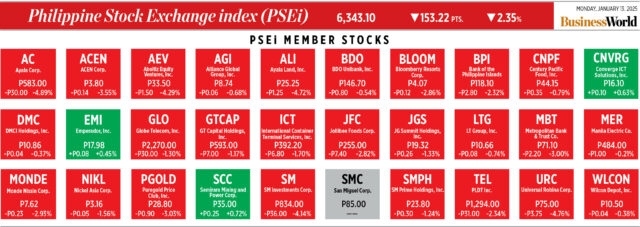
How PSEi member stocks performed — January 13, 2025

Here’s a quick glance at how PSEi stocks fared on Monday, January 13, 2025.


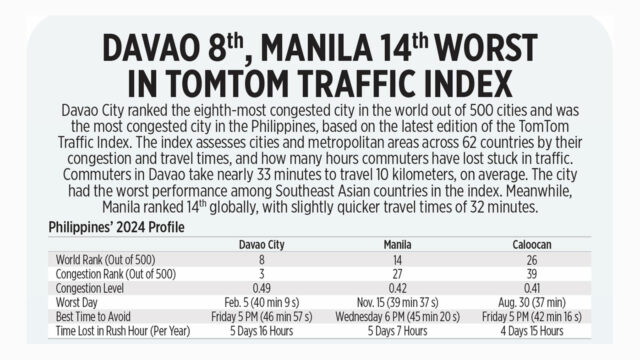
Davao 8th, Manila 14th worst in Tomtom Traffic Index

Davao City ranked the eighth-most congested city in the world out of 500 cities and was the most congested city in the Philippines, based on the latest edition of the TomTom Traffic Index. The index assesses cities and metropolitan areas across 62 countries by their congestion and travel times, and how many hours commuters have lost stuck in traffic. Commuters in Davao take nearly 33 minutes to travel 10 kilometers, on average. The city had the worst performance among Southeast Asian countries in the index. Meanwhile, Manila ranked 14th globally, with slightly quicker travel times of 32 minutes.

Davao 8<sup>th</sup>, Manila 14<sup>th</sup> worst in Tomtom Traffic Index

New mining rules expected to boost investor confidence

FREEPIK

By Adrian H. Halili, Reporter

MINERS said that the new reporting rules for mining companies are expected to improve mineral reporting, thereby boosting investor confidence in the industry.

Chamber of Mines of the Philippines (CoMP) Chairman Michael T. Toledo said via Viber that the new rules help raise the quality of reporting when miners disclose output tonnages, grades and estimated reserves.

The implementing rules and regulations (IRR) of the Philippine Mineral Reporting Code 2020 (PMRC) now require miners to submit quarterly and annual exploration results, exploration targets, mineral resources, and mineral reserves.

The Securities and Exchange Commission has recently approved the IRR, according to a memorandum from the Philippine Stock Exchange (PSE). The rules took effect on Monday, Jan. 13.

“This will help advance investor confidence through a balanced presentation of risks, challenges, along with the technical, environmental, social, and economic aspects prepared by accredited competent persons,” Mr. Toledo added.

“These developments will help achieve PMRC 2020’s primary purpose of protecting the investing public through transparency and consistency in promoting a common understanding in public reporting of minerals comparable with global standards,” he said.

He added that investors interested in mining can now make informed and balanced judgments regarding reported exploration results, mineral resources or reserves.

CoMP was among the members of the committee which drafted the PMRC alongside the PSE, the Philippine Society of Mining Engineers, the Geological Society of the Philippines, the Society of Metallurgical Engineers of the Philippines, the Philippine Mining and Exploration Association, and the Philippines-Australia Business Council.

Mr. Toledo said that the PMRC served as the primary basis for the formal admission of the Philippines into the PMRC Committee.

“This underscores that the PMRC has the same level of detail and transparency in reporting mineral resources and mineral reserves as those of its global counterparts in Australia, Canada, Chile, South Africa, Europe, and the US, among others,” he added.

Separately, Philex Mining Corp. President and Chief Executive Officer Eulalio B. Austin, Jr. said via Viber that “mineral resources and reserves for sure should be declared (after undergoing) technical evaluation.”

However, Mr. Austin added that publicizing exploration reports may be taken negatively by the public.

“Reporting exploration projects, however, might be too early but it can be articulated in such a way that the public is not being assured of its viability. It can be reported in broad terms and not forward-looking,” he said.

According to the Mines and Geosciences Bureau, the value of metallic mineral production rose 3.17% to P195.92 billion in the first nine months of 2024.

The rise in mineral value was mainly due to the increased in the value of gold and silver during the period.

MPIC unit Landco’s Baguio foray a play for strong leisure market

PHILSTAR FILE PHOTO

By Justine Irish D. Tabile, Reporter

THE interim management contract awarded to Metro Pacific Investment Corp. (MPIC) unit Landco Pacific Corp. for Camp John Hay is a play on the leisure segment, where interest is currently high, analysts said.

“The MVP group has been pushing to boost its property and hospitality business through Landco Pacific Corp., and this potential Baguio deal looks like a good opportunity for expansion,” China Bank Capital Corp. Managing Director Juan Paolo E. Colet said via Viber, referring to the group run by MPIC Chairman and President Manuel V. Pangilinan (MVP).

“MVP clearly sees the growth potential of the tourism industry. We expect that he will turn Camp John Hay into a sustainable world-class destination,” he added.

Last week, the Bases Conversion and Development Authority named Landco the interim manager of the Manor and Forest Lodge at Camp John Hay.

Under the agreement, Landco will operate the two facilities for one year, extendable to two.

Asked to comment, Colliers Research Director Joey Roi H. Bondoc described Landco’s decision as a “strategic move.”

“Now is an opportune time to invest in leisure-themed developments, and Baguio is definitely one of the ideal locations that developers should further explore,” he said via Viber.

“Landco has always been known for these developments, and the focus on Baguio complements the launch of the Spinnaker, a beachside property in Batangas,” he added.

The Department of Tourism reported that visitors spending at least a night in Baguio City numbered 1.31 million in 2023, accounting for 2.37% of all overnight travelers during the period.

“I think the interim management of the Manor is a good opportunity for Landco to assess further expansion into similar developments that are resort- or leisure-themed developments, as these projects cater to a thriving domestic and foreign tourism market,” Mr. Bondoc said.

According to Mr. Bondoc, leisure-oriented developments in the Philippines are being buoyed by the tourism rebound.

“This kind of project is popular. One developer’s project in Makati had a slow take-up, but its condotel in Batangas is sold out,” he said.

“These projects also benefit from the rebound of tourism. Note that foreign ownership for vertical development is allowed up to 40%,” he added.

Colliers reported that The Spinnaker, Pico Terraces, and Solmera Coast in Batangas have sold over 50% of launched units, while Escana in Boracay has sold over 70%.

Launched units at Villas at Aruga of Cebu and the Dusit Thani Residences in Davao were sold out. 

Meanwhile, Alpine Villas-Basel in Cavite had a take-up rate of 43%, and The Crown Residences and Bridgeport Park Sapphire Tower in Davao are at 69% and 81% sold, respectively.

Rice price ceiling could be adjusted to reflect declining international prices

PHILIPPINE STAR/EDD GUMBAN

WEAKER international rice prices could cause the proposed price ceiling on imported rice to be set lower, the Department of Agriculture (DA) said on Monday.

“The maximum suggested retail price (MSRP) for imported rice… most likely, in the coming days will further go down,” Agriculture Assistant Secretary and Spokesperson Arnel V. de Mesa said in a briefing.

The DA had set the MSRP at P58 per kilogram for imported rice with broken-grain content of 5%. A price ceiling has not yet set for imported 25% broken rice. The price ceiling is expected to take effect on Jan. 20, initially in Metro Manila.

He estimated an MSRP for 25% broken rice of below P50 per kilo.

Last week, the DA announced plans to set an MSRP for imported rice to further lower rice prices and curb profiteering from rice traders.

It also set labeling rules for imported rice identifying country of origin, type, and broken-grain content. The DA had noted that prices of some imported rice brands remained elevated despite lower import tariffs.

President Ferdinand R. Marcos, Jr. last year issued Executive Order No. 62 which slashed tariffs on rice imports to 15% from 35% previously until 2028.

The lower tariff rates on rice, which took effect on July 5, were intended to bring down prices and curb inflation.

The Philippines imported a record 4.78 million metric tons (MT) of rice in 2024, according to the Bureau of Plant Industry (BPI).

Mr. De Mesa said that there was an upward revision of the 2024 data due to “delayed counting.” Last week, the BPI reported rice imports of 4.68 million MT.

The BPI had issued 9,795 sanitary and phytosanitary import certificates (SPSIC) last year, equivalent to about 9.37 million MT of rice. Utilization by rice importers was about 66.13% or 6,477 SPSICs used.

He added that not all issued SPSICs will be fully utilized by rice traders due to factors like delayed shipping and transactions.

“There are applications which were not acted upon by the BPI, after seven days they will be deemed approved,” Mr. De Mesa said.

He added that international rice prices have declined, setting the tone for domestic rice prices.

Citing data from Vietnam as of Jan. 10, he added that the price of 5% broken rice dropped to $434 per MT from $510 per as of Dec. 10, while 25% broken rice fetched $409 per MT, down from $454.

According to DA price monitors, as of Jan. 10, a kilogram of imported special rice in Metro Manila markets sold for between P53 and P65 per kilo, while imported premium rice fetched between P52 and P60 per kilo.

The Philippines remains the world’s top importer of rice, according to the USDA. The Philippines is projected to import 5.3 million MT of rice in 2025. — Adrian H. Halili

Exporters urged to develop underserved markets in EU

A worker uses a microscope at an electronics manufacturing assembly plant in Biñan, Laguna, April 20, 2016. — REUTERS

EXPORTERS need to maximize the potential of electronic equipment, machinery, electricity, precious metals, and fruit exports to Europe, according to the Philippine Exporters Confederation, Inc. (Philexport).

Citing the International Trade Centre’s (ITC) Export Potential Map, Philexport said these product categories have unrealized potential in the European Union (EU)  and Western Europe.

The map identified electronic integrated circuits (ICs) and IC processors as the products with the most export potential, valued at $4 billion.

Actual exports of ICs amounted to $1.7 billion and $1.5 billion, respectively, with unrealized potential of about $493 million and $653 million, respectively.

Gold exports amounted to $1.3 billion with $497 million in further export potential.

Storage for data-processing machines had exports valued at $1.3 billion and unrealized potential worth $753 million.

Other products with top export potential are coconut oil, static converters, printers and copying machines, semi-manufactured gold, and parts of automatic data-processing machines.

Nelli Hajdu, ITC EU Market Access Expert, said that several regulatory and policy developments in the last five years have impacted business opportunities in the EU market.

These include climate change and its global response, supply chain vulnerability and changing geostrategic perception of the food trade, and greening initiatives.

“The shift from sanitary and phytosanitary and food safety to sustainability points to the EU trade agenda,” Ms. Hajdu said.

In the agriculture and food and beverage sector, the top products include bananas, crude coconut oil, pineapples (fresh or dried), and prepared or preserved tunas.

Other top products are desiccated coconuts, pineapples (prepared or preserved), mucilages and thickeners derived from vegetable products, edible parts of plants, and frozen yellowfin tuna. — Justine Irish D. Tabile

Arms industry expects gun law amendments to unlock growth

PHILSTAR FILE PHOTO

FIREARMS manufacturers and dealers said they support amendments to an 11-year-old law to unlock growth in the industry.

“By amending Republic Act (RA) No. 10591, we are not simply adjusting regulations, we are empowering an industry that can generate significant economic returns, provide employment and support innovation,” said Alaric Alexander J. Topacio, comptroller for the Association of Firearms and Ammunitions Dealers, during a House of Representatives hearing.

RA 10591 is also known as the Comprehensive Law on Firearms and Ammunition.

The House public safety and order committee held its first hearing on bills seeking to rationalize RA 10591, which regulates the manufacturing, import, and export of firearms.

Sta. Rosa City Rep. Danilo S. Fernandez, who heads the House public safety panel, formed a technical working group to consider the possibility of consolidating three separate bills seeking to amend the firearms law.

“We must support industries that can offer stability and growth. The firearms sector, with its potential to expand domestically and internationally, should be recognized as a key player in our economic strategy,” Mr. Topacio said.

President Ferdinand R. Marcos, Jr. signed into law in October the Self-Reliant Defense Posture Act, which seeks to “fully harness the potential of the defense industry.”

“This (firearms) industry has the capacity to generate thousands of jobs… and contribute to our economic development,” Mr. Topacio said.

He urged legislators to amend the law in a manner that effectively “addresses the root causes of illegal firearms trafficking, while supporting responsible gun ownership.”

The Philippines is among the least gun restrictive countries in Southeast Asia partly due to cultural influences from the American occupation. The national police, which regulates gun ownership in the country, allows Filipinos to own high-powered rifles.

Police General Ericson D. Dalig said there are about 2.7 million registered firearms in the country, while the count for “loose firearms” is more than 545,000.

“We have around 545,742 firearms that can be categorized as loose firearms (as) they cannot be renewed anymore because (their permits) were revoked,” he told legislators. — Kenneth Christiane L. Basilio

LANDBANK expects to boost credit support for sugar farmers

PHILSTAR FILE PHOTO

SUGAR FARMERS are expected to have expanded access to credit under the revised implementing rules and regulations (IRR) of the Sugarcane Industry Development Act’s (SIDA) Social Credit Program, Land Bank of the Philippines (LANDBANK) said.

In a statement, LANDBANK said it recently signed the revised IRR of the Social Credit Program, alongside the Sugar Regulatory Administration (SRA), which will expedite credit applications by sugarcane farmers.

“The streamlining of the program’s processes aims to provide more accessible and affordable credit support, in line with the Bank’s commitment to empowering sugarcane farmers and boosting the agriculture sector,” it added.

SIDA, also known as Republic Act 10659, seeks to raise the competitiveness of the sugarcane industry and improve incomes of farmers and workers.

Currently 50% of SIDA funds go to the construction of farm-to-market roads. The remaining funds are allocated to research and mechanization, socialized credit, and block farm development, with 10% dedicated to scholarships.

SRA Administrator Pablo Luis S. Azcona did not immediately reply to a Viber message seeking comment.

As of the end of November, LANDBANK had approved P1.32 billion for the Social Credit Program, benefitting over 4,000 farmers, including six block farms and four common service centers. — Adrian H. Halili

Inventory list and schedules for real estate, construction firms

Traditionally, the Bureau of Internal Revenue (BIR) inventory list is associated with taxpayers in manufacturing and retail, where inventories form part of the cost of goods sold, which is a critical component of major deductions on the income tax return.

However, when the BIR issued Revenue Memorandum Circular (RMC) 57-2015, it significantly broadened the scope, requiring other types of businesses, including those in the real estate and construction industries, to submit an inventory list along with the schedules.

The RMC requires all businesses with “tangible asset-rich” balance sheets to submit an annual inventory list along with schedules in the format prescribed by the BIR. Accordingly, a tangible asset-rich balance sheet is defined as at least 50% of the total assets composed of working capital, such as accounts receivable and inventory. This requirement has consequently brought real estate and construction businesses into the fold of compliance if they meet the criteria. If qualified, they must submit the required inventory list and schedule within 30 days after the close of a taxable year.

Moreover, the preparation of the required list and schedules for these industries must conform with the prescribed format, specifically dedicated to real estate and construction, under Annexes B and C of RMC 8-2023, respectively. Non-compliance with these formats will result in the submission being considered as not received by the BIR and subject to penalties.

If we look into the aforementioned annexes, it is clear that the information needed is significantly more data-intensive, as compared to a typical manufacturing or retail business, where taxpayers simply need to report basic details such as the inventory on hand, the valuation method, unit prices, quantity in stock, and total cost. For taxpayers involved in real estate, there is a detailed disclosure of the individual projects involved, contracted sales, and movement of the beginning and ending accounts receivable.

Similarly, for construction businesses, taxpayers must provide detailed information such as client names per project, the contracted price, the movement of the beginning and ending accounts receivable, billings and collections for the year, the estimated gross profit, and the percentage of completion, among others.

Based on my experience with these industries, gathering and preparing the required information for the list and schedule, while ensuring accuracy, could pose significant challenges, especially when aiming to meet the deadline within the 30th day after the close of the taxable year.

Real estate and construction companies typically have numerous transactions and projects, making it difficult to accurately account for the transactions with clients, track the movement of their accounts receivable, and reconcile their cash collections.  Additionally, for construction companies, obtaining the percentage-of-completion reports from the engineers on time is critical for calculating the estimated project cost and profit as part of the schedule. Thus, we cannot discount the significant time and effort that goes into preparing and organizing the information into the required BIR format.

Hence, it is important that these taxpayers should employ a computerized accounting system capable of generating the necessary data and timely report preparation. Additionally, effective coordination among the accounting, operations, and procurement departments is essential to prevent any miscommunication or inconsistent data entry, which could lead to errors and delays in compliance.

Another challenge is that the information available during the preparation and submission to the BIR on Jan. 30 may be based on unaudited account balances. As such, the reported figures in the schedules could still change due to adjustments made during the finalization of the financial statements (FS). These adjustments may be attributed to client’s adjustments (CAJE), external auditor’s adjustments (PAJE), or a combination of both, aimed at correcting the account balances.

In this light, it is crucial for taxpayers to assess the impact of any changes. If the adjustments are significant, it would be prudent for the taxpayer to refile and amend the previously submitted inventory list and schedule to the BIR. The main goal is to ensure that the submitted inventory list and schedules are accurate and would line up with the amount in the audited FS and Annual Income Tax Return (ITR) since the BIR uses this information in audits.

Normally, the BIR uses the inventory list and its schedule to identify any discrepancies that might indicate under-declaration of revenue when the BIR cross-checks the amount in the AFS and ITR. It may also include procedures of recalculating and analyzing the relationship between the accounts receivable movements, cash collections, gross profit recognized in the previous and among others. Any discrepancies identified must be adequately explained by the taxpayer. Otherwise, failure to provide a satisfactory explanation could result in the imposition of deficiency taxes.

It is worth noting that some taxpayers choose to pay the administrative penalties of P25,000 for failing to comply with the submission of the inventory list and schedule, as the fine may be relatively low compared to the cost and/or difficulty of preparing the report. However, these taxpayers should be cautious, as the BIR may view such non-compliance as willful. If deemed intentional, this act could be grounds for a mandatory tax audit.

In conclusion, while complying with BIR inventory list and schedule submission requirements may be cumbersome, particularly for the real estate and construction business, taxpayers should explore strategies to automate record-keeping and monitoring processes to efficiently capture the necessary information. Beyond fulfilling this annual statutory submission, the preparation of the list and schedule should offer a valuable opportunity to pinpoint areas for improvements and enhance transparency, ultimately fostering sustained growth of the business.


Richard R. Ibarra is a director of the Tax Advisory & Compliance Practice Area of P&A Grant Thornton.

Tweet us: @GrantThorntonPH Facebook: P&A Grant Thornton

pagrantthornton@ph.gt.com

www.grantthornton.com.ph

Peso sinks as markets trim Fed cut bets

THE PESO sank to an over three-week low against the dollar on Monday on expectations of a more cautious US Federal Reserve as strong jobs data stoked fresh inflation concerns.

The local unit closed at P58.70 per dollar on Monday, plummeting by 34 centavos from its P58.36 finish on Friday, Bankers Association of the Philippines data showed. This was the peso’s weakest finish in more than three weeks or since its P58.81-a-dollar close on Dec. 20, 2024

The peso opened Monday’s session weaker at P58.525 against the dollar. Its intraday best was at P58.50, while its worst showing was at P58.70 versus the greenback.

Dollars exchanged declined to $1.35 billion on Monday from $1.82 billion on Friday.

“The peso closed lower on the back of a strong dollar following stronger-than-expected US nonfarm payrolls and unemployment rate, which reduced bets of a rate cut by the Fed,” a trader said by phone.

Rising consumer inflation expectations in the US also affected Fed easing bets, Rizal Commercial Banking Corp. Chief Economist Michael L. Ricafort said.

For Tuesday, the trader sees the peso moving between P58.50 and P58.80 per dollar, while Mr. Ricafort expects it to range from P58.60 to P58.80.

The dollar charged higher on Monday and drove its peers to multi-year lows after a blowout US jobs report underscored the strength of the world’s largest economy and muddied the outlook for further Federal Reserve rate cuts this year, Reuters reported.

The greenback surged to its highest in over two years on Monday against a basket of currencies to peak at 109.98, extending a rally from last week.

Trading was thinned in the Asian session with Japan markets closed for a holiday, but nonetheless moves in the foreign exchange market were volatile and other currencies notched fresh lows on the back of the dollar’s strength.

Friday’s data showed US job growth unexpectedly accelerated in December while the unemployment rate fell to 4.1% as the labor market ended the year on a solid footing, leaving traders heavily scaling back bets of Federal Reserve rate cuts this year.

Markets are now pricing in just 27 basis points worth of Fed rate cuts this year, down from roughly 50 bps at the start of the year.

With Wednesday’s reading on US inflation up next, any upside surprise could threaten to close the door on easing altogether. A slew of Fed officials is also due to speak this week. — A.M.C. Sy with Reuters