Home Blog Page 170

KPop Demon Hunters is headed to the Oscars — live on stage

A SCENE from KPop Demon Hunters.

LOS ANGELES — The lead vocalists behind KPop Demon Hunters — Netflix’s most‑watched animated film of all time — are headed to the Oscars stage for the first time. EJAE, Rei Ami, and Audrey Nuna will perform “Golden” during Sunday’s ceremony, executive producer and showrunner Raj Kapoor and executive producer Katy Mullan announced Tuesday.

The ceremony will be televised live on ABC and streamed live on Hulu.

The trio’s performance in Los Angeles will showcase music from the Oscar-nominated film’s chart-topping soundtrack and feature “a fusion of traditional Korean instrumentalists and dance” — a tribute to the Korean cultural roots that shaped the movie’s sound and story.

The singers from the fictional group, HUNTR/X, will deliver the Oscar‑nominated original song co‑written by EJAE, marking a milestone moment in their careers.

Directed by Maggie Kang and Chris Appelhans, KPop Demon Hunters has become a global sensation, with its music continuing to trend worldwide.

The story follows three demon hunters who double as K‑pop idols, battling supernatural forces while captivating fans onstage.

Also making his Oscars performance debut is American musician and actor Miles Caton, known for his breakout role as Sammie in Oscar-nominated director Ryan Coogler’s Oscar‑nominated horror film Sinners.

Mr. Caton will join Raphael Saadiq to perform the film’s Oscar‑nominated original song “I Lied To You.”

The performance will expand into a sweeping, blues‑driven tribute featuring Misty Copeland, Eric Gales, Buddy Guy, Brittany Howard, Christone “Kingfish” Ingram, Jayme Lawson, Li Jun Li, Bobby Rush, Shaboozey, and Alice Smith.

The Warner Bros. feature film — celebrated for its rich exploration of blues music and Black culture in the segregation‑era US South — leads all films this year with a record‑setting 16 Oscar nominations, the most of any film.

Sinners follows twin brothers, both played by Oscar nominee Michael B. Jordan, who open a juke joint in 1930s Mississippi, only to encounter a community of vampires. The supernatural peril becomes a powerful allegory for segregation and racism. — Reuters

Aboitiz, HI seal JV for 184-ha TARI Estate expansion

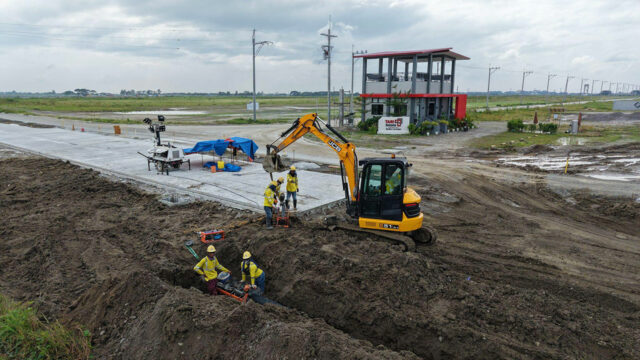
WITH ITS FIRST 90-hectare phase fully sold and developed, subsequent phases are being rolled out. — HOUSE OF INVESTMENTS

ABOITIZ Economic Estates and House of Investments (HI) have finalized a joint venture (JV) through Tarlac Terra Ventures, Inc. to develop an additional 184 hectares (ha) at TARI Estate in Tarlac City to support manufacturing and logistics growth in Central Luzon.

“We see TARI Estate as a compelling long-term investment that aligns with our strategy of supporting developments that contribute to economic growth,” House of Investments President and Chief Executive Officer Lorenzo V. Tan said in a disclosure on Thursday.

“Through this partnership, we are participating in the creation of an industrial ecosystem that can support manufacturing, logistics, and supply chains for decades to come,” he added.

TARI Estate is a 384-hectare Philippine Economic Zone Authority (PEZA)-registered special economic zone in Tarlac City. The site sits near major expressway intersections and is close to Clark International Airport and key seaports, supporting industrial, commercial, and institutional developments.

The partnership combines Aboitiz Economic Estates’ industrial estate development capabilities with HI’s investment resources to support the estate’s expansion.

Rafael Fernandez de Mesa, president and chief executive officer of Aboitiz Land and Aboitiz Economic Estates, said integrated industrial ecosystems are becoming increasingly important for manufacturing.

“Industrial competitiveness increasingly depends on ecosystems rather than standalone sites,” he said.

“As more companies establish operations here, we expect the estate to become an important node within Central Luzon’s evolving industrial corridor,” Mr. De Mesa added.

TARI Estate’s development is progressing toward full locator-ready status, Aboitiz Equity Ventures, Inc. (AEV), the listed holding company of the Aboitiz Group, said.

The estate’s first 90-hectare phase has been fully sold, with locators advancing facility construction and operational planning. Subsequent phases are progressing in parallel to meet rising demand for industrial land in Central Luzon.

The project is also rolling out key infrastructure, including roads linking to Luisita Road, power and water systems, fiber connectivity, and utilities to support continuous industrial operations. PEZA and Bureau of Customs facilities are expected to be operational by the first quarter of 2027.

Early locator activity at TARI Estate is building operational momentum, with manufacturers such as Coca-Cola Europacific Aboitiz Philippines (CCEAP) and Ajinomoto Philippines Corp. establishing facilities and moving toward operations.

Their commitments signal confidence in the estate’s location for large-scale manufacturing, while additional companies are in advanced stages of negotiation, the company said.

Once fully developed, TARI Estate is expected to generate more than 60,000 jobs in Tarlac province and the wider Central Luzon region. The estate officially broke ground in May 2024. — Alexandria Grace C. Magno

Peso slides as US data bolster hawkish Fed bets

BW FILE PHOTO

THE PESO depreciated further against the dollar on Thursday as the latest US consumer price index (CPI) data heightened expectations that the US Federal Reserve will keep rates steady at its meeting next week.

The local unit dropped by 21.5 centavos to close at P59.385 against the greenback from its P59.17 finish on Wednesday, data from the Bankers Association of the Philippines showed.

The peso opened Thursday’s trading session sharply weaker at P59.32 per dollar. Its intraday best was at P59.223, while its worst showing was at P59.65, surpassing its latest record-low close of P59.50 logged on March 9.

Dollars traded went down to $1.92 billion from $2.057 billion.

“The peso continued to weaken after the US CPI report for February came in within market expectations, which fueled views of a policy rate hold from the US central bank this month,” a trader said in an e-mail.

US consumer prices rose moderately in February as rents maintained a steady pace of increases, though households paid more for gasoline and at the supermarket and higher costs are in store because of the escalating war in the Middle East, Reuters reported.

The consumer price index report from the Labor department on Wednesday, which also showed underlying inflation muted last month, covered the period before the US and Israel launched strikes against Iran. The attacks at the end of February were met with retaliation by Tehran and have boosted oil prices.

Economists estimated that consumer prices could increase by as much as 1% in March and expected the US Federal Reserve to keep interest rates unchanged next week.

The consumer price index rose 0.3% last month after gaining 0.2% in January, the Labor department’s Bureau of Labor Statistics said. In the 12 months through February, the CPI advanced 2.4%, matching January’s increase, and reflecting last year’s high readings dropping out of the calculation. The increase in the CPI was in line with economists’ expectations.

The US central bank tracks the personal consumption expenditures (PCE) price indexes for its 2% inflation target.

Economists said the tame core CPI readings were unlikely to translate into moderate core PCE inflation gains in February because of different weights and unexpected strength in services prices in the January producer price index report.

January’s delayed PCE price index data due on Friday is expected to show a solid increase in core inflation. February’s PCE inflation data will be released on April 9. Economists forecast core PCE increasing by as much as 0.5% in January, with estimates for February as high as 0.4%.

The peso also weakened against a stronger dollar on growing inflation worries due to rising global crude oil prices as the war in the Middle East continues, Rizal Commercial Banking Corp. Chief Economist Michael L. Ricafort said in a Viber message.

The dollar gained for a third consecutive session on Thursday, staying close to its strongest levels this year as surging crude prices stoked inflation worries, which could potentially force central banks to reassess the need for interest-rate hikes, Reuters reported.

Brent crude futures rose more than 10% at one point to highs of $101.59 per barrel, even after the International Energy Agency on Wednesday agreed to release a record 400 million barrels of oil from strategic stockpiles to combat the spike in crude prices.

Oil market volatility has continued to climb, with Iran saying the world should be ready for crude at $200 a barrel as its military attacked merchant ships on Wednesday, and vessel traffic through the Strait of Hormuz dwindled to a trickle.

For Friday, the trader said the peso could weaken further as the US PCE report could bolster hawkish Fed expectations.

Both Mr. Ricafort and the trader expect the peso to move between P59.25 and P59.50 per dollar on Friday. — A.M.C. Sy with Reuters

A friendship woven with sampaguita: The dawn of a new era in Korea-Philippine relations

PRESIDENT Ferdinand R. Marcos, Jr. (R) and President Lee Jae Myung of the Republic of Korea witness the exchange and presentation of signed agreements at the President’s Hall in Malacañan Palace on March 3, 2026. — PPA POOL/MARIANNE BERMUDEZ

By Lee Sang-hwa

THE STATE VISIT of President Lee Jae Myung to the Philippines began with a serendipity that felt more like a calculated masterstroke of diplomacy. President Lee arrived in Manila on March 3, which fell on the exact day of the 77th anniversary of the establishment of diplomatic ties between the Philippines and the Republic of Korea (ROK). Against the backdrop of this historic coincidence, the two leaders shared a period of warm camaraderie, cementing a friendship befitting our Strategic Partnership. During the visit, the two sides signed 10 Memoranda of Understanding spanning defense, digital cooperation, trade, agriculture, education, and culture — an outcome that clearly demonstrates the expanding scope and depth of Korea-Philippines cooperation.

The ROK is one of only five countries with which the Philippines maintains a Strategic Partnership, a status that underscores the vast horizon of our cooperation and the profound depth of our mutual trust. Today, the Philippines stands as a vital partner in high-value industries that are shaping the future, such as shipbuilding, defense, and nuclear energy.

The Subic Shipyard, revitalized by investments from HD Hyundai, stands as a “beacon of hope” for a nation reclaiming its maritime glory during the Manila-Acapulco Galleon Trade. Soon, vessels built in the Agila Subic Shipyard, one of the world’s largest drydocks, will traverse global trade routes carrying “Made in the Philippines” products, symbolizing the joint industrial ambitions of Seoul and Manila.

On security matters, the ROK has become a trusted partner and a backbone of the Armed Forces of the Philippines’ modernization efforts. Building on the landmark acquisition of 12 FA-50 PH fighter jets, along with a series of deals for frigates, corvettes, and offshore patrol vessels, Korean defense systems now serve as vital pillars of Philippine maritime security.

Energy cooperation represents the next frontier. As the Philippines revisits nuclear power to secure its future energy needs, momentum is building. During the recent Korea-Philippines summit, the two leaders agreed that nuclear energy development is essential to meeting the power demands of the AI era, affirming that the ROK is the Philippines’ optimal partner in this endeavor.

Economically, the partnership has entered a golden age. With the ROK-Philippines Free Trade Agreement now on its third year, Korean investors have solidified their position in the country. This momentum was further galvanized at the Korea-Philippines Business Forum on March 4, where over 250 government and business leaders translated diplomatic goodwill into concrete industrial cooperation. The forum marked a significant milestone with the signing of seven MoUs in strategic sectors — such as nuclear energy, shipbuilding, and aerospace — while Korean and Philippine firms signed $16.4 million worth of contracts on-site. For an archipelago of over 7,000 islands, the Philippines remains a “blue ocean” of opportunity, particularly for large-scale infrastructure and maritime connectivity projects.

Yet, the true engine powering this vibrant partnership lies in the dynamic exchange between the peoples of both nations. Koreans consistently rank as the largest group of visitors to the Philippines, where tourism contributes roughly 10% of the country’s GDP. Many Koreans return home with lasting impressions on Filipinos’ warm hospitality, rich and diverse culture, and the country’s breathtaking natural beauty.

In the same vein, Korean culture — from food to K-pop and K-dramas — has gained remarkable popularity in the Philippines. Reflecting this growing affinity, Filipino visitors to Korea ranked first among Southeast Asian tourists last year. These two-way exchanges show how naturally our peoples connect with each other. Events like the Everyone’s K-pop showcase — starring Filipino singer Gwyn Dorado, whose popularity spans Korea and beyond — have deepened the connection between our peoples, building bonds through shared culture and mutual admiration.

President Lee’s state visit also carries significance beyond bilateral relations. It marks the first visit by a foreign leader since the Philippines assumed the ASEAN 2026 Chairship. As the Philippines seeks to elevate its regional role through this leadership position, the warm reception extended to President Lee reflects the importance Manila places on its partnership with the ROK. On the other hand, the visit underscores the ROK’s commitment to strengthening ties with Southeast Asia, with the Philippines serving as a key gateway to a broader Comprehensive Strategic Partnership with the ASEAN — Korea’s largest regional market for trade and investment after the United States and China.

At the state dinner, the table was adorned with 33 and 77 blossoms of the sampaguita — the Philippines’ national flower. The 33 blooms marked the significance of March 3, while the 77 others honored the 77th anniversary of a storied diplomatic bond. Their quiet fragrance symbolized the enduring friendship between the two nations. Like a garland woven from sampaguita, the partnership between the ROK and the Philippines continues to grow stronger, promising a future in which cooperation, trust, and shared aspirations will bloom for generations.


Lee Sang-hwa is the ambassador of the Republic of Korea to the Philippines.

Stealth Pokémon hit boosts Nintendo Switch 2 momentum sentiment

Stills from Pokémon Pokopia — POKOPIA.POKEMON.COM

TOKYO — Nintendo said on Thursday it has sold more than 2.2 million copies of Pokémon Pokopia in the four days since launch as the game’s popularity helps offset fear about Switch 2 sales momentum.

Industry observers have fretted that the Switch 2 lacks high-profile games to drive sales, with spiking prices for memory chips also driving market concern about impact on profit margins.

The new life simulation game, a spin-off from the mainline Pokémon series, has been widely praised and has a metascore of 89 on review aggregator Metacritic.

The game is a “stealth hit,” Jefferies analyst Atul Goyal wrote in a client note.

Pokopia serves as a critical software catalyst, accelerating adoption for the … (Switch 2) hardware install base by capturing the lucrative non-gamer demographic,” he wrote.

Nintendo previously attracted a wide range of consumers with island life simulator Animal Crossing: New Horizons, which become an escapist hit during the COVID-19 pandemic. — Reuters

RLC profit rises to P13.5B on portfolio growth

ROBINSONSLAND.COM

ROBINSONS LAND Corp. (RLC) said its attributable net income for 2025 rose 1.97% to P13.47 billion, supported by contributions from its investment and development portfolios.

The property developer posted consolidated revenues of P48.52 billion for the year, up 13% from the previous year across all segments.

Its investment portfolio grew 8%, while the development portfolio expanded 30%. The organic residential segment recorded a 71% increase in revenues, driven by improved inventory management and project completions.

“Our full-year performance reflects the resilience and diversified strength of our portfolio, highlighting the value of disciplined execution across all business segments. As we move forward, we remain focused on strategic growth, unlocking value in high-potential sectors, and delivering sustainable benefits for our customers, tenants, and stakeholders,” RLC President and Chief Executive Officer Mybelle V. Aragon-GoBio said in a statement on Thursday.

The company said attributable income rose 9% year on year if noncore gains from the 2024 GoTyme investment reclassification and insurance are excluded.

As of Dec. 31, 2025, RLC had total assets of P275 billion, including P11.06 billion in cash, and shareholders’ equity of P185.05 billion after settling P13.80 billion in maturing debt.

The company reduced its net debt-to-equity ratio to 16% from 27% at the end of 2024, lowering exposure to interest rate and market volatility while strengthening liquidity.

RLC raised P13.96 billion through oversubscribed block placements of RL Commercial REIT (RCR) shares in April and September, which were 1.8 times and 3.7 times subscribed, respectively, reflecting strong investor demand.

The company infused nine mall assets into RCR, increasing the REIT’s market capitalization to P150.53 billion as of Dec. 31, 2025, while retaining a 60.51% ownership stake.

Robinsons Malls recorded full-year revenues of P19.67 billion, up 10% year on year. Rental income rose 11%, while same-mall sales increased 8%, supported by improving consumer activity.

Robinsons Offices posted revenues of P8.43 billion for 2025, up 6% from the previous year. Same-office occupancy rose 200 basis points to 90% on new leases, bringing overall portfolio occupancy to 85% including recently completed buildings, with business process outsourcing tenants occupying 82% of space.

Robinsons Hotels and Resorts reported an 8% increase in revenues to P6.50 billion as travel and tourism demand continued to recover.

Growth was supported by hotels operated by international brands and company-owned luxury properties, including the five-star Fili and ultra-luxury NUSTAR Cebu, which launched in May 2025. Systemwide occupancy reached 67%, up 100 basis points from the previous quarter and above the market’s 60%.

Robinsons Residences generated P5.18 billion in organic net sales and P3.11 billion from joint ventures in 2025.

RLX, Robinsons Land’s logistics and industrial unit, reported revenues of P890 million for 2025, driven by demand for industrial sites supporting supply chains and e-commerce.

“The portfolio maintained a 94% occupancy rate across 15 industrial facilities located in strategic logistics hubs, demonstrating continued tenant demand and the expansion of logistics activity,” RLC said.

“In line with the Company’s growth strategy, two additional logistics hubs — RLX Taytay 2 and RLC Calamba 2E — were completed in the fourth quarter of 2025, further strengthening its presence in key logistics corridors and positioning the platform to capture increasing demand from distribution, manufacturing, and e-commerce tenants,” it added.

Robinsons Destination Estates (RDE) recorded P1.06 billion in property development revenues, driven by deferred land sales to joint ventures that signal continued monetization of its development pipeline.

At the local bourse on Thursday, RLC shares fell 2.82% to P17.26 apiece. — Alexandria Grace C. Magno

Sun Life Philippines to increase AI investments

BW FILE PHOTO

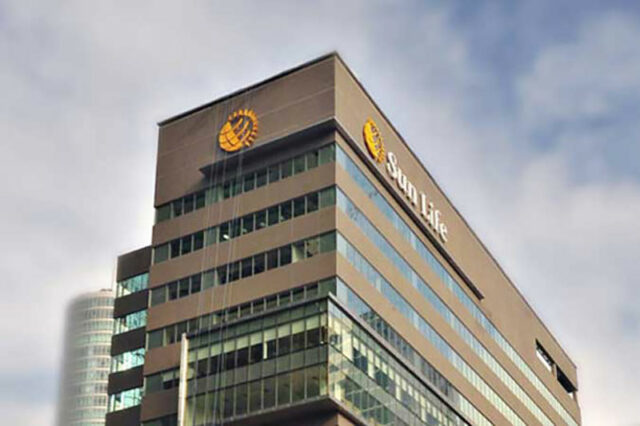
SUN LIFE of Canada (Philippines), Inc. (Sun Life Philippines) is boosting its artificial intelligence (AI) investments across its core operations to better cater to customer demand.

“For Sun Life, globally, regionally, and of course in the Philippines, we’ve already made a decision that AI is actually the direction where we decided to proceed,” Sun Life Philippines President Jonathan Juan “JJ” D. Moreno said in a forum last week.

“We have been making investments in AI as we speak, and we will continue to make investments that will benefit the multiple facets of our operations, from our core operations to our advisors, to our distribution channels, as well as with our own people.”

AI is helpful in key tasks like underwriting new claims and managing customer service, he said.

“We see it as also impacting the way we operate, the way our agents operate, and also our ability to put ourselves in the middle of an ecosystem we would like to build,” Mr. Moreno said.

But he emphasized the importance of having skilled humans in the AI adoption process.

The official said in January that they will increase their spending on technology to further expand its reach via online distribution platforms and create specialized products to cater to Filipinos’ varying insurance needs.

The financial and insurance sector can also grow by P300 billion (around $5.2 billion) — increasing its gross value added by 12% — if it adopts AI, according to according to a 2025 report by Google Philippines and consulting firm Public First.

In 2025, Sun Life Philippines topped the life insurance industry in premium income terms with P61.81 billion. It was also ranked first in terms of net income, net worth, invested assets, and total assets. — Beatriz Marie D. Cruz

Energy falling below $100 shows the world a way out

FREEPIK

By David Fickling

WORRIED ABOUT the way crude oil has stampeded above and then back below $100 a barrel in a matter of hours this week? What if I told you that another crucial component of energy prices has just slumped permanently beneath the same level?

That’s what’s happening with lithium-ion battery packs. Grid electricity from four-hour batteries cost $78 per megawatt-hour at the end of last year, down from $107/MWh a year earlier, according to BloombergNEF. It’s fallen more than 50% since the eve of the world’s last major energy shock, when Russia invaded Ukraine in early 2022.

The smaller batteries that go in your car have also dropped below a $100 threshold of late. The dominant lithium-iron-phosphate variety now costs $81 per kilowatt-hour, against $97 the previous year and $120/kWh at the end of 2021.

Lithium-ion battery prices don’t get constantly discussed the way crude is, but these declines add up to a decisive shift that will determine the energy landscape of the next decade. Solar and wind have been cheaper than fossil fuels for a while, but the last time we had an energy crisis like this, oil and gas still drove the prices paid by consumers. The falling cost of battery storage changes that.

Consider cars. Four years ago, a vehicle running on gasoline was the cheapest to buy everywhere in the world. Even factoring in savings on fuel, the conventional model typically came out ahead. Crude’s brief spikes above $120/barrel during the initial months of the war weren’t enough to alter that math.

Long before 2022, though, $100/kWh batteries were seen as a tipping point by the auto industry: Below that level, electric vehicles are fundamentally more affordable to buy. That’s the world we’re now in. EVs are far cheaper in China, roughly at price parity in Thailand and Australia, and imminently heading that way in the rest of the world.

My Geely Automobile Holdings Ltd. EX5, purchased for A$42,000 ($29,400) in December, has the feel of a luxurious European marque but charges up for half the cost of an equivalent tank of gas. This advantage will only widen if the current chaos in the oil market goes on. That makes a switch from gasoline to electricity a far more attractive proposition than the last time surging fuel prices started to affect hip pockets.

It’s the same situation on the grid. Until very recently, the cost of electricity in developed markets was typically shaped by gas, due to longstanding rules that set prices based on the most expensive power plant running — known as the “last marginal generator,” and typically a gas-powered plant. Even European countries with plenty of cheap renewables found their electricity priced at the level of LNG, causing bills to surge.

Thanks to those falling costs, batteries are now seizing the role of last marginal generator, and setting market prices at a lower level. Electricity from a four-hour battery is now cheaper in almost every market that depends on LNG, where prices from baseload gas plants typically hover around $100/MWh.* It’s yet more competitive if the battery is charged up from its own solar or wind plant, rather than costlier grid power. Even Saudi Arabia can now provide solar-plus-storage for less than gas.

The real-world effects are already showing up. In Australia’s main grid, wholesale prices in the December quarter were the lowest in four years, as rising deployment of renewables and batteries squeezed out gas. It’s a similar picture in California, where peak prices were cheaper than $70/MWh for 97% of the time last year, compared to just 14% of the time in 2022.

Pricing shifts activate one of the ground rules of commodity markets: the law of substitution. Any time a raw material grows too expensive or challenging to acquire, users will find an alternative. Substitution is why plumbers switched to PVC the minute copper became too important in electronics to be wasted on pipework. It’s why horsepower collapsed in the early 20th century as motor cars became the more affordable means of transport.

The same dynamic is now affecting the commodities that have driven the world’s energy flows for more than a century: oil and gas. Even countries that have long slow-walked the energy transition, such as Indonesia, Saudi Arabia, South Korea, and Uzbekistan, are now finding that EVs and renewables-plus-batteries are too cheap to resist.

With such an affordable, clean solution waiting in the wings, why would any sane economy hitch its fate to the price of one volatile commodity, when the whims of President Donald Trump and Israeli Prime Minister Benjamin Netanyahu are turning its main producing region into a chaotic disaster zone?

In the past, most of us had no alternative to a world dominated by oil and gas. Cheap solar and wind started to erode that proposition in the 2010s. It’s the plummeting price of batteries since 2022 that will prove the real game changer.

BLOOMBERG OPINION

*This is ultimately determined by the price of crude. In markets dependent on LNG, the price of fuel per MWh is roughly the same as the price of crude, thanks to long-standing linkages between oil and gas prices and the efficiency of combined-cycle gas turbine generators. About $25/MWh of non-fuel costs can be added, coming out to around $100/MWh. Markets with cheap piped gas instead of LNG will be cheaper, while those with carbon pricing will be more expensive.

Female workforce seen held down by expectations of childcare, housework

UNSPLASH

By Erika Mae P. Sinaking, Reporter

THE PHILIPPINES is grappling with weak female labor force participation even though it has some of the best gender gap ratings in the region by traditional metrics, advocates for women in the workplace said.

At a conference this week, participants singled out the persistence of social norms like childcare roles as well as what they called structural workplace biases.

Julia Andrea R. Abad, executive director of the Philippine Business Coalition for Women Empowerment, said societal expectations remain the primary hurdle, as both men and women continue to view men as the primary providers.

“In a stage of a family, whether it’s caring for a child or household duties, it will be the woman who drops out because it’s the man who’s seen as the primary (breadwinner),” she said at a panel discussion in Mandaluyong this week.

She added that even when women reach executive levels, estimated at nearly 40% of leadership teams in publicly listed firms, they are often confined to secondary roles rather than operational positions with the high visibility required for top-tier promotions.

Anna Leah Colina, project officer and women coordinator for the Federation of Free Workers, said that culture that favors men remains deeply rooted despite technological advancements.

She noted that 17 million women aged 15 and above remain outside the labor force, largely due to invisible labor or unpaid care work.

“We are still perceived as secondary to men economically, politically, and socially,” Ms. Colina said, adding that even when women seek work, they often are relegated to vulnerable informal jobs.

Anita E. Baleda, deputy executive director for operations at the Philippine Commission on Women, said that as of 2024, women spend an average of 3.2 hours a day on unpaid care and domestic work, compared to just 1.7 hours for men.

“If we’re talking evidence-based, we know for a fact, that women do twice as much, spend twice as much time as men in doing unpaid care and domestic work,” she told BusinessWorld.

Reducing this burden, she said, requires investment in care-support infrastructure such as facilities and labor-saving household technology.

Merriam Leilani M. Reynoso, director of the Bureau of Workers with Special Concerns at the Department of Labor and Employment, noted a 99.9% compliance rate among monitored establishments for laws protecting women workers, including maternity and solo-parent leave benefits.

Panelists urged employers to complement regulatory enforcement with proactive workplace reforms, including bias-resistant hiring practices, transparent promotion pathways, and intentional inclusion of non-traditional candidates in leadership pipelines.

These discussions accompanied the launch of the “Juana Trabaho Framework,” an initiative of the Department of Economy, Planning, and Development in partnership with the Australian government. The program aims to achieve the female-related goals of the Trabaho Para Sa Bayan Plan 2025–2034, which targets a female labor force participation rate of 59% by 2034, up from 53.7% in 2025.

“This reality underscores why increasing women’s labor force participation is a clear priority of the Philippine government,” Economy Secretary Arsenio M. Balisacan said. “Achieving this requires not only creating quality, secure, and accessible jobs for women but also ensuring that these jobs align with emerging industry demands brought about by a modernizing economy.”

Australian Ambassador to the Philippines Marc Innes-Brown added that the collaboration focuses on policy reforms that support gender-inclusive workplaces and a care economy to drive sustainable economic growth in the region.

EU threatens to pull Venice Biennale funding over Russia’s return

ROME — The European Commission has threatened to withdraw funding from the Venice Biennale art exhibition if organizers proceed with plans to allow Russia to reopen its pavilion at this year’s edition.

Russia’s pavilion at the art fair was closed after Moscow’s full‑scale invasion of Ukraine in 2022, which triggered the exclusion of Russian artists and institutions from major European cultural events.

“Member States, institutions and organizations must act in line with EU (European Union) sanctions and avoid giving a platform to individuals who have actively supported or justified the Kremlin’s aggression against Ukraine,” an EU statement said.

It added it would examine further action “including the suspension or termination of an ongoing EU grant to the Biennale Foundation,” which organizes the contemporary visual arts event that runs from May 9 to Nov. 22.

The EU provides the Biennale with a grant of 2 million ($2.32 million) for film production over a three-year period, a spokesperson said. The festival receives annual financing, mainly from Italian state, estimated at around 19 million.

Culture and foreign ministers from more than 20 European countries, including Germany, France, and Spain, also sent a letter to letter to Biennale President Pietrangelo Buttafuoco saying they considered Russia’s presence “unacceptable.”

Mr. Buttafuoco described the festival as “a space of coexistence for the whole planet” without censorship, which should also be open to countries in conflict.

ITALY GOVERNMENTAGAINST BIENNALE DECISION
However, Italy’s Culture Minister Alessandro Giuli said the government disagreed with the Biennale Foundation’s “entirely autonomous” decision.

Prime Minister Giorgia Meloni has been a staunch supporter of EU sanctions against Russia, but prior to the invasion of Ukraine the co-ruling League Party had strong ties with President Vladimir Putin’s United Russia party.

Italian events have attempted on several occasions to host Russian artists, only to back down in the face of criticism.

Last year authorities canceled a classical concert in a palace near Naples over the planned participation of Russian conductor Valery Gergiev, widely regarded as close to Mr. Putin.

Ukraine’s Foreign Minister Andrii Sybiha and Deputy Prime Minister Tetyana Berezhna on Sunday urged the international art community to stay vigilant over Russia’s use of culture as an instrument of propaganda.

“The Venice Biennale is one of the world’s most authoritative art platforms, and it must not become a stage for whitewashing the war crimes that Russia commits daily against the Ukrainian people and our cultural heritage,” they said.

This year Russia and Belarus were readmitted to the Winter Paralympic Games, currently being hosted by Italy in Milan and Cortina, following a contested decision by the International Paralympic Committee. — Reuters

Davao Light to build submarine cable linking Davao City and Samal

The 69-kilovolt project is scheduled for completion by the middle of the year. — ABOITIZPOWER

DAVAO LIGHT and Power Co., the distribution utility unit of Aboitiz Power Corp. (AboitizPower), is set to construct a submarine cable that will allow the export of electricity from Davao City to the Island Garden City of Samal.

Spanning 1,015 meters across the Pakiputan Strait, the subsea cable will enable the island to connect to the mainland grid, which has faced power supply issues, AboitizPower said in a statement on Thursday.

The 69-kilovolt project is scheduled for completion by the middle of this year to support growing electricity demand in Samal.

The project has secured a certificate of public convenience and necessity from the Energy Regulatory Commission, allowing the submarine cable to be laid to connect Samal to the mainland grid.

As of 2024, the Island Garden City of Samal has a population of 119,701, based on data from the Philippine Statistics Authority.

Citing a former local executive, AboitizPower said the island incurred annual damages of about P120 million to P150 million for more than a decade due to unresolved power issues stemming from aging infrastructure and network maintenance concerns.

“Davao Light is ready, poised, and equipped to serve the people, communities, and businesses of the Island Garden City of Samal,” said Davao Light President and Chief Operating Officer Enriczar Tia.

“Our immediate priorities will be customer service support, network expansion, and substation upgrades that will help build a robust electric distribution system,” he added.

Davao del Norte Governor Edwin Jubahib said the initiative serves as “a turning point” for the province and signals more reliable power service moving forward.

Davao Light is the country’s third-largest electric distribution utility, serving the cities of Davao and Panabo as well as the municipalities of Carmen, Dujali, and Santo Tomas in Davao del Norte.

The company expanded its services to several areas in Davao del Norte and Davao de Oro, including Samal, following the enactment of Republic Act No. 12144. — Sheldeen Joy Talavera

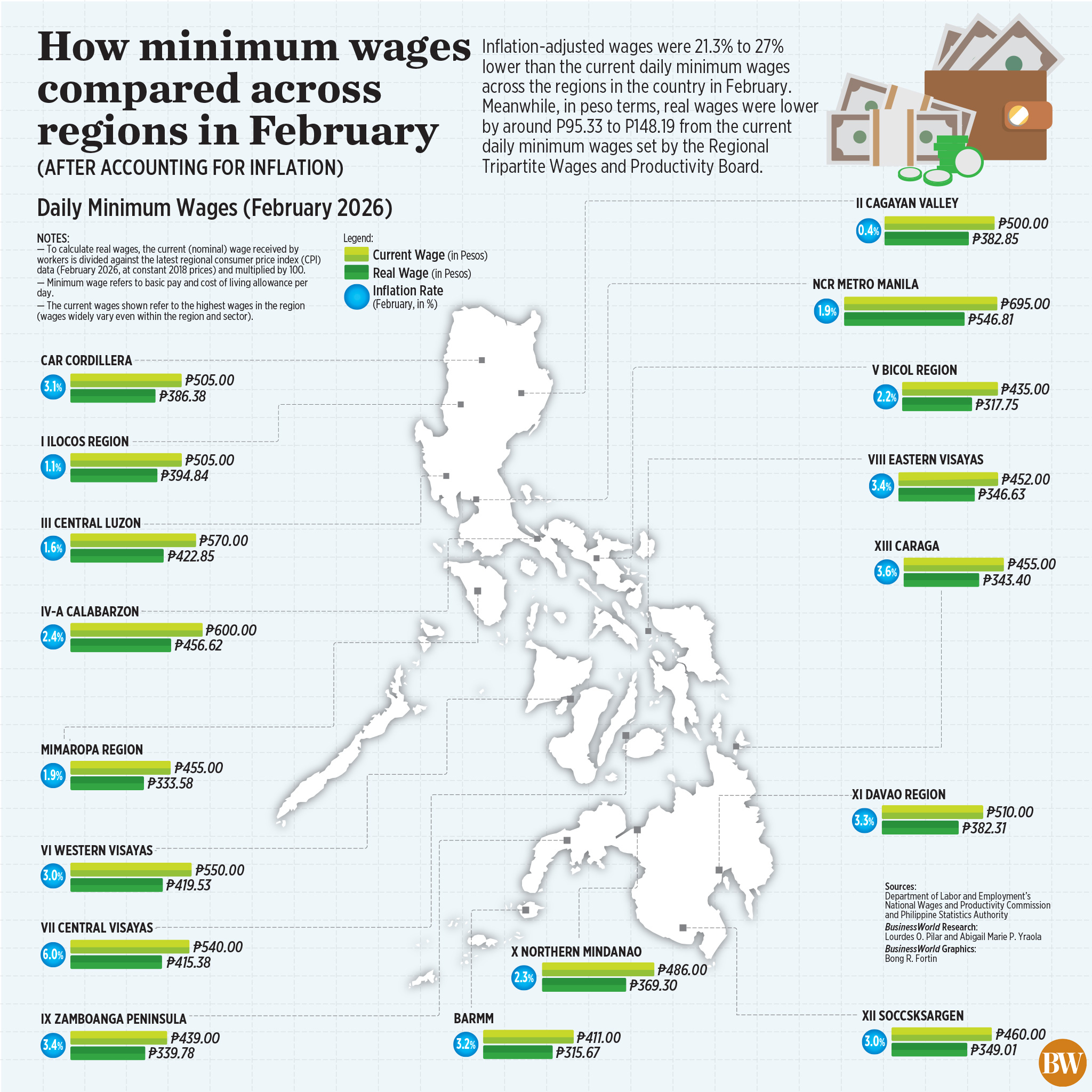
How minimum wages compared across regions in February

(After accounting for inflation)

Inflation-adjusted wages were 21.3% to 27% lower than the current daily minimum wages across the regions in the country in February. Meanwhile, in peso terms, real wages were lower by around P95.33 to P148.19 from the current daily minimum wages set by the Regional Tripartite Wages and Productivity Board.