Home Blog Page 1672

The M to hold Pitoy Moreno retrospective

A RETROSPECTIVE exhibition on the work of couturier Jose “Pitoy” Moreno is set to open on Feb. 27 at the Metropolitan Museum of Manila, just in time for the designer’s birth centennial (the designer was born on Feb. 25, 1925, and passed away on 2018).

The exhibition, entitled Timeless: J. Moreno at the Metropolitan Museum of Manila (The M Museum) in BGC will also be accompanied by a book.

“Pitoy Moreno promoted traditional Philippine textiles such as jusi and piña, bringing them into the global fashion spotlight. He revived interest in the Maria Clara and played a pivotal role in popularizing the Barong Tagalog for both men and women. This revitalization of traditional Filipino garments attracted a distinguished international clientele, including French couturier Pierre Cardin, the Emperor of Japan, and the kings of Morocco and Malaysia,” said a statement from the museum. “His clientele for his exquisite evening dresses, formal gowns, and ternos, was equally star-studded: Philippine first ladies, socialites, movie stars.” These included American actress Rita Moreno, who accepted her Oscar in 1962 for West Side Story wearing a Pitoy Moreno creation. She wore the gown again to attend the 2018 Academy Awards. The late Queen Elizabeth II’s sister, the United Kingdom’s Princess Margaret, had also worn Pitoy Moreno creations.

Timeless: J Moreno is curated by New York-based art historian Florina H. Capistrano-Baker, assisted by co-curator Ditas R. Samson, and Los Angeles-based fashion curator Clarissa M. Esguerra, and The M’s curatorial department, in close collaboration with exhibition and graphic designers Stanley Ruiz, Stephanie Yerba, and Cocoy Lumbao.

The exhibition is made possible by the Jusi at Piña Legacy Foundation. For more information, contact info@metmuseummanila.org

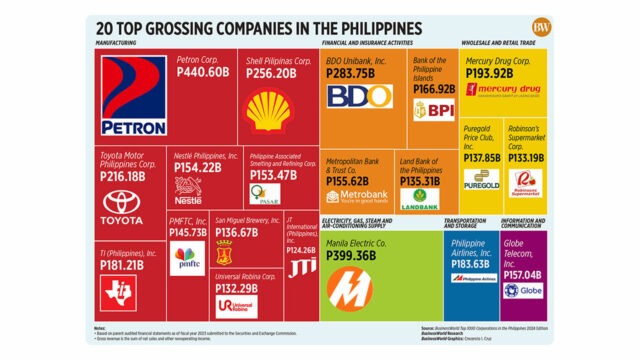
20 Top Grossing Companies in the Philippines

THE TOP 1,000 corporations in the Philippines saw a 7.2% increase in combined revenues to P17.8 trillion in 2023, slowing from the previous year as elevated inflation weighed on economic activity. Read the full story.

20 Top Grossing Companies in the Philippines

Remembering the lessons from the pandemic

BEN GARRATT-UNSPLASH

The World Health Organization (WHO) said that five years ago, its Country Office in China came across a media statement on the Wuhan Municipal Health Commission’s website regarding cases of “viral pneumonia” in Wuhan. Shortly after, COVID-19 would go on to profoundly impact the world with a pandemic that caused lockdowns and the deaths of millions worldwide.

The biopharmaceutical industry has earlier shared valuable insights for future pandemic preparedness, drawing from its successful experience in developing and manufacturing vaccines, treatments, and diagnostics to combat COVID-19. These lessons are essential as COVID-19 continues to evolve, and as new health threats emerge.

In late December, China’s disease control authority announced that it is testing a new monitoring system for pneumonia of unknown origin, anticipating an increase in cases of certain respiratory illnesses throughout the winter.

A report by the International Federation of Pharmaceutical Manufacturers & Associations (IFPMA), titled “Applying Lessons Learned from COVID-19 to Create a Healthier, Safer, More Equitable World,” outlines key actions to better prepare for future pandemics or health emergencies.

At the heart of these lessons are the urgent need for pathogen and surveillance sharing, fostering an innovation-driven ecosystem, regulatory flexibility, partnerships focused on health equity, strengthening health systems, and maintaining vaccine confidence, according to the IFPMA.

One critical lesson emphasizes the importance of pathogen surveillance and sharing. While additional investments are necessary to improve and expand pathogen and disease surveillance, ensuring immediate access to pathogens and their genetic data is equally vital.

The report also highlights the significance of partnerships to accelerate research, development, and manufacturing. Effective global collaborations, including over 330 public-private, private-private, and academic partnerships, played a key role in speeding up R&D and vaccine production. This collaboration led to a remarkable increase in vaccine doses — from zero in 2020 to over 12 billion doses administered by 2022.

Another lesson points to the importance of advance market commitments, which support the scaling up of manufacturing capacity for a global pandemic response. Advance market commitments for COVID-19 vaccines and therapeutics enabled crucial investments in production and technology transfer.

The role of innovation is also underscored. Years of research and development investment, even in the face of failures, laid the foundation for the rapid development of mRNA and viral vector vaccines for COVID-19. For example, the first approved vaccine was developed in just about a year, with early vaccine shipments from research-based pharmaceutical companies arriving by early 2021.

However, the report also notes the challenges posed by delays in the availability of globally sourced components. Shortages of raw materials, compounded by trade restrictions and intense competition for supplies, hindered the efficient manufacturing and distribution of COVID-19 vaccines and treatments.

For low-income countries, the report stresses the need for an organized procurement system. The IFPMA points out that the COVAX facility was not adequately funded or structured in time to secure advance purchase agreements at the same scale as high-income nations.

Regulatory flexibility and convergence were crucial in ensuring the safety and speed of vaccine access. The rapid development of COVID-19 vaccines was made possible by unprecedented collaboration between industry and national/regional regulatory authorities, allowing for a balance of speed, safety, and efficacy.

The report also warns that vaccine nationalism undermines global health security. Policies like export restrictions and vaccine hoarding, driven by national interests, likely extended the duration of the COVID-19 pandemic. Strengthening healthcare delivery infrastructure is another key takeaway. There is a collective responsibility to ensure equitable access to vaccines and treatments while building the necessary infrastructure to support timely delivery in future health crises.

Lastly, maintaining vaccine confidence is critical for future success. Sustained public trust in vaccines and the systems that distribute them is essential to overcoming the pandemic. Building public confidence through concerted, cross-sector efforts is necessary not only during the pandemic but also in preparation for future health emergencies.

The IFPMA’s “lessons learned” serve as a reminder of the importance of building on past successes while addressing the gaps identified in pandemic preparedness. These lessons must guide future efforts so that we don’t lose the progress made in combating current health threats and remain better prepared for emerging illnesses that could be of pandemic proportions.

The lesson remains clear: “No one is safe until everyone is safe.”


Teodoro B. Padilla is the executive director of Pharmaceutical and Healthcare Association of the Philippines which represents the biopharmaceutical medicines and vaccines industry in the country. Its members are in the forefront of research and development efforts for COVID-19 and other diseases that affect Filipinos.

When lease is more

Will electrified vehicles call for a reevaluation of the notion of ownership? — PHOTO BY KAP MACEDA AGUILA

Will ‘usership’ rather than ownership eventually become the norm as cars quickly evolve?

THE GROWTH streak of the Philippine automotive market continues. As of November 2024, the Chamber of Automotive Manufacturers of the Philippines, Inc. (CAMPI) reported that its 425,208 unit sales total reflected 8.8% growth versus the same period (January to November) in 2023. Significantly, CAMPI nearly eclipsed its 2023 sales total (429,807) with still a month of selling to go. Note that in 2023, CAMPI member companies’ sales mustered 22% growth.

The country is back on track to motorization. A study by Asian Automotive Analysis reported that in 2022, the number of vehicles per 1,000 people in the Philippines was at 48. This compared with Malaysia at 533, Thailand at 290, Indonesia at 87 and Vietnam at 44. Clearly, we have a long runway ahead of us.

The resurgence of motorization is expected to become even stronger as the Philippines prepares to transition to an upper-middle-income economy. If predictions by local economists hold true, we should breach the US$4,516 gross national income (GNI) per capita threshold of the World Bank by late this year or early 2026. It has been a long while coming but it seems tantalizingly close, according to recent estimates. At the end of 2023, our GNI per capita was reported at US$4,335.

GROWING FINANCED VEHICLE PURCHASES
This rise in middle-income status, a young population (with a median age of 25.7 years), and expanding access to credit is a trifecta that is expected to drive vehicle sales to record levels in the years ahead. The prospects are exciting, indeed.

The increased credit worthiness of Filipino car buyers and the expanded access to consumer credit can be a positively explosive combination. A finance industry executive estimates that the current profile of payments for car purchases in the Philippines would be about 20% cash, 25% company purchase orders and 55% through financing. In Thailand, a study by Deloitte reported that 74% of Thais prefer installment payments while 21% prefer cash purchases. Fitch Ratings, on the other hand, reports that 80% of car sales in Indonesia are financed.

Financed car purchases can grow even more rapidly especially if we consider that the household debt-to-gross domestic product (GDP) ratio of the Philippines stood at only 12.5% in 2023, the lowest among ASEAN markets. In comparison, the Institute of International Finance Global Debt Monitor reported Indonesia at 16.5%, Vietnam at 26.5%, Singapore at 47.3%, Malaysia at 68.9% and Thailand at 91.6%.

LEASING OPTION
Leasing is an emerging alternative to cash or financing when buying a car. In the USA, for example, an updated report by The Zebra in April this year revealed that one in two Americans bought their vehicle through an auto loan; 38% did so by cash and 7% through leasing.

There are two types of leasing: the finance lease and the full-service operating lease (FSOL). The finance lease is a straightforward installment package with three to five years as the commonly preferred tenures. The goal is ownership of the vehicle. The biggest provider of finance leases is Toyota Motor Financial Services Philippines, the captive financing arm of Toyota Motor Philippines. It offers products to individual and corporate buyers. There are a number of other companies that offer finance leases as well, but they deal more commonly with business-to-business transactions, presumably so as not to compete with their parent bank in the field of auto retail financing. Banks are not allowed to offer finance leases.

The difference between a finance lease and financing through a bank loan is that, in the former, the car belongs to the financing institution until it is fully paid for. The registration documents will show the name of the financing institution with a notation that it is “for the account” of the buyer.

FULL SERVICE OPERATING LEASES
The other type of lease is the FSOL. In this case, the car belongs to the lessor and there is no presumption of car purchase at the end of the lease term. There is no notation in the registration documents about who the lessee is. Among the providers are Toyota’s Kinto One Leasing, Orix Rental Corp., BPI Century Tokyo, Security Bank Leasing, BDO Leasing, Diamond, Safari, and Enterprise. In the Philippines, it is emerging as a practical option for those who are more concerned about having a car to use than one to own.

In today’s world, companies are constantly on the lookout for solutions that streamline operations, cut costs, and boost efficiency. Likewise, with the emergence of Mobility as a Service (MaaS) and the sharing economy, some people are shifting their view of mobility from one of “ownership” to one of “usership.” The FSOL provides a convenient solution to those who are less inclined to own their car. This leasing option entails a fixed monthly fee over a fixed period. It bundles vehicle use with registration, insurance, maintenance, and other services — offering car users a highly flexible and cost-effective alternative to traditional vehicle ownership. At the end of the lease term, the lessor can choose to extend the lease or simply return the vehicle, without worrying about its residual value or depreciation.

AN EFFECTIVE BUSINESS SOLUTION
For businesses, cash flow is critical. Vehicle ownership requires a significant upfront capital investment, followed by ongoing costs such as maintenance, insurance, and depreciation. In the case of FSOLs, the fixed monthly lease payments help businesses better manage their budgets as all vehicle-related expenses, including servicing and repairs, are typically included in the lease.

Managing a fleet of vehicles comes with significant administrative responsibilities as well. Scheduling maintenance, managing insurance, keeping track of mileage, and ensuring compliance with regulatory requirements can quickly become overwhelming. FSOLs often include a range of services designed to reduce this administrative load, with some using connected devices that provide the company full access to vehicle information such as location and vehicle condition.

An FSOL offers businesses the opportunity to drive the latest models without the long-term commitment of purchasing them. With rapid changes in automotive technology — evolving to be connected, electrified, and shared — businesses benefit from having access to the latest and the best. Leasing allows businesses to avoid the depreciation risks associated with owning a vehicle, which can lose significant value over time. At the end of the lease term, businesses simply return the vehicle and choose a new model, keeping their fleet fresh and aligned with their operational needs.

Mobility is evolving in line with changes in the way people consume it. Most people still consider cars as an asset — to have and to own, in good shape or bad, until it’s time to hand it down to the next generation. But others look at cars as a utility, a tool that gets them from place to place. They are not intending to keep their car for 10 years or a lifetime but are keen to always have the latest models in their garage. In this case, FSOLs might just be what they’re looking for.

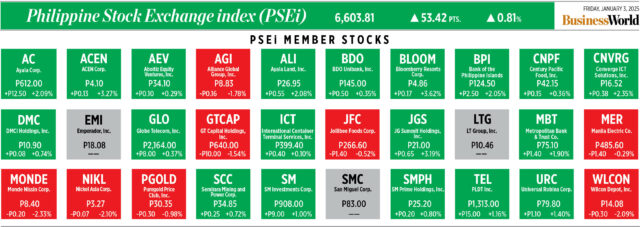
How PSEi member stocks performed — January 3, 2025

Here’s a quick glance at how PSEi stocks fared on Friday, January 3, 2025.


Peso may move sideways vs dollar before US jobs, PHL inflation reports

BW FILE PHOTO

THE PESO may move sideways against the dollar this week following stronger-than-expected US data and as the market awaits the release of key economic reports in the coming days.

The local unit closed the shortened trading week at P58.20 per dollar on Friday, weakening by 29 centavos from its P57.91 finish on Thursday, Bankers Association of the Philippines data showed. Philippine financial markets were closed for holidays on Dec. 30, Dec. 31, and Jan. 1.

Week on week, the peso slumped by 35.5 centavos from its P57.845-a-dollar finish on Dec. 27.

The peso dropped on Friday following strong US initial jobless claims data, a trader said in a phone interview.

The local unit weakened against a broadly stronger dollar on expectations that the US Federal Reserve will stay hawkish, Rizal Commercial Banking Corp. Chief Economist Michael L. Ricafort said in a Viber message.

For this week, the main market drivers will be the latest US nonfarm payrolls data as well as the December and full-year 2024 Philippine inflation report, the trader said.

The trader sees the peso moving between P58 and P58.40 per dollar this week, while Mr. Ricafort expects it to range from P57.90 to P58.40.

The number of Americans filing new applications for unemployment benefits dropped to an eight-month low two weeks ago, pointing to low layoffs at the end of 2024 and consistent with a healthy labor market, Reuters reported.

The report from the Labor department on Thursday added to a recent raft of upbeat economic data, including consumer spending, in reinforcing the Federal Reserve’s projections for fewer interest rate cuts this year. Labor market resilience is keeping the economic expansion on track.

Initial claims for state unemployment benefits dropped 9,000 to a seasonally adjusted 211,000 for the week ended Dec. 28, the lowest level since April. Economists polled by Reuters had forecast 222,000 claims for the latest week. — AMCS with Reuters

Stocks may rise further before key economic data

BW FILE PHOTO

PHILIPPINE STOCKS could extend their climb this week as trading volumes normalize and as the market awaits the release of key economic data.

On Friday, the Philippine Stock Exchange index (PSEi) rose by 0.81% or 53.42 points to end at 6,603.81, while the broader all shares index increased by 0.8% or 30.38 points to 3,785.48.

Week on week, the PSEi went up by 1.15% or 75.02 points from its 6,528.79 close on Dec. 27.

“Local gauges were little changed during the two-day trading week, with most participants returning from the extended holiday break,” online brokerage firm 2TradeAsia.com said in a note.

Philippine financial markets were closed for holidays on Dec. 30, Dec. 31, and Jan. 1.

“The local market has been showing positive signs after bouncing from its support at 6,400 last Dec. 20, 2024. The market has been up five out of the last six trading days. It also managed to get past its 10-day exponential moving average, which has been considered as a dynamic resistance. However, as seen in the first trading week of the year, trading is still thin, implying tepid conviction,” Philstocks Financial, Inc. Senior Research Analyst Japhet Louis O. Tantiangco said in a Viber message.

For this week, the market’s movement will depend on key economic reports, he said.

“Eyes are going to be on the Philippines’ December inflation data as this will provide clues on the BSP’ (Bangko Sentral ng Pilipinas) policy outlook. An inflation print within the BSP’s 2.3%-3.1% forecast range forecast, especially one biased to the lower end, may give sentiment a boost this week. Investors are also expected to look forward to the country’s November 2024 labor force survey for clues on the strength of the local economy,” Mr. Tantiangco said.

The Philippine Statistics Authority will release December and full-year 2024 inflation data on Jan. 7 (Tuesday) and the November labor force survey results on Jan. 8 (Wednesday).

“Investors may also monitor the performance of the local currency against the US dollar. An appreciation of the peso may help lift the market while a depreciation is expected to lead to the opposite,” he added.

Mr. Tantiangco put the PSEi’s support at 6,400 and resistance at 6,800.

For his part, Rizal Commercial Banking Corp. Chief Economist Michael L. Ricafort placed the market’s support at 6,500 and resistance at 6,635-6,820.

Meanwhile, 2TradeAsia.com pegged the PSEi’s immediate support at 6,400-6,500 and resistance at 6,700.

“‘Cloudy with a chance of rain’ has been thematic of the last few weeks of 2024; markets went into 2025 with umbrellas out and risk aversion at full mast… The plays for 2025 are set against a backdrop of numerous uncertainties in the macroeconomy but with excellent valuations at the corporate level. As such, a lot of the central themes for the year are likely sector-locked and/or story-specific to preserve returns amidst swings in the macroeconomy,” it added. — Revin Mikhael D. Ochave

Exporters vying with biodiesel for dwindling coconut supply

PHILSTAR FILE PHOTO

By Adrian H. Halili, Reporter

THE biodiesel industry is competing for the limited supply of coconuts, crowding out exporters of products like coconut oil and coconut water, industry officials said.

“The recent increase in the country’s biodiesel requirement may possibly divert more coconuts for domestic consumption,” Romeo I. Chan, chairman and chief executive officer of Axelum Resources Corp., told BusinessWorld via e-mail.

He sees a possible erosion of volume available for export, while acknowledging “the positive benefits for the environment (from biodiesel use), better fuel efficiency and higher copra prices,” Mr. Chan said.

“We also need to caution that this may potentially erode the competitiveness of the export sector, which produces high-value coconut products and generates dollar flows for the country,” he added.

In October, the biodiesel fuel blend was raised to 3%, or B3, on order of the Department of Energy. The government plans to increase the biodiesel blend to B5 in the next three years.

“In the end, we believe this necessitates a delicate balancing act to manage its broader impacts,” Mr. Chan said.

The US Department of Agriculture has reported that El Niño could dampen coconut oil exports due to declining production.

Exports are projected to drop to 900,000 metric tons during the 2024 to 2025 market year, from 1.14 million MT the prior year.

Confederation of Coconut Farmers’ Organizations of the Philippines, Executive Director Charles R. Avila said that the increased requirement for coco-diesel may not be adequately supplied by the industry, citing limited yields due to the age of Philippine coconut trees.

“The legally expected increase in biodiesel blend is one thing. Coconut production, however, is clearly on the decline by easily 15% year on year, so it cannot be expected to meet the demand without sacrificing exports,” Mr. Avila told BusinessWorld via Viber.

Axelum’s Mr. Chan expects coconut production to be flat this year.

Coconut production hit 14.89 million metric tons (MT) in 2023, against the 14.93 million MT posted a year earlier, according to the Philippine Statistics Authority.

“There is no substitute for a serious planting or replanting program,” Mr. Avila said.

In 2023, President Ferdinand R. Marcos, Jr. ordered the Philippine Coconut Authority (PCA) to draft a plan to rehabilitate the coconut Industry, including planting 100 million coconut trees by 2028.

Under the Philippine Coconut Industry Development Plan 2024-2034, the replanting project is expected to increase coconut output by 4.7 billion nuts annually, valued at P33.1 billion, by 2034.

This year, the PCA aims to plant 15.3 million trees, followed by 25.4 million yearly between 2026 and 2028.

Mr. Avila said that coconut farmers should have a bigger role in the government’s replanting efforts.

“We can dream of greater exports and a thousand more uses of coconut products — but the evidence mounts that the only sure thing is the government denying the coconut farmers their constitutional right to participate in programs affecting their welfare and development, which, of course, is a sure formula for ultimate failure,” he added.

Green energy industry urges no delays in auction round

SMCGLOBALPOWER.COM.PH

THE Philippine Solar and Storage Energy Alliance (PSSEA) has urged the Department of Energy (DoE) to ensure that the fourth round of green energy auction (GEA-4) goes ahead with no delays this year to reassure investors.

“The industry strongly urges the Department of Energy… to relentlessly pursue its net zero emission goals by ensuring the implementation of the contracting round for solar in the first quarter of 2025,” the alliance said in a statement at the weekend.

The GEA program establishes the framework for facilitating timely investments for new and additional renewable energy (RE) capacities, to ensure the adequate supply of RE under a competitive process.

The program is designed to help the Philippines achieve its renewable energy goal which is to increase the RE share of the power generation mix to 35% by 2030 and 50% by 2040.

The government had planned to conduct two auction rounds last year but had to postpone. 

“The one-year gap in the scheduled auction has already caused jitters for potential investors,” the PSSEA said.

“Any further delay on the upcoming (GEA-4) will have significant impact on the commitment of funders and partners,” it added.

GEA-4 is designed to cover integrated renewable energy and energy storage system (IRESS), an energy solution that combines renewable energy technology with energy storage systems.

Energy storage systems help address the intermittency of renewables such as solar and wind by storing excess energy when it is available and releasing it when the grid needs it.

Investors are awaiting the auction round for floating, rooftop, and land-based solar, the PSSEA said.

“The additional installations resulting from the auction will increase the share of solar in the energy mix, and the fulfillment of the government promise to hold yearly auctions will greatly improve the credibility of this administration in its commitment to the transition goals,” it said.

The PSSEA said that IRESS could provide a short-term solution and encourage the building of additional solar capacity.

“We urge the DoE to remain steadfast in its commitment to renewables and introduce storage solutions to the 2025 auction schedule,” the alliance said. — Sheldeen Joy Talavera

Rice traders capturing tariff cut savings

PHILIPPINE STAR/KRIZ JOHN ROSALES

By Adrian H. Halili, Reporter

AS DROUGHT and typhoons continue to disrupt rice production, the need to lower the price paid by the public for the staple grain remains pressing, with the government resorting to lowering the tariffs on imported rice to 15% from 35% until 2028. But who exactly is capturing the benefits of the lowered tariffs?

“Traders are capturing the value of cheap tariffs. They may be affected by supply issues from rice exporting countries, but once imported rice is available from these sources, traders directly and immediately benefit from lower tariffs,” Roy S. Kempis, director of the Center for Business Innovation at Angeles University, said via Viber.

However, farmers and industry groups have remained wary and cautioned about the influx of imported rice and the impact on domestic production when much of the value is cornered elsewhere in the supply chain.

Federation of Free Farmers National Manager Raul Q. Montemayor has said that the beneficiaries of lower tariffs are mainly importers, wholesalers and retailers.

In June, President Ferdinand R. Marcos, Jr. signed Executive Order (EO) No. 62 which lowered tariffs on imported rice.

“The tariff savings on rice are not being passed on to the public. All of these indicate that business sense informs many traders as well as retailers to increase prices jointly while keeping the same amount of rice in the market,” Leonardo A. Lanzona, an economics professor at the Ateneo De Manila, said via Facebook chat.

Former Agriculture Secretary William D. Dar said lower tariffs could bring down prices in the long run.

“At present although there is a little drop in rice prices, over time it will definitely lower prices eventually,” Mr. Dar said via text message.

“The importers and traders are not flooding the market, hence there is little decrease in rice prices. They are ones that benefitted most in the lowering of tariffs instead consumers. The reduction in rice prices should have been insignificant,” he added.

The Department of Agriculture has said that the tariff cuts on imported rice could lower grain prices by about P5 to P7 per kilogram at retail.

University of Asia and the Pacific Center for Food and Agribusiness Executive Director Marie Annette Galvez-Dacul said via Viber that the goal of dropping rice prices to the expected range has not been fully realized.

That range is estimated at P44-49 per kilo, assuming P34 per kilo landed cost, Ms. Dacul added.

As of Dec. 11, the average price of imported well-milled rice was P40 to P52 per kilogram, lower than the P42 to P53 range a month prior, according to the Department of Agriculture (DA).

Agriculture Secretary Francisco P. Tiu Laurel, Jr. has said that the full impact of the lowered tariffs will be felt by January.

“If international rice prices continue to ease, the peso remains stable, and tariffs stay low, we would most likely see the price of well-milled rice decline further in the coming months,” Mr. Laurel said in a recent statement.

The government’s intent in lowering tariffs has been for the savings to reflect in retail prices, thereby dampening growth in inflation, of which food makes up the largest component.

Inflation accelerated to 2.5% in November from 2.3% a month prior, amid increasing prices of vegetables, meat and fish, according to the Philippine Statistics Authority.

Food inflation at the national level accelerated to 3.5% in November from 3% a month earlier.

On the other hand, rice inflation slowed to 5.1% from 9.6% in September. However, it remained the top contributor to inflation, accounting for 17.7% to the overall consumer price index.

In response to persistently high rice prices, the DA expanded the Rice-for-All program to more outlets, with the aim of supplying well-milled rice at P40 per kilo.

The Philippines imports rice and other agricultural commodities to address gaps in domestic production and to tame food prices.

According to the US Department of Agriculture, the Philippines is the world’s top rice importer, projected to ship in about 5.4 million metric tons (MMT) of rice next year amid increasing demand and lowered tariffs.

In its December Grain: World Markets and Trade report, the USDA said 2025 imports will be driven by expectations of a smaller rice crop.

On the sidelines of a House of Representatives hearing, Mr. Laurel said the tariff regime on rice is subject to review.

“If after four months rice prices remain elevated then we would have to maintain (tariffs). The next review is in February, then after that June,” he added, noting that EO 62 provides for a review to account for possible changes in global prices and supply.

Mr. Laurel has said that the DA would propose to raise rice import tariffs once retail prices fall to about P42-P45 per kilo.

“Putting the tariff back to 35% will not lead to higher prices but will only reduce traders’ profits, and it will increase tariff collections that are supposed to go to farmers,” Mr. Montemayor added.

TARIFFS FUND LOCAL RICE PRODUCTION
The government funds rice industry modernization programs from import tariff collections, with tariffs supporting the Rice Competitiveness Enhancement Fund (RCEF).

Mr. Montemayor said that the expanded RCEF has yet to address specific problems or needs of farmers in particular locations.

“Farmers must be given the freedom to choose the variety of seed, brand of machinery, types of fertilizer and other assistance provided. We have to monitor whether these interventions actually increase yield, profitability and competitiveness,” he added.

RCEF is intended to boost rice production and support farmers through the distribution of farm machinery, seed, training, and financial assistance. It is funded by import tariffs, as authorized by the Rice Tariffication Law of 2019 or Republic Act No. 11203.

The President has signed Republic Act 12078, amending the Agricultural Tariffication Act, which tripled the annual allocation of RCEF to P30 billion and extended the fund’s term until 2031.

Mr. Laurel has said that the full impact of the increased funding for RCEF will be felt by 2026.

Weather-related occurrences continue to affect production, keeping the Philippines reliant on imports.

According to DA estimates, palay or unmilled rice production for 2024 will fall to 19.3 MMT due to the dry conditions brought by El Niño and the various typhoons during latter part of the year.

“With all the natural disasters and the potential reduction of palay production this year, we need to sustain lower tariffs. There is no alternative. If you remove this lower tariff now then you will see rice prices spiral,” Mr. Dar said.

He added that the Philippines needs long-term solutions to improve rice production.

“We need to (utilize) 1.3 million hectares of unirrigated land… in an accelerated manner. (With proper irrigation investment), we can start planting rice earlier to avoid the typhoon months,” he said.

Among the DA’s flagship projects is the construction of solar powered irrigation systems, which are projected to add about 180,000 hectares to the stock of irrigated farmland.

“Technological solutions applied in a big way will boost productivity and income of small farmers,” Mr. Dar said.


More EPIRA reforms needed to cut electricity costs — advocacy 

PHILIPPINE STAR/EDD GUMBAN

THE House of Representatives must pursue more “comprehensive” reforms to the law that liberalized the energy industry, according to an advocacy group, citing the need to reduce power costs.

Legislators need to amend the 2001 Electric Power Industry Reform Act (EPIRA) that “uphold the rights of energy consumers to fair rates, reliable services, and transparent decision-making processes” to make electricity cheaper,” according to Nic Satur, Jr., chief advocate officer of Partners for Affordable and Reliable Energy (PARE).

“Meaningful reforms must prioritize transparency, accountability, consumer participation as an ex officio member in regulating agencies and the delivery of affordable and reliable energy,” he said via Viber.

“Empowering consumers to actively participate in rate-setting, policy formulation, and energy-related cases will ensure that our voice, grassroots experiences and insights contribute to a more equitable and efficient energy sector,” he added.

Amendments to the 24-year-old power law are among President Ferdinand R. Marcos, Jr.’s legislative priorities. The House last year approved a bill rationalizing the government’s power assets management body, which Speaker Ferdinand Martin G. Romualdez touted as an amendment to EPIRA. 

“We believe this measure falls short of addressing the core issues of high electricity rates and inefficient power delivery,” Mr. Satur said.  

Aside from making the energy industry more transparent and letting consumer groups have a say in power rate-setting, he said legislators should also look at sanctioning weak power companies.

He attributed mounting electricity costs to “mismanaged electric cooperatives,” delayed grid projects, and unplanned shutdowns, while citing system loss charges, the generation rate-setting process, and pass-through taxes as the reasons behind “frequent price hikes.”

“Congress should impose stricter and higher penalties on underperforming companies and agencies across power generation, transmission, and utility distribution,” he said.

Mr. Satur said he and other energy advocates “remain cautiously optimistic” that legislators will pass comprehensive power sector reforms before the 19th Congress steps down in June. — Kenneth Christiane L. Basilio

GOCC subsidies up over 81% in November

PHILSTAR FILE PHOTO

SUBSIDIES extended to government-owned and -controlled corporations (GOCCs) rose 81.65% year on year in November, the Bureau of the Treasury (BTr) said.

The BTr reported that budgetary support to GOCCs amounted to P12.23 billion in November.

Month on month, GOCC subsidies rose 2.21%.

State-owned firms receive monthly subsidies from the National Government (NG) to support their daily operations if their revenue is insufficient.

The National Irrigation Authority (NIA) received the top subsidy for November with P6.84 billion, followed by the National Food Authority (NFA) with P3 billion, and the National Electrification Administration (NEA) with P900 million.

The NIA was the top GOCC recipient in the first 11 months.

Receiving at least P200 million in subsidies were the National Power Corp. with P248 million and the Philippine Children’s Medical Center with P211 million.

The Philippine Heart Center (P168 million), the National Kidney and Transplant Institute (P163 million), the Social Housing Finance Corp. (P127 million), and the Philippine Coconut Authority (P87 million) rounded out the list.

Receiving less that P100 million were the Light Rail Transit Authority (P72 million), the Lung Center of the Philippines (P70 million), and the Development Academy of the Philippines (P57 million).

At least P50 million in subsidies were granted to the Philippine Rubber Research Institute (P55 million), the Cultural Center of the Philippines (P38 million), the Philippine Institute for Development Studies (P21 million), and Aurora Pacific Economic Zone and Freeport Authority (P20 million).

In the P20 million or less category were the People’s Television Network, Inc. (P18 million), the Philippine Institute of Traditional and Alternative Health Care (P17 million), and the Metropolitan Waterworks and Sewerage System (P16 million).

Those granted subsidies below P15 million were the Intercontinental Broadcasting Corp. (IBC-13) (P12 million), the Subic Bay Metropolitan Authority (P9 million), and the Center for International Trade Expositions and Missions (P9 million).

Also on the subsidy list were the Philippine Tax Academy, the Credit Information Corp., and the Tourism Promotions Board (P5 million each), while the Zamboanga City Special Economic Zone Authority and the Philippine Center for Economic Development received P4 million and P3 million respectively.

GOCCs that did not receive subsidies for the month included PhilHealth, the Tourism Infrastructure and Enterprise Zone Authority, the Sugar Regulatory Administration, the Power Sector Assets and Liabilities Management Corp., the Philippine Postal Corp., and the Philippine Fisheries Development Authority.

Also receiving no subsidies were the Bases Conversion and Development Authority, the Philippine National Railways, the National Housing Authority, the Small Business Corp., the Philippine Crop Insurance Corp., the Philippine Deposit Insurance Corp., the National Home Mortgage Finance Corp., and the Bangko Sentral ng Pilipinas.

In the first 11 months, subsidies totaled P129.44 billion, down 15.43% from a year earlier.

During the period, the National Irrigation Administration took in P67.05 billion or 51.80% of the total, followed by PhilHealth (P9.60 billion) and the NFA (P8.26 billion).

In the 11 months, PhilHealth subsidies declined 81.08% from a year earlier.

Rizal Commercial Banking Corp. Chief Economist Michael L. Ricafort said the subsidies reflect the impact of the budget deficit, in the wake of the adverse weather, which put pressure on the National Government (NG) to provide more assistance to calamity zones.

He also cited the preparations for the May 2025 midterm elections, in view of the need to expedite some government projects especially infrastructure and other programs before the election ban sets in.

PhilHealth only received subsidies twice in 2024, in June (P260 million) and September (P9.34 billion).

PhilHealth was allocated zero subsidies in the 2025 budget, signed by President Ferdinand R. Marcos Jr., but reported a P150 billion surplus and P280 billion total reserves as of October. — Aubrey Rose A. Inosante