Home Blog Page 1667

BDO sees PHL as global economic outperformer
BW FILE PHOTO

THE  ECONOMY is expected to stand out as a global outperformer due to strong domestic consumption and a young demographic, a BDO Unibank, Inc. official said.

BDO Investor Relations Group Senior Vice-President Dante Tinga, Jr. said in a statement on Wednesday that he is optimistic about the economic outlook despite global headwinds.

“The young, fast-growing population underpins its economic resilience. With half of its citizens aged 25 or younger and an annual population growth rate of 1.6%, domestic consumption has remained strong,” he said.

Household spending has surpassed pre-pandemic levels due to the recovery of overseas labor employment, leading to a stable flow of remittances.

“These inflows continue to strengthen the purchasing power of families, driving consumption-led growth,” BDO said.

Household consumption rose 5.1% in the third quarter, improving from 4.7% in the second quarter. Consumption accounts for over 70% of the economy.

BDO also sees economic growth bolstered by the easing cycle of central banks, including the Bangko Sentral ng Pilipinas (BSP).

With inflation settling within the central bank’s 2-4% target range, BDO sees the Monetary Board continuing to cut borrowing costs cautiously.

Headline inflation picked up to 2.9% in December from 2.5% in November due to higher utility and transport costs, still below the year-earlier 3.9% and within the central bank’s 2.3%-3.1% forecast.

As a result, full-year 2024 inflation averaged 3.2%, slowing from 6% in 2023 and marking the first time since 2021 that the consumer price index settled within the BSP’s 2-4% annual target. This also matched the central bank’s baseline forecast for the year.

“Stabilized rice prices, supported by government measures such as reduced import tariffs, have contributed to price stability. As a result, the BSP is expected to lower interest rates cautiously, creating a favorable environment for business investments and improved consumer confidence,” he said.

The Monetary Board has slashed benchmark borrowing costs by a total of 75 basis points (bps) since it began its easing cycle in August, bringing its policy rate to 5.75%.

Last month, BSP Governor Eli M. Remolona, Jr. said that while the BSP remains in an easing cycle, 100 bps worth of cuts this year may be “too much” amid inflation concerns. He added that the authorities will continue to bring down benchmark interest rates in “baby steps.”

Mr. Remolona added that the central bank is “neither more dovish nor less dovish” and is open to delivering another cut in its first policy meeting for this year, which is scheduled on Feb. 20.

The Federal Reserve’s own easing cycle is also expected to boost Philippine private-sector investment and business sentiment.

“Private capital expenditures remain subdued due to previously high interest rates, but with inflation now under control and rates set to decline, the outlook for private sector investment is improving,” the bank said.

However, economic growth may slow due to worries about US President-elect Donald J. Trump’s fiscal policies, which have also resulted in a stronger dollar, the bank said.

A stronger dollar would weigh on the peso and make imports costlier.

“Moreover, while the Philippines excels in services exports and benefits from significant remittance inflows, there is an urgent need to upskill the workforce to stay competitive in an increasingly digital global economy,” BDO said. — Aaron Michael C. Sy

Vehicles will be required to display fuel economy ratings, DoE says

PHILSTAR FILE PHOTO

VEHICLES will be required to display their fuel efficiency ratings starting this quarter, according to the Department of Energy (DoE).

Manufacturers, importers, distributors, dealers, and rebuilders of all public and private road vehicles will be subject to the rules of the Vehicle Fuel Economy Labeling Program (VFELP), it said.

“The purpose of the program is to provide our public information as to the fuel efficiency of the vehicles that they’re producing,” Patrick T. Aquino, director of the Energy Utilization Management Bureau, said in a briefing on Wednesday.

Authorized by Section 17 of the Energy Efficiency and Conservation Act, VFELP aims to help consumers make informed decisions about vehicle purchases.

The program ensures that fuel economy data, including the engine fuel economy ratings, are readily accessible and verified through the performance labeling requirements set by the DoE with the assistance of the Department of Environment and Natural Resources and the Department of Transportation.

Companies in the industry will be required to undergo registration, covering their head offices and all branches. The registration is valid for three years.

Each vehicle unit must also be registered, with a validity period of six years.

The processing of registrations and label are to be completed within seven working days for company and vehicle registrations and three working days for the fuel economy label and fuel economy sticker, provided submissions are complete and accurate.

Separately, the DoE said it will move to terminate inactive renewable energy contracts to clear the way for “more serious” investments. 

“If they are not able to move then the others who have the technical, the legal, and the financial capability should be given an opportunity to develop the same,” Energy Secretary Raphael P.M. Lotilla said.

“They become idle assets insofar as our people are concerned if they are not developed,” he added.

Last year, the DoE said at least 105 renewable energy projects are being processed for termination due to non-compliance with project timelines. 

Out of the total 105 projects, 88 are either stalled in pre-development or not progressing at all.

“For the first 105, we have almost finished sending out the letters. But you know that some of them might request reconsideration,” Energy Undersecretary Rowena Cristina L. Guevara said.

There are currently over 1,400 renewable energy service contracts, she said.

“We want to make sure that those that are not moving can be removed. And therefore, others can actually apply for those areas but we cannot open those areas unless you terminate the projects that have been assigned to those areas,” Ms. Guevara said. 

These renewable energy projects are expected to provide additional supply to the grid.

For 2025, Mr. Lotilla is seeing a “much better situation” due to fresh capacity generated by new power projects and delivered by energized transmission lines.

“While it is election year, it is also not an El Niño year; in fact it is seen as a La Niña year and therefore the constraints that we saw last year will not be as great as this year in 2025,” Mr. Lotilla said. — Sheldeen Joy Talavera

DoE put in charge of EV, hybrid vehicle classifications for excise tax purposes

REUTERS

THE Bureau of Internal Revenue (BIR) has transferred to the Department of Energy (DoE) the authority to classify automobiles as electric vehicles (EVs) or hybrids, which will determine eligibility for an excise tax exemption. 

“During the inter-agency consultation called by the Department of Finance (DoF) with representatives from Department of Energy, Department of Environment and Natural Resources-Environmental Management Bureau (DENR-EMB), and the BIR, the DoE proposed that the determination of whether an automobile is hybrid or purely electric be reverted to the DoE as originally assigned by RR No. 5-2018,” the BIR said in a Revenue Regulations 001-2025.

Currently, the determination of whether an automobile is hybrid or purely electric is the responsibility of the EMB, which issues Certificates of Conformity and Certificates of Non-Coverage.

Under the Tax Reform for Acceleration and Inclusion law, or Republic Act No. 10963, electric vehicles are fully exempt from the excise tax on vehicles, while hybrid automobiles are 50% exempt.

Under the new setup, the BIR will collect the appropriate excise based on the electric vehicle recognition list published by the DoE.

The list contains the information and classifications for battery electric vehicles, or purely electric vehicles, plug-in hybrid electric vehicles, and hybrid electric vehicles. — Aaron Michael C. Sy

Las Piñas IT park attracts P500-M investment

AN information technology and business process management (IT-BPM) company is set to invest P500 million in One Townsquare Place, a recently proclaimed IT Center in Las Piñas City, the Philippine Economic Zone Authority (PEZA) said.

“The fully built IT Center will host companies in various IT-BPM services, with one prospective locator expected to employ more than 500 Filipinos and invest more than P500 million,” PEZA said in a statement on Wednesday.

On Dec. 20, President Ferdinand R. Marcos, Jr. issued Proclamation No. 765, which designated around 3,729 square meters of land in barangay Almanza Uno, Las Piñas City, as an IT Center.

“The approval of this new ecozone will boost Las Piñas City’s growth and employment in the National Capital Region,” PEZA said.

According to PEZA, the construction of the IT Center cost P1 billion. It has been fully developed since 2017.

Including IT Center, 28 economic zones (ecozones) have been proclaimed during the administration of Mr. Marcos.

Eleven ecozones were proclaimed in 2023, while 17 were proclaimed last year.

Last month, PEZA Director General Tereso O. Panga said he is hoping to increase the number of new ecozone proclamations to 30 in 2025.

He said that the growth areas for economic zones include Calabarzon, Region III, Cebu, and Mindanao.

He added that the investment promotion agency is also looking to expand its portfolio of IT parks.

According to PEZA, it currently regulates 427 ecozones hosting 4,382 locators.

Of the total, 304 are IT parks and centers, 78 are manufacturing hubs, 24 are agro-industrial parks, 17 are tourism hubs, and three are medical tourism hubs. — Justine Irish D. Tabile

Aligning MORE with BEPS

The New Year is a time of renewal and fresh beginnings. For businesses, it is a time to revisit existing policies, and keep abreast of new developments.

In the spirit of new opportunities and progress, the government recently passed Republic Act No. 12066 or the Corporate Recovery and Tax Incentives for Enterprises to Maximize Opportunities for Reinvigorating the Economy (CREATE MORE), with the goal of making the Philippines a more attractive destination for foreign investors wishing to set up their businesses. CREATE MORE builds on the foundations of the CREATE law by introducing, among others, additional enhanced deductions and tax incentives. The new tax law also lowered the corporate income tax (CIT) rate of registered enterprises availing of the enhanced deductions regime to 20%.

From a global tax perspective, I wonder if this is a step for the Philippines to slowly align with the adoption of Base Erosion and Profit Shifting (BEPS), specifically Pillar 2.

Pillar 2 aims to introduce a global minimum 15% tax rate to help ensure that multinational companies with a global annual revenue of 750 million euros or more pay a minimum level of tax on income generated in each jurisdiction where they operate. These rules hope to reduce the instances of profit shifting to low-tax jurisdictions.

While the Philippines signed on to the OECD’s Inclusive Framework on BEPS, we have yet to put in place clear rules on Pillar 2. There are certain intricacies in the adoption of the Pillar 2 rules, as the Philippines would still want to keep a competitive edge in attracting foreign investment. From a regional perspective, neighboring countries have begun adopting Pillar 2 rules. Vietnam and Thailand currently both offer a standard CIT rate of 20%; whereas Malaysia has a standard CIT rate of 24%. Nonetheless, while these countries are also adopting Pillar 2, they continue to offer incentives to qualified projects or enterprises.

Further delving into the incentives in line with Pillar 2, Vietnam adopted Pillar 2 rules effective Jan. 1, 2024. It still offers tax incentives, but if the effective tax rate of the Vietnamese entity falls below 15%, the Qualified Domestic Minimum Top-Up Tax (QDMTT) ensures that the difference is collected domestically rather than by foreign jurisdictions. This allows Vietnam to retain the additional tax revenue (which may otherwise be collected by other jurisdictions) and reinvest it into its own economic and industry development. Malaysia is expected to implement the same in 2025.

On the other hand, Thailand has taken significant steps towards adopting Pillar 2. Currently, the necessary legislation is being drafted and is expected to be effective in 2025. Among its priorities are ensuring that a top-up tax will be applied to ensure that multinational companies operating in Thailand pay a minimum effective tax rate of 15%; and the Thai Board of Investment will propose measures to mitigate the impact of the new tax rules on existing tax incentive programs and to support the country’s competitiveness.

The recently passed CREATE MORE Act appears to be a significant step in the same direction, offering competitive tax incentives similar to those in neighboring ASEAN countries. One of the salient provisions of CREATE MORE is the reduction of the CIT rate to 20% under the Enhanced Deductions Regime (EDR). Specifically for businesses in energy-intensive industries, the EDR may be more attractive because the deduction for power expenses increased from 50% to 100%. The CREATE MORE Act also introduced new deductible expense items related to trade fairs and exhibitions. In addition to these, the incentive period has also been extended to a maximum of 24 to 27 years for entities registered with the Fiscal Incentives Review Board.

Taxpayers also have the option of forgoing the Income Tax Holiday (ITH) and directly availing of the 5% special CIT or EDR. The new law also amended the reckoning period to carry over net operating losses as a deduction for registered enterprises to the last year of the ITH period (previously from the year of loss) to maximize the recovery period.

With the expanded list of enhanced deductions offered by CREATE MORE and lower CIT rate of 20%, qualified entities forming part of a multinational group of companies may be in a better position to still enjoy incentives without paying top-up tax in another jurisdiction. However, as the 15% minimum tax under Pillar 2 is based on financial reporting income, this will need to be validated by crunching the numbers. On the other hand, entities which are not bound to observe Pillar 2 rules might still find the reduced tax rates, enhanced deductions, and longer availment of incentives beneficial. This dual advantage is poised to attract increased investments and stimulate economic activity within the Philippines, reinforcing its position as a prime destination for global business.

In conclusion, as we embrace the New Year with optimism and a forward-looking mindset, the CREATE MORE Act represents a significant step forward in the Philippines’ efforts to create a more favorable investment climate yet still align with global tax standards. By lowering corporate tax rates and offering enhanced incentives, the Philippines is positioning itself as a competitive destination for foreign investment. While promising, careful implementation and monitoring are essential to ensure that these incentives are appropriately targeted and that the country continues to progress towards a fair and transparent tax system yet adopting global tax trends.

The government may also need to take a closer look at how we could properly and effectively integrate Pillar 2 in our taxing environment, maybe following the footsteps of our neighbors. It would need to find the right balance to capture top-up tax from entities which would not meet the minimum 15% effective tax rate (ETR), rather than allowing foreign jurisdictions to collect this, without sacrificing the attractiveness of the incentives being offered to foreign investors. Ultimately, as the global tax landscape evolves, the Philippines must remain vigilant and adaptable to maintain its competitive edge and attract sustainable investments. Here’s to a prosperous and transformative year ahead!

The views or opinions expressed in this article are solely those of the author and do not necessarily represent those of Isla Lipana & Co. The content is for general information purposes only, and should not be used as a substitute for specific advice.


Ruthie Mae G. Clemente is a manager at the Tax Services department of Isla Lipana & Co., the Philippine member firm of the PwC network.

ruthie.mae.clemente@pwc.com

Wildfire rages in Los Angeles, forcing 30,000 to evacuate

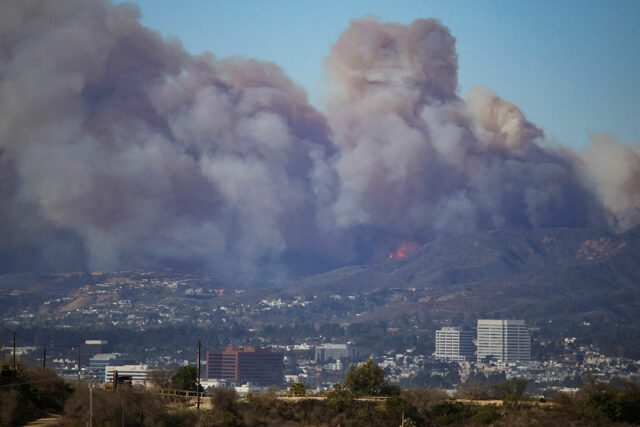
SMOKE rises from a wildfire burning near Pacific Palisades on the west side of Los Angeles during a weather driven windstorm, in Los Angeles, California, Jan. 7, 2025. — REUTERS

LOS ANGELES — A rapidly growing wildfire raged across an upscale section of Los Angeles on Tuesday, destroying homes and creating traffic jams as 30,000 people evacuated beneath huge plumes of smoke that covered much of the metropolitan area.

At least 2,921 acres (1,182 hectares) of the Pacific Palisades area between the coastal settlements of Santa Monica and Malibu had burned, officials said, after they had already warned of extreme fire danger from powerful winds that arrived following extended dry weather.

The fire spread as officials warned the worst wind conditions were expected to come overnight, leading to concerns that more neighborhoods could be forced to flee. The city of Santa Monica later ordered evacuations in the northern fringe of town.

Witnesses reported a number homes on fire with flames nearly scorching their cars when people fled the hills of Topanga Canyon, as the fire spread from there down to the Pacific Ocean.

“We feel very blessed at this point that there’s no injuries that are reported,” Los Angeles Fire Chief Kristin Crowley told a press conference, adding that more than 25,000 people in 10,000 homes were threatened.

Firefighters in aircraft scooped water from the sea to drop it on the nearby flames. Flames engulfed homes and bulldozers cleared abandoned vehicles from roads so emergency vehicles could pass, television images showed.

As the sun sets over Los Angeles, towering orange flames illuminated the hills leading to Topanga Canyon.

The fire singed some trees on the grounds of the Getty Villa, a museum loaded with priceless works of art, but the collection remained safe largely because of preventive efforts to trim brush surrounding the buildings, the museum said.

With only one major road leading from the canyon to the coast, and only one coastal highway leading to safety, traffic crawled to a halt, leading people to flee on foot.

Cindy Festa, a Pacific Palisades resident, said that as she evacuated out of the canyon, fires were “this close to the cars,” demonstrating with her thumb and forefinger.

“People left their cars on Palisades Drive. Burning up the hillside. The palm trees — everything is going,” Ms. Festa said from her car.

Before the fire started, the National Weather Service had issued its highest alert for extreme fire conditions for much of Los Angeles County from Tuesday through Thursday, predicting wind gusts of 50 to 80 mph (80 to 130 kph).

With low humidity and dry vegetation due to a lack of rain, the conditions were “about as bad as it gets in terms of fire weather,” the Los Angeles office of the National Weather Service said on X.

Governor Gavin Newsom, who declared a state of emergency, said the state positioned personnel, firetrucks and aircraft elsewhere in Southern California because of the fire danger to the wider region, he added.

“Hopefully, we’re wrong, but we’re anticipating other fires happening concurrently,” Mr. Newsom told the press conference.

A second blaze dubbed the Eaton Fire later broke out some 30 miles (50 km) inland in the foothills above Pasadena, consuming 200 acres (80 hectares), Cal Fire said.

The powerful winds changed President Joseph R. Biden’s travel plans, grounding Air Force One in Los Angeles. He had planned to make a short flight inland to the Coachella Valley for a ceremony to create two new national monuments in California but the event was rescheduled for a later date at the White House.

“I have offered any federal assistance that is needed to help suppress the terrible Pacific Palisades fire,” Mr. Biden said in statement. A federal grant had already been approved to help reimburse the state of California for its fire response, Mr. Biden said.

Pacific Palisades is home to several Hollywood stars. Actor James Woods said on X he was able to evacuate but added, “I do not know at this moment if our home is still standing.”

Actor Steve Guttenberg told KTLA television that friends of his were impeded from evacuating because others had abandoned their cars in the road.

“It’s really important for everybody to band together and don’t worry about your personal property. Just get out,” Mr. Guttenberg said. “Get your loved ones and get out.” — Reuters

US trade deficit with Vietnam soars beyond $110 billion, as weak dong boosts exports

A VIETNAM DONG note is seen in this illustration photo May 31, 2017. — REUTERS

HANOI — The US trade deficit with Vietnam exceeded $110 billion in the first 11 months of 2024, latest US figures show, as exports from the Southeast Asian industrial hub grew amid a record fall of its currency against the dollar.

The latest reading, released on Tuesday by the US statistics agency, showed a nearly 18% rise in the deficit compared with the same period the previous year. The data confirms the Communist-run country has the fourth highest commercial surplus with the United States, topped only by China, the European Union and Mexico.

The large gap is seen by analysts as a major risk for the export-reliant nation amid threats from President-elect Donald Trump to impose tariffs of up to 20% on all US imports.

That risk has been compounded by a sharp fall of Vietnam’s dong in recent months, with the dong trading near its lowest ever levels against the dollar. The trend is closely watched in Washington as Vietnam is one of the countries under scrutiny for potential currency manipulation.

Vietnam, which counts the US as its biggest market, is home to big export-focussed industrial operations of US multinationals such as Apple , Google, Nike  and Intel.

Latest seasonally adjusted trade figures show that in the January-November period Vietnam accumulated a commercial surplus with the US of $111.6 billion, up from $94.8 billion in the same period in 2023. Unadjusted data pointed to a larger gap of $113.1 billion.

In November, the trade gap expanded by another $11.3 billion, accelerating from October, as Vietnam’s exports to the US rose, the adjusted data show, possibly supported by the weak dong.

“If the US perceives that Vietnam is deliberately keeping the dong weak to gain an unfair trade advantage, it could trigger renewed accusations of currency manipulation,” said Leif Schneider, head of international law firm Luther in Vietnam.

Mr. Trump ended his first term in the White House with Treasury declarations of Vietnam and Switzerland as currency manipulators over their market interventions to weaken the value of their currencies.

Vietnam’s central bank has said it was ready to intervene in the foreign exchange market in case of adverse economic impacts from currency moves, and has sold dollars in the past to strengthen the dong.

On Tuesday, before new trade figures were released, the bank said it would monitor Mr. Trump’s policies and adjust accordingly.

The dong’s most recent depreciation against the dollar is broadly in line with other major currencies. — Reuters

EU warns of ‘serious blow’ from Trump on climate change

REUTERS

BRUSSELS — Global efforts to address climate change will be dealt a severe blow if US President-elect Donald Trump again pulls the country out of the Paris Agreement, the European Union’s (EU) head of climate change policy has warned.

Mr.Trump’s transition team has prepared executive orders to withdraw the United States — currently the world’s second-biggest polluter, after China — from the main global treaty on climate change, according to sources in the team.

“If that were to happen, that would be a serious blow for international climate diplomacy,” EU climate commissioner Wopke Hoekstra told Reuters in an interview.

Another US exit from the Paris Agreement would require other countries to “double down on climate diplomacy” in response, he said.

“There’s no alternative to make sure that, in the end, everyone chips in, because climate change is indiscriminate,” Mr. Hoekstra said of the United Nations (UN) climate talks. “This truly is a problem that the world needs to solve together.”

The Paris Agreement is the centerpiece of United Nations climate negotiations in which nearly 200 countries discuss steps to curb emissions and funding to pay for these efforts.

The US has played a central role in the talks, including by working with China — the world’s biggest polluter and second-biggest economy — to lay the groundwork for recent global climate deals.

A turnaround is expected under Mr. Trump, who returns to the White House on Jan. 20. He has called climate change a hoax, and withdrew from the Paris Accord during his first term from 2017 to 2021. Last month he warned the EU it must buy more US oil and gas or face tariffs.

Mr. Hoekstra said the EU will “constructively engage” with the new US administration on issues including climate change. He said the Commission is reaching out to US contacts across the political spectrum, including at the non-federal level.

“Making sure that our American friends, as much as is possible, are actually staying on board and are working on this together with us, is clearly something I will strive for,” he said.

But even as Brussels faces pressure to step up its climate leadership to fill a potential US vacuum, the EU is set to miss a February deadline for all countries to send new national climate plans to the U.N. The outgoing Biden administration already published the US’s contribution.

Mr. Hoekstra said the timings of the EU’s political cycle did not line up with the U.N. deadline but that Europe would have its 2035 climate plan ready by this year’s U.N. climate summit in November in Belem, Brazil.

“The important thing here is to make sure we have an ambitious number before we walk into Belem,” he said. “I can promise you that we will have.” — Reuters

Las Vegas Cybertruck suspect used ChatGPT to plan blast, police say

STOCK PHOTO | Image by Gerd Altmann from Pixabay

WASHINGTON — The suspected driver of the Tesla Cybertruck that exploded outside the Trump International Hotel in Las Vegas on New Year’s Day used popular chatbot ChatGPT to plan the blast, officials told reporters on Tuesday.

The suspect used ChatGPT to try and work out how much explosive was needed to trigger the blast, officials said.

Authorities last week identified the person found dead inside the Cybertruck as Matthew Livelsberger, 37, an active-duty Army soldier from Colorado Springs, and said he acted alone. The Feeral Bureau of Investigation says the incident appeared to be a case of suicide.

The Las Vegas Metropolitan Police Department said on Tuesday the Cybertruck blast was the first incident on US soil where ChatGPT had been used to build an explosive device.

Critics of artificial intelligence have warned it could be harnessed for harmful purposes, and the Las Vegas attack could add to that criticism.

“Of particular note, we also have clear evidence in this case now that the suspect used ChatGPT artificial intelligence (AI) to help plan his attack,” Sheriff Kevin McMahill of the Las Vegas Metropolitan Police Department told a press conference.

“This is the first incident that I am aware of on US soil where ChatGPT is utilized to help an individual build a particular device,” Mr. McMahill added.

CHATGPT WARNINGS
ChatGPT maker OpenAI said the company was “committed to seeing AI tools used responsibly” and that its “models are designed to refuse harmful instructions.”

“In this case, ChatGPT responded with information already publicly available on the internet and provided warnings against harmful or illegal activities,” the company said in a statement cited by Axios.

The FBI says there was no definitive link between a truck attack in New Orleans that killed more than a dozen people and the Cybertruck explosion, which left seven with minor injuries. They added the suspect had no animosity towards US President-elect Donald Trump and probably had post-traumatic stress disorder.

Mr. Livelsberger’s phone had a six-page manifesto that authorities were investigating, police said. — Reuters

Have a taste of the perfect day in paradise with SULÀ Spirits

SULA Spirits celebrates Filipino artistry with bottles that are as refined as the craft they hold.

Taste the story of this world-class Filipino sugarcane liqueur crafted from husk to heart

Have you ever wondered how the perfect day in paradise tastes? Imagine basking under the sun at the beach in the Philippines, with palm trees swaying gently, the white sand glistening, as do the crystal-clear cerulean waters out front. It’s an impeccable scene with an inimitable feeling, an essence, now captured in a bottle as SULÀ Spirits, the premium Filipino liqueur that presents a taste of paradise in a transformative experience.

SULÀ has been making waves by representing the very nature of the Philippines’ beauty and bounty. Crafted using only the finest 100% sugarcane sourced from the country’s most esteemed producers in Negros, the world-class coconut liqueur practices mindful consideration to both society and the environment. With its soulful nature delivered from husk to heart, and its tropical taste achieved by capturing the feeling of the beach to the bottle, SULÀ distinguishes itself as a proudly Filipino treasure that ought to be shared with the world.

Savor the taste of paradise and make every moment unforgettable with SULA.

Every sip is a celebration of natural goodness as SULÀ contains no preservatives. This purity shines through in each of the brand’s three products, top of which is the SULÀ Coconut Liqueur. Using coconuts sourced from the verdant fields of San Pablo, Laguna, its meticulous extraction process ensures that every note, every nuance, and every hint of coconut presents itself, creating a pure drinking experience that awakens the tropical spirit with its luxurious taste and soulful story.

SULA Chocolate Liqueur delivers velvety cacao tablea notes with a smooth luxurious taste.

Equally pure, rich, and proudly Filipino are the SULÀ Dark Chocolate Liqueur and SULÀ Coffee Liqueur, which are sure to delight even the most discerning connoisseurs. The SULÀ Dark Chocolate Liqueur opens a world of velvety taste from its key ingredient of handpicked ripe cacao pods from the fertile soils of Davao, presenting exceptional flavor and complexity.

Meanwhile, the SULÀ Coffee Liqueur features the harmonious fusion of premium spirits and the rich, aromatic essence of our locally grown coffee beans, including Benguet’s arabica, liberica or barako from Quezon province and Batangas, and Cavite’s robusta. These exceptional beans are hand-selected for their outstanding quality, ensuring a truly remarkable taste experience: the vibe of true Filipino locale, converted into an exceptional flavor.

SULA Coffee Liqueur blends rich-roasted flavors with a smooth indulgent finish.

Aside from SULÀ’s finely crafted premium liqueurs, its bottle, in itself, merits its own conversation as a piece of art. The design takes inspiration from the country’s “Pearl of the Orient” moniker, where its round bottle cap signifies the precious gemstone, as free-flowing accents mimic the waves of the Philippine seas.

By representing the best the country has to offer, SULÀ has found its way into the hands of guests in social gatherings as a product that champions the Philippines. Whether it’s enjoyed with friends at a local events or sipped on a foreign shore, SULÀ is a taste of home — a celebration of everything that makes the Philippines special.

For more information about SULÀ, visit drinksula.com. Follow SULÀ on social media at facebook.com/drinksula and instagram.com/drinksula.


Spotlight is BusinessWorld’s sponsored section that allows advertisers to amplify their brand and connect with BusinessWorld’s audience by publishing their stories on the BusinessWorld Web site. For more information, send an email to online@bworldonline.com.

Join us on Viber at https://bit.ly/3hv6bLA to get more updates and subscribe to BusinessWorld’s titles and get exclusive content through www.bworld-x.com.

First months of 2025 likely rainy amid La Niña conditions, says PAGASA

PAGASA Logo | https://www.pagasa.dost.gov.ph/

The Philippines is expected to experience above-normal rainfall conditions from January to March due to La Niña conditions, the Philippine Atmospheric, Geophysical and Astronomical Services Administration (PAGASA) said on Monday. 

According to recent data, cooler-than-average sea surface temperatures in the equatorial Pacific, observed since September, have strengthened and reached La Niña conditions by December. 

“It is likely that this La Niña condition will continue at least until JFM (January-February-March) 2025 season as suggested by several climate model,” PAGASA said in a press statement on Monday.  

Under La Niña conditions, the chance of heavy, above-normal rainfall in the country is likely, said by Ana Liza S. Solis, PAGASA’s Assistant Weather Services Chief and Chief of the Climate Monitoring and Prediction Section.   

So, makakaranas pa rin tayo ng maraming [We will still experience a lot of] rain-bearing weather systems due to the combined effects of La Niña-like conditions, Shearline, Intertropical Convergence Zone, Low Pressure Area, at kasama itong [and this includes] Northeast Monsoon activity,” Ms. Solis said in an interview.  

There is also an increased chance of tropical cyclone activity within the Philippine Area of Responsibility (PAR) during the forecast period, PAGASA said. 

“For 2025, yung first six months natin (during the first six months), we have forecasted around two to eight tropical cyclones, at least for the first quarter of the year from January to June,” Ms. Solis said.  

Ms. Solis noted that tropical cyclones are usually uncommon during the early months of the year. However, due to La Niña conditions, their occurrence is possible. She urged caution, particularly in areas such as Bicol Region, Eastern Visayas, Northern Mindanao, Palawan, and MIMAROPA.  

“Kailangang laging maging handa sa mga possible na mga changing weather patterns natin at this time of the year [We need to always be prepared for possible changes in our weather patterns during this time of the year],” Ms. Solis said.  

Apart from rainy conditions, colder temperatures are expected from January to February, Ms. Solis added, as the Northeast Monsoon remains in effect, particularly affecting the northern and central parts of Luzon and the eastern parts of the Visayas. Edg Adrian A. Eva

Spain says social media platforms such as Musk’s X must be neutral, not interfere

FREEPIK

 – Social media platforms should be neutral and not interfere in other nations’ political affairs, the Spanish government’s spokesperson said on Tuesday, after X’s CEO Elon Musk commented on statistics about foreigners jailed for rape in Spain.

Pilar Alegria was answering a question about the high-profile spat between the billionaire owner of X and European leaders such as Britain’s Keir Starmer and France’s Emmanuel Macron.

“We believe that these platforms must always act with absolute neutrality and above all, without interfering,” she told a news conference.

Mr. Musk, who is set to serve Donald Trump’s new administration as an outside adviser, waded into Spanish affairs on Sunday by commenting “Wow” while reposting an X post from the account Visegrad24 featuring a screenshot of an article on rape convictions in Spain’s northeastern region of Catalonia.

The article, originally published by La Razon newspaper on Sept. 27 of last year, carried the headline “91% of those convicted for rape in Catalonia are foreigners” and the subheading “Immigrants make up 17% of the region’s total population”.

A spokesperson for the Catalan region Justice Department confirmed to Reuters the data cited by the local media, adding that it was published at the beginning of last summer.

Data from Catalan authorities highlighted by La Razon showed that 22 out of the 24 people convicted or on remand on rape charges in Catalonia were non-Spanish citizens.

“We can’t allow democracy to fall into the hands of tech billionaires allied with the far right,” Catalonia’s Socialist regional leader, Salvador Illa, told an event in Barcelona later on Tuesday.

“We won’t allow anyone to use Catalonia’s name to spread hate speech,” Mr. Illa added, without explicitly naming Musk.

Spanish Prime Minister Pedro Sanchez, whose liberal stance on immigration is harshly criticized by far-right party Vox, has rejected any links between rates of immigration and crime and has said that “foreigners are neither better nor worse than Spaniards” in terms of criminality.

Spanish crime rates have either remained stable or diminished every year since 2011. A Spanish Interior Ministry report published in September concluded that “the immigration phenomenon is not having a negative or significant impact on crime rates”. – Reuters