THE Board of Investments (BoI) has become a district-level member of the Customs Industry Consultative and Advisory Council (CICAC), helping address investors’ customs-related concerns.
“CICAC bridges the gap between public and private stakeholders, particularly in trade facilitation,” BoI Investment Assistance Service (IAS) Director Ernesto C. delos Reyes, Jr. said via Viber.
“This synergy allows for the smooth entry and departure of goods, ensuring that timely delivery of shipments empowers businesses to thrive and reach their full potential,” he added.
At the meeting formalizing its membership, BoI officials met with Bureau of Customs officials from the Manila International Container Port on May 2.
“This partnership underscores our shared efforts in addressing challenges faced by investors, particularly importers, and promoting long-term, sustainable economic growth,” BoI IAS Executive Director Bobby G. Fondevilla said. — Justine Irish D. Tabile
ONLINE SELLERS from the Philippines are lagging the region in the adoption of artificial intelligence (AI), according to Lazada Philippines.
“Filipino sellers are on a slower adoption curve for AI vs. the rest of Southeast Asia, but we see that actual adoption is already currently focused on certain aspects of their business operations like customer service and marketing and advertising,” according to Pauline Castro, head of user product operations at Lazada Philippines.
“AI is helping Filipino sellers in the form of chatbots, order tracking, and multichannel interaction, as well as for predictive analytics, social media marketing, and content creation,” she added.
According to Lazada’s Bridging the AI Gap: Online Seller Perceptions and Adoption Trends in Southeast Asia report, 3% of the Filipino sellers said they avoid relying on AI, while 5% expressed caution.
Meanwhile, only 35% of the Filipinos said they fully embrace AI, lagging the 48% regional average.
In terms of actual AI adoption in businesses, the rate is 32% among Filipino sellers and 37% in Southeast Asia.
Ms. Castro said sellers from the Philippines face a number of challenges in AI adoption, as with other emerging technologies.
“About half of the surveyed Filipino sellers from our research indicate that they are unsure about the usefulness of the technology, as well as the cost and time required to adopt it,” she said.
“Filipino sellers also face challenges in transitioning from familiar, manual processes to AI-driven solutions; while nearly all sellers agree on the importance of upskilling, the majority concede that employees still prefer tools they are familiar with,” she added.
Some 80% of sellers from the Philippines consider AI to be critical in increasing productivity, while 91% see AI cost savings in the long run. The corresponding Southeast Asian averages are 89% and 93%, respectively.
“This disparity points to their dilemma of having short-term reservations while still believing in AI’s long-term gains,” said Ms. Castro.
The study also revealed that with high familiarity and caution towards AI, the Philippines sits in the yellow zone, which signifies the need for resources to be invested in infrastructure implementation.
“While infrastructure development trails behind, we still excel in AI tool knowledge, suggesting that a focus on infrastructure investment is needed to bridge the adoption gap,” she said.
However, she said the use of AI in inventory tracking and classification is a positive sign for the automation of infrastructure.
“Sellers could also consider investing in AI-powered surveillance and warehouse management to cement their foundation,” she added. — Justine Irish D. Tabile
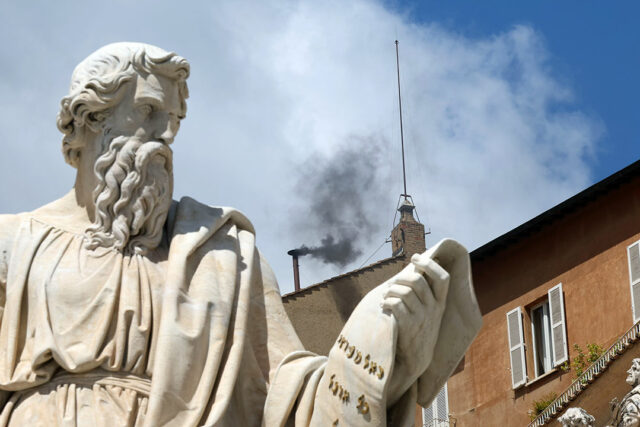
BLACK SMOKE in the third ballot. Second day of the Conclave, the Cardinals gathered in the Sistine Chapel vote for the election of the new pontiff successor to Pope Francis. — MARCO IACOBUCCI / IPA-AGENCY.NET/IPA/SIPA USA
VATICAN CITY — Black smoke billowed from a chimney atop the Sistine Chapel on Thursday, signaling that the cardinals locked in a conclave have not yet chosen a new pope to guide the Roman Catholic Church.
Thousands of faithful gathered in St. Peter’s Square waited for smoke to pour from the flue on the chapel’s roof, which it did shortly before noon (1000 GMT; 6 p.m. Manila time).
The 133 cardinals under the age of 80 began the heavily ritualised and secret process on Wednesday, shut away in complete isolation as they pick a successor to the late Pope Francis.
They burn the ballot papers and mix them with chemicals to show how proceedings are going — black signaling no pope and white announcing a new pontiff.
The cardinals held an initial inconclusive vote on Wednesday evening. They are scheduled to hold up to two more ballots on Thursday afternoon, with possible smoke signals expected some time after 5:30 p.m. (1530 GMT; 11:30 p.m. Manila time).
The red-hatted “princes of the Church” will keep on voting up to four times a day until someone wins a two-thirds majority.
No pope in modern times has been elected on the first attempt, so Wednesday’s black smoke was widely expected. But given recent history, a final result is possible from the second day.
Francis, the first pope from Latin America, was elected on the evening of the second day of the last conclave, held in 2013, as was his predecessor, Benedict XVI, in 2005. — Reuters
A WORKER folds an Indian flag at a workshop in India, Aug. 11, 2005. — REUTERS
MUMBAI — The latest conflict between India and Pakistan may impact New Delhi’s efforts to pitch itself as a safe haven for foreign investors amid global economic turmoil — but not much, investors and analysts said on Wednesday, as tensions ratcheted up between the nuclear-armed neighbors.
India’s $4-trillion economy has limited direct trade with Pakistan, and even its overnight cross-border missile strikes had little immediate impact on local equity, currency and bond markets, on the view that full-fledged conflict is unlikely.
“If there is a cessation of hostilities like there should be, pragmatically and practically, the investment climate may not actually be harmed,” said Ajay Marwaha, head of fixed income at Mumbai-headquartered investment house Nuvama Group.
Previous conflicts have not had a lasting impact on Indian assets, Citibank analysts wrote in a note on Wednesday.
In the last such flare-up with Pakistan, in February 2019, the Indian rupee held steady and bond yields rose 15 basis points over that month but retreated later.
In June 2020, when fighting broke out between Indian and Chinese troops in the Galwan valley, the rupee weakened 1% but regained ground as the two sides disengaged, Citi analysts said.
Since US President Donald J. Trump unveiled a slate of huge tariffs on his country’s trading partners, Indian markets have in fact performed well.
“The Indian market had begun to outperform on the back of the perception that there is some insulation from Trump tariffs given the strength of domestic consumption and a clear signal of monetary loosening from the central bank,” said Sat Dhura, portfolio manager at Janus Henderson Investors.
He acknowledged that: “Recent events are likely to keep foreign investors away,” but added that local investment flows are likely to be sticky, helping serve as a support to the markets.
India is expected to remain the fastest-growing major economy with the central bank forecasting gross domestic product growth of 6.5% this financial year. It is also among the best performing of the world’s big stock markets since early April, when Washington announced reciprocal tariffs on its trading partners, with the benchmark Nifty 50 rising 4.6% since then.
Foreign investors, who had heavily sold Indian stocks from last October to March of this year, turned buyers in April and early May purchasing about $1.5 billion. They remained sellers of Indian bonds, offloading $1.7 billion since the start of April.
UAE-based asset manager NAV Capital reckons that the geopolitical flare-up may temper immediate foreign portfolio flows into India but it expects global investors to remain invested in the country unless the latest conflict spirals.
FOCUS ON TRADE DEALS The focus, analysts said, remains on trade deals.
India sealed a long-negotiated trade agreement with the UK on Tuesday and discussions are ongoing for a bilateral trade agreement with the US.
“While sentiments are likely to be jittery in the immediate term, these tensions are unlikely to derail the medium-term appeal of the Indian economy,” said Radhika Rao, senior economist at DBS Bank in Singapore.
More “substantial developments” like the just-concluded India-UK trade deal, the impending agreement with the US and the central bank’s dovish policies will dictate the path of India’s growth trade outlook, Mr. Rao said.
As part of these trade negotiations, India plans to bring down high tariffs for raw materials which have prevented large-scale manufacturing to move to the country.
The impact of the conflict between India and Pakistan on any potential longer-term investment “may not be very much,” said Subhash Chandra Garg, a former top government bureaucrat.
The areas bordering Pakistan are in the north and west of India but most foreign investment for manufacturing facilities is centered in southern and central India, Mr. Garg noted. — Reuters
WASHINGTON — A US judge said any effort by the Trump administration to deport migrants to Libya would clearly violate a prior court order barring officials from swiftly deporting migrants to countries other than their own without first weighing whether they risk persecution or torture if sent there.
US District Judge Brian Murphy issued an order restricting their removal on Wednesday after Reuters, citing three US officials, reported on Tuesday that the Trump administration may for the first time deport migrants to Libya despite previous US condemnation of Libya’s harsh treatment of detainees.
Two of the officials said the US military could fly the migrants to the North African country as soon as Wednesday, but stressed that plans could change.
Reuters could not determine how many migrants would be sent to Libya or the nationalities of those the administration was eyeing for deportation, including whether any were Libyan nationals. The relatives of one Mexican national told Reuters he had been instructed to sign a document allowing for his deportation to the African nation.
Immigration rights advocates said in court filings that individuals potentially subject to deportation to Libya also included Filipino, Laotian and Vietnamese migrants.
When asked about the planned deportations, President Donald J. Trump said he did not know whether they were happening.
“You’ll have to ask Homeland Security,” Mr. Trump told reporters in the Oval Office on Wednesday.
The Pentagon referred queries to the White House. The White House and the Department of Homeland Security (DHS) did not respond to requests for comment.
A State Department spokesperson said: “We do not discuss the details of our diplomatic communications with other governments.”
Libya’s Government of National Unity said on Wednesday it rejected the use of Libyan territory as a destination for deporting migrants without its knowledge or consent. It also said there was no coordination with the United States regarding the transfer of migrants.
Khalifa Haftar’s Libyan National Army, which controls eastern Libya, also rejected the idea, saying in a statement that taking in migrants deported from the US “violates the sovereignty of the homeland.”
After news broke of the potential flight to Libya, lawyers for a group of migrants pursuing a class action lawsuit made an emergency request that Mr. Murphy block migrants from being deported to Libya or any country en route, including Saudi Arabia, without ensuring their due process rights were met.
Mr. Murphy, who was appointed by Democratic President Joseph R. Biden, wrote: “If there is any doubt — the Court sees none — the allegedly imminent removals, as reported by news agencies and as Plaintiffs seek to corroborate with class-member accounts and public information, would clearly violate this Court’s Order.”
The administration had recently argued that Mr. Murphy’s prior order only applied to DHS and not the Department of Defense, which US officials told Reuters would be involved in flying migrants to Libya.
Murphy said on Wednesday that DHS could not “evade” his order by transferring responsibility to the Defense Department or any other agency.
Mr. Trump, a Republican who made immigration a major issue during his election campaign, has launched aggressive enforcement action since taking office, surging troops to the southern border and pledging to deport millions of immigrants in the United States illegally.
As of Monday, the Trump administration had deported 152,000 people, according to DHS.
The administration has tried to encourage migrants to leave voluntarily by threatening steep fines, trying to strip away legal status and deporting migrants to notorious prisons in Guantanamo Bay and El Salvador.
MEXICO TO LIBYA Family members of a Mexican national said they feared he could be deported from the United States to Libya after he called them on Tuesday from immigration detention in Texas, saying he had been told to sign a document allowing for his deportation to the African nation.
Valentin Yah, 39, said several others of various nationalities at the immigration detention center in Pearsall, Texas, had been told to sign the same document, according to two of his family members.
His family members, who asked not to be identified for fear of retaliation, said he was pleading with immigration officials to be sent to Mexico on Tuesday, only about 100 miles (160 kilometers) from where he was detained.
“He’s literally closer to his hometown in Mexico and begging them to send him back,” one of his family members said.
Mr. Yah, an Indigenous Mexican from Yucatan, has a conviction for sexual abuse and served about 15 years in prison in the United States before being detained by immigration authorities, records show. He was ordered deported by an immigration judge in 2009, records show.
LIFE-THREATENING In its annual human rights report last year before Mr. Trump took office in January, the US State Department criticized Libya’s “harsh and life-threatening prison conditions.” The department advises US citizens against visiting due to “crime, civil unrest, kidnapping and armed conflict.”
Libya has had little peace since a 2011 NATO-backed uprising, and it split in 2014 between eastern and western factions, with rival administrations governing in each area. Major fighting ended with a truce in 2020, but the underlying political dispute remains and there are sporadic clashes.
US Secretary of State Marco Rubio last week hinted that Washington was looking to expand the number of countries where it may deport people beyond El Salvador.
“The further away from America, the better,” Mr. Rubio said at a cabinet meeting at the White House last Wednesday. — Reuters
AND the only Rookie-MVPs in UAAP history meet again.
National University’s (NU) Bella Belen and De La Salle University’s Angel Canino — the undisputed best collegiate players in today — star in a blockbuster bill for not only individual supremacy but lasting legacy for their respective schools.
The super senior Ms. Belen wants no less than an explosive exit with her second straight championship and third overall while the third-year Ms. Canino seeks a second one starting on Sunday for Game 1 of the best-of-three titular showdown at Ms. Belen is eyeing the team prize for NU in its fourth straight finals more than her individual glory that could propel her to the Mt. Rushmore of UAAP history.
Aside from a possible hat trick of championships, Ms. Belen is poised to win her second straight MVP and third overall to tie the legend Alyssa Valdez for the most in the UAAP women’s volleyball ever.
She started her reign by becoming the first-ever Rookie-MVP in Season 84 when the NU Lady Bulldogs completed a 16-0 sweep highlighted by a win against La Salle in the finals to end a 65-year title drought.
Ms. Belen then bowed to Ms. Canino, the second Rookie-MVP in Season 85, and La Salle before a redemption against University of Santo Tomas in Season 86.
Another win this season would cement Ms. Belen’s place in the list of the greatest UAAP players ever and would leave a dynasty intact in NU under new coach Sherwin Meneses.
But she is not keen on getting ahead.
It may be the third installment of the NU-La Salle modern day rivalry but Ms. Canino was still in high school during their first meeting and for her, only one thing matters and it’s the La Salle legacy under mentor Ramil de Jesus.
Mmess. Belen and Canino take the spotlight but Mr. De Jesus, in his 21st finals with 12 titles, and seven-time PVL champion but first-year NU mentor Mr. Meneses also offer interesting stories starting in the much-awaited Game 1. — John Bryan Ulanday
THE Philippines’ Jem Garcia and Pau Bersamina took the right path towards a FIDE World Cup ticket and a Grandmaster norm after pulling off giant-sized results at the start of the Asian Individual Chess Championships in Al Ain, United Arab Emirates (UAE) on Wednesday night.
Mr. Garcia pulled off one of the biggest upsets of the opening round after slaying 13th seed GM V Pranav of India in 40 moves of a King’s Indian duel while Mr. Bersamina eked out an equally stunning 80-move draw with top seed GM Nihai Sarin of India of a Sicilian duel.
Mr. Garcia outmaneuvered Mr. Pranav in the opening phase that allowed him to win the exchange and the match while Mr. Bersamina leaned on an outside-passed pawn that helped him extract the draw by repetition despite being a piece down.
Also coming through was another Filipino, GM Daniel Quizon, a 38-move winner over China’s Xu Pengmo in yet another King’s Indian encounter.
Messrs. Garcia, Bersamina and Quizon were clashing with Chinese International Master Chen Qi B, Uzbek GM Nodirbek Yakkubboev and Russian GM David Paravyan with all three seeking one of the 10 FIDE World Cup slots that are up for grabs in this nine-round meet.
It will be more important for Messrs. Garcia and Bersamina to excel as they are shooting GM norms.
In the women’s side, the country’s Woman Grand Master (WGM) Janelle Mae Frayna opened her World Cup return bid with a bang following a 38-move triumph over fellow WGM Manisha Mohanty Kiran of India in their Sicilian battle.
Ms. Frayna was eyeing another win versus Mongolian WGM Uurtsaikh Uuriintuya with hopes of claiming one of the two World Cup seats staked in their division.
It was a clinical win for Ms. Frayna as she managed to send her game into a winning endgame where she had a better pawn formation even though both have the same number of pawns. — Joey Villar
TWO-TIME Olympian Elreen Ando will spearhead the five-strong Philippine team seeing action in the Asian Weightlifting Championships unfurling on Saturday until May 15 in Jiangshan, China.
Ms. Ando is plunging into action in the women’s 64-kilogram division where she hopes to eventually secure a spot in the 2028 Los Angeles Olympics.
Also part of the squad are Kristel Macrohon (women’s 71kg), Fernando Agad, Jr. (men’s 55kg) and fast-rising sister tandem Rose Jean (W45kg) and Rosegie Ramos (W49kg).
Samahang Weightlifting ng Pilipinas(SWP) President Monico Puentevella on Thursday told The STAR that both Vanessa Sarno and John Ceniza, who competed in last year’s Paris Games with Ms. Ando, will not be around the national time possibly for a long time.
“Out indefinitely. They’re recuperating from injuries,” said Mr. Puentevella of Mmess. Sarno and Ceniza.
Mr. Puentevella did not elaborate.
Aside from the five waging war in Jiangshan, he said the country is putting its faith on their young guns that included Jhodie Peralta, who accounted for three of the 10 gold medals the country scooped up in the World Youth and Juniors Championships in Lima, Peru just a week ago.
“For the last five consecutive Olympics, the SWP always qualified and garnered the first Olympic gold for this country,” said Mr. Puentevella referring to Hidilyn Diaz-Naranjo’s historic mint.
“In three years time, a new group will try to grab a medal again in 2028 in LA,” he added. — Joey Villar
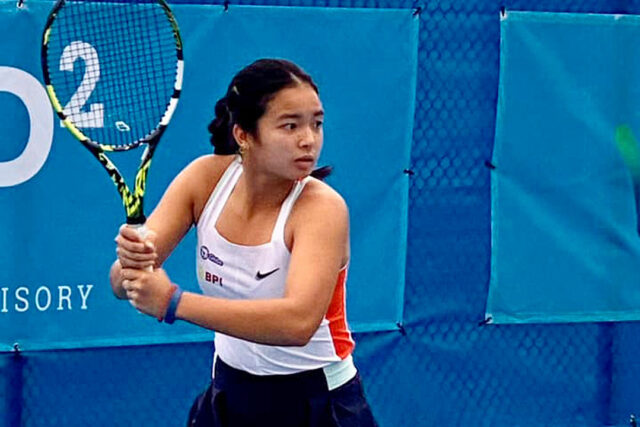
FILIPINA tennis ace Alex Eala — ALEX EALA FACEBOOK PAGE
ALEX EALA absorbed a near shutout against world No. 27 Marta Kostyuk of Ukraine, 6-0, 6-1, to bow out early in Round 1 of the Italian Open on Thursday.
Ms. Eala bled for just a game in the second set after being wiped out in the first, crashing out of Rome tourney in just a little over an hour of play.
The Italian Open serves as Ms. Eala’s final tourney before a much-awaited Grand Slam main draw debut in the French Open on May 25 to June 8 in Paris.
Ms. Kostyuk, 22, will face WTA No. 15and Italian Open No. 14 seed Daria Kasatkina of Australia in the Round of 64.
Still, there’s a silver lining for the 19-year-old Filipina pride, who will have a chance in the doubles with world No. 3 Coco Gauff of the United States.
The Filipina-American tandem will slug it out against Alexandra Panova of Russia and Fanny Stollar of Hungary in the Round of 64 on Friday.
Ms. Gauff is playing in the doubles first after gaining a bye in the singles of the Italian Open.
The 21-year old Ms. Gauff is a doubles champion in the 2024 French Open with Kateřina Siniaková of the Czech Republic, making it a strong chance for her and Ms. Eala in Rome.
Ms. Eala, for her part, won the girls’ doubles in the 2020 Australian Open with Priska Madelyn Nugroho of Indonesia and the 2021 French Open with Russian partner Oksana Selekhmeteva. — John Bryan Ulanday
SHAI GILGEOUS-ALEXANDER scored 34 points to lead the Oklahoma City Thunder to a 149-106 home blowout of the Denver Nuggets in Game 2 of their Western Conference semifinal series on Wednesday.
The Thunder, who set a franchise single-game playoff scoring record, tied the best-of-seven series 1-1 ahead of Game 3 in Denver on Friday.
After losing on a 3-pointer in the closing seconds of Game 1, the Thunder made sure the Nuggets wouldn’t have a chance to pull off another late shocker. Oklahoma City poured it on early, scoring 45 first-quarter points and stretching the lead to 24 just more than 10 minutes into the game.
The Thunder tied the NBA playoff record for points in a half with 87, leading by as many as 35 before intermission. The only other team to score 87 points in a half during the postseason was the Milwaukee Bucks in the second half of a second-round game in 1978 against the Nuggets.
Oklahoma City didn’t let up in the third quarter, stretching the advantage to 48 points heading into the fourth.
By that time, Denver star Nikola Jokic had fouled out, and the only question was how big the margin would be.
With Denver trailing by 41 points and just more than a minute remaining in the third quarter, Jokic was called for his second offensive foul in less than a minute to end his night.
After his 42-point, 22-rebound performance in Game 1, Jokic had just 17 points and eight rebounds in Game 2. He shot 6 of 16 from the field.
Gilgeous-Alexander had his night end soon after for another reason.
The Most Valuable Player favorite hit two free throws in the last second of the quarter before heading to the bench to watch the Thunder bench handle the fourth.
Gilgeous-Alexander finished 11 of 13 from the floor and hit all 11 of his free throws. He added eight assists and finished plus-51 in plus/minus.
Oklahoma City’s Jalen Williams added 17 points and Chet Holmgren, who missed a pair of critical free throws just before Aaron Gordon’s Game 1 winner, finished with 15 points and 11 rebounds. Holmgren was 7 of 7 from the free-throw line.
Russell Westbrook led the Nuggets with 19 points, and Jamal Murray contributed 14. Gordon, who had 22 points and 14 rebounds in the series opener, finished with just 10 points (on 3-of-12 shooting) and five boards. — Reuters
Two weeks ago, not a few Pacers fans were beside themselves in anger after The Athletic published an anonymous poll that pointed to Tyrese Haliburton as the most “overrated” player in the National Basketball Association. Not that the numbers were conclusive; only 90 of his so-called peers participated, and he topped the list with a 14.4% plurality. Neither was the methodology sound; after all, such multiple Most Valuable Player award winners as Giannis Antetokounmpo and LeBron James were named as well.
To be sure, Haliburton saw fit to view the news as a positive. “I must be doing something right if that’s the case,” he noted, rightly indicating the interplay of ego and jealousy for those who were counted in the survey. “I know who I am. I’m confident in my own skin and not worried what anybody thinks.” And why should he have been, really? He’s a two-time All-Star and reigning All-NBA selection that just earned a gold medal in the 2024 Paris Olympics as a bona fide member of Team USA.
That said, Haliburton was most definitely spurred to prove his worth in the aftermath. On the same day The Athletic’s piece went live, he put up 21 points and 12 assists to lead the Pacers to a second-straight victory over the Bucks. Since then, he has normed a remarkable 19.8 markers (on 51% shooting from the field, a good 400 basis points above his regular season average), 10.5 dimes, and 6.2 caroms. And, most importantly, he has steered the blue and gold to a 2-0 advantage versus the top-seed Cavaliers in the East semifinals.
To argue that Haliburton has given the lie to his “overrated” tag would be to understate how influential he has been to the Pacers’ playoff success to date. For good measure, he has been responsible for two game winners that all but underscored his capacity to deliver under pressure; one, a running lay-in over the outstretched arms of Antetokounmpo, sent the Bucks packing, and the other, a trey after a rebound off his own missed free throw, clinched yesterday’s set-to against the vaunted Cavaliers.
Bottom line, Haliburton is clutch. In the play-by-play era dating back to 1977, he and all-time-great LeBron James are the only players to have multiple go-ahead baskets in the last two seconds of a contest over a single playoff run. And, given the benefit of hindsight, the same fans who railed against The Athletic’s article are now thankful for it. Clearly, there’s no better Hali than a wronged Hali.
Anthony L. Cuaycong has been writing Courtside since BusinessWorld introduced a Sports section in 1994. He is a consultant on strategic planning, operations and human resources management, corporate communications, and business development.
HARIPHIL Asia Resources, Inc. (HARI), the Philippine distributor of Hyundai commercial vehicles (CV), has been one of the main drivers of the Philippine automotive industry, contributing to several sectors with their trucks and buses for the past 10 years. With the government aiming for 50% of all vehicle fleets to be electric by 2040 under a clean energy scenario, Hyundai Truck and Bus, one of several internationally acclaimed brands under HARI’s portfolio, takes the spotlight with its fleet of innovative electric vehicles (EVs) designed to support the country’s transition to sustainable mobility, including e-trucks, e-buses, and passenger models.
HARI showcased Hyundai’s latest innovations in commercial and public mobility at the Hyundai Truck and Bus EVolution expo last May 2 at Filinvest Alabang. During the event, the company launched three new vehicles to show its strong commitment to mobility and innovation: the Hyundai Mighty Electric, a light-duty electric truck; the Hyundai County Electric, Hyundai’s first electric minibus; and the HARI Cab, a locally assembled light-duty truck.
Mobility EVolution also served as a platform to connect and recognize exceptional transport cooperatives, fleet operators, and potential entrepreneurs. For the first time ever, Hyundai gave the first “Biyahenyo” award to the Magnificat Transport Cooperative, which displayed outstanding operational excellence in 2025. Similarly, the company honored the Tayug Pangasinan Transport Cooperative with a “Biyahero Award” for their compelling display of discipline, dedication, and heart.
“’Biyahenyo‘ embodies the heart of HARI CV’s advocacy,” HARI Vice-Chair, President and CEO Maria Fe Perez-Agudo said in a statement. “We want to reach out to all the entrepreneurs and so generate a wave of ‘Biyahenyos,’ empowered to uplift lives and to transform the transport industry with passion and purpose. And from this network of achievers, we hope to give rise to exceptional individuals whom we call Biyaheroes.”
In attendance at HARI’s grand launch of their future-forward commercial vehicles are (L-R) HARI Director, Treasurer, and Chief Finance Officer Ladislao Avila, Jr.; HARI Chair Richard L. Lee; HARI Vice-Chair, President, and CEO Maria Fe Perez-Agudo; and Hyundai Motor Company Asia-Pacific Vice-President Jun Heo.
Through its growing lineup of sustainable vehicles, strong after-sales service, and active engagement with key transport stakeholders, HARI is laying down the foundation for a cleaner, smarter, and more inclusive mobility future.
“Today marks an exhilarating milestone for HARI as we advance into a new era of our commercial vehicle business. Our enduring commitment to pioneering solutions has always centered on driving sustainable progress for enterprises,” Ms. Perez-Agudo said.
HARI’s CEO revealed to the media during the event that the company achieved a 27% growth rate last year compared to 2023, and it is aiming to sell 700 units for all the models that they have launched this year. She also underscored the role of mobility in the Philippines, highlighting its impact on major components of the country’s gross domestic product, such as consumption, investment, and net exports. In this regard, she shared that HARI’s business model for Hyundai CVs in the Philippines is designed for local conditions and the needs of the Filipino market.
“We emphasize affordability, easy maintenance, and nationwide after-sales support, including the availability of original parts and mobile service teams. By aligning with government programs and providing flexible financing, HARI ensures Hyundai vehicles are accessible and sustainable for micro, small, and medium enterprises (MSMEs) and transport cooperatives,” Ms. Perez-Agudo explained.
HARI’s CEO also delved into the efforts made by both the public and private sectors in pushing for electrification and a more sustainable transportation industry in the Philippines.
“Adopting EVs in the commercial vehicle industry will take time, yet the foundations for success are already being laid. A multi-sector approach is crucial to addressing concerns and hesitancy around electrification,” she said.
Some of the efforts by the government were lauded by Ms. Perez-Agudo, including tax incentives for consumers and manufacturers, efforts to reduce costs associated with EV adoptions, promoting local EV production to foster innovation and economic growth, as well as expanding a network of charging stations to support longer travel distances and wider accessibility.
“The infrastructure is low, so we will progress as the infrastructure improves faster. So that’s why the challenge for the private and public sector is to really improve the logistics and infrastructure development, which is through building more charging stations,” Ms. Perez-Agudo explained. “There should be some sense of balance between infrastructure development and the availability of electric vehicles.”
The HARI executive also acknowledged that the availability and sales of vehicles outpace the current infrastructure for EVs in the country for the time being. The government has its own infrastructure budget but is also encouraging private sector investment. While vehicle sales may currently be growing faster than infrastructure development, Ms. Perez-Agudo believes that infrastructure will eventually catch up. Hyundai and other stakeholders are already launching initiatives, and as these progress, they will also focus on building and developing their own infrastructure.
Lights On. The HARI Board and VIP guests herald HARI’s entry to the EV market with the symbolic lighting of the Hyundai Truck and Bus Mobility EVolution stage. (L-R) HARI Vice-Chairman, President, and CEO Maria Fe Perez-Agudo; DoTr Office of Transportation Cooperatives Chairman Reymundo D.J. de Guzman, Jr.; EVAP President Edmund Araga; Hyundai Motor Company Asia Pacific Vice-President Jun Heo; HARI Chairman Richard L. Lee; and HARI Director, Treasurer, and Chief Finance Officer, Ladislao Avila, Jr.
The future of electric vehicles in the Philippines, Ms. Perez-Agudo also stressed, may not be solely reliant on vehicle sales and infrastructure but also on the local manufacturing of key components, especially batteries.
“I think everybody needs to concentrate on the battery,” she said. “Because even if you manufacture these parts, if there’s no battery supply, then it will be challenging. I think it’s a whole ecosystem that we have to look at for this; but we’re not in a rush. The Philippines is at the best time right now to take advantage of some other issues that is happening around the world and capture the business from other parts of the world,” she said.
As for what lies ahead for HARI in the country, Ms. Perez-Agudo said HARI is focused on building brands under its portfolio, which includes the likes of Hyundai, Chevrolet, and Volvo. Car enthusiasts can expect more new models to come this year, as well as new dealerships to open across the archipelago.
“To achieve our goals, Team HARI and our dealership network continue to embrace and smartly invest in new technology to enhance operations while delivering customer satisfaction with ‘the heart’ that HARI is known for,” she said.
Spotlight is BusinessWorld’s sponsored section that allows advertisers to amplify their brand and connect with BusinessWorld’s audience by publishing their stories on the BusinessWorld Web site. For more information, send an email to online@bworldonline.com.
Join us on Viber at https://bit.ly/3hv6bLA to get more updates and subscribe to BusinessWorld’s titles and get exclusive content through www.bworld-x.com.