Home Blog Page 1617

FBI advocates appeal to Congress as agents face scrutiny for Jan 6 work

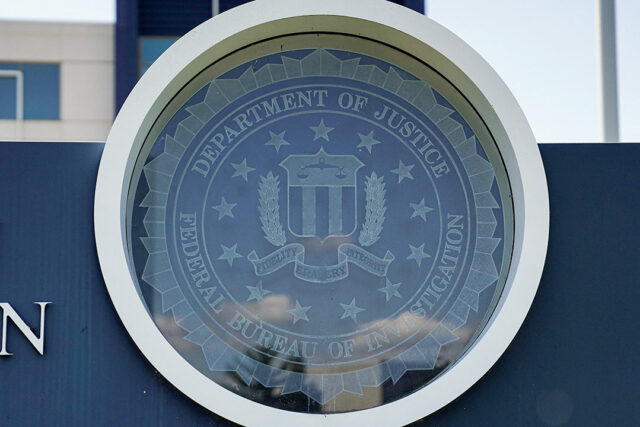
A VIEW shows the seal of the Federal Bureau of Investigation (FBI) outside of the FBI’s Cincinnati Field Office in Cincinnati, Ohio, US, Aug. 11, 2022. — REUTERS

 – Advocacy groups representing FBI agents appealed to the U.S. Congress on Monday to intervene to stop possible mass firings of agents who worked on the investigation of the Jan. 6, 2021 Capitol attack and other probes condemned by President Donald Trump.

In a letter to Republican and Democratic leaders in the Senate and House of Representatives, the groups warned that Trump-appointed leaders at the Justice Department were taking actions that imperiled the careers of thousands of FBI agents.

Republicans hold narrow majorities in both the chambers and have so far shown little interest in criticizing or reining in the administration’s actions.

A senior Justice Department official appointed by Mr. Trump asked the FBI to compile a list of employees who worked on cases related to the Capitol attack. FBI employees were ordered to fill out a questionnaire on Sunday detailing their work on those cases.

“We urge you to work with President Trump to prevent acting officials from taking personnel actions that undermine our shared goal of keeping the FBI out of politics,” the groups wrote in the letter. It was signed by the head of the FBI Agents Association, which represents 14,000 current and former special agents, and other law enforcement groups.

The directive has stoked fears that the Trump administration, which has already fired or reassigned dozens of Justice Department prosecutors and senior FBI officials, may take action against FBI agents who worked on the Capitol riot probe.

The Justice Department has not commented on the personnel moves. Officials have said some of the moves were aimed at employees who could not be trusted to carry out Trump’s agenda.

Separately on Monday, Senate Judiciary Committee Democrats wrote letters to Mr. Trump’s nominees to lead the Justice Department and FBI demanding records relating to the removal of career officials.

“We can only assume these decisions are intended to prevent the Department from investigating national security and public corruption, while also serving as political retribution against the President’s perceived enemies,” lawmakers led by Senator Dick Durbin wrote in the letter. – Reuters

Transatlantic trade war would hurt both sides, European leaders warn

RAWPIXEL

 – European leaders warned on Monday that U.S. President Donald Trump’s threat to expand tariffs to the EU risked igniting a trade war that would harm consumers on both sides of the Atlantic.

European Union foreign policy chief Kaja Kallas said if the U.S. and Europe started a trade war “then the one laughing on the side is China”.

European Commission head Ursula von der Leyen said the EU was aware of “potential challenges” in U.S. trade relations – a euphemism for new tariffs – but was ready for them.

“When targeted unfairly or arbitrarily, the European Union will respond firmly,” von der Leyen said following an informal gathering of EU leaders in Brussels.

She said EU leaders wanted to be pragmatic, engage early, discuss and negotiate with Washington if necessary. They knew the European economy had to become more competitive to have the necessary strength to handle any trade tensions, she said.

“The debate today in the room was about the principle, first of all, be prepared. And I can only say we are prepared,” she told a news conference.

EU diplomats said the 27-nation bloc had a range of possible responses to any U.S. action, but wanted to see what Trump’s next move was before finalizing anything and the aim for now was to avoid pouring fuel on the fire.

Trump said on Sunday the EU was next in line following his decision to impose sweeping tariffs on Mexico, Canada and China, but on Monday he paused the new tariffs on Mexico and Canada for one month. A senior European diplomat said it was hard to plan when dealing with someone “who is totally unpredictable”.

“It will definitely happen with the European Union. I can tell you that because they’ve really taken advantage of us,” Trump told reporters on Sunday, reiterating complaints about a trade deficit in goods with the EU.

“They don’t take our cars, they don’t take our farm products. They take almost nothing and we take everything from them.”


US CONSUMERS TO SUFFER

Germany’s conservative opposition leader Friedrich Merz, who is widely seen as the next German Chancellor after Feb 23 elections, said late on Sunday that tariffs risked backfiring.

“Trump will now also realize that the tariffs he is imposing will not have to be paid by those who import into America. They will have to be paid for by consumers in America,” he said.

French central bank governor Francois Villeroy de Galhau said Mr. Trump’s tariffs were “very brutal” and would hit the autos sector especially. “Everybody loses in this kind of protectionist trade war,” he told France Info radio.

Shares in European carmakers fell on Monday on concerns about the impact of tariffs. In his complaints about the trade balance with the EU, Trump has focused on goods trade alone.

The EU has consistently exported more goods to the United States than it has imported and the U.S. goods trade deficit stood at 155.8 billion euros ($159.5 billion) in 2023, according to Eurostat data.

However, in services, the U.S. has a surplus of exports over imports with the European Union of 104 billion euros in 2023, according to Eurostat. – Reuters

Young filmmakers shine: Pioneer Insurance honors Real to Reel Gen Z short film competition winners

Pioneer Group Head Lorenzo Chan, Jr. (leftmost) and Fire and Ice Entertainment CEO Liza Diño (rightmost) award the Grand Prize Winners of Pioneer’s Real to Reel: Gen Z Short Film Competition — (from L-R) Glenn Faller, Jerry Surpia, and Jaff Jaro from Leyte Normal University.

Pioneer Insurance showcased the creativity of the younger generation at the Real to Reel: Gen Z Short Film Competition Grand Finals held at Greenbelt Cinema 3, impressing a star-studded panel of judges and Gen Z audiences, online and in cinemas.

Ang Panawagan ni Googly, submitted by Jerry Surpia from Leyte Normal University, emerged as the top entry among over 120 submissions from Gen Z students representing top universities and public schools nationwide.

The winning film, starring a used plastic milk tea container named “Googly,” addresses the pressing issue of climate change in a unique way, highlighting pollution caused by the country’s waste problem.

Pioneer Group Head Lorenzo Chan, Jr., who served as one of the judges in the competition, shared his insights on the results, commending the vision of Gen Zs.

“It became clear today that two of the top concerns young people have about the future are, first, climate change — ranging from global warming to other related issues — and second, politics, including graft and corruption,” Mr. Chan said.

“These issues are clearly top of mind for them. What’s even more impressive is how they’ve tackled these topics in such creative ways, using drama, comedy, and other genres. I’m optimistic that these films will inspire the next-gen and viewers of all ages to work towards a better future,” he added.

Meanwhile, award-winning actress and CEO of Fire and Ice Entertainment, Liza Diño, who led the formidable panel, was particularly impressed at how outspoken the younger generation are regarding their stance on social issues.

“The competition revealed what these kids care about. They are very aware of social issues and want to make a difference,” Ms. Diño shared.

Fire and Ice CEO and President Liza Diño poses with the Real to Reel audience at the jam-packed Greenbelt Cinema 3. In photo are the esteemed judges, including director and Carlos Palanca awardee Chris Martinez, Unitel Straight Shooters Media, Inc. President and CEO Madonna Tarrayo, and Octopus & Whale Founder and CEO Joey Tiempo.

Aside from Mr. Chan and Ms. Diño, the panel of judges also included the multi-awarded director Chris Martinez, renowned for his exceptional work on various iconic Filipino movies like Ang Babae sa Septic Tank and the Kimmy Dora series; Madonna Tarrayo, President and CEO of Unitel Straight Shooters Media, Inc. and highly respected figure in film and television production; and Joey Tiempo, founder of the game and experience design agency Octopus & Whale and award-winning Creative who has judged and earned recognition from international creative competitions.

The second-place award was given to Calor by Troy Bryan Fontanar from Visayas State University, featuring “Quip,” a robot living underground in a climate-ravaged future embarking on a journey to witness the Earth’s remaining greenery.

Meanwhile, Trapo by Danreb Dela Cruz, Myro Andrada, and John Rhey Flores from Doña Montserrat Lopez Memorial High School was named third-placer for its sharp critique on traditional politics in the Philippines.

The short film Siya Na Walang Pangalan was also awarded as the Online Favorite after garnering the most number of likes on Pioneer Insurance’s Facebook page.

The film captures mental health through the lens of Leah Oliquino, Clare Puno, Jexel Keane Alejo, Gera Escobar, and Bien Bisenio from the University of the Philippines Baguio.

About Real to Reel

A decade after launching its first youth campaign, Pioneer Insurance proudly introduced Real to Reel, a short film competition that showcases the unique perspective of Gen Z on building a better future and inspiring action on today’s most pressing social issues.

It is the latest addition to Pioneer’s award-winning youth campaigns, following successful projects like the HeART for Tomorrow Mobile Photography and Art Competition (2019), Big Heart Shirt Design Competition (2018), Move On Lang Songwriting Competition (2017), Stories of Hope Playwriting Competition (2015), and Stories of Friendship Film Competition (2014).

More than just a competition, Real to Reel is part of Pioneer’s longstanding advocacy to empower the youth to take control of their future and make every moment count.

The top 10 entries are still available on Pioneer’s Facebook page, where interested viewers can watch them.


Spotlight is BusinessWorld’s sponsored section that allows advertisers to amplify their brand and connect with BusinessWorld’s audience by publishing their stories on the BusinessWorld Web site. For more information, send an email to online@bworldonline.com.

Join us on Viber at https://bit.ly/3hv6bLA to get more updates and subscribe to BusinessWorld’s titles and get exclusive content through www.bworld-x.com.

Trump pauses tariffs on Mexico and Canada, but not China

REUTERS

MEXICO CITY/WASHINGTON/OTTAWA – U.S. President Donald Trump suspended his threat of steep tariffs on Mexico and Canada on Monday, agreeing to a 30-day pause in return for concessions on border and crime enforcement with the two neighboring countries.

U.S. tariffs on China are still due to take effect within hours.

Both Canadian Prime Minister Justin Trudeau and Mexican President Claudia Sheinbaum said they had agreed to bolster border enforcement efforts in response to Trump’s demand to crack down on immigration and drug smuggling. That would pause 25% tariffs due to take effect on Tuesday for 30 days.

Canada agreed to deploy new technology and personnel along its border with the United States and launch cooperative efforts to fight organized crime, fentanyl smuggling and money laundering.

Mexico agreed to reinforce its northern border with 10,000 National Guard members to stem the flow of illegal migration and drugs.

The United States also made a commitment to prevent trafficking of high-powered weapons to Mexico, Sheinbaum said.

“As President, it is my responsibility to ensure the safety of ALL Americans, and I am doing just that. I am very pleased with this initial outcome,” Trump said on social media.

The agreements forestall, for now, the onset of a trade war that economists predicted would damage the economies of all involved and usher in higher prices for consumers.

After speaking by phone with both leaders, Trump said he would try to negotiate economic agreements over the coming month with the two largest U.S. trading partners, whose economies have become tightly intertwined with the United States since a landmark free-trade deal was struck in the 1990s.

CHINA TARIFFS STILL PLANNED
No such deal has emerged for China, which faces across-the-board tariffs of 10% that are poised to begin at 12:01 a.m. ET on Tuesday (0501 GMT). A White House spokesperson said Trump would not be speaking with Chinese President Xi Jinping until later in the week.

Trump warned he might increase tariffs on Beijing further.

“China hopefully is going to stop sending us fentanyl, and if they’re not, the tariffs are going to go substantially higher,” he said.

China has called fentanyl America’s problem and said it would challenge the tariffs at the World Trade Organization and take other countermeasures, but also left the door open for talks.

The latest twist in the saga sent the Canadian dollar soaring after slumping to its lowest in more than two decades. The news also gave U.S. stock index futures a lift after a day of losses on Wall Street.

Industry groups, fearful of disrupted supply chains, welcomed the pause.

“That’s very encouraging news,” said Chris Davison, who heads a trade group of Canadian canola producers. “We have a highly integrated industry that benefits both countries.”

Trump suggested on Sunday the 27-nation European Union would be his next target, but did not say when.

EU leaders at an informal summit in Brussels on Monday said Europe would be prepared to fight back if the U.S. imposes tariffs, but also called for reason and negotiation. The U.S. is the EU’s largest trade and investment partner.

Trump hinted that Britain, which left the EU in 2020, might be spared tariffs.

Trump acknowledged over the weekend that his tariffs could cause some short-term pain for U.S. consumers, but says they are needed to curb immigration and narcotics trafficking and spur domestic industries.

The tariffs as originally planned would cover almost half of all U.S. imports and would require the United States to more than double its own manufacturing output to cover the gap – an unfeasible task in the near term, ING analysts wrote.

Other analysts said the tariffs could throw Canada and Mexico into recession and trigger “stagflation” – high inflation, stagnant growth and elevated unemployment – at home. — Reuters

Manufacturing growth slows in Jan.

REUTERS

PHILIPPINE manufacturing activity continued to expand in January, albeit at the slowest pace in five months, S&P Global said on Monday.

The S&P Global Philippines Manufacturing Purchasing Managers’ Index (PMI) stood at 52.3 in January, easing from the 54.3 logged in December 2024. This was the lowest PMI reading in five months or since the 51.2 reading in August 2024.

In its report, S&P Global said the PMI reading signaled a “solid improvement” in manufacturing conditions in the Philippines.

Manufacturing Purchasing Managers’ Index (PMI) of select ASEAN economies, January 2025A PMI reading above 50 denotes better operating conditions than in the preceding month, while a reading below 50 shows a deterioration.

“The Filipino manufacturing sector started the year with a further and strong improvement in demand. Output grew again, albeit at a pace which notably weakened from December,” Maryam Baluch, economist at S&P Global Market Intelligence, said in a statement on Monday.

In January, the Philippines had the fastest PMI reading among six Association of Southeast Asian Nations (ASEAN) member countries ahead of Indonesia at 52.3.

A contraction in manufacturing activity was seen in Thailand (49.6), Vietnam (48.9),  Malaysia (48.7), and Myanmar (47.4).

Demand for Philippine-made goods improved in January, although the pace of growth slightly decelerated from the recent high observed in December, S&P Global said.

“Nevertheless, the rate of expansion in intakes of new orders remained historically robust, as firms reported that strong client demand and the acquisition of new customers drove increased sales,” it said.

S&P noted that solid demand trends drove manufacturing output higher, but January marked the second weakest in the current 10 consecutive months of growth.

This was attributed to competition and elevated raw material prices that constrained production.

However, an increase in production requirements prompted manufacturers to hike purchasing activity in January.

“Companies also focused on stock building, with both pre- and post-production inventories rising at historically strong rates during the latest survey period,” S&P said.

“Notably, stocks of finished goods recorded a fresh increase following a sharp decline in December.”

In January, supply chains remained under pressure. The lack of delivery trucks and port congestion prolonged the average lead times for inputs, S&P said.

The decline in vendor performance in January was the least pronounced in five months.

S&P Global said employment remained flat for the second consecutive month.

The increased sales enticed manufacturing companies to hire more workforce but was offset by reports of resignations, it said.

“Regarding prices, both cost burdens and output charges increased at similar, but historically subdued, rates,” S&P said, adding that high material and transportation costs drove up expenses which firms pass on to their clients.

For the coming year, manufacturers maintained a positive outlook, driven by expectations of stronger market demand and the upcoming election period. However, overall sentiment remained below the trend level.

“If demand trends continue to improve as they have done, then employment growth could be on the cards in the months ahead,” Ms. Baluch said.

Ms. Baluch said the election year will likely help drive growth in the manufacturing sector, citing the survey respondents.

“We could see 2025 shaping up to be another strong year of growth for the Philippines manufacturing sector with industrial production growth forecasted at 3.9% in 2025, up from 2.4% in 2024,” she said.

“In fact, the anticipation of greater demand has already prompted goods producers to increase their inventory levels.”

The Philippines will hold its midterm elections on May 12.

Rizal Commercial Banking Corp. Chief Economist Michael L. Ricafort said the slower pace in factory activity was partly due to “the seasonal decrease in demand and production activities upon crossing the new year after the Christmas holiday season.”

“Still relatively higher prices, interest rates, and weaker peso exchange rate vs. the US dollar since 2022 also partly weighed on demand and manufacturing activities,” Mr. Ricafort added.

He also said that increased government spending on infrastructure and some election-related spending could benefit some manufacturers that are part of the supply chains for various infrastructure projects.

In an e-mail, Pantheon Macroeconomics Chief Emerging Asia Economist Miguel Chanco said the Philippines remains as the region’s main outperformer but “hit a big speed bump.”

“Overall, the regionwide index for January was the softest print in 11 months; at best, its general slowdown is still stabilizing.”

ASEAN PMI stood at 50.4 in January, easing from 50.7 in December.

Mr. Chanco said headline reading will likely fall rather than improve, “as short-term leading indicators continue to weaken.” — Aubrey Rose A. Inosante

Food security emergency declared

Rice prices are displayed at a market in Manila, Feb. 1, 2025. — PHILIPPINE STAR/NOEL B. PABALATE

THE DEPARTMENT of Agriculture (DA) declared on Monday a food security emergency on rice, the latest effort by the government to lower the cost of the staple grain.

“This emergency declaration allows us to release rice buffer stocks held by the National Food Authority to stabilize prices and ensure that rice, a staple food for millions of Filipinos, remains accessible to consumers,” Agriculture Secretary Francisco P. Tiu-Laurel, Jr. said in a statement.

The DA cited the “extraordinary” increase in local rice prices despite the drop in global prices and the reduction in tariffs last July.

Last month, the National Price Coordinating Council approved the resolution urging the DA to declare a food security emergency for rice.

Under Republic Act No. 12708 or the Agricultural Tariffication Act, the Agriculture secretary can declare a food security emergency in case of rice supply shortages or extraordinary price spikes.

Under a food security emergency, the NFA would release its rice buffer stock to government agencies, local government units, and the KADIWA ng Pangulo program.

“The NFA currently holds a buffer stock of approximately 300,000 metric tons (MT) of rice, half of which could be released over the next six months to ensure sufficient supply for emergencies and disaster response,” the DA said.

“The NFA may increase this volume, if necessary, as it prepares to begin palay procurement in the coming weeks,” it added.

The department said the food security emergency “will remain in effect until the situation improves,” adding it will regularly review the situation.

Last week, the NFA said that it would release about 150,000 MT of rice stocks over a six-month period or 30,000 MT per month, allowing the NFA warehouses to free up space during the incoming harvest season.

President Ferdinand R. Marcos, Jr. last year issued Executive Order No. 62 which slashed tariffs on rice imports to 15% from 35% previously until 2028. This was aimed at lowering rice prices and tame inflation.

According to the DA’s price monitoring of Metro Manila markets as of Feb. 1, a kilo of imported special rice was priced between P52 and P61, compared with the P57 and P65 per kilo a year ago.

The price of imported premium rice stood at P51-P58 per kilo as of Feb. 1. from P54-P62 per kilo last year.

On the other hand, imported well-milled rice is currently between P40 and P52 per kilo, while imported regular milled rice is at P38 to P48 per kilo. — A.H.Halili

PHL unlikely to reach the upper end of 2025 target

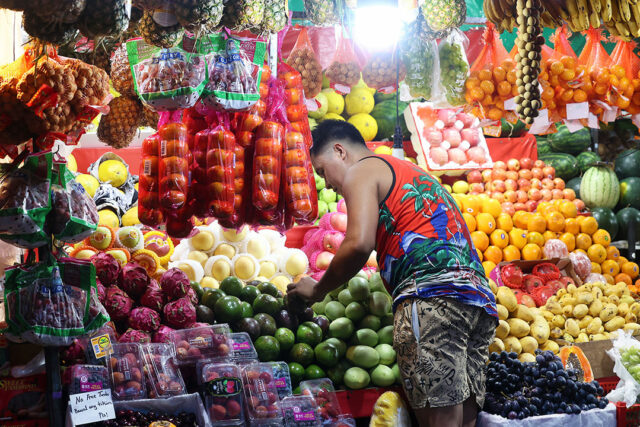
A man arranges fruits at a stall in Quezon City, Dec. 29, 2024. — PHILIPPINE STAR/MIGUEL DE GUZMAN

By Aubrey Rose A. Inosante, Reporter

THE PHILIPPINES may have difficulty achieving the upper end of the government’s 6-8% gross domestic product (GDP) growth target amid heightened global uncertainties this year.

Asked if the country could hit 8% growth this year, Finance Secretary Ralph G. Recto told BusinessWorld: “6-6.5% [growth] is doable for 2025.”

Mr. Recto, however, said the outlook will depend on “inflation, interest rates, and strength of US dollar.”

The Philippine economy expanded by 5.6% last year, slightly faster than 5.5% in 2023 but fell short of the government’s revised 6-6.5% target.

The National Economic and Development Authority earlier said the GDP growth was hampered by extreme weather events, geopolitical tensions, and subdued global demand — which is now considered as the “new normal.”

Multilateral lenders World Bank and the Asian Development Bank project the Philippines to grow by 6.1% and 6.2% in 2025.

In an e-mail interview with BusinessWorld, Ateneo School of Government Dean Philip Arnold “Randy” P. Tuaño said the Philippines will “face difficulty” meeting the 8% growth target.   

“It was relatively easy to achieve a 7% to 8% growth in the 2022-2023 period as we have been coming from a low-income base during the pandemic,” Mr. Tuaño said.   

“Even then, 5% to 6%, while a respectable rate of growth, would make it difficult to achieve significant growth in income among the middle class and vulnerable in the next few years,” he added. 

HSBC economist for ASEAN Aris D. Dacanay said that achieving an 8% growth rate is possible, but “a tall order.”

He cited global and domestic headwinds, including a sluggish Chinese economy, tariff risks, and climate-related impacts on the agricultural sector.

“This isn’t to say the Philippines won’t grow. Growing by 6.3%, we expect it to be one of Asia’s top performers in 2025 with the business process outsourcing sector (BPO), digitalization, and household consumption — sectors of the economy that are not subject to tariff risks — leading the charge,” he told BusinessWorld via e-mail.

In a note, Citi downgraded its 2025 GDP forecast to 5.9%, from 6% previously, after the weaker-than-expected growth momentum in 2024.

“Still, recent activity data such as income remittances  continue to suggest that domestic demand would remain well-supported. Commercial bank loans rose 11.1% year on year in November 2024 suggesting robust business activities and consumption growth… Furthermore, continued monetary easing and more moderate inflation are also expected to support domestic demand expansion in 2025,” Citi said.

MORE INVESTMENTS NEEDED
Mr. Recto said the upper end of the government’s target “can only be achieved if private investments double or triple.”

Department of Budget and Management (DBM) Principal Economist Joselito “Jojit” R. Basilio said the economy is likely to post 6-7% growth this year, although the upper end of the target “remains doable under certain circumstances.”

“Aside from the government’s continued ramping up of spending on public construction, recently approved PPPs (public-private partnership) projects should complement the aggressive ‘Build Better More’ program,” he said.

“But there are conditions that can push the economy to do more and grow by 7% to 8% in 2025,” he added.

Rizal Commercial Banking Corp. Chief Economist Michael L. Ricafort said hitting the upper end of the 2025 goal is a “long shot, realistically.”

“This would require more foreign and local investments, more tourists especially foreign, more merchandise exports that all generate more jobs and other economic opportunities that lead to higher per capita income,” he said.

To drive faster growth this year, Mr. Tuaño said the government should accelerate infrastructure projects and push regulatory reforms to boost investments, especially outside of the main urban centers.

The government should also invest in human resource development via education, healthcare, technological upgrading, and boost small businesses to drive growth, he said.

“Some potential opportunities for growth include stronger consumption driven by remittance growth and continuous expansion of services, and also the rebound of tourism,” Mr. Tuaño said.

Citi said continued policy easing by the Bangko Sentral ng Pilipinas will support GDP growth this year. It maintained its expectation for a 25-basis-point (bp) rate cut this month.

“We expect the BSP to cut again in June and August, skipping April, partly to ascertain a few outcomes, including the potential increase of US tariffs and possible impact on global trade and US dollar-Philippine peso, the Fed’s rate cut decisions, the Philippines’ midterm election campaigning’s potential positive impact on domestic demand (although investment may see some delays from the 45-day pre-election ban on project disbursement) etc,” Citi said.

The Monetary Board has cut benchmark borrowing costs by a total of 75 bps since it began its easing cycle in August 2024, bringing its key rate to 5.75%.

Mr. Basilio said private consumption is expected to recover strongly, increasing by 6% in 2025 due to stabilized inflation and lower interest rates.

“The domestic demand is also anticipated to shift from ‘being subdued’ to one of gaining its momentum,” he said.

Mr. Basilio also noted that agricultural output is anticipated to make “a strong rebound” this year.

However, Mr. Dacanay said relying on fiscal and monetary policy to boost growth will be difficult.

“The government is in the midst of consolidating its fiscal resources from the pandemic, while the Federal Reserve puts a floor under how much the Bangko Sentral ng Pilipinas can cut policy rates to boost growth,” Mr. Dacanay said.

RISKS TO THE OUTLOOK
Analysts cited geopolitical tensions and uncertainty as one of the downside risks to the Philippines’ economic outlook.

“Downside risks include geopolitical risks and uncertainties in global trade markets, considering further that goods export sector performance has been relatively anemic,” DBM’s Mr. Basilio said.

Mr. Tuaño said other downside risks include slower export growth due to “tariff escalation in the developed world… and natural disasters taking a toll on productive labor and capital.”

On the other hand, key upside risks include improved labor market conditions and election spending.

“For the current year, election spending is expected to result in increased economic activities, including advertising and campaign-related expenses in transport, hospitality, retail trade and others,” DBM’s Mr. Basilio said. — with inputs from Aaron Michael C. Sy

BSP: Shift from ‘obsolete’ OTPs to more secure methods needed

By Luisa Maria Jacinta C. Jocson, Reporter

THE BANGKO SENTRAL ng Pilipinas (BSP) is seeking to veer away from the use of one-time passwords (OTPs) in favor of more secure and advanced authentication methods.

“Our objective is to make it future proof. You know how technology is. If you say that what we have right now is efficient, then by next week or next year, it may no longer be,” BSP Deputy Governor Elmore O. Capule said in a seminar over the weekend.

“We are encouraging the banks to go on a higher level of protection. While what we have now may be sufficient for now, we want them to continually upgrade,” he added.

The BSP said OTPs as an authentication method are becoming “obsolete.”

Other central banks in the region, like Singapore, have begun to gradually phase out OTPs as a means for bank account logins, amid increasing instances of financial scams such as phishing.

“That’s where we are coming from, we are looking at banks having more sophisticated methods,” Mr. Capule added.

The BSP recently released a draft circular seeking to strengthen the regulatory framework on IT risk management of banks and nonbanks.

Under the draft rules, the central bank is seeking to limit the use of interceptable authentication mechanisms, such as OTPs through short message service (SMS) or e-mail, as these can be shared or intercepted by third parties.

It cited the “increasing prevalence of social engineering attacks aimed at obtaining login credentials.”

“Our basis is it really depends on how sophisticated your system and the bank are. Like if we’re talking about a rural bank or thrift bank, perhaps we will be satisfied with the OTPs,” Mr. Capule said.

“But if you are looking at, let’s say, digital banks, then being a digital bank means your system should be more robust and more advanced. So, we are trying to influence their behavior.”

Mr. Capule said the goal is to eventually veer away from OTPs to adopt more advanced security methods.

The central bank will need to consult with the industry to discuss the transition, he added.

“Of course, we have to listen to them, realistically, how long will it take you to change technology,” he added.

CHALLENGES
Meanwhile, analysts said moving away from the use of OTPs will help strengthen the security of the banking system but noted implementation will be difficult given the lack of technology and infrastructure.

“Transitioning from OTPs to more secure methods like biometric authentication, behavioral biometrics, and passwordless systems could significantly reduce risks,” said Dominic Vincent D. Ligot, founder of Cirrolytix, and AI, technology and research consultant for the IT and Business Process Association of the Philippines.

“However, the implementation of such technologies is not without its challenges. The cost and infrastructure required to deploy these advanced security measures can be substantial, and not all institutions may be equipped to handle such an overhaul promptly.”

Fintech Alliance.PH Founding Chairman and Rizal Commercial Banking Corp. Executive Vice-President and Chief Innovation and Inclusion Officer Angelito “Lito” M. Villanueva said the move to limit OTP is “critical.”

“Relying on SMS or e-mail for OTPs is no longer sustainable, as these methods are inherently susceptible to interception, phishing, and SIM-swapping attacks,” he said.

Ronald B. Gustilo, national campaigner for Digital Pinoys, said the proposed rules are a significant step to address security vulnerabilities in the system.

OTPs offer a basic level of protection but are not foolproof, he added.

“It’s susceptible to interception, which is a weak link, especially when paired with the limited cybersecurity awareness of some users,” Mr. Gustilo said.

Cybersecurity firm Kaspersky reported that the Philippines recorded the highest number of financial phishing attempts targeting business devices in Southeast Asia in 2023.

Earlier data from the BSP also showed that 59.48% of cyber fraud losses among BSP-supervised financial institutions (BSFIs) in 2023 were attributed to account takeovers, identity theft, and phishing.

Overall, cyber fraud losses surged by 212% compared with 2022.

Instead of OTPs, the BSP is pushing to shift to stronger authentication mechanisms such as biometric authentication, behavioral biometrics, passwordless authentication, and AI.

“BSP’s recommendations for alternative authentication methods, such as biometric and passwordless systems, are certainly forward-looking. These methods are harder to replicate or intercept, making them more secure,” Mr. Gustilo said.

However, adopting these methods will be costly and difficult to implement.

“The transition to these methods will require investments in infrastructure, user education, and regulatory support. It is a necessary shift, though, as it ensures the security and trust of the financial system in the long run,” Mr. Gustilo said.

“While transitioning to these advanced methods may require significant investment and user education, the long-term benefits far outweigh the costs,” Mr. Villanueva said.

Among the security features mentioned by the central bank, Mr. Gustilo said biometric authentication would likely be the easiest to implement.

For example, biometric authentication such as fingerprint or facial recognition is already being used as a security measure for mobile devices.

“Biometric authentication is the most realistic and immediate solution for many BSFIs as most smartphones already support these features,” he said.

“Other options such as passwordless authentication could also be implemented relatively quickly, especially for financial institutions that already leverage apps and digital ecosystems.”

Allan S. Cabanlong, regional director for Southeast Asia at the Global Forum on Cyber Expertise, also noted the need to be inclusive when implementing these technologies, citing its availability to the general public.

“For example, what if the user does not have a cellphone capable of doing that, then they have no other option to use OTP,” Mr. Cabanlong said in mixed English and Filipino via phone call.

There are still many consumers that do use devices capable of utilizing biometrics, he added.

Mr. Cabanlong also raised concern about how registration processes would go, as most rely on OTP.

“Assuming there’s no OTP, how would you register new users? What is the authentication method if there’s no OTP? There is still a need for KYC (Know Your Customer) in the registration.”

STRENGTHEN THE SYSTEM
In the meantime, the central bank can also push to strengthen OTP systems.

“Enhancing the security features of OTPs — for instance, by including more transaction details in the messages — can be a useful interim measure,” Mr. Ligot said.

“It could help in ensuring that even if an OTP is intercepted, the lack of contextual data would make it harder to misuse.”

Under the draft rules, the BSP also called for OTP messages to be more personalized and contain sufficient transaction details to allow the customers to accurately identify or verify the transaction.

Analysts said institutions must also put the effort to educate the public on how to be more vigilant against these cyberattacks.

“Ultimately, educating users on the proper management of their digital credentials and the handling of authentication messages is crucial. Awareness and vigilance can significantly mitigate the risks associated with OTPs and other forms of digital authentication,” Mr. Ligot said.

Mr. Villanueva said organizations must adopt “a proactive approach to stay ahead of cybercriminals.”

“This includes continuous monitoring, regular security audits, and fostering a culture of cybersecurity awareness among users,” Mr. Villanueva said.

“By phasing out outdated authentication methods and embracing modern, resilient technologies, we can significantly mitigate the risks posed by social engineering and other evolving threats.”


PCCI opposes P200 daily wage hike

Workers are seen at a construction site along Commonwealth Ave in Quezon City, Jan. 30, 2025. — PHILIPPINE STAR/NOEL B. PABALATE

THE PHILIPPINE Chamber of Commerce and Industry (PCCI) is opposing the proposed P200 across-the-board daily minimum wage hike for workers.

“A blanket national minimum wage (hike) does not take into account the differences in the cost of living across regions as well as the unique needs of businesses based on the specific industry, location, and type of labor they need. Cities have higher costs of living versus rural areas,” said PCCI President Enunina V. Mangio in a statement on Monday.

The business group’s statement came after a House Committee on Labor approved last week a bill that will grant a P200 across-the-board wage increase for private-sector workers.

“Legislating a single wage for all areas can harm businesses in lower-cost regions and remove the flexibility of the Regional Wage Boards to set wages that are aligned with the situation in the local areas. This could lead to business inefficiency and stagnation,” Ms. Mangio said.

According to the PCCI, Congress should leave the determination of wage hikes to the Regional Wage Boards, which were “created and designed to set region-specific rates based on the local cost of living.”

Ms. Mangio said that although the wage hike is meant to improve the livelihood of workers, it is expected to lead to higher labor costs, which may lead to a spike in the cost of goods and services.

“Micro, small, and medium enterprises (MSMEs) are already operating on tight margins. The mandated wage hike will force these small enterprises to shoulder higher payroll expenses,” she said.

“For some businesses, particularly those in low-margin industries like retail, hospitality, and agri-food, the wage increase forces them to pass on the cost to consumers,” she added.

This inflationary effect, she said, will erode purchasing power, which will negate the intended benefit of the wage increase while reducing jobs in the market.

“Making everyday items more expensive will simply offset the benefits of a higher wage, especially for workers in the low-income brackets. But the inflationary effect will bear down more on workers in the informal sector who are not bound by the minimum wage law,” she added.

The PCCI noted the across-the-board wage increase is expected to push microenterprises to shift operations to the informal sector to cut costs.

Only 25-30% or 10-12 million of the total employed workforce are in the formal sector, while the informal sector accounts for 40-50%, representing 15-20 million workers.

“A legislated minimum wage hike not only exacerbates the already rising cost of goods and unemployment but also fails to provide long-term solutions for productivity and competitiveness,” said PCCI.

“Instead of legislating wages, our wage policy should have a comprehensive approach that balances the needs of workers with the capacity of businesses and ensures that MSMEs continue to thrive while still providing fair wages,” it added. — Justine Irish D. Tabile

Beyoncé wins top Grammys prize for first time with Cowboy Carter

BEYONCÉ receives Album of the Year award for Cowboy Carter during the 67th Annual Grammy Awards in Los Angeles, California, Feb. 2, 2025. — REUTERS/MARIO ANZUONI

LOS ANGELES — Beyoncé won the top prize at music’s Grammy Awards on Sunday, taking album of the year for the first time in her career with her country album Cowboy Carter.

The superstar singer triumphed over Taylor Swift, Billie Eilish, and others to claim the trophy that had eluded her even as she collected more lifetime Grammys than any other artist.

“I just feel very full and very honored. It’s been many, many years,” Beyoncé said on stage on Sunday.

Rapper Kendrick Lamar claimed record of the year and song of the year for “Not Like Us,” a diss track in his feud with Canadian rapper and singer Drake.

“Pink Pony Club” singer Chappell Roan was named best new artist and used her time on stage to urge record labels to pay musicians a living wage with healthcare benefits. She recalled a time when she felt “dehumanized” to not have health insurance. “Labels — we got you, but do you got us?” she said.

This year’s Grammy festivities were revamped to be part awards show and part fundraiser for people affected by the wildfires, which were contained on Friday after killing 29 people and displacing thousands including many musicians.

Broadcast live on CBS, the show opened with an all-star rendition of “I Love LA” featuring Altadena-based band Dawes backed by John Legend, Brad Paisley, St. Vincent, and Brittany Howard.

“Tonight, we decided we are not just celebrating our favorite music. We are also celebrating the city that brought us so much of that music,” said host Trevor Noah, who directed viewers to donation options throughout the show.

Grammy winners are chosen by the 13,000 singers, songwriters, producers, engineers and others who make up the Recording Academy. — Reuters


Grammys 2025: And the winners are…

LOS ANGELES — The 67th Grammy Awards, the highest honors in the US music industry, were handed out at a ceremony on Sunday, broadcast on CBS and hosted by Trevor Noah.

The following are the winners in the televised ceremony.

Album of the Year Cowboy Carter, Beyoncé

Record of the Year — “Not Like Us,” Kendrick Lamar

Song of the Year — “Not Like Us,” Kendrick Lamar

Best New Artist — Chappell Roan

Best Pop Vocal Album Short n’ Sweet, Sabrina Carpenter

Best Pop Duo/Group Performance — “Die With A Smile,” Lady Gaga and Bruno Mars

Best Latin Pop AlbumLas Mujeres Ya No Lloran, Shakira

Best Country Album Cowboy Carter, Beyoncé

Best Rap Album Alligator Bites Never Heal, Doechii

Senate OKs Meralco franchise bill on final reading

PHILIPPINE STAR/RYAN BALDEMOR

THE SENATE on Monday approved on third and final reading a proposed measure that will extend Manila Electric Co.’s (Meralco) franchise for another 25 years.

With an 18-1-0 vote, senators approved House Bill No. 10926, which will allow the power provider to continue constructing, operating, and maintaining its electric distribution systems in areas such as Metro Manila, Bulacan, Cavite, Laguna, Batangas, and Rizal.

“We believe that we can improve Meralco’s services and provide better and more reasonable electricity prices,” Senator Emmanuel Joel J. Villanueva, who sponsored the measure, told the plenary following the approval.

“So again, we stand by our ‘yes’ vote knowing that this measure not only renews a franchise but also strengthens our country’s energy security and consumer rights.”

Under the bill, Meralco will have to allow Filipinos to hold at least 30% of its outstanding capital stock, or a higher percentage, or face franchise revocation.

It must also submit an annual report of its finances and operations to the Philippine Congress by April 30 after the measure takes effect. The report must include details on its rollout of services, audited financial statements, and plans to expand its business.

The power distributor may face a fine of P1 million for each working day of noncompliance if it fails to submit the yearly report.

Under the Electric Power Industry Reform Act (EPIRA) of 2001, power suppliers are mandated to ensure a reliable supply of electricity in a “least-cost manner” or at reasonable rates.

In his third address to Congress in July last year, President Ferdinand R. Marcos Jr. sought a review of EPIRA to address issues affecting the energy sector, particularly high energy prices.

Meralco’s controlling stakeholder, Beacon Electric Asset Holdings, Inc., is partly owned by PLDT, Inc. Hastings Holdings, Inc., a unit of PLDT Beneficial Trust Fund subsidiary MediaQuest Holdings, Inc., has an interest in BusinessWorld through the Philippine Star Group, which it controls. — John Victor D. Ordoñez

Bagets musical adaptation in the works

THE POSTER of the original 1984 movie Bagets. A theater adaptation is in the works.

THE HIT 1984 comedy film Bagets will be given new life through a stage adaptation, Bagets the Musical, the show’s producers announced on Friday.

The musical centers on five friends who are coming of age, played in the original film by Aga Muhlach, William Martinez, JC Bonnin, Herbert Bautista, and Raymond Lauchengco.

Set to arrive in 2026, the theater project is produced by Viva Communications, Inc., and the Philstar Media Group through Philstar Next, its division that handles ventures beyond news publishing.

Philstar Media Group Executive Vice-President Lucien C. Dy Tioco said in a Facebook post that the agreement is for the two companies to “co-produce an adaptation of one of the iconic films that defined the ’80s generation.”

Present at the contract signing on Friday were Mr. Dy Tioco, Philstar Media Group President and Chief Executive Officer Miguel G. Belmonte, Viva Communications Chairman and Chief Executive Officer Vicente R. del Rosario, Jr., and Viva Communications President and Chief Operating Officer Vincent G. del Rosario III.

While the cast and crew behind the musical are still being organized, the producers have revealed that audiencegoers can expect it to hit the stage by the first quarter of 2026. — BHL