Home Blog Page 1598

US lawmaker targets Nvidia chip smuggling to China with new bill

 – A U.S. lawmaker plans to introduce legislation in coming weeks to verify the location of artificial-intelligence chips like those made by Nvidia NVDA after they are sold.

The effort to keep tabs on the chips, which drew bipartisan support from U.S. lawmakers, aims to address reports of widespread smuggling of Nvidia’s chips into China in violation of U.S. export control laws.

Nvidia’s chips are a critical ingredient for creating AI systems such as chatbots, image generators and more specialized ones that can help craft biological weapons. Both President Donald Trump and his predecessor, Joe Biden, have implemented progressively tighter export controls of Nvidia’s chips to China.

In Nvidia’s last fiscal year that ended on January 26, China generated $17 billion in revenue, or 13% of the company’s total sales.

But Reuters and other news organizations have documented how some of those chips have continued to flow into China, and Nvidia has publicly claimed it cannot track its products after they are sold.

U.S. Representative Bill Foster, a Democrat from Illinois who once worked as a particle physicist, said the technology to track chips after they are sold is readily available, with much of it already built in to Nvidia’s chips. Independent technical experts interviewed by Reuters agreed.

Mr. Foster, who successfully designed multiple computer chips during his scientific career, plans to introduce in coming weeks a bill that would direct U.S. regulators to come up with rules in two key areas: Tracking chips to ensure they are where they are authorized to be under export control licenses, and preventing those chips from booting up if they are not properly licensed under export controls.

Mr. Foster told Reuters that there are already credible reports – some of which have not been publicly disclosed – of chip smuggling occurring on a large scale.

“This is not an imaginary future problem,” Mr. Foster told Reuters. “It is a problem now, and at some point we’re going to discover that the Chinese Communist Party, or their military, is busy designing weapons using large arrays of chips, or even just working on (artificial general intelligence), which is as immediate as nuclear technology.”

Nvidia declined to comment for this story.

Chip smuggling has taken on new urgency after the emergence of China’s DeepSeek, whose AI systems posed a strong challenge to U.S. systems and were built with Nvidia chips that were prohibited for sale to China, according to analyst firm SemiAnalysis. Prosecutors in Singapore have charged three people, including one Chinese national, with fraud in a case that involved servers that may have contained Nvidia chips.

Though it has not been put into broad use, the technology to verify the location of chips already exists. Alphabet’s Google already tracks the location of its in-house AI chips and others in its vast network of data centers for security purposes, according to two sources with direct knowledge of its operations.

Google did not respond to a request for comment.

Foster’s legislation would give the U.S. Department of Commerce six months to come up with regulations to require the technology.


BIPARTISAN SUPPORT

Mr. Foster’s bill has support from fellow Democrats such as Representative Raja Krishnamoorthi, the ranking member on the House Select Committee on China. “On-chip location verification is one creative solution we should explore to stop this smuggling,” Krishnamoorthi said in a statement.

Republicans are also supportive, though none have yet signed on to specific legislation because it has not yet been introduced. Representative John Moolenaar, who chairs the committee, supports the concept of location tracking and plans to meet with lawmakers in both the House and U.S. Senate this week on potential legislative approaches.

“The Select Committee has strong bipartisan support for requiring companies like Nvidia to build location-tracking into their high-powered AI chips — and the technology to do it already exists,” Mr. Moolenaar told Reuters.

The technology for verifying the location of chips would rely on the chips communicating with a secured computer server that would use the length of time it takes for the signal to reach the server to verify where chips are, a concept that relies on knowing that computer signals move at the speed of light.

Tim Fist, a former engineer and director of emerging technology policy at Washington think tank Institute for Progress, said such tracking would provide a general, country-level location for chips. But that is far more information than the Bureau of Industry and Security, the arm of the U.S. Commerce Department responsible for enforcement of export controls, currently has.

“BIS has no idea which chips they should be targeting as a potential high priority to investigate once they’ve gone overseas,” Mr. Fist said. With location verification, “they now at least have bucketed the set of chips that are out there in the world into ones that are very likely to not have been smuggled and ones that warrant further investigation.”

Mr. Foster’s second legislative goal of preventing AI chips from booting up if they are not properly licensed under U.S. export controls would be more technologically complex to implement than location verification, but he said the time has come to begin discussions for both efforts.

“We’ve gotten enough input that I think now we can have more detailed discussions with the actual chip and module providers to say, ‘How would you actually implement this?'” Mr. Foster told Reuters. – Reuters


US appeals court rejects Trump bid to revoke thousands of migrants’ status

FREEPIK

 – A federal appeals court rejected on Monday a request by U.S. President Donald Trump‘s administration to allow it to revoke the temporary legal status of hundreds of thousands of Cubans, Haitians, Nicaraguans and Venezuelans living in the United States.

The Boston-based 1st U.S. Circuit Court of Appeals declined to put on hold a judge’s order halting the Department of Homeland Security’s move to cut short a two-year “parole” granted to the migrants under Mr. Trump’s Democratic predecessor, Joe Biden.

The administration’s action marked an expansion of the Republican president’s hardline crackdown on immigration and push to ramp up deportations, including of noncitizens previously granted a legal right to live and work in the United States.

The administration argued Homeland Security Secretary Kristi Noem had discretion to categorically end the migrants’ status and that the judge’s order was forcing the U.S. government to “retain hundreds of thousands of aliens in the country against its will.”

But a three-judge panel comprised entirely of appointees of Democratic presidents said Noem “has not at this point made a ‘strong showing’ that her categorical termination of plaintiffs’ parole is likely to be sustained on appeal.”

Karen Tumlin, a lawyer whose immigrant rights group Justice Action Center pursued the case, welcomed the court’s decision. She called the administration’s actions “reckless and illegal.”

The administration could now ask the U.S. Supreme Court to intervene.

“The Trump administration is committed to restoring the rule of law to our immigration system,” Homeland Security Department spokesperson Tricia McLaughlin said in a statement. “No lawsuit, not this one or any other, is going to stop us from doing that.”

A lawsuit by immigrant rights advocates representing migrants challenged the agency decision to pause various Biden-era programs that have allowed Ukrainian, Afghan, Cuban, Haitian, Nicaraguan and Venezuelan migrants to enter the country.

While the case was pending, the Homeland Security Department on March 25 announced in a Federal Register notice that it had decided to terminate the two-year parole granted to about 400,000 Cubans, Haitians, Nicaraguans and Venezuelan migrants.

U.S. District Judge Indira Talwani, an appointee of Democratic President Barack Obama, on April 25 halted the agency’s action, which she said revoked previously granted parole and work authorizations for migrants on a categorical basis and without a necessary case-by-case review.

She said the department’s sole basis for declining to allow the migrants’ parole status to naturally expire was based on a legal error, as it wrongly concluded doing so would foreclose the department’s ability to legally expedite their deportations. – Reuters

OpenAI dials back conversion plan, nonprofit to retain control

OpenAI has dialed back a significant restructuring plan, with its nonprofit parent retaining control in a move that is likely to limit CEO Sam Altman’s power over the pioneering maker of ChatGPT.

The announcement follows a storm of criticism and legal challenges, including a high-profile lawsuit filed by rival and co-founder Elon Musk, who has accused OpenAI of straying from its founding mission to develop artificial intelligence for the benefit of humanity.

“OpenAI was founded as a non-profit, is today a non-profit that oversees and controls the for-profit, and going forward will remain a non-profit that oversees and controls the for-profit. That will not change,” Altman said in a blog post on Monday.

OpenAI had outlined plans in December to convert its for-profit arm into a public benefit corporation, a structure designed to balance shareholder returns with social goals, unlike nonprofits, which are solely focused on public good. Under that proposal, the nonprofit parent would have been a big shareholder in the PBC but would cede control over the startup.

On Monday, OpenAI said the nonprofit parent would continue to control the PBC and become a big shareholder in it. The company will push ahead with plans to change the structure of its for-profit arm to allow more capital-raising to keep pace in the AI race.

The move to an outright for-profit was intended to help OpenAI raise more capital and ease restrictions tied to its nonprofit parent. But it sparked concerns over whether the company would fairly allocate assets to the nonprofit and how it would balance profit-making with its mission to develop AI for the public good.

“We made the decision for the nonprofit to stay in control after hearing from civic leaders and having discussions with the offices of the Attorneys General of California and Delaware,” Bret Taylor, chairman of OpenAI’s board, said in a blog post, adding that the new announcement meant the startup would continue to have a structure “extremely close” to the current one.

Altman called the move a compromise “that (works) well enough for investors that they’re happy to continue to fund us to a degree we think we will need.” He said OpenAI would work with major backer Microsoft, regulators and newly appointed nonprofit commissioners to finalize the updated plan, and decide how much equity stake in the for-profit business each party would receive.

“We believe this is well over the bar of what we need to be able to fundraise,” Altman said, adding there were “no changes to any existing investor relationships” and that the company would proceed with the earlier plan to remove caps on the profit that investors can earn.

But questions remain over what exactly was changing, and what level of control the non-profit will have under the newly proposed plan, which lacks details. Currently, OpenAI’s nonprofit fully owns the for-profit entity, and the nonprofit board’s mission is ensuring that “artificial general intelligence benefits all of humanity,” instead of providing value for shareholders.

“We’re glad that OpenAI is listening to concerns from civil society leaders … but crucial questions remain,” said Page Hedley, OpenAI’s former policy and ethics adviser, and lead organizer of the group Not For Private Gain.

“Will OpenAI’s commercial goals continue to be legally subordinate to its charitable mission? Who will own the technology that OpenAI develops? The 2019 restructuring announcement made the primacy of the mission very clear, but so far, these statements have not,” he said. He added he was concerned that in the PBC structure, the board would be obligated to maximize shareholder value.


MUSK SUIT TO PROCEED

As the expensive pursuit of artificial general intelligence, or AI that surpasses human intelligence, heats up, OpenAI has been looking to make changes to attract further investment.

It announced in March it would raise up to $40 billion in a new funding round led by SoftBank Group, at a $300 billion valuation. The round was contingent on the AI firm transitioning to for-profit status by the end of the year, a structure that drew attention in November 2023 during one of the biggest boardroom dramas in Silicon Valley, where members of the nonprofit board ousted Altman over a breakdown in communication and loss of trust. He was reinstated after five days, following an outpouring of support from employees and investors.

Mr. Altman said OpenAI would still be able to receive funding from the Japanese tech investor after Monday’s move.

SoftBank did not immediately respond to a request for comment, while Microsoft declined to comment.

The announcement also came amid a bitter legal battle brought by OpenAI co-founder Elon Musk, which sought to block OpenAI’s transition away from nonprofit control, among other claims. A jury trial had been scheduled for March 2026.

Mr. Musk’s lawyer said there was no plan to drop the lawsuit against OpenAI.

“The announcement obscures critical details about the supposed ‘non-profit control’ arrangement, and particularly the sharply reduced ownership stake the non-profit will receive in Altman’s for-profit enterprise – where the non-profit currently holds majority equity.”

A consortium led by Mr. Musk had also made an unsolicited $97.4 billion bid for OpenAI earlier this year that was swiftly rebuffed by Altman with a “no thank you.” – Reuters

Israel may seize all Gaza in expanded operation, officials say

WIKIMEDIA.ORG

 – Israeli Prime Minister Benjamin Netanyahu said on Monday an expanded offensive against Palestinian militant group Hamas would be “intensive” after his security cabinet approved plans that may include seizing the Gaza Strip and controlling aid.

However an Israeli defense official said the operation would not be launched before U.S. President Donald Trump concludes his visit next week to the Middle East.

The decision, after weeks of faltering efforts to agree a ceasefire with Hamas, underlines the threat that a war heaping international pressure on Israel amid dwindling public support at home could continue with no end in sight.

A report by Israel’s public broadcaster Kan, citing officials with knowledge of the details, said the new plan was gradual and would take months, with forces focusing first on one area of the battered enclave.

Netanyahu said in a video message the operation would be “intensive” and would see more Palestinians in Gaza moved “for their own safety”.

He said Israeli troops would not follow previous tactics based on short raids by forces based outside Gaza. “The intention is the opposite,” he said, echoing comments from other Israeli officials who have said Israel would hold on to the ground it has seized.

U.S. envoy Steve Witkoff said Israel is a sovereign state that makes its own decisions, according to Axios, which also reported that he hopes for progress on a hostage and ceasefire deal before or during Mr. Trump’s visit. The White House did not immediately respond to a request for comment.

Israeli troops have already taken over an area amounting to around a third of Gaza, displacing the population and building watchtowers and surveillance posts on cleared ground the military has described as security zones, but the new plan would go further.

One Israeli official said the newly approved offensive would seize the entire territory of the Gaza Strip, move its civilian population southward and keep humanitarian aid from falling into Hamas’ hands.

The defense official said aid distribution, which has been handled by international aid groups and U.N. organizations, would be transferred to private companies and handed out in the southern area of Rafah once the offensive begins.

The Israeli military, which throughout the war has shown little appetite for occupying Gaza, declined to comment on the remarks by government officials and politicians.

Israel resumed its offensive in March after the collapse of a U.S.-backed ceasefire that had halted fighting for two months. It has since imposed an aid blockade, drawing warnings from the UN that the 2.3 million population faces imminent famine.

The defense official said Israel would hold on to security zones seized along the Gaza perimeter because they were vital for protecting Israeli communities around the enclave.

But he said there was a “window of opportunity” for a ceasefire and hostage release deal during Trump’s visit.

“If there is no hostage deal, Operation “Gideon Chariots” will begin with great intensity and will not stop until all its goals are achieved,” he said.

Hamas official Mahmoud Mardawi rejected what he called “pressure and blackmail”.

“No deal except a comprehensive one, which includes a complete ceasefire, full withdrawal from Gaza, reconstruction of the Gaza Strip, and the release of all prisoners from both sides,” he said.


‘OCCUPATION’

Israel has yet to present a clear vision for post-war Gaza after a campaign that has displaced most of Gaza’s population and left it depending on aid supplies that have been dwindling rapidly since the blockade.

Ministers have said that aid distribution cannot be left to international organizations which it accuses of allowing Hamas to seize supplies intended for civilians.

Instead, officials have looked at plans for private contractors to handle distribution, through what the United Nations has described as Israeli hubs.

On Monday, Jan Egeland, secretary-general of the Norwegian Refugee Council, said on X that Israel was demanding that the U.N. and non-governmental organizations shut down their aid distribution system in Gaza.

The decision to expand the operation was immediately hailed by Israeli government hardliners who have long pressed for a full takeover of the Gaza Strip by Israel and a permanent displacement of the population, along the lines of the “Riviera” plans outlined by Mr. Trump in February.

“We are finally going to conquer Gaza. We are no longer afraid of the word ‘occupation’,” Finance Minister Bezalel Smotrich told a pro-settler conference in an online discussion.

However, opinion polls show the Israeli public increasingly wants a deal to bring back the remaining 59 hostages still held in Gaza and there were angry scenes outside parliament with dozens of protesters scuffling with police.

“All the families are tired,” said Ruby Chen, whose son Itay was killed in the Hamas attack on October 7, 2023. “All the families have been scared about this new maneuvering because there is no guarantee that it will get us to where the families want.”

With Israel facing threats from the Iranian-backed Houthis in Yemen, who on Sunday fired a missile that hit close to Ben Gurion Airport, an unstable Syria next door and a volatile situation in the occupied West Bank, the capacity for prolonged military operations also faces growing constraints.

Israel’s Chief of Staff Lieutenant General Eyal Zamir said on Sunday that the military has already begun issuing tens of thousands of call-up orders for reservists.

A government spokesman said reserve soldiers were being called up to expand operations in Gaza, not to occupy it.

Mr. Zamir, who took office in March, has pushed back against calls by government hardliners who want to choke off aid entirely and has told ministers aid must be let in soon, according to Kan.

The war was triggered by the Hamas October 7, 2023 attack on Israel that killed 1,200 people, mostly civilians, according to Israeli tallies, and saw 251 taken hostage into Gaza.

Israel’s ground and air campaign in Gaza has since killed more than 52,000 Palestinians, most of them civilians according to local health authorities, and left much of Gaza in ruins. – Reuters

US seeks to weaken global development finance efforts, UN document shows

STOCK PHOTO | Image by Jcomp from Freepik

 – The United States is seeking to weaken a global deal aimed at helping developing countries struggling with the impacts of climate change and other issues, an internal United Nations document seen by Reuters showed.

The Trump administration opposes draft reforms of the world’s financial system intended to help developing countries, including around taxation, credit ratings and fossil fuel subsidies. It also wants mentions of “climate,” “gender equality” and “sustainability” stripped out.

The previously unreported document sheds light on how the Trump administration is seeking to imprint an “America First” agenda, including opposition to efforts to slow climate change and promote diversity, on the institutions at the heart of fixing global systemic crises.

The once-a-decade, 4th International Conference on Financing for Development (FFD4) in Seville, Spain, in June aims to influence the strategic direction of the world’s development finance institutions. Countries agreed at FFD3, for example, to broaden tax cooperation efforts so that developing countries could help set the rules and as of last May more than 140 countries were involved.

“This conference is about bringing the world’s leaders together and setting the underlying rules and priorities for financing development goals over the next decade,” Tom Mitchell, executive director of the International Institute for Environment and Development, told Reuters.

Compiled by the permanent representatives to the U.N. of Mexico, Nepal, Norway, and Zambia, with help from the U.N. secretariat, the April 11 negotiating draft is annotated with the positions of the 193 nations involved in the discussions.

At U.N. negotiations over the FFD4 document in March, the U.S. mission said the draft at that time was too long and prescriptive and denounced “the ever-widening definition of sustainable development.”

“The international financial institutions have independent mandates and authorities, and we do not support attempts in the U.N. system to dictate their priorities or activities,” the U.S. statement from acting U.N. Economic and Social Council representative Jonathan Shrier said.

The U.N. does not hold direct authority over the multilateral development finance institutions.

With ongoing changes at the World Bank and International Monetary Fund in the fight against climate change already facing pushback from U.S. Treasury Secretary Scott Bessent, the document showed it was seeking to water down the U.N.’s reform prescriptions.

Among specific points in the text that refer to the systemic reform, the document shows the U.S. wants to remove a reference to a “package of reforms” for sustainable development. It wants to replace a line promising to “commit to reform the international financial architecture” with a pledge to “recognize the need to enhance its resilience and effectiveness in responding to present and future challenges and crises.”

Such changes in language signal the degree of shared commitment that can then be used as support for action or inaction in future talks.

U.N. Secretary-General António Guterres has acknowledged the need to overcome multiple challenges ahead of the conference, but urged “all countries to be at the table in Sevilla focused on solutions,” spokesperson Florencia Soto Niño said in an email to Reuters.

The Treasury Department and State Department both declined to comment. The White House did not respond to a request for comment.

While the U.S.’ position on development has become tougher under Trump, the negotiating document shows it remains supportive of efforts that include developing countries working more closely with the private sector, and fostering innovation and financial literacy.


CLIMATE CHANGE

A key goal of the global reforms is to better help poorer nations cope with weather disasters, which are worsening due to climate change, and to boost economic development using low-carbon energy rather than traditional fossil fuels.

President Donald Trump has quit the UN Paris climate agreement, slashed U.S. foreign development aid by more than 80% as part of a government overhaul led by billionaire Elon Musk and embarked on a trade war that is hurting many poorer nations.

Among areas of the FFD4 document that the U.S. objects to is a call for countries to explore “global solidarity levies” that could include taxes on highly polluting activities or on the super-rich to finance sustainable development.

If included, the levies could be taken up in U.N. negotiations on taxes this year and would bolster a task force led by France, Kenya and Barbados that aims to develop such taxes among smaller groups of countries.

Other countries to object include Russia, Saudi Arabia and China.

The U.S. is also seeking to delete a paragraph calling for companies to pay tax to the countries where economic activity occurs; a paragraph on helping developing countries bolster tax transparency; and another on phasing out inefficient fossil fuel subsidies, the document shows.

Many of the world’s poorest countries struggle with high debt and the costs of rebuilding after disastrous storms, but the FFD4 document shows the U.S. wants to strike a paragraph on reforming the credit-rating system.

That includes a push for raters to take a more forgiving approach to poorer nations that voluntarily restructure their debt to invest in green projects, it showed.

The U.S. also opposes a commitment to ensure countries receive “adequate and uninterrupted funding on appropriate terms of social protection and other essential social spending during shocks and crises,” the document shows.

While the U.S. has considerable influence as the biggest shareholder in both the World Bank, which provides loans and grants to developing countries, and the IMF, and is currently reviewing its role in both, the draft deal is likely to change further as countries continue negotiations in May, before reaching consensus on a final document in mid-June.

The U.S. position puts pressure on other countries to accept a weaker deal, since the talks aim to adopt a deal by consensus. – Reuters

Website for US deportation airline GlobalX defaced by hackers

A man holds a laptop computer as cyber code is projected on him in this illustration picture taken on May 13, 2017. — REUTERS

 – Hackers defaced one of the websites of the airline at the center of President Donald Trump’s campaign of deportations to an offshore detention center in El Salvador, a Reuters viewing of the site showed on Monday.

A message posted to a subdomain of GlobalX said the site had been hijacked by hackers operating under the banner of “Anonymous,” a label often chosen to evoke rebellious cyber activism.

GlobalX’s fleet of aircraft played a key role in the Trump administration’s deportation of Venezuelan migrants to El Salvador in March despite a judge’s order that the planes be turned around. The deportations have recently been ruled unlawful, but the Trump administration has so far refused to back off the campaign.

The website showed white text on a black background, accompanied by an illustration of a Guy Fawkes mask, a symbol commonly used to symbolize Anonymous.

In their message, the hackers said that “Anonymous has decided to enforce the Judge’s order since you and your sycophant staff ignore lawful orders that go against your fascist plans.”

GlobalX and U.S. immigration officials did not return a message seeking comment on the defacement. The airline was recently profiled in ProPublica, which drew on the testimony of flight attendants to highlight concerns over safety and treatment of the shackled detainees on its planes. – Reuters

Philippine annual inflation slows to 1.4% in April, lowest in more than 5 years

PHILIPPINE STAR/MIGUEL DE GUZMAN

MANILA – Philippine annual inflation was 1.4% in April, the statistics agency said on Tuesday, below the previous month’s 1.8% rate and the lowest reading since November 2019, according to LSEG data.

Economists in a Reuters poll had expected annual inflation of 1.8% April, within the central bank’s 1.3% to 2.1% forecast range for the month.

The core inflation rate, which strips out volatile energy and food prices, was 2.2%, the same as in March.

The central bank resumed its easing cycle last month, cutting its key policy rate by 25 basis points. It signalled more reductions to come in “baby steps” to help the economy cope with global challenges. Its next policy meeting is on June 19. — Reuters

Why now is a smart time to consider condo ownership

The Trion Towers at BGC

The real estate landscape continues to evolve, shaped by economic conditions, buyer preferences, and market shifts. Despite concerns about supply and demand, industry experts forecast continued growth in 2025. A report from Colliers International highlights a positive trajectory for the Metro Manila residential market, making now an opportune time for prospective homeowners to explore their options.

While some may hesitate due to perceived market saturation, more flexible homeownership solutions are emerging. Banks now offer lower mortgage rates, and property developers are introducing attractive payment terms and promos to help renters transition into homeowners. Brands like RLC Residences are maximizing these opportunities by offering schemes and incentives tailored to various financial situations. For those unsure when to take the leap, today’s environment presents a unique chance to secure a home while staying financially stable.

Flexible and Lease-To-Own Options 

Traditional homeownership often requires a significant upfront investment, which can be a barrier for many. Emerging options, like lease-to-own programs, provide a more accessible route, allowing individuals to invest in a property while already living in it.

Installment-based reservation payments also ease the burden of upfront costs, offering a practical entry point for first-time buyers who want to secure a home without financial strain.

The Sapphire Bloc in Ortigas Center, Pasig City

For instance, professionals working in BGC or Ortigas may find rental costs limiting while simultaneously saving for a future property to own. Lease-to-own options at RLC Residences’ ready-for-occupancy condos — like The Trion Towers (BGC) and The Sapphire Bloc (Ortigas) — allow them to convert rental expenses into ownership, with terms payable over 120 months and no interest incurred. Meanwhile, those seeking accessibility to major transport hubs, such as commuters in Mandaluyong and Cubao, can explore flexible terms at Gateway Regency Studios (Mandaluyong) and Aurora Escalades (Cubao). These developments provide strategic locations for individuals who value the perfect balance of convenience and long-term investment.

Adapting to Lifestyle and Financial Goals

SYNC by RLC Residences located along C5 Road in Pasig City (Artist’s Perspective)

Real estate decisions are deeply personal and are influenced by one’s financial position, career trajectory, and long-term aspirations. Some homebuyers prioritize immediate homeownership, while others prefer a longer timeline to accommodate professional growth or overseas employment. Developers now recognize these diverse needs and offer payment structures that align with various financial capabilities, from a low or no downpayment scheme to a monthly amortization period of up to 6 years, reduced initial costs, or special discounts on select properties.

For individuals working abroad, flexible payment schemes — such as a 5% downpayment, 15% monthly amortization during the construction period, and an 80% retention fee — make it possible to start their homeownership journey while continuing to grow their careers. Meanwhile, young professionals who prefer to establish financial stability before taking on major expenses can opt for gradual payment plans, including no downpayment and monthly amortization spread over the construction phase. These options reflect an industry that is becoming increasingly responsive to the evolving needs of buyers, moving away from a one-size-fits-all approach.

1-Bedroom Unit at MIRA (Artist’s Perspective)

Interested buyers of RLC Residences projects — such as SYNC (Pasig), Gateway Regency Studios (Pioneer, Mandaluyong), MIRA (Cubao), Sierra Valley Gardens (Cainta, Rizal), and more — can take advantage of this offer alongside other exclusive promotions and discounts designed to make homeownership more accessible. For instance, couples who are planning for their future may opt for MIRA and take advantage of its special discounts and flexible pay terms. Meanwhile, families looking for a suburban setting with urban connectivity can explore Sierra Valley Gardens, which offers a balance between affordability and accessibility. These options cater to various lifestyles, ensuring buyers can choose a home that aligns with their long-term aspirations.

Maximizing Value in a Shifting Market

As the property sector moves forward, incentives such as discounts on pre-selling and ready-for-occupancy units add another layer of opportunity. While prices in real estate tend to appreciate over time, current offers allow buyers to secure homes at more accessible rates. Those who carefully assess their options now may benefit from favorable terms that could become less available as market conditions shift.

Sierra Valley Gardens in Cainta, Rizal (Artist’s Perspective)

In addition to flexible payment terms and split reservation fee, RLC Residences has up to 25% promo discounts on pre-selling projects like SYNC, Sierra Valley Gardens, MIRA, and Le Pont Residences (Bridgetowne), giving homebuyers the chance to enjoy significant savings, subject to corresponding terms and conditions.

Ready-for-occupancy developments such as The Radiance Manila Bay in Roxas Boulevard, AmiSa Private Residences in Mactan, Cebu, The Sapphire Bloc, and The Trion Towers offer discounts of up to 30%. These discounts can be combined with Early Move-In and Lease-to-Own promos available for select units.

On top of these, buyers are also given an additional discount should they attend RLC Residences’ property preview events slated in the coming weeks, plus loyalty incentives for repeat buyers.

Ultimately, homeownership is a long-term commitment, and the decision to buy should be grounded in personal readiness rather than external pressures. But with today’s flexible terms and limited-time offers, those who have been thinking about buying a home may find this the right moment to act.

Explore your options today by visiting rlcresidences.com or checking out their Facebook and Instagram pages.


Spotlight is BusinessWorld’s sponsored section that allows advertisers to amplify their brand and connect with BusinessWorld’s audience by publishing their stories on the BusinessWorld Web site. For more information, send an email to online@bworldonline.com.

Join us on Viber at https://bit.ly/3hv6bLA to get more updates and subscribe to BusinessWorld’s titles and get exclusive content through www.bworld-x.com.

BSP sees ‘a lot of policy space’ amid cooling inflation

A vendor waits for customers at a stall in a market in Manila. — PHILIPPINE STAR/EDD GUMBAN

By Chloe Mari A. Hufana, Reporter

APRIL INFLATION that’s likely to go below 2% gives the Philippine central bank “a lot of policy space,” while first-quarter growth that could be near or below the government’s 6-8% target would be an “important factor” in the Monetary Board’s policy meeting next month, according to its governor.

“I think it would be a good number,” Bangko Sentral ng Pilipinas (BSP) Governor Eli M. Remolona, Jr. told reporters at the presidential palace on Monday, referring to last month’s inflation. “It gives us a lot of policy space. It makes our life easier.”

Inflation likely settled at 1.3% to 2.1% last month, according to BSP estimates released last week, which gives it leeway to cut benchmark interest rates further.

A BusinessWorld poll of 14 analysts last week yielded a median estimate of 1.8% for the consumer price index (CPI) in April, same as the March print.

The Philippine Statistics Authority is set to release the April inflation data on Tuesday (May 6), and preliminary first-quarter GDP data on Thursday (May 8).

Gross domestic product (GDP) growth that could be below the full-year goal of 6-8% also puts pressure on the BSP to ease monetary policy and stimulate growth. 

“Growth will be an important factor [when] we decide in June,” Mr. Remolona said.

The BSP’s next policy meeting is on June 19.

The Monetary Board in April resumed its easing cycle with a 25-basis-point (bp) rate cut, bringing the key rate to 5.75%. It lowered rates by a total of 75 bps in 2024.

Philippine GDP likely expanded by 5.8% in the first quarter, according to a median forecast of 15 economists and analysts polled by BusinessWorld, picking up from the revised 5.3% in the fourth quarter of 2024.

However, it would be a tad slower than the 5.9% growth recorded in the first quarter of 2024.

“Low inflation may be a sign of better supply control, but can also reflect slowing demand, of which the latter can negatively impact growth. Rate cuts can help with driving demand higher as it makes borrowing costs cheaper, allowing credit growth,” Reinielle Matt M. Erece, an economist at Oikonomia Research and Advisory, Inc., said in a Viber message.

Mr. Erece said he understands why the BSP is “hesitant,” as heightened global uncertainty can affect inflation.

“Right now, the Fed is hawkish on policy as they weigh in on the impacts of tariffs. This may be the time for the BSP to perhaps deviate from the Fed’s moves and decide policy based on what the country needs.”

Rizal Commercial Banking Corp. Chief Economist Michael L. Ricafort said inflation likely eased to 1.6% year on year in April. He expects inflation to average 2.2% for the full year, well within the BSP’s 2%-4% target range.

With subdued inflation and slowing economic growth, he said the BSP is expected to continue cutting policy rates to support growth.

“Relatively benign inflation at 2% levels is already possible for most of 2025, well within and even at the lower end of the BSP’s inflation target of 2%-4%, thereby could justify/support future local policy rate cut/s that would match future Fed rate cuts in 2025,” he noted.

Filomeno S. Sta. Ana III, cofounder and coordinator of Action for Economic Reforms, said Mr. Remolona’s statement points to the further easing of monetary policy.

“Inflation is no longer a binding constraint,” he said in a Viber chat. “What should worry us is fiscal policy that has encouraged unproductive, inefficient and corruption-prone government spending, made worse by government’s rolling back of tax reforms.”

Mr. Remolona earlier signaled further rate reductions this year as the benchmark is still “slightly restrictive.” Rate cuts will likely be delivered in “baby steps” or in 25-bp increments, he said.

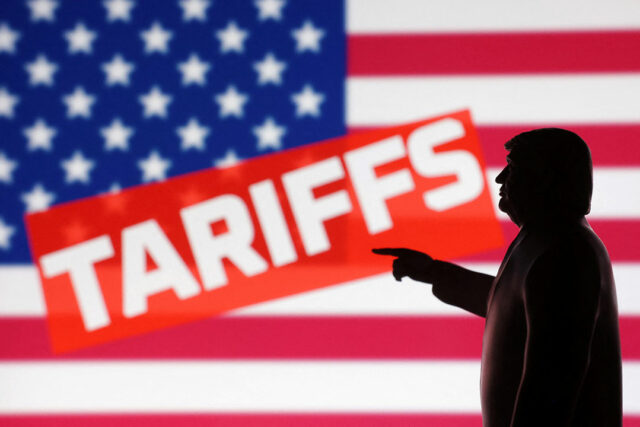
PHL to continue tariff talks with US

A 3D-printed miniature model depicting U.S. President Donald Trump depicting US flag and word “tariffs” in this illustration taken, April 17, 2025. — REUTERS

By Justine Irish D. Tabile and Chloe Mari A. Hufana, Reporters

THE PHILIPPINE government is optimistic that a deal on tariffs can be reached with the US, as it is set to continue negotiations for a lower tariff rate.

“The negotiation is a process. Not a one-time meeting. We believe the meeting went very well and our points were well received,” Trade Secretary Ma. Cristina A. Roque said in a statement on Monday.

Ms. Roque, Special Assistant to the President for Investment and Economic Affairs Frederick D. Go and Philippine Ambassador to the US Jose Manuel D. Romualdez met with the US Trade Representative (USTR) Jamieson Greer in Washington on May 2.

Before the trip, the Trade secretary said that the aim is to bring back the tariffs to at least the pre-“Liberation Day” level.

Last month, US President Donald J. Trump announced higher reciprocal tariffs on most of the country’s trading partners, with Philippine goods facing the second-lowest rate in Southeast Asia at 17%.

However, the reciprocal tariffs have been paused for 90 days until July. A baseline 10% tariff remains in place.

At a Palace briefing, Mr. Go said there will be more meetings with the USTR, although the Trade Undersecretary Allan B. Gepty would lead the talks.

He did not elaborate on a timeline.

Mr. Go said the meeting with the USTR focused on the local semiconductor and electronics industries since these are the top exports to the US.

Discussions also centered on the coconut, garment, furniture, food processing, and automotive industries, he added.

“The coconut industry is very important to us because it is our number one agricultural export to America,” he said in Filipino. “We brought up all the concerns and issues of our stakeholders, and as I said earlier, I believe it was very well received.”

In 2024, the US was the country’s top export market, receiving $12.12 billion worth of Philippine goods. The US was the Philippines’ fifth-largest source of imports accounting for $8.17 billion.

The Philippines’ top exports to the US are semiconductors, electronic integrated circuits, and insulated wire and other insulated electric conductors.

The country’s top imports from the US are soya beans, electronic integrated circuits, and wheat and meslin.

When asked if the USTR had committed to lowering the 17% reciprocal tariff imposed by Mr. Trump, Mr. Go said, “Let’s allow the process to take place.”

“I ask for your patience; let’s just wait for the outcome,” he added.

He refused to divulge if the US promised anything during the dialogues due to confidentiality agreements but noted it will take several negotiations to reach a favorable resolution.

The Foreign Trade Office of the DTI will now handle the negotiations with their American counterparts, he noted.

“We have to let the technical working groups work on a framework for discussions… both sides will have to work together to put a framework before the 90-day moratorium period is over,” he added.

Mr. Go noted the Philippine delegation was “well prepared” for the meeting, adding they discussed with Cabinet officials and the business sector before flying out.

Meanwhile, Department of Economy, Planning, and Development (DEPDev) Undersecretary Rosemarie G. Edillon said that the meeting with the USTR showed the Philippine government’s intention to strengthen trade relations with the US.

“We are very interested, especially in our trade relations, and to inform them of our initiatives to reduce, if not totally eliminate, what they call nontariff barriers,” she added.

Asked to comment, former Trade Undersecretary Rafaelita M. Aldaba said that the Philippines should get “as many products as possible in the exemption list.”

“In exchange we can offer zero tariffs on products that are important to the US,” she added.

In previous statements, Ms. Roque said that the Philippines might increase imports of US products, particularly soybeans and frozen meat, in exchange for lower tariffs.

According to the DTI Export Marketing Bureau, the US was the country’s third-largest trading partner last year, with total trade amounting to $20.29 billion.

Ateneo School of Government Dean and Economics Professor Philip Arnold P. Tuaño said that the country should also seek the reauthorization of the Generalized System of Preferences (GSP) while negotiating for lower tariffs.

“We should negotiate for lower tariffs on Philippine goods entering the United States and possibly also request the USA to reauthorize the GSP, which allows eligible developing countries to export their goods to the US tariff-free,” said Mr. Tuaño in an e-mail.

“[We should] also argue for preferential rates for strategic goods under the supply-chain resilience program, such as semiconductors and agricultural products,” he added.

While active, the Philippines was the GSP’s fifth-largest beneficiary, with about $1.6 billion in duty-free exports in 2020. This made up 10% of the total US GSP imports, which amounted to $16 billion.

The trade preference scheme eliminated duties on approximately 5,000 or 47% of the total US tariff lines. However, these benefits expired on Dec. 31, 2020.

ADB chief says Asia can’t be complacent amid tariff uncertainty

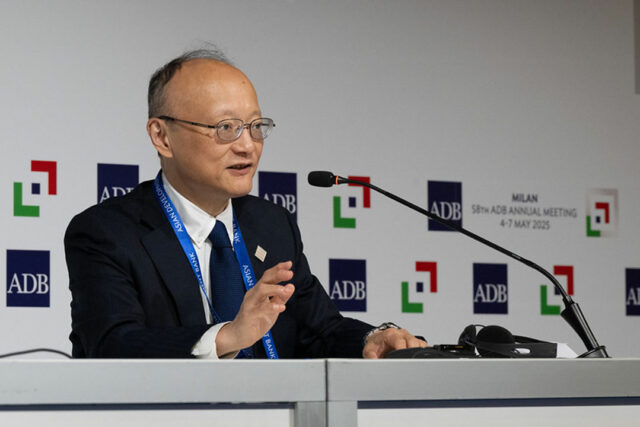
Asian Development Bank (ADB) President Masato Kanda holds a press conference during the 58th Annual Meeting of the ADB Board of Governors in Milan, Italy. — ASIAN DEVELOPMENT BANK

By Luisa Maria Jacinta C. Jocson, Senior Reporter

MILAN, Italy — The Asian Development Bank’s (ADB) top official said the Asia-Pacific (APAC) region must evolve to be able to withstand the shocks from tariff policies.

“Given this unprecedented uncertainty, you can’t be complacent,” ADB President Masato Kanda said during a press conference here on Sunday.

“I believe this is a good opportunity for Asian and Pacific countries to turn these challenges into the opportunity to make their economies more resilient, stronger, open and interconnected in the region and with their new partners.”

Mr. Kanda said these economies must “continue the reform path.”

“It is changing day by day. So, it’s hard to see what will happen. But for Asian countries, they are relatively exposed to these issues because they have benefited from the open trade system.”

“But I think if you compare to the past, such as the Asian financial crisis, the regional countries are much stronger,” he added.

The 58th Annual Meeting of the ADB Board of Governors is being held in Italy for the first time at a time of growing uncertainty for the global economy.

In its latest Asian Development Outlook, the ADB expects developing Asia to grow by 4.9% this year and 4.7% next year. However, these forecasts do not yet take into account the US  reciprocal tariffs which are on hold until July.

Countries must implement economic policies that safeguard and sustain stability, as well as enhance regional connectivity, Mr. Kanda said.

At the opening session of the Annual Meeting of the ADB Board of Governors on Monday, Mr. Kanda reiterated the need to press forward despite the uncertainty.

“Uncertainty is not a reason for retreat. It is a call for action. It challenges us to be bolder, to move faster, and to work more closely than ever before,” he said in his speech.

“We must seize the opportunity to transform lives and build a brighter future for the next generation.”

The Asia-Pacific region is “rich with potential,” he said, which can be transformed to lasting progress with the right actions.

“We are at a critical juncture in history and there is no textbook for this situation. We must recognize that we don’t have all the answers. But we are not starting from zero.” 

“Growth remains solid, driven by strong domestic demand. Trade and economic integration are deepening, not only within the region but with key partners here in Europe and around the world.”

Mr. Kanda cited four areas that will be crucial to address, including the vulnerability of food systems; the digital divide; the need for sustainable energy systems; and rising sea levels and other severe weather conditions.

Meanwhile, Bank of Italy Fabio Panetta likewise warned of the spillover effects of these restrictive tariff policies.

“Protectionism now threatens to undo these achievements and weaken the very fabric of global prosperity,” he said.

“Until the recent resurgence of trade tariffs, the Asia-Pacific region was on a path of steady growth, with inflation gradually easing.”

Mr. Panetta said the Asia-Pacific is the “most dynamic region” in the world, but flagged risks from rising trade barriers and policy uncertainty.

“These risks are acute for Asia-Pacific, but they also affect Europe, where external demand plays a crucial role  in sustaining growth.”

“In this context, preserving economic integration and reinforcing international cooperation are not optional. They are essential. Multilateral institutions play a pivotal role in safeguarding openness, stability, and the shared roots that underpin global prosperity,” Mr. Panetta added.

Italian Minister of Economy and Finance Giancarlo Giorgetti also cited the need for “strong and coordinated policy actions” that are aimed at a “clearer, more stable, and predictable trading environment.”

“Enhanced collaboration would support higher and sustainable long-term economic growth, averting the downside risks and mitigating the possible consequences.”

“At the same time, it might be time to rethink globalization as we know it. While it might be true that the global economy has benefited from trade and labor relations, it is also true that the fruits of this process have not always been evenly distributed among nations, and among the various production factors within each nation.”

ADB SUPPORT
Amid these uncertainties, Mr. Kanda said the ADB stands ready to extend support to its member nations to help them cope with these shifting global trade dynamics.

“ADB is quite willing to support countries and people to protect them from these external shocks. As a result, we help them to make the economy stronger, sustainable, and inclusive.”

He cited several instruments that the multilateral institution can use to support countries, such as countercyclical financial assistance or debt management support.

“Also, we have the trade and supply chain enhancement program, which will help the trade flows and the supply chains in the region.”

The ADB will help developing countries “to reform to a more diversified economy,” Mr. Kanda said.

“We have created $100 billion in additional headroom, which we will allow us to grow our operations by 50% over the next decade — from $24 billion to $36 billion dollars a year — to meet the rising aspirations of our developing member countries.”

The ADB earlier announced that it ramped up its funding to boost food security in Asia and the Pacific to $40 billion up until 2030.

In the region, almost two billion people lack access to a nutritious diet. Developing Asia accounts for more than half of the world’s hungry population.

“At the same time, we are investing deeply in digitalization. Access to reliable, affordable, and secure digital services is a foundation for opportunity,” he said.

“ADB’s support for digital technologies is helping millions access formal financial services, modernizing payment platforms, and introducing national digital IDs in the Pacific and beyond to reduce costs, improve transparency, and strengthen trust.”

The multilateral bank is also working to commit up to $10 billion for the ASEAN Power Grid, which will “modernize and interconnect energy systems across fast-growing Southeast Asian economies.”

Government unveils 10-yr. jobs masterplan

Thousands of job seekers flock to the job fair organized by the Department of Labor (DoLE) on May 1, 2025.— PHILIPPINE STAR/NOEL B. PABALATE

THE PHILIPPINE government on Monday launched a 10-year employment masterplan, which is targeting to increase the labor force participation rate (LFPR) to 68.2% by 2034.

“This is a very ambitious plan. If you look at the targets, it’s simple, we want to raise our LFPR from 64% to 68%,” Department of Economy, Planning, and Development (DEPDev) Undersecretary Rosemarie G. Edillon told reporters on the sidelines of the launch on Monday.

“So, this is actually a big ask, especially since by 2035, the majority of the workforce will be coming from Gen Z and Gen Alpha. So, we actually need a big policy reform,” she added.

Launched by the DEPDev, the Department of Trade and Industry (DTI), and the Department of Labor and Employment, the Trabaho Para sa Bayan (TPB) Plan aims to strengthen and future-proof the country’s workforce.

Under the plan, the government set near-term and long-term initiatives aimed at addressing challenges faced by the local labor market, such as rapid digitalization, geopolitical tensions, climate change, and demographic shifts.

Ms. Edillon said that the country’s LFPR is the lowest among the Association of Southeast Asian Nation (ASEAN) countries.

“Taking out the COVID-19 (coronavirus disease 2019) years, our LFPR is about less than 65%, but for the other countries, it is actually in the high 60s. You have Vietnam over there with an LFPR in the high 70s,” she added.

Preliminary data from the Philippine Statistics Authority showed that LFPR in February was estimated at 64.5%. For the first two months, the average LFPR stood at 64.2%.

However, the new jobs masterplan did not indicate any targets on how many jobs will be created until 2034.

“The problem with having a target with respect to jobs is that it’s very difficult, especially since we are moving towards a framework for flexible work arrangements where it would be possible for you to hold more than one job,” said Ms. Edillon.

“We’re also moving towards having a framework for part-time jobs. So, it’s difficult [to see] how it will translate into the number of jobs,” she added.

Labor Secretary Bienvenido E. Laguesma said that there have been previous targets to create a million jobs.

“But this does not ensure there will be enough jobs created for the new entrants (to the labor market),” he said.

“It’s not that simple to say that we want to create one or two million jobs by a certain year. What we want to see is that every Filipino family will have a job,” he added.

The TPB Plan also set a target of decreasing the unemployment rate to 3% by 2034 from 3.8% in 2024 and the underemployment rate to 7-9% from 13.3% last year.

In addition, the masterplan also aims to increase the female LFPR to 59% by 2034, which Ms. Edillon said is the lowest in the ASEAN region.

“Ours is about 48.8%, while in Vietnam it is actually 72.5%. So can you just imagine how much more human capital we could add if we could actually increase the LFPR for women?” she added.

The TPB Plan is also targeting to improve the country’s domestic industry diversification and production, as well as export complexity.

Citing the Global Innovation Index, Ms. Edillon said that the two factors measure the level of sophistication of the economy.

“That is actually the goal, that we will be a more competitive country before 2034. So that is actually the goal of the National Innovation Agenda and Strategy Document,” she added.

The TPB Plan outlines priority strategies that aim to address labor demand, supply, and governance, as well as how to future-proof labor demand, supply, and governance.

Strategies to ensure labor demand include expansion of market access, encouraging investments in priority sectors, ensuring ease of doing business, establishment of a dynamic innovation ecosystem, and promotion of technology adoption and enterprise-based education and training.

To improve labor supply, the TPB Plan recognized the need to expand lifelong learning opportunities, upgrade the design of skills training programs, enhance overseas Filipino reintegration programs, and increase program take-up among disadvantaged sectors.

Meanwhile, the TPB also cited 18 policy recommendations, which are seen to create an “inclusive and dynamic labor market environment.”

These policies include the Konektadong Pinoy bill, the Lifelong Learning Development Bill, tax incentives for employees on a work-from-home program, the Freelancers’ Protection Act, and the Amendment of the Maternity Leave Law, among others. — Justine Irish D. Tabile